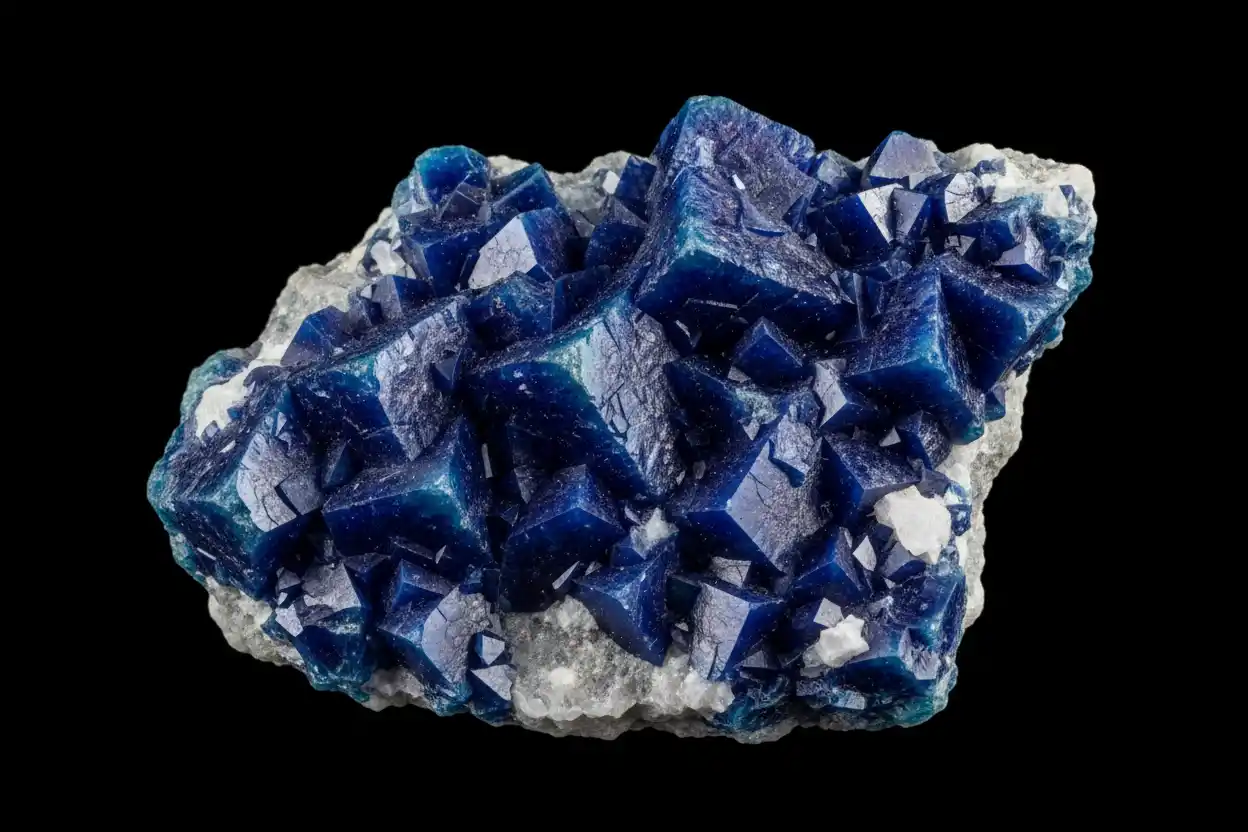
Lazulite: Meaning, Properties & Symbolism
Lazulite is a rare blue magnesium-aluminum phosphate mineral found in metamorphic rocks, quartz veins and selected granitic pegmatites. Its deep azure color and strong pleochroism can make transparent crystals attractive collector gems, although most material remains better suited to mineral specimens than everyday jewelry.
Lazulite at a Glance
| Property | Lazulite Characteristics |
|---|---|
| Material type | Magnesium-aluminum phosphate mineral |
| Composition | MgAl₂(PO₄)₂(OH)₂, with iron commonly substituting for magnesium |
| Colors | Azure blue, sky blue, dark blue, blue green, yellow green and rarely green |
| Crystal system | Monoclinic |
| Habit or texture | Stubby-to-acute dipyramidal crystals, tabular crystals, granular masses and inclusions in quartz |
| Luster | Vitreous |
| Transparency | Transparent to translucent; sometimes nearly opaque |
| Mohs hardness | Approximately 5.5–6 |
| Cleavage | Poor to good in one direction and indistinct in another |
| Tenacity | Brittle |
| Common uses | Mineral specimens, rare faceted collector gems, cabochons and inclusion specimens |
| Main care concern | Cleavage, brittleness, dark cutting orientation and confusion with other blue minerals |
What Is Lazulite?
Lazulite is a recognized mineral species with the ideal formula MgAl₂(PO₄)₂(OH)₂. Magnesium, aluminum, phosphate and hydroxyl form its principal structure, while iron commonly substitutes for part of the magnesium.
The mineral belongs to the lazulite group and forms a compositional series with scorzalite. Magnesium-dominant material is lazulite, whereas increasing ferrous iron moves the composition toward scorzalite.
That chemical relationship helps explain why lazulite ranges from vivid blue to darker blue green. Iron affects both color and optical absorption, so two crystals from the same deposit can look noticeably different.
Lazulite should not be confused with lazurite, the blue mineral responsible for much of lapis lazuli’s color. Despite their similar names, the minerals belong to different chemical and structural groups.
Most lazulite reaches collectors as natural crystals on matrix, blue grains in quartzite or small inclusions inside clear quartz. Facetable transparent rough exists, but it represents only a tiny part of production.
Why Is Lazulite Blue?
Iron-related charge transfer produces lazulite’s characteristic blue color.
The mineral can contain iron in more than one oxidation state. Electronic interaction between iron ions absorbs selected wavelengths of visible light and leaves blue dominant.
This absorption is strongly directional, creating pronounced pleochroism. A transparent crystal may appear nearly colorless or pale yellow along one direction, blue along another and darker blue along the third.
Consequently, crystal orientation strongly affects the appearance of a faceted stone. A cutter must preserve the richest blue direction without making the finished gem overly dark.
Thick crystals can look almost opaque even when their edges are transparent. Conversely, a thin section may reveal bright blue or blue-green color that is invisible through the full crystal.
Gray, yellow-green or muted blue tones can result from lower iron concentration, compositional variation, inclusions or weathering.
Lazulite and Scorzalite
Lazulite forms a solid-solution series with scorzalite.
Both minerals have the same general structural arrangement, but their dominant divalent element differs. Lazulite is magnesium rich, while scorzalite contains more ferrous iron.
Many natural specimens fall between the ideal end members. As iron increases, the material commonly becomes darker and more blue green.
Visual appearance cannot determine the exact composition. A dark crystal marketed as lazulite may require chemical analysis to establish whether it remains magnesium dominant or crosses into scorzalite.
The distinction matters scientifically but may have limited effect on an ornamental specimen’s appeal. Collectors often prioritize crystal form, color, locality and condition before exact position within the series.
How Lazulite Forms
Lazulite forms in aluminum-rich rocks where phosphate, magnesium and water-bearing fluids become available during metamorphism or late-stage igneous activity.
In high-grade metamorphic settings, phosphate-bearing sedimentary or volcanic rocks experience elevated pressure and temperature. Existing minerals break down, and their elements reorganize into new phases such as lazulite, kyanite, andalusite, rutile and quartz.
The mineral may appear as disseminated blue grains in quartzite or schist. It can also grow within quartz veins that cut the metamorphic host.
Complex granitic pegmatites provide another formation environment. Late fluids enriched in phosphorus and water react with aluminum- and magnesium-bearing minerals along pegmatite borders or replacement zones.
Lazulite can then occur with albite, quartz, muscovite, tourmaline and beryl.
Weathering releases durable fragments into alluvium and slope deposits, although rounded gem-quality pieces remain uncommon.
Major Lazulite Localities
Rapid Creek and the nearby Big Fish River area in Canada’s Yukon Territory are among the world’s most famous lazulite localities. Fine crystals occur with transparent quartz, siderite and several uncommon phosphate minerals. Some quartz crystals contain blue lazulite both on their surfaces and within their interiors, creating highly desirable inclusion specimens.
Graves Mountain in Lincoln County, Georgia, has produced large lazulite crystals in quartzite with rutile, kyanite, pyrophyllite and other metamorphic minerals. Many crystals are dark or partly embedded, although sharp blue specimens can carry strong locality value.
The Werfen area of Salzburg, Austria, is another classic source. Austrian occurrences contributed to the early scientific understanding of the mineral and have produced well-formed crystals in metamorphic rock.
Gemmy blue-green crystals have also been reported from northern Pakistan, particularly areas near Nanga Parbat and Chilas. Some of this material supplies the very small faceted-gem market.
Additional occurrences include Minas Gerais in Brazil, Madagascar, Sweden, California, Nevada and several Alpine localities.
Precise provenance matters because Rapid Creek, Graves Mountain and classic European material can receive different collector premiums even when crystal size is similar.
Lazulite in Quartz
Lazulite commonly occurs beside or within quartz.
At Rapid Creek, blue crystals can be enclosed inside clear quartz or attached to transparent crystal surfaces. These combinations interest both mineral collectors and gem inclusion specialists.
Polishing a window into the quartz may reveal an internal lazulite crystal more clearly. However, cutting can remove natural faces and reduce the value of a rare undamaged specimen.
The decision depends on the quality of the quartz host, the position of the inclusion and the specimen’s natural aesthetics.
An ordinary included-quartz cabochon should not automatically receive a premium because the blue mineral is claimed to be lazulite. Raman spectroscopy or another analytical method may be necessary to separate it from dumortierite, tourmaline, apatite and other blue inclusions.
Lazulite vs Lapis Lazuli
Lapis lazuli is a multi-mineral metamorphic rock rather than one mineral species.
Its blue color comes mainly from lazurite, accompanied by calcite, pyrite, sodalite-group minerals and other phases.
Lazulite instead has a magnesium-aluminum phosphate composition and commonly forms recognizable individual crystals.
Lapis is usually opaque and may show white calcite or metallic pyrite. Lazulite ranges from opaque masses to transparent crystals and does not require either calcite or pyrite.
Their similar names and blue color create frequent retail confusion. The distinction is chemical, structural and geological rather than merely a spelling difference.
Lazulite vs Lazurite and Sodalite
Lazurite is a sulfur-bearing feldspathoid mineral in the sodalite group. It is an important component of lapis lazuli and normally occurs as massive grains rather than transparent facetable crystals.
Sodalite is also a feldspathoid-group mineral. It commonly appears royal blue with white calcite veining and has lower density than lazulite.
The focused lapis lazuli versus sodalite guide owns the detailed separation of those two ornamental materials.
Lazulite can generally be distinguished through its crystal habit, phosphate chemistry, greater density, strong pleochroism and different refractive properties.
Lazulite vs Azurite and Blue Apatite
Azurite is a copper carbonate mineral. It is softer, reacts with acid and commonly forms deep-blue crystals or earthy masses in oxidized copper deposits.
Lazulite does not contain essential copper and forms in metamorphic or pegmatitic phosphate environments.
Apatite can occur in vivid blue and blue-green colors. Transparent apatite may resemble faceted lazulite, but it is hexagonal, slightly softer and has different optical measurements.
Color alone cannot distinguish these minerals. Density, refractive index, pleochroism, spectroscopy and geological association provide more reliable evidence.
How to Identify Lazulite
A sound identification begins with crystal form, color behavior and geological context.
Well-formed lazulite commonly develops wedge-shaped, dipyramidal or tabular monoclinic crystals. Rough surfaces may show complex twinning or re-entrant angles.
Strong pleochroism is particularly useful in transparent material. A dichroscope can reveal colorless-to-blue and darker-blue directions.
Refractive indices commonly span approximately 1.60–1.66, while specific gravity generally falls near 3.12–3.24. These measurements help separate lazulite from sodalite, lapis, glass and several blue silicates.
Hardness around 5.5–6 places it below quartz but above fluorite. Scratch testing should not be used on a collectible crystal or cut stone.
Raman spectroscopy, X-ray diffraction and chemical analysis provide the strongest confirmation. The sequence in how to identify crystals should therefore conclude with laboratory testing when a rare identity affects price.
Is Lazulite a Gemstone?
Transparent lazulite can be faceted, making it a legitimate but exceptionally uncommon collector gemstone.
Cut stones are usually small because transparent rough is scarce and commonly fractured. Strong pleochroism also complicates orientation, while cleavage and brittle behavior reduce cutting yield.
Ovals, cushions and step cuts may preserve more rough than round brilliant shapes. A well-oriented stone can show blue, blue green and flashes of yellowish green as it moves.
Opaque material may be cut into cabochons or polished objects, although some products marketed as lazulite are mixed rock, dyed stone or trolleite-rich material.
Fine faceted lazulite belongs within the blue gemstones market, but it should be compared with rare collector gems rather than sapphire or aquamarine as a practical jewelry choice.
The wider blue crystals category covers specimens and modern symbolism without replacing mineral identification.
Hardness, Cleavage and Jewelry Durability
Lazulite ranks approximately 5.5–6 on the gemstone hardness chart.
It can be scratched by quartz-bearing dust, topaz, sapphire and diamond. Facet edges may show abrasion after repeated wear.
Cleavage ranges from poor to good in one direction, with another indistinct direction. As explained in gemstone cleavage, a concentrated force can exploit these structural planes.
The mineral is also brittle. The distinction in gemstone toughness versus hardness makes pendants, earrings and protected collector jewelry safer than daily rings.
A ring should use a low protective bezel and should be worn only occasionally. Thin points, exposed corners and pre-existing fissures increase breakage risk.
Treatments and Imitations
Lazulite does not have an established routine treatment market.
Possible interventions include resin stabilization of fractured masses, oil applied to improve surface appearance, clear coatings, glue repair and artificial attachment to matrix.
Dyed quartzite, sodalite, magnesite and other porous materials can imitate opaque blue lazulite. Glass and synthetic spinel can imitate transparent faceted stones.
The broad checks in how to spot fake crystals help reveal dye, resin and manufactured material, but they cannot confirm a rare phosphate species.
Very large, clean and inexpensive faceted stones deserve particular skepticism. Genuine transparent lazulite is too uncommon for mass-produced calibrated jewelry.
Lazulite Price and Value
Lazulite prices depend on whether the material is an ordinary blue mass, a sharp locality specimen, an inclusion in quartz or a transparent faceted gem.
| Lazulite Material | Broad Current Asking Range |
|---|---|
| Small rough fragment or basic specimen | $10–$40 |
| Attractive small crystal | $40–$150 |
| Better crystal group or matrix specimen | $100–$400 |
| Fine Rapid Creek or Graves Mountain specimen | $300–$1,000+ |
| Commercial faceted material | Approximately $150–$600 per carat |
| Fine clean, strongly pleochroic collector gem | Approximately $600–$1,500+ per carat |
| Exceptional historic or museum-quality specimen | Individually priced and potentially much higher |
These ranges describe specialist asking markets rather than guaranteed resale values.
For specimens, sharp crystal form, saturated blue, luster, matrix contrast, locality and old labels create the strongest premiums.
For faceted stones, color orientation, transparency, size and independent identification matter more than a generic rarity claim.
Buying Lazulite
Ask whether the item is a natural crystal, a mixed rock, a quartz-hosted inclusion or a faceted gem.
A meaningful locality should include more than a country. Rapid Creek, Big Fish River, Graves Mountain and specific Pakistani districts have different geological and market contexts.
Photographs should show the reverse, matrix contact and any repairs. Bright backlighting can make a dark crystal appear far more transparent than it looks on display.
Faceted material should have a reputable laboratory report when the price depends on lazulite identification.
Avoid confusing polished blue rock with lapis lazuli or assuming that every blue inclusion in quartz is lazulite.
Cleaning and Storage
Use a soft brush or brief hand cleaning with lukewarm water and mild soap for stable, untreated material.
Avoid acids, prolonged soaking and aggressive scrubbing. Mixed specimens may contain calcite, siderite, pyrophyllite or repaired matrix that responds differently from lazulite.
Ultrasonic cleaning is unsuitable for valuable crystals and included quartz specimens. Vibration may extend cleavage fractures or detach crystals, as discussed in gemstones and ultrasonic cleaners.
Store specimens and jewelry in padded individual compartments. A sharp quartz or sapphire can scratch lazulite, while movement inside a box can chip protruding crystal edges.
Lazulite Meaning and Symbolism
Lazulite’s name and azure color have encouraged modern associations with insight, thoughtful communication and intellectual curiosity.
Strong pleochroism provides a material-specific symbolic theme. The same crystal can appear nearly colorless, blue or much darker depending on direction, suggesting that an object or idea may reveal different qualities from another viewpoint.
Collectors may also connect lazulite with patience because meaningful identification often requires careful observation and laboratory work rather than a quick visual judgment.
These meanings remain personal, cultural or spiritual interpretations. Scientific evidence does not show that lazulite treats illness, improves concentration or emits measurable healing energy.
Frequently Asked Questions About Lazulite
Is lazulite a real mineral?
Yes. Lazulite is a recognized magnesium-aluminum phosphate mineral.
Is lazulite the same as lapis lazuli?
No. Lapis lazuli is a multi-mineral rock, while lazulite is one distinct phosphate mineral species.
Is lazulite the same as lazurite?
No. Lazurite is a sulfur-bearing feldspathoid mineral and a major blue component of lapis lazuli.
What causes lazulite’s blue color?
Iron-related charge-transfer absorption produces the blue and strong pleochroic colors.
Where is lazulite found?
Important sources include Austria, Rapid Creek in Canada’s Yukon, Graves Mountain in Georgia, Pakistan, Brazil and Madagascar.
Is lazulite rare?
The mineral has several known occurrences, but sharp crystals and transparent facetable material are rare.
Can lazulite be faceted?
Yes. Transparent rough can produce small collector gems, although cleavage, fractures and pleochroism complicate cutting.
How hard is lazulite?
It ranks approximately 5.5–6 on the Mohs scale.
Is lazulite suitable for rings?
Only for occasional wear in a protective setting. Pendants and earrings are safer.
Is lazulite normally treated?
No routine treatment is expected, although filling, coating, oil and repairs remain possible.
Can lazulite go in water?
Brief gentle cleaning may suit a stable specimen. Avoid soaking mixed, repaired or fragile material.
Can lazulite go in an ultrasonic cleaner?
No. Hand cleaning is safer because vibration can exploit cleavage and detach crystals.
Lazulite belongs in both Crystals That Start With L and Gemstones That Start With L, although fine specimens remain much more available than wearable gems.
Safety disclaimer: Avoid inhaling dust from lazulite, quartzite or associated phosphate-bearing matrix. Do not ingest, lick or dry-cut specimens. Use wet lapidary methods, effective extraction, eye protection and suitable respiratory protection during preparation.