
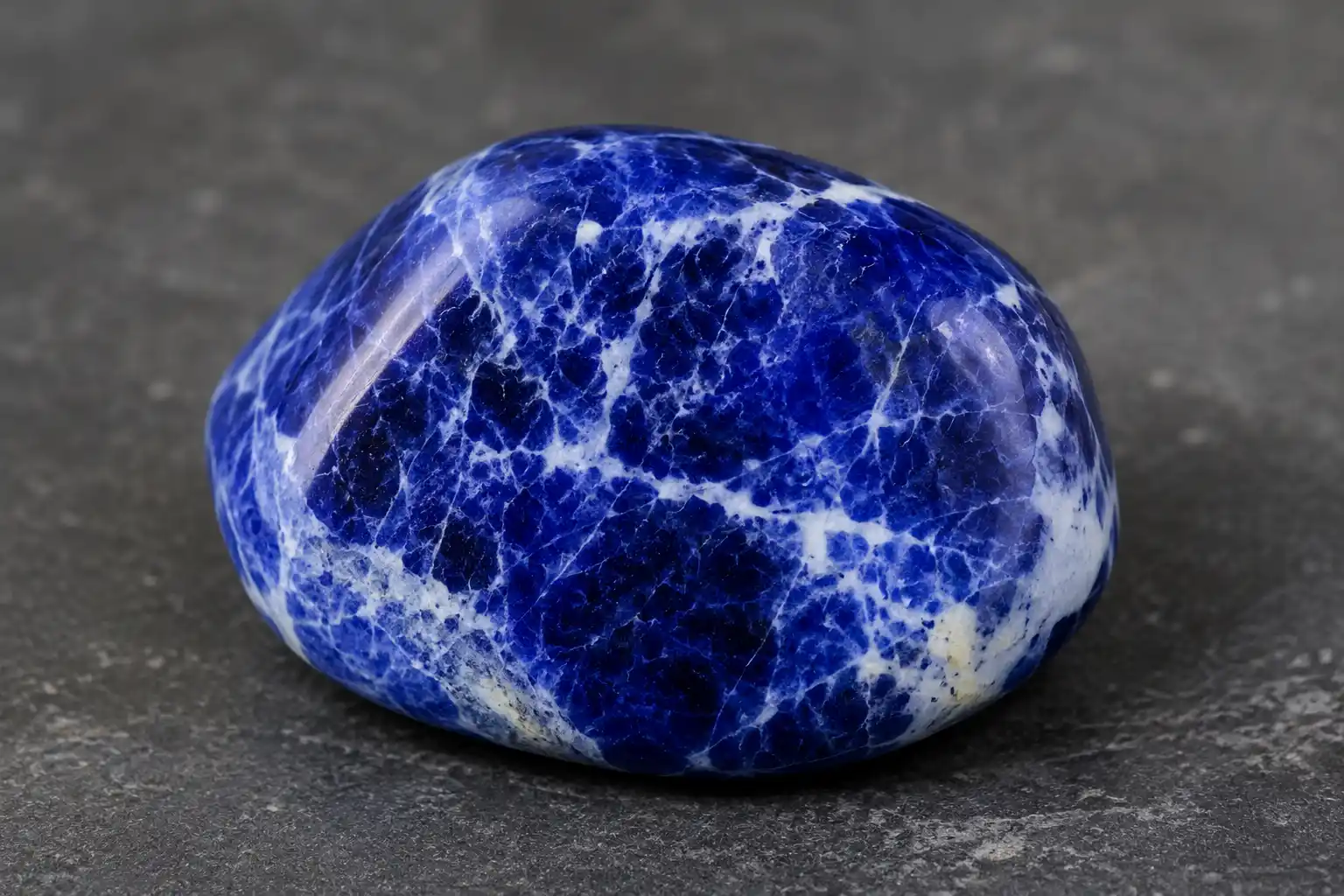

Sodalite is a sodium-rich blue feldspathoid mineral best known as an ornamental stone with white, gray or cream veining. Its strongest material often resembles Lapis Lazuli, although Sodalite usually lacks the abundant golden Pyrite flecks associated with fine Lapis.
Most jewelry and carvings use massive blue Sodalite rather than transparent crystals. Its moderate hardness supports pendants, earrings, beads and protected rings, while its brittle structure requires more care than its substantial appearance suggests.
Sodalite at a Glance
| Property | Sodalite |
|---|---|
| Mineral group | Sodalite group and feldspathoid group |
| Ideal composition | Na₄Al₃Si₃O₁₂Cl |
| Mineral class | Tectosilicate |
| Crystal system | Cubic |
| Common color | Royal blue to dark blue with white or gray veining |
| Other colors | Colorless, white, gray, yellow, green, violet and reddish |
| Crystal habit | Usually massive; crystals are uncommon |
| Luster | Vitreous to greasy |
| Transparency | Transparent to opaque |
| Mohs hardness | 5.5–6 |
| Cleavage | Poor |
| Fracture | Uneven to conchoidal |
| Specific gravity | Approximately 2.27–2.33 |
| Common uses | Cabochons, beads, carvings, decorative stone and specimens |
| Main care concern | Scratching, chipping, acids and harsh cleaning |
What Is Sodalite?
Sodalite is both a mineral species and the name-giving member of the Sodalite mineral group. It belongs to the feldspathoids, a family of aluminosilicate minerals that form in geological environments with less silica than would be required to create abundant Quartz.
Its ideal composition contains sodium, aluminum, silicon, oxygen and chlorine. Natural specimens can incorporate substitutions and inclusions that influence color, fluorescence and appearance.
Although collectors sometimes find transparent or translucent crystals, commercial blue Sodalite usually occurs as massive material. This means it forms compact rock-like masses rather than obvious individual crystals.
White veining commonly consists of Calcite, Nepheline or other associated minerals. Dark areas may contain additional minerals from the host rock, so many polished objects are technically multi-mineral materials dominated by Sodalite.
Sodalite Is a Feldspathoid, Not Feldspar
Feldspathoids resemble feldspars chemically and occur in some of the same broad igneous settings, but they form under silica-poor conditions. Free Quartz and primary Sodalite generally do not crystallize together in equilibrium because sufficient silica would favor feldspar instead.
Sodalite commonly occurs with Nepheline, Cancrinite, Aegirine and alkali feldspar in nepheline syenites, phonolites and related rocks.
The broader Feldspar guide helps distinguish the abundant feldspar family from feldspathoids such as Sodalite and Nepheline.
This geological distinction explains why Sodalite should not be described as blue Quartz or a form of Feldspar.
How Sodalite Forms
Sodalite develops primarily in alkaline igneous rocks that are undersaturated in silica. Nepheline syenite is one of its most familiar host rocks.
It may form as a primary mineral during crystallization, fill veins and cavities, or develop where chemically active fluids alter suitable rocks. Some occurrences also appear in metasomatized carbonate rocks.
Massive ornamental material can form extensive blue zones within pale nepheline syenite. When cut, the contrasting minerals create irregular white streaks and mottling.
Crystals are rarer and may occur in cavities in volcanic blocks or alkaline complexes. They can be colorless, pale or strongly colored and may show cubic-system forms such as dodecahedra.
Discovery and Name
Sodalite was described in the early nineteenth century from Greenland’s Ilímaussaq alkaline complex. Its name refers to its high sodium content.
The mineral became better known as an ornamental material after substantial blue deposits were recognized in Ontario, Canada. The Bancroft area developed a particularly strong association with decorative Sodalite.
The Princess Sodalite Mine received its name after Canadian material attracted royal attention in the early twentieth century. Large quantities were used as decorative stone, helping establish Sodalite beyond specialist mineral collections.
Its history therefore combines mineralogical discovery, architectural use, lapidary work and modern crystal symbolism.
Sodalite Color
Royal blue is the best-known color, but Sodalite can also be white, gray, green, yellow, violet, reddish or nearly colorless.
Color is connected with structural defects and sulfur-bearing species trapped within the mineral’s cage-like crystal structure. Small chemical changes can produce substantial differences in hue and optical behavior.
Massive blue material usually shows uneven color. Some pieces contain intense ultramarine patches, while others appear denim blue, gray-blue or violet-blue.
White Calcite or Nepheline commonly creates broad veins and clouds. These markings are natural, although excessive pale matrix may reduce the amount of visible blue in a small cabochon.
Hackmanite and Other Sodalite-Group Minerals
Hackmanite is a photochromic or tenebrescent variety of Sodalite. After exposure to ultraviolet light, some Hackmanite develops or intensifies pink, purple or violet color and then gradually fades when kept away from the activating light.
Not every Sodalite specimen is Hackmanite, and ordinary blue material should not be marketed as tenebrescent without testing.
The Sodalite group also includes minerals such as Lazurite, Haüyne, Nosean and Tugtupite. Their related cage structures contain different combinations of ions and sulfur species.
Lazurite is the principal blue mineral in Lapis Lazuli, but Lapis itself is a rock composed of Lazurite and varying amounts of Calcite, Pyrite and other minerals.
Major Sources
Greenland remains important as the type-locality region and a source of unusual Sodalite-group specimens.
Ontario, Canada, is known for massive blue ornamental Sodalite, particularly around Bancroft. Quebec’s alkaline mineral localities produce collectible crystals and associated minerals.
Brazil supplies substantial massive material for carvings, beads, slabs and decorative objects. Namibia is known for blue ornamental rough and, in some localities, transparent crystals.
Additional Sodalite occurs in Afghanistan, Bolivia, Myanmar, Portugal, Romania, Russia, Italy and parts of the United States. Locality should be supported by provenance rather than inferred from shade or veining.
Sodalite Meaning and Symbolism
Modern crystal traditions associate Sodalite with communication, reason, self-expression and the integration of thought with emotion. Its blue color encourages links with truth, language and calm reflection.
Some people use it as a symbolic study stone, keeping a polished piece near books, notes or a workspace. Others hold it before conversations in which clarity and respectful expression matter.
Sodalite is also associated with self-acceptance. Its irregular white veining is sometimes interpreted as a reminder that complexity and imperfection can remain part of a coherent whole.
These meanings arise from cultural and spiritual practice rather than experimentally demonstrated properties of the mineral.
Healing Properties in Crystal Traditions
Crystal practitioners commonly describe Sodalite as emotionally calming and mentally organizing. A stone may be used during breathing exercises, journaling or preparation for a difficult discussion.
It is often associated with distinguishing facts from assumptions. In a reflective exercise, a person might write what is known, what is feared and what still needs clarification while holding or viewing the stone.
Other traditions connect Sodalite with confidence in communication. The crystal acts as a personal cue to pause, listen and choose words deliberately rather than producing a physiological effect.
Claims that Sodalite cures anxiety, lowers blood pressure, treats throat disorders or changes brain chemistry are not supported by clinical evidence. Medical symptoms require appropriate professional assessment.
Chakra Associations
Sodalite is commonly connected with the throat and third-eye chakras in modern crystal practice. The throat association relates to speech, truth and self-expression, while the third-eye association relates symbolically to perception and insight.
Some practitioners place a stone near the throat during meditation or rest it above the brow for short reflective sessions. Others simply wear a pendant or keep a palm stone nearby.
Because Sodalite can chip and polished stones may contain treatments or surface residues, it should not be taped tightly to the body, placed in the mouth or used to prepare drinking water.
Chakra practices are spiritual frameworks rather than medical anatomy.
Meditation, Study and Communication Uses
A Sodalite palm stone can provide a tactile focus during study breaks. The user may hold it while summarizing what has been learned or identifying the next task.
Before a conversation, the stone can function as a reminder to separate observation from interpretation. This makes it useful as part of a deliberate communication routine without claiming that the mineral controls speech.
For meditation, its broad blue areas provide a calm visual field, while the white veining adds enough variation to hold attention. Larger spheres or polished freeforms often serve as desk and room objects.
People who combine stones can review Crystal pairings for symbolic combinations and physical storage compatibility.
Common Uses
Sodalite is extensively carved into spheres, eggs, bowls, figurines, obelisks and decorative tiles. Its strong color remains visible across large polished surfaces.
Beads and cabochons are common in jewelry. Massive material cuts more predictably than rare transparent crystals, although hidden fractures and softer associated minerals can complicate polishing.
Architectural Sodalite-bearing rock may appear in panels, tabletops and interior decoration. Large-scale use highlights the mineral’s role as ornamental stone rather than only a small gemstone.
Collectors also seek well-formed crystals, fluorescent specimens and Hackmanite with strong reversible photochromism.
Jewelry Suitability
With a hardness of 5.5–6, Sodalite is softer than Quartz and can gradually scratch during daily wear. It is also brittle, so a sharp impact may chip an edge.
Pendants, earrings and brooches are generally safer than exposed rings. Beaded bracelets can be worn, but beads may abrade when they repeatedly strike harder stones, metal surfaces or desk edges.
A bezel protects a cabochon more effectively than high, exposed prongs. Broad, gently domed cuts reduce vulnerable corners.
Sodalite should be removed before exercise, bathing, cleaning and household work. Acids and aggressive chemicals can damage the mineral or its Calcite-rich matrix.
Sodalite Versus Lapis Lazuli
Sodalite and Lapis Lazuli can both appear royal blue with pale veining. However, Lapis is a multi-mineral rock whose blue component is largely Lazurite.
Fine Lapis often contains small metallic-gold Pyrite grains. Sodalite usually lacks abundant Pyrite and may show broader white Calcite or gray Nepheline areas.
Color alone is insufficient because low-quality Lapis may contain little Pyrite and some Sodalite-bearing rocks contain dark accessory minerals.
The detailed Lapis Lazuli versus Sodalite guide compares texture, composition, Pyrite, streak, market naming and testing procedures.
Sodalite Versus Azurite
Azurite is a copper carbonate mineral with a deeper azure color, greater density and substantially lower hardness.
Azurite may occur with green Malachite and commonly shows a different texture from the white-veined appearance of massive Sodalite. It can also react more readily with acids.
The dedicated Sodalite versus Azurite comparison addresses identification without requiring destructive tests on a finished object.
Other Blue Lookalikes
Blue Calcite is much softer and commonly appears pale, waxy and translucent rather than intensely royal blue.
Dumortierite can occur in blue massive material and Quartz-rich rocks. It is generally harder, and its texture may look fibrous or granular.
Dyed Howlite, Magnesite and Quartzite can imitate saturated blue Sodalite. Dye may concentrate in cracks, drill holes and porous areas.
Glass and resin imitations may contain bubbles, molded seams or unnaturally uniform patterns. The guide to real versus fake Sodalite explains these warning signs in detail.
Treatments and Market Practices
Low-quality pale material may be dyed to produce stronger blue. Dye commonly gathers around white veins, surface cracks and bead holes.
Wax, resin or surface coatings may improve polish or temporarily deepen color. These treatments can change cleaning requirements and should be disclosed.
Reconstituted products made from crushed material and binding agents may be sold as Sodalite. They can show unusually regular fragments, abundant resin or repeated patterns.
Synthetic Sodalite exists for industrial and research uses, but most inexpensive blue ornamental objects are more likely to be natural low-grade stone, dyed material, imitation or composite than gem-quality laboratory-grown Sodalite.
How to Identify Sodalite
Begin with color distribution and texture. Natural massive Sodalite commonly shows irregular blue zones mixed with white, gray or cream minerals.
Its hardness of 5.5–6 means a steel blade may scratch it with difficulty, while Quartz should scratch it more readily. Do not perform such tests on jewelry or valuable polished pieces.
Sodalite has a white streak, but a streak test damages both the specimen and the plate. Density, refractive index and microscopic features provide better professional evidence.
Fluorescence can occur but varies significantly. A lack of fluorescence does not prove that a stone is fake, while fluorescence alone does not prove that it is Sodalite.
The general crystal identification guide explains how multiple non-destructive properties can narrow an identification.
Buying Sodalite
Judge the piece by the balance of color, pattern, polish and intended use. Deep blue material with attractive natural veining is popular, but an evenly blue stone is not automatically superior.
For jewelry, inspect drill holes, edges and thin areas for fractures. Cabochons should have smooth domes without pits, dye concentrations or poorly polished Calcite veins.
Carvings need stable bases and sufficient thickness around projections. Large spheres should be checked for filled cavities and fractures hidden by polish.
Ask the seller whether the material has been dyed, stabilized, reconstructed or coated. Significant Hackmanite specimens should be demonstrated under appropriate ultraviolet light rather than identified from color alone.
Care and Cleaning
Use a soft damp cloth or a brief wash with lukewarm water and mild soap. Rinse quickly and dry thoroughly.
Avoid prolonged soaking because massive Sodalite can contain fractures and associated minerals that respond differently to water. Reconstructed, dyed or glued material needs especially conservative care.
Do not use acids, bleach, household chemicals, steam or ultrasonic cleaners. Acid can attack Sodalite and Calcite-rich veining, while vibration can worsen fractures.
Store Sodalite separately from Quartz and harder gemstones. A fabric pouch or divided jewelry box reduces scratching.
The dedicated guide to cleansing and charging Sodalite covers dry spiritual methods. General options also appear in the guide to cleansing crystals.
Directory Placement
Sodalite is included among the crystals beginning with S and gemstones beginning with S. It qualifies as a mineral and ornamental gem material, although most commercial pieces use massive rock rather than individual transparent crystals.
Final Perspective
Sodalite’s blue color is only one part of its identity. Its real geological distinction lies in a sodium-rich, cage-like feldspathoid structure formed in silica-poor alkaline environments where Quartz is absent.
The best pieces combine rich natural blue, stable structure and honest treatment disclosure. Whether worn as a pendant, carved into a desk object or used as a reflective prompt before a conversation, Sodalite becomes more meaningful when its mineral identity and limitations remain clear.
Frequently Asked Questions
1. What is Sodalite made of?
Its ideal composition is Na₄Al₃Si₃O₁₂Cl, containing sodium, aluminum, silicon, oxygen and chlorine.
2. Is Sodalite a type of Lapis Lazuli?
No. Sodalite is a mineral species. Lapis Lazuli is a rock whose blue color usually comes primarily from Lazurite.
3. Why does Sodalite have white veins?
The white areas commonly consist of Calcite, Nepheline or other associated minerals within the massive ornamental rock.
4. Is Hackmanite the same as Sodalite?
Hackmanite is a tenebrescent variety of Sodalite that changes or intensifies color after ultraviolet exposure and gradually fades afterward.
5. Is Sodalite a Feldspar?
No. It is a feldspathoid. Feldspathoids form in silica-poor environments and are structurally and chemically distinct from Feldspar minerals.
6. What does Sodalite symbolize?
Crystal traditions associate it with communication, truth, reason, self-expression, emotional balance and thoughtful decision-making.
7. Can Sodalite go in water?
Brief contact during careful cleaning is usually acceptable for untreated, solid material. Avoid soaking because fractures, Calcite veins, dye, resin or glue may be affected.
8. Can Sodalite fade in sunlight?
Ordinary blue Sodalite is generally stable during normal wear, but prolonged intense light should be avoided. Hackmanite may change color because of reversible photochromism.
9. Is Sodalite suitable for rings?
It can be worn in a protective setting, but its hardness of 5.5–6 and brittle nature make pendants and earrings safer for frequent use.
10. How can I tell Sodalite from dyed Howlite?
Dyed Howlite often shows dark dye concentrated in spiderweb-like veins and is softer. Professional testing remains safer than scratching either stone.
11. Does real Sodalite contain Pyrite?
It may occur with accessory minerals, but abundant metallic-gold Pyrite is more characteristic of Lapis Lazuli. Its absence does not by itself prove Sodalite.
12. Where is Sodalite found?
Important occurrences include Greenland, Canada, Brazil, Namibia, Afghanistan, Russia and several alkaline-rock localities in Europe and the United States.
Sodalite’s communication, emotional-healing and chakra associations are spiritual traditions rather than scientifically established medical effects. Do not ingest Sodalite, prepare crystal drinking water with it or use it instead of professional healthcare. Avoid acids, prolonged soaking and harsh cleaning.