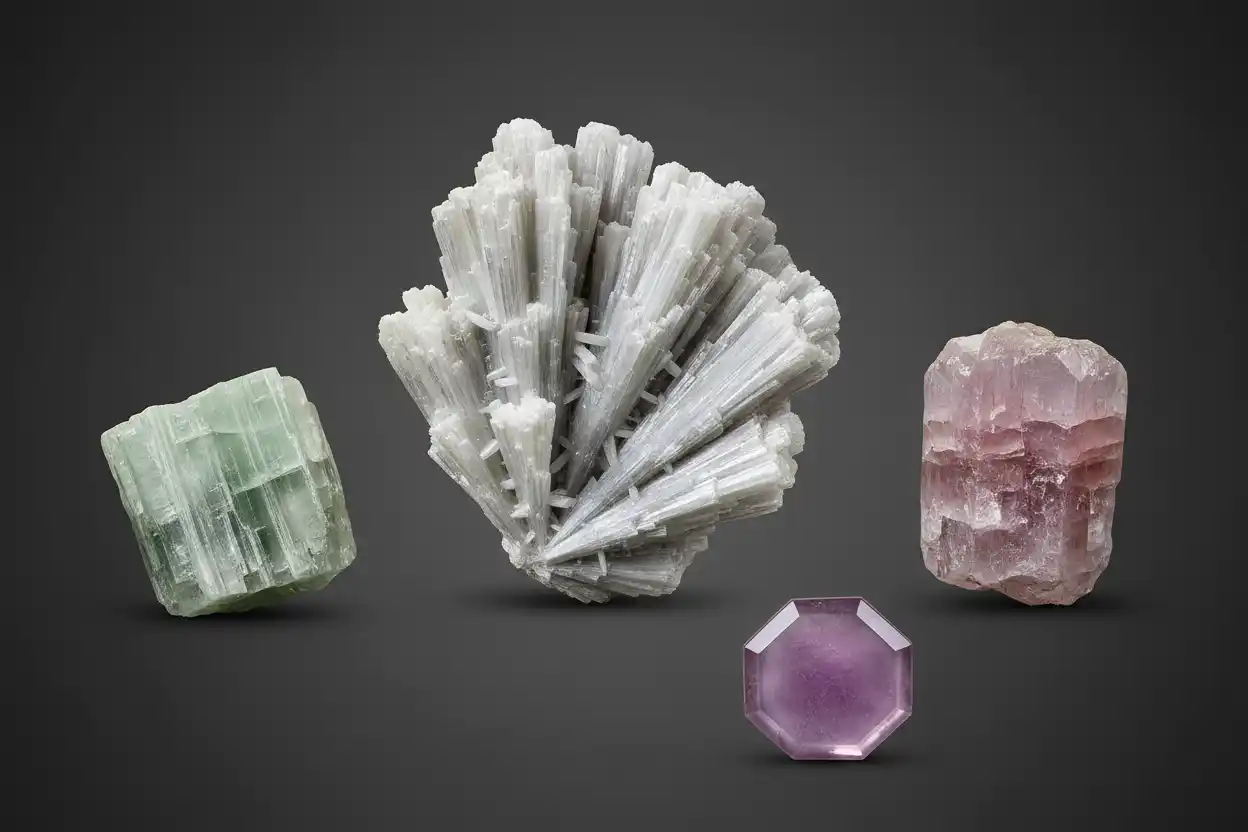
Tremolite: Meaning, Properties & Symbolism
Tremolite is a calcium-magnesium amphibole that occurs as white, grey, cream, pale green, yellowish, lavender, pink, and colorless crystals or aggregates. It forms mainly during metamorphism of magnesium-rich carbonate rocks and is closely related to actinolite, nephrite jade, and several fibrous amphibole materials.
The word tremolite covers more than one physical habit. Attractive prismatic or granular crystals can be collected and occasionally faceted, while asbestiform tremolite consists of extremely thin separable fibers that present a serious inhalation hazard when disturbed.
Tremolite at a Glance
| Property | Tremolite |
|---|---|
| Composition | Calcium-magnesium silicate hydroxide, Ca₂Mg₅Si₈O₂₂(OH)₂ |
| Group or type | Calcium amphibole; tremolite-actinolite series |
| Color | Colorless, white, cream, grey, pale green, yellow, brown, pink, lavender |
| Crystal system or texture | Monoclinic |
| Habit | Prismatic, bladed, columnar, acicular, fibrous, granular, massive, interlocking |
| Luster | Vitreous, silky, pearly, or dull |
| Transparency | Transparent to opaque |
| Mohs hardness | Approximately 5–6 |
| Cleavage | Perfect amphibole cleavage intersecting near 56° and 124° |
| Tenacity | Brittle; thin crystals may be splintery |
| Common uses | Mineral specimens, rare faceted collector gems, cabochons, scientific material, major component of some nephrite |
| Primary care concern | Cleavage, scratching, fibrous or asbestiform material, dust, and mineral misidentification |
What Is Tremolite?
Tremolite belongs to the amphibole supergroup, whose minerals contain double chains of silica tetrahedra linked with magnesium, iron, calcium, sodium, aluminum, and other elements.
Its ideal composition is calcium- and magnesium-rich. As ferrous iron increasingly substitutes for magnesium, the composition moves toward actinolite and eventually ferro-actinolite.
This compositional transition often affects color. Low-iron tremolite is commonly colorless, white, cream, or pale grey, while iron-bearing material may appear increasingly green.
Tremolite is primarily a mineral-specimen material rather than a mainstream gemstone. Transparent crystals are uncommon, and perfect cleavage limits their usefulness in jewelry.
Its broader classification appears in types of gemstones, while its alphabetical placement belongs in crystals that start with T.
Tremolite and Actinolite
Tremolite and actinolite form a continuous compositional series based largely on the ratio of magnesium to iron.
Tremolite occupies the magnesium-rich end. Actinolite contains more ferrous iron and usually develops a medium-to-dark green color.
The transition is chemical rather than based solely on appearance. A pale green crystal may still be tremolite, while a darker specimen may require laboratory analysis before it can be assigned confidently to actinolite.
Both minerals share monoclinic symmetry, amphibole cleavage, similar hardness, and comparable prismatic habits.
A label such as “tremolite-actinolite” may be reasonable for untested intermediate material. However, a valuable gemstone or scientific specimen deserves a more precise identification.
How Tremolite Forms
Tremolite commonly forms during metamorphism of dolomite, limestone, and other magnesium-rich carbonate rocks.
When dolomite and quartz react under suitable temperature, pressure, and fluid conditions, tremolite may crystallize with calcite and release carbon dioxide.
This process occurs in contact-metamorphic aureoles around igneous intrusions and during regional metamorphism associated with mountain building.
Tremolite can also form in skarns, calc-silicate rocks, altered ultramafic rocks, serpentinites, talc deposits, and hydrothermal veins.
The surrounding mineral assemblage may include calcite, dolomite, quartz, diopside, talc, phlogopite, forsterite, serpentine, chlorite, graphite, spinel, and other amphiboles.
Changing conditions can create several tremolite habits within one deposit. Thick prismatic crystals may occur beside fine fibers, granular masses, or compact interlocking material.
Crystal Habits
Well-formed tremolite usually appears as elongated prisms or blades with a roughly diamond-shaped or flattened cross-section.
Amphibole cleavage produces two prominent directions intersecting near 56° and 124°. This distinguishes tremolite from pyroxenes, whose cleavage directions approach 90°.
Crystals may form parallel groups, radiating sprays, columnar aggregates, granular masses, or silky fibers.
Coarse fibrous material can appear splintery, while extremely fine asbestiform material separates into flexible, high-aspect-ratio fibers.
Compact interlocking tremolite-actinolite aggregates can form part of nephrite. Their toughness comes from a dense felted texture rather than the properties of one isolated crystal.
Surface quality ranges from bright and glassy to etched, weathered, silky, or chalky. A specimen’s habit and condition strongly influence its collector value.
Tremolite Colors and Varieties
Colorless and white tremolite occur where iron and other coloring elements remain low.
Pale green material can contain small amounts of iron or chromium. Chromium-bearing green material is frequently called chrome tremolite.
Lavender-to-pink tremolite colored partly by manganese is traditionally called hexagonite. Despite its name, hexagonite is monoclinic tremolite rather than a hexagonal mineral.
The best-known hexagonite comes from the Fowler and Gouverneur areas of St. Lawrence County, New York. Fine crystals may show lilac, lavender, raspberry, or violet-pink tones.
Yellow, tan, brown, and grey colors can result from iron, inclusions, weathering, or associated minerals.
Some tremolite displays weak chatoyancy when fibrous structures align in parallel. Such material may be cut as cat’s-eye cabochons, although laboratory confirmation is advisable.
Tremolite and Nephrite Jade
Nephrite is a tough interlocking aggregate composed mainly of tremolite-actinolite amphiboles.
The defining feature of nephrite is not simply the presence of tremolite. Its microscopic fibers and blades interlock densely enough to produce exceptional toughness.
A loose tremolite crystal, fibrous amphibole specimen, and polished nephrite carving can therefore share related chemistry while behaving very differently.
The wider jade name covers nephrite and jadeite. Tremolite itself is not a third recognized type of jade.
The distinction between the two accepted jade materials is explained in jadeite vs nephrite.
Dealers sometimes apply names such as tremolite jade, white jade, or mutton-fat jade to compact amphibole material. These terms should be supported by evidence that the stone has the interlocking structure and toughness expected of nephrite.
Tremolite Asbestos and Nonfibrous Tremolite
Tremolite can develop in nonfibrous prismatic, bladed, granular, compact, and massive habits. It can also occur in an asbestiform habit.
Asbestiform tremolite consists of bundles of extremely thin, long, flexible, separable fibers. When disturbed, these fibers can become airborne and enter the lungs.
The presence of the mineral name tremolite does not prove that a polished stone or blocky crystal is asbestos. Habit, fiber dimensions, separability, and analytical context matter.
However, unknown fibrous material should never be cut, brushed aggressively, crushed, drilled, or tested by breaking it apart.
Even nonasbestiform amphibole generates mineral dust and sharp cleavage fragments during lapidary work. Professional controls remain appropriate for any unknown rough.
A seller should identify whether the material is prismatic, granular, compact nephrite-like, fibrous, or specifically confirmed as asbestiform.
Important Localities
Campolungo in Ticino, Switzerland, is a classic tremolite locality. White and pale crystals occur in metamorphosed dolomitic rocks with calcite, dolomite, talc, and related minerals.
The mineral was named for the Tremola Valley region, although the historically important specimens are commonly associated with nearby Campolungo.
St. Lawrence County, New York, is famous for lavender hexagonite. The Gouverneur and Fowler districts have yielded crystals in talc- and carbonate-rich metamorphic rocks.
Canada contains significant tremolite occurrences in Ontario, Quebec, British Columbia, and other metamorphic or ultramafic regions.
Pakistan and Afghanistan supply white, colourless, and green prismatic crystals, including material offered for faceting.
Tanzania has produced green and chrome-bearing tremolite crystals, including unusual collector-quality transparent material.
Italy, Austria, Finland, Norway, Russia, Myanmar, China, Australia, and the United States contain additional deposits.
Locality documentation matters because habit and color vary considerably. A generic country label provides less collector value than a mine, quarry, or district.
How to Identify Tremolite
Tremolite commonly combines a white-to-green color, elongated amphibole habit, hardness around 5–6, white streak, and two cleavage directions intersecting at approximately 56° and 124°.
Specific gravity commonly falls close to 3.0. A solid crystal therefore feels moderately heavy but not metallic.
Transparent material has refractive indices generally around the low 1.60s, with birefringence sufficient to produce visible doubling under some conditions.
Pleochroism is commonly weak in colorless tremolite but may become more noticeable in green or colored material.
A pyroxene such as diopside can look similar. The cleavage-angle difference provides an important clue, although destructive examination should be avoided on valuable crystals.
Raman spectroscopy, X-ray diffraction, optical microscopy, and chemical analysis offer reliable species confirmation. Electron microscopy may be required when fiber habit and asbestos classification matter.
The general how to identify crystals guide explains why mineral identity, physical habit, and safety classification should be treated as separate questions.
Common Lookalikes
Actinolite is the closest chemical lookalike. Increasing iron shifts the series toward greener color, but appearance alone does not define the boundary.
Diopside can form pale green or white prismatic crystals in marble. Its near-90-degree cleavage distinguishes it from amphibole when crystal faces are unclear.
Wollastonite may occur in white bladed or fibrous calc-silicate aggregates. It has different cleavage, structure, and optical properties.
Talc can occur with tremolite and may appear pale green or white, but it is dramatically softer.
Calcite is common in tremolite matrix. It is softer, has rhombohedral cleavage, and reacts readily with acid.
Serpentine can form green fibrous, massive, or polished material, yet its chemistry, hardness, texture, and structure differ.
Compact nephrite may be mislabeled as ordinary tremolite or vice versa. The real vs fake jade guide addresses identification where a jade-level price is involved.
Treatments and Enhancement
Most tremolite mineral specimens are untreated. Cleaning, trimming, matrix removal, repair, and stabilization are more common than intentional color treatment.
Oil or wax may deepen green, lavender, or white surfaces and conceal light scratches.
Resin impregnation can strengthen fractured cabochon rough, compact aggregates, and porous material.
Dye may be applied to pale tremolite-like material to imitate darker green jade or chrome-rich crystals. Color concentrated in fractures and pores deserves scrutiny.
Repairs can reconnect broken blades or attach a crystal to matrix. Adhesive may be visible under magnification or ultraviolet light.
Nephrite-related material can receive treatments discussed on the dedicated treated jade page, but those practices should not automatically be assumed for every tremolite specimen.
Synthetic Tremolite and Imitations
Tremolite can be synthesized for petrological and materials research, but laboratory-grown gem tremolite is not an established jewelry market.
Natural actinolite, diopside, serpentine, talc, nephrite, glass, and resin can be mislabeled as tremolite.
Dyed carbonate or marble may imitate pale green massive material. It will usually have lower hardness and different cleavage or acid behavior.
Glass can imitate transparent color but lacks amphibole cleavage and may show bubbles, flow lines, or mold features.
A synthetic or imitation stone should not be marketed as nephrite simply because it resembles compact tremolite.
Cutting and Faceting
Transparent tremolite can be faceted, but clean rough is rare and perfect cleavage complicates cutting.
The lapidary must orient the stone to reduce the risk of splitting while preserving the best color and transparency.
Polishing pressure should remain light. A catch on the lap can chip an edge or open a cleavage plane.
Faceted stones are generally small collector gems rather than mainstream jewelry material. Colorless, pale green, chrome-green, and lavender material are the most distinctive.
Fibrous, splintery, unknown, or asbestos-suspect rough should never enter a home lapidary workshop.
Compact verified nonasbestiform material may be cut into cabochons or carvings, but dust controls remain necessary.
The difference between scratch resistance and breakage risk is discussed in gemstone toughness vs hardness.
Durability and Jewelry Suitability
Tremolite has only moderate hardness. Quartz dust, masonry, harder gemstones, and metal edges can scratch a polished surface.
Perfect cleavage creates substantial impact risk. A prismatic crystal or faceted gem can split when struck in an unfavorable direction.
Pendants, earrings, brooches, and protected collector jewelry are more practical than daily rings.
Compact nephrite behaves differently because its interlocking structure produces far greater toughness. That durability should not be projected onto an individual tremolite crystal.
Unknown fibrous specimens should not be worn where they can rub, shed fibers, or break.
The gemstone hardness chart provides scratch-resistance comparisons, but it does not measure fiber hazard or cleavage.
Tremolite Value and July 2026 Asking Prices
Tremolite pricing depends strongly on habit, color, transparency, locality, and whether the material is a specimen, carving, cabochon, or faceted collector gem.
As of July 2026, small common prismatic or bladed specimens commonly carry asking prices around $10–$50.
Attractive white or green crystals, matrix specimens, and better transparent pieces often appear around $50–$200.
Chrome-green crystals, fine hexagonite, classic Campolungo material, and aesthetic specimens from documented localities may ask approximately $200–$1,000 or more.
Current exceptional green specimen listings can exceed $400, while rare major crystals or historic collection pieces may reach substantially higher levels.
Faceted collector stones are frequently offered around $10–$75 per carat, although unusually clean chrome-green or lavender gems can exceed that range.
A high price should reflect confirmed species, nonfibrous condition, color, clarity, crystal form, locality, damage disclosure, and analytical documentation rather than the mineral name alone.
Buying Tremolite
Ask the seller to describe the physical habit precisely. “Natural tremolite” is incomplete when the material appears fibrous.
Request clear photographs of the front, back, edges, broken areas, matrix, and any silky or hair-like zones.
For expensive crystals, ask for the exact mine or district and whether the species was confirmed through Raman spectroscopy, X-ray diffraction, or chemical analysis.
For a polished gem, request weight, dimensions, optical data, treatment disclosure, and a rotating video.
Do not purchase unidentified fibrous material for cutting, tumbling, or classroom handling.
A piece marketed as jade should be evaluated under nephrite standards rather than accepted as jade because the seller mentions tremolite. The distinction is especially important when reviewing types of jade.
General seller, return, and documentation checks appear in how to buy gemstones online.
Cleaning and Storage
A stable nonfibrous crystal can be cleaned gently with lukewarm water, mild soap, and a soft cloth or brush.
Do not brush fibrous, splintery, weathered, or unidentified tremolite. Friction can release particles.
Avoid acids because associated calcite, dolomite, and other carbonate minerals may dissolve.
Steam and ultrasonic cleaning are unsuitable for cleaved, fractured, repaired, or fibrous specimens. The general risks are covered in gemstones in ultrasonic cleaners.
Prolonged soaking is unnecessary, especially when the specimen contains matrix, glue, resin, iron staining, or unknown fibers. The distinction between rinsing and immersion appears in crystals you can put in water.
Store blocky crystals and faceted gems in padded individual boxes. Isolate any fibrous specimen inside a sealed rigid display container and minimize handling.
Tremolite Meaning and Symbolism
Tremolite has little unified ancient symbolism as a mineral species because many historical objects would have been identified broadly as jade, amphibole, or pale carving stone.
Modern crystal traditions commonly associate white tremolite with clarity, patience, simplicity, and reducing unnecessary complications.
Green material may symbolize growth, practical renewal, adaptability, and maintaining calm while circumstances change.
Lavender hexagonite is sometimes associated with creativity, individuality, reflection, and recognising subtle differences.
Tremolite’s metamorphic origin can serve as a personal metaphor for gradual structural change under pressure and heat.
These meanings belong to cultural, spiritual, and personal belief systems. Scientific evidence does not show that tremolite treats illness, removes toxins, improves breathing, or produces guaranteed emotional effects.
Frequently Asked Questions
1. Is tremolite an amphibole?
Yes. It is a magnesium-rich calcium amphibole in the tremolite-actinolite series.
2. What is the difference between tremolite and actinolite?
Tremolite is more magnesium-rich, while actinolite contains more iron and is usually greener.
3. Is every tremolite specimen asbestos?
No. Tremolite can be prismatic, granular, massive, compact, fibrous, or asbestiform; asbestos classification depends on its specific fibrous habit.
4. Is tremolite dangerous to touch?
A sound nonfibrous specimen presents a different risk from disturbed asbestiform material, but unknown fibrous pieces should be sealed and handled minimally.
5. Is nephrite made from tremolite?
Many nephrites consist mainly of densely interlocking tremolite-actinolite amphiboles.
6. Is tremolite itself a type of jade?
No. Only material with the characteristic compact interlocking nephrite structure should be classified as nephrite jade.
7. What is hexagonite?
Hexagonite is a lavender-to-pink manganese-bearing variety of tremolite, best known from New York.
8. What is chrome tremolite?
It is green tremolite whose color is associated with chromium, sometimes together with other trace elements.
9. Can tremolite be faceted?
Rare transparent nonfibrous crystals can be faceted, though cleavage makes cutting difficult.
10. Is tremolite suitable for a daily ring?
No. Moderate hardness and perfect cleavage make pendants or collector settings safer.
11. How should fibrous tremolite be stored?
Keep it sealed in a rigid labelled container and avoid brushing, cutting, breaking, or unnecessary handling.
12. What most affects tremolite value?
Color, transparency, crystal form, locality, nonfibrous condition, rarity, damage, treatment, and documentation determine value.
Tremolite is best approached as a mineral whose crystal chemistry, physical habit, and safety classification must all be understood separately. A polished collector gem, tough nephrite aggregate, prismatic marble crystal, and asbestiform fiber may share related chemistry, yet they are not interchangeable materials.
Tremolite can occur in a regulated asbestiform habit. Never cut, drill, sand, tumble, brush, crush, or dry-clean unknown fibrous tremolite. Suspect material should be sealed and evaluated by a qualified mineral or asbestos laboratory. Even confirmed nonasbestiform rough requires wet methods, enclosed local exhaust, sealed eye protection, suitable respiratory protection, and controlled waste handling during lapidary work.