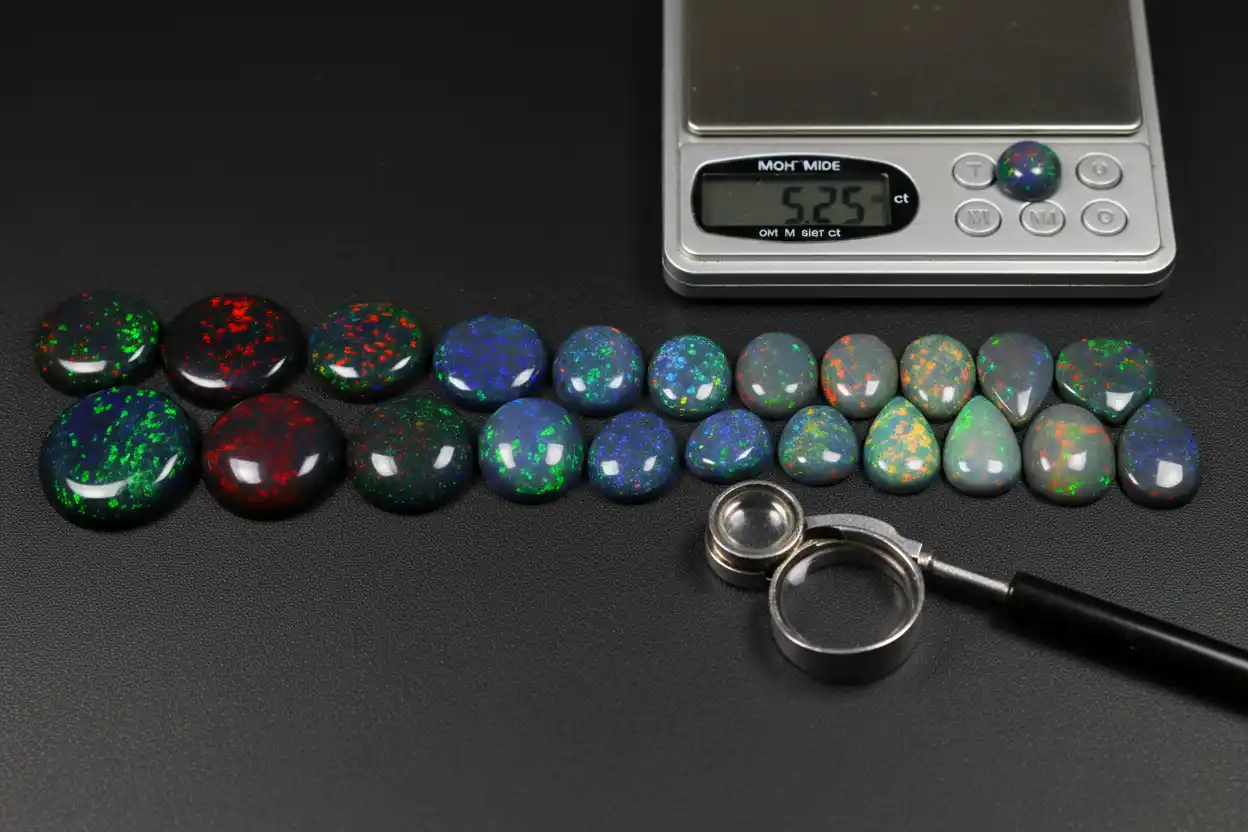
Black Opal Price: Typical Value Drivers, Color, Quality & Market Demand
Black opal price varies enormously because each stone combines a unique body tone, play-of-color, brightness, pattern, coverage, transparency, inclusions, cut, dimensions, stability, treatment status, origin and condition. A universal price-per-carat table cannot capture those differences reliably. GIA identifies play-of-color as the most important opal quality factor and evaluates opal through color, pattern and clarity, while its Australian research describes black opal as one of the rarest and most highly valued opal types because the dark bodycolor can intensify the visual contrast of spectral color.
Anyone comparing black opal price should therefore begin with the physical quality of the individual stone rather than with weight alone. The Gems Lore guide on how to buy black opal covers identity, treatment, doublets and triplets, condition and seller verification in detail. Those buying checks are also valuation checks: a stone that is treated, assembled, unstable or poorly documented belongs in a different comparison group from a fine untreated solid opal with strong play-of-color.
Black Opal Price At a Glance
| Value Factor | What Raises Value | What Can Lower Value |
|---|---|---|
| Play-of-Color Brightness | Strong vivid flashes visible in normal movement | Weak or dull color visible only under intense lighting |
| Color Range | Bright multicolor display, especially strong warm colors with other hues | Restricted or subdued color when other factors are ordinary |
| Coverage | Play-of-color across most of the face | Large dead zones or inactive areas |
| Pattern | Distinctive, broad, balanced and attractive arrangement | Weak, fragmented or visually confusing pattern |
| Body Tone | Naturally dark background providing strong contrast | Artificially darkened material or unattractive dull body tone |
| Clarity | Appropriate transparency and few distracting defects | Cracks, pits, sand, unwanted matrix or distracting inclusions |
| Stability | Sound stone without crazing | Existing cracks or suspected instability |
| Cut | Effective orientation, polish, thickness and face-up appearance | Poor orientation, excessive potch, weak polish or awkward proportions |
| Size | Larger fine stone with quality maintained | Extra weight that adds little visible beauty |
| Construction | Solid natural opal | Doublet or triplet when compared with equivalent solid material |
| Treatment | Natural appearance with clear disclosure | Undisclosed smoke, dye, sugar, resin or other enhancement |
| Origin | Credible provenance when relevant | Unsupported locality claim |
| Market Context | Strong collector demand for exceptional quality | Weak demand for ordinary or compromised material |
Why Black Opal Has No Single Reliable Price Per Carat
Price-per-carat language can be useful after quality has already been established, but it becomes misleading when used as the starting point. Two black opals weighing five carats can differ dramatically in brightness, pattern, body tone, color coverage, stability, thickness and treatment. One may display brilliant red, green and blue across almost its entire surface, while another may show a few small blue flashes surrounded by inactive dark material.
GIA emphasizes that individual opals vary as distinctly as fingerprints and that color, pattern and clarity must be evaluated together. This individuality prevents a simple commodity-style benchmark from working well across the entire market.
The same principle appears in other Gems Lore value guides. Benitoite price depends strongly on size and rarity but still requires color, clarity and cut comparison, while ammolite price depends heavily on optical display, condition and treatment. Black opal has its own gemological framework, but all three illustrate why price becomes meaningful only after quality categories are aligned.
Play-of-Color Brightness Is Usually the Most Important Price Driver
GIA calls play-of-color the most important quality factor in opal. For black opal, the dark background can amplify the perceived strength of spectral flashes, making brightness particularly influential.
A valuable stone should produce clear color under ordinary viewing rather than relying completely on a concentrated display light. Rotate the gem and observe whether flashes remain bright across several angles. A stone that becomes lifeless as soon as it leaves the seller’s spotlight may deserve a substantially lower valuation than one that stays vivid in diffuse daylight and normal indoor light.
Brightness should also be distinguished from photographic exposure. Increasing contrast and saturation can make an online image look spectacular without changing the actual stone. Video under neutral conditions provides a better basis for price comparison than one highly optimized still photograph.
Color Range Influences Demand but Does Not Work as a Simple Ranking
Black opal can display blue, green, yellow, orange, red, violet and combinations across the spectrum. GIA’s research notes that full-spectrum play-of-color is particularly prized and that red play-of-color is comparatively rare and often highly valued.
That observation should not become an oversimplified rule that every red-flashing opal must cost more than every blue-green stone. A tiny weak red patch does not automatically outrank an exceptionally bright, broad blue-green pattern. Coverage, brightness, pattern, body tone, size and stability remain essential.
The strongest premiums often appear when desirable color occurs in large, vivid, well-organized areas rather than as isolated spots. Buyers should therefore judge the total display rather than checking whether a listing contains the word “red.”
Pattern Can Create Major Differences Between Similar-Weight Stones
Opal pattern is the arrangement of play-of-color. GIA identifies many descriptive pattern types, from fine pinfire effects to broader mosaic or harlequin-like arrangements, and notes that larger, brighter, well-distributed patches commonly attract strong interest.
Pattern value is partly aesthetic and cannot be reduced to a universal formula. Distinctive broad patterning can command significant collector demand, particularly when combined with intense color and a dark body. Highly organized or unusual patterns may also make a stone memorable enough to stand apart from ordinary commercial opal.
Dead areas work in the opposite direction. If a large percentage of the surface shows only background color and little active play-of-color, the stone may have less visual impact even if its carat weight is substantial.
Dark Body Tone Adds Contrast but Does Not Replace Quality
Black opal’s market strength derives partly from its dark background, which makes play-of-color appear highly contrasted. GIA describes black opal as the rarest and generally most valuable broad opal type when other quality factors are comparable.
The qualification is essential. A dark body without strong play-of-color is still an ordinary-looking stone. Conversely, a slightly lighter dark opal with exceptional pattern and brightness may be worth more than an almost-black specimen with weak color.
Natural body tone must also be separated from treatment. Smoke, sugar, dye and other enhancements can darken opal, particularly porous hydrophane material. Treated dark opal can be beautiful and commercially legitimate when disclosed, but it should not automatically be compared with untreated fine black opal as though the materials were equivalent.
Size Raises Price Only When Quality Survives the Increase
Larger fine black opals can command substantial premiums because maintaining exceptional brightness, pattern and stability across a larger area is difficult. Carat weight therefore matters, but its contribution depends on the quality retained.
An additional five carats of inactive potch, unnecessary backing thickness or poorly colored material does not add the same value as five carats of vivid face-up precious opal. Compare length, width and depth as well as total weight so that you understand how much of the mass contributes to the visible stone.
Opal’s relatively low density also means its dimensions can look larger than those of many other gemstones of similar carat weight. Weight should therefore be interpreted with face-up size rather than used by itself.
Clarity Has to Be Judged According to Black Opal Standards
A common error is to assume that the clearest or most transparent black opal must be the most valuable. GIA explains that clarity expectations differ among opal types and that opacity can be desirable in black opal because the dark background strengthens the contrast of play-of-color.
Value-lowering clarity issues include distracting sand, pits, unwanted matrix, prominent internal fractures and surface-reaching cracks. Some natural internal features may have little effect if the play-of-color is exceptional and the stone remains durable.
Crazing deserves particularly strong attention because it is a durability defect rather than merely a clarity characteristic. GIA describes crazing as a network of cracks related to moisture loss and notes that cracked material carries lower durability and commercial value.
Cut, Thickness and Orientation Affect Black Opal Price
Unlike gems where standardized faceting symmetry dominates value discussions, opal cutting often follows the natural color bar. GIA notes that fine opals are frequently fashioned in freeform or irregular shapes to preserve play-of-color.
A high-value cut should present the best color face-up, retain useful thickness, provide an attractive polished surface and avoid obvious unnecessary bulk. The rear may contain natural potch, but buyers should determine whether the weight includes a substantial amount of material that contributes little to face-up appearance.
Orientation is particularly important. A stone may contain excellent color that disappears when viewed from normal face-up angles if the cutter did not orient the color bar effectively. Such a stone should not be valued solely according to what becomes visible at one extreme tilt.
Solid Opal, Doublet and Triplet Prices Belong in Different Categories
A solid black opal should not be compared directly with an opal doublet or triplet. GIA explains that doublets and triplets use thin layers of natural opal bonded to one or more additional materials and that assembled opals generally sell for a fraction of the price of substantial natural material.
A doublet may produce strong color because a dark backing increases contrast, while a triplet can use a transparent cap to protect and magnify a very thin opal layer. These constructions can provide excellent visual value for jewelry buyers on a lower budget.
The pricing problem occurs only when an assembled stone is compared with or represented as solid black opal. Always verify construction before using another listing as a price comparable.
Treatment Status Can Shift the Appropriate Comparison Group
Smoke treatment, sugar treatment, dyeing, oil, wax and polymer impregnation are among treatments documented in opal. Some treatments alter bodycolor, while others modify apparent clarity or help fill pores or fractures.
A treated stone is not automatically worthless. The key issues are disclosure, stability, visual quality and market acceptance. A beautifully treated opal offered transparently at an appropriate price can be a legitimate purchase, but undisclosed treatment undermines the reliability of the comparison.
For expensive black opal, independent testing becomes increasingly useful because natural dark bodycolor is itself an important value attribute.
Lightning Ridge Has Strong Market Recognition, but Origin Is Not a Quality Grade
Lightning Ridge is internationally famous for fine black opal and is described by GIA as a major source of top-quality material. That recognition can increase buyer interest, especially when provenance is credible.
GIA nevertheless states directly that opal value is based on quality, not simply on where it was mined. A Lightning Ridge label cannot compensate for weak color, cracks, poor cutting or other deficiencies.
Current GIA services include geographic-origin reporting for qualifying natural opal, so significant locality claims can potentially be supported through laboratory documentation where appropriate. Seller statements and laboratory conclusions should be kept distinct.
Realized Auction Prices Show Why Generic Price Tables Can Mislead
A public auction result can demonstrate the range of the market but should never be converted into a universal benchmark. Heritage Auctions sold a 21.16-carat black opal for $11,875 in May 2025. The lot was accompanied by a GIA report, and the auction description stated that the report showed no indications of color treatment; the auction house described the origin as presumed Australian rather than laboratory-confirmed Australian origin.
Dividing that sale by 21.16 carats would produce a mathematical price-per-carat figure, but applying it to another black opal would ignore brightness, pattern, color coverage, body tone, cut, condition, report details, auction demand and the individuality of the stone. Other publicly recorded black-opal auction results vary widely even at broadly similar weights, reinforcing the danger of treating carats as interchangeable units of quality.
Auction records are most useful as comparables when the stones are genuinely similar and the transaction conditions are understood.
Retail Asking Price, Auction Result and Dealer Offer Measure Different Things
A specialist retailer’s asking price includes inventory risk, expertise, photography, selection, insurance, payment costs, customer service, return privileges and profit margin. An auction result reflects competition for one particular lot at one particular sale. A dealer purchasing from a private owner must leave room for testing, possible repair, marketing, holding time and resale margin.
These different transaction structures explain why one stone can reasonably carry several different value figures. The original retail purchase price may be substantially higher than a dealer cash offer, while an insurance appraisal may exceed both because its purpose is replacement rather than immediate liquidation.
A black opal price should always be labeled according to the market being discussed.
Appraisal Value Is Not Guaranteed Resale Value
An appraisal should state whether it estimates replacement value, fair market value, liquidation value or another defined basis. Insurance replacement appraisals are often designed around the cost of obtaining an equivalent item through an appropriate retail channel, which is not the same as what an owner would receive by selling to a dealer.
Because black opals are highly individual, an appraiser may have difficulty finding precise comparables. Pattern, body tone and color distribution can make one stone materially different from another even when size is similar.
Treat the appraisal as a professional valuation for its stated purpose, not as a promise that someone will buy the opal for that amount.
Market Demand Can Magnify Differences in Fine Material
Supply and demand influence black opal price just as they influence other collectibles, but market demand does not affect every quality tier equally. Exceptional stones with vivid color, attractive patterns, natural dark body tone and strong provenance can appeal to serious collectors who compete for scarce material, while ordinary commercial stones compete in a broader market with more substitutes.
GIA field reporting has documented both the scarcity of fine Australian opal production and historical shifts in international demand. Those observations show why a static price chart can become obsolete even if the physical gem remains unchanged.
Demand should be treated as a market factor rather than a guarantee. Strong collector interest today does not promise future appreciation.
Retailer “Grades” Do Not Create Standardized Black Opal Value
GIA evaluates opal but does not issue an overall opal grade. Consequently, labels such as AAA, AAAA, top gem, museum grade or investment grade belong to the seller unless the seller identifies a specific independent system.
A useful grade should be translated into actual observable attributes: brightness, body tone, dominant play-of-color, pattern, percentage of active surface, clarity, stability, treatment and cut.
If two sellers both advertise “AAA black opal,” there is no reason to assume the stones occupy the same quality tier without comparing the actual gems.
What Usually Raises Black Opal Price?
The strongest premiums generally occur when several desirable characteristics coincide: naturally dark body tone, brilliant play-of-color, broad color coverage, multiple spectral hues, distinctive pattern, limited dead areas, good stability, sound condition, attractive cut, sufficient thickness, credible documentation and meaningful size. A compelling provenance can add collector interest, but quality should remain visible even without the locality label.
A small stone with those attributes can command a stronger price per carat than a much larger stone with mediocre color. This is exactly why buying decisions should begin with the Gems Lore buy black opal guide rather than with a generic per-carat number.
What Usually Lowers Black Opal Price?
Weak play-of-color, dull brightness, limited coverage, large inactive areas, unattractive body tone, distracting sand or pits, cracks, crazing, poor polish, bad orientation, excessive inactive backing, undisclosed treatment, uncertain construction and weak seller documentation can all reduce value.
An assembled doublet or triplet will generally belong to a lower price category than a comparable solid opal, but that does not make it an inferior purchase for every buyer. The important issue is correct disclosure and an appropriate price.
A lower black opal price can therefore reflect a legitimate compromise rather than a defect or deception. The buyer simply needs to know which compromises are present.
How to Compare Black Opal Prices Fairly
Before comparing price-per-carat, match the stones according to:
Solid, doublet or triplet construction.
Natural, synthetic or imitation status.
Treatment disclosure.
Dark body tone.
Brightness of play-of-color.
Color range and dominant hues.
Percentage of face covered by active color.
Pattern type and attractiveness.
Transparency, inclusions and stability.
Weight and millimeter dimensions.
Cut, thickness and polish.
Geographic-origin evidence where relevant.
Existing damage or repair.
Laboratory documentation.
Transaction type and return protections.
Once these variables are reasonably similar, price-per-carat can provide additional context. Before that point, it risks comparing fundamentally different products.
Conclusion
Black opal price is determined by the interaction of visual quality, rarity, stability, treatment, construction, documentation and market context rather than by carat weight alone. Play-of-color remains the central quality factor, but brightness, coverage, pattern, body tone, clarity, cut, size and condition determine how effectively that color is presented. GIA’s guidance makes clear that each opal is highly individual and that black opal’s dark bodycolor is valuable chiefly because of the contrast it provides for an exceptional color display.
The most reliable valuation method is comparative. Confirm whether the stone is solid or assembled, verify treatment, inspect stability, separate seller origin claims from documented origin, and compare only with stones of similar quality. Retail prices, appraisals, auction results and resale offers should remain separate concepts. When those distinctions are maintained, a black opal price becomes much more meaningful than any generic internet range.
Frequently Asked Questions
How much is black opal worth per carat?
There is no universal black opal price per carat because play-of-color brightness, pattern, body tone, coverage, clarity, stability, size, construction, treatment and provenance can vary enormously. Per-carat comparison becomes useful only after stones have been matched closely for quality.
Why is black opal more expensive than many light opals?
GIA notes that black opal’s dark background can provide strong contrast with play-of-color and describes black opal as the rarest and generally most valuable principal opal type when other factors are comparable. The dark body alone is not enough; fine play-of-color remains essential.
Does red play-of-color make black opal more valuable?
Bright red can contribute strongly to value because it is relatively uncommon in opal play-of-color, particularly when it appears with other vivid hues. A weak red spot does not automatically make a stone superior to an exceptionally bright blue-green opal, so coverage, pattern and brightness must still be considered.
Is larger black opal always more expensive?
No. Larger fine stones can command major premiums, but weight only adds value when desirable color and quality continue across the larger area. A heavy stone containing extensive inactive material, cracks or weak color can be less valuable than a smaller exceptional stone.
Is Lightning Ridge black opal worth more?
Lightning Ridge has exceptional market recognition and is famous for fine black opal, but GIA states that opal value is based on quality rather than locality alone. Documented provenance may add interest, but the individual stone still has to justify its price.
Is a black opal doublet worth the same as a solid black opal?
Generally no. A doublet contains a thin natural opal layer bonded to another material, while a solid black opal is not assembled in that manner. GIA notes that assembled opals typically occupy a lower price tier than comparable substantial natural opal.
Can treatment lower black opal value?
Treatment can change the appropriate comparison group because smoke, sugar, dye and impregnation can alter bodycolor or appearance. Treatment does not automatically eliminate value, but accurate disclosure is essential and untreated natural dark bodycolor may command a different market premium.
Does a GIA report give a black opal price?
No. GIA states that it evaluates opal but does not grade it, and its laboratory reports address identity, characteristics and detectable treatment rather than retail value. Monetary appraisal requires a separate valuation process.
Is an auction sale a reliable price-per-carat benchmark?
Only with caution. Auction results document what buyers paid for specific stones under specific sale conditions. A 21.16-carat black opal sold by Heritage Auctions for $11,875 in May 2025, but its realized price should not be converted into a universal per-carat value for unrelated black opals.
Is black opal guaranteed to appreciate?
No. Fine black opal can be rare and collectible, but future prices depend on demand, quality, condition, liquidity, transaction costs and broader market conditions. No legitimate quality grade guarantees financial appreciation.