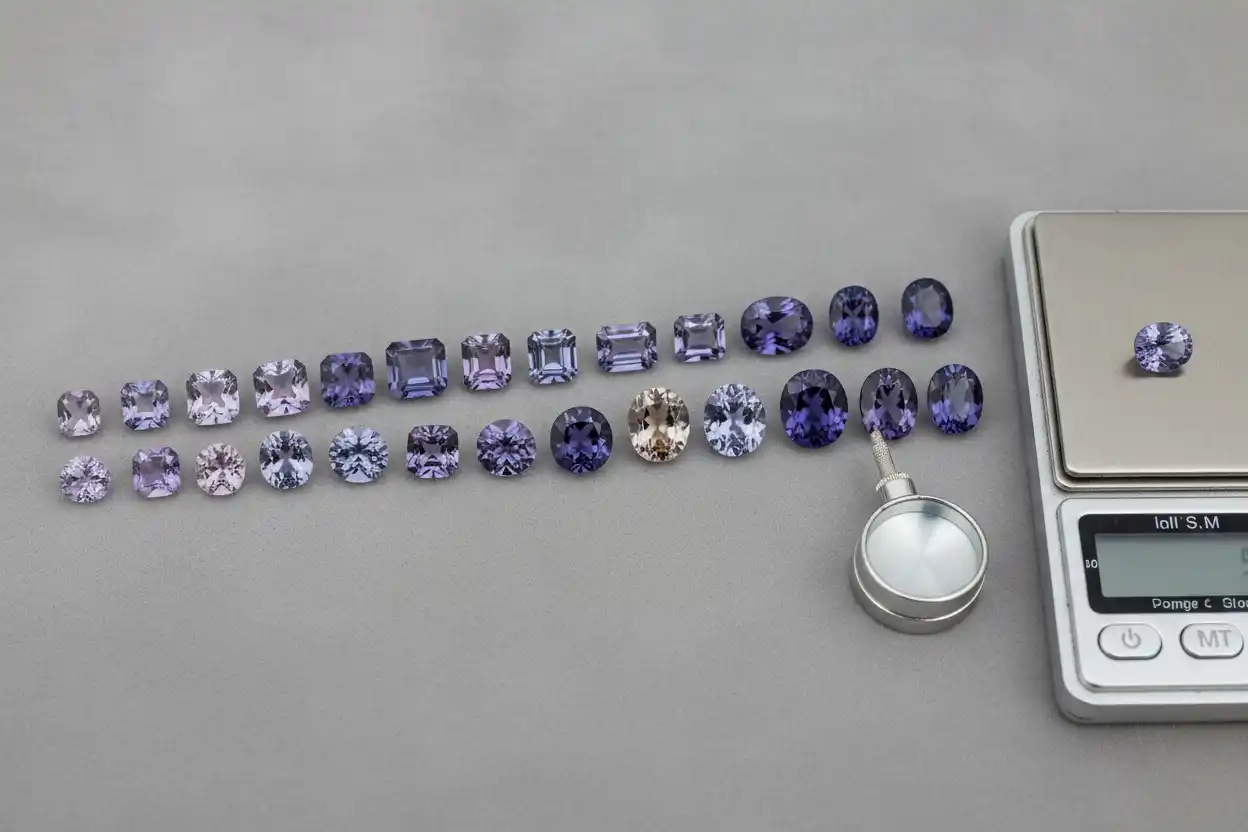
Iolite Price: Value Factors, Condition, Quality & Rarity
Iolite price is determined primarily by face-up violet-blue color, saturation, grayness, pleochroic orientation, transparency, clarity, cut, size, optical phenomena, condition, and market demand rather than by a single standard price per carat. GIA describes fine iolite as strongly pleochroic cordierite whose most desirable colors fall in the violetish-blue to fine-blue range, while commercial-quality material often contains a noticeable gray component.
Carat weight becomes more important as quality rises because GIA notes that fashioned iolite is commonly available between roughly one and ten carats but that fine-quality faceted stones above five carats are relatively rare. A six-carat stone with vivid face-up blue, strong transparency, excellent orientation, and fine cutting can therefore belong to a substantially different market from a six-carat gray, poorly oriented, windowed gem. Buyers evaluating an actual purchase should first use the Gems Lore buy iolite guide to establish quality, durability, and seller claims before trying to compare iolite price.
Iolite Price At a Glance
| Value Factor | What Usually Raises Iolite Price | What Can Lower Iolite Price |
|---|---|---|
| Color | Saturated violetish blue to fine blue | Gray, brown, pale, or weakly saturated face-up color |
| Pleochroic Orientation | Best blue direction dominates through the table | Yellowish, colorless, or excessively dark direction faces up |
| Tone | Strong blue with visible brilliance | Very dark material with extensive extinction |
| Transparency | Bright transparent gemstone | Haze, cloudiness, weak light transmission |
| Clarity | Eye-clean appearance in ordinary faceted material | Distracting inclusions, fractures, surface-reaching features |
| Phenomena | Fine cat’s-eye or aventurescence | Weak, diffuse, or poorly oriented effect |
| Cut | Skilled orientation, symmetry, polish, limited windowing | Poor orientation, large window, excess depth, weak polish |
| Size | Fine stone above five carats | Extra weight paired with weaker quality |
| Cleavage/Condition | Sound stone with crisp facets | Cleavage cracks, chips, scratches, abrasion |
| Treatment | Naturally colored material with clear disclosure | Unsupported treatment claims; although routine treatment is uncommon |
| Origin | Provenance with mineral-collector significance | Country name used as substitute for quality |
| Documentation | Reliable identification for significant stones | Undefined seller grade |
| Jewelry Context | Fine craftsmanship, metal, historical importance | Generic setting adds little independent value |
Face-Up Blue Is the Central Iolite Price Factor
GIA identifies vivid violet to blue as iolite’s most valuable color and describes violetish-blue through slightly violetish-blue as the characteristic fine range.
A stone should therefore be judged in the orientation in which it will actually be viewed and worn. The deepest blue visible from the side does not necessarily determine price if the table faces a gray, yellowish, or near-colorless pleochroic direction.
This is one reason iolite photographs can be misleading. A seller can position the gem to display its strongest blue axis while concealing the weaker face-up direction. Continuous rotation under neutral light is a much better basis for valuation.
Grayness Can Reduce Price Even When the Stone Is Technically Blue
GIA notes that commercial-quality iolite often contains a grayish component. Gray can mute the violet-blue bodycolor and make the gem appear smoky or less lively.
Two stones with similar saturation may therefore command different demand if one appears clean blue and the other strongly gray-blue.
A slightly lighter but more vivid stone can be more desirable than a darker grayish gem because colored-stone value depends on an optimal color range rather than simply maximum darkness. GIA’s broader colored-stone research similarly notes that overly dark stones can become difficult to sell when little light returns to the observer.
Pleochroism Is Both an Attraction and a Price Risk
Iolite displays striking eye-visible pleochroism. GIA explains that bluish iolite can show colorless to yellow, blue-gray, and dark violet directions, while more violet stones can display light violet, dark violet, and yellow-brown.
A well-oriented stone uses that property to create rich violet-blue face-up color, while a poorly oriented stone may look significantly less attractive despite originating from good rough.
The price difference between two otherwise similar stones can therefore reflect cutter skill rather than any change in mineral identity.
Cut Orientation Can Be More Valuable Than Extra Carat Weight
Because pleochroism is so strong, cutters must often sacrifice weight to place the most desirable color direction properly. GIA identifies careful orientation as one of the principal cutting challenges for iolite.
A five-carat poorly oriented stone can consequently be less desirable than a four-carat stone cut for excellent violet-blue face-up color.
Buyers who judge value only by dollars per carat can miss this distinction entirely. Iolite is a strong example of why colored gemstone cutting must be evaluated as part of quality rather than as a simple shape preference.
Transparency Is Expected in Fine Faceted Iolite
GIA states that iolite is commonly transparent and often relatively free of inclusions. This means good light transmission is an ordinary expectation in fine faceted material.
Cloudiness or dense inclusion fields can therefore reduce value more noticeably than in gemstone varieties where heavily included material is accepted as normal.
Transparency should still be considered together with color. A perfectly transparent but pale gray stone may be less desirable than a somewhat included gem with exceptional violet-blue saturation.
Eye-Clean Appearance Usually Supports Stronger Value
Because ordinary faceted iolite can be relatively clean, eye-visible inclusions generally reduce price unless they contribute to a recognized optical phenomenon. GIA’s buyer guide specifically notes that inclusions typically reduce iolite value except when they produce chatoyancy or aventurescence.
A small inconspicuous inclusion near the girdle may have little effect, while a large central feature or surface-reaching fracture can reduce both beauty and durability.
The clarity premium should remain proportional. Microscopic perfection that produces no visible improvement does not necessarily justify a dramatic retail markup.
Cat’s-Eye Iolite Follows a Different Value Framework
GIA notes that long parallel tubular inclusions can produce chatoyancy when the gem is oriented and cut properly.
A fine cat’s-eye iolite is therefore not “low clarity” in the conventional sense. Its inclusions create the effect that collectors value.
Price depends on the sharpness, centering, movement, contrast, bodycolor, size, and overall attractiveness of the eye. A diffuse weak line should not receive the same premium as a crisp mobile eye across a well-cut cabochon.
Aventurescent and “Bloodshot” Iolite Can Attract Collectors
GIA also documents iolite containing reflective metallic platelets that produce aventurescence, with reddish or brownish platelet-rich examples sometimes marketed as bloodshot iolite.
This material belongs to a specialized phenomenal market rather than the ordinary transparent faceted category.
The quality of the sparkle, bodycolor, transparency, pattern, cutting, and overall aesthetics determine whether the inclusions add value rather than merely making the stone appear heavily included.
Fine Stones Above Five Carats Receive a Scarcity Premium
GIA states consistently that fine faceted iolites above five carats are relatively rare.
This provides a meaningful size threshold for valuation, but only for fine-quality material. A large stone must retain attractive violet-blue color, proper pleochroic orientation, transparency, good clarity, and strong cutting for the size premium to be justified.
Large gray or dark stones are physically large, but their additional weight does not create the same desirability.
Carat Weight Should Be Paired With Dimensions
A deep iolite can carry substantial carat weight beneath the girdle without looking correspondingly large. Rare larger rough can encourage cutters to preserve weight, but the buyer should understand how efficiently that weight translates into visible area.
Compare length, width, and depth with total carats.
A lighter stone that faces up broader and brighter can represent better jewelry value even if its price per carat appears higher.
Cut Style Can Influence Both Beauty and Marketability
GIA notes that transparent iolite is commonly faceted and that step cuts are often used because the material can be clean and transparent.
Brilliant, mixed, cushion, oval, emerald-style, and specialty cuts can all work when the orientation is correct.
The most important question is whether the cut reveals the desired blue, minimizes large windows and extinction, provides useful face-up spread, and maintains structural soundness around the cleavage direction.
Precision Cutting Can Create a Separate Craftsmanship Premium
Custom-cut iolite can command more than mass-produced calibrated material even if both stones have similar rough quality.
The premium can reflect stronger pleochroic orientation, better symmetry, superior polish, specialized facet design, greater rough loss, and the reputation of the cutter.
That additional cost should be identified as craftsmanship value rather than portrayed as geological rarity.
Cleavage Can Lower the Value of Damaged Stones Quickly
Iolite has perfect cleavage in one direction and only fair toughness despite a Mohs hardness around 7 to 7.5. GIA warns that sharp blows, excessive pressure, high heat, and sudden temperature changes can cause breakage.
A cleavage crack near a girdle or prong can therefore affect price significantly because repair may require recutting or may place the gem at continued risk.
Condition deserves careful inspection in estate or secondhand jewelry even when the face-up color remains excellent.
Hardness Does Not Mean Iolite Is an Ideal Rough-Wear Stone
The Mohs number describes scratch resistance rather than toughness. Iolite can resist many ordinary abrasives but still split along its cleavage plane after a hard impact.
This distinction affects valuation for rings because a fine stone already carrying a size premium may require a protective mounting and more careful ownership than a sapphire of similar visual color.
Pendants and earrings may preserve condition more easily over long periods, which can matter in the resale market.
Treatment Has Less Influence Than in Many Blue-Gem Markets
GIA states that iolite is not typically treated and highlights its naturally attractive blue-violet color as a commercial strength.
This is very different from markets such as blue topaz or many sapphires, where treatment is common. Untreated status in iolite should still be disclosed honestly, but it does not automatically create an extraordinary rarity premium because untreated material is normal.
The buyer’s money is usually better directed toward exceptional face-up color, cut, size, and condition.
Natural Color Stability Supports Long-Term Wear
GIA describes iolite’s color as stable under normal conditions.
This means normal daylight exposure is not generally expected to fade untreated iolite, although high heat and sudden temperature changes can cause structural damage.
Color stability is therefore a positive ownership characteristic, especially compared with treated gems whose induced color may be light-sensitive.
Origin Usually Has a Secondary Effect on Price
Iolite occurs in multiple producing regions, including India, Brazil, Norway, Madagascar, and documented Canadian deposits.
For ordinary faceted stones, country of origin typically matters less than face-up color, size, clarity, cut, and condition. Mineral collectors may pay a premium for unusual documented localities or exceptional crystals, but that is partly a specimen market rather than routine jewelry pricing.
An origin label should therefore add context rather than act as an automatic quality grade.
Canadian Cat’s-Eye Iolite Illustrates a Specialized Origin Market
GIA research on British Columbia material documented strongly pleochroic faceted stones and chatoyant cabochons, with acicular fluid inclusions responsible for cat’s-eye effects in some material.
Such a documented source can be scientifically and collector-interesting, but pricing should still reflect the quality of the individual phenomenon.
A weak cat’s eye does not become elite solely because the deposit is unusual.
Iolite Price Versus Indicolite Price
Iolite and indicolite both compete in the blue-gem market, but their price structures differ. Indicolite is tourmaline and can show strong value escalation with size, while iolite is cordierite and GIA specifically identifies fine stones above five carats as relatively rare.
The Gems Lore indicolite price guide explains the blue-tourmaline market, including the critical distinction between ordinary iron-colored indicolite and copper-bearing Paraíba material.
A simple dollars-per-carat comparison between the two species is therefore not meaningful unless color, size, clarity, cut, and market category are matched carefully.
Iolite Price Versus Aquamarine Price
Aquamarine is beryl and can reach large clean sizes relatively readily, while iolite’s strongest value depends heavily on pleochroic orientation.
Gems Lore’s aquamarine price guide provides the appropriate framework for the beryl market.
Buyers should decide whether they prefer aquamarine’s generally lighter blue and beryl durability profile or iolite’s deeper violet-blue and dramatic pleochroism rather than assuming one is universally the better financial value.
Iolite Price Versus Andalusite Price
Both iolite and andalusite reward cutters who manage pleochroic directions effectively. Gems Lore’s andalusite price guide explains how directional colors can influence cut and face-up appearance in another mineral species.
Their markets remain separate because color preferences, supply, typical sizes, and consumer demand differ.
Retail Asking Price Is Not Resale Value
Retail iolite price includes more than the mineral. Cutting, setting, metal, photography, store overhead, returns, warranties, and dealer margin all contribute.
A dealer purchasing a used stone needs enough room for verification, repolishing if necessary, inventory time, marketing, and profit. The cash offer can therefore be substantially below the original retail purchase amount.
An insurance appraisal may be higher again because replacement value answers a different financial question.
Jewelry Craftsmanship Can Dominate Total Price
Iolite is often used in designer jewelry because its strong blue-violet color offers substantial visual presence. A custom platinum or high-karat gold setting with diamond accents can cost much more than the center iolite.
Dividing the finished jewelry price by the iolite’s carat weight would therefore produce a misleading gemstone benchmark.
Separate the stone, metal, side stones, craftsmanship, brand, and antique or designer provenance when analyzing value.
Undefined Retailer Grades Are Weak Price Evidence
Terms such as AAA iolite, AAAA iolite, sapphire quality, premium violet, collector grade, or investment grade do not substitute for objective description.
A defensible price comparison uses actual face-up color, grayness, pleochroic orientation, transparency, clarity, cut, weight, dimensions, condition, and phenomenon.
The more expensive the stone, the less useful an undefined grade becomes.
What Usually Raises Iolite Price?
Iolite price generally rises when a stone combines vivid violetish-blue or fine-blue face-up color, limited grayness, strong transparency, eye-clean appearance, excellent pleochroic orientation, skilled cutting, larger fine size, sound cleavage condition, and crisp surface finish.
Rare phenomena such as a sharp cat’s-eye or attractive aventurescence can create a separate collector premium. Precision cutting, unusual provenance, antique jewelry, and important designer workmanship may add additional value.
What Usually Lowers Iolite Price?
Strong grayness, brownish or yellowish face-up color, poor pleochroic orientation, excessive darkness, weak saturation, cloudiness, ordinary distracting inclusions, large windows, excessive depth, chips, cleavage cracks, surface abrasion, or exaggerated seller grades can reduce price.
A lower price can still represent excellent value when the compromise is understood. A slightly gray stone with fine cutting and useful size may suit a buyer better than a more expensive heavily saturated gem.
How to Compare Iolite Prices Fairly
Compare natural cordierite identity, face-up hue, saturation, gray component, pleochroic orientation, transparency, clarity, optical phenomenon when present, carat weight, dimensions, cut, cleavage condition, treatment disclosure, provenance, jewelry craftsmanship, and transaction type. Only when those variables align does a per-carat number become a meaningful comparison.
Conclusion
Iolite price is driven first by the quality of the face-up violet-blue color and then by how well the cutter has managed the gem’s extreme pleochroism. GIA identifies saturated violet to blue as the most valuable color range and notes that the same crystal can display blue-gray, dark violet, yellow, or nearly colorless directions.
Fine transparent stones are normally expected to be relatively clean, while special inclusion patterns can create collectible cat’s-eye or aventurescent iolite. Size becomes increasingly important above five carats because GIA describes fine faceted stones in that range as relatively rare.
Treatment generally plays a smaller role because iolite is not typically enhanced, but condition matters greatly because perfect cleavage and fair toughness make the stone vulnerable to hard impact. Buyers who evaluate those factors together can understand iolite price far more accurately than anyone relying on a universal chart or seller-defined grade.
Frequently Asked Questions
How much is iolite worth per carat?
There is no universal iolite price per carat. Face-up color, grayness, pleochroic orientation, clarity, transparency, cut, size, phenomenon, condition, and market context can all materially affect value.
What iolite color is most valuable?
GIA identifies saturated violet to blue and fine violetish-blue colors as the most desirable and valuable.
Does grayness reduce iolite price?
It often can because commercial iolite frequently contains a gray component, while fine material is valued for more attractive saturated violet-blue color.
Why does cut affect iolite value so much?
Iolite is strongly pleochroic, so the cutter must orient the crystal carefully to display its best blue direction through the table. Poor orientation can produce gray, yellowish, nearly colorless, or excessively dark face-up appearance.
Are large iolites expensive?
Fine size matters. GIA notes that fashioned iolite can occur from about one to ten carats but that fine-quality faceted stones above five carats are relatively rare.
Should iolite be eye-clean?
Ordinary fine faceted iolite is generally transparent and relatively free from inclusions, so eye-clean appearance is desirable. Cat’s-eye and aventurescent iolite are exceptions because inclusions create the optical phenomenon.
Is cat’s-eye iolite valuable?
It can be collectible when the eye is sharp, centered, mobile, and combined with attractive bodycolor. GIA documents chatoyancy caused by properly aligned inclusions in iolite.
Is iolite usually treated?
No. GIA states that iolite is not typically treated.
Does iolite fade in sunlight?
GIA describes iolite’s natural color as stable. High heat and sudden temperature changes are greater concerns because they can cause breakage.
Does origin have a large effect on iolite price?
Usually less than color, size, pleochroic orientation, clarity, and cut for conventional faceted jewelry. Special mineral specimens or phenomenal material from unusual documented sources can create collector premiums.
Is iolite price the same as appraisal value?
No. Retail price, appraisal value, dealer resale offer, private sale, and auction realization represent different market contexts.
Is iolite a guaranteed investment?
No. Fine iolite can be desirable and collectible, but future value depends on quality, size, condition, phenomenon, provenance, demand, and liquidity.