Buy Jeremejevite: Quality & Authenticity, Color, Clarity & Value
To buy jeremejevite responsibly, make independent identification the first requirement because the mineral is genuinely rare, little known outside specialist gem and mineral circles, and expensive enough in fine faceted quality that a visual mistake can be financially significant. Jeremejevite is a rare aluminum borate with the ideal formula Al₆(BO₃)₅(F,OH)₃, belongs to the hexagonal crystal system, and typically forms prismatic crystals in pegmatitic or related geological environments. GIA continues to describe jeremejevite as a rare mineral and has examined faceted violetish-blue material as well as historical blue and yellow examples.
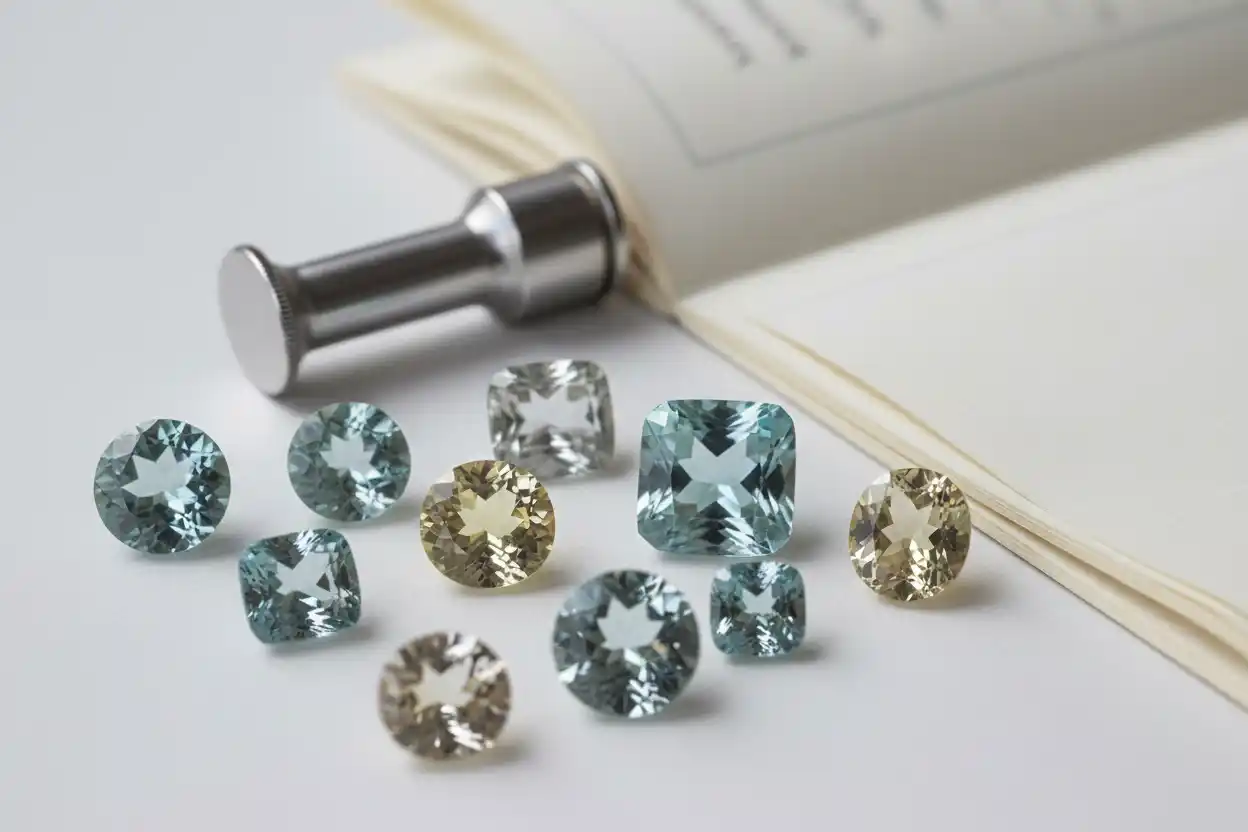
Jeremejevite occurs in colors ranging from colorless and pale yellow through aquamarine blue and violetish blue. Mineralogical reference data place it around Mohs 7 with vitreous luster, approximately 3.28 specific gravity, and no routinely observed cleavage, making it reasonably suitable for carefully worn jewelry while still deserving protection from hard impact like any rare faceted gem. Rarity alone should not determine what a buyer pays, however. Color, transparency, clarity, size, cut, crystal quality, condition, provenance, documentation, and whether the piece is a mineral specimen or faceted gemstone all need to be considered before the asking price can be judged.
Buy Jeremejevite At a Glance
| Buying Factor | What to Examine | Why It Matters |
|---|---|---|
| Identity | Independent confirmation that the stone is jeremejevite | Rare blue and colorless gems can be confused visually with other minerals |
| Color | Pale blue, aquamarine blue, violetish blue, colorless, or yellow | Attractive blue and violet-blue commonly drive gem demand |
| Transparency | Transparent faceting-quality material | Gem-quality transparent material is much scarcer than ordinary mineral occurrence |
| Clarity | Crystals, hollow channels, fractures, clouds | Internal features affect beauty but can also support natural origin |
| Size | Carat weight together with dimensions | Fine faceted jeremejevite is uncommon, making larger clean stones especially notable |
| Cut | Symmetry, brilliance, polish, windowing, orientation | Rare rough should still be cut for beauty rather than weight alone |
| Crystal Form | Termination, transparency, luster, completeness | Important for mineral-specimen value |
| Hardness | Approximately Mohs 7 | Suitable for jewelry with sensible care |
| Cleavage | No routinely observed cleavage in standard mineral data | Still inspect for fractures and chips |
| Treatment | Seller disclosure and laboratory findings | Do not assume untreated status solely because the gem is rare |
| Provenance | Namibia, historic locality, or other source evidence | Certain localities have major collector significance |
| Documentation | Reputable gemological identification report | Particularly important for high-value faceted pieces |
| Condition | Chips, scratches, broken terminations, repolishing | Damage can affect both gem and specimen value |
| Market Type | Faceted gem versus crystal specimen | These markets value different attributes |
Jeremejevite Is a Rare Aluminum Borate
GIA describes jeremejevite as a rare aluminum borate with ideal chemistry expressed as Al₆B₅O₁₅(F,OH)₃ and notes that it crystallizes in the hexagonal system, commonly forming prismatic crystals.
The mineral was first described from Russia, and later discoveries—especially in Namibia—greatly increased the number and quality of crystals available to collectors and cutters. Mindat identifies the Russian Soktuj Gora occurrence as the type locality and lists important occurrences in Namibia, Myanmar, Madagascar, and other regions, while Namibia contains several of the classic modern collector localities.
This geographic history helps explain why a jeremejevite can possess value both as a gemstone and as a mineral specimen. A transparent terminated Namibian crystal may appeal to collectors even if it is never cut, while an eye-clean faceted stone belongs to a different jewelry and gem-collector market.
Namibia Is the Most Recognized Modern Source
Namibia transformed the jeremejevite market by producing notable blue crystals and gem-quality material. GIA has studied large collections reportedly from Namibia, including a group of approximately 400 crystals submitted for research, demonstrating that the country has yielded enough significant material to become central to modern understanding of the mineral.
GIA’s Gübelin Gem Project also includes a 2.60-carat faceted jeremejevite documented from Namibia, illustrating that faceted stones exceeding ordinary small calibrated sizes do exist in important collections.
Namibian origin can therefore create collector interest, particularly when a stone or crystal is linked credibly to a classic occurrence. The locality name should still supplement, not replace, actual quality.
The Famous Blue Color Is Only Part of Jeremejevite’s Natural Range
Many buyers encounter jeremejevite through photographs of pale sky-blue or violetish-blue Namibian crystals, but the mineral is not exclusively blue. GIA’s gemological update examined a 4.54-carat light-yellow jeremejevite, while its later microscopy work documented a 1.78-carat violetish-blue faceted stone. Mineral reference data also list colorless, light yellow-brown, and aquamarine-blue material.
This means yellow or colorless jeremejevite should not automatically be dismissed as misidentified merely because the marketplace strongly associates the species with blue.
Color value is ultimately market-driven. Blue and violet-blue may command stronger demand because of beauty and association with desirable Namibian crystals, while unusual yellow material can possess separate collector interest because it is less familiar.
Evaluate Blue Jeremejevite for Saturation and Brightness
Pale blue jeremejevite can be attractive because its high transparency and vitreous luster produce a delicate crystalline appearance. Stronger blue or violetish-blue color may create more immediate visual impact, but deeper tone should still preserve brightness.
A very pale stone may look almost colorless under certain lighting, while a stronger blue stone can command a premium if the color remains evenly distributed and the cut returns light effectively.
Buyers should compare stones under neutral lighting because photographs against saturated blue backgrounds or with aggressive editing can make pale material look much more intense than it appears in person.
Transparency Is Essential for Fine Faceted Jeremejevite
Jeremejevite’s highest jewelry appeal generally comes from transparent material capable of producing a clean faceted gem. Crystal specimens can be valuable for other reasons, but faceting quality requires enough transparency for light to travel through the stone.
A hazy or heavily fractured piece may remain rare mineralogically yet belong to a lower jewelry-quality category.
This is similar to the distinction described in Gems Lore’s grandidierite price guide, where mineral rarity and transparent faceting quality create very different market levels. Rare mineral identity establishes scarcity, but transparency determines whether the material also occupies a premium faceted-gem segment.
Clarity Needs a More Nuanced Approach Than “Flawless”
GIA’s recent microscopic examination of a 1.78-carat violetish-blue jeremejevite documented unusual hollow channels forming branching patterns resembling rime ice or lightning strikes. The features were interpreted as growth-related structures rather than foreign mineral inclusions.
Such internal features can reduce conventional clarity while simultaneously providing fascinating evidence of natural crystal growth. A collector may value an unusual inclusion scene that a mainstream jewelry buyer would consider distracting.
The right question is therefore not merely whether the stone contains inclusions but whether those features reduce transparency, weaken the stone, disrupt face-up beauty, or create scientifically and aesthetically interesting character.
Eye-Clean Stones Deserve Stronger Scrutiny as Size Increases
Jeremejevite is rare enough that a large, transparent, eye-clean faceted specimen should not be treated as routine material. GIA’s historical gemological update considered a 4.54-carat yellow stone large enough and unusual enough to motivate a detailed study, while documented collection examples around two to several carats remain noteworthy.
This does not create a rigid size threshold above which a stone must be fake. It means that increasingly extraordinary combinations of size, transparency, color, and clarity deserve increasingly strong documentation.
A five-carat or larger vivid-blue eye-clean stone offered without a recognized laboratory report should therefore receive far more scrutiny than a modestly priced small collector gem.
Carat Weight Must Be Paired With Dimensions
Long prismatic rough can encourage elongated cuts, and a cutter may preserve depth to retain valuable weight. Two jeremejevites of equal weight can therefore have very different visible sizes.
Compare length, width, and depth together with carat weight. A slightly lighter stone can present a larger face-up area when its proportions are more efficient.
Because rare rough can command strong premiums, buyers should be especially careful not to pay heavily for hidden pavilion weight that contributes little to visual presence.
Cut Quality Still Matters in an Extremely Rare Gem
Rarity does not excuse poor craftsmanship. A jeremejevite can be genuinely rare and still suffer from a large window, weak symmetry, poor polish, excessive depth, or an outline chosen purely to preserve rough.
Cutters understandably try to conserve rare material, and some compromises can be rational when a crystal contains fractures or an unusual shape. The finished gem should nevertheless look intentional.
A precision-cut jeremejevite may deserve a premium because the cutter has sacrificed expensive rough to produce stronger brilliance and face-up beauty.
Crystal Specimens Follow a Different Quality System
Many of the finest jeremejevites are collected as natural crystals rather than cut gemstones. Specimen collectors may prioritize termination, crystal length, transparency, color zoning, luster, absence of contact damage, associated minerals, provenance, and aesthetic form.
A complete doubly terminated blue crystal can therefore be more valuable as a specimen than as potential cutting rough even if its weight could produce a respectable faceted stone.
Never divide a specimen’s sale price by total carat weight and treat the result as a jeremejevite gemstone price per carat. The two objects serve different collector markets.
Broken Terminations Matter in Mineral-Specimen Value
Natural jeremejevite crystals can command substantial premiums when their terminations are complete and undamaged. A broken tip, repaired crystal, chipped prism edge, or glued contact may reduce specimen desirability even when the material remains authentic.
Conversely, a partially damaged crystal with outstanding blue color and transparency might still yield fine faceting rough.
The intended use therefore determines whether the damage is primarily an aesthetic specimen issue or a cutting-yield issue.
Jeremejevite Has Reasonable Hardness for Jewelry
Mindat lists jeremejevite at approximately Mohs 7, with vitreous luster, transparent habit, conchoidal fracture, and no routinely observed cleavage.
A hardness around 7 provides useful scratch resistance compared with softer collector minerals, making faceted jeremejevite more practical for jewelry than its rarity might imply.
Hardness still does not mean indestructibility. Hard blows can chip any gemstone, and a rare jeremejevite deserves conservative wear because replacement with an equivalent color, size, cut, and provenance may be difficult.
Rings Require More Care Than Pendants or Earrings
A jeremejevite can be set in a ring, but daily exposure brings greater risk of impact and abrasion than earrings or pendants.
Protective prongs, a halo, partial bezel, or other design that shields vulnerable edges can reduce risk, particularly in elongated cuts with exposed points.
For an exceptional collector-quality gem, occasional-wear jewelry may be a more rational choice than unrestricted daily wear.
Colorless Jeremejevite Can Be Difficult to Identify Visually
Colorless transparent stones can resemble quartz, topaz, beryl, danburite, synthetic materials, and numerous other gems. Pale blue material can similarly resemble aquamarine, blue topaz, certain tourmalines, or other collector minerals.
Jeremejevite’s rarity means visual appearance should never be the sole basis for a high-value purchase.
A laboratory can use refractive index, specific gravity, spectroscopy, microscopy, Raman analysis, and chemical techniques to establish identity far more reliably than home observation.
Do Not Rely on Seller Certificates for Extraordinary Stones
A printed card produced by the dealer can document the seller’s representation, but it is not equivalent to independent gemological testing.
GIA’s general Colored Stone Identification Report is available for polished loose or mounted material and identifies the material and any detectable treatments. Jeremejevite is not one of the stones listed for GIA’s standard geographic-origin report, so a laboratory identification should also not be misrepresented as proof of a Namibian locality unless the actual report states such information through an appropriate service.
For a rare stone whose price depends heavily on identity, independent testing is one of the most defensible expenses in the transaction.
Treatment Should Be Discussed Without Inventing a Routine Treatment Market
The authoritative GIA literature on jeremejevite focuses on identification, chemistry, spectroscopy, localities, crystal growth, and unusual inclusions rather than describing a widespread commercial enhancement process.
That absence does not prove that no jeremejevite could ever be coated, filled, assembled, irradiated, or otherwise modified. GIA’s broader treatment guidance emphasizes that sellers should disclose known gemstone treatment because modifications may not be obvious to an untrained buyer.
The appropriate wording is therefore that routine treatment is not a defining feature of the known jeremejevite market, while high-value purchases should still rely on disclosure and laboratory examination rather than an absolute “never treated” claim.
Natural Versus Synthetic Claims Should Be Documented
Mindat notes that a synthetic OH-analogue related to jeremejevite has been produced scientifically, although this does not imply a broad commercial synthetic jeremejevite jewelry market.
A buyer should distinguish laboratory mineralogical synthesis from routine gem-market availability. The existence of experimental synthesis is not evidence that every inexpensive blue jeremejevite listing is synthetic rather than natural; many suspicious listings may simply be other natural or manufactured materials misrepresented under a rare name.
Independent identification remains the correct solution.
Namibia Provenance Can Add Collector Interest
Namibia’s Mile 72/Cape Cross and Erongo-region occurrences are among the most historically important modern jeremejevite sources. Mindat classifies Mile 72 as a classic and world-significant locality for the species, while GIA has conducted research on extensive collections reportedly from Namibia.
A crystal with trustworthy locality provenance can therefore command a mineral-collector premium beyond its gem qualities.
That premium should be based on documented provenance rather than color alone. Blue jeremejevite does not prove Namibia by appearance.
Russia Has Type-Locality Significance
Jeremejevite was first described from the Soktuj Gora locality in Russia, which remains the type locality for the species.
Type-locality material can attract special mineral-collector interest because it connects directly to the original scientific description.
Such value belongs primarily to the specimen/provenance market rather than conventional faceted-jewelry quality.
Other Localities Expand the Collector Story
Mindat records jeremejevite occurrences in places including Myanmar and Madagascar in addition to Russia and Namibia. The existence of multiple localities means that “Namibian” should never be treated as part of the mineral’s definition.
Different deposits can produce different colors, crystal habits, inclusions, and available sizes.
For collectors, a less common provenance may itself be interesting even if the color is less commercially desirable than classic blue Namibian material.
Jeremejevite Versus Aquamarine
Pale blue jeremejevite can resemble aquamarine visually, but aquamarine is blue beryl and is vastly more available in transparent faceted sizes. Gems Lore’s buy aquamarine guide and aquamarine price guide explain the beryl market, where fine color, clarity, cut, and size follow a very different supply structure.
A blue stone should never be valued as jeremejevite merely because it resembles an unusually pale aquamarine.
The difference must be established gemologically.
Jeremejevite Versus Grandidierite
Jeremejevite and grandidierite are both rare collector gems associated with blue to blue-green colors and limited faceting material, yet their mineral identities are completely different.
Gems Lore’s buy grandidierite guide and grandidierite price guide show why transparent gem-quality scarcity must be established separately for each species.
A broad “rare blue gemstone” price category is not useful enough for either material.
Jeremejevite Versus Benitoite
Benitoite is another genuinely rare blue collector gem but has very different optical properties, chemistry, locality history, and market recognition.
The Gems Lore buy benitoite guide and benitoite price guide provide the relevant comparison framework.
These examples reinforce the same buying principle: rarity is mineral-specific, and one rare gem should not be used as a direct per-carat benchmark for another.
Rarity Does Not Guarantee Liquidity
Jeremejevite is genuinely uncommon, but the buyer pool is much narrower than the market for diamond, sapphire, emerald, ruby, or even many tourmalines.
A specialist collector may pay strongly for an exceptional blue crystal or clean faceted gem, while a general jewelry dealer may have limited experience or limited demand for the material.
This can create a large difference between specialist retail asking price and immediate resale value.
Retail Price and Resale Value Should Be Separated
A specialist dealer’s jeremejevite price can include difficult sourcing, years of inventory holding, laboratory identification, specimen provenance research, cutting risk, insurance, photography, and access to a small collector market.
A dealer buying the same stone back must account for re-verification, resale time, market depth, possible recutting, and profit margin.
The rarity of the material does not guarantee that it can be converted quickly into cash at the original retail price.
Undefined Grades Are Particularly Weak for Rare Gems
Terms such as AAA jeremejevite, museum grade, investment grade, top blue, exceptional collector quality, or flawless grade have no universal laboratory meaning.
A seller can use descriptive language, but the buyer should insist on the underlying facts: identity, color, transparency, clarity, size, dimensions, cut, condition, provenance, and documentation.
For a rare gemstone, objective description is more useful than a dramatic grade label.
Common Red Flags When You Buy Jeremejevite
Be cautious when:
A large clean blue stone is sold without independent identification.
A seller claims Namibian origin based only on blue color.
“AAA” or “museum grade” is described as an official international grade.
A suspiciously inexpensive stone is called jeremejevite solely from appearance.
A crystal’s broken termination is concealed in photographs.
A faceted stone is extremely deep but marketed primarily by carat weight.
Rare-mineral status is used to excuse poor cutting or heavy fractures.
A seller claims a laboratory report proves origin when the report only identifies the mineral.
“Untreated forever” is claimed without qualification or evidence.
A mineral-specimen price is converted directly into a gemstone per-carat benchmark.
An appraisal figure is presented as guaranteed resale value.
Future appreciation is promised because the mineral is rare.
The more extraordinary the claimed size, color, clarity, and provenance, the stronger the documentation should become.
How to Compare Jeremejevite Listings Fairly
Compare verified mineral identity, color, transparency, clarity, size, millimeter dimensions, cut, brilliance, windowing, crystal or faceted form, condition, treatment disclosure, provenance, laboratory documentation, and seller return rights. A transparent 2-carat faceted violet-blue jeremejevite should not be compared mechanically with a 20-carat rough crystal specimen, a pale damaged crystal, or an unverified blue gemstone sold under the same name. Matching the market category is essential before the price means anything.
Conclusion
To buy jeremejevite confidently, treat independent identification as part of the purchase rather than an optional luxury. Jeremejevite is a genuinely rare aluminum borate documented by GIA in blue, violetish-blue, yellow, and other pale colors, with Namibia becoming one of the most important modern sources of notable crystals and faceting material.
The best faceted stones combine attractive color, transparency, useful clarity, skilled cutting, appropriate size, crisp condition, and trustworthy documentation. Mineral specimens follow another quality system in which crystal form, termination, provenance, luster, and aesthetics can matter as much as transparency.
Rarity should support value only after quality and identity are proven. Buyers who distinguish faceted-gem quality from specimen value, laboratory identification from locality provenance, and specialist retail price from resale liquidity can evaluate jeremejevite much more responsibly than anyone relying on the rare name alone.
Frequently Asked Questions
What is jeremejevite?
Jeremejevite is a rare aluminum borate mineral with the ideal formula Al₆B₅O₁₅(F,OH)₃. It crystallizes in the hexagonal system and commonly forms prismatic crystals.
What colors can jeremejevite be?
Jeremejevite can occur colorless, pale yellow to yellow-brown, aquamarine blue, blue, and violetish blue. GIA has documented both a 4.54-carat light-yellow gem and a 1.78-carat violetish-blue example.
Is jeremejevite really rare?
Yes. GIA consistently describes jeremejevite as a rare gemstone mineral, and major research collections are noteworthy precisely because significant crystals and transparent faceting material are uncommon.
Where does jeremejevite come from?
The type locality is Soktuj Gora in Russia, while Namibia has produced some of the most famous modern blue crystals and gem material. Additional occurrences are recorded from Myanmar, Madagascar, and other locations.
What is jeremejevite’s hardness?
Standard mineralogical data place jeremejevite at approximately 7 on the Mohs scale. This makes it reasonably scratch resistant for careful jewelry wear, although hard impact should still be avoided.
Does jeremejevite have cleavage?
Mindat’s current mineral data report no observed cleavage and a conchoidal fracture. Existing fractures, chips, and damaged edges can still affect durability and value.
Are blue jeremejevites more valuable than yellow ones?
Blue and violetish-blue material generally has strong collector and jewelry appeal, particularly from famous Namibian occurrences, but there is no universal rule that every blue stone outranks every yellow one. Transparency, size, clarity, cut, provenance, and rarity of the particular specimen all matter.
Are large faceted jeremejevites rare?
Fine faceted jeremejevite is uncommon enough that multi-carat examples are noteworthy. GIA’s literature includes a 4.54-carat yellow gem and a documented 2.60-carat Namibian example in the Gübelin collection.
Can jeremejevite have unusual inclusions?
Yes. GIA documented branching hollow channels resembling rime ice and lightning in a 1.78-carat violetish-blue jeremejevite, interpreted as growth-related structures.
Is jeremejevite routinely treated?
Authoritative GIA research does not describe a routine commercial enhancement process as a defining feature of the jeremejevite market. That should not be interpreted as proof that every stone is automatically untreated; important purchases should still include seller disclosure and laboratory examination where appropriate.
Can GIA identify jeremejevite?
GIA’s Colored Stone Identification Report is available for polished colored-stone material and can identify the material and list detectable treatments.
Can GIA confirm Namibia origin for jeremejevite?
Jeremejevite is not currently among the gemstones listed for GIA’s standard Colored Stone Identification & Origin Report. Namibian provenance should therefore be supported by the documentation actually available rather than inferred from a standard identification report.
Is jeremejevite a guaranteed investment?
No. Jeremejevite is genuinely rare, but future resale depends on color, transparency, clarity, size, condition, provenance, documentation, collector demand, and market liquidity. Rare mineral identity cannot guarantee appreciation.