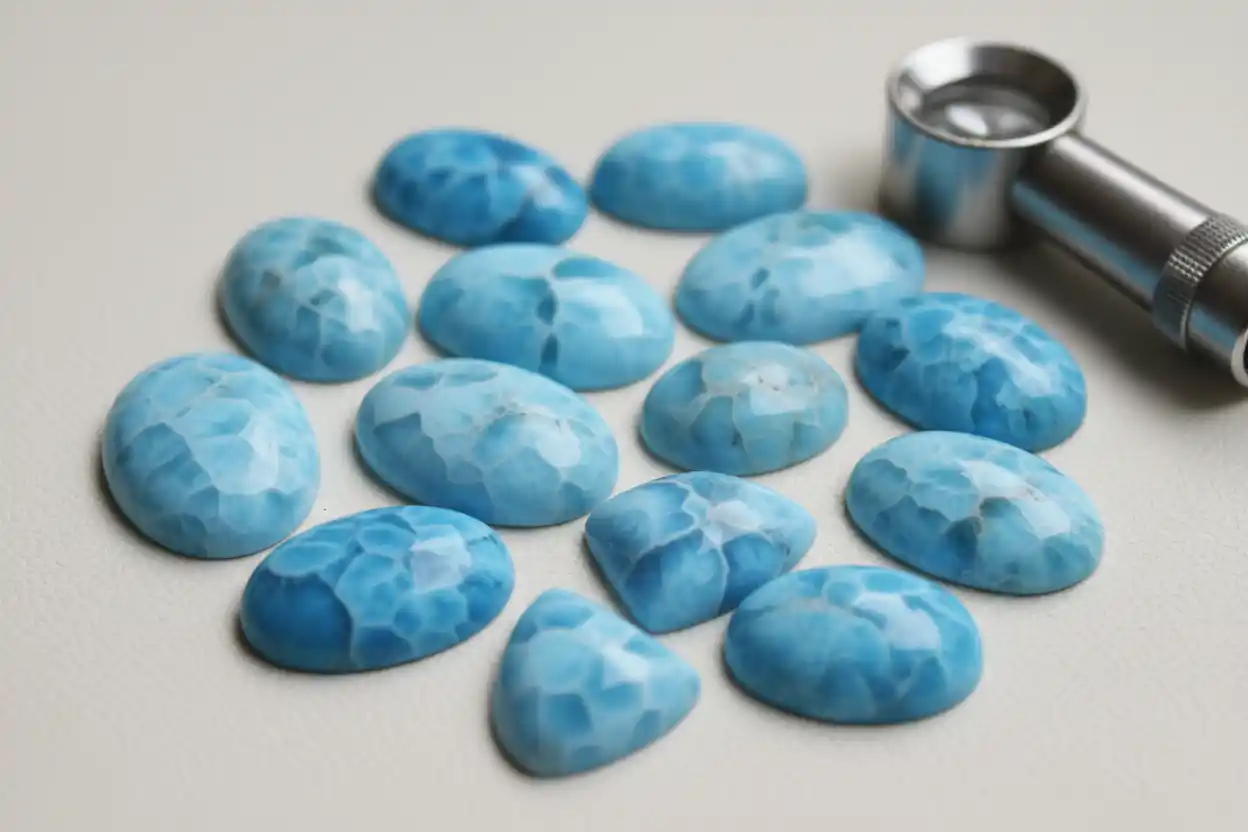
Buy Larimar: Smart Buying Tips & Red Flags
If you want to buy larimar intelligently, begin with the quality and authenticity of the blue pectolite itself, not with a seller’s description such as Caribbean blue, volcanic blue, AAAA, Atlantis stone, or rare ocean pattern. Larimar is the trade name for distinctive blue pectolite associated with the Dominican Republic, and its most desirable polished material combines convincing natural blue color, attractive white patterning, dense enough structure for a smooth polish, and limited fractures or unattractive host-rock areas.
The difficulty is that several different qualities can produce similar photographs. Pale genuine Larimar can be darkened through editing, dye, oil, wax, coating, or backing; fractured material can be filled or stabilized; ceramic, resin, glass, dyed chalcedony, howlite, magnesite, calcite, and other blue materials can imitate its blue-and-white appearance; and a natural pectolite cabochon can still be priced too aggressively simply because the seller calls it rare.
The strongest methodology when you buy larimar is therefore material identity first, natural blue quality second, pattern third, structural condition fourth, cutting and polish fifth, treatment disclosure sixth, Dominican provenance seventh, jewelry construction eighth, and price last. This order prevents unusually dark photography, elaborate ocean metaphors, exaggerated rarity language, or seller-created grades from replacing the qualities that actually determine whether the stone is worth buying.
The broader Larimar properties guide explains the mineralogy, formation, physical properties, colors, and broader background of the material. This guide focuses specifically on how to buy larimar as a loose cabochon, bead, carving, or finished jewel while separating fine natural material from weak color, poor cutting, treatments, imitations, and unsupported provenance.
What to Judge First When You Buy Larimar
Larimar is a compact form of blue pectolite, a sodium-calcium silicate hydroxide. Unlike a transparent faceted gemstone whose quality might be judged mainly through color, clarity, and precision faceting, Larimar is usually translucent to opaque and gains much of its visual appeal from the interaction between blue pectolite, white fibrous or mineral areas, radial textures, and natural pattern.
When you buy larimar, use this hierarchy:
| Priority | What to evaluate | Why it matters |
|---|---|---|
| 1 | Genuine blue pectolite identity | Many stones and manufactured materials imitate Larimar |
| 2 | Natural blue color | Blue intensity is one of the strongest value drivers |
| 3 | Pattern quality | White wave, cloud, web, and radial patterns can add substantial appeal |
| 4 | Blue-to-white balance | Too much white can reduce the amount of premium blue material |
| 5 | Structural condition | Fractures, cavities, cleavage and weak zones affect durability |
| 6 | Cut and polish | Poor shaping or rough polish can weaken an otherwise attractive piece |
| 7 | Treatment | Dye, resin, coating, wax, oil, backing and reconstruction can change appearance |
| 8 | Dimensions and thickness | Visible area and structural support matter more than weight alone |
| 9 | Dominican provenance | The Larimar trade identity is tied to Dominican material |
| 10 | Jewelry construction | Metal, setting protection and workmanship affect finished value |
| 11 | Documentation | More important when authenticity, treatment or provenance materially affects price |
| 12 | Price | Price should follow the complete quality picture |
When you buy larimar according to this sequence, deep blue becomes meaningful only after you know that the material and its color are represented accurately.
Genuine Larimar Is Blue Pectolite
The first protection when you buy larimar is knowing what the name should represent.
Larimar is associated with blue pectolite from the Dominican Republic, particularly deposits in the southwestern part of the country. Ordinary pectolite can occur in white, gray, colorless, or other pale forms, while the Dominican blue material became commercially distinctive because of its unusual coloration and attractive compact structure.
The real versus fake Larimar guide covers the authentication workflow in more detail, including ceramic, resin, glass, dyed stones, and other lookalikes.
When you buy larimar, a seller should be able to state clearly that the piece is natural blue pectolite rather than simply calling it a blue Caribbean stone.
Color Alone Cannot Prove Larimar Identity
Blue is one of the easiest gemstone colors to reproduce.
Ceramic can be manufactured in pale blue and white.
Resin can be poured into cloud-like swirls.
Glass can be colored turquoise blue.
Howlite and magnesite can be dyed.
Chalcedony can be treated blue.
Calcite can be dyed.
A composite can contain genuine Larimar fragments within polymer.
When you buy larimar, therefore, an ocean-like appearance is evidence of beauty, not proof of mineral identity.
A believable purchase combines color and pattern with natural mineral texture, proper documentation where necessary, and a seller willing to disclose treatment and construction.
Deep Blue Usually Commands the Strongest Premium
Fine Larimar can range from nearly white through pale sky blue, blue-green, turquoise blue, and deeper saturated blue. Stronger blue generally attracts greater demand when the material remains visually clean, structurally sound, and well polished.
When you buy larimar for premium color, compare stones under the same neutral lighting.
A rich blue piece should remain clearly blue rather than looking vivid only when photographed against black or under strongly cool illumination.
The blue gemstones guide places Larimar among many blue gem materials with completely different compositions, durability, and treatment histories.
For Larimar specifically, stronger blue is desirable only when the color looks natural and belongs to an attractive complete stone.
The Darkest Stone Is Not Automatically the Best
A seller may describe a very dark cabochon as volcanic blue, deep Caribbean blue, imperial blue, or another dramatic commercial term.
When you buy larimar, inspect whether the darker tone actually improves the gemstone.
A deep blue stone can be excellent when it remains lively and clearly patterned. However, an excessively dark, grayish, muddy, or greenish stone can be less attractive than a cleaner medium-blue cabochon with better contrast and polish.
Do not pay simply for darkness.
Pay for attractive blue.
Sky-Blue Larimar Can Offer Exceptional Value
Pale-to-medium sky blue is one of Larimar’s most recognizable appearances.
A lighter stone may not receive the same premium as the strongest saturated blue, but it can display exceptional white patterning and a soft aquatic appearance that many buyers prefer.
When you buy larimar for jewelry rather than collection-level color, sky-blue material can offer a strong balance between beauty and price.
A lighter stone with excellent wave-like patterning and polish can outperform a more expensive dark stone with weak structure or unattractive matrix.
Turquoise-Blue Larimar Needs Accurate Naming
Some Larimar leans toward turquoise blue or greenish blue.
This can be completely natural.
However, Larimar is not turquoise.
The materials differ in mineral composition, structure, hardness, cleavage behavior, typical matrix, and treatment history.
When you buy larimar, a seller can reasonably describe the hue as turquoise blue, but should not imply that the stone is a turquoise variety.
Color similarity does not create mineral identity.
White Pattern Is Part of Larimar’s Character
Larimar often displays white clouds, branching structures, radial forms, cells, wave-like patterns, feathers, or interconnected patches that contrast against the blue body.
These white areas can consist of pale pectolite, calcite, or associated mineral structures depending on the individual piece.
When you buy larimar, judge whether the white pattern improves the composition.
Fine pattern can make a cabochon resemble sunlight moving through shallow water.
Random white material occupying most of the surface is less likely to support a premium.
Pattern Quality Can Be as Important as Blue Saturation
Two Larimar cabochons can have nearly identical blue tone but look completely different because of pattern.
One may contain a dramatic centered wave structure.
Another may show scattered white patches with little visual organization.
When you buy larimar, ask whether the pattern creates a coherent image across the stone rather than simply whether white is present.
Highly distinctive natural pattern can justify a premium even when the blue is slightly lighter than another stone.
Ocean Patterns Should Look Mineral, Not Painted
Natural Larimar pattern generally has depth.
Fibrous, radial, and cloud-like structures can continue beneath the polished surface and may change subtly when the stone is tilted.
When you buy larimar, inspect whether the white areas appear embedded in the gemstone rather than sitting as a flat design on top.
Painted ceramic or poured resin can reproduce blue-and-white swirls, but those patterns may appear more surface-level, repetitive, smooth, or manufactured.
A convincing natural pattern usually contains irregularity at several scales.
Full Blue Is Not Automatically Better Than Patterned Material
Some premium pieces contain very little white and display a broad field of deep blue.
Others derive their appeal from dramatic white-and-blue contrast.
When you buy larimar, there is no requirement to choose one style universally.
Uniform blue emphasizes color rarity.
Strong pattern emphasizes the material’s distinctive visual identity.
The strongest choice depends on which feature matters more to you.
Too Much White Usually Reduces the Blue Premium
Larimar rough can contain large areas of pale pectolite, calcite, and related material.
When you buy larimar at a premium blue price, inspect how much of the visible face is actually blue.
A white-dominant stone with a narrow blue streak may be genuine, but it should not usually cost as much as an equally sized cabochon with strong blue coverage and equally good cutting.
The complete composition matters more than the product title.
Greenish Areas Need Context
Some Larimar contains greenish blue or more distinctly green areas, and the geological material can show transitions among green, blue, and white zones.
When you buy larimar, a green modifier is not automatically evidence of treatment or poor authenticity.
Judge whether the color remains attractive.
A subtle turquoise-green region can add character.
Large muddy or olive areas generally reduce the classic blue premium.
Reddish or Brown Inclusions Can Be Natural
Some Larimar contains reddish, brown, black, or gray patterns associated with hematite, copper-bearing minerals, host rock, or other natural components.
When you buy larimar, these features can add geological individuality.
They do not automatically authenticate the stone, however, because manufactured products can contain pigments or embedded particles.
The relevant question is whether the inclusion looks integrated naturally into the fibrous mineral structure and whether it improves the appearance.
Do Not Buy Larimar From One Saturated Photograph
Blue color can be manipulated dramatically through lighting and editing.
When you buy larimar online, ask for actual-stone images against white and neutral-gray backgrounds.
Look at the background as carefully as the cabochon.
If supposedly white paper appears strongly blue, cyan, violet, or gray, the gemstone may also be shifted.
If dark blue exists only against black velvet but becomes pale gray under neutral light, the listing is giving you an incomplete impression.
Request Several Angles, Not Several Copies of the Same Angle
Opaque and translucent cabochons can hide fractures, cavities, pale areas, treatment, and rough backs easily when photographed only face-up.
When you buy larimar at meaningful value, request:
front view, back view, side profile, close view of major patterns, and a slow rotation.
These views reveal more about thickness, natural structure, color distribution, cracks, and workmanship than another carefully styled front photograph.
Actual-Stone Media Matters
Larimar patterns are highly individual.
A stock photograph of a premium ocean-pattern stone cannot represent the exact piece you will receive unless the product is explicitly sold as a random selection and priced accordingly.
When you buy larimar at a premium, insist on knowing whether the listing shows the exact gemstone.
This is especially important for:
cabochons, freeforms, carvings, matched earrings, beads, and high-value jewelry.
Compare the Front With the Back
The back of a Larimar cabochon can be highly informative.
When you buy larimar, examine whether the blue quality continues through the material or whether the front is dramatically more saturated than every exposed side and back area.
A difference alone does not prove treatment because natural zoning can be substantial, and a back may be unpolished.
However, a vivid blue polished surface over a very pale porous interior deserves further investigation for coating, dye, or other enhancement.
Drill Holes Are Useful Inspection Areas
Bead holes expose material beneath the outer polished surface.
When you buy larimar beads, inspect whether blue color concentrates unusually around hole edges, cracks, pores, or cavities.
Also look for:
chips, fractures, glue, resin, rough drilling, and a pale interior inconsistent with the external color.
A premium strand should have structurally clean holes as well as attractive faces.
Larimar Is Usually a Cabochon Material
Its translucent-to-opaque fibrous aggregate structure makes cabochon cutting particularly suitable.
A polished dome or tablet emphasizes color and pattern without requiring transparency and internal reflection like a faceted sapphire.
When you buy larimar cabochons, evaluate:
outline, dome, surface polish, thickness, pattern placement, girdle or edge condition, back finish, and structural soundness.
A beautifully colored stone with poor cutting can still be a weak purchase.
Cabochon Shape Should Serve the Pattern
Round, oval, pear, rectangle, square, shield, heart, freeform, and custom Larimar shapes can all work well.
When you buy larimar, do not demand perfect symmetry if doing so would have required the cutter to remove the strongest blue or most attractive pattern.
A slightly irregular freeform can preserve far more visual quality than a calibrated oval.
The strongest cutting respects the rough.
Freeform Larimar Can Be Excellent
Larimar often forms in irregular veins and cavities, so the best blue section may not naturally yield a symmetrical calibrated gemstone.
When you buy larimar as a freeform, focus on whether the outline looks intentional and whether it captures a strong color-and-pattern composition.
Freeform does not mean low quality.
Poor workmanship means low quality.
Polish Should Be Smooth and Even
Premium Larimar should display a clean, reflective polish appropriate to compact pectolite.
When you buy larimar, rotate the stone under a broad reflection and inspect for:
scratches, dull patches, pits, uneven surfaces, flat spots, undercut mineral areas, and polishing marks.
Natural cavities and mineral differences can make absolutely perfect polish difficult on some material, but obvious rough workmanship should reduce the price.
White and Blue Zones Can Polish Differently
Different mineral components and structural zones may respond differently during polishing.
When you buy larimar, minor relief between blue pectolite and associated white material can be understandable.
Large recessed patches, rough calcite, broken fibers, or numerous pits are another matter.
The seller should not use natural variation as an excuse for poor finishing.
Thickness Matters
A very thin tablet can maximize visible blue area from expensive rough and may work well in a protected pendant or inlay.
A thicker cabochon can provide better structural support and a more substantial appearance.
When you buy larimar, request thickness in millimeters rather than relying on face-up dimensions alone.
The ideal thickness depends on the object.
Extremely Thin Pieces Need More Protection
A thin Larimar plaque or cabochon can crack more readily when flexed, struck, or squeezed during setting.
When you buy larimar in thin material, check whether the jewelry provides support behind the stone.
A secure backing or carefully constructed bezel can be beneficial when disclosed and designed properly.
Excessive Thickness Can Hide Weight
The opposite issue also occurs.
A cabochon can carry substantial material on the back without improving the visible blue area.
When you buy larimar, do not treat weight as though every additional carat adds equal beauty.
Face-up color, pattern, polish, dimensions, and structural quality matter more.
The Larimar value guide provides the broader relationship among these factors without making weight the sole pricing method.
Larimar Hardness Is Modest
Pectolite is much softer than sapphire, ruby, topaz, quartz, and diamond.
Compact Larimar is commonly placed around the middle of the Mohs scale, with practical variation according to structure and associated minerals.
When you buy larimar, expect the polish to scratch more readily than harder everyday gemstones.
This does not prevent jewelry use.
It means the jewelry should match the material.
Cleavage Is a More Serious Risk Than Many Buyers Realize
Pectolite has strong cleavage directions, which means impact or concentrated setting pressure can exploit structural planes within the material.
The gemstone cleavage guide explains why directional splitting is different from surface hardness.
When you buy larimar, inspect for existing planar fractures or cracks near edges before setting the stone.
A highly polished surface does not eliminate internal weakness.
Compact Fibrous Structure Can Improve Cohesion
Larimar is usually encountered as compact fibrous aggregate rather than as a single isolated pectolite crystal.
That intergrown structure can make some pieces behave more cohesively than a fragile individual crystal.
However, this should not be interpreted as evidence that Larimar is highly tough.
The gemstone toughness versus hardness guide explains why compact texture, cleavage, fractures, treatment, shape, and setting all influence real-world durability together.
When you buy larimar, judge the individual piece.
Inspect Every Significant Fracture
Natural Larimar can contain cracks, veins, cavities, matrix, and structurally weaker areas.
When you buy larimar, distinguish between an attractive mineral pattern and an actual break.
Look for:
open fissures, edge-reaching cracks, bright planar separations, cavities, chipped corners, fractures around drill holes, and filled cracks.
A closed internal feature may remain stable.
A crack crossing the complete width of a thin cabochon deserves far more caution.
Fractures Near Setting Points Matter More
A small crack near the center of a thick pendant and a similar crack exactly beneath a ring bezel do not create equal risk.
When you buy larimar for jewelry, consider where metal pressure will be applied.
Prongs, bezels, drill holes, and tight frames can concentrate force.
A jeweler should not force metal directly over a weak fracture simply to hold the stone securely.
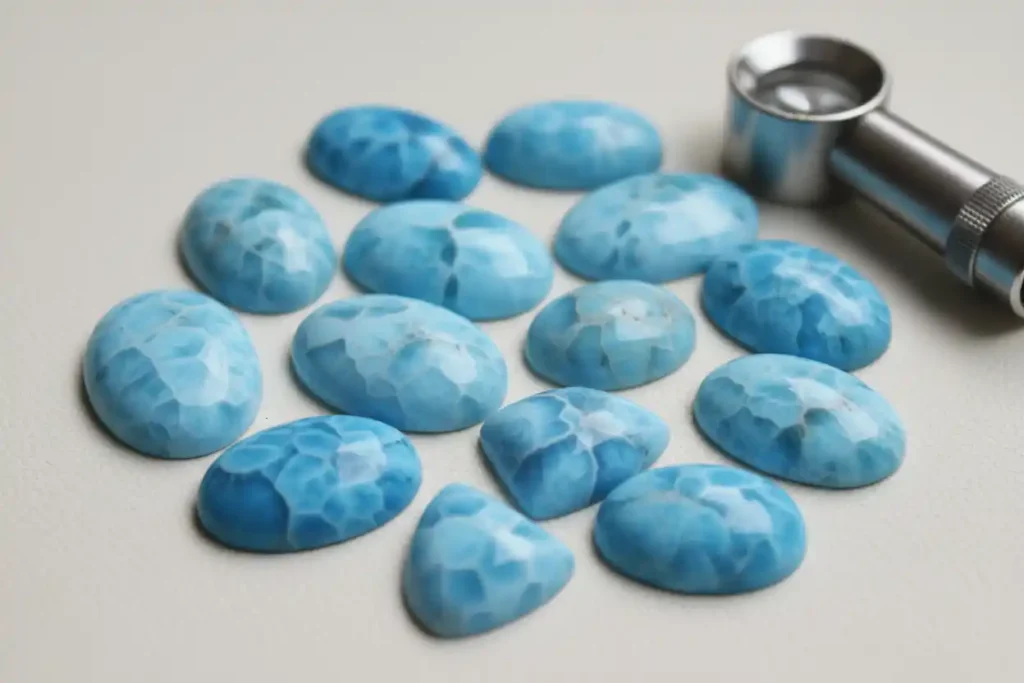
Dye Can Strengthen Weak Blue
Natural Larimar has its own blue coloration, but pale or lower-quality material can potentially be dyed to intensify its appearance.
When you buy larimar, pay attention to color that looks unusually concentrated in:
fractures, pores, fibrous boundaries, pits, cavities, drill holes, or worn edges.
A vivid blue line exactly following every crack can justify closer inspection.
Do not assume that every naturally patterned blue area is dye.
Use several clues together.
Stable Dye May Not Rub Off
A common consumer test involves wiping the stone and checking for blue transfer.
This is weak evidence.
Some unstable colorants may transfer.
Stable dye may not.
A surface coating can seal the dye.
Resin can isolate it.
When you buy larimar, a clean cloth proves very little about deeper treatment status.
Resin Can Stabilize Weak Material
Clear resin can fill fractures, pores, cavities, or structurally weak zones and improve polish.
This may make otherwise fragile Larimar usable in jewelry.
When you buy larimar, stabilization is not automatically unacceptable.
The critical questions are:
How extensive is the resin?
Does it contribute materially to the appearance?
Does it alter care?
Was it disclosed?
Is the price appropriate?
A lightly stabilized commercial cabochon belongs to a different value category from exceptional naturally compact untreated material.
Filling Can Improve Apparent Clarity and Surface Quality
Larimar is not graded for clarity like diamond, but a transparent filler can still reduce the visibility of cracks and cavities.
When you buy larimar, inspect suspiciously smooth fractures for:
bubbles, transparent material, unusual reflections, flow structures, filler residue, or different luster.
A filled crack remains a crack beneath the treatment.
Coatings Can Deepen Color or Gloss
A coating can strengthen blue appearance or produce a more uniform glossy surface.
When you buy larimar, inspect high-contact areas and edges where a coating would wear first.
Possible warning signs include:
peeling, scratches exposing a lighter layer, different color at chipped edges, or surface color that appears independent of the underlying mineral texture.
Do not scrape the coating to test it.
Wax and Oil Can Temporarily Improve Appearance
Wax or oil may deepen surface color and improve luster, particularly on porous or less perfectly polished material.
When you buy larimar, this type of treatment should be considered separately from heavy resin stabilization or dye.
A minor surface treatment does not make natural pectolite an imitation.
It does affect how the current appearance was achieved.
Backing Can Change the Face-Up Appearance
A thin translucent Larimar stone may appear deeper blue when mounted over a dark or colored backing.
When you buy larimar in closed-back jewelry, ask whether the backing is simply structural or whether it materially enhances color.
Backing can be a legitimate jewelry construction method.
It should not be concealed when the stone’s face-up color depends heavily on it.
Doublets and Composite Pieces Need Clear Disclosure
A thin layer of Larimar can be attached to another stone, glass, resin, or backing material.
A composite can also contain natural fragments suspended or bonded in polymer.
When you buy larimar, the seller should distinguish:
solid natural Larimar, treated solid Larimar, backed material, doublet, reconstructed material, and resin composite.
These are different products.
Reconstructed Larimar Should Not Be Sold as One Solid Stone
Fragments, chips, powder, and cutting waste can potentially be bound together with resin to create beads, slabs, or cabochons.
When you buy larimar, inspect whether apparent natural fragments are separated by transparent binder or artificial seams.
A reconstructed product can be visually attractive and economical.
It should not receive the same price as one solid fine natural cabochon.
Ceramic Is a Serious Larimar Imitation
Ceramic can reproduce Larimar’s pale blue and white cloud-like appearance effectively.
Manufactured patterns may look remarkably convincing in ordinary product photographs.
When you buy larimar, possible ceramic clues can include:
gas bubbles, painted-looking blue concentrations, homogeneous manufactured texture, mold characteristics, unusual density, or chips showing a different internal body.
A ceramic imitation can feel cool and stone-like.
Touch is not enough.
Resin Can Create Convincing Ocean Patterns
Blue and white polymers can be poured together into natural-looking swirls.
When you buy larimar, watch for:
round casting bubbles, mold seams, identical repeated patterns, overly smooth swirls, very low weight, soft scratches, or a transparent polymer body surrounding blue-and-white material.
A high-quality resin imitation may not show every clue.
Dyed Howlite and Magnesite Are Common Blue Imitations
Howlite and magnesite are pale porous minerals that accept dye easily.
They can be colored turquoise or sky blue and sold under numerous blue-gem names.
When you buy larimar, dark spiderweb veins are more characteristic of dyed howlite-style material than of typical Larimar’s white fibrous and cloud patterns, but appearance can overlap.
Do not rely on one visual rule.
Dyed Chalcedony Can Be Particularly Convincing
Blue chalcedony or dyed crackled chalcedony can reproduce a pale blue body and whitish fracture network resembling some Larimar patterns.
When you buy larimar, quartz-based material differs in hardness, microscopic texture, refractive properties, and Raman spectrum from pectolite.
This is exactly the kind of imitation that demonstrates why color and pattern should not be treated as definitive identification.
Calcite Can Also Be Dyed Blue
Pale calcite can be colored blue and fashioned into cabochons or carvings.
Its softness and cleavage differ from pectolite, but destructive hardness or acid testing is unnecessary.
When you buy larimar, professional mineral identification is preferable to risking damage to the piece.
Glass Can Imitate Transparent or Cloudy Larimar
Blue glass may contain white swirls, bubbles, or internal flow structures.
A manufactured product can even be designed specifically to resemble the ocean-like patterns that make Larimar recognizable.
When you buy larimar at a meaningful price, inspect for round bubbles, flow lines, molded surfaces, and a homogeneous glassy texture while remembering that absence of visible bubbles does not prove natural pectolite.
Turquoise Is Different From Larimar
Larimar and turquoise overlap in sky-blue and greenish-blue appearances, particularly in relatively uniform cabochons.
However, turquoise is a hydrated copper aluminum phosphate, whereas Larimar is blue pectolite.
When you buy larimar, do not accept the phrase Caribbean turquoise as literal mineral identification.
It is a descriptive nickname at most.
Strong Dominican Provenance Matters
Larimar’s accepted trade identity is tied to the Dominican Republic, making origin more central than it is for many ordinary gemstone varieties.
When you buy larimar at a premium, the seller should be able to explain where the material entered the supply chain.
A plausible answer might involve:
Dominican supplier relationships, rough purchased through established dealers, cutter records, mine-area sourcing documentation, or longstanding trade provenance.
A dramatic blue pattern by itself does not establish origin.
Dominican Origin and Mine-to-Market Traceability Are Different
A seller may have good reason to believe a stone is Dominican pectolite while lacking a complete chain of custody from the individual miner.
Those are different evidence standards.
When you buy larimar because ethical sourcing or precise mine traceability matters to you, ask exactly what is documented and what is assumed.
Clear uncertainty is preferable to an elaborate story that cannot be supported.
“Caribbean” Is Not Precise Provenance
Caribbean blue is a useful color description.
Caribbean gemstone is a broad regional phrase.
Neither proves Dominican pectolite.
When you buy larimar, a seller using island imagery, ocean terminology, or tropical branding should still provide the actual material identity.
Seller Grades Are Not Universal
You may encounter:
AAA, AAAA, 5A, premium ocean blue, volcanic blue, royal blue, top Dominican grade, collector grade, museum grade, or investment grade.
Larimar has no single universal independent retail grading system that gives these phrases identical meaning everywhere.
When you buy larimar with a seller-created grade, translate it into observable characteristics:
How strong is the blue?
How much of the face is blue?
How attractive is the white pattern?
How much matrix is visible?
How well polished is it?
Are fractures present?
Is the color natural?
Is resin present?
What supports Dominican provenance?
Once those questions are answered, the grade itself adds little information.
“Volcanic Blue” Is a Color Description, Not a Mineral Grade
Larimar occurs within altered volcanic host rocks, but it is not a blue volcanic glass.
When you buy larimar marketed as volcanic blue, do not let the phrase suggest that dark color is a separate scientific grade.
Judge the actual blue pectolite.
Large Larimar Is Not Automatically Fine Larimar
Substantial Larimar rough can occur, but large fine areas with strong blue, attractive pattern, limited fracture, and useful cutting quality are more difficult to obtain.
When you buy larimar in a large cabochon or carving, ask whether the quality survives the increased size.
A large pale slab containing extensive white material should not receive the same premium as a smaller but intensely blue, beautifully patterned cabochon.
Size amplifies quality only when quality remains strong.
Face-Up Area Matters More Than Weight Alone
A heavy cabochon can contain considerable thickness or matrix on the back.
When you buy larimar, compare the amount of attractive visible blue surface rather than simply comparing carats or grams.
This is especially important with large freeforms and carvings where shape and workmanship make direct weight comparison misleading.
Pair Matching Is a Real Quality Factor
Natural Larimar patterns are difficult to duplicate exactly, so a well-matched pair of earrings can require careful selection.
When you buy larimar earrings, compare:
blue tone, pattern density, dimensions, shape, polish, structural condition, and visual weight.
The dedicated Larimar earrings guide covers the jewelry format in more detail.
A refined pair should look related rather than artificially identical.
Matching Does Not Mean Identical Patterns
Exact duplication can look suspicious in highly patterned natural material.
When you buy larimar as a pair, complementary patterns can be more believable and attractive than perfect copies.
One stone can have a wave leaning left while the other mirrors it.
The blue quality and overall visual balance should match even when the mineral pattern remains individual.
Bead Strands Need Consistent Blue Quality
When you buy larimar beads, inspect every section of the strand rather than judging only the center or the few brightest stones.
Check:
blue consistency, white pattern, drill quality, fracture frequency, polish, shape consistency, and matching.
A strand can contain natural variation without looking random.
The weakest beads should not be hidden near the clasp in a supposedly premium product.
Drill Damage Can Become a Breakage Point
A fracture radiating from a drilled hole can extend under string tension or impact.
When you buy larimar beads, inspect the openings closely.
Large chips and cracks are more important than small differences in shape.
Carvings Need Artistic Evaluation
Larimar’s white-and-blue pattern can be exceptionally effective in carvings.
A skilled lapidary can orient waves, clouds, feathers, or light areas to become part of the subject.
When you buy larimar carvings, evaluate:
design, proportion, use of natural pattern, polish, back finishing, recesses, repair, fracture, thickness, and treatment.
A larger carving is not automatically better.
Recessed Areas Can Reveal Repairs
Glue, filler, rough polishing, pale untreated areas, and repair seams may be easier to see in grooves and undersides than on the polished front.
When you buy larimar carvings, inspect the complete object rather than the presentation side alone.
Rings Are the Highest-Risk Jewelry Use
Larimar’s modest hardness and cleavage make rings more demanding than earrings or pendants.
When you buy larimar for a ring, select a structurally sound cabochon with adequate thickness and limited edge fractures.
The Larimar ring guide explains why low protective settings are generally preferable to high exposed mounts.
A beautiful stone should not be forced into a jewelry format that exposes every weak edge.
A Bezel Can Help, but Setting Pressure Matters
A protective bezel can shield the girdle from many impacts.
However, metal must be formed around the stone during setting.
When you buy larimar for bezel mounting, a large pre-existing fracture near the edge remains a concern because excessive pressure can extend it.
Protection after setting does not erase risk during setting.
Earrings Are Among the Safer Choices
Earrings generally receive much less impact and abrasion than hand jewelry.
When you buy larimar for earrings, you can prioritize pattern, blue color, and size more heavily because physical exposure is lower.
Matching becomes the main challenge.
Pendants Can Support Larger Cabochons
A pendant allows a broad area of Larimar to be displayed while keeping the stone away from many hard surfaces.
When you buy larimar as a statement piece, this can be one of the best ways to use a large patterned cabochon.
Inspect the bail and metal construction carefully because a heavy stone requires secure hardware.
Bracelets Need More Caution
Wrist jewelry repeatedly contacts tables, bags, walls, and other surfaces.
When you buy larimar for a bracelet, prioritize compact sound material, secure links or stringing, and enough protection around the stone.
Large exposed cabochons are more vulnerable than small protected settings.
Finished Jewelry Price Includes More Than Larimar
A modest Larimar cabochon set into heavy sterling silver, gold, handmade filigree, or designer work can cost substantially more than the loose stone.
When you buy larimar jewelry, separate:
stone value, metal value, manufacturing labor, design, accent stones, branding, and seller service.
A high finished price is not automatically evidence that the Larimar itself belongs to the highest material grade.
Inspect Sterling Silver Quality
Larimar is frequently paired with silver because the cool metal complements blue material.
When you buy larimar in silver jewelry, inspect:
metal fineness marks, prong or bezel thickness, solder quality, polish, clasp construction, ring shank strength, and whether the stone moves.
A weak setting can turn a good Larimar purchase into a poor jewelry purchase.
Gold Does Not Upgrade the Stone Automatically
A pale or treated Larimar cabochon set in gold remains pale or treated Larimar.
When you buy larimar in higher-value metal, evaluate the gem and mounting separately.
The setting can be excellent even when the stone is commercial quality.
That can still be a rational purchase when the design is what you value.
Ask What the Accent Stones Are
A Larimar ring or pendant may contain diamond, cubic zirconia, moissanite, white sapphire, topaz, or another accent material.
When you buy larimar jewelry at a substantial price, ask for exact disclosure rather than assuming every clear accent is diamond.
Laboratory Testing Is Not Necessary for Every Larimar
Most modest commercial Larimar does not justify expensive individual testing.
Good seller disclosure, realistic photography, magnification, construction inspection, and a useful return policy may be proportionate for ordinary purchases.
When you buy larimar at higher value, professional identification becomes more useful when:
- the stone is exceptionally deep blue;
- the material may be ceramic or composite;
- treatment is disputed;
- an unusually expensive carving is involved;
- Dominican identity is uncertain;
- transparent or unusual material is being sold;
- or a provenance premium is substantial.
A Laboratory Report Should Answer the Actual Question
A report identifying pectolite can help establish mineral identity.
Additional analytical work may be necessary to investigate coatings, resin, dyes, or unusual treatment.
When you buy larimar, determine what uncertainty you actually need resolved before paying for testing.
A report that answers the wrong question provides little practical protection.
Seller Certificates Are Not Automatically Independent
A retailer-issued authenticity card can be useful as written evidence of what the seller is claiming.
It is not automatically equivalent to independent gemological examination.
When you buy larimar at a premium, ask who tested the material and whether the document comes from a separate laboratory.
An Appraisal Is Not an Authenticity Test
An appraisal provides a monetary opinion for a stated purpose.
It does not automatically prove pectolite identity, untreated color, Dominican provenance, or absence of resin.
When you buy larimar, use gemological analysis for material questions and market comparison for price.
Compare Like With Like
Larimar can be sold as:
rough, cabochon, bead, matched pair, carving, slab, specimen, sterling-silver jewelry, gold jewelry, or designer work.
When you buy larimar, do not compare a carved pendant with a loose cabochon solely by carat or gram weight.
The workmanship category can change value dramatically.
Deep Blue Should Cost More Only When the Rest of the Stone Supports It
The strongest blue is scarce enough to attract attention, but color should not erase every other quality factor.
When you buy larimar, a deep blue stone still needs:
attractive pattern, structural soundness, competent polish, appropriate thickness, treatment disclosure, and credible origin.
A cracked dyed dark-blue cabochon can be worth less than a naturally colored medium-blue stone with exceptional structure and workmanship.
Pattern Can Justify a Premium
Some Larimar pieces contain unusually dramatic white patterns resembling water, clouds, feathers, islands, geometric cells, or radial explosions.
When you buy larimar, the premium for pattern is most defensible when:
the pattern is natural, well centered, visually coherent, supported by good blue, and preserved through skilled cutting.
A random white vein should not be marketed automatically as rare ocean pattern.
Unique Pattern Is More Important Than a Pattern Name
Commercial names such as turtleback, ocean web, cloud, volcano, Atlantis, storm, or wave can help describe appearance.
They do not create standardized quality grades.
When you buy larimar, pay for the actual design you can see rather than the creativity of the name.
Extremely Low Prices Need Context
Larimar is not so rare that every genuine piece must be expensive.
Pale, white-dominant, small, fractured, irregular, or commercial material can be relatively accessible.
When you buy larimar cheaply, the price alone does not prove imitation.
However, a very large flawless deep-blue cabochon with spectacular pattern offered for less than ordinary commercial material deserves careful verification.
Extremely High Prices Need an Explanation
When you buy larimar at a major premium, ask what creates the difference.
Legitimate reasons can include:
exceptional natural blue, outstanding pattern, unusually large clean dimensions, master carving, precise matching, credible provenance, precious metal, designer workmanship, or collectible mineral character.
Seller-created grades alone are a weaker explanation.
Return Terms Are Part of the Buying Method
Larimar is especially suited to an inspection period because its color, white pattern, fractures, polish, and treatment clues can look different outside optimized sales photography.
When you buy larimar online, confirm that you can inspect the piece carefully without altering it.
Do not scratch it.
Do not test it with acid.
Do not heat it.
Do not apply solvents.
Do not repolish it.
Do not remove it from a setting.
Verification should preserve the product.
Do Not Use Acid Tests
Pectolite and associated minerals can be damaged by aggressive acids, and calcite areas are particularly vulnerable.
When you buy larimar, an acid reaction does not provide enough useful information to justify harming the stone.
Professional testing is safer.
Do Not Use a Hot Needle
A hot needle may damage resin or plastic and release unpleasant fumes, but it can also mark the object permanently.
When you buy larimar, do not turn a potentially valuable piece into a destructive imitation test.
Do Not Use a Scratch Test
Larimar is relatively soft enough that intentional scratching can permanently damage its polish.
When you buy larimar, hardness belongs in professional mineral identification, not in destructive consumer testing.
Heat Is a Specific Larimar Risk
High heat can affect Larimar’s appearance and can also damage resin, wax, glue, coating, and other treatments.
When you buy larimar already set in jewelry, tell future jewelers what the stone is before soldering or other high-temperature repair.
The stone may need protection or removal depending on the construction.
Strong Illumination Should Not Be Used as an Authenticity Test
Ordinary viewing under natural and artificial light is useful for evaluating color.
Deliberately exposing Larimar to concentrated heat or extreme illumination is not a good treatment test.
When you buy larimar, preserve the stone rather than trying to force a color reaction.
Cleaning Should Be Gentle
The Larimar jewelry cleaning guide provides the material-specific cleaning method.
For a structurally sound stone, use lukewarm water, a small amount of mild soap, and a soft cloth or brush. Clean briefly and dry carefully.
Avoid harsh chemicals, abrasives, steam, and ultrasonic equipment.
When treatment is uncertain, even greater caution is appropriate.
Store Larimar Away From Harder Gemstones
Quartz, topaz, sapphire, ruby, and diamond can scratch Larimar when pieces rub together.
When you buy larimar, store it in a separate padded compartment or soft pouch.
This is especially important for polished cabochons whose value depends heavily on a smooth glossy surface.
Major Red Flags When You Buy Larimar
| Red flag | Why it matters |
|---|---|
| Seller cannot identify the material as pectolite | Larimar identity remains unresolved |
| Ocean-like blue pattern is treated as proof of authenticity | Ceramic and resin can imitate the appearance |
| Every photograph uses a black or strongly blue background | Saturation may be exaggerated |
| White background looks blue in the image | Color balance may be manipulated |
| Exact stone is not shown for a premium purchase | Pattern and condition may differ materially |
| Front is vivid blue while exposed interior is dramatically pale | Dye, coating or natural zoning needs investigation |
| Blue concentrates strongly in cracks or drill holes | Dye may be present |
| Surface has a peeling blue or clear film | Coating should be investigated |
| Transparent material fills a large crack | Resin or another filler may be present |
| Cabochon contains a major edge-reaching fracture | Setting and impact risk increase |
| Seller says the stone is hard because it comes from volcanic rock | Larimar remains relatively soft pectolite |
| “Volcanic glass Larimar” appears in the description | Larimar is not volcanic glass |
| Caribbean turquoise is presented as mineral identity | Larimar and turquoise are different materials |
| Large size is treated as proof of top quality | Blue coverage, pattern and condition matter more |
| “Dominican” is inferred solely from blue color | Geographic provenance needs separate support |
| “AAA” or “5A” is presented as a universal standard | Seller grades are not standardized |
| Extremely uniform blue strand has no treatment disclosure | Dye or heavy matching should be investigated |
| Bead holes show cracks or heavy blue concentrations | Structural damage or treatment may be present |
| Identical patterns repeat across several pieces | Molded or composite material deserves scrutiny |
| Seller recommends acid, scratching or flame testing | Destructive methods can damage the object |
| Seller certificate is presented as independent laboratory analysis | The document may simply repeat retailer claims |
| Appraisal value is used as proof of authenticity | Valuation and gemological identification differ |
| Expensive ring uses a high exposed setting | Larimar is vulnerable to abrasion and impact |
| Final-sale terms accompany unresolved treatment or identity | Independent verification becomes difficult |
Several of these warning signs together are a strong reason not to buy larimar until the seller provides stronger evidence.
A Practical Buy Larimar Decision Matrix
Strong premium purchase: The stone is confidently identified as natural Larimar, shows rich natural blue under neutral light, has an attractive well-positioned white pattern, limited unattractive matrix, excellent polish, useful thickness, and no significant structural fracture.
Strong value purchase: The cabochon is sky blue rather than the deepest blue, contains slightly more white material, or has a modest irregular outline, but retains an attractive natural pattern, good polish, sound structure, and accurate treatment disclosure.
Pattern-priority purchase: The stone is not the darkest available, but the natural white-and-blue composition is exceptional and the cutter has positioned it deliberately across the face.
Color-priority purchase: Strong natural blue dominates the stone with relatively limited white material, and treatment or photographic manipulation has been reasonably excluded.
Freeform purchase: The outline is irregular because the cutter followed the strongest blue and pattern zones. The workmanship remains deliberate and the structural condition is sound.
Bead-strand purchase: The beads coordinate in blue quality, pattern, dimensions, polish, and drilling while retaining believable natural variation.
Matched-pair purchase: Two stones share similar color, size, visual weight, and pattern density without appearing artificially duplicated.
Carving purchase: The cutter has used natural white-and-blue zoning as part of the artistic composition, while recesses, back surfaces, and structural areas remain well finished.
Treated purchase: Dye, resin, wax, oil, coating, backing, or filler is disclosed clearly, the object remains attractive, and the price reflects enhancement rather than implying premium untreated material.
Composite purchase: Natural Larimar layers or fragments are combined with another material, and the construction is represented accurately rather than sold as one solid untreated stone.
Provenance-driven purchase: Dominican source and supply history materially influence the price, and the seller can provide credible sourcing evidence beyond simply pointing to blue color.
Jewelry-value purchase: The Larimar itself is commercial-to-fine quality while much of the total cost comes from precious metal, matching accent stones, hand construction, or designer work. Those components are evaluated separately.
Poor purchase: The stone is large but pale, heavily white-dominant, badly polished, cracked, excessively filled, weakly patterned, or priced mainly through seller-created grading.
Walk away: Material identity remains unclear, the object is ceramic or resin sold as natural Larimar, major treatment is deliberately hidden, a structural crack is concealed, or the seller refuses realistic inspection.
Where the Best Value Often Appears
The strongest value when you buy larimar often appears slightly below the deepest-blue collector tier.
A medium sky-to-turquoise-blue cabochon with beautiful natural white patterning can provide more visual character than a very dark stone costing substantially more. A slight irregularity in outline can reduce the price while preserving a superior blue area. A small amount of non-distracting white pectolite can create the wave effect that makes the material immediately recognizable.
Likewise, an attractive stone with ordinary provenance documentation can be a better purchase than a weaker stone carrying an elaborate unsupported mine story.
Value improves when you decide which premium characteristics you actually care about.
Buy Natural Blue Before Seller Grade
When you buy larimar, an accurately represented ungraded stone with excellent blue can be stronger than an AAAA stone whose grading criteria are never explained.
Translate every grade into visible quality.
Buy Pattern Before Perfect Symmetry
A symmetrical oval is useful when the rough supports it.
When you buy larimar, do not sacrifice exceptional natural pattern merely to obtain mathematically perfect geometry.
The visual design is part of the gemstone.
Buy Structural Condition Before Maximum Size
A smaller sound cabochon is usually a better jewelry stone than a larger piece carrying a crack across its full width.
When you buy larimar, size should follow structural integrity.
Buy Treatment Disclosure Before Perfect Color
A naturally varied sky-blue stone can be worth more than an artificially perfect deep-blue stone whose appearance depends heavily on undisclosed dye or coating.
When you buy larimar at a premium, understand how the current color was produced.
Buy the Jewelry Construction as Carefully as the Stone
A secure protective setting can extend the practical life of Larimar substantially.
When you buy larimar jewelry, poor metalwork should not be ignored simply because the cabochon is beautiful.
Inspect the complete object.
Final Buying Method
The smartest way to buy larimar is to separate mineral identity, natural color, pattern, structural condition, treatment, and provenance into individual questions.
First confirm that the material is blue pectolite rather than ceramic, resin, glass, dyed howlite, magnesite, chalcedony, calcite, or another imitation. Then judge the face-up blue under neutral lighting and determine whether the color remains attractive without aggressive editing, dark backgrounds, or concentrated illumination.
Next, examine the white pattern. Decide whether it creates an attractive natural composition or simply reduces the amount of blue. Look for depth and fibrous mineral character rather than a flat painted or poured design.
Then turn your attention to physical condition. Inspect the front, back, sides, drill holes, and setting points for cleavage cracks, open fractures, cavities, chips, and structurally weak zones. Larimar’s relatively modest hardness and cleavage make these issues much more consequential than tiny cosmetic irregularities.
After that, investigate dye, resin, coating, wax, oil, backing, filling, glue, and reconstructed construction. Natural pectolite can still be treated, and genuine Larimar fragments can still be incorporated into a composite.
Only after the material itself is convincing should you pay additional premiums for Dominican provenance, unusually deep blue, exceptional ocean-like pattern, large clean dimensions, precise matching, master carving, or high-end jewelry workmanship.
When you buy larimar through this hierarchy, the strongest purchase is not simply the darkest blue stone. It is the piece whose genuine pectolite identity, natural color, pattern, structural quality, polish, treatment disclosure, provenance, and price all support the same credible story.
The wider Buying & Value section connects this decision framework with additional gemstone identification, treatment, value, and purchasing topics.
Frequently Asked Questions
What should I check first when I buy larimar?
Confirm that the stone is genuine blue pectolite, then judge whether its blue color appears natural. After that, evaluate white pattern, fractures, cutting, polish, treatment, provenance, and price.
What color is the best Larimar?
Fine Larimar often shows strong sky blue, turquoise blue, or deeper blue with attractive contrast against white fibrous patterns. The strongest choice balances saturation, pattern, polish, and structural condition.
Is darker Larimar always better?
No. Deeper blue often attracts a premium, but an excessively dark, muddy, gray, heavily fractured, or treated stone can be less desirable than a cleaner medium-blue cabochon.
Is sky-blue Larimar valuable?
Yes. Sky-blue material can be highly attractive, particularly when it displays strong natural wave-like white patterning and good polish.
What creates Larimar’s blue color?
Larimar’s blue coloration is associated with trace-element chemistry within pectolite. Research has examined copper as well as other trace elements and structural factors involved in the blue-to-green appearance.
Is all blue pectolite Larimar?
The accepted Larimar trade identity is specifically associated with blue pectolite from the Dominican Republic rather than every blue-looking pectolite-like material from elsewhere.
Is Larimar found only in the Dominican Republic?
Gem-quality material sold under the Larimar trade name is associated with the recognized Dominican occurrence, which is why provenance matters more strongly than it does for many common gem varieties.
Does Dominican origin make every Larimar valuable?
No. Material from the correct source still varies enormously in blue saturation, pattern, fractures, matrix, polish, thickness, and workmanship.
Can Larimar be dyed?
Yes. Pale or lower-quality material can potentially be dyed to strengthen blue. Dye may concentrate around pores, fractures, cavities, fibrous boundaries, and drill holes.
Does dye rub off Larimar?
Unstable dye may transfer, but stable dye may not. A clean wipe does not prove that the color is untreated.
Can Larimar be resin filled?
Yes. Resin can fill fractures and cavities, improve apparent polish, or stabilize structurally weak material. Significant treatment should be disclosed.
Can Larimar be coated?
Yes. A surface coating can alter gloss or apparent color. Wear, scratches, peeling, or differences at chipped edges can raise suspicion.
Can Larimar be waxed or oiled?
Yes. Wax or oil can improve luster or temporarily deepen color. These treatments are different from dye or heavy polymer impregnation but still form part of the finished condition.
Is stabilized Larimar fake?
No. Stabilized Larimar can still contain genuine natural pectolite. The stabilization should be disclosed because it affects value, construction, and care.
What is reconstructed Larimar?
Reconstructed material can contain Larimar fragments or powder bonded with resin or another binder. It should be described as reconstructed rather than one solid natural stone.
Is synthetic Larimar common?
True laboratory-grown Larimar-equivalent pectolite is not a mainstream jewelry product. Items described as synthetic Larimar are frequently better understood as ceramic, resin, glass, composite, or another imitation.
Can ceramic imitate Larimar?
Yes. Ceramic can reproduce Larimar’s blue-and-white appearance convincingly and is one of the important manufactured imitations.
Can glass look like Larimar?
Yes. Colored glass can reproduce pale or turquoise-blue tones and may contain white swirls or bubbles intended to imitate natural pattern.
Can resin imitate Larimar?
Yes. Blue and white resin can be poured into cloud-like or ocean-like patterns that resemble polished Larimar.
Can dyed howlite imitate Larimar?
Yes. Howlite accepts blue dye readily. Its darker vein pattern often differs from Larimar’s white fibrous clouds, but appearance alone is not conclusive.
Can dyed chalcedony imitate Larimar?
Yes. Dyed or crackled blue chalcedony can produce blue-and-white networks that resemble selected Larimar patterns, making mineral identification important for valuable purchases.
Is Larimar the same as turquoise?
No. Larimar is blue pectolite, while turquoise is a hydrated copper aluminum phosphate. They can overlap in color but differ mineralogically and commercially.
What should Larimar white patterns look like?
Natural patterns can appear cloudy, fibrous, feathered, radial, branching, cellular, or wave-like. They should look integrated within the stone rather than simply painted on the surface.
Does all Larimar have white patterns?
No. Some genuine material is relatively uniform blue, while other pieces contain extensive white structures.
Is more white better?
Not automatically. White pattern can create exceptional visual appeal, but too much white generally reduces the amount of premium blue material.
Can Larimar have red or brown inclusions?
Yes. Natural pieces can contain reddish, brown, black, or gray mineral features and host-rock material. These inclusions should be judged for appearance rather than treated automatically as defects or proof of authenticity.
How hard is Larimar?
Larimar is relatively soft compared with quartz, topaz, sapphire, ruby, and diamond. Its polished surface can therefore scratch more readily during frequent wear.
Does Larimar have cleavage?
Yes. Pectolite has strong cleavage directions, so concentrated impact or setting pressure can chip or split the material, particularly around existing fractures.
Is Larimar suitable for a ring?
Yes, but it is better suited to protected and careful ring wear than unrestricted frequent impact. A structurally sound cabochon in a low protective setting is preferable to a high exposed stone.
Is Larimar good for earrings?
Yes. Earrings are among the safer uses because they receive relatively little impact and abrasion compared with rings or bracelets.
Is Larimar good for pendants?
Yes. Pendants can display large patterned cabochons effectively while providing lower mechanical exposure than hand jewelry.
What should I check when buying Larimar beads?
Inspect blue matching, white pattern, drill holes, fractures, polish, bead dimensions, treatment, and whether color concentrates unnaturally around holes or cracks.
What should I check when buying Larimar earrings?
Compare color, pattern density, dimensions, shape, polish, setting quality, and structural condition across both stones. Natural patterns can differ while the pair still looks balanced.
What should I check in a Larimar carving?
Examine pattern placement, artistic design, polish, recesses, back finishing, cracks, repairs, filler, treatment, thickness, and whether the cutter used the natural blue-and-white structure intentionally.
Does Larimar need a laboratory report?
Most modest commercial pieces do not. Independent testing becomes more useful for expensive deep-blue material, disputed treatment, possible ceramic or composite imitation, high-value carvings, or uncertain pectolite identity.
Can a laboratory prove Larimar is pectolite?
Appropriate gemological and mineralogical methods can identify pectolite and distinguish it from many imitations. Exact mine-level provenance may require additional commercial documentation.
Is a seller authenticity card enough?
It records the seller’s representation but is not automatically equivalent to independent laboratory testing. Stronger documentation becomes more appropriate as the financial risk increases.
Is an appraisal proof that Larimar is genuine?
No. An appraisal provides a monetary opinion. Gemological identity and treatment require appropriate testing.
Why do Larimar dimensions matter?
Weight does not reveal how much attractive blue surface you receive or whether the stone is unnecessarily thick. Length, width, and thickness provide more useful information for jewelry.
Is large Larimar rare?
Large Larimar exists, but large areas combining strong natural blue, attractive pattern, good polish, and limited fracturing are more difficult to obtain. Size deserves a premium only when quality remains strong.
What does AAA Larimar mean?
AAA and similar designations are seller-created grading systems rather than one universal independent standard. Ask what the seller’s grade actually means for color, pattern, treatment, fractures, polish, and provenance.
Is volcanic blue Larimar a separate variety?
Volcanic blue is primarily a commercial color description rather than a separate mineral species or universally standardized grade.
Should I buy Larimar based on carat price?
Carat price can provide context for loose stones, but color, pattern, dimensions, polish, fractures, treatment, carving quality, and jewelry construction often matter more than weight alone.
How should Larimar be cleaned?
Use brief gentle cleaning with lukewarm water, mild soap, and a very soft cloth or brush for a sound stone. Avoid steam, ultrasonic equipment, harsh chemicals, abrasives, and excessive heat.
What is the biggest mistake when you buy larimar?
The biggest mistake is buying the deepest-blue photograph before verifying the stone underneath it. When you buy larimar, confirm blue pectolite identity, judge natural color under neutral light, inspect pattern and fractures, investigate treatment and construction, evaluate Dominican provenance appropriately, and only then decide whether the price is justified.