How to Clean Larimar Jewelry Safely
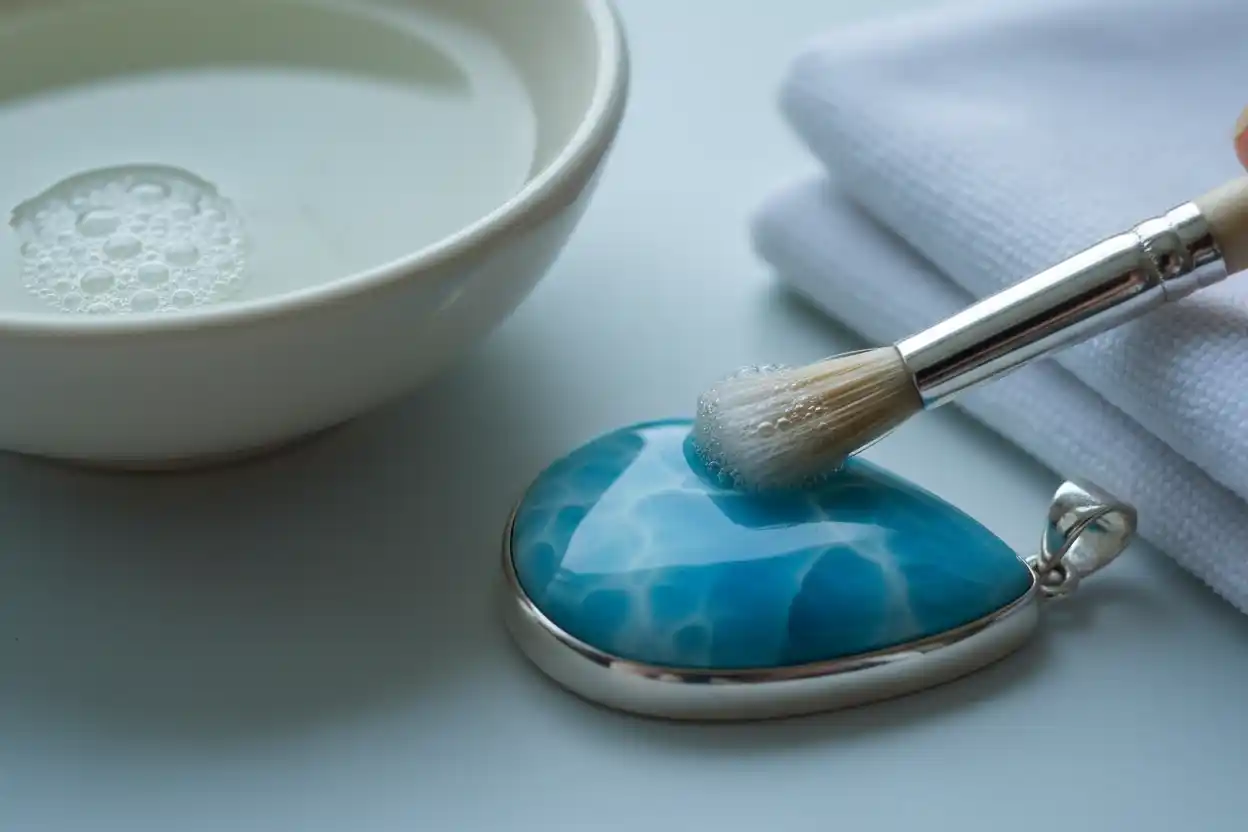
Larimar jewelry should be cleaned briefly with lukewarm water, a small amount of mild liquid soap, and a very soft cloth or brush. Ultrasonic machines, steam cleaners, abrasive products, prolonged soaking, high heat, and sudden temperature changes should be avoided.
Larimar is considerably softer and more cleavage-sensitive than quartz, sapphire, or diamond. Its polish can scratch, while sharp pressure or impact may chip the stone or separate it along an existing structural weakness.
Why Larimar Needs Gentle Care
Larimar is the blue ornamental variety of pectolite associated with the Dominican Republic. Its sky-blue, greenish-blue, turquoise-blue, and white patterns often resemble waves, clouds, or Caribbean water.
The material’s geology, color, locality, and symbolism belong to the broader Larimar meaning guide. This page is limited to physical jewelry cleaning, setting inspection, and storage.
Pectolite ranks approximately 4.5 to 5 on the Mohs scale. It is also brittle and has perfect cleavage in two directions, although compact material can be tougher than individual fibrous crystals.
| Property | Cleaning implication |
|---|---|
| Mineral species | Pectolite |
| Typical color | Pale blue to deeper blue with white or greenish patterning |
| Mohs hardness | Approximately 4.5 to 5 |
| Tenacity | Brittle, though compact material may be tougher |
| Cleavage | Perfect in two directions |
| Safest routine method | Brief lukewarm soapy-water cleaning |
| Ultrasonic cleaning | Avoid |
| Steam cleaning | Avoid |
| Main risks | Scratching, cleavage, chipping, treatments, glue, and heat |
The gemstone hardness chart explains why ordinary dust containing quartz can scratch Larimar if it is rubbed across the surface.
Hardness and resistance to breaking are separate properties. That distinction appears in Gemstone Toughness vs Hardness, while Larimar’s directional weakness is placed in context by Gemstone Cleavage Explained.
Inspect the Larimar Before Washing
Examine the jewelry beneath bright, indirect light. Look for chips around the cabochon edge, open cracks, loose bezels, raised prongs, cloudy glue, damaged drill holes, peeling coatings, and missing accent stones.
Natural white streaks, fibrous patterns, and color boundaries are not necessarily fractures. However, a line that reaches the surface, catches a fingernail, or changes when gentle pressure is applied may indicate damage.
Do not clean a loose stone or cracked cabochon at home. Water and brushing can enter an opening or worsen a weakened setting.
Larimar is often mounted in sterling silver. Tarnish around the setting may require attention, but the cleaning method must remain safe for the stone rather than being selected solely for the metal.
Check for Treatment and Assembly
Larimar may be waxed, oiled, impregnated, stabilized, dyed, coated, repaired, or assembled with backing material.
Treatment can improve polish, deepen color, reduce visible porosity, or stabilize a weaker section. However, it may also create sensitivity to detergents, solvents, heat, abrasion, and prolonged water exposure.
The full identification and disclosure boundaries belong to How to Spot Treated or Synthetic Larimar and Gemstone Treatments Explained.
When treatment is unknown, use a barely damp cloth rather than soaking the piece. Stop immediately if blue color transfers, a coating becomes tacky, or the surface changes.
Prepare a Safe Cleaning Area
Place a folded towel beneath the jewelry so the Larimar will land on a padded surface if it slips.
Fill a shallow bowl with lukewarm water and add a few drops of mild liquid dish soap. Prepare a second bowl of clean water at a similar temperature.
Use a soft lint-free cloth, a new soft toothbrush, or a delicate makeup brush. Avoid worn brushes with stiff, bent, or split bristles.
Do not clean directly over an uncovered sink. A pendant, bead, or loosened cabochon can disappear through the drain.
Clean Larimar Briefly
Dampen the cloth or brush with the mild solution. Wipe the polished surface gently, then clean around bezel edges, prongs, bails, drill holes, and setting openings.
Rinse away visible dust before rubbing. Dry grit can scratch the relatively soft polish.
Do not press on the cabochon dome, exposed edge, or a visible fracture. Larimar’s compact texture can feel substantial, but concentrated force may still cause cleavage or chipping.
A brief cleaning is sufficient. Extended soaking provides no advantage and may affect wax, dye, resin, glue, stringing, or repaired areas.
Rinse and Dry Without Heat
Remove soap with a clean cloth dampened in plain lukewarm water or rinse the jewel briefly in the second bowl.
Blot it with a lint-free cloth rather than rubbing forcefully. Let moisture beneath the mounting evaporate naturally at room temperature.
Do not use a hair dryer, radiator, heated jewelry cabinet, or sunny windowsill. Heat may affect treatments, adhesives, solder, and existing structural weaknesses.
Inspect the setting once the jewel is dry. A bezel gap, catching prong, or moving cabochon requires professional repair.
Never Use an Ultrasonic Cleaner
Larimar should not enter an ultrasonic cleaner.
Vibration may stress its cleavage, enlarge cracks, dislodge a cabochon, or damage resin, wax, coatings, glue, and backing material.
Many ultrasonic solutions also contain ingredients formulated for harder and less porous gemstones. Those chemicals may dull Larimar’s polish.
The broader equipment boundaries appear in Which Gemstones Can Go in an Ultrasonic Cleaner?.
Never Steam Clean Larimar
Steam exposes the jewel to pressure, concentrated heat, and rapid temperature change.
These conditions may cause cleavage-related damage, weaken adhesives, alter treatments, or affect soldered components.
Lukewarm manual cleaning removes ordinary skin oil and residue without those risks.
Cleaning a Larimar Ring
A Larimar ring receives more impact than earrings or a pendant.
Clean around the cabochon and setting without pressing on its dome. Remove the ring before gardening, exercise, cleaning, washing dishes, bathing, or working at a hard desk.
A protective bezel is preferable to an exposed prong mounting, although debris can collect where the metal meets the stone.
Larimar rings are generally better suited to careful or occasional wear than to unprotected daily use.
Cleaning Larimar Earrings
Larimar earrings usually face less impact but can collect cosmetics, hairspray, and skin oils.
Clean posts, hooks, backs, caps, and settings separately. Keep alcohol-based disinfectant on compatible metal fittings and away from the Larimar, glue, coatings, or resin.
Avoid soaking earrings with glued cabochons or decorative inlays.
Cleaning a Larimar Necklace
A Larimar necklace or pendant may develop a film from perfume, sunscreen, lotion, and contact with the skin.
Apply cosmetics before putting on the necklace and allow them to dry. Prevent chains and clasps from rubbing across the Larimar during cleaning and storage.
Large pendants should be supported by their metal setting rather than held by the cabochon.
Cleaning a Larimar Bracelet
A Larimar bracelet combines soft stones with repeated wrist movement and contact against desks or furniture.
Inspect every bead, cabochon, drill hole, link, hinge, knot, and clasp.
Wipe elastic or corded bracelets instead of immersing them. Dry the strand flat so wet stringing material does not stretch.
Remove the bracelet before activities that repeatedly strike the wrist against hard surfaces.
Cleaning Tarnished Silver Around Larimar
Sterling silver may tarnish even when the Larimar remains clean.
Do not place the complete jewel in a silver dip unless the product explicitly permits soft, porous, treated ornamental stones. Many metal dips contain acids or other chemicals that may damage Larimar.
Use a silver-polishing cloth on exposed metal while preventing contact with the stone. Work slowly around bezel edges.
Deep tarnish beside a delicate cabochon is better handled by a jeweler who can protect or temporarily remove the stone.
Larimar Versus Turquoise
Larimar and turquoise can share blue, greenish-blue, and white-patterned appearances, but they are different materials.
The complete visual and material comparison belongs to Larimar vs Turquoise.
Both require gentle care, but cleaning response should not be used as an identification test. Acids, scratches, solvents, and heat can damage the jewel without providing a reliable conclusion.
Imitations and Misleading Products
Dyed howlite, dyed magnesite, glass, resin, ceramic, reconstructed material, and other blue products may imitate Larimar.
The full authenticity workflow belongs to Real vs Fake Larimar.
A laboratory may identify pectolite and detect certain treatments or manufactured substitutes. However, cleaning the jewel aggressively will not establish its origin.
Storage and Preventive Care
Store Larimar separately in a lined compartment or soft pouch.
Quartz, topaz, sapphire, ruby, and diamond can scratch it. Metal chains and clasps may also create wear if they rub against the polished surface.
Do not place heavy jewelry on top of a Larimar cabochon. Pressure near an existing fracture or cleavage direction may cause damage.
The Larimar buying guide covers color, pattern, polish, treatment, construction, and seller disclosure. Market considerations belong to the Larimar price guide.
Larimar also appears in the tracker’s wider Blue Gemstones guide, where its durability and appearance can be compared with harder blue materials.
Physical Cleaning Versus Cleansing
Physical cleaning removes dust, cosmetics, skin oils, and setting residue.
Traditional symbolic practices belong to How to Cleanse and Charge Larimar. Those practices should still avoid salt, prolonged soaking, intense heat, and abrasive contact.
The broader guide to crystals in water should not be interpreted as permission to leave Larimar jewelry immersed for long periods.
Frequently Asked Questions
1. What is the safest way to clean Larimar?
Use a soft cloth or brush dampened with lukewarm water and mild soap, then rinse briefly and dry at room temperature.
2. Can Larimar get wet?
Brief controlled washing is usually acceptable for sound untreated material. Avoid soaking dyed, coated, stabilized, glued, strung, or damaged jewelry.
3. Can Larimar go in an ultrasonic cleaner?
No. Vibration may damage cleavage planes, cracks, treatments, glue, and settings.
4. Can Larimar be steam cleaned?
No. Steam introduces heat, pressure, and thermal change that may damage the stone or its mounting.
5. Can Larimar be soaked overnight?
No. Prolonged soaking is unnecessary and may affect wax, dye, resin, glue, stringing, or fractures.
6. Is dish soap safe for Larimar?
A few drops of mild liquid dish soap are generally suitable. Avoid bleach, abrasives, ammonia, and aggressive degreasers.
7. Can vinegar clean Larimar?
No. Acids may damage the stone, treatment, setting, or polish.
8. Can toothpaste polish Larimar?
No. Toothpaste is abrasive and can scratch or dull the relatively soft surface.
9. How should tarnished silver around Larimar be cleaned?
Polish exposed silver locally with a suitable cloth while keeping chemical dips and abrasive polish away from the stone.
10. Why does Larimar look dull after cleaning?
Soap residue, fine scratches, worn wax, damaged polish, coating deterioration, or trapped debris may be responsible.
11. How often should Larimar jewelry be cleaned?
Wipe it after wear and use damp cleaning only when visible residue remains.
12. When should Larimar receive professional care?
Professional attention is appropriate for cracks, chips, loose settings, unstable color, damaged coatings, antique construction, or deep tarnish beside the stone.
Conclusion
Larimar’s compact appearance can conceal the fact that it is a soft, brittle pectolite with strong cleavage. Brief manual cleaning preserves its blue-and-white polish without exposing it to vibration, heat, or harsh chemistry. When the stone remains dull after cleaning, its surface treatment and polish should be examined before stronger products are attempted.