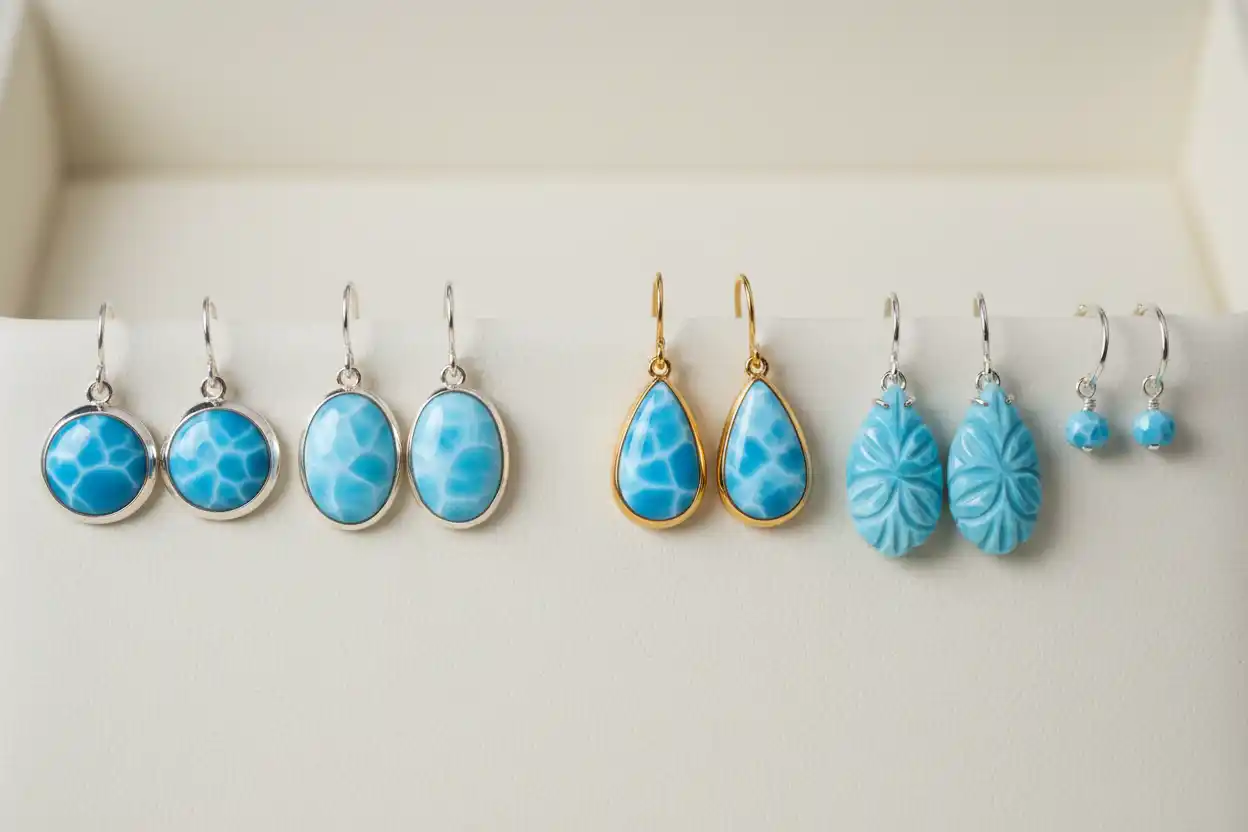
Larimar Earrings: Styles, Quality and Buying Guide
Larimar earrings bring the stone’s sky-blue, turquoise and white patterns close to the face, where they remain visible without facing the repeated impact encountered by rings and bracelets. Studs can show a compact field of blue, while drops and dangles allow larger cabochons and carvings to move in the light.
Earrings are among the safest ways to wear Larimar, but the stone remains relatively delicate. Blue pectolite has hardness of approximately 4.5–5 and strong cleavage, while natural material may contain fractures, cavities, white veins and areas that polish differently.
Pair matching creates another challenge. Two stones can share the same outline yet differ in blue coverage, pattern direction, tone, matrix and structural quality. A refined pair should look related without pretending that natural Larimar patterns can be perfectly duplicated.
The broad Larimar gemstone guide covers its mineral identity, formation, history and symbolism. This guide focuses on earring styles, matching, construction, comfort, treatment, buying and care.
Larimar Earrings at a Glance
| Feature | What to evaluate |
|---|---|
| Gem material | Natural Dominican blue pectolite |
| Typical appearance | Pale to deep blue with white cloudlike, cellular or streaked patterns |
| Mohs hardness | Approximately 4.5–5 |
| Structural weakness | Cleavage, cavities and surface-reaching fractures |
| Safest style | Low bezel studs |
| Best movement style | Short bezel-set drops |
| Main quality issue | Pair matching in color, pattern, dimensions and condition |
| Common treatment | Resin, wax, oil, dye, backing, coating and filling |
| Main authenticity issue | Dyed chalcedony, glass, resin and reconstructed products |
| Main comfort issue | Weight of large cabochons and silver settings |
| Main care concern | Chemicals, scratches, heat and impact |
Why Earrings Are Well Suited to Larimar
Earrings rarely strike desks, tools or countertops. Studs remain close to the ear, while short drops move in a relatively protected area.
The stone’s low hardness still matters. Metal posts, earring backs, diamond accents and other jewelry can scratch Larimar during storage.
Strong cleavage also means that a sharp drop onto tile or stone flooring can split or chip a cabochon. The earrings should therefore be handled over a padded surface when being inserted, cleaned or stored.
The gemstone hardness chart provides broader durability context, while Gemstone Toughness vs Hardness explains why resistance to scratching does not fully predict breakage.
Main Larimar Earring Styles
| Earring style | Main advantage | Main concern |
|---|---|---|
| Bezel studs | Strong edge protection and compact wear | Backing or glue may be hidden |
| Prong-set studs | Shows more of the stone | Exposed girdle and pressure points |
| Halo studs | Adds visual size and contrast | Hard accents and many prongs |
| Short drops | Movement without excessive leverage | Bail and connector strength |
| Long dangles | Supports larger or several stones | Weight, snagging and collision |
| Hoop charms | Modern and interchangeable | Charm impact and hinge wear |
| Carved earrings | Distinctive artistic forms | Thin sections and drilled loops |
| Inlay earrings | Smooth geometric design | Adhesive and thin-stone failure |
| Bead earrings | Accessible and lightweight | Drill holes and treatment |
| Mismatched pair | Celebrates natural pattern variation | Design must appear intentional |
Larimar Stud Earrings
Studs are the most practical style for regular wear. They stay near the ear, do not swing into clothing and can show a clear oval, round, cushion or freeform field of blue.
A pair should sit upright instead of tilting downward. Large stones need supportive backs that distribute weight across the earlobe.
Bezel Studs
A bezel surrounds the edge and provides the strongest protection against side impact.
The metal should follow the cabochon evenly. Gaps, folded metal, glue seepage or a stone that moves within the setting indicate poor workmanship.
A closed back may support a thin cabochon, but it can conceal backing, resin, fractures or composite construction. Ask whether the stone is solid Larimar throughout its visible depth.
Prong-Set Studs
Prongs create a lighter, more open design, although they leave more of the edge exposed.
The cabochon should rest in a supportive basket rather than balance only between the prong tips.
Prongs should not press over a visible fracture or weak white vein. Uneven tightening can chip the stone during setting or future repair.
Halo Larimar Earrings
A halo can surround Larimar with diamonds, lab diamonds, sapphires, moissanite, cubic zirconia or white topaz.
The pale accents make blue appear more saturated and can enlarge the pair’s face-up footprint. A low halo may also provide some lateral protection.
However, the accent stones are harder than Larimar. Their girdles must not touch the pectolite, and flexible metal should not allow repeated contact.
The listing should identify every material. A vague reference to white crystals does not reveal whether the accents are diamond, glass or another product.
Larimar Drop Earrings
Short drops allow the stones to move enough for their pattern and polish to catch the light.
Oval, pear, cushion, tablet and freeform cabochons are common. The connectors should attach near each stone’s center of balance so both earrings hang face-forward.
One drop should not rotate backward while its partner remains visible. Ask for a video showing the pair suspended together rather than placed flat on a display.
The jump rings, bails and solder joints deserve as much inspection as the stones. A beautiful cabochon cannot compensate for an open connector or a thin hook.
Long Larimar Dangles
Long dangles can combine several Larimar cabochons, beads, chains or metal elements.
The components should move without striking one another. Repeated Larimar-to-Larimar contact can abrade edges, while harder accents can scratch the pectolite.
Weight becomes increasingly important as length grows. Ask for the weight of each earring, not just the total weight of the pair.
A long earring that touches the shoulder during normal movement may experience repeated impact. The design should clear clothing and skin comfortably.
Leverbacks or secure posts are generally preferable for valuable dangles. Open hooks should use stoppers.
Carved Larimar Earrings
Larimar may be carved into leaves, dolphins, flowers, hearts, waves, shells and abstract forms.
Carving can use the natural blue-and-white pattern creatively, but thin projecting sections are vulnerable.
Inspect drilled loops, points, openwork and metal caps. A cap may strengthen the top of the carving, although it can also conceal glue or a previously broken hole.
The two carvings do not need to be exact copies. Their overall color, dimensions, finish and visual weight should still form a balanced pair.
Inlay and Tablet Earrings
Inlay places thin Larimar sections within metal channels. Tablets use broader flat pieces with geometric outlines.
Both styles can create a clean modern surface, but their thin construction depends heavily on backing and adhesive.
The surface should feel level. Raised edges, gaps, cloudy glue, discoloration and missing fragments indicate deterioration.
Inlay earrings should not be soaked or exposed to ultrasonic vibration. Water can enter the seams and weaken adhesive.
A solid blue inlay may be natural Larimar, reconstructed stone, dyed substitute or resin. Written material disclosure matters more than the style name.
Matching Larimar Earrings
Natural Larimar should be matched for visual harmony rather than exact duplication.
| Matching factor | What to compare |
|---|---|
| Hue | Pale blue, sky blue, turquoise blue or greenish blue |
| Tone | Similar lightness or darkness |
| Blue coverage | Proportion of blue relative to white |
| Pattern | Cellular, cloudlike, streaked or mottled structure |
| Shape | Coordinated outline and symmetry |
| Dimensions | Length, width, thickness and dome height |
| Polish | Similar surface gloss |
| Condition | Fractures, cavities, chips and filled areas |
| Treatment | Shared or clearly disclosed enhancement |
| Weight | Similar comfort and movement |
One stone can contain more white than the other without making the pair poor. The difference should look intentional rather than accidental.
Continuous video helps reveal whether one earring appears noticeably duller, greener or more fractured in ordinary light.
Choosing Color and Pattern
Deeper blue Larimar usually attracts stronger demand, but a vivid blue photograph does not automatically indicate higher quality.
The blue should remain visible under ordinary indoor light. Strong digital saturation can make pale or greenish material appear richer than it is.
White cellular or cloudlike patterns can be highly attractive when they move across a blue ground. Broad white sections generally reduce blue coverage but may still suit a distinctive artisan design.
Brown or gray matrix can appear in natural material. It usually lowers commercial value when it dominates the face.
The complete quality framework appears in the Larimar Buying Guide, while the Larimar price guide owns market value.
Surface and Structural Condition
Inspect the cabochons under diffused side lighting.
A sound surface should not show deep scratches, pits, open cracks, loose filler or cloudy coating.
Flat reflective lines may indicate cleavage or fractures rather than harmless white pattern. Open cavities can collect cosmetics and moisture.
Damage near a prong or drill hole is particularly important because the setting concentrates force there.
Treatments and Imitations
The treated-Larimar guide explains resin, coating, dye, filling, backing and related alterations.
Treatment can improve polish or stabilize weak stone. It may also change how the earrings respond to heat, solvents and cleaning.
The Real vs Fake Larimar guide covers dyed chalcedony, glass, howlite, magnesite, resin and composite imitations.
Do not rely on one visual feature. High-quality dyed or manufactured material may reproduce ocean-like patterns convincingly.
Professional testing may include microscopy, Raman spectroscopy and mineralogical analysis. The gemstone certification guide explains when independent identification is worthwhile.
Larimar vs Turquoise Earrings
Larimar and turquoise can both create opaque blue earrings, particularly when the pattern is subtle.
Turquoise tends to show earthy, webbed or dark host-rock matrix. Larimar more commonly displays white, fibrous, cloudlike or cellular patterning.
Their mineral compositions and treatment histories differ, so the direct Larimar vs Turquoise guide should be used when identity is uncertain.
Color alone cannot provide the answer because both stones and their imitations can be dyed or stabilized.
Metal Selection
Sterling silver remains the traditional and most common setting choice. It complements Larimar’s cool color and keeps many pairs accessible.
White gold creates a more refined variation on the same contrast. Yellow gold makes blue appear warmer and can give Larimar a formal look.
Rose gold works best with clear sky-blue material. It may make greenish stones appear slightly warmer.
The metal touching the ear deserves separate attention. Posts, backs, solder and plating can cause irritation even when the Larimar is harmless. The best gemstones and metals for sensitive skin explains those concerns.
Posts, Hooks and Backs
Small studs commonly use friction backs. Larger cabochons benefit from supportive disk backs that prevent forward tilting.
Screw backs provide additional security but take longer to insert. Locking backs can support substantial earrings when the post dimensions are compatible.
Drops may use leverbacks, hinged hoops, posts or hooks. Leverbacks reduce loss risk, while hooks should include silicone or metal stoppers.
A post should attach to a proper metal setting rather than rely solely on glue applied directly to the stone.
Weight and Comfort
Larimar itself is not exceptionally dense, but large cabochons combined with substantial silver can become heavy.
Request the weight per earring and compare it with a pair that can already be worn comfortably for several hours.
Broad studs distribute weight differently from narrow dangles. A moderately heavy stud may feel more stable with a support back, while a long drop creates leverage.
Both earrings should have similar weight. Noticeable imbalance can become uncomfortable and may indicate different stone thicknesses or metal construction.
Buying Larimar Earrings Online
The transaction safeguards in How to Buy Gemstones Online Without Getting Scammed apply directly to Larimar.
Ask for a continuous video of both earrings together, neutral-light photographs, exact dimensions, weight per earring, metal alloy, treatment disclosure, back construction and a clear return period.
The seller should show the front, sides and reverse. A closed-back earring provides too little information when only the polished face is photographed.
The broader blue gemstones guide can help when the intended wearer needs greater durability, transparency or a different shade of blue.
Styling and Coordinating Larimar Earrings
Larimar pairs naturally with white, cream, pale gray, navy, denim and understated summer colors.
Simple silver studs work easily with casual and professional clothing. Gold-framed drops create stronger contrast, while carved earrings make the stone the main visual feature.
A Larimar necklace can coordinate through metal and blue tone without matching every white pattern. A Larimar bracelet creates a wider field of color but receives more impact.
A Larimar ring should be selected separately because hand-level jewelry requires much stronger physical protection.
Cleaning and Storage
Follow How to Clean Larimar Jewelry Safely for the complete procedure.
Use lukewarm water, mild soap and a soft cloth or brush. Avoid prolonged soaking, particularly when the earrings contain backing, glue, filler or unknown treatment.
Do not use ultrasonic or steam cleaning. Heat can alter the stone or setting materials, while vibration can enlarge fractures.
Apply hairspray, perfume, sunscreen and cosmetics before putting on the earrings. Remove them before swimming, showering, exercise, sleep and salon treatments.
Store each earring separately so its post, metal frame or harder accent stones do not scratch the other cabochon.
The How to Identify Crystals guide provides broader non-destructive observation principles. The Crystals That Start With L and Gemstones That Start With L directories provide the alphabetical context.
Frequently Asked Questions
1. Are Larimar earrings suitable for everyday wear?
Studs and short drops can tolerate careful regular wear because they receive limited impact. They should still be removed before sleep, exercise, swimming and hair styling.
2. What is the safest Larimar earring style?
Low bezel studs generally provide the strongest edge protection.
3. Should a Larimar pair have identical patterns?
No. Natural patterns cannot be duplicated exactly, but the stones should coordinate in color, dimensions, polish and visual weight.
4. Is darker blue Larimar more valuable?
Deeper blue often receives stronger demand, although pattern, condition, cut and treatment also affect quality.
5. Are white lines in Larimar cracks?
Some are natural color patterns, while others may be fractures or cleavage planes. Side lighting and magnification help distinguish them.
6. Can Larimar earrings be dyed or filled?
Yes. Dye, resin, coating, filling, wax, oil and backing can occur.
7. Can Larimar be paired with diamond halos?
Yes, but the diamond girdles must not touch the softer Larimar.
8. Why does one Larimar earring look greener?
The stones may differ naturally in color, or lighting, treatment and digital editing may affect their appearance.
9. Are large Larimar earrings heavy?
They can become heavy when large cabochons are combined with substantial silver. Request the weight per earring.
10. Can Larimar earrings be cleaned ultrasonically?
No. Vibration can worsen fractures and cleavage-related weakness.
11. Do Larimar earrings need laboratory reports?
Most commercial pairs do not. Testing becomes more useful for expensive, disputed or suspiciously represented material.
12. What should I do if a cabochon becomes loose?
Stop wearing the earring and store the pair separately. A jeweler familiar with soft opaque gems should inspect the stone before tightening the setting.
Larimar earrings work best when the pair celebrates natural variation without sacrificing balance. Coordinated color, secure low settings, suitable weight, dependable backs and honest treatment disclosure allow the blue pectolite to remain comfortable and recognizable rather than becoming a fragile decorative afterthought.