Buy Moissanite: Smart Buying Tips & Red Flags
If you want to buy moissanite intelligently, start with cut quality, face-up dimensions, and the optical character you actually prefer, not with a diamond-like color grade or the largest carat-equivalent number in the listing. Nearly all jewelry-size moissanite is laboratory-grown silicon carbide, and well-made material can be exceptionally hard, brilliant, clean, and colorless-looking, but its optical behavior is not identical to diamond because moissanite has stronger dispersion and double refraction.
That difference is not a defect. Many people buy moissanite specifically because its intense rainbow fire gives it a lively appearance that would be difficult to obtain from another durable colorless gemstone at a similar cost. Others want a stone that resembles diamond as closely as possible and therefore prefer restrained facet patterns, smaller sizes, carefully selected color, and cuts designed to reduce the visual prominence of double refraction.
The strongest methodology when you buy moissanite is material identity first, cut and light performance second, millimeter dimensions third, color and undertone fourth, clarity fifth, cut style sixth, coating and treatment disclosure seventh, documentation eighth, setting quality ninth, warranty and return terms tenth, and price last. Following that hierarchy prevents impressive D–F labels, VVS claims, “diamond equivalent” carat numbers, branded certificates, or luxury packaging from replacing the qualities you will actually see.
The broader moissanite properties guide explains silicon carbide, optical properties, hardness, history, colors, and material identity. Here, the focus is narrower: how to buy moissanite as a loose center stone or finished jewel without overpaying for seller-created grading, choosing the wrong cut style, misunderstanding equivalent weight, or mistaking a coating, cubic zirconia, or diamond for the product you intended to purchase.
What to Judge First When You Buy Moissanite
Moissanite is silicon carbide, written chemically as SiC. Natural moissanite exists, but natural crystals occur in extraordinarily limited sizes and geological settings, so commercial jewelry material should ordinarily be expected to be laboratory-grown unless unusually strong independent evidence establishes otherwise.
When you buy moissanite, use this hierarchy:
| Priority | What to evaluate | Why it matters |
|---|---|---|
| 1 | Genuine silicon-carbide identity | Cubic zirconia, glass, diamond, and other materials can be confused with moissanite |
| 2 | Cut quality | Cut controls brilliance, fire, contrast, spread, and visible facet pattern |
| 3 | Millimeter dimensions | Diamond-equivalent weight can obscure the stone’s actual size and mass |
| 4 | Face-up color | Colorless-looking stones can still show gray, yellow, or green undertones |
| 5 | Optical personality | Some buyers love intense rainbow fire while others prefer restrained reflections |
| 6 | Clarity | Eye-clean appearance matters more than seller-created microscopic grades |
| 7 | Shape-specific performance | Ovals, cushions, radiants, emerald cuts, and rounds behave differently |
| 8 | Treatment and coating | Some fancy colors may depend on surface-applied films |
| 9 | Documentation | The issuer, measurements, and material identification matter more than the card design |
| 10 | Setting construction | Metal, prongs, side stones, and craftsmanship can cost more than the center stone |
| 11 | Returns and warranty | Real-world lighting may change your reaction to the stone substantially |
| 12 | Price and resale | Manufactured supply creates different value expectations from diamond |
When you buy moissanite through this sequence, the gemstone has to earn its price through visible performance and clear identification rather than through borrowed diamond terminology.
Buy Moissanite as Moissanite, Not as a Fake Diamond
One of the most important decisions when you buy moissanite is accepting that it is a separate gemstone material.
Natural and laboratory-grown diamond are crystalline carbon.
Moissanite is silicon carbide.
Cubic zirconia is zirconium oxide.
White sapphire is corundum.
Glass is an amorphous manufactured material.
These materials can overlap visually when they are colorless and faceted, but they do not share the same composition, density, refraction, hardness, or optical behavior.
The real versus fake moissanite guide explains how genuine silicon carbide can be separated from diamond, cubic zirconia, glass, and other lookalikes.
When you buy moissanite, the invoice should simply say moissanite rather than “moissanite diamond,” “lab diamond moissanite,” or another phrase that blurs two different materials.
Natural Moissanite Is Not the Normal Jewelry Product
Natural moissanite exists, but it does not supply the ordinary jewelry market in large facetable crystals.
When you buy moissanite for an engagement ring, earrings, pendant, or loose center stone, laboratory-grown origin is normal and should not be treated as a negative characteristic.
A seller claiming that a large faceted stone is earth-mined natural moissanite is making an extraordinary claim.
That claim requires extraordinary independent evidence.
Do not pay a natural-rarity premium simply because a product page uses words such as meteorite, cosmic, extraterrestrial, ancient, or natural crystal.
Cut Quality Should Be Your First Visual Priority
When you buy moissanite, cut matters more than the paper description suggests.
A well-proportioned stone can return intense brightness, controlled rainbow fire, balanced contrast, and an attractive face-up pattern. A poorly cut stone can appear dark, watery, transparent through the center, excessively splintery, or smaller than its advertised equivalent size.
Evaluate:
table size, crown height, pavilion depth, girdle thickness, symmetry, polish, facet pattern, center brightness, edge brightness, and how the reflections change during movement.
Moissanite’s very high refractive index gives cutters substantial optical potential.
The cut determines whether that potential becomes beauty.
A High “Excellent Cut” Label Is Not Enough
Unlike standard diamond grading systems, moissanite cut descriptions are frequently supplied by manufacturers or retailers rather than through one universal independent scale.
When you buy moissanite described as excellent, ideal, super ideal, hearts and arrows, premium, or precision cut, ask what the term actually represents.
Does the stone show symmetrical patterning?
Does it remain bright across the center?
Are the arrows visible and balanced?
Is the pavilion unnecessarily deep?
Does the girdle hide weight?
Does the stone look good under ordinary room light?
The word excellent should confirm what you see rather than replace your evaluation.
Round Brilliant Moissanite Is the Easiest Starting Point
A round brilliant is often the safest shape when you buy moissanite and want strong brightness with a familiar diamond-inspired appearance.
Modern round cuts can be oriented and proportioned to reduce obvious facet doubling through the normal face-up view. They also divide reflections into many small components, which can make the stone look crisp despite moissanite’s double refraction.
When you buy moissanite in a round brilliant, compare actual diameters rather than only carat-equivalent labels.
Also compare the center pattern.
A strong round should not show a broad watery center, severe darkness beneath the table, or a visibly uneven ring of reflections.
Hearts-and-Arrows Claims Need Visual Evidence
Some round moissanites are cut to produce hearts-and-arrows-style optical symmetry.
When you buy moissanite with this premium, the claim should correspond to genuinely precise facet alignment rather than a decorative term placed on every round stone.
If special pattern imagery is supplied, examine whether the arrows appear balanced and evenly spaced.
More importantly, confirm that the gemstone looks attractive without specialized viewing equipment.
Optical symmetry can support beautiful performance.
It should not become an abstract specification that makes you ignore ordinary face-up appearance.
Brilliant, Crushed-Ice, and Hybrid Cuts Look Different
The types of moissanite are useful because two stones with the same shape can have very different internal reflection patterns.
A brilliant-style moissanite generally produces larger, cleaner flashes and stronger organized contrast.
A crushed-ice style breaks reflections into many smaller fragments, creating a glittering, splintered appearance.
A hybrid cut combines characteristics of both.
When you buy moissanite, decide which optical texture you like before deciding which one is supposedly more premium.
There is no universal winner.
Crushed-Ice Moissanite Can Hide Double Refraction
One reason buyers choose crushed-ice cuts is that the dense pattern of small reflections can reduce the obviousness of doubled facet edges.
When you buy moissanite because you want a more diamond-like visual impression, this can be useful.
The trade-off is that some crushed-ice stones look hazy, gray, or watery through the center.
A strong crushed-ice cut should remain bright rather than simply fragmented.
Do not assume that more complex reflections automatically mean better cutting.
Brilliant Cuts Show Moissanite’s Personality More Clearly
A brilliant cut can emphasize exactly what makes moissanite distinctive: intense spectral fire, strong brightness, and crisp flashes.
When you buy moissanite because you enjoy rainbow sparkle rather than trying to suppress it, brilliant-style cutting can be particularly satisfying.
The same strong fire that one buyer calls excessive may be the reason another buyer prefers moissanite over diamond.
The correct cut is the one that matches your visual preference.
Ovals Need Careful Bow-Tie Inspection
Oval moissanite can provide excellent face-up spread and an elegant elongated shape, but bow-tie behavior varies substantially.
When you buy moissanite in an oval, inspect the center under slow continuous movement.
A mild contrast band can create attractive scintillation.
A broad dark bow tie that remains black through most viewing positions can dominate the gemstone.
Do not accept a seller’s statement that every oval has a bow tie as a reason to ignore a particularly severe example.
Variation is significant.
Oval Length-to-Width Ratio Is Personal
Some buyers prefer fuller rounded ovals.
Others prefer long narrow stones.
When you buy moissanite, compare the length-to-width ratio visually rather than assuming one proportion is universally superior.
The setting matters too.
A slender oval can make a finger appear longer.
A wider oval can produce greater horizontal presence.
The outline should remain symmetrical and free from obvious flat shoulders unless the design intentionally calls for them.
Pear Moissanite Needs Tip Protection
Pear-shaped stones combine a rounded end with a pointed tip.
When you buy moissanite in a pear, inspect both the bow tie and the point.
The tip should be symmetrical and free from chips.
For a ring, a V-prong or another protective metal structure can reduce impact exposure.
A large face-up pear is only a good purchase if the setting can protect its most vulnerable area.
Marquise Moissanite Can Look Very Large
Marquise cuts provide exceptional visual spread for their weight because so much length is visible from the face.
When you buy moissanite in a marquise, however, watch for:
severe bow ties, asymmetrical points, uneven shoulders, excessive darkness, and thin vulnerable tips.
A long stone can appear impressive on paper while looking poorly balanced in person.
Proportion and symmetry should come before headline dimensions.
Cushion Moissanite Requires Pattern Selection
Cushions can range from square to elongated and from chunky brilliant patterns to crushed-ice interiors.
When you buy moissanite in a cushion, compare the actual videos rather than treating all cushions as interchangeable.
A chunky cushion can show broad flashes and strong fire.
A crushed-ice cushion can look softer and more glittering.
An elongated cushion can provide more finger coverage.
The best value comes from choosing the visual style intentionally rather than paying for whichever description sounds more luxurious.
Radiant Moissanite Can Balance Shape and Sparkle
Radiant cuts combine a rectangular or square outline with brilliant-style faceting.
When you buy moissanite in a radiant, inspect whether the center remains lively and whether the corners are balanced.
A crushed-ice radiant may hide double-refraction effects effectively but can also become gray or overly busy.
A brilliant radiant may show stronger organized flashes.
Compare several stones in ordinary light before deciding which style works best for you.
Emerald-Cut Moissanite Shows Its Material Identity Clearly
Step cuts such as emerald and Asscher shapes produce broad mirrored reflections rather than the fragmented sparkle of a brilliant cut.
When you buy moissanite in a step cut, double refraction can become easier to notice because the viewer looks through large open facets toward rear facet junctions.
That does not make step-cut moissanite poor quality.
It gives it a distinctive optical character.
If your goal is to make the stone look as much like diamond as possible, examine the effect carefully before buying.
Step Cuts Need Better Clarity
Large open facets reveal inclusions more readily.
When you buy moissanite in an emerald or Asscher cut, inspect the table region for visible tubes, needles, crystals, cavities, or other growth features.
Modern material can be extremely clean, so there is little reason to accept a large central inclusion unless the price reflects it.
Step cuts also reveal body color more easily than many brilliant styles.
Moissanite Fire Is Stronger Than Diamond Fire
Moissanite’s dispersion is substantially greater than diamond’s, which means white light can separate into vivid red, orange, yellow, green, blue, and violet flashes very readily.
The moissanite versus diamond comparison explains the broader optical distinction.
When you buy moissanite, do not judge fire only under jewelry-store spotlights.
Concentrated point lighting makes dispersion dramatic.
Broad daylight and diffused indoor lighting produce a calmer appearance.
You should like both.
“Disco Ball” Is a Preference, Not a Defect Grade
Large brilliant-cut moissanite can display so much colored fire under certain lighting that people describe the effect as a disco ball.
Some buyers dislike it.
Others consider it spectacular.
When you buy moissanite in a large size, make sure you have seen comparable material in several lighting conditions.
The bigger the stone and the more brilliant the cut, the more obvious the material’s distinctive optical behavior can become.
A three-carat-equivalent center will not necessarily look like a larger version of a subtle one-carat-equivalent stone.
Double Refraction Can Make Facets Look Soft or Doubled
Most jewelry moissanite is doubly refractive through ordinary viewing directions.
Under magnification, rear facet junctions can appear doubled, creating a slightly layered or fuzzy internal appearance.
When you buy moissanite, do not confuse this inherent optical property with poor polish automatically.
The cutter can orient the stone so the effect is less obvious face-up, but it may still appear through the sides or at oblique angles.
The strength of the effect varies by cut and orientation.
Double Refraction Is More Noticeable in Some Shapes
Large step cuts and some elongated shapes can reveal facet doubling more clearly because their internal reflections are broad and open.
Rounds and complex brilliant cuts can conceal it more effectively.
When you buy moissanite, therefore, shape is partly an optical decision rather than merely an outline decision.
If visible doubling bothers you, compare your preferred shape in person before committing to a very large stone.
Colorless Labels Need Context
Moissanite is commonly marketed through color descriptions such as colorless, near colorless, D–F, G–H, or other diamond-inspired ranges.
When you buy moissanite, understand that those descriptions do not automatically represent a GIA diamond color grade.
They may be manufacturer or retailer classifications designed to communicate approximate visual appearance.
That can still be useful.
It simply should not be mistaken for a universally interchangeable grading system.
Judge Color Face-Up and From the Side
A moissanite may look bright white through the face but reveal warmth or a gray-green modifier when viewed through the pavilion.
When you buy moissanite, inspect both directions.
This becomes increasingly important as stone size increases because longer light paths can make subtle body color easier to see.
Look for:
yellow warmth, grayness, green tint, brown influence, and consistency across the stone.
A slight modifier may be invisible once mounted.
Near-Colorless Can Be Excellent Value
You do not necessarily need the whitest available product when you buy moissanite.
A mild warm tint can become almost invisible in yellow or rose gold.
Even in white metal, many near-colorless stones appear bright face-up unless compared directly beside a whiter stone.
If the visual difference is negligible but the price difference is substantial, the near-colorless option may provide stronger value.
White Metal Exposes Undertones More Clearly
Platinum and white gold create a cool neutral frame around the center.
When you buy moissanite for one of these metals, inspect side color carefully because a yellow, gray, or green modifier can become easier to notice against the setting.
This does not mean every white-metal ring requires the highest seller color category.
It means color should be judged in context.
Yellow and Rose Gold Can Hide Mild Warmth
Warmer metals reflect into the gemstone and surrounding environment.
When you buy moissanite for yellow or rose gold, a slight warm body color can blend naturally with the setting.
This can allow you to allocate more of the budget toward cut or craftsmanship rather than chasing the whitest label available.
Gray Moissanite Is Its Own Aesthetic
Gray moissanite is not necessarily defective colorless material.
When represented honestly, smoky gray, gunmetal, charcoal, or stormy moissanite can be a deliberate fashion choice.
When you buy moissanite in gray, judge the consistency and attractiveness of the color rather than expecting colorless standards.
Make sure the stone is described as gray intentionally rather than presented as D-color material that happens to look gray.
Fancy-Color Moissanite Needs Treatment Disclosure
Blue, green, yellow, black, pink, and other colors can appear in the moissanite market.
Some color can be associated with the grown silicon-carbide material itself.
Other appearances can involve surface coatings.
When you buy moissanite in an unusual fancy color, ask whether the color extends through the material or comes from a surface treatment.
The distinction affects durability and price.
Coated Moissanite Needs Extra Inspection
GIA research has documented coatings on colored synthetic moissanite.
When you buy moissanite with coated color, inspect:
facet edges, scratches, girdle areas, prong contact points, and worn surfaces.
A coating may chip, abrade, or respond differently to heat and chemicals than the silicon carbide beneath it.
The underlying stone can still be genuine moissanite.
Its visible color is treated.
Pink Moissanite Deserves Particular Coating Scrutiny
Pink is one of the colors for which surface treatment has been used commercially.
When you buy moissanite in pink, do not assume the color necessarily exists throughout the crystal.
Ask for explicit disclosure.
If the stone is coated, ensure the setting protects high-contact surfaces and keep the treatment information with the jewelry for future repair.
Light Blue Can Also Be Coated
Selected light-blue moissanite can receive surface-applied color.
When you buy moissanite in blue, ask whether the hue is intrinsic to the silicon carbide or applied as a film.
A deeper blue product and a pale coated blue stone can belong to different treatment categories even though both are sold under the same broad color name.
Black Moissanite Needs Surface Inspection
Black moissanite may be produced through different manufacturing or treatment approaches depending on the product.
When you buy moissanite in black, inspect whether the color appears uniform through chips, edges, and pavilion surfaces.
A surface coating should be disclosed separately from through-color material.
Clarity Should Be Judged by Eye
Modern gem-quality moissanite is often extremely clean.
When you buy moissanite, therefore, a seller’s VVS, VS, or flawless description generally matters less than whether you can see anything distracting with the unaided eye.
Possible internal features include:
needles, tubes, growth structures, crystals, reflective features, cavities, and minute remnants associated with manufacturing.
A small inclusion hidden near the girdle may have no practical effect.
A dark inclusion directly beneath the table matters more.
Diamond Clarity Grades Do Not Transfer Automatically
A retailer may label moissanite VVS1, VVS2, or another diamond-style grade.
When you buy moissanite, treat that as a commercial clarity description unless an appropriate independent report states exactly how the classification was established.
The practical question is simpler:
Is the stone eye-clean?
Does any inclusion weaken transparency?
Is there any surface-reaching damage?
Is the inclusion visible in the finished setting?
Those answers matter more than a borrowed abbreviation.
Do Not Pay Heavily for Microscopic Perfection
A stone that is perfectly clean under strong magnification does not necessarily look better at normal viewing distance than one containing a tiny hidden needle.
When you buy moissanite, prioritize cut, face-up color, dimensions, and optical pattern before paying a major premium for a microscopic clarity difference.
Manufacturing already makes clean material widely obtainable.
Carat Equivalent Is Not Actual Carat Weight
This is one of the most important concepts when you buy moissanite.
Moissanite is less dense than diamond.
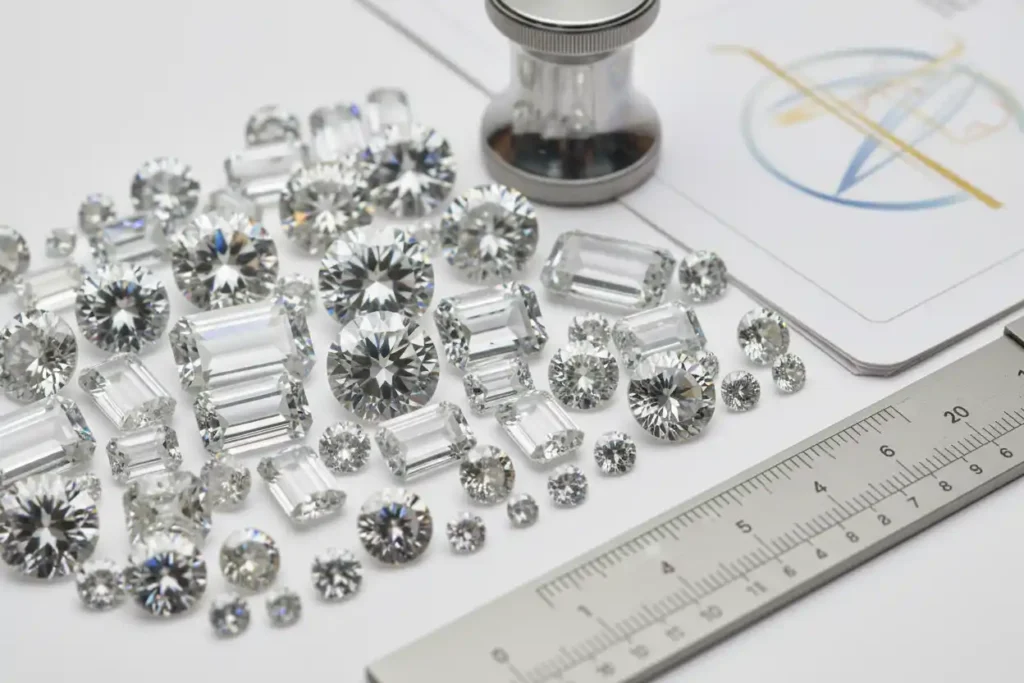
A moissanite and diamond with the same millimeter dimensions therefore do not have the same actual weight.
Retailers often solve this comparison problem by using terms such as:
diamond-equivalent weight, DEW, carat equivalent, or diamond-equivalent carat.
These expressions describe approximately how large the moissanite looks compared with a diamond.
They do not necessarily state what the moissanite weighs on a scale.
Always Request Millimeter Dimensions
The carat-versus-millimeter size chart explains why dimensions are more useful than equivalent weight for cross-material comparison.
When you buy moissanite, ask for:
length, width, and depth.
For rounds, diameter is especially useful.
For elongated shapes, examine the length-to-width ratio.
A seller describing a stone only as three carats without clarifying whether that is actual weight or diamond-equivalent weight is leaving out an important detail.
Equivalent Weight Is Useful When Disclosed Correctly
Diamond-equivalent terminology is not inherently deceptive.
It gives consumers an intuitive way to compare visible size across materials.
The problem begins when the word equivalent disappears and the buyer believes the stone physically weighs the advertised number of carats.
When you buy moissanite, ask for both size systems whenever possible:
actual dimensions and actual weight, plus equivalent size if the retailer wants to provide it.
Face-Up Spread Matters More Than the Equivalent Number
Two moissanites advertised with the same equivalent size can have different actual dimensions because of shape and cutting.
When you buy moissanite, compare the visible footprint rather than assuming equivalent weight standardizes every stone perfectly.
An elongated oval can look much larger than a round with a similar equivalent number.
A deep cushion can look smaller.
Dimensions reveal the difference.
Deep Cutting Can Hide Size
A moissanite with excessive pavilion depth may carry more actual weight while presenting less visible surface.
When you buy moissanite, check whether the stone’s depth contributes to attractive light performance or simply hides mass beneath the girdle.
There is little reason to pay for hidden weight in a manufactured diamond alternative whose primary value proposition is visual performance.
Very Large Moissanite Changes the Visual Balance
Large moissanite remains relatively accessible because manufactured crystal supply does not carry the same geological size scarcity as natural diamond.
When you buy moissanite in very large dimensions, inspect the optical personality particularly carefully.
Double refraction becomes easier to notice.
Rainbow fire becomes stronger.
Body tint may become more visible.
The setting becomes physically heavier.
A stone can be impressive without being the right aesthetic for every wearer.
Try Your Preferred Size in Person
A large center can look very different on the hand compared with a magnified product photograph.
When you buy moissanite, use actual millimeter dimensions to compare sample rings whenever possible.
A stone that seems moderate on a computer screen may dominate a small finger.
Choose size because you like the proportion, not because manufacturing makes a huge stone affordable.
Moissanite Versus Lab Diamond Is a Material Decision
The lab diamond versus moissanite comparison explains the direct difference between these two manufactured jewelry options.
When you buy moissanite rather than lab diamond, you are choosing:
silicon carbide rather than diamond carbon, stronger rainbow dispersion, double refraction, slightly lower hardness, lower density, and usually a lower material cost.
A laboratory-grown diamond gives you diamond optics and diamond identity.
Neither product should be described ambiguously.
Falling Lab-Diamond Costs Make Comparison More Important
Premium branded moissanite can sometimes occupy a price range that overlaps with competitively priced laboratory-grown diamonds of similar visual size.
When you buy moissanite, therefore, do not assume automatically that it is always dramatically less expensive than every lab diamond.
Compare:
stone price, setting price, report quality, warranty, optical preference, and material identity.
If the prices are close, your decision should become more about which gemstone you genuinely prefer.
Moissanite Versus Cubic Zirconia Is Not Just a Price Question
The moissanite versus cubic zirconia comparison separates these two manufactured diamond alternatives in detail.
When you buy moissanite rather than cubic zirconia, one of the main benefits is much greater resistance to scratching and long-term facet abrasion.
Cubic zirconia can look exceptionally bright when new and remains a useful inexpensive jewelry material.
It is considerably denser and softer than moissanite.
For a frequently worn engagement ring, moissanite generally offers the stronger long-term surface durability.
A Basic Diamond Tester Can Misidentify Moissanite
Traditional thermal diamond testers can react to moissanite because silicon carbide conducts heat unusually well.
When you buy moissanite or verify an existing stone, a tester that simply flashes diamond is therefore not enough to establish that the material is diamond.
Combined thermal-electrical testers provide more useful screening, although even those instruments have limitations.
The seller should not wave a basic tester over moissanite and use the result to imply diamond identity.
Testers Do Not Grade Quality
A tester can help separate materials.
It cannot tell you whether the cut is excellent.
It cannot determine whether the color is attractive.
It cannot establish a retailer grade.
It cannot tell you whether you paid a fair price.
When you buy moissanite, use testing for identity rather than quality marketing.
Facet Doubling Is Useful but Not Universal
Under magnification, rear facet edges may appear doubled because moissanite is doubly refractive.
When you buy moissanite and want to screen identity, this can be a useful observation.
However, cutting orientation can minimize doubling through certain directions.
Small stones may be difficult to inspect.
Reflections can confuse inexperienced viewers.
The absence of obvious doubling does not prove the stone is diamond.
Strong Fire Is Not an Authentication Test
Moissanite normally produces abundant rainbow fire, but cubic zirconia can also create strong colored flashes.
When you buy moissanite, do not accept statements such as “it has lots of rainbows, so it must be moissanite” as complete authentication.
Identity should be based on converging evidence.
Fog Tests, Newspaper Tests, and Water Tests Are Weak
A wide range of home methods circulate online.
Fog dissipation depends on temperature, cleanliness, stone size, and environment.
Reading through the stone depends heavily on cutting.
Dropping a gemstone in water proves little because many transparent gems sink.
When you buy moissanite, avoid treating tricks as gemological conclusions.
Never Scratch the Stone to Prove It
Moissanite’s hardness is approximately 9.25 on the Mohs scale, making it one of the hardest widely used jewelry materials.
That does not mean a scratch test is sensible.
When you buy moissanite, do not rub it against glass, sapphire, sandpaper, or another jewelry stone.
The test can damage other materials, the mounting, or polished surfaces while failing to answer more complicated identity questions.
Moissanite Is Highly Suitable for Everyday Jewelry
High hardness is one of the strongest practical reasons people buy moissanite.
Its scratch resistance exceeds sapphire and ruby and sits below diamond.
That makes a sound, well-cut stone highly suitable for engagement rings and other frequently worn jewelry.
However, hardness does not make the entire ring indestructible.
Prongs can bend.
Girdles can chip.
Side stones can loosen.
Metal can deform.
Inspect the Girdle
When you buy moissanite as a loose stone, examine the girdle for:
chips, excessively thin sections, rough polishing, cavities, and unusual thickness.
A very thick girdle can hide weight and reduce face-up spread.
A very thin edge can be more vulnerable during setting or impact.
Fancy shapes deserve particular attention near tips and corners.
Pointed Shapes Need Protective Metal
Pear, marquise, and some custom cuts concentrate stress at their points.
When you buy moissanite for a ring, protect those areas with V-prongs, bezels, or other appropriate structures.
A point exposed above the surrounding metal can chip after a sufficiently hard impact even though the material is highly scratch resistant.
Ring Setting Quality Can Matter More Than the Center-Stone Price
The moissanite ring guide explains ring-specific construction, but the key purchasing lesson is that an affordable center does not justify a flimsy mounting.
When you buy moissanite already set, inspect:
prong thickness, shank thickness, gallery construction, setting height, soldering, stone security, accent stones, metal purity, and resizing limitations.
A strong 14K gold or platinum setting can cost substantially more than a generic center stone.
That is not necessarily overpricing.
Engagement Rings Need Whole-Piece Evaluation
The moissanite engagement-ring guide covers bridal-specific decisions including wedding-band fit, setting height, side stones, and long-term servicing.
When you buy moissanite for an engagement ring, make sure the center stone is not the only high-quality component.
A large center in a fragile setting can be less practical than a slightly smaller stone in a substantial ring.
Ask What Every Side Stone Is
A moissanite center can be surrounded by:
moissanite, natural diamond, laboratory-grown diamond, cubic zirconia, white sapphire, or another material.
When you buy moissanite jewelry, the invoice should identify significant side stones accurately.
Do not assume that a diamond-like halo automatically matches the center material.
Earring Pairs Need More Than Equal Size
The moissanite earrings guide explains pair-specific quality.
When you buy moissanite earrings, compare:
cut pattern, face-up dimensions, color, undertone, brightness, and setting height.
Two ovals can have the same millimeter measurements and still look mismatched if one uses a brilliant pattern and the other a crushed-ice pattern.
Matching optics matter.
Large Earrings Show More Rainbow Fire
Small studs can resemble diamond at normal conversational distance because the optical differences are compressed into a small area.
When you buy moissanite earrings in larger sizes, intense dispersion becomes more obvious.
That can be attractive.
Make sure the visual effect is intentional.
Report Quality Should Match the Price
Moissanite does not need an expensive independent report in every situation.
A modest loose stone from a seller with strong returns may not justify substantial testing costs.
Independent documentation becomes more useful when you buy moissanite that is:
expensive, unusually large, branded at a premium, represented as natural, difficult to distinguish from diamond, fancy colored, suspected of coating, or part of high-value jewelry.
The gemstone certification guide explains why identification reports, grading reports, manufacturer warranties, authenticity cards, and appraisals are different documents.
A Fancy Certificate Is Not Proof of Quality
Many moissanites are accompanied by laminated cards, booklets, QR codes, or report-style paperwork.
When you buy moissanite, judge the document by:
who issued it, whether the issuer is independent, what was actually tested, whether the report number can be verified, whether the measurements match, and whether the stone is identified specifically as moissanite.
A professionally printed card can still be little more than a product label.
Be Cautious With Generic GRA-Style Cards
Moissanite products are frequently sold with documents styled to resemble formal diamond reports.
When you buy moissanite accompanied by such paperwork, inspect whether almost every stone seems to receive the same D color, VVS clarity, and excellent-cut claims.
A repetitive template provides less useful information than an independent report matched to the exact stone.
The card does not need to be fraudulent to be commercially limited.
Understand what it represents.
Verify Any Report Number That Claims Independence
If the document comes from an independent laboratory that offers online verification, check the report number.
Then compare:
material identity, shape, measurements, weight, color description, and photograph or identifying features where supplied.
When you buy moissanite, documentation should correspond to the exact object rather than to a representative stone from the same parcel.
Laser Inscriptions Can Help but Are Not Absolute Proof
Moissanite may carry a manufacturer name, serial number, report number, or other inscription on the girdle.
When you buy moissanite with an inscription, compare it with the accompanying documentation.
However, fraudulent inscriptions have been documented on diamond simulants.
An inscription is therefore useful supporting evidence.
It is not a substitute for material identification when the financial stakes are high.
Raman Spectroscopy Can Confirm Silicon Carbide
When a valuable or disputed stone needs definitive identification, professional spectroscopy can distinguish silicon carbide from diamond, cubic zirconia, and other simulants.
When you buy moissanite at a price where identity matters substantially, this type of testing is stronger than consumer tricks.
Independent confirmation is particularly useful when a seller has described the stone ambiguously as diamond, natural moissanite, or laboratory-grown diamond.
Reports Do Not Establish Resale Value
A laboratory or authenticity report can confirm material identity and describe characteristics.
It does not guarantee that someone will buy the stone later at a particular price.
When you buy moissanite, separate identification from financial expectation.
A perfectly documented stone can still have modest secondary-market demand.
Moissanite Pricing Depends Heavily on Brand and Cut
The moissanite value guide explains why apparently similar stones can have very different asking prices.
When you buy moissanite, price can reflect:
manufacturer, cut precision, color selection, stone size, proprietary shapes, warranty, retailer service, marketing, setting construction, and brand reputation.
The raw silicon-carbide material is only part of the finished price.
Generic Moissanite Can Be Very Affordable
Manufacturing competition has made unbranded or generic moissanite available at relatively low prices.
When you buy moissanite from this part of the market, low price does not automatically indicate cubic zirconia.
A well-cut generic stone can be genuine silicon carbide and perform beautifully.
The key is verifying identity and cut rather than assuming that only expensive branded material is authentic.
Premium Branded Moissanite Needs a Clear Reason
A brand can legitimately add value through:
consistent quality control, proprietary cutting, warranties, replacement programs, established color standards, customer service, and predictable product selection.
When you buy moissanite at a substantial brand premium, determine which of those advantages you actually receive.
If the stone looks equivalent to inexpensive generic material and the warranty is weak, the premium deserves scrutiny.
Precision Cutting Can Be Worth Paying For
Exceptional lapidary work can improve symmetry, face-up spread, brightness, contrast, and the way double refraction appears.
When you buy moissanite from a skilled cutter, the price may reflect genuine craftsmanship rather than rarity of the raw crystal.
That can be a defensible premium.
Look for visible evidence:
clean symmetry, balanced reflections, sharp facet junctions, excellent polish, and strong face-up performance.
Custom Cuts Should Be Judged as Custom Work
Fantasy cuts, antique-inspired cuts, Portuguese patterns, old-mine-style cushions, portrait cuts, rose cuts, and other specialized designs can give moissanite a distinctive personality.
When you buy moissanite in a custom shape, do not compare it directly with mass-produced round pricing.
You may be paying primarily for cutting labor.
Resale Expectations Should Be Conservative
Moissanite is manufactured in substantial supply and does not derive its value from geological rarity in the way many mined collector gemstones do.
When you buy moissanite, purchase primarily for:
appearance, durability, design, size, and initial affordability.
Do not assume the loose stone will appreciate.
Secondhand value can depend heavily on brand, setting, metal value, designer name, and the demand for the completed jewelry.
“Investment Moissanite” Needs Skepticism
Guaranteed appreciation claims deserve particular caution.
When you buy moissanite, ask what established secondary market supports the promised return.
The ability to manufacture additional silicon-carbide gemstones means supply can respond differently from rare natural materials.
A beautiful engagement ring can have immense personal value.
That is different from an investment guarantee.
Buyback Programs Need Written Terms
Some retailers offer trade-up, upgrade, replacement, or buyback policies.
When you buy moissanite partly because of one of these programs, read the conditions carefully.
A trade-up may require purchasing a much more expensive replacement.
A buyback may apply only to certain branded stones.
A warranty may cover manufacturing defects but not loss.
A replacement guarantee may require periodic inspections.
The headline does not tell you the economic value of the program.
Returns Are Essential for Online Buying
Moissanite changes character dramatically between jewelry-store spotlights, daylight, office lighting, warm home lighting, and diffuse cloudy light.
When you buy moissanite online, a useful return period allows you to decide whether you genuinely like the optical behavior.
Inspect the stone in multiple environments before removing return tags or modifying the setting.
Request Actual-Stone Video for a Significant Center
Stock photography can be acceptable for low-cost standardized melee or tiny calibrated stones.
When you buy moissanite as a large center stone, request the exact item whenever possible.
Video should show:
slow movement, neutral white balance, face-up view, side view, pavilion, bow tie where relevant, and enough time to assess the reflection pattern.
A fast spinning video under intense spotlights can hide cut problems.
Diffused Light Reveals Cut Better Than Spotlights
Spot lighting makes fire spectacular.
Diffuse light makes brightness distribution and dark areas easier to judge.
When you buy moissanite, ask to see both.
A strong stone should not become dull or dead as soon as the colorful flashes calm down.
Side Views Reveal Color and Depth
Face-up photographs can make almost every colorless moissanite look white.
When you buy moissanite, side video can reveal:
yellow, green, or gray tint, excessive pavilion depth, thick girdles, inclusions, coating wear, and setting problems.
This is especially important for large stones.
Ask Whether Fancy Color Is Coated
A seller should state whether blue, pink, green, yellow, or another unusual color originates throughout the material or from a surface film.
When you buy moissanite, this information affects:
care, repair, repolishing, setting, and expected long-term appearance.
A coated stone can still be an attractive purchase.
It should be priced and maintained according to its actual construction.
The Invoice Should Identify Moissanite Clearly
When you buy moissanite at meaningful value, the final paperwork should preserve the material description.
Useful information can include:
moissanite, shape, millimeter dimensions, actual weight where supplied, diamond-equivalent size where used, color description, coating or treatment, manufacturer, report number, metal purity, and side-stone identity.
A product repeatedly marketed as premium moissanite should not become simply “diamond-like stone” on the receipt.
Sustainability Claims Need Evidence
Moissanite is manufactured rather than mined in ordinary jewelry sizes, but manufactured origin does not automatically establish negligible environmental impact.
Energy source, crystal-growth efficiency, cutting location, transport, metal sourcing, and factory practices can all matter.
When you buy moissanite because environmental considerations are important, ask for evidence behind claims such as carbon neutral, renewable powered, sustainable, or zero impact.
Specific information is stronger than a green marketing label.
“Conflict-Free” Is Not the Complete Ethical Question
Manufactured moissanite avoids a conventional gemstone mine supply chain, but ethics can also involve:
factory labor, energy sourcing, cutting conditions, metal mining, jewelry manufacturing, and retailer practices.
When you buy moissanite for ethical reasons, evaluate the complete product rather than assuming one material label answers every supply-chain question.
Compare Alternatives Before Deciding
The best diamond alternatives include several materials with different visual and durability profiles.
When you buy moissanite, it is a particularly strong option if you want:
very high scratch resistance, strong brilliance, abundant rainbow fire, large visual size, and a lower initial material cost than many diamonds.
Someone who prefers restrained sparkle may choose white sapphire.
Someone who specifically wants diamond identity may choose laboratory-grown diamond.
The best alternative depends on what you actually value.
Moissanite Is Excellent for Everyday Rings
A well-cut, untreated colorless moissanite in a secure setting can tolerate daily jewelry use extremely well.
When you buy moissanite for frequent wear, remember that the setting will often require more maintenance than the center stone.
Prongs should be inspected.
Pavé can loosen.
White-gold finishes can wear.
Shanks can thin.
A durable center does not make the ring maintenance-free.
Oil and Soap Can Make Moissanite Look Dull
Moissanite attracts skin oil, lotion, cosmetics, and soap residue readily.
A dirty stone can lose much of its crisp brightness even though the material itself has not changed.
The moissanite jewelry cleaning guide explains routine maintenance and the oil-slick film sometimes associated with the surface.
When you buy moissanite, clean it before deciding that it has become cloudy.
The Stone Does Not Normally “Cloud” Like Worn CZ
Moissanite is highly resistant to surface abrasion, so a sound stone should not develop the same type of heavily abraded surface commonly associated with extensively worn softer simulants.
Temporary dullness is often contamination.
When you buy moissanite, inspect an older stone after professional cleaning before assuming the material has deteriorated.
Coated Stones Need Different Care
A surface-treated colored moissanite may require stricter care because the coating can be more vulnerable than the silicon carbide.
When you buy moissanite with coated color, avoid treating every cleaning or jewelry-repair procedure as though only the base material mattered.
Tell the jeweler about the treatment before heat, polishing, or aggressive cleaning.
Major Red Flags When You Buy Moissanite
| Red flag | Why it matters |
|---|---|
| Seller calls the stone a “moissanite diamond” | Moissanite and diamond are different materials |
| Large stone is claimed to be natural earth-mined moissanite | Jewelry-size natural material would require exceptional evidence |
| Basic thermal tester is used as proof of diamond identity | Moissanite can trigger many thermal testers |
| Diamond-style D/VVS labels are presented as universal independent grades | Moissanite grading terminology often comes from sellers or manufacturers |
| Certificate gives identical top grades to every stone | The document may function mainly as a product card |
| Report issuer cannot be verified | Documentation has limited independent value |
| Report dimensions do not match the gemstone | Paperwork may belong to another stone |
| Laser inscription is treated as absolute proof | Fraudulent inscriptions have been documented |
| “Three carats” is listed without saying actual or diamond-equivalent weight | Size and mass may be confused |
| Millimeter dimensions are missing | Visible size cannot be compared reliably |
| Stone is extremely deep for its face-up dimensions | Hidden weight may add cost without visible benefit |
| Oval is shown only under fast-moving spotlights | A severe bow tie may be hidden |
| Crushed-ice stone looks permanently gray or watery | Reflection pattern may be weak despite fashionable terminology |
| Brilliant stone has a broad transparent center | Windowing or poor proportions may be present |
| Very large stone is shown only from the face | Side tint and depth may be concealed |
| D-color claim conflicts with obvious yellow or green side tint | Seller grading may be unreliable |
| Pink or light-blue moissanite has no treatment disclosure | Surface coating may be responsible for color |
| Coated stone is sold as through-color material | Durability and value categories differ |
| “Flawless” creates a huge premium | Very clean lab-grown material is widely obtainable |
| Branded stone costs far more with no meaningful service difference | Premium may be mainly marketing |
| Seller compares retail price only with natural diamond | Moissanite requires its own market comparison |
| Guaranteed appreciation is promised | Manufactured supply does not guarantee investment returns |
| Lifetime upgrade is advertised without written conditions | Restrictions may limit practical value |
| Side stones are not identified | Finished jewelry may contain unexpected materials |
| Return period ends before realistic inspection | Optical preferences cannot be tested properly |
| Stock images are used for a premium center stone | Actual cut, color, and inclusions remain unknown |
| Seller recommends scratch, flame, or acid tests | Destructive tests are unnecessary and unsafe for jewelry |
Several of these warning signs together are a strong reason not to buy moissanite until the seller provides clearer evidence.
A Practical Buy Moissanite Decision Matrix
Strong overall purchase: The stone is confidently identified as moissanite, has excellent cut performance, efficient dimensions, attractive face-up color, eye-clean clarity, a reflection pattern you genuinely like, and clear disclosure of any coating or treatment.
Strong value purchase: The stone is generic rather than premium branded, slightly near-colorless rather than the whitest seller category, and perhaps just below a fashionable equivalent-size threshold, yet its cut and face-up appearance are excellent.
Diamond-like purchase: You want moissanite to resemble diamond as closely as practical, so you choose restrained colorless material, a smaller-to-moderate size, a cut that controls double refraction, and an optical pattern with balanced white brightness rather than extreme fire.
Moissanite-character purchase: You actively prefer intense rainbow flashes, so you select a brilliant-style stone that emphasizes dispersion rather than trying to suppress what makes the material distinctive.
Crushed-ice purchase: You prefer a softer fragmented facet pattern and reduced obvious doubling, while making sure the stone remains bright rather than gray or watery.
Precision-cut purchase: The premium comes from exceptional symmetry, polish, face-up spread, contrast, and controlled optical performance. The workmanship is visibly better than mass-cut inventory.
Fancy-color purchase: The color is attractive and the seller identifies whether it is intrinsic, post-growth modified, or surface coated. The price and care reflect the treatment.
Large-size purchase: You intentionally want substantial visual size, but the face-up dimensions, setting strength, color, double-refraction appearance, and optical personality all remain convincing.
Engagement-ring purchase: The center stone is strong, while the gold or platinum setting is substantial, repairable, compatible with the wedding band, and supported by sensible service terms.
Documentation-dependent purchase: The stone is unusually expensive, sold as natural, confused with diamond, highly branded, or coated in a way that affects value. Independent identification is proportionate to the financial risk.
Poor purchase: The moissanite is genuine but badly cut, gray, heavily tinted, excessively deep, severely bow-tied, visibly included, coated without adequate disclosure, or overpriced according to brand prestige.
Walk away: The seller blurs diamond and moissanite identity, misstates equivalent weight as actual weight, uses fraudulent-looking documentation, hides color treatment, or refuses realistic inspection.
Where the Best Value Often Appears
The strongest value when you buy moissanite often lies in excellent cut with modest branding rather than maximum paper specifications.
A well-cut near-colorless stone can look better than a badly proportioned supposedly D-color stone. A precision-cut generic center can outperform expensive branded inventory. A stone slightly below an arbitrary equivalent-size threshold may look almost identical on the hand while allowing more budget for a stronger setting.
Likewise, a tiny hidden inclusion can reduce price without affecting visible beauty.
Spend first on what you can see.
Buy Moissanite for Cut Before Color Grade
Cut controls the stone every time you look at it.
A tiny difference between two seller color categories may be invisible once the gemstone is mounted.
When you buy moissanite, an excellent cut should generally outrank an unnecessary color upgrade.
Buy Moissanite for Dimensions Before Equivalent Carats
A carat-equivalent label is useful only as a shorthand.
Millimeter measurements tell you what actually occupies space on the finger.
When you buy moissanite, compare visible size directly.
Buy Moissanite for Optical Preference Before Diamond Resemblance
Moissanite does not have to succeed by being mistaken for diamond.
Its intense fire is a legitimate gemstone characteristic.
When you buy moissanite, decide whether you enjoy that characteristic.
A purchase made specifically because you love moissanite will generally be more satisfying than one made while hoping nobody can tell it differs from diamond.
Buy Moissanite for Setting Quality Before Extreme Size
Manufacturing makes large centers affordable enough that buyers can allocate too much attention to gemstone size and too little to the ring holding it.
When you buy moissanite, a substantial secure setting is more useful than squeezing the final few millimeters of center size into the budget.
Buy Moissanite With Realistic Resale Expectations
The material’s strength is initial value, visual size, brilliance, durability, and design flexibility.
It is not geological scarcity.
When you buy moissanite with that expectation, resale limitations become less disappointing.
Final Buying Method
The smartest way to buy moissanite is to evaluate the gemstone as silicon carbide first and as a diamond alternative second.
Begin by confirming that the stone is genuine moissanite rather than cubic zirconia, glass, diamond, or another colorless material. For ordinary jewelry, laboratory-grown origin is normal; a claim of large natural moissanite should trigger an exceptionally high evidence threshold.
Next, prioritize cut. Watch the stone under diffuse light and spot lighting, examine center brightness, bow ties, crushed-ice haze, facet pattern, symmetry, pavilion depth, and face-up spread. Decide whether you prefer brilliant flashes, crushed-ice texture, or a hybrid style rather than assuming one cut label is universally superior.
Then compare millimeter dimensions with the advertised size. Clarify whether carat terminology represents actual weight or diamond-equivalent weight. Moissanite is less dense than diamond, so the two numbers are not interchangeable.
After that, evaluate color and clarity. Look at the stone face-up and from the side for yellow, gray, green, or other undertones. Choose an eye-clean stone rather than paying automatically for a microscopic clarity grade borrowed from diamond terminology.
If the moissanite is fancy colored, determine whether the color is intrinsic or created by a surface coating. Preserve that treatment information because it can affect cleaning, repair, and long-term wear.
Then evaluate documentation, the setting, side-stone disclosure, return rights, warranty, upgrade conditions, and complete jewelry price. A premium branded stone can be worth buying when cutting and service genuinely justify the difference, but the brand name should not substitute for visible quality.
When you buy moissanite through this hierarchy, its advantages become much clearer: exceptional hardness, strong brilliance, intense fire, generous visible size, and a lower rarity premium than diamond. The strongest purchase is the stone whose silicon-carbide identity, cut, dimensions, color, optical personality, treatment disclosure, documentation, setting, service, and price all work together convincingly.
The broader Buying & Value section connects these principles with additional gemstone identification, pricing, treatment, and purchasing guidance.
Frequently Asked Questions
What should I check first when I buy moissanite?
Confirm genuine silicon-carbide identity, then prioritize cut quality and actual millimeter dimensions. Color, clarity, brand, reports, and equivalent carat size should come after those fundamentals.
Is moissanite a real gemstone?
Yes. Moissanite is silicon carbide and exists as a mineral species, although virtually all jewelry-size material is laboratory grown.
Is lab-grown moissanite fake?
No. Laboratory-grown moissanite is genuine silicon carbide. Cubic zirconia, glass, and other materials sold under the moissanite name are imitations.
Is moissanite a lab-grown diamond?
No. Laboratory-grown diamond is crystalline carbon. Moissanite is silicon carbide and has different optical and physical properties.
Is moissanite the same as cubic zirconia?
No. Cubic zirconia is zirconium oxide, while moissanite is silicon carbide. Moissanite is harder, less dense, and optically different.
Why does moissanite show so many rainbows?
Moissanite has very high dispersion, allowing it to separate white light into spectral colors more strongly than diamond. This creates conspicuous red, green, blue, yellow, and other flashes.
Is too much rainbow fire a quality problem?
Not inherently. Strong fire is a natural property of moissanite. Whether it looks beautiful or excessive is a matter of personal preference and cut style.
What cut should I choose when I buy moissanite?
Round brilliant is a strong all-purpose choice, while ovals, cushions, radiants, pears, emerald cuts, and other shapes offer different optical effects. Choose according to face-up performance rather than shape name alone.
What is crushed-ice moissanite?
Crushed-ice cutting uses many small fragmented reflections rather than broad organized flashes. It can reduce obvious facet doubling but may appear gray or watery when poorly executed.
Is crushed-ice moissanite better?
Not universally. Some buyers prefer its softer reflection pattern, while others prefer the crisp brilliance of traditional brilliant cuts.
What is hybrid-cut moissanite?
A hybrid combines characteristics of brilliant and crushed-ice facet patterns, aiming to balance organized brightness with more fragmented reflections.
Does moissanite have a bow tie?
Ovals, pears, marquises, and other elongated brilliant shapes can show bow ties. A mild moving contrast zone is normal, while a large persistent black area is less desirable.
What does double refraction mean in moissanite?
Light can split into two rays inside most jewelry moissanite, causing rear facet junctions to appear doubled through certain viewing directions.
Is facet doubling a flaw?
No. It is an inherent optical property of ordinary moissanite rather than a polishing defect. Cut orientation can make the effect less obvious face-up.
Does every moissanite show obvious doubling?
No. Stone orientation, shape, facet pattern, viewing angle, and size all affect how easy the effect is to see.
What does D–F moissanite mean?
It generally describes a seller or manufacturer’s colorless range. It should not automatically be treated as the same standardized color grade assigned to diamond by a diamond-grading laboratory.
Can moissanite look yellow?
Yes. Some stones display yellow, green, gray, or warm undertones, especially from the side or in larger sizes.
Is near-colorless moissanite bad?
No. Near-colorless material can offer excellent value and may appear completely white once mounted, particularly in yellow or rose gold.
Can moissanite be gray?
Yes. Gray moissanite can be sold deliberately as a fashion color. It should be described accurately rather than represented as colorless.
Can moissanite be blue or pink?
Yes. Fancy-color moissanite exists, but some colors can involve coatings. Treatment should be disclosed because surface-applied color may require different care.
Is coated moissanite real moissanite?
The base can still be genuine silicon carbide, but the visible color is treatment dependent. The coating should be disclosed separately from material identity.
Can a moissanite coating wear off?
Surface-applied color can potentially abrade, chip, or respond to heat and chemicals differently from the underlying stone.
Is moissanite usually eye-clean?
Modern jewelry-grade moissanite is commonly very clean, so an eye-clean appearance is a reasonable expectation for most center stones.
What inclusions occur in moissanite?
Possible features include needles, tubes, growth structures, crystals, cavities, and other manufacturing-related inclusions. Many modern stones appear extremely clean.
Does VVS moissanite mean the same thing as VVS diamond?
Not necessarily. Diamond-style clarity labels on moissanite are often commercial classifications rather than directly interchangeable independent diamond grades.
What is diamond-equivalent weight?
Diamond-equivalent weight estimates how large a moissanite looks compared with a diamond. It is not necessarily the stone’s actual scale weight.
Why does moissanite weigh less than an equal-size diamond?
Moissanite has lower density than diamond, so two stones with the same dimensions and similar proportions normally have different actual weights.
Should I buy moissanite by carat or millimeters?
Millimeter dimensions provide the clearest indication of visible size. Equivalent carat terminology can be useful, but it should not replace actual measurements.
Can a basic diamond tester mistake moissanite for diamond?
Yes. Moissanite’s high thermal conductivity can cause it to register as diamond on many simple thermal testers.
What type of tester separates moissanite better?
Combined thermal-electrical testers provide more useful screening, although difficult cases still benefit from professional gemological examination.
Does a certificate guarantee genuine moissanite?
No. The issuer, testing process, report verification, and stone-to-document match all need to be considered.
Does moissanite need an independent laboratory report?
Not every ordinary commercial stone does. Independent identification becomes more useful for expensive, unusually large, branded, fancy-colored, disputed, or ambiguously represented stones.
Can an inscription prove moissanite authenticity?
An inscription provides supporting evidence when it matches legitimate documentation, but it is not absolute proof because inscriptions can be fraudulent or incorrectly matched.
What laboratory test can confirm moissanite?
Professional spectroscopy, including Raman analysis, can identify silicon carbide reliably and distinguish it from diamond, cubic zirconia, and glass.
Is moissanite good for an engagement ring?
Yes. Its approximately 9.25 Mohs hardness, strong brilliance, and good practical durability make it highly suitable for frequent ring wear.
Can moissanite chip?
Yes. High hardness does not make it indestructible. Severe impacts can damage girdles, points, corners, or the setting.
Is moissanite harder than sapphire?
Yes. Moissanite is approximately 9.25 on the Mohs scale, while sapphire and ruby are 9.
Is moissanite as hard as diamond?
No. Diamond ranks 10 on the Mohs scale and is more resistant to scratching.
Does moissanite become cloudy?
Moissanite itself normally remains highly transparent, but oil, soap, cosmetics, and surface residue can make it look dull. Cleaning often restores brightness.
What is moissanite oil slick?
It is an iridescent-looking surface film that can develop from residues or contamination on some stones. Proper cleaning or professional attention can usually address it.
Does moissanite hold its value?
Secondary-market value is generally limited compared with original retail pricing because new material can continue to be manufactured. Brand, setting, metal, and design can influence resale.
Is branded moissanite worth more?
A brand can justify a premium through cut consistency, warranty, replacement programs, color selection, or customer service. The premium is worthwhile only when those benefits matter to you.
Is generic moissanite real?
It can be. Generic describes branding rather than material identity. A low-cost unbranded stone can still be genuine silicon carbide.
Is precision-cut moissanite worth buying?
It can be when the cutting produces visibly stronger symmetry, brightness, spread, polish, and reflection pattern than mass-cut alternatives.
What should I inspect when buying a moissanite ring?
Check the center stone, prongs, setting height, shank thickness, metal purity, side stones, wedding-band fit, resizing limitations, warranty, and return policy.
What should I inspect when buying moissanite earrings?
Compare both stones for dimensions, color, cut pattern, brightness, setting height, metal quality, and closure security.
Should side stones match the moissanite center?
They should be disclosed clearly. Side stones can be moissanite, natural diamond, lab diamond, cubic zirconia, or another material depending on the design.
Is moissanite environmentally friendly?
Manufactured origin avoids conventional gemstone mining for the center stone, but total environmental impact depends on energy, production efficiency, cutting, transport, metal sourcing, and other supply-chain factors.
Is moissanite a good investment?
It is better approached as durable jewelry and a visual-value purchase rather than an asset with guaranteed appreciation.
What should I do before the return period ends?
Inspect the exact stone under daylight, diffuse indoor lighting, spot lighting, and warm room light. Check color, fire, bow tie, dimensions, setting quality, documentation, and overall appearance before altering the jewelry.
How should moissanite be cleaned?
For ordinary sound jewelry, lukewarm water, mild soap, and a soft brush provide a conservative routine method. Clean beneath the stone where oil and soap residue accumulate.
What is the biggest mistake when you buy moissanite?
The biggest mistake is choosing the largest diamond-equivalent number before deciding whether you actually like the stone’s cut and optical character. When you buy moissanite, verify silicon-carbide identity, prioritize cut and dimensions, judge color and clarity realistically, investigate coatings and documentation, evaluate the complete setting, and only then decide whether the price is justified.