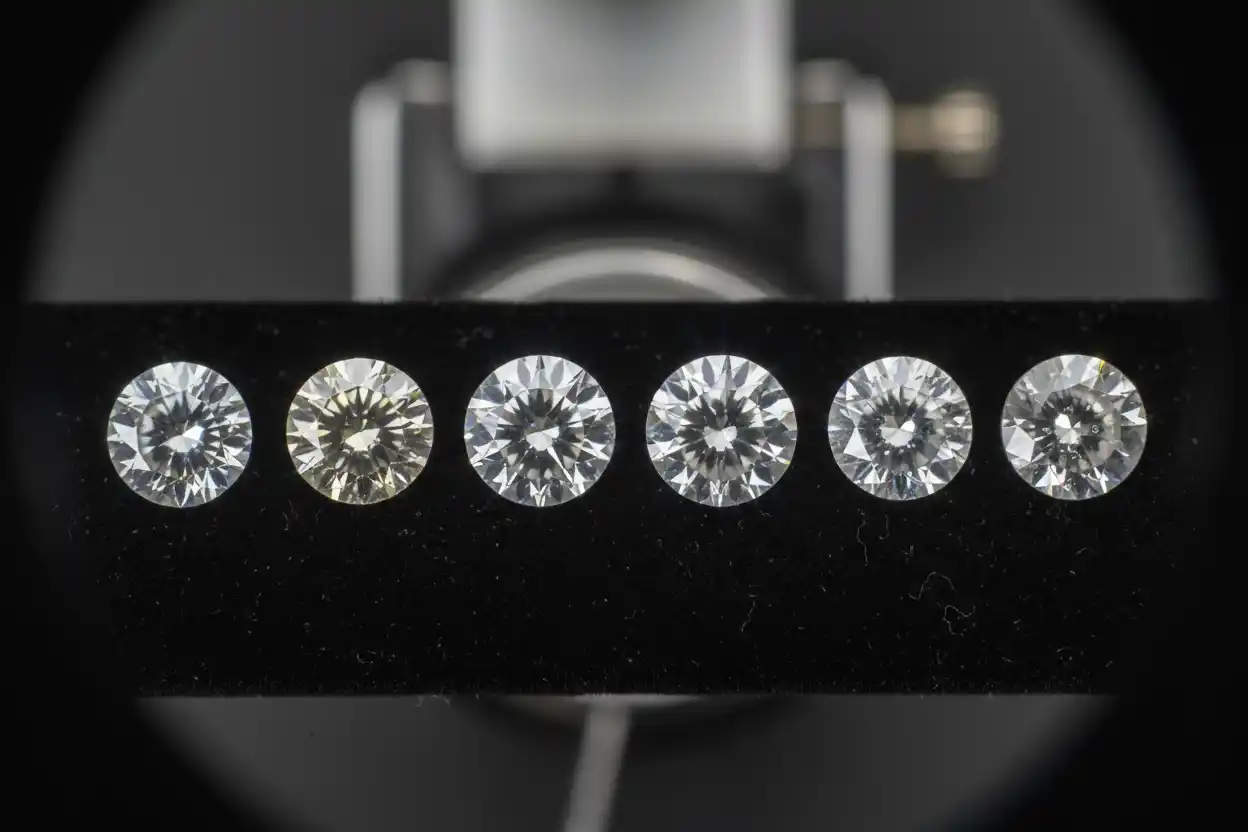
Real vs Fake Moissanite: Tests, Simulants and Certificates
Real moissanite is crystalline silicon carbide. Nearly all moissanite used in modern jewelry is grown in laboratories because natural moissanite occurs only in extremely small and uncommon geological or extraterrestrial settings.
That distinction makes “real versus fake” terminology unusually important. A laboratory-grown moissanite is genuine moissanite because its material is silicon carbide. It is not a mined natural gemstone, but neither is it cubic zirconia, glass or plastic.
Common moissanite imitations include cubic zirconia, glass, synthetic spinel and other colorless manufactured stones. Diamond and laboratory-grown diamond can also be confused with moissanite, although they are separate gem materials rather than inferior forms of it.
Identification should therefore answer two questions. First, is the stone silicon carbide? Second, has its color or surface been altered through coating or another treatment?
This page owns the direct authenticity workflow. The treated-moissanite guide retains coatings, color treatment and manufacturing modifications.
Genuine Moissanite vs Common Lookalikes
| Feature | Genuine moissanite | Diamond or lab-grown diamond | Cubic zirconia | Glass |
|---|---|---|---|---|
| Material | Silicon carbide | Crystalline carbon | Zirconium oxide | Manufactured amorphous glass |
| Normal jewelry origin | Laboratory-grown | Natural or laboratory-grown | Manufactured | Manufactured |
| Mohs hardness | About 9.25 | 10 | About 8–8.5 | Commonly about 5–6 |
| Refractive index | Approximately 2.65–2.69 | About 2.42 | About 2.15–2.18 | Variable and generally lower |
| Refraction | Doubly refractive in most directions | Singly refractive | Singly refractive | Singly refractive |
| Specific gravity | Approximately 3.22 | Approximately 3.52 | Approximately 5.6–6.0 | Variable |
| Dispersion or fire | Very strong | Strong but usually more balanced | Strong, often broader | Generally lower |
| Thermal conductivity | High | Very high | Much lower | Much lower |
| Electrical conductivity | Commonly useful for separation from diamond | Usually lower, with exceptions | Low | Low |
| Typical visual clue | Facet doubling and intense rainbow flashes | Crisp single facet junctions | Greater weight and glassier appearance | Bubbles, flow lines or softer facet edges |
| Best confirmation | Combined thermal-electrical testing, microscopy and spectroscopy | Laboratory growth-origin analysis when needed | Standard gemological tests | Standard gemological tests |
A stone can fail to display an obvious visual clue and still be genuine. Cut orientation, size, setting and optical cleanliness affect what can be seen.
What Is Genuine Moissanite?
The moissanite meaning guide owns the material’s history, properties and symbolism.
Moissanite consists of silicon and carbon arranged as silicon carbide. Several silicon-carbide crystal structures, called polytypes, exist. Gem-quality moissanite has commonly been produced in hexagonal forms such as 4H and 6H silicon carbide.
These structures explain why ordinary colorless moissanite is doubly refractive. Light entering the gem usually separates into two rays, creating the possibility of visible facet doubling.
Natural moissanite exists, but it does not supply the ordinary jewelry trade. A seller offering a large “earth-mined natural moissanite” as a center stone should provide exceptional independent laboratory evidence.
Is Laboratory-Grown Moissanite Real?
Yes. Laboratory-grown moissanite is real silicon carbide.
The word laboratory-grown describes origin rather than imitation. It is comparable in terminology to laboratory-grown diamond or synthetic sapphire: the crystal was manufactured, but its defining composition and structure correspond to the named material.
A cubic zirconia sold as moissanite is an imitation. A laboratory-grown silicon-carbide gem sold as laboratory-grown moissanite is accurately represented.
The broader laboratory-grown-versus-natural gemstone guide explains why laboratory growth, treatment and imitation must remain separate categories.
Facet Doubling
Facet doubling is one of the most useful visual moissanite clues.
Look through the crown toward rear facet junctions near the opposite side of the pavilion. In a correctly oriented moissanite, one facet edge may appear as two parallel lines.
The effect results from birefringence rather than poor cutting. It can be easier to see through bezel facets than straight through the table.
Doubling becomes less obvious when the cutter orients the stone along an optic direction that minimizes the effect. Small stones and heavily included or dirty gems can also conceal it.
Diamond and cubic zirconia are singly refractive, so their rear facets should not double in the same way.
A loupe observation remains a screening result. Strong reflections, scratches and adjacent facets can create apparent double lines that an inexperienced observer misinterprets.
Rainbow Fire
Moissanite has very high dispersion, producing strong spectral flashes.
Under spot lighting, it may show frequent red, orange, yellow, green and blue fire. Diamond commonly displays more white brilliance relative to its rainbow flashes, although cut quality can alter the balance substantially.
Cubic zirconia can also show strong fire. Therefore, “too many rainbows” is not an authentication test.
Lighting matters greatly. Store spotlights and phone flashes can exaggerate dispersion, while diffused daylight may make the same stone appear calmer.
The completed moissanite-versus-diamond guide owns the complete appearance and buying comparison.
Thermal Diamond Testers
Moissanite conducts heat well enough to register as diamond on many basic thermal probes.
A positive reading from a simple diamond tester may therefore mean diamond or moissanite. It does not prove natural diamond, laboratory-grown diamond or moissanite specifically.
Cubic zirconia and ordinary glass usually conduct heat more slowly and are easier for the tester to reject.
Incorrect probe contact, dirty surfaces, small accent stones and nearby metal can produce errors. Testing a mounted stone requires particular care because the probe may touch a prong.
A thermal tester is useful for initial screening, not final identification.
Electrical-Conductivity Testers
Many modern multi-testers combine thermal and electrical measurements.
Moissanite often conducts electricity differently from colorless diamond, allowing the instrument to distinguish the two after confirming high thermal conductivity.
Exceptions exist. Certain diamonds containing boron can conduct electricity, and equipment performance varies with stone color, size, coating and mounting.
A multi-tester still cannot determine the quality, manufacturer, treatment or exact growth history of a moissanite.
Professional results should be checked through microscopy or spectroscopy when the transaction value warrants it.
Moissanite Versus Cubic Zirconia
Cubic zirconia is a manufactured zirconium-oxide crystal.
It is considerably denser than moissanite. Two loose stones with identical dimensions and similar cutting will not have the same weight; the cubic zirconia will feel substantially heavier.
CZ is also softer and more prone to developing abraded facet junctions after prolonged wear.
Both can show abundant rainbow fire, so sparkle is not sufficient. Moissanite’s facet doubling, thermal conductivity and electrical behavior provide stronger evidence.
The completed moissanite-versus-cubic-zirconia guide owns their full side-by-side comparison.
Moissanite Versus Diamond
Diamond is crystalline carbon, whereas moissanite is silicon carbide.
Diamond is singly refractive and should not show moissanite’s characteristic pavilion-facet doubling. It is slightly denser and has a different balance of brilliance, fire and contrast.
Both materials conduct heat strongly. A basic thermal tester may therefore confuse them.
The recently drafted real-versus-fake diamond guide owns natural diamond, laboratory-grown diamond and diamond-simulant testing.
A seller should not describe moissanite as a moissanite diamond. That phrase combines two different materials and can mislead buyers about what they are purchasing.
Moissanite Versus Laboratory-Grown Diamond
A laboratory-grown diamond is crystalline carbon grown through HPHT or CVD processes.
Its optical and physical properties are those of diamond rather than moissanite. It does not show moissanite’s normal double refraction.
Laboratory-grown diamond and moissanite can both be manufactured and used as diamond alternatives, but their prices, reports and resale markets differ.
The completed lab-diamond-versus-moissanite guide owns the detailed comparison.
A report stating laboratory-grown gemstone is incomplete unless it names whether the stone is diamond, moissanite or another material.
Moissanite Versus Glass
Colorless glass can imitate low-cost moissanite jewelry.
Round gas bubbles, curved flow lines and molded seams may appear under magnification. Facet edges may also become scratched or rounded more quickly.
Glass has lower thermal conductivity and should not register as diamond or moissanite on a correctly used tester.
Some high-quality optical glass contains few bubbles. Consequently, bubble absence cannot prove moissanite.
The completed glass-versus-crystal guide explains the wider distinction between amorphous glass and crystalline gems.
Weight and Diamond-Equivalent Size
Moissanite is less dense than diamond.
A moissanite and diamond with the same millimeter dimensions will not have identical carat weights. Retailers therefore often use diamond-equivalent weight to describe apparent size.
Diamond-equivalent weight is a comparison, not the stone’s actual scale weight.
A seller should provide millimeter dimensions and actual moissanite weight whenever possible. The word carat can otherwise create the false impression that a one-carat moissanite and one-carat diamond have identical visible dimensions.
The completed carat-versus-millimeter-size chart explains this relationship across materials.
Inclusions in Genuine Moissanite
Modern moissanite is often very clean.
Possible microscopic features include needles, tubes, crystals, growth remnants and internal structures associated with silicon-carbide manufacture.
Older material may show more visible inclusions, greenish or grayish tint and stronger doubling than newer colorless products.
A flawless-looking stone is not automatically cubic zirconia or glass. Laboratory growth can produce highly clean moissanite.
Likewise, an inclusion does not prove moissanite because glass, CZ and other manufactured gems can contain bubbles or crystals.
Color Grades
Colorless moissanite may be marketed with diamond-like letter grades such as D, E or F.
These grades are commercial descriptions rather than proof that the stone was graded using exactly the same system and tolerances applied to diamond.
Some moissanite appears colorless face-up but reveals yellow, green or gray undertones from the side.
The completed types-of-moissanite guide owns colorless, near-colorless, colored and polytype-related categories.
Compare stones under daylight-equivalent and warm indoor light before buying.
Colored and Coated Moissanite
Blue, green, yellow and other colors can originate within the silicon-carbide material through its composition or growth process.
Pink and selected light-blue appearances may also be produced through surface coatings. Coating wear can expose a different underlying color along facet edges or scratches.
A coated moissanite remains moissanite as its base material, but the surface treatment must be disclosed.
The completed treatment article owns microscopic coating clues and care. Authentication should first confirm silicon carbide before treatment origin is assessed.
Certificates and “GRA” Cards
A card or report should be judged by the independence, testing methods and accountability of its issuer.
Generic documents that repeat D color, VVS1 clarity and excellent cut for nearly every stone may function primarily as product cards rather than rigorous independent identification reports.
A report number should be verifiable, and the dimensions should correspond with the stone.
Moissanite does not require an expensive report in every case. Nevertheless, paperwork should never substitute for a meaningful return period or independent testing.
The gemstone-certification guide explains differences among identification reports, grading reports and retailer certificates. Use how to read a gem-lab report to check wording and measurements.
Raman and Spectroscopic Identification
Raman spectroscopy can identify silicon carbide through its characteristic vibrational pattern.
Additional infrared, ultraviolet-visible and photoluminescence methods may examine color origin, coatings and structural features.
Reflectivity and advanced optical measurements can also distinguish moissanite from diamond and cubic zirconia.
These tests are especially useful when a coating confuses a handheld tester or when mounted small stones cannot be examined easily.
Home Tests That Do Not Prove Moissanite
The fog test is unreliable because stone size, dirt and environmental temperature affect how quickly condensation disappears.
A newspaper or dot test measures cutting and transparency more than material identity.
Dropping the stone in water proves nothing because moissanite, diamond, CZ and glass all sink.
Ultraviolet fluorescence varies and cannot provide a universal result.
Scratch testing is destructive. Moissanite can scratch many materials, but the same procedure cannot distinguish it from diamond or other hard gemstones safely.
A Safe Home Screening Sequence
Clean the stone with an appropriate jewelry method.
Use a 10× loupe to inspect the rear facet junctions through the crown. Look for consistent doubling rather than one isolated reflection.
Compare fire under diffused daylight and spot lighting.
Check the stone with a calibrated thermal-electrical multi-tester when available. Avoid touching metal prongs with the probe.
Review the weight and millimeter dimensions. Unusual density may indicate cubic zirconia or another simulant.
Inspect the report, invoice and return policy. Stop before scratch, flame, acid or impact tests.
When uncertainty remains, ask a qualified gemologist to confirm silicon carbide.
Buying Genuine Moissanite
The completed moissanite buying guide owns cut, color, clarity, size and seller selection.
The moissanite price guide explains why brand, cut precision, color and size affect price.
A seller should identify the stone as moissanite rather than diamond and disclose coatings or unusual color treatments.
The completed best diamond alternatives guide places moissanite among competing materials without treating them as interchangeable.
For remote transactions, follow how to buy gemstones online and preserve enough time for independent inspection.
Jewelry and Care
A moissanite engagement ring can tolerate frequent wear because of the material’s high hardness and generally good durability.
The completed moissanite ring guide owns broader ring styles. Moissanite earrings, a moissanite necklace and a moissanite bracelet have different setting and impact concerns.
Moissanite attracts oils, which can reduce brilliance temporarily. Use the completed moissanite jewelry cleaning guide for physical care, particularly when the color may be coated.
Frequently Asked Questions
1. Is laboratory-grown moissanite real moissanite?
Yes. It is crystalline silicon carbide and is genuine moissanite, although its manufactured origin should be disclosed.
2. Is natural moissanite used in engagement rings?
Almost all jewelry-size moissanite is laboratory-grown. A claim of a large natural moissanite requires exceptional laboratory evidence.
3. What is usually sold as fake moissanite?
Cubic zirconia, glass, synthetic spinel and other colorless simulants may be mislabeled as moissanite.
4. Can a diamond tester identify moissanite?
A basic thermal tester may register moissanite as diamond. A combined thermal-electrical tester is more useful.
5. Does facet doubling always appear in moissanite?
No. Cutting orientation, stone size and viewing direction can make doubling difficult to see.
6. Is stronger rainbow fire proof of moissanite?
No. Cubic zirconia and other simulants can also produce strong spectral flashes.
7. Is moissanite heavier than diamond?
No. It is slightly less dense, so an equal-size moissanite normally weighs less than an equal-size diamond.
8. Is cubic zirconia heavier than moissanite?
Yes. Cubic zirconia is substantially denser and weighs more when dimensions and cutting are comparable.
9. Can real moissanite have a coating?
Yes. Some colored moissanite has a surface-applied film. The base can be genuine silicon carbide while the color is treated.
10. Does a certificate guarantee genuine moissanite?
Not automatically. The issuer’s independence, testing methods and report matching must be evaluated.
11. Which laboratory test confirms moissanite?
Raman spectroscopy can confirm silicon carbide, supported by optical, thermal and electrical measurements.
12. Can a home test distinguish natural from laboratory-grown moissanite?
No practical home test can prove natural geological origin. Jewelry-size material should normally be assumed laboratory-grown unless a qualified laboratory states otherwise.
Real moissanite is defined by silicon carbide—not by a diamond-like card, exceptional sparkle or the word created. Facet doubling and combined conductivity testing can screen the material effectively, while Raman spectroscopy resolves difficult cases. The most important disclosure is straightforward: moissanite should be sold as moissanite, not as diamond and not as vague “lab-created stone.”