Buy Morganite: How to Judge Quality, Authenticity, Origin & Price
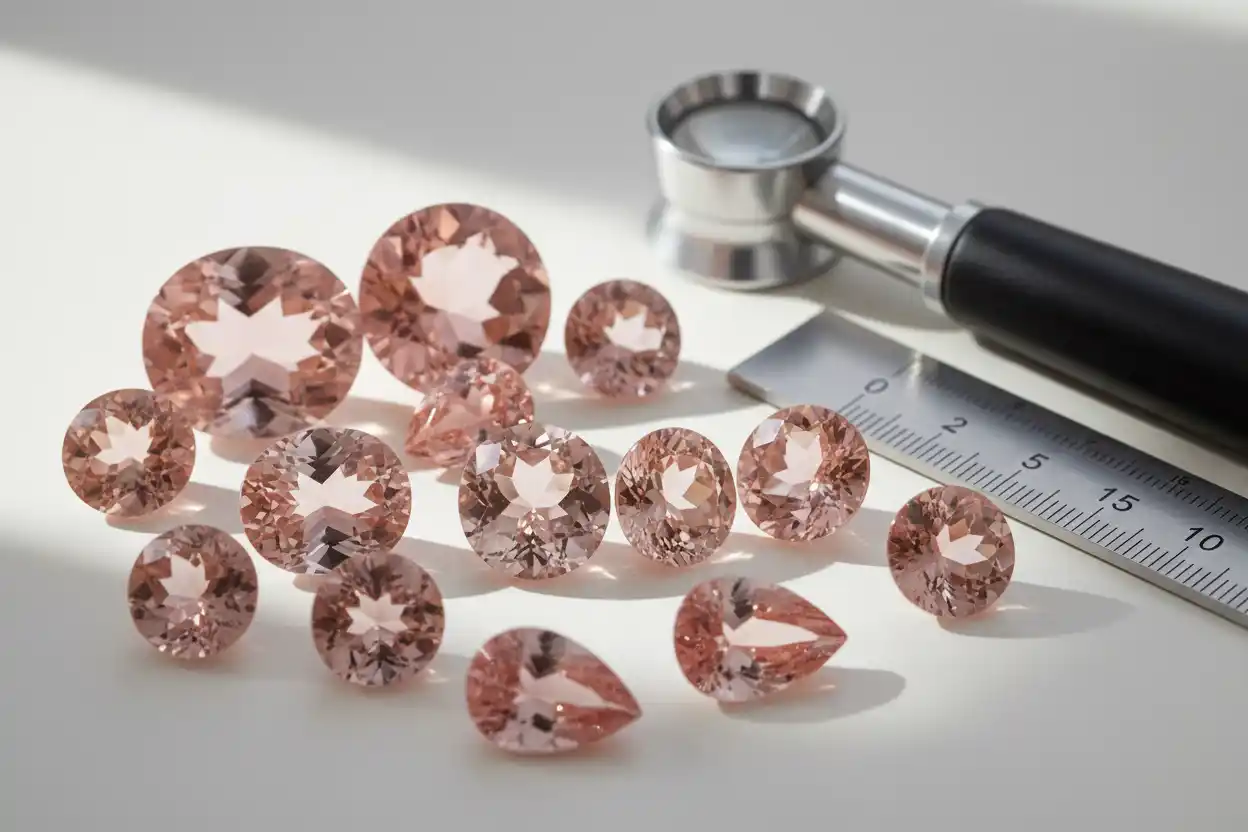
To buy morganite intelligently, judge color first but understand why the most desirable color may not represent the untreated appearance of the rough. Morganite is the pink to orange-pink variety of beryl, the same mineral family that includes emerald and aquamarine, with manganese responsible for its delicate pink coloration. GIA describes its normal palette as pink, rose, peach, salmon, purplish pink, and orangy pink, often in soft pastel tones, while stronger saturated pink is comparatively uncommon. The current market generally favors pure pink through purplish pink, but untreated peach and salmon material has developed a collector following of its own, so the strongest buying decision depends on whether you value fashionable pink, documented untreated character, or simply the color you personally prefer.
Heat treatment is central to this market. GIA states that morganite is routinely heated to remove yellow or orange components and produce a purer pink, that the resulting color is stable, and that the treatment is not detectable by normal gemological testing. This means a seller offering an ordinary pure-pink morganite as definitively unheated should provide a credible basis for the claim rather than relying on appearance, while a heated stone should not automatically be viewed as inferior. Heat treatment is a normal commercial practice, and the value difference depends on buyer preference, documentation, rarity of the untreated color, and overall beauty.
Buy Morganite At a Glance
| Buying Factor | What to Examine | Why It Matters |
|---|---|---|
| Identity | Natural morganite/pink beryl | Synthetic morganite exists and other pink gems can imitate it |
| Color | Pink, purplish pink, rose, peach, salmon | Color is morganite’s leading quality factor |
| Saturation | Stronger attractive color without excessive darkness | Strong pink is rarer than typical pastel material |
| Heat Treatment | Assume routine heating is possible | Heat commonly removes orange/yellow components and cannot usually be detected |
| Untreated Claims | Documentation and provenance rather than appearance alone | Treatment may be undetectable |
| Clarity | Eye-clean appearance | Faceted morganite is commonly free of eye-visible inclusions |
| Cut | Symmetry, brilliance, windowing, color concentration | Light rough is sometimes cut deeper to intensify color |
| Carat Weight | Size plus face-up dimensions and color | Large stones are available, so weight alone does not create extreme rarity |
| Pleochroism | Orientation of pink versus bluish-pink directions | Cutting direction affects face-up color |
| Origin | Brazil, Madagascar, Mozambique, Afghanistan and other sources | Origin can interest collectors but usually ranks below color |
| Synthetic Risk | Laboratory-grown morganite is possible | Independent testing can separate synthetic and natural material |
| Durability | Mohs 7.5–8 beryl | Suitable for jewelry but still requires sensible care |
| Fracture Filling | Rare but possible | Filling can alter cleaning recommendations |
| Report | Natural/lab-grown identity and detectable treatments | GIA identifies but does not give an overall morganite quality grade |
| Seller Grade | Actual characteristics behind AAA/AAAA | Letter grades are not universal |
Morganite Is Pink Beryl, Not “Pink Emerald”
Morganite, emerald, aquamarine, heliodor, and goshenite all belong to the beryl family, but they are separate gem varieties. GIA explicitly rejects “pink emerald” as a misleading commercial term and recommends calling the gem morganite or pink beryl.
This matters because the phrase pink emerald can be used to suggest that morganite should inherit emerald’s rarity, market prestige, and pricing structure. It does not. Morganite commonly forms much cleaner and much larger crystals than fine emerald, which changes both its appearance and supply economics.
Buyers familiar with Gems Lore’s buy emerald guide and emerald price guide should therefore avoid transferring emerald assumptions directly to morganite even though the minerals share a beryl structure.
Color Is the Most Important Quality Factor
GIA identifies color as the primary morganite quality factor and notes that pure pink through purplish pink with strong saturation is generally the rarest and most valuable market appearance. Typical morganite is much lighter, creating the pastel aesthetic that has made the gem popular in engagement and fashion jewelry.
A pale stone can still be beautiful, but very weakly colored material may appear almost colorless in certain lighting, especially at smaller sizes. Stronger pink creates better visual presence and often commands a higher price when clarity and cutting are comparable.
Color should be judged face-up under neutral light rather than through strongly pink backgrounds or warm rose-gold reflections that can make the gem appear more saturated than it really is.
Peach and Salmon Morganite Should Not Be Treated as Inferior by Default
Untreated morganite often contains an orange component, creating peach, salmon, or orangy-pink coloration. GIA notes that some collectors value untreated peach material more highly than heat-treated pink despite current fashion generally favoring rose and pink.
This produces two legitimate market preferences. Mainstream jewelry buyers often prefer the cleaner pink obtained through heating, while collectors may pay more for attractive untreated salmon or peach material when the treatment history is credible.
The buyer should therefore avoid a simplistic hierarchy in which every pink stone is automatically better than every peach stone.
Heat Treatment Is Routine and Usually Undetectable
GIA states that morganite is almost always heated to improve pink color, with heating driving away yellow or orange components and leaving a purer pink. The resulting color is stable, and the treatment is not detectable.
This has important buying consequences. A laboratory can identify morganite and many other characteristics, but it may not be able to prove that a pink stone was never heated. An untreated premium therefore depends heavily on provenance, mining history, old stock, or other credible documentary evidence.
For ordinary jewelry, heating should generally be understood as accepted market practice rather than a defect.
“Unheated” Should Not Be Used as an Unsupported Luxury Label
Because routine heat treatment may leave no detectable evidence, a seller claiming unheated status solely from visual inspection is offering more certainty than the gem itself can justify. A peach or salmon color can be consistent with untreated material, but color alone is not proof.
If an unheated claim increases the asking price significantly, ask how the seller knows. Old mine provenance, documented rough, a chain of custody, or historical collection information can provide stronger support than a generic certificate repeating the retailer’s assertion.
The underlying stone can still be high quality without an unheated premium.
Morganite Is Usually Eye-Clean
GIA states that faceted morganite generally lacks eye-visible inclusions, much like aquamarine. This changes the clarity standard considerably compared with emerald, where inclusions are normal and eye-clean stones are much rarer.
A visible dark crystal, large fracture, broad cloud, or distracting liquid inclusion therefore deserves more scrutiny in morganite because cleaner alternatives are relatively accessible.
Extremely high microscope-level clarity, however, may add little visual value once a stone is already eye-clean. Buyers should prioritize color and cut rather than paying heavily for an invisible clarity distinction.
Multiphase Inclusions Can Still Occur
GIA notes that morganite can contain liquid inclusions with gas bubbles and potentially solid phases. These inclusions can help establish natural character and interest gemologists, but they can also affect beauty or durability when large or surface-reaching.
Step-cut stones expose internal features more readily because broad facets reveal the interior clearly, while brilliant cushions and ovals can disguise small inclusions through scintillation.
A buyer should therefore set clarity expectations according to the cut rather than applying one rigid standard to every shape.
Cut Can Be Used to Intensify Light Color
Morganite’s frequent pastel character means cutters sometimes use greater depth to strengthen apparent face-up saturation. GIA specifically notes that light-colored crystals may be cut a little deeper to intensify color.
This can produce a visually richer gem, but too much depth hides weight below the girdle and reduces face-up spread. A large carat figure can therefore be less impressive than a slightly lighter stone with better visible dimensions.
Compare length, width, and depth together. The ideal stone has enough depth to maintain attractive color without sacrificing excessive visible size.
Pleochroism Makes Orientation Important
Morganite is pleochroic, showing different shades in different crystallographic directions, and GIA notes pale pink and deeper bluish-pink directional colors that cutters must consider when orienting rough.
A well-oriented stone can present the more desirable pink direction face-up, while poor orientation may leave the gem looking weaker or more orangy than necessary.
This is another reason cut quality should not be reduced to symmetry alone. The cutter is also managing how the crystal’s intrinsic color appears through the final design.
Large Morganite Is Readily Available Compared With Many Fine Gems
Morganite can form very large crystals. GIA reports Brazilian crystals exceeding 10 kilograms and notes that large faceted morganites are readily available on the market despite the gem being rarer than aquamarine mineralogically.
This means a ten-, twenty-, or even much larger carat morganite should not be treated as if its weight alone creates the extreme scarcity seen in similarly sized fine alexandrite, ruby, or emerald.
Larger stones can still cost more because stronger color is often easier to achieve in greater depth and because cutting large clean rough involves more material, but the price-per-carat curve should be interpreted within morganite’s relatively generous crystal-size supply.
Bigger Stones Often Show Color Better
GIA notes that strong morganite color is rare and that larger gems often achieve finer visible color because greater optical path length makes the pastel coloration appear more saturated.
This gives size a legitimate visual advantage beyond simple prestige. A pale one-carat gem can look nearly colorless, whereas a five- or ten-carat stone cut from similarly colored rough can show a much more recognizable pink.
Buyers should still avoid paying for weight hidden beneath the girdle. The best large stone combines stronger color with attractive face-up dimensions.
Brazil Is the Dominant Modern Source
GIA states that most morganite currently on the market comes from pegmatite mines in Minas Gerais, Brazil, while Madagascar, Afghanistan, Mozambique, Namibia, the United States, and other countries have also supplied material.
Brazil’s strong production means Brazilian origin by itself does not establish elite rarity. Individual color and cutting remain more important for most buyers.
A seller describing a stone as Brazilian should therefore still provide the actual quality information needed to justify the price.
Madagascar Has Historical and Color Significance
Morganite received its modern name after important pink beryl discoveries in Madagascar, and GIA notes that magenta-colored rough from the original Madagascar deposits continues to set a quality benchmark for strong color.
Documented old Madagascar material can therefore attract collectors, especially when the stone retains strong untreated pink, magenta, or orangy-pink coloration.
The locality premium should remain evidence-based. A vivid stone does not become Madagascan simply because it resembles classic material.
Other Origins Should Be Treated as Provenance, Not Grade
GIA documents morganite from Mozambique, Afghanistan, China, Russia, the United States, Namibia, Pakistan, and other localities, though many produce inconsistently compared with Brazil.
Country of origin can add collector interest, but morganite generally does not have the same highly developed origin-premium structure seen in ruby, sapphire, or emerald.
Most jewelry buyers should place greater emphasis on color, cut, clarity, size, treatment history, and documentation.
Synthetic Morganite Exists
GIA confirms that synthetic morganite has been produced, although not in large commercial quantities, and that gemological laboratory testing can separate it from natural material.
This means a large clean pink beryl should not be assumed natural solely because morganite commonly occurs in large eye-clean crystals.
For ordinary retail pieces from established jewelers, synthetic substitution may be a relatively minor risk, but independent identification becomes sensible when a high-value stone has unusual claims or uncertain provenance.
A GIA Report Identifies Rather Than Grades Morganite
GIA states that it evaluates morganite but does not assign an overall quality grade. Its Colored Stone Identification Report can document characteristics, state whether the material is natural or laboratory-grown, and name detectable treatments.
AAA, AAAA, 5A, premium rose, investment pink, and similar designations are therefore private seller terminology rather than universal GIA grades.
A buyer should ask what those labels mean in measurable terms: hue, saturation, tone, clarity, cut, dimensions, treatment status, and origin evidence.
Morganite Has Good Jewelry Durability
GIA places morganite at Mohs 7.5–8 and considers it durable enough for all jewelry types and daily wear, although rough handling should still be avoided.
This makes morganite substantially more scratch-resistant than moonstone, larimar, malachite, or moldavite and helps explain its popularity as an engagement-ring center stone.
Durability should not be confused with indestructibility. Facet edges can chip after hard impact, prongs can loosen, and inclusions or fractures can create local weaknesses.
Fracture Filling Is Rare but Possible
GIA’s morganite-care guidance notes that fracture filling is rare but can occur, and filled stones should be cleaned only with warm soapy water because the filler can be affected by more aggressive cleaning.
Most clean faceted morganite will not require such enhancement, but a seller should disclose it when present.
Warm water, mild soap, and a soft brush provide a conservative cleaning method for any morganite, especially when treatment history is uncertain.
Rose Gold Can Change Perceived Color
Morganite is frequently mounted in rose gold because the warm metal reinforces pink and peach tones. This design can be beautiful, but it can also make a weakly colored stone appear more saturated in photographs and during wear.
White gold and platinum provide stronger visual contrast and may make subtle pink easier to judge independently from the setting.
When comparing loose stones, inspect them against a neutral white or gray background before deciding which actually has stronger color.
Morganite Versus Aquamarine
Morganite and aquamarine are both beryl varieties and share broadly similar durability and clarity expectations. Gems Lore’s buy aquamarine guide and aquamarine price guide provide a useful comparison because both gems commonly occur in large eye-clean crystals.
The main market difference is color. Aquamarine is valued for blue to greenish-blue, while morganite is judged by pink, purplish pink, peach, and salmon.
Neither gem should inherit emerald’s rarity assumptions simply because all belong to beryl.
Morganite Versus Heliodor and Goshenite
Gems Lore’s buy heliodor guide, heliodor price guide, buy goshenite guide, and goshenite price guide cover yellow and colorless beryl varieties whose large clean crystals illustrate the broad crystal-forming capability of the beryl family.
These comparisons can help a buyer understand why size and clarity alone do not determine morganite value.
Pink color quality and market demand create the distinguishing premium.
Common Red Flags When You Buy Morganite
Be cautious when a seller calls morganite pink emerald, guarantees unheated status solely from color despite GIA’s statement that routine heat treatment can be undetectable, charges an extreme rarity premium for ordinary large size, presents AAAA as an official GIA grade, uses rose-gold photography to exaggerate weak pink, refuses to disclose whether a report identifies natural versus synthetic material, claims geographic origin from appearance alone, or treats visible inclusions as proof of natural origin. Synthetic morganite exists, and natural morganite is commonly eye-clean, so neither clarity nor size alone authenticates the stone.
How to Compare Morganite Listings Fairly
Compare stones by natural or synthetic identity, hue, tone, saturation, peach versus pink character, treatment claims, eye-visible clarity, cut, face-up dimensions, depth, pleochroic orientation, carat weight, source documentation, setting quality, condition, laboratory report, warranty, and return policy. A pale heated Brazilian ten-carat cushion, vivid untreated Madagascar old-stock stone, small synthetic morganite, and weakly cut rose-gold-mounted commercial gem belong to different value categories even when every listing uses the word morganite.
Conclusion
To buy morganite well, prioritize color, cutting, and honest treatment representation. GIA identifies pure pink through purplish pink with strong saturation as the rarest and most valuable mainstream color category, while peach and salmon untreated material can attract collectors who appreciate natural warm coloration.
Routine heating is one of the most important facts in this market because the process removes yellow-orange components, produces a purer pink, creates stable color, and may not be detectable afterward. A premium for unheated morganite therefore needs stronger documentary support than visual inspection alone.
Morganite’s naturally large crystal sizes, usually eye-clean clarity, Mohs hardness of 7.5–8, and broad availability from Brazil make it an excellent jewelry stone without requiring exaggerated rarity claims. Buyers who understand those realities can select an attractive stone for its actual color and workmanship rather than paying for misleading “pink emerald,” AAAA, or unsupported unheated language.
Frequently Asked Questions
What is morganite?
Morganite is the pink to orange-pink variety of beryl, the mineral family that also includes emerald and aquamarine. Its color is associated primarily with manganese.
What morganite color is most valuable?
GIA states that pure pink to purplish pink with strong saturation is generally the rarest and most valuable mainstream color. Peach and salmon stones can also attract collectors, particularly when credible untreated provenance exists.
Is most morganite heat treated?
Heat treatment is routine and very common. GIA notes that morganite is almost always heated to remove yellow-orange components and create a purer pink.
Can a laboratory tell whether morganite was heated?
GIA states that the routine heat treatment used to improve morganite’s pink color is not detectable. This makes unsupported unheated premiums difficult to justify without provenance.
Is peach morganite lower quality?
Not automatically. Mainstream fashion favors pink and rose, but some collectors value untreated peach or salmon material specifically because it preserves its natural warm color.
Is morganite usually eye-clean?
Yes. GIA notes that faceted morganite usually lacks inclusions visible to the unaided eye. Large obvious inclusions therefore deserve closer comparison against cleaner alternatives.
Is large morganite rare?
Morganite can form very large crystals, and large faceted gems are readily available. GIA reports Brazilian crystals exceeding 10 kilograms. Large size alone should not be treated as extreme rarity.
Where does most morganite come from?
GIA states that Minas Gerais, Brazil, is the dominant modern source, with Madagascar, Afghanistan, Mozambique, Namibia, the United States, and other countries also contributing material.
Why is Madagascar morganite important?
The original Madagascar material helped establish the modern morganite name and produced magenta-colored rough that GIA says still sets a quality benchmark for strong color.
Does synthetic morganite exist?
Yes. GIA confirms synthetic morganite exists, although it is not produced in large commercial quantities, and laboratory testing can distinguish it from natural material.
Is morganite durable enough for an engagement ring?
Yes. Morganite is Mohs 7.5–8 and GIA considers it durable enough for daily jewelry wear, although rough handling should still be avoided.
Does GIA grade morganite AAA?
No. GIA evaluates and identifies morganite but does not issue an overall quality grade. AAA and similar labels are seller-defined.
Is morganite the same as pink emerald?
No. GIA considers “pink emerald” misleading and recommends the names morganite or pink beryl.
Is morganite a guaranteed investment?
No. Future value depends on individual color, treatment claims, provenance, cutting, condition, market demand, jewelry craftsmanship, and resale liquidity rather than the gem name alone.