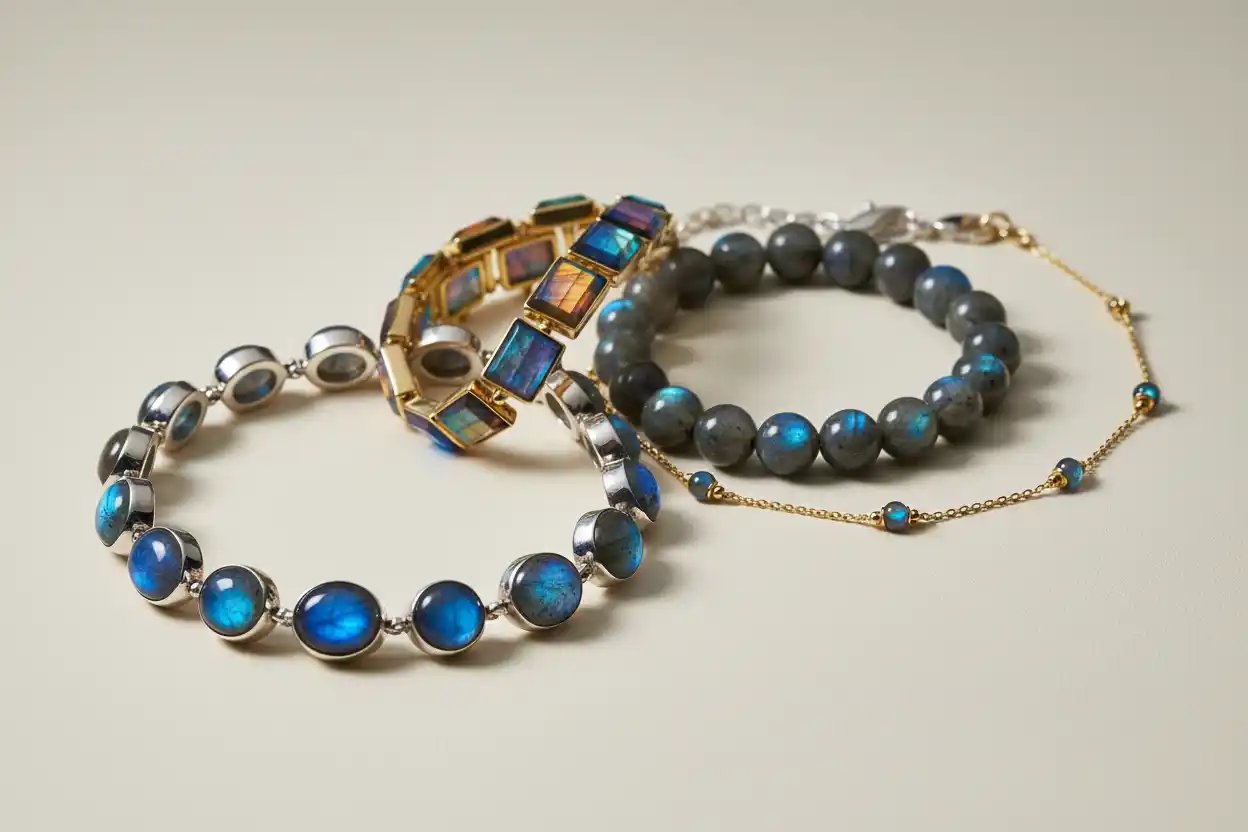
Labradorite Bracelets: Styles, Flash and Buying Guide
Labradorite bracelets transform as the wrist moves. A stone that appears gray or smoky at one angle may suddenly reveal blue, green, gold, orange, violet or multicolored light. That directional flash, called labradorescence, is the feature that determines most of the bracelet’s visual appeal.
Movement makes bracelets an effective format for displaying the phenomenon. However, the wrist also exposes labradorite to frequent impact, abrasion and moisture. The gem belongs to the feldspar group, ranks approximately 6–6.5 on the Mohs scale and has two strong cleavage directions.
A successful bracelet must therefore combine well-oriented flash with protected stones, reliable stringing or links, suitable fit and careful wear.
The broad labradorite guide owns the mineral’s formation, symbolism and uses. This page focuses specifically on bracelet styles, construction, orientation, matching, durability and buying.
Labradorite Bracelet at a Glance
| Feature | Practical meaning |
|---|---|
| Mineral family | Plagioclase feldspar |
| Signature phenomenon | Labradorescence |
| Common bodycolor | Gray, dark gray, colorless, brownish or black-looking |
| Common flash colors | Blue, green, gold, yellow, orange, red and violet |
| Mohs hardness | Approximately 6–6.5 |
| Cleavage | Strong in two directions |
| Toughness | Fair to poor for impact-prone jewelry |
| Common bracelet forms | Beads, cabochon links, stations, cuffs and charms |
| Strongest construction | Low bezel links and securely knotted beads |
| Main buying concern | Whether the flash remains visible in normal wrist movement |
| Main care concern | Impact, scratches, cleavage and stringing wear |
What Makes Labradorite Flash?
Labradorite is a member of the plagioclase feldspar series. During slow cooling, microscopic layers with slightly different compositions can develop inside the crystal.
When light enters the stone, it interacts with those internal lamellae. Interference and reflection return selected wavelengths to the viewer, producing the broad moving color known as labradorescence.
The effect is directional. A stone may flash strongly from one angle and appear plain from another.
The family-level feldspar guide explains labradorite’s relationship with moonstone, sunstone and other feldspars.
Why Orientation Matters in a Bracelet
A cutter must orient each cabochon so the flash appears across the face rather than disappearing toward one edge.
That task becomes more difficult in a bracelet because the stones rotate around the wrist. A cabochon that flashes beautifully while laid flat may become dull when the link turns sideways.
When evaluating a bracelet, do not look only at a still photograph. Watch continuous video showing the piece:
- Laid flat under diffused light
- Curved as it would sit on the wrist
- Rotated slowly
- Worn on a moving wrist
- Viewed in daylight and normal indoor light
A good bracelet does not need every stone to flash at the same instant. However, the visual movement should feel balanced rather than leaving half the bracelet permanently gray.
Labradorite Durability
Labradorite’s hardness of approximately 6–6.5 provides moderate scratch resistance. Quartz dust, steel, topaz, sapphire and diamond can scratch it.
Its more important weakness is cleavage. A sharp blow can split or chip the feldspar along internal structural planes.
The gemstone hardness chart explains scratch resistance. The guide to gemstone toughness versus hardness explains why a moderately hard gem may still be vulnerable to impact.
Bracelets encounter more knocks than earrings or pendants. Labradorite should therefore be treated as carefully worn jewelry rather than an unrestricted everyday bracelet.
Main Labradorite Bracelet Styles
| Bracelet style | Visual advantage | Main risk |
|---|---|---|
| Round bead bracelet | Continuous casual color | Drill-hole fractures and elastic failure |
| Faceted bead bracelet | Additional surface sparkle | Sharp edges abrade adjacent beads |
| Bezel-link bracelet | Displays individual flashes | Link, hinge and bezel wear |
| Prong-link bracelet | Exposes more stone | Open girdles and impact |
| Station bracelet | Lightweight modern design | Stones flip away from the viewer |
| Cuff bracelet | Large central cabochon | Rigid impact and poor wrist fit |
| Charm bracelet | Small moving labradorite elements | Charms collide with chain and each other |
| Spectrolite bracelet | Strong multicolor flashes | Premium terminology and matching |
| Rainbow-moonstone bracelet | Pale body with multicolor sheen | Trade-name confusion and cleavage |
| Mixed-gem bracelet | Contrasting colors and textures | Harder stones can scratch labradorite |
Bead Bracelets
Bead bracelets are the most common and accessible labradorite style.
Round beads show flash through curved surfaces, but not every bead can be oriented to face the viewer continuously. A good strand should produce shifting flashes around the bracelet rather than one fixed presentation.
Inspect the drill holes carefully. Cracks, chips and white stress marks can grow as the cord pulls through the bead.
Elastic is convenient but degrades from heat, skin oils, stretching and time. A high-quality bracelet should use durable elastic with a protected knot or an alternative cord system.
Knotted cord reduces bead-to-bead contact. Flexible jewelry wire provides greater security for heavier strands but requires strong crimps and end fittings.
Cabochon Link Bracelets
Cabochons allow cutters to orient broad areas of labradorescence toward the face.
A low bezel-link design offers strong edge protection and gives the stones enough movement to follow the wrist. The bezel should fit each cabochon evenly without gaps, glue or rough pressure points.
Prong-set links expose more of the stone but leave the girdles open to impact. Wide cabochons should have enough support beneath the pavilion to prevent rocking.
Link articulation is essential. A stiff bracelet can lever against the stones and sit uncomfortably.
Cuff Bracelets
A cuff may feature one large labradorite or several stones across a rigid metal band.
The central cabochon should sit low enough to avoid frequent impact. Very large stones may show exceptional flash but add weight and leverage.
The cuff must match the wearer’s wrist shape. Repeatedly bending an adjustable cuff weakens metal and can transfer force into the setting.
Check whether the opening allows the bracelet to be put on without pressing the stone against the hand.
Spectrolite Bracelets
Spectrolite is a trade name associated with especially colorful labradorite from Finland.
Fine spectrolite may display blue, green, yellow, orange, red and violet within one stone. Its dark bodycolor can create dramatic contrast.
Not every multicolored labradorite should be called Finnish spectrolite. A seller using the term should disclose whether it refers to documented locality or merely appearance.
A spectrolite bracelet may cost more because matching several strong multicolor stones is difficult. Evaluate each cabochon rather than accepting the trade name as a quality grade.
Rainbow Moonstone Bracelets
Material sold as rainbow moonstone is generally transparent to translucent white labradorite rather than traditional orthoclase moonstone.
Its flash may include blue, green, yellow, orange and violet over a pale or colorless body.
The rainbow moonstone guide explains the trade name, while Labradorite vs Moonstone owns the direct mineral and optical comparison.
A seller should not imply that gray labradorite, rainbow moonstone and traditional moonstone are identical products simply because all belong to the feldspar family.
Choosing Flash Color
Blue is the most common and familiar labradorite flash. Green, gold and yellow are also widespread.
Orange, red, violet and strong multicolor effects are generally less common and can attract premiums.
Color alone does not determine quality. Consider:
- Brightness
- Coverage
- Direction
- Contrast
- Number of colors
- Visibility during normal movement
- Surface polish
- Bodycolor
- Matching
A narrow vivid blue stripe may be attractive, while a broad weaker flash may cover more of the stone. The preferred balance depends on design.
Full-Face vs Partial Flash
Full-face flash covers most of the visible cabochon when the stone reaches its best angle.
Partial flash appears in one edge, band, patch or sector. It can still create an appealing design when the orientation is deliberate.
A bracelet does not need every stone to show full-face color. However, a seller should not photograph each cabochon at its one perfect angle and imply that the flash remains constant.
The strongest purchase video shows realistic movement without placing a separate spotlight directly over every stone.
Matching Several Stones
A cabochon bracelet should be matched for more than blue color.
Compare:
| Matching factor | What to evaluate |
|---|---|
| Bodycolor | Gray, dark gray, brown or pale background |
| Flash hue | Blue, green, gold or multicolor |
| Flash brightness | Relative intensity |
| Coverage | Full-face, partial or narrow-band flash |
| Orientation | Whether flashes appear during similar movement |
| Shape | Consistent outlines |
| Dimensions | Similar length, width and dome height |
| Polish | Even surface quality |
| Condition | Chips, cleavage lines and cracks |
A deliberate gradient can work well. Random stones with no shared visual rhythm usually look less refined.
Surface Quality and Fractures
Labradorite commonly contains internal planes, veins and dark inclusions. Some are harmless, while others reach the surface or follow cleavage.
Inspect for:
- Open cracks
- Flat reflective cleavage lines
- Chipped corners
- Surface pits
- Undercut polishing
- Glue beneath bezels
- Filled cavities
- Drill-hole fractures
- Delamination-like areas
A fracture beneath a bezel may be difficult to see. Side and back photographs provide important evidence.
Treatments and Imitations
Labradorite is not routinely enhanced on the scale of sapphire or emerald, but coatings, backing, resin filling, dyeing and assembled products can occur.
A dark backing may strengthen contrast. Coatings can add color or gloss. Resin may fill fractures or stabilize lower-quality material.
Glass and coated stones can imitate labradorescence, although their optical movement and internal structure differ.
The Labradorite Buying Guide owns the complete quality and authenticity process.
Price Factors
The labradorite price guide owns valuation.
Bracelet price depends on:
- Flash brightness
- Flash coverage
- Rarer colors
- Matching
- Cabochon size
- Bead quality
- Spectrolite locality claims
- Surface condition
- Setting metal
- Link construction
- Clasp quality
- Designer workmanship
A large bracelet with dull gray stones may cost less than a delicate bracelet containing several small, vivid multicolor cabochons.
Fit and Wrist Size
A bracelet should move slightly without sliding over the hand or striking the wrist bone repeatedly.
Bead bracelets that fit too tightly place constant pressure on drill holes and elastic. Loose strands collide with desks and doorframes more often.
Measure the wrist with a flexible tape and add allowance based on bead size. Large beads require more internal circumference than small beads because they occupy space inside the bracelet.
Link bracelets should articulate smoothly and use a secure clasp. A safety chain can reduce loss risk when it remains short enough not to catch.
Metal Choices
Sterling silver is common because its cool color complements blue and green flash. Yellow gold creates warmer contrast with gold and orange labradorescence, while rose gold can emphasize violet and coppery tones.
The metal should be strong enough for the stone weight. Very thin bezels and jump rings can distort long before the labradorite wears out.
The guide to gemstones and metals for sensitive skin explains why clasps, solder, plating and alloy composition need separate attention.
Wearing a Labradorite Bracelet
Wear the bracelet on the non-dominant wrist when practical. This reduces desk contact and impact during routine tasks.
Remove it before:
- Exercise
- Gardening
- Cleaning
- Swimming
- Showering
- Cooking
- Mechanical work
- Lifting luggage
- Sleeping
Do not stack labradorite directly beside diamond, sapphire, topaz or hard-edged metal jewelry.
The guide to best gemstones for everyday wear provides tougher alternatives for unrestricted daily use.
A matching pair of labradorite earrings or a future labradorite necklace exposes the stone to less impact. A future labradorite ring requires even stricter protection.
Symbolic Wearing
Labradorite is commonly associated with transformation, protection, intuition and creativity in modern crystal traditions.
The dedicated labradorite healing-properties guide owns those belief-based uses.
A bracelet can serve as a personal reminder or meditation cue, but its physical performance depends on mineral structure, setting and care—not metaphysical claims.
Cleaning and Spiritual Cleansing
Follow How to Clean Labradorite Jewelry Safely for physical cleaning.
Use lukewarm water, mild soap and a soft cloth or brush. Avoid ultrasonic and steam cleaning because vibration, heat and cleavage can increase damage risk.
Do not soak bead bracelets unnecessarily. Water can remain around drill holes, knots, elastic, crimps and metal components.
The separate How to Cleanse and Charge Labradorite guide explains belief-based practices that avoid damaging the stone.
Storage
Store the bracelet flat in a separate padded compartment.
Harder gemstones can scratch labradorite. Labradorite can also scratch softer stones and organic gems.
Do not leave a heavy bead bracelet hanging permanently from its elastic or clasp. Lay it in a broad curve to reduce strain.
The Crystals That Start With L and Gemstones That Start With L directories place labradorite within its wider alphabetical group.
Frequently Asked Questions
1. Is labradorite durable enough for a bracelet?
It can be worn carefully, but its moderate hardness and cleavage make it more vulnerable than sapphire, ruby or diamond.
2. Why does my bracelet look gray indoors?
Labradorescence is directional. The light source and viewing angle may not align with the internal layers that produce the flash.
3. Is blue flash more valuable than green flash?
Not automatically. Brightness, coverage, matching and overall appearance matter more than one color alone.
4. What is full-flash labradorite?
It describes a stone whose labradorescence covers most of the visible face at the best viewing angle.
5. Is spectrolite different from labradorite?
Spectrolite is a trade name associated with especially colorful Finnish labradorite. It remains part of the labradorite feldspar range.
6. Is rainbow moonstone actually labradorite?
Most material sold as rainbow moonstone is transparent white labradorite rather than traditional orthoclase moonstone.
7. Are elastic labradorite bracelets safe?
They can be wearable, but elastic degrades. Inspect it regularly and restring the bracelet before visible stretching or fraying becomes severe.
8. Can labradorite beads crack around drill holes?
Yes. Drilling creates stress points, and tight stringing or impact can enlarge existing cracks.
9. Can I wear labradorite beside diamonds?
Direct contact is not advisable because diamond can scratch labradorite.
10. Can a labradorite bracelet go in water?
Brief gentle cleaning is acceptable for sound stones, but soaking can affect cord, elastic, glue, fractures and metal components.
11. Can labradorite be cleaned ultrasonically?
No. Vibration can exploit cleavage and existing fractures.
12. What should I do if a cabochon becomes loose?
Stop wearing the bracelet and store it flat. A jeweler should inspect the stone and setting before tightening or gluing anything.
Labradorite bracelets succeed through motion, but that motion must be controlled. Strongly oriented flash, balanced matching, low protective settings, secure stringing and a close comfortable fit allow the stone to transform across the wrist without exposing its cleavage to unnecessary impact.