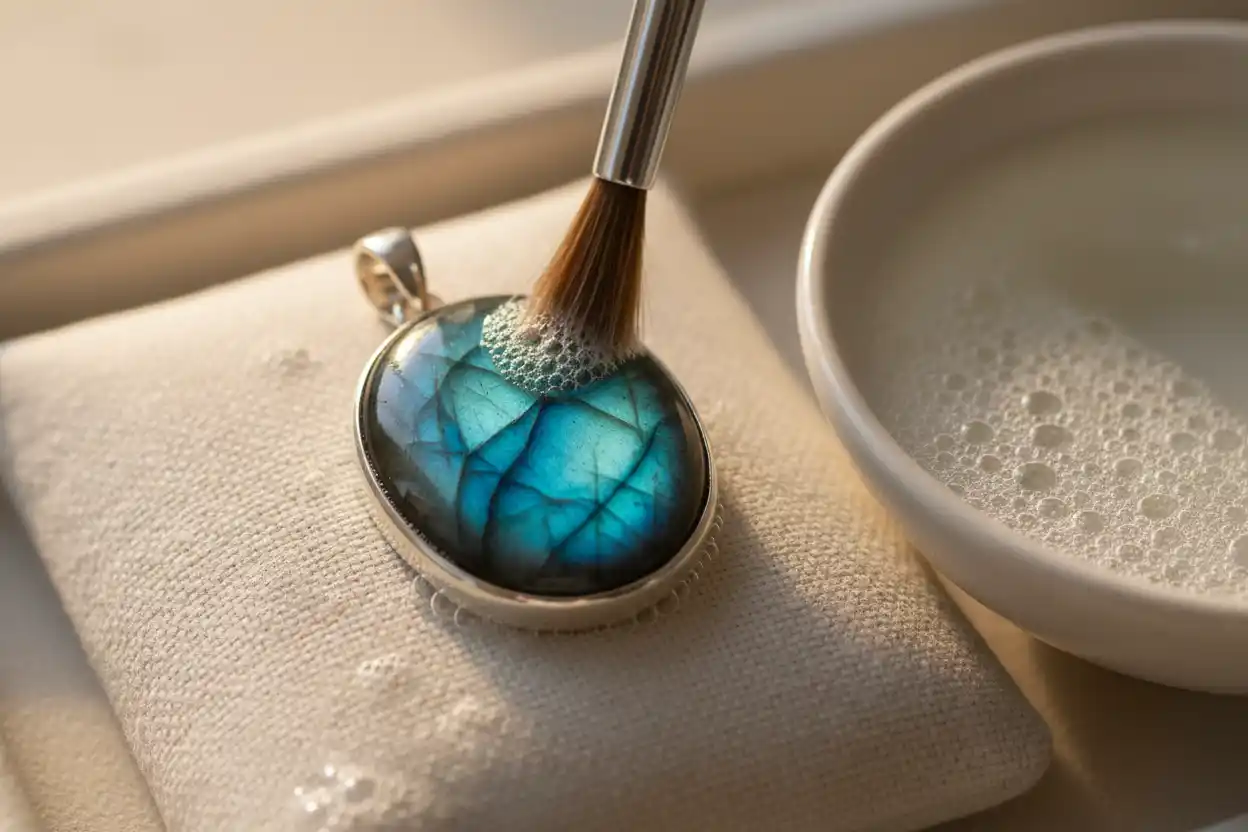
How to Clean Labradorite Jewelry Safely
Labradorite jewelry should be cleaned with lukewarm water, mild liquid soap, and a soft cloth or brush. Ultrasonic and steam cleaners should be avoided because labradorite is a cleavage-sensitive feldspar that may chip or split under impact, vibration, pressure, or sudden temperature change.
The shifting blue, green, gold, orange, or multicolored flash known as labradorescence comes from the stone’s internal structure. It is not a surface coating that needs aggressive polishing, although ordinary oil and fine scratches can make the effect less visible.
Why Labradorite Needs Feldspar-Specific Care
Labradorite is a member of the plagioclase feldspar series. Its material properties, optical effect, sources, and symbolism belong to the broader Labradorite guide and the parent Feldspar guide.
The gem usually ranks approximately 6 to 6.5 on the Mohs scale. It also has pronounced cleavage directions, meaning that a sharp impact can separate the material along relatively weak structural planes.
| Property | Cleaning implication |
|---|---|
| Mineral group | Plagioclase feldspar |
| Mohs hardness | Approximately 6 to 6.5 |
| Tenacity | Brittle |
| Cleavage | Perfect in one direction and less perfect in another |
| Optical effect | Labradorescence |
| Safest routine method | Lukewarm water, mild soap, and a soft cloth or brush |
| Ultrasonic cleaning | Avoid |
| Steam cleaning | Avoid |
| Main risks | Cleavage, impact, scratching, thermal shock, coatings, and loose settings |
The difference between hardness and resistance to breaking appears in the gemstone hardness chart and Gemstone Toughness vs Hardness.
The effect of structural weakness on otherwise wearable gems is covered in Gemstone Cleavage Explained.
Labradorescence Is an Internal Optical Effect
Labradorescence appears when light interacts with microscopic internal layers in the feldspar.
The flash may be visible only from a particular direction. A stone can look gray, dark, or nearly featureless until it is tilted into the correct viewing angle.
Cleaning removes oils that obscure the polish. It cannot change the angle at which the flash appears, correct poor cutting orientation, or create color in an area that never displayed labradorescence.
Do not scrub a non-flashing area in an attempt to uncover hidden color. Excessive polishing can remove material, change the cabochon’s shape, and damage the orientation that makes the effect visible.
Inspect the Stone Before Cleaning
Examine the jewel under bright, indirect light. Tilt it through several angles while checking the surface and setting.
Look for loose prongs, movement in the cabochon, chips along the girdle, open fractures, lifting layers, cloudy glue, and missing accent stones.
Natural internal lines and lamellar structures are not necessarily cracks. However, a fracture that reaches the surface requires conservative care.
Labradorite is frequently cut as a cabochon with a broad face. Its raised dome and exposed edges can be vulnerable in rings and bracelets.
Check for Coating, Filling, and Assembly
Labradorite may be backed with dark material, assembled into decorative pieces, coated to improve luster, filled, dyed, or stabilized.
Not every dark backing indicates deception. A designer may use a closed setting to increase contrast or protect a thin slab. Nevertheless, glue and backing materials limit water and machine cleaning.
The broader treatment categories appear in Gemstone Treatments Explained.
When the stone has a visible coating, adhesive seam, resin-filled fracture, foil back, or unknown construction, use a barely damp cloth rather than immersion.
Prepare a Gentle Cleaning Solution
Fill a shallow bowl with lukewarm water and add a few drops of mild liquid dish soap.
Prepare a second bowl of clean lukewarm water for rinsing. Use a soft lint-free cloth, a soft makeup brush, or a very soft toothbrush.
Place a folded towel beneath the working area. The padding protects the stone if it slips.
Avoid cleaning directly over an uncovered drain.
Clean Labradorite Briefly
Dampen the cloth or brush with the mild solution. Wipe the stone gently and clean around the bezel, prongs, bail, gallery, and other metal components.
Do not scrub repeatedly across a dry, dusty surface. Rinse or lift loose grit first because quartz-rich dust can scratch labradorite.
Use minimal pressure around natural edges, thin slabs, fractures, and exposed cleavage surfaces.
A brief wash is sufficient for a sound, uncoated stone in a secure setting. Extended soaking provides no meaningful benefit and may affect glue, coatings, repairs, stringing, or other materials.
Rinse and Dry Carefully
Rinse the jewelry in the second bowl or remove the soap with a clean damp cloth.
Keep the rinse close to the wash temperature. Abrupt movement between hot and cold water can stress the stone and mounting.
Blot with a lint-free cloth and allow hidden moisture to evaporate naturally.
Do not dry labradorite on a radiator, hot windowsill, vehicle dashboard, or beneath a hair dryer.
Never Use an Ultrasonic Cleaner
Labradorite should not be placed in an ultrasonic cleaner.
The vibration can stress cleavage planes, enlarge fractures, loosen a cabochon, or disturb glue, filler, and backing material.
The broader equipment comparison belongs to Which Gemstones Can Go in an Ultrasonic Cleaner?.
Even a visually intact stone may contain internal structural features that are difficult to evaluate without magnification.
Never Steam Clean Labradorite
Steam introduces heat, pressure, and rapid temperature change.
Those conditions are unsuitable for a brittle feldspar with cleavage. They may also soften glue, alter coatings, weaken repairs, or damage companion materials.
Lukewarm soapy water provides adequate routine cleaning without thermal stress.
Cleaning a Labradorite Ring
A Labradorite ring faces frequent impact against desks, doors, counters, and household objects.
Clean around the cabochon without pressing on its dome or edge. Check that the bezel or prongs remain tight.
Remove the ring before exercise, gardening, household cleaning, swimming, and manual work.
Protective bezels are preferable to highly exposed settings, although dirt may collect around the metal edge.
Cleaning Labradorite Earrings
Labradorite earrings usually face less impact than rings.
Clean posts, hooks, backs, caps, and drilled components carefully. Avoid prolonged immersion when stones are glued into metal caps.
Keep alcohol-based disinfectant on compatible metal fittings and away from adhesive, coatings, or filled areas.
Cleaning a Labradorite Necklace
A Labradorite necklace or pendant is a practical format for displaying a broad area of labradorescence.
Apply perfume, hairspray, sunscreen, and lotion before putting on the necklace. These products can create a film that obscures the flash.
Prevent the chain from rubbing across the cabochon during cleaning and storage.
Cleaning a Labradorite Bracelet
A Labradorite bracelet combines cleavage-sensitive stones with repeated wrist movement.
Inspect every cabochon, bead, link, knot, and clasp before cleaning.
Beaded bracelets may contain elastic or cord that should not be soaked. Wipe individual beads and dry the strand flat.
Remove the bracelet before desk work or other activities that repeatedly strike the wrist against hard surfaces.
Spectrolite and Rainbow Moonstone
Spectrolite is a trade name associated particularly with Finnish labradorite displaying a broad and vivid spectral range.
Its variety-specific background belongs to the Spectrolite guide. It follows the same conservative physical cleaning method as other labradorite.
So-called rainbow moonstone is commonly a transparent to translucent labradorite with blue or multicolored flash. Its identity is covered in the Rainbow Moonstone guide.
The direct distinction between the two feldspar materials belongs to Labradorite vs Moonstone.
Labradorite Versus Moonstone Care
Both stones belong to the feldspar group and require protection from impact, cleavage, ultrasound, steam, and sudden temperature changes.
The separate guide to cleaning Moonstone jewelry owns the adularescence-specific sibling intent.
This page remains focused on plagioclase labradorite, labradorescence, broad cabochons, and commonly encountered backed or glued constructions.
Chemicals and Abrasives to Avoid
Do not use toothpaste, baking soda, scouring powder, stiff brushes, polishing paste, or abrasive cloths.
Keep labradorite away from bleach, chlorine, acetone, drain cleaner, oven cleaner, strong acids, and aggressive alkaline products.
Vinegar and lemon juice offer no advantage over mild soap and may affect the setting, plating, glue, or accompanying stones.
Household polishing compounds can alter the cabochon’s surface and reduce the quality of the flash.
Storage and Preventive Care
Store labradorite separately in a padded compartment or soft pouch.
Diamond, sapphire, ruby, topaz, quartz, and many other stones can scratch it. Metal chains and clasps can also create wear.
The Types of Labradorite guide covers color, transparency, spectrolite, rainbow moonstone, sunstone-related material, and trade terminology.
Buying considerations belong to the Labradorite buying guide, while market factors appear in the Labradorite price guide.
Physical Cleaning Versus Cleansing
Physical cleaning removes dust, skin oil, cosmetics, and residue that obscure the polish.
Traditional spiritual practices belong to How to Cleanse and Charge Labradorite. Those practices should still respect the material’s cleavage and should not replace cleaning or setting inspection.
Questions about prolonged immersion belong to the broader guide to crystals in water. A brief controlled wash is different from soaking jewelry for hours.
Frequently Asked Questions
1. What is the safest way to clean labradorite?
Use lukewarm water, mild soap, and a soft cloth or brush, followed by careful rinsing and room-temperature drying.
2. Can labradorite get wet?
Brief controlled washing is normally acceptable for a sound stone. Avoid soaking glued, coated, filled, backed, strung, or damaged jewelry.
3. Can labradorite go in an ultrasonic cleaner?
No. Vibration can stress cleavage planes, fractures, glue, and settings.
4. Can labradorite be steam cleaned?
No. Steam introduces heat, pressure, and thermal shock that may fracture the stone.
5. Does cleaning improve labradorescence?
Cleaning can remove oil that obscures the polish, but it cannot change cutting orientation or create an internal flash.
6. Can toothpaste polish labradorite?
No. Toothpaste is abrasive and may dull the surface or alter the cabochon.
7. Is dish soap safe for labradorite?
A few drops of mild liquid dish soap are suitable. Avoid bleach, abrasives, and aggressive chemical formulas.
8. Can vinegar clean labradorite?
Vinegar is unnecessary and may affect metal, glue, coatings, and companion materials.
9. Why does my labradorite flash only at one angle?
Labradorescence depends on how light meets internal layers and the way the stone was oriented during cutting.
10. Can scratches be removed at home?
No. Repolishing changes the stone’s surface and may affect its flash orientation, so it belongs to an experienced lapidary.
11. How often should labradorite jewelry be cleaned?
Wipe it after wear and wash it only when oils or residue noticeably reduce the polish.
12. When does labradorite require professional care?
Seek professional help for cracks, chips, lifting layers, loose settings, damaged coatings, or a sudden loss of polish and flash.
Conclusion
Labradorite’s optical display depends on its internal feldspar structure and careful cutting rather than a removable surface layer. Mild manual cleaning preserves the polish without stressing cleavage or backing materials. When the flash appears weak after cleaning, examine the viewing angle, cut orientation, and surface condition before attempting any stronger method.