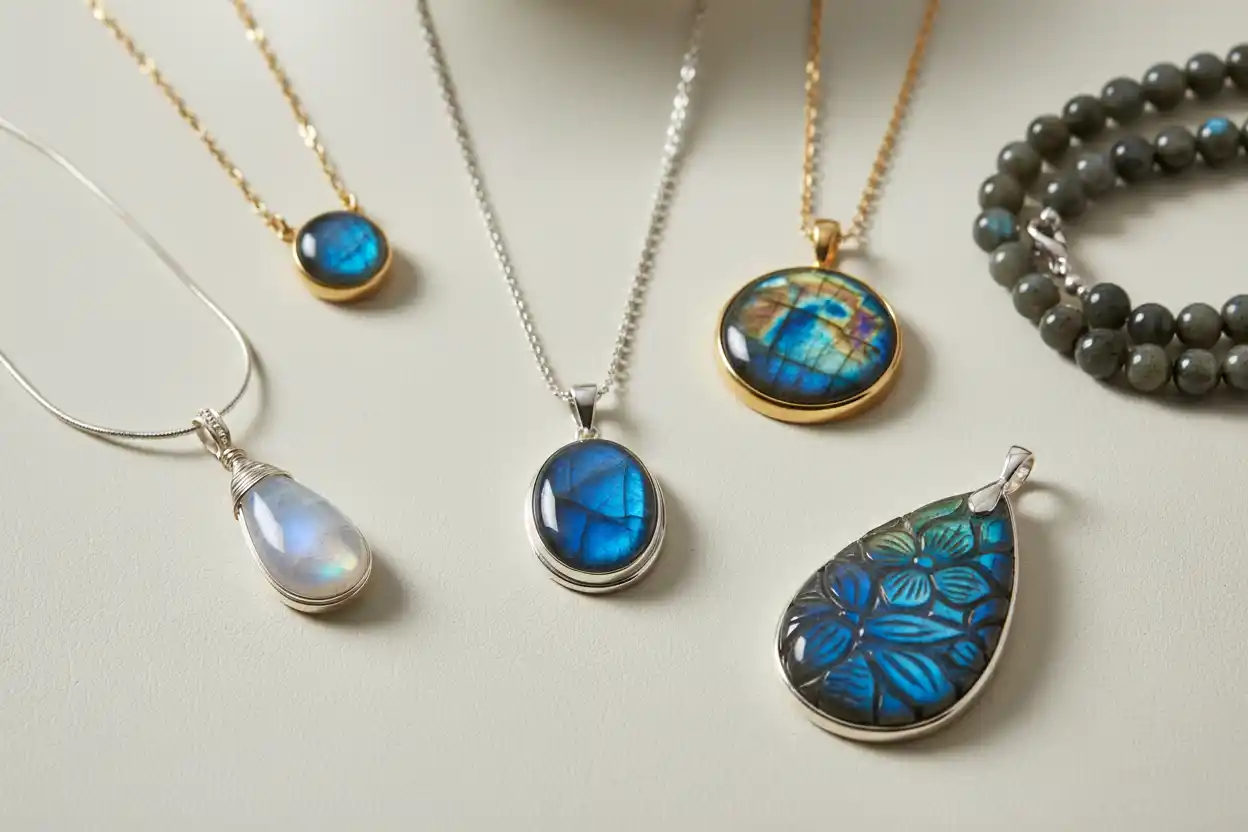
Labradorite Necklaces and Pendants: Buying Guide
Labradorite necklaces place the gemstone where movement and changing light can reveal its strongest feature: labradorescence. A pendant may look smoky gray while resting, then produce a broad blue, green, gold or multicolored flash as the wearer turns.
Necklaces also protect labradorite better than rings and bracelets. The chest encounters fewer hard surfaces, allowing larger cabochons and carvings to be worn with less impact. However, orientation, bail construction, chain strength, setting height and pendant balance still determine whether the piece displays well and remains secure.
The broader labradorite guide explains the feldspar’s geology and optical phenomenon. This page focuses specifically on finished necklaces and pendants.
Labradorite Necklace at a Glance
| Feature | What to evaluate |
|---|---|
| Main visual factor | Brightness and face-up orientation of labradorescence |
| Best stone form | Well-oriented cabochon or protected carving |
| Strongest setting | Low bezel or supportive framed setting |
| Typical flash colors | Blue, green, gold, orange, red, violet and multicolor |
| Mohs hardness | Approximately 6–6.5 |
| Main weakness | Cleavage and edge chipping |
| Best chain position | Upper to mid-chest for most substantial pendants |
| Main construction concern | Bail, jump ring and chain strength |
| Main authenticity concern | Coatings, backing, glass and trade-name confusion |
| Safest cleaning | Lukewarm water, mild soap and gentle hand cleaning |
Why Pendants Suit Labradorite
Labradorite has moderate scratch resistance but strong cleavage in two directions. Hand jewelry exposes it to frequent impact, while pendants usually hang in a lower-risk position.
A necklace also allows the stone to move through a controlled arc. That movement can reveal labradorescence without the chaotic rotation seen in loose bead bracelets.
The guide to best gemstones for everyday wear provides durability context. Labradorite is not an unrestricted daily-wear stone, but pendants are among its most practical jewelry forms.
Long necklaces can still strike desks and counters. Large pendants should therefore hang high enough to avoid frequent collisions.
Main Labradorite Necklace Styles
| Style | Main visual advantage | Main concern |
|---|---|---|
| Solitaire cabochon pendant | Focuses on one strong flash | Orientation and bail balance |
| Full-bezel pendant | Strong edge protection | Closed backs can hide treatments |
| Prong-set pendant | Exposes more of the stone | Girdle and corner vulnerability |
| Halo pendant | Adds contrast and visual size | Hard accents and many prongs |
| Wire-wrapped pendant | Artistic handmade appearance | Pressure points and exposed edges |
| Carved pendant | Large surface and personal motif | Thin sections and drilled areas |
| Station necklace | Several flashes along a chain | Stones can flip backward |
| Bead strand | Broad field of changing color | Drill holes, cord and bead abrasion |
| Spectrolite pendant | Strong multicolor display | Locality and trade-name claims |
| Rainbow-moonstone pendant | Pale body with deep iridescence | Confusion with traditional moonstone |
| Multi-stone necklace | Graduated or complementary flashes | Matching and numerous settings |
| Raw-crystal pendant | Natural texture | Cleavage, glue and unstable matrix |
Solitaire Cabochon Pendants
The simplest pendant uses one oval, round, pear, shield, rectangle or freeform cabochon.
A good cabochon should display strong color while hanging upright—not only while lying flat beneath a spotlight.
Before buying, ask for a continuous video showing the pendant:
- Flat on a neutral background
- Held vertically by the bail
- Rotated from side to side
- Hanging against skin or fabric
- Viewed in diffused daylight
- Viewed under ordinary indoor lighting
The flash should appear through realistic movement. A seller who rotates the stone nearly sideways may be demonstrating an orientation that will not be visible during wear.
Full-Bezel Pendants
A bezel surrounds the labradorite’s perimeter and provides strong protection against lateral impact.
The metal should fit smoothly without gaps, crushed edges or glue seepage. An open or partially open back allows inspection and may reduce weight.
A fully closed back can strengthen the pendant, but it may also conceal:
- Fractures
- Dark backing
- Foil
- Resin
- Glue
- Composite construction
- A replacement stone
- An unfinished surface
Ask for written disclosure when the reverse cannot be inspected.
Prong-Set Pendants
Prongs expose more of the gemstone and can make a transparent or pale labradorite appear lighter.
However, open settings leave more of the girdle vulnerable. The stone should sit within a supportive basket rather than extending below or beyond the metal frame.
Rounded cabochons need fewer corner protections than rectangular or pointed shapes. Pears and marquises should have guarded tips.
One prong should not press over a visible cleavage line. Labradorite can split if setting pressure concentrates at a structural weakness.
Halo Pendants
A halo can frame labradorite with diamonds, sapphires, moissanite, cubic zirconia or other gems.
The accents create contrast and can make a moderate cabochon look more substantial. A low halo may also protect its edges.
Hard accent stones should not touch the labradorite directly. Their girdles and prongs can scratch or chip the softer feldspar if the setting flexes.
Every accent material should be identified on the invoice rather than described only as “sparkling stones.”
Wire-Wrapped Labradorite
Wire-wrapped pendants are common because freeform labradorite does not always fit standard settings.
A good wrap supports the stone at several balanced points without placing sharp wire pressure over a cleavage plane. The pendant should not rattle or slide within the frame.
Inspect the wire ends. They should be tucked away from skin and clothing.
Very thin wire can deform, while thick wire may place excessive force against the stone. Adhesive should be disclosed if it contributes to security.
Carved Labradorite Pendants
Labradorite may be carved as leaves, moons, animals, geometric shapes, faces, talismans or abstract forms.
The cutter must preserve the correct flash orientation while creating the design. A beautiful carving can still appear dull if the iridescent plane faces sideways.
Inspect thin points, drilled loops, openwork and narrow bridges. Cleavage makes these areas more vulnerable.
A metal cap can strengthen a drilled top but may conceal a fracture or glue. Side and back photographs are essential.
Raw Labradorite Pendants
Raw pendants preserve natural crystal faces, broken surfaces or matrix.
They may be drilled, capped, wire wrapped or glued into metal.
The main concerns are loose flakes, cleavage edges, unstable matrix and sharp points. A raw specimen suitable for display may not be safe against clothing or skin.
A smooth polished back improves comfort but should not be mistaken for a completely natural, unaltered crystal.
Spectrolite Necklaces
Spectrolite is associated with vivid Finnish labradorite that may display several saturated spectral colors.
A fine pendant can show blue, green, yellow, orange, red and violet against a dark bodycolor.
Because spectrolite is a locality-associated trade name, ask whether the stone is documented as Finnish or is merely being described for its appearance.
A multicolor flash does not automatically establish Finnish origin.
Rainbow Moonstone Pendants
Most rainbow moonstone is transparent or translucent white labradorite.
Its iridescence may appear deeper within the stone than the surface-like flash of dark-body labradorite.
These pendants often use prongs or open backs to emphasize transparency. The setting should still protect the feldspar from impacts and pressure.
The direct Labradorite vs Moonstone guide explains why rainbow moonstone, traditional moonstone and dark labradorite should not be treated as identical products.
Labradorite Bead Necklaces
Bead strands provide constant shifting color as individual beads rotate.
Round, oval, faceted, disk, graduated and freeform beads are available. No strand can keep every bead at its best angle simultaneously, so balanced movement matters more than one perfect product photograph.
Inspect drill holes for:
- Chips
- Cracks
- White stress marks
- Rough edges
- Resin
- Uneven drilling
- Thin walls
- Cord abrasion
Knots between beads reduce contact and limit loss if the strand breaks. Heavy strands need strong cord, reinforced ends and a clasp suited to the total weight.
The general crystal necklaces guide explains strand styles and symbolic wearing.
Station Necklaces
Station necklaces place small labradorites at intervals along a chain.
The stones may be bezel set, drilled or capped. Each station should connect at two balanced points if the design is intended to remain face-up.
One-point connections allow more movement but can cause frequent flipping.
The stones should remain far enough apart that they do not strike one another when the necklace curves.
Matching Multiple Labradorites
A multi-stone necklace can use identical flashes, a color gradient or intentionally varied stones.
Compare:
| Matching factor | What to assess |
|---|---|
| Bodycolor | Pale, gray, brown, dark or transparent |
| Flash color | Blue, green, gold, orange, violet or multicolor |
| Brightness | Relative intensity |
| Coverage | Full-face, partial or narrow-band |
| Orientation | Angle at which the flash appears |
| Shape | Uniform or deliberately graduated |
| Dome height | Consistency in cabochons |
| Surface polish | Scratches, pits and undercutting |
| Condition | Chips and cleavage fractures |
Perfect uniformity is not necessary. The layout should still feel deliberate.
Flash Orientation
Orientation is the central quality factor in a labradorite pendant.
The internal lamellae responsible for the color occupy particular planes. A cutter who angles the polished surface correctly can create a strong face-up flash. A small error can move the best color toward the edge.
A pendant setting introduces another orientation decision: how the stone hangs.
The bail should support the gem so its strongest face remains approximately toward the viewer. An off-center bail can rotate the stone away from its best color.
Full-Face and Partial Flash
Full-face flash covers most of the cabochon at the correct angle. It creates a bold solitaire.
Partial flash can appear as a band, patch or diagonal sweep. It may suit carved and asymmetrical designs.
Brightness and color rarity must be considered with coverage. A narrow vivid red-orange flash may be more distinctive than a broad weak blue sheen.
The Labradorite Buying Guide provides the complete quality framework.
Choosing Flash Color
Blue remains the most popular and widely available.
Green and gold can create warm transitions, while orange, red and violet are generally less common. Multicolor stones can become the focal point of a necklace without accent gems.
White metal emphasizes blue and green. Yellow gold strengthens gold and orange, while rose gold can complement violet and coppery flashes.
The metal can change the apparent warmth but cannot create labradorescence that is absent from the stone.
Bail Construction
The bail carries the pendant’s complete weight and determines how it hangs.
Check:
- Opening size
- Chain-end compatibility
- Metal thickness
- Solder joints
- Alignment
- Articulation
- Hidden glue
- Wear at the jump ring
- Clearance above the stone
A large pendant on a thin decorative bail creates a mechanical mismatch.
An articulated bail allows natural movement. A fixed bail may keep the stone facing forward but must be aligned precisely.
Choosing the Chain
The chain should support the pendant without looking disproportionately heavy or delicate.
Suitable styles include cable, box, wheat, curb, rope and snake chains. Strength varies according to construction, metal and link thickness.
A substantial labradorite should not be placed on the thinnest chain simply because the combination photographs elegantly.
The chain’s end fitting must pass through the bail. A pendant sold without a chain should list the internal bail dimensions.
Necklace Length
| Style | Typical placement | Labradorite consideration |
|---|---|---|
| Choker | Base of the neck | Good for small pendants; greater cosmetic contact |
| Princess | Upper chest | Versatile and relatively protected |
| Matinee | Mid-chest | More movement and desk contact |
| Opera | Lower chest | Greater swinging and snagging |
| Rope | Long or doubled | Higher risk of collision and tangling |
Princess length suits many medium and large cabochons because it allows movement without placing the stone near a tabletop.
Exact placement depends on the wearer’s proportions, clothing and pendant dimensions. Request actual chain length rather than relying only on style names.
Metal Choices
Sterling silver is common and complements blue, green and violet flash. Yellow gold works well with gold, orange and multicolored stones. Rose gold can warm gray bodycolor and strengthen violet tones.
The setting metal must be thick enough to protect the gem. Thin bezels, jump rings and prongs can distort before the labradorite itself shows wear.
The guide to gemstones and metals for sensitive skin explains alloy, nickel, solder and plating concerns.
Treatments, Backing and Imitations
Labradorite is not routinely enhanced through one dominant process, but commercial alterations occur.
These include:
- Resin filling
- Surface coating
- Dark backing
- Foil
- Dye
- Wax
- Oil
- Assembly with glass
- Glue
- Composite construction
Coated glass and layered materials can imitate shifting color. Larvikite, moonstone and rainbow moonstone may also be marketed under confusing names.
A closed-back setting deserves special attention because it can conceal backing and assembly.
Price and Value
The labradorite price guide owns detailed valuation.
Pendant price depends on flash brightness, coverage, color, size, carving, surface condition, spectrolite claims, setting metal, chain quality, designer labor and brand.
Large size alone does not create rarity. A smaller vivid full-face cabochon may be more desirable than a large gray stone whose flash appears only at an extreme angle.
In gold jewelry, metal and craftsmanship can exceed the gemstone’s value.
Buying Online
Follow How to Buy Gemstones Online Without Getting Scammed and request:
| Buying detail | What to confirm |
|---|---|
| Material | Natural labradorite or accurately disclosed alternative |
| Trade name | Spectrolite, rainbow moonstone or ordinary labradorite |
| Flash | Continuous video while the pendant hangs vertically |
| Stone dimensions | Length, width and depth |
| Pendant dimensions | Complete length and weight |
| Setting | Bezel, prongs, wrap, cap, drilling or glue |
| Treatment | Backing, coating, resin, dye or assembly |
| Metal | Alloy, hallmark and plating |
| Chain | Length, gauge, clasp and removability |
| Condition | Cracks, chips, scratches and repairs |
| Returns | Time for non-destructive inspection |
A laboratory report may be useful for an expensive spectrolite claim, unusual transparent feldspar or a disputed imitation. The gemstone certification guide explains the document’s role.
Styling a Labradorite Necklace
A blue-flash pendant pairs naturally with black, gray, navy, denim and cool neutral clothing.
Gold and multicolor labradorite can work with warm earth tones. Pale rainbow-moonstone material suits lighter fabrics and minimal metalwork.
The necklace does not need to match every flash in the wearer’s labradorite earrings. Coordinating bodycolor or metal often creates a more natural set.
A labradorite bracelet adds more movement but receives greater impact. A future labradorite ring requires a more protective setting.
Symbolic Wearing
Modern crystal traditions associate labradorite with transformation, intuition, creativity and protection.
The dedicated labradorite healing-properties guide owns those beliefs and their evidence limits.
A pendant may serve as a reminder of a personal change or boundary. Its optical flash results from internal feldspar structures rather than a scientifically detected protective field.
Cleaning and Storage
Follow How to Clean Labradorite Jewelry Safely.
Use lukewarm water, mild soap and a soft cloth or brush. Avoid ultrasonic and steam cleaning.
Support a heavy pendant while cleaning so its weight does not pull on the bail. Rinse over a bowl rather than an open drain.
Dry around the setting, bail, chain and drilled areas. Store the necklace flat or in a broad curve, with the pendant in its own padded compartment.
Spiritual cleansing belongs to How to Cleanse and Charge Labradorite and should use non-damaging methods.
Repair and Maintenance
Inspect the bail, jump rings, prongs, bezel, chain, clasp, drill holes and glue periodically.
Stop wearing the necklace if the stone moves or the bail begins opening.
Tell the jeweler that the gemstone is labradorite. Heat, pressure, vibration and aggressive polishing can damage the feldspar or alter its orientation.
Replacing a stone in a custom pendant can be difficult because the new cabochon must match the outline, depth and flash direction.
Frequently Asked Questions
1. Is labradorite suitable for necklaces?
Yes. Pendants and necklaces are among the safest jewelry forms because they expose the stone to less impact than rings and bracelets.
2. What is the best setting for a labradorite pendant?
A low, accurately fitted bezel generally provides the strongest edge protection.
3. Why does my pendant look gray while hanging?
Its best flash may have been oriented for a flat photograph rather than an upright setting, or the current light angle may not activate the labradorescence.
4. Is full-face flash necessary?
No. Partial flash can be attractive, but the visible color should appear through realistic movement rather than an extreme angle.
5. What chain length is best?
Princess length works well for many pendants because it places the stone on the upper chest with controlled movement.
6. Is spectrolite better than ordinary labradorite?
Fine spectrolite can show exceptional multicolor flash, but the term should be supported by Finnish origin rather than used as a generic grade.
7. Is rainbow moonstone a labradorite necklace?
Most rainbow-moonstone jewelry contains transparent white labradorite rather than traditional orthoclase moonstone.
8. Can labradorite be wire wrapped safely?
Yes, when the wire supports the stone without applying sharp pressure over cleavage planes or leaving unstable edges exposed.
9. Can a dark backing make the flash stronger?
Backing can increase contrast and should be disclosed. It does not create the internal labradorescence itself.
10. Can a labradorite necklace be cleaned ultrasonically?
No. Vibration can worsen fractures and cleavage-related weakness.
11. Should an expensive pendant have a laboratory report?
A report can be useful for a disputed identity, unusual transparent stone or valuable spectrolite claim, though ordinary commercial pieces rarely require one.
12. What should I do if the pendant starts flipping backward?
Check the bail alignment, chain weight and setting balance. A jeweler may be able to alter the connector without replacing the stone.
Labradorite necklaces work best when the lapidary and jeweler solve the same problem together: the internal layers must face the light, and the finished pendant must continue facing the wearer. Strong orientation, a balanced bail, adequate chain, protected edges and honest disclosure allow the flash to remain the centerpiece rather than a moment created only for the product photograph.