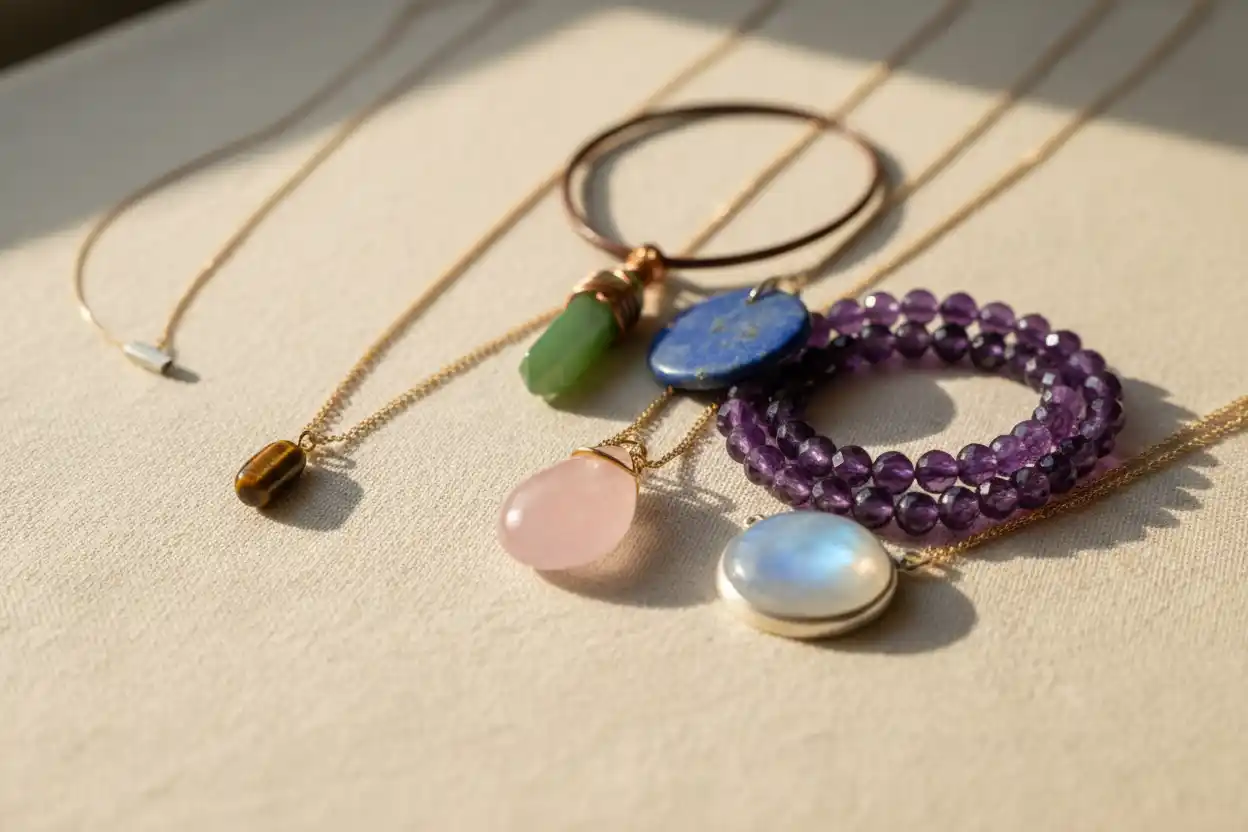
Crystal Necklaces: Meanings, Styles and How to Choose
Crystal necklaces include bead strands, polished pendants, faceted gemstones, wire-wrapped points and carved charms worn around the neck. They can be selected for color, birthstone tradition, mineral interest, personal symbolism or the tactile reminder created by jewelry that remains close to the upper body.
The word crystal does not identify the material. A necklace may contain quartz, jade, glass, resin, pearl, coral, laboratory-grown gems or reconstructed stone. Therefore, choosing well requires more than matching a meaning with a color: the wearer also needs accurate material disclosure, secure construction, appropriate length and care suited to the softest component.
Crystal Necklaces at a Glance
| Necklace type | Main advantage | Primary concern |
|---|---|---|
| Single-stone pendant | Highlights one material clearly | Bail and setting security |
| Bead strand | Displays color around the neckline | Thread, knots, drill holes and clasp |
| Wire-wrapped crystal | Flexible artisan style | Wire pressure and exposed points |
| Cabochon pendant | Protects opaque or included material | Setting should support the edge |
| Faceted gemstone pendant | Adds brilliance and formal style | Cut, treatment and prong condition |
| Crystal-point necklace | Preserves a recognizable shape | Sharp tips and fragile terminations |
| Chip necklace | Accessible and informal | Rough edges and weak drill holes |
| Station necklace | Lightweight and easy to layer | Links may flip or open |
| Multi-strand necklace | Strong visual impact | Weight and clasp strength |
| Cage pendant | Allows stones to be changed | Loose stones can escape |
| Carved-heart necklace | Adds relationship symbolism | Lower point can chip |
| Cluster pendant | Natural crystal appearance | Fragility and excessive weight |
What Is a Crystal Necklace?
A crystal necklace is any neck-worn design containing a material sold within the crystal, mineral or gemstone market.
Some pieces use natural crystals with visible faces. Others contain polished beads or cabochons cut from massive material.
A necklace may also use rocks such as lapis lazuli, organic gems such as pearl or coral, and manufactured materials such as glass or cubic zirconia.
The completed crystals-versus-gemstones guide explains the categories.
The seller should identify the exact material rather than relying on phrases such as natural healing crystal, gemstone-style or authentic energy stone.
Crystal Necklace Meanings
A necklace’s meaning comes from several overlapping sources:
- The material.
- Color.
- Shape.
- Birthstone tradition.
- Cultural history.
- Chakra symbolism.
- The person who gave it.
- The event it commemorates.
- The wearer’s own intention.
A rose quartz heart pendant combines compassion symbolism with the heart shape.
A jade bead strand may represent continuity and stewardship, while a clear quartz point may symbolize a defined intention.
The current crystal meanings chart provides a quick comparison of common stones.
These meanings remain symbolic rather than scientifically proven effects.
Pendants Versus Bead Necklaces
A pendant concentrates attention on one central stone.
It usually uses less gemstone material and can be transferred to another chain when the bail is large enough.
A bead necklace displays repeated material around the neckline. Matching, drill-hole condition, stringing and clasp construction become major quality factors.
Pendants generally allow easier stone identification because a larger surface remains visible.
Beads may hide treatments around drill holes or combine several quality grades within one strand.
Neither format is universally better.
The choice depends on comfort, visual effect, durability and the amount of maintenance the wearer accepts.
Common Necklace Lengths
| Length | Typical placement |
|---|---|
| 14–16 inches | Choker or close to the base of the neck |
| 18 inches | Near the collarbone on many wearers |
| 20–24 inches | Upper chest |
| 28–36 inches | Long strand or layering length |
| Over 36 inches | Rope style, often doubled |
Body proportions, neck circumference, clothing and pendant size change where a necklace sits.
A large bead strand fits more tightly than a fine chain with the same outer measurement because beads reduce the internal circumference.
Request the complete length and pendant dimensions rather than relying on model photographs.
An extender adds flexibility, but it must remain strong enough for the necklace’s weight.
Choosing a Length by Use
A short necklace keeps the stone visible near the collarbone but may feel restrictive during heat, swelling or long wear.
Eighteen inches offers a common everyday starting point.
Longer chains work with high necklines and larger pendants, although they move more and may strike furniture or equipment.
For active work, a shorter secured pendant or no necklace may be safer.
A necklace should not interfere with uniforms, tools, machinery, medical devices or protective equipment.
Comfort and occupational safety take priority over chakra placement.
Pendant Styles
Bezel-Set Pendants
A bezel surrounds the stone’s edge and provides useful protection.
It works especially well for cabochons, opaque gems and cleavage-prone stones.
Prong-Set Pendants
Prongs expose more of a transparent gemstone and allow light to enter.
Each prong should contact the stone securely without snagging clothing.
Drilled Pendants
The material may be drilled directly for a cord or metal loop.
Inspect the hole for cracks and chipping.
Wire-Wrapped Pendants
Wire wrapping allows irregular stones to be worn without drilling.
The wire should support the stone without creating concentrated pressure.
Glued-Cap Pendants
A metal cap may be attached with adhesive.
This construction can fail through heat, water or age and should be disclosed.
Bead Necklace Construction
A bead strand may use silk, synthetic thread, flexible beading wire or metal links.
Individual knotting reduces bead contact and limits loss when a strand breaks.
Knots should sit close to each bead.
Large gaps can indicate stretched thread.
Flexible beading wire provides strength but must not show sharp kinks or exposed strands.
Crimps need professional compression.
The clasp, end connections and final knots often fail before the center of the strand, so inspect the complete necklace rather than the beads alone.
Rose Quartz Necklaces
The completed rose quartz necklace guide owns the material-specific selection, construction and care intent.
Rose quartz traditionally symbolizes compassion, affection and self-respect.
Its soft pink color works in beads, cabochons, hearts and polished drops.
Natural rose quartz is commonly cloudy.
A necklace does not attract love or guarantee reconciliation.
Its responsible meaning can involve care that remains compatible with boundaries.
Amethyst Necklaces
The drafted amethyst necklace guide explains color, settings and wear.
Amethyst traditionally represents contemplation, moderation and reflective awareness.
Faceted stones provide more brilliance, while bead strands and polished points show color zoning and inclusions.
Prolonged intense sunlight can fade purple quartz.
The necklace does not treat anxiety, insomnia or addiction.
Moonstone Necklaces
The completed moonstone necklace guide covers adularescence, orientation and setting quality.
Moonstone symbolizes cycles, transition and adapting to change.
A pendant protects feldspar better than an exposed ring, although the stone can still chip through cleavage.
The strongest color flash should face forward when the pendant hangs naturally.
Moonstone does not regulate hormones, create fertility or guarantee emotional calm.
Jade Necklaces
The completed jade necklace guide owns jadeite, nephrite, treatment and construction.
Jade traditionally symbolizes continuity, stewardship and wisdom.
True jade means jadeite or nephrite.
Serpentine, quartz, aventurine, glass and composites may be sold under jade-like names.
High-value jadeite requires particular attention to bleaching, polymer impregnation and dyeing.
Lapis Lazuli Necklaces
The completed lapis lazuli necklace guide explains bead quality, treatment and metal choices.
Lapis lazuli traditionally symbolizes knowledge, truth and responsible communication.
It is a multi-mineral rock rather than a single mineral crystal.
White calcite and golden pyrite can occur naturally.
Dyeing, waxing and reconstruction are common commercial concerns.
Avoid perfume, prolonged water exposure and abrasive cleaning.
Tiger’s Eye Necklaces
The completed tiger’s-eye necklace guide covers chatoyancy, bead orientation and buying.
Tiger’s eye symbolizes observation, practical confidence and risk awareness.
A well-cut pendant displays a moving band as the piece turns.
The necklace can remind the wearer to pause before acting, but it cannot protect against accidents or guarantee business success.
Heat treatment and imitation material occur.
Pearl Necklaces
The completed pearl necklace guide owns matching, knotting, surface and clasp selection.
Pearl is an organic gem rather than a mineral crystal.
It traditionally symbolizes wisdom, continuity and gradual development.
Pearls are soft and sensitive to acids, cosmetics and dry storage conditions.
Put them on after fragrance and makeup, then wipe them gently after wear.
A pearl strand benefits from individual knotting.
Opal Necklaces
The completed opal necklace guide explains opal body types, treatments and setting concerns.
Opal symbolizes creativity, complexity and changing perspective.
A pendant protects opal better than many ring designs, although heat, dryness and impact remain important.
Doublets and triplets use assembled construction and should be disclosed.
An opal necklace should not be soaked or exposed to rapid temperature changes.
Sapphire Necklaces
The completed sapphire necklace guide owns color, treatment, settings and buying.
Sapphire symbolizes integrity, discipline and commitment.
Its hardness of 9 supports regular wear.
Natural, heat-treated, diffusion-treated and laboratory-grown stones are available.
A secure prong or bezel setting remains important despite the gemstone’s scratch resistance.
Hardness does not prevent every chip or loss.
Coral Necklaces
The drafted coral necklace guide covers organic material identity, treatment, stringing and sourcing.
Coral is animal-derived skeletal gem material rather than a mineral crystal.
Its symbolism includes continuity, vitality and connection with the sea.
Coral is soft, porous and chemically sensitive.
Species, legal source and international trade documentation can be as important as bead matching.
Heart Pendants
The current crystal hearts guide explains the carved shape and gift symbolism.
A heart pendant adds themes of affection, remembrance and connection to the stone’s meaning.
Inspect the lower point and center notch because both areas can chip or crack.
A heart does not create commitment or consent.
The message should match the relationship rather than relying on the shape alone.
Crystal-Point Necklaces
Point pendants may be natural crystals, polished carvings or manufactured shapes.
Natural points retain growth faces and terminations, while polished points have been cut.
A point can symbolize direction and focus.
However, it does not emit a scientifically proven energy beam.
Sharp tips should face away from the skin or use a protective cap.
Avoid sleeping in a point necklace because the tip, wire or chain can press into the body or catch bedding.
Choosing a Necklace by Traditional Meaning
| Intention | Common necklace choices | Responsible interpretation |
|---|---|---|
| Compassion | Rose quartz, rhodonite and jade | Offer care without losing boundaries |
| Confidence | Carnelian, tiger’s eye and citrine | Prepare and act deliberately |
| Communication | Lapis lazuli, sodalite and aquamarine | State facts and needs clearly |
| Reflection | Amethyst, moonstone and smoky quartz | Pause and examine assumptions |
| Focus | Clear quartz, sapphire and iolite | Define one task and reduce distraction |
| Grounding | Smoky quartz, onyx and red jasper | Return attention to immediate needs |
| Transition | Moonstone, labradorite and aventurine | Adapt the plan thoughtfully |
| Commitment | Garnet, sapphire and jade | Follow through through repeated action |
| Protection symbolism | Black tourmaline, obsidian and tiger’s eye | Pair symbolism with real safety measures |
| Prosperity symbolism | Citrine, jade and aventurine | Review resources and take practical action |
The necklace cannot create the outcome listed in the first column.
Necklaces and Chakra Placement
Modern practices associate necklaces with the throat, heart and upper-body chakra areas.
Blue stones may be linked with the throat chakra, while pink and green stones are associated with heart traditions.
A pendant’s location changes with chain length, body shape and movement.
No evidence shows that a gemstone opens a medically verified energy center because it rests near a particular part of the body.
Choose chain length for comfort, appearance and safety first.
Spiritual placement can remain optional symbolism.
Metal Choices
Yellow gold adds warmth to red, orange, green and pink stones.
White gold, platinum and silver create stronger contrast with many colors.
Rose gold complements pink, peach and warm neutral materials.
The complete alloy matters.
Nickel, copper, brass, plating and solder can cause skin reactions.
The completed guide to gemstones and metals for sensitive skin explains common concerns.
Do not assume that a natural crystal makes the full necklace hypoallergenic.
Cords, Chains and Clasps
Cotton and synthetic cords provide an informal appearance but absorb moisture and wear through friction.
Leather can dry, stretch and react poorly to repeated water exposure.
Fine chains suit small pendants, while heavy stones need stronger links.
The bail opening should accommodate the chain without rubbing excessively.
Lobster clasps provide practical security, while spring rings may be difficult for people with limited dexterity.
A safety chain or secondary latch benefits valuable bead necklaces and tennis-style designs.
Sleeping in a Crystal Necklace
Remove necklaces before sleep.
Chains and cords can catch bedding, hair or nearby objects.
Pendants can press into the chest or neck, while points and chips can scratch the skin.
A broken necklace may release small stones that become hazards for children or pets.
The completed guide to wearing crystals while sleeping explains broader safety considerations.
Place the necklace in a secure box instead.
Showering and Swimming
Remove crystal necklaces before showering, bathing or swimming.
Even water-tolerant quartz may be attached to glue, cord, plated metal or a clasp that does not tolerate prolonged moisture.
Soap leaves residue, while chlorine and saltwater can damage stones and settings.
Organic and porous materials such as pearl, coral, turquoise and amber require particular caution.
Dry the necklace thoroughly after accidental exposure.
Cleaning Crystal Necklaces
Care should follow the most vulnerable component.
Use a soft cloth for routine cleaning.
Do not soak a necklace unless the stone, metal, stringing, adhesive and treatment are all known to tolerate water.
Steam and ultrasonic machines are unsuitable for many included, filled, porous, organic and cleavage-prone gems.
The completed guide to cleansing crystals separates symbolic cleansing from physical cleaning.
Symbolic sound or visualization does not require exposing the necklace to water, smoke or salt.
Authenticity and Treatment
Inspect color, pattern, bubbles, drill holes, surface and seller disclosure.
Common issues include:
- Dyed howlite sold as turquoise.
- Glass sold as quartz.
- Composite jade.
- Dyed agate.
- Reconstructed coral.
- Synthetic birthstones sold as natural.
- Coated quartz.
- Plastic sold as amber.
The exact material may require professional testing.
Avoid scratch, flame, solvent and impact tests on finished jewelry.
Buying a Crystal Necklace
Ask for:
- Exact material.
- Natural, laboratory-grown or simulated status.
- Treatment.
- Pendant or bead dimensions.
- Necklace length.
- Total weight.
- Metal composition.
- Stringing material.
- Clasp type.
- Actual-item photographs.
- Return policy.
The completed guide to buying gemstones online provides seller and photography checks.
A high price does not prove authenticity, while a modest laboratory-grown or manufactured stone can remain attractive when disclosed honestly.
Frequently Asked Questions
1. What does wearing a crystal necklace mean?
Its meaning depends on the stone, shape, cultural tradition, gift context and wearer’s own intention.
2. Which crystal necklace is best for beginners?
Clear quartz, amethyst, rose quartz, tiger’s eye or durable agate provides an accessible starting point.
3. Which crystal necklace represents love?
Rose quartz, rhodonite, garnet and jade carry relationship symbolism, but they cannot create attraction or commitment.
4. Which crystal necklace symbolizes confidence?
Carnelian, tiger’s eye, citrine, sunstone and ruby are common choices.
5. Does necklace length change a crystal’s energy?
No proven evidence shows that chain length changes metaphysical energy. Length primarily affects comfort, placement and appearance.
6. Can I wear several crystal necklaces together?
Yes, when their weight, lengths, hardness and metal components remain compatible and comfortable.
7. Can crystal necklaces be worn every day?
Durable stones and secure settings may suit daily wear. Softer, porous or cleavage-prone materials require greater caution.
8. Can I sleep in a crystal necklace?
Removing it is safer because chains, cords, pendants and points can catch or press into the body.
9. Can I shower with a crystal necklace?
Removing it is recommended because water, heat, soap and chemicals can damage stones, metals, cords and adhesives.
10. How can I tell whether a crystal necklace is genuine?
Check material disclosure, pattern, bubbles, drill holes, treatment and seller evidence. Important pieces may require professional testing.
11. How should a crystal necklace be cleaned?
Use the method appropriate to the softest stone, treatment, setting and stringing component. A soft cloth is the safest routine starting point.
12. Do crystal necklaces have scientifically proven healing effects?
No. Their chakra, healing and energy meanings are spiritual traditions rather than established medical effects.
Choose for the Neckline and the Material
A crystal necklace can combine personal symbolism with color, craftsmanship and wearable design. Yet a meaningful stone will not compensate for a weak clasp, uncomfortable length or undisclosed treatment.
Start with how the necklace will be worn, identify the material accurately and choose a setting that protects it. The symbolism can accompany the wearer, while construction and care determine whether the piece remains usable.
Disclaimer: Crystal-necklace healing, chakra, protection, attraction and prosperity properties reflect cultural and spiritual traditions rather than established medical, relationship or financial effects. Necklaces should not replace healthcare, safety measures or professional advice, and they should be removed whenever they create entanglement, skin irritation or workplace hazards.