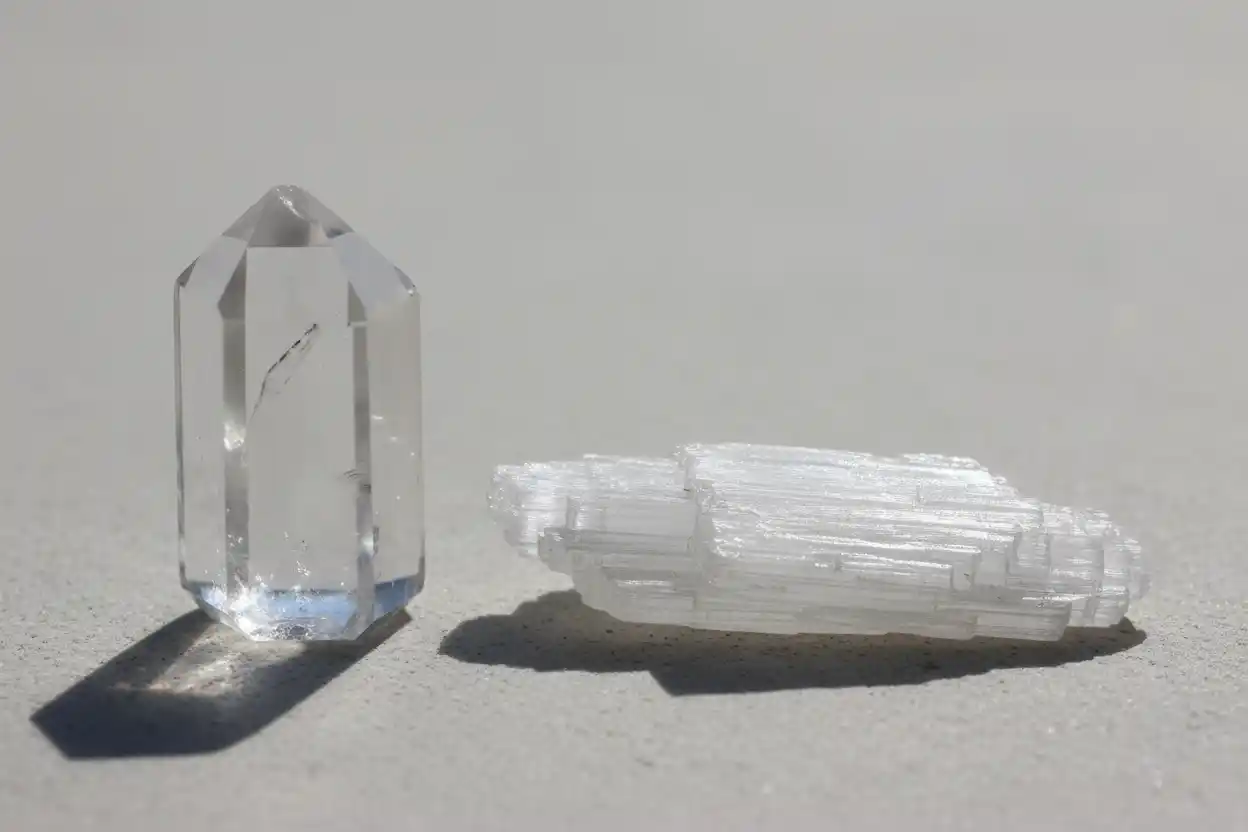
Clear Quartz vs Selenite: Differences & Which to Choose
Clear quartz vs selenite is an unusually useful comparison because the two materials can share a colorless, translucent, or transparent appearance while differing dramatically in mineral identity, hardness, cleavage, density, optical properties, water resistance, jewelry suitability, and safe handling. Clear quartz is crystalline silicon dioxide, SiO₂, with a Mohs hardness of about 7 and no true cleavage, whereas selenite is a transparent to translucent crystalline variety of gypsum, CaSO₄·2H₂O, with a Mohs hardness near 2 and highly developed cleavage. Those differences are large enough that a correctly examined specimen is usually much easier to separate than photographs might suggest. Within Gems Lore’s Identification coverage, the important principle is therefore to identify the material through converging physical evidence rather than treating transparency, spiritual terminology, or a retail label as proof.
The practical choice is equally different. Clear quartz tolerates routine handling, polishing, jewelry use, and ordinary environmental exposure far better because it is substantially harder and mechanically less cleavage-prone. Selenite can be beautiful as a specimen, display striking transparency and cleavage-related reflections, and suit protected display exceptionally well, but it scratches easily and can split or abrade under conditions that would barely affect quartz. Neither material is universally superior. The correct choice depends on whether the owner needs a durable wearable stone, a delicate display specimen, a transparent mineral for collecting, a carved decorative object, or a symbolic item whose physical limitations are fully understood.
Clear Quartz vs Selenite at a Glance
| Property | Clear Quartz | Selenite |
|---|---|---|
| Mineral identity | Crystalline quartz | Transparent to translucent crystalline gypsum |
| Simplified composition | SiO₂ | CaSO₄·2H₂O |
| Crystal system | Trigonal | Monoclinic |
| Typical appearance | Colorless, transparent to translucent, commonly prismatic | Colorless to white, transparent to translucent, commonly tabular, bladed, or elongated |
| Mohs hardness | About 7 | About 2 |
| Specific gravity | About 2.65 | About 2.3 |
| Refractive index | Roughly 1.544–1.553 | Roughly 1.519–1.530 |
| Cleavage | No true cleavage | Highly developed cleavage |
| Typical fracture behavior | Conchoidal to uneven | Cleavage dominates breakage |
| Surface durability | Good for many jewelry and handling situations | Very easy to scratch and abrade |
| Water exposure | Generally resistant to brief ordinary water contact | Better kept away from prolonged soaking and aggressive wet cleaning |
| Common commercial confusion | Glass, synthetic quartz, coated quartz, polished manufactured shapes | Satin spar gypsum frequently sold under the broader “selenite” name |
| Best general use | Jewelry, lapidary work, durable specimens, carvings, display | Protected specimen display, delicate decorative use |
| Strongest easy distinction | Much greater hardness and lack of gypsum-like cleavage | Extreme softness and obvious cleavage |
These standard mineralogical and gemological property ranges make the underlying distinction much stronger than the visual resemblance. Clear quartz and selenite overlap enough in transparency and luster to confuse an untrained observer in a photograph, yet a hardness difference of roughly five Mohs units represents a profound difference in everyday behavior. A fingernail can scratch gypsum under suitable conditions, while it cannot scratch quartz; however, deliberately scratching a valuable, polished, historic, or fragile specimen is unnecessary when non-destructive identification methods and existing damaged surfaces can provide safer evidence.
Clear Quartz and Selenite Are Completely Different Minerals
Clear quartz is the colorless transparent form of crystalline quartz. Its silicon-oxygen framework is responsible for the hardness, chemical resistance, lack of true cleavage, and characteristic crystal habit associated with quartz. Natural crystals frequently develop as six-sided prisms capped by rhombohedral faces, although growth conditions can create squat, elongated, distorted, twinned, skeletal, or otherwise modified forms. Internal fluid inclusions, healed fractures, mineral inclusions, growth zoning, and cloudy areas are common enough that transparency should never be interpreted as proof of absolute purity.
Selenite is a crystalline variety of gypsum, a hydrated calcium sulfate. The water molecules are part of gypsum’s crystal structure rather than simply moisture trapped on its surface, and the resulting material has a very different mechanical character from quartz. Well-developed selenite may occur as transparent plates, blades, elongated crystals, swallow-tail twins, or other forms whose broad cleavage surfaces can produce striking reflections. Its softness is so pronounced that routine contact with harder objects can leave permanent marks.
This species-level difference is more important than any shared metaphysical description. Similar-looking stones are frequently assigned comparable symbolic roles because they are white or transparent, but mineral identity does not follow color symbolism. The same reasoning applies when comparing unrelated materials in fluorite vs amethyst: visual overlap can begin the investigation, but structure and measurable properties settle it.
Selenite Is Not the Same Thing as Every White Fibrous Gypsum Object
One of the most persistent commercial naming problems involves satin spar gypsum. Long fibrous white wands, towers, bowls, charging plates, and carved objects are frequently sold as “selenite,” even though mineralogical usage more precisely distinguishes transparent crystalline selenite from fibrous satin spar. Both are gypsum and therefore share the same basic chemical composition, but their crystal habits, visual textures, and mechanical behavior are not identical.
This distinction matters when comparing clear quartz vs selenite because a transparent bladed gypsum crystal may superficially resemble colorless quartz more closely than an opaque silky satin spar tower does. If a seller shows a luminous white fibrous wand and calls it selenite, the underlying mineral may still genuinely be gypsum, but the variety or habit name is being used loosely. Correcting that language does not make the object fake; it simply makes the description more precise.
Trade naming problems occur across the gem market. The broader principles explained in gemstone treatments explained are useful here because mineral identity, treatment, trade name, and appearance should always be treated as separate attributes rather than compressed into one sales term.
Visual Clues Under the Same Light and Scale
Clear quartz generally has a glassy vitreous luster and, where natural crystal faces survive, a recognizable prismatic geometry. Internal fractures can produce bright reflective planes and rainbow-like interference colors, while growth faces may display subtle horizontal striations. A broken quartz surface commonly curves through conchoidal fracture rather than separating into broad repeated cleavage sheets.
Selenite can also appear vitreous, particularly on fresh crystal surfaces, but cleavage faces may show a pearly quality and broad planar reflections that behave differently from typical quartz fracture surfaces. Thin transparent selenite plates may look remarkably glass-like until edge structure, cleavage, or surface softness becomes apparent. Some elongated crystals also show internal-looking linear features related to cleavage and growth that should not automatically be interpreted as fibrous inclusions.
The photographs become most informative when both specimens are shown at the same scale, under identical lighting, with front, side, termination, and naturally damaged surfaces visible. If one stone is photographed against black velvet under strong backlighting while the other is shown under diffuse room light, apparent brilliance and transparency become almost meaningless comparison points. This controlled-light principle is equally important in transparent gem comparisons such as citrine vs yellow topaz, where camera settings can create a larger visual difference than the minerals themselves.
An Original Same-Light, Same-Scale Photo Framework
A useful photo comparison begins with two confirmed or well-documented specimens placed on the same neutral background and photographed in one frame rather than as separately edited images. The camera should remain fixed while both specimens receive the same diffused light. A ruler or neutral scale marker can establish physical dimensions, while an unedited white or gray reference can help reveal whether color balance has shifted. This setup does not create a laboratory identification, but it removes several avoidable sources of visual bias.
The first photograph should show overall crystal habit. Clear quartz should be evaluated for prismatic form, terminations, contact faces, fracture, and natural growth surfaces, while selenite should be examined for tabular or bladed development, cleavage, twinning, and broad planar faces. A second image from the side can reveal whether the apparent “point” is natural growth or a manufactured polished termination, which matters particularly for decorative quartz towers.
A third close photograph should focus on an existing edge, damaged surface, or naturally exposed fracture rather than deliberately harming the specimen. Quartz commonly reveals conchoidal or irregular breakage, whereas gypsum may show flat cleavage-related separation. Surface abrasion also matters: a selenite specimen may display fine scratches and bruised edges from ordinary handling that would be unusual on comparable quartz.
The final photograph should use transmitted or back lighting at equal exposure. This can reveal internal veils, fractures, cloudiness, cleavage traces, or growth structures without pretending that light transmission establishes species. The framework is intended to compare evidence consistently; it does not turn photographs into refractometers, hardness tests, or chemical analyses.
Hardness Is the Most Dramatic Practical Difference
Quartz sits around 7 on the Mohs scale, while gypsum sits around 2. This means clear quartz can scratch many common materials and resists scratching from objects that would easily damage selenite. Gypsum is soft enough to be scratched by a fingernail, although intentionally performing that test on a collector specimen can permanently reduce its condition and value.
The difference becomes obvious in ownership. A clear quartz point can usually tolerate careful routine handling, placement on shelves, gentle washing when appropriate, and conventional lapidary work far better than selenite. Selenite can acquire scratches merely from contact with harder mineral specimens, metal tools, gritty dust, or abrasive cloth. Even careless wiping can dull a delicate surface when hard particles are trapped between the cloth and crystal.
Hardness should still not be confused with toughness. Quartz can fracture when dropped or sharply struck, while its pointed terminations can chip. The advantage is comparative rather than absolute: quartz is much more resistant to surface wear and does not possess gypsum’s pronounced cleavage vulnerability.
Cleavage Changes How Selenite Breaks
Selenite’s cleavage is one of its most characteristic mechanical properties. The crystal structure permits relatively easy separation along specific planes, which can create broad flat surfaces and thin plates. This is why a crystal that looks substantial can still split unexpectedly when pressure is applied in an unfavorable direction.
Clear quartz lacks true cleavage. When it breaks, the fracture commonly curves rather than repeatedly following a crystallographic plane. This distinction can sometimes be recognized on pre-existing damage, making it useful without performing a destructive test.
Cleavage is also why a higher hardness number alone never describes gemstone durability completely. The same broader lesson appears in citrine vs yellow sapphire: hardness helps predict scratching, while fracture and cleavage behavior help predict how a material responds to impact and setting stress.
Optical Properties: Close Enough to Confuse the Eye, Different Enough to Test
Clear quartz generally has a refractive index around 1.544 to 1.553, whereas gypsum falls lower, around approximately 1.519 to 1.530. The ranges are separated enough that conventional refractive-index measurement can help identify a suitable polished specimen, although testing an unpolished crystal face may be impractical depending on orientation and surface quality.
Both materials are doubly refractive, but their crystallographic and optical characters differ. Quartz is trigonal and uniaxial, while gypsum is monoclinic and biaxial. These are meaningful diagnostic distinctions for a trained observer using appropriate instruments, although they are far more technical than most household identification needs require.
The important limitation is that apparent sparkle cannot substitute for optical measurement. Cut, polish, lighting, internal fractures, surface condition, and photography can make one specimen look more brilliant than the other. Similar limitations arise in aquamarine vs topaz, where optical measurements carry considerably more diagnostic weight than impressions such as “looks brighter.”
Density Can Support the Identification, but It Is Less Dramatic Than Hardness
Clear quartz has a specific gravity near 2.65, while gypsum is around the low 2.3 range. A quartz object and a gypsum object with genuinely identical volume should therefore not weigh exactly the same, although the difference is modest compared with comparisons involving exceptionally dense minerals.
Subjective heft is rarely enough for a secure identification because people estimate volume poorly, particularly when comparing different shapes. A broad thin selenite plate and compact quartz point may feel different primarily because their geometry is different. Hydrostatic testing can provide stronger density evidence when the specimen is appropriate for the method, but fragile or valuable gypsum should not be subjected to unnecessary procedures simply to satisfy curiosity.
The practical hierarchy is therefore clear: crystal habit and existing cleavage can provide initial clues, hardness differences are highly diagnostic when assessed safely, and conventional optical or density measurements can confirm uncertainty without relying on photographs alone.
Clear Quartz vs Selenite and Glass Confusion
Glass adds another complication because transparent manufactured glass can imitate many colorless minerals. Gas bubbles, mold seams, flow structures, perfectly uniform surfaces, and manufactured shapes can suggest glass, but each clue needs context. Some natural quartz contains rounded-looking fluid inclusions, and a polished quartz sphere will obviously lack natural external crystal faces.
Selenite is usually easier to distinguish from ordinary glass because its softness and cleavage are so different, yet a highly polished or manufactured gypsum object can still confuse someone working only from photographs. The broader glass vs crystal reference is useful when the question has expanded beyond quartz versus gypsum and the material may not be a natural mineral at all.
The key is to avoid false elimination. Showing that an object is not selenite does not automatically prove quartz, just as showing that something is not quartz does not prove glass. Identification requires positive properties that support the proposed material.
Treatments and Manufactured Appearance
Clear quartz can enter commerce in natural, synthetic, polished, drilled, coated, filled, heated, irradiated, assembled, or otherwise altered forms. A clear quartz tower may be genuine natural quartz whose entire outer geometry was shaped by a lapidary. Aura-style quartz can involve a genuine quartz substrate with an artificial metallic coating. Synthetic quartz is also chemically and structurally quartz even though it was grown under controlled conditions rather than through natural geological processes.
Selenite and other gypsum varieties are generally less treatment-intensive in ordinary mineral retail, but cutting, carving, polishing, dyeing, coating, gluing, repairing, or assembling pieces can still occur. Decorative satin spar items are routinely manufactured into towers, bowls, plates, and lamps. The fact that a shape was cut by people does not make the gypsum artificial as a mineral material.
Composite objects deserve additional caution whenever a transparent item displays suspicious boundaries, adhesive lines, mismatched optical behavior, or separate layers. The concepts covered in gemstone doublets and triplets explain why an apparently unified object can contain more than one material, particularly in jewelry and manufactured decorative pieces.
An Original Decision Matrix: Which Material Fits the Job?
| Your priority | Clear Quartz is usually the better fit when… | Selenite is usually the better fit when… |
|---|---|---|
| Frequent handling | You want a specimen that tolerates routine careful handling | The object can remain largely protected and stationary |
| Jewelry wear | You need practical hardness for pendants, earrings, beads, or some rings | You accept a very soft material suited only to highly protected or specialized use |
| Scratch resistance | Surface durability is important | Scratching and abrasion can be carefully controlled |
| Water exposure | Occasional gentle washing is desirable for an appropriate specimen | Dry or minimally damp care can be maintained |
| Natural crystal collecting | You prefer robust prismatic quartz forms and varied inclusions | You value bladed, tabular, twinned, or transparent gypsum crystal forms |
| Carved decorative objects | You want a more wear-resistant polished object | You specifically like gypsum’s soft luminous appearance and can protect it |
| Optical clarity | You want durable transparent material | You want transparent gypsum and accept delicate handling |
| Low-maintenance display | You want fewer concerns about routine dusting and repositioning | A closed or protected display environment is practical |
| Symbolic use | You want an object that can be handled repeatedly with less wear | You can use the specimen mainly as a visual symbol without frequent manipulation |
| Mineral identification study | Quartz habit, fracture, inclusions, and optics are the focus | Cleavage, twinning, gypsum habit, and softness are the focus |
This matrix shows why the clear quartz vs selenite decision is not simply “which crystal is better.” Clear quartz usually wins when durability and handling matter, while selenite can be the more interesting choice when a collector values gypsum crystal habit, cleavage phenomena, transparency, or a particular specimen aesthetic. The physical requirements of the use case should drive the choice before price or symbolic marketing does.
The same decision-based approach works well in aventurine vs jade, where materials that may serve similar decorative purposes still have different structures, wear properties, and market expectations.
Jewelry Durability Strongly Favors Clear Quartz
Clear quartz is suitable for many jewelry forms because its hardness around 7 provides reasonable resistance to ordinary scratching. It can still chip, fracture, and abrade, especially in rings or bracelets exposed to repeated impact, but properly cut and set quartz is a conventional wearable gemstone.
Selenite is poorly suited to ordinary exposed jewelry. Its hardness around 2 means a polished surface can scratch quickly, while cleavage increases the risk of splitting. Pendants or earrings designed around protected gypsum may survive occasional careful wear, but everyday rings, exposed bracelets, and settings that place pressure on the crystal are inherently demanding choices.
This does not mean every object sold as “selenite jewelry” is fraudulent. Some pieces genuinely use gypsum, while others may use different white or transparent materials. The important question is whether the seller accurately identifies the material and whether the design acknowledges its mechanical limitations.
Comparative durability should always be treated as material-specific. Carnelian vs red jasper involves two silica-rich materials with far closer mechanical behavior, whereas clear quartz and gypsum occupy very different durability categories.
Care: Clear Quartz Is More Forgiving
A clean, untreated clear quartz specimen without delicate associated minerals can often be rinsed or gently washed using mild methods, although the full specimen must always determine the care plan. Matrix minerals, coatings, repaired fractures, adhesives, metallic inclusions, or other components may be less tolerant than the quartz itself.
Selenite deserves more conservative care. Gypsum is relatively soft and has limited water solubility, so prolonged soaking, repeated wetting, vigorous scrubbing, or aggressive chemical cleaning can damage surfaces and sharp edges over time. The mechanical action of cleaning is often as important as chemistry because a brush or gritty cloth can readily scratch the mineral.
A soft dry brush, controlled air movement, or very careful minimally damp cleaning may be more suitable depending on the object, but valuable specimens should not be subjected to improvised experiments. Water should never be treated as an authenticity test.
Value: Neither Material Has One Universal Price
Clear quartz is abundant globally, but the phrase “quartz is common” does not mean every quartz specimen is cheap. Collector value can increase with exceptional transparency, crystal perfection, large undamaged terminations, rare inclusions, unusual growth forms, attractive matrix associations, documented locality, historic collection provenance, aesthetic composition, or high-quality lapidary work.
Selenite is also widespread enough that ordinary commercial material can be inexpensive, particularly mass-produced satin spar decorative items. Exceptional transparent crystals, dramatic twins, large pristine plates, important localities, historic specimens, and aesthetically strong associations can command much greater collector interest.
Price alone therefore cannot identify either material. A high price does not transform satin spar into rare selenite, and a low price does not prove that transparent quartz is glass. Value follows the specific specimen, documentation, condition, craftsmanship, and market rather than the mineral name by itself.
Comparison pages such as fluorite vs amethyst reinforce the same valuation principle: abundance at the species level and desirability at the specimen level are different questions.
Which Is Better for a Collection?
Choose clear quartz when you want a collection that can emphasize crystal habit, inclusions, phantoms, unusual growth forms, transparency, association minerals, or broad locality diversity while remaining comparatively tolerant of routine careful handling. Quartz offers enormous mineralogical variety even within a nominally colorless category.
Choose selenite when gypsum crystallography itself is the attraction. Transparent blades, plates, twins, cleavage surfaces, and unusual crystal groups can be visually distinctive in ways that quartz does not reproduce. The tradeoff is conservation: edges, cleavage surfaces, and crystal contacts generally require greater protection.
Neither collecting path is inherently more sophisticated. The strongest specimen is the one whose identity, condition, provenance, and features genuinely support the collector’s interest.
Which Is Better for a Home Display?
Clear quartz is generally easier to display in open environments because incidental contact and careful dusting are less likely to cause immediate surface damage. Large points and clusters can still chip if knocked over, so physical stability and secure placement matter.
Selenite benefits more from a protected location away from frequent handling, abrasive dust, splashing water, and objects that may strike or rub against it. A transparent specimen can be especially attractive under soft side lighting because cleavage and crystal surfaces interact strongly with light, but the lighting setup should not create excessive heat or require repeated repositioning.
For homes with children or pets, physical placement matters more than metaphysical terminology. Stable shelves, enclosed cabinets, and sensible handling rules protect both the specimen and the surrounding environment.
Symbolic Meanings Do Not Establish Mineral Effects
Clear quartz is commonly associated in modern crystal traditions with clarity, amplification, focus, and intention, while selenite is frequently associated with purification, peace, spiritual connection, or symbolic cleansing. These ideas can be meaningful within personal or community practices, but they are interpretations rather than scientifically established effects of SiO₂ or hydrated calcium sulfate.
The stones do not medically detoxify a room, remove disease, cure anxiety, regulate sleep, alter another person’s emotions, or create a measurable protective field merely by being present. Likewise, placing one mineral beside another does not scientifically prove that either “charges,” cleanses, or amplifies the other.
A grounded symbolic practice can use visual qualities as metaphors. Quartz transparency may represent clarity, while the luminous layered appearance of gypsum may symbolize quiet or simplicity. The meaning comes from the practice and interpretation rather than from a demonstrated therapeutic emission.
Can Selenite “Cleanse” Clear Quartz?
In modern metaphysical communities, selenite is often said to cleanse or recharge other crystals, including clear quartz. There is no established mineralogical mechanism showing that placing quartz beside gypsum removes an invisible accumulated energy or restores a measurable spiritual charge.
If someone enjoys this practice symbolically, physical contact should still respect the materials. Selenite is much softer than quartz, so rubbing the two together, stacking rough quartz directly onto polished gypsum, or placing sharp quartz points on a selenite plate can scratch or gouge the gypsum. Symbolic practice should not override basic materials care.
A non-contact arrangement can preserve the ritual meaning while avoiding unnecessary abrasion. This is a useful example of how symbolism and physical evidence can coexist without one being presented as proof of the other.
Visual Identification Is Sometimes Insufficient
The enormous hardness difference often makes clear quartz vs selenite easier than many gemstone comparisons, but there are still situations where visual evidence cannot settle the question. A polished transparent object may lack natural crystal habit, a photograph cannot communicate hardness directly, and an unusual coating or composite construction may conceal important surfaces.
Professional examination becomes appropriate when the object is valuable, historically important, mounted in jewelry, sold with a major provenance claim, or impossible to test safely. Refractive index, specific gravity, polarized-light behavior, magnification, spectroscopy, and other techniques can provide progressively stronger evidence depending on the question.
A credible laboratory or gemologist should also state limitations. The broader gemstone certification guide explains why identification documentation should be distinguished from appraisal, provenance, and treatment conclusions. A report confirming quartz or gypsum does not automatically authenticate a seller’s story about mine origin, ritual history, or collector rarity.
When a Laboratory Is Probably Unnecessary
Routine commercial specimens with obvious natural habit and strongly diagnostic properties usually do not justify expensive laboratory analysis. A transparent bladed gypsum crystal with characteristic cleavage and extreme softness is unlikely to need sophisticated spectroscopy merely to distinguish it from an ordinary quartz point.
The equation changes when value or uncertainty rises. An unusually expensive colorless object represented as an important locality specimen, a historically documented piece, a composite jewelry object, or a supposedly untreated and naturally terminated quartz crystal may justify stronger evidence because the financial or scientific consequence of misidentification is greater.
Testing should therefore be proportionate to the claim. The goal is not to use the most complicated instrument available; it is to gather enough reliable evidence to answer the material question without damaging the object.
Frequently Asked Questions About Clear Quartz vs Selenite
What is the main difference between clear quartz and selenite?
Clear quartz is crystalline silicon dioxide with Mohs hardness around 7, while selenite is crystalline gypsum, a hydrated calcium sulfate with hardness around 2. Quartz is therefore dramatically more scratch-resistant and lacks the prominent cleavage that makes selenite mechanically delicate.
How can I tell clear quartz from selenite?
Look at several properties together. Quartz commonly shows prismatic crystal habit, vitreous luster, conchoidal fracture, and much greater hardness, while selenite commonly shows tabular or bladed habit, pronounced cleavage, lower hardness, and easily scratched surfaces. Valuable specimens should not be damaged merely to perform a scratch test.
Can selenite scratch clear quartz?
No under ordinary conditions. Gypsum is far softer than quartz, so a clean selenite surface cannot scratch genuine clear quartz. Quartz, however, can readily damage selenite if the two are rubbed together.
Can a fingernail scratch selenite?
Gypsum is approximately Mohs 2, while a fingernail is harder, so a fingernail can generally scratch gypsum. This is diagnostically useful in principle, but deliberately scratching a finished, valuable, or collectible specimen is unnecessary.
Is clear quartz better for jewelry than selenite?
Generally, yes. Clear quartz’s hardness and lack of strong cleavage make it much more practical for conventional jewelry. Selenite can be used in highly protected decorative pieces, but its softness and cleavage make frequent exposed wear risky.
Can selenite go in water?
Brief accidental water contact is not the same as instant destruction, but prolonged soaking and repeated wet cleaning are poor default practices for gypsum. Selenite is soft, cleavage-prone, and slightly water-soluble, so conservative dry or minimally damp care is usually more appropriate.
Is satin spar the same as selenite?
Both are varieties or habits of gypsum, but they are not the same crystal habit. Mineralogical usage generally reserves selenite for transparent to translucent crystalline gypsum, while satin spar describes fibrous gypsum with a silky appearance. Retailers often use “selenite” broadly for both.
Which is more valuable, clear quartz or selenite?
Neither mineral has one universal value hierarchy. Ordinary examples of both can be inexpensive, while exceptional crystals with strong aesthetics, condition, provenance, locality, size, or rarity can command collector premiums. The individual specimen matters more than the generic mineral name.
Can selenite cleanse clear quartz?
That idea belongs to modern metaphysical practice rather than established mineral science. If someone uses the stones together symbolically, avoid rubbing quartz against selenite because the much harder quartz can scratch or gouge the gypsum.
Can photographs reliably distinguish clear quartz from selenite?
Sometimes the crystal habit and cleavage are sufficiently obvious, but photographs cannot measure hardness, refractive index, density, or optical character directly. A polished or unusually formed specimen may therefore require physical examination.
Is clear quartz safer to handle than selenite?
Both intact minerals can generally be handled normally, but clear quartz is far more resistant to accidental scratches and abrasion. The primary special concern with quartz arises during cutting or grinding because respirable crystalline silica dust is hazardous; ordinary intact handling is a different exposure scenario.
Clear Quartz vs Selenite: Which Should You Choose?
Choose clear quartz when durability, repeated handling, jewelry use, conventional lapidary work, or lower-maintenance display matters. Its hardness, lack of true cleavage, and broad availability make it the more practical choice for most wearable and frequently handled applications. It can still chip or fracture, but its mechanical tolerance is fundamentally different from gypsum.
Choose selenite when you specifically value transparent gypsum crystal habit, cleavage-related reflections, delicate bladed or tabular forms, or a protected decorative specimen. Its softness should be accepted as an intrinsic material property rather than treated as a defect, and good ownership means preventing abrasion instead of expecting gypsum to behave like quartz.
The strongest clear quartz vs selenite decision therefore comes from matching mineral properties to the intended use. Quartz provides the harder, more forgiving material; selenite provides a much softer, cleavage-rich gypsum specimen with a distinctive visual and crystallographic character. Once hardness, cleavage, crystal habit, optical data, care requirements, and value context are considered together, the two materials become far easier to distinguish than their shared colorless appearance initially suggests.
Gems Lore explains its authorship and site context on the About page, while the Disclaimer clarifies the limits of general mineral identification and symbolic information. Questions, corrections, or documentation relevant to a specific specimen can be submitted through Contact, and information about site data handling is available in the Privacy Policy.