Diamond Earrings: Styles, Quality and Buying Guide
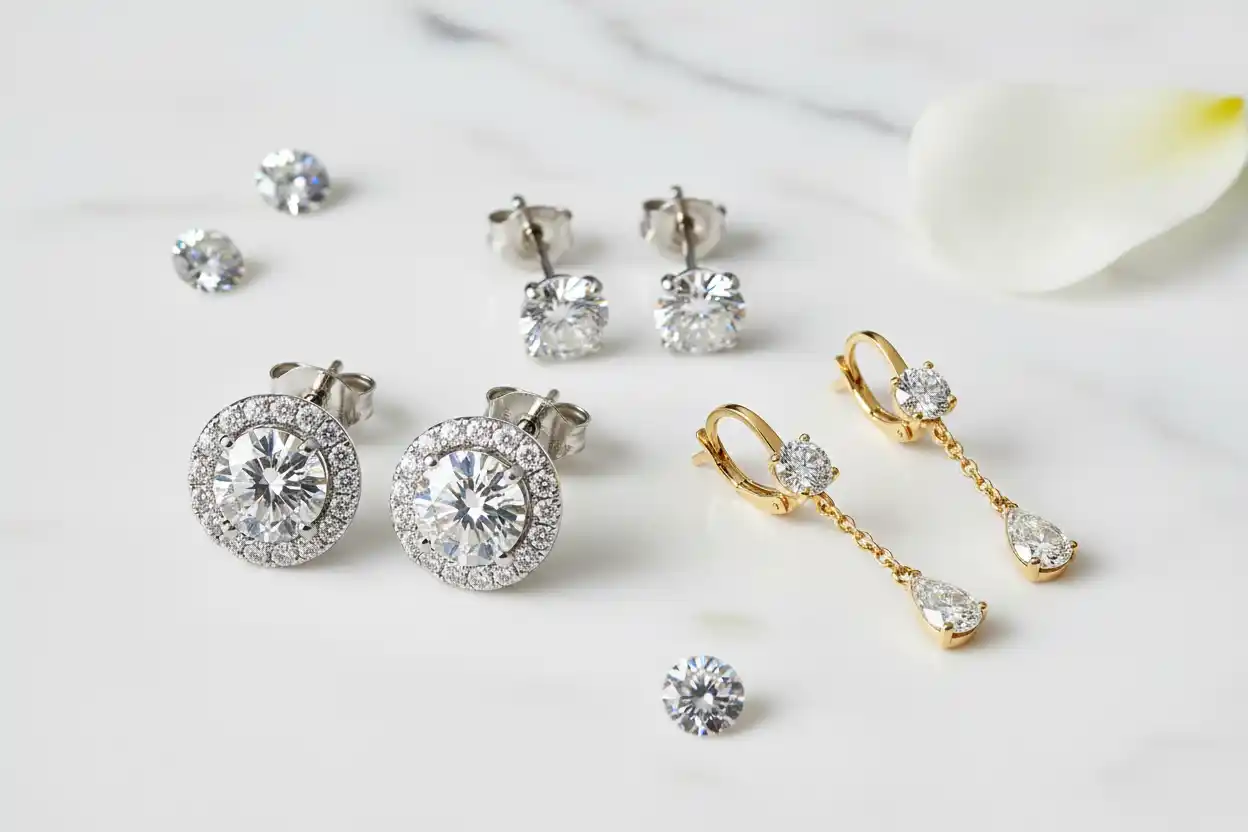
Diamond earrings range from understated studs to halos, hoops, drops and elaborate statement designs. Because earrings receive relatively little impact compared with rings and bracelets, they are one of the most practical ways to wear diamonds regularly.
For studs, matching and cut quality usually matter more visually than extremely high color or clarity grades. Secure backs, balanced settings and appropriate total weight are equally important because an earring that droops, twists or opens unexpectedly will not perform well regardless of diamond quality.
Diamond Earrings at a Glance
| Factor | What to look for |
|---|---|
| Diamond quality | Strong cut with color and clarity suited to budget |
| Matching | Similar diameter, color, cut pattern and brightness |
| Carat description | Confirm whether weight is per stone or total pair weight |
| Setting | Secure prongs, bezels, halos or hoop channels |
| Posts | Straight, smooth and appropriate to earring size |
| Backs | Friction, screw or locking backs matched to weight |
| Metal | Gold or platinum with clear alloy disclosure |
| Best everyday style | Low-profile studs or huggies |
| Best formal style | Halo, drop or graduated earrings |
| Main safety concern | Backing failure, snagging and poorly balanced weight |
Diamond Earrings and the 4Cs
Diamond quality is described through cut, color, clarity and carat weight.
For earrings, those factors should be considered as a pair rather than as two unrelated stones.
Cut affects brightness and sparkle. Color differences become obvious when the earrings frame the face. Clarity usually needs only to be clean enough that inclusions are not distracting at normal distance.
Carat weight can be confusing because sellers may describe the total weight for both earrings rather than each diamond individually.
The completed diamond buying guide provides a broader explanation of the 4Cs and laboratory reports.
Diamond Stud Earrings
Studs are the most versatile diamond earring style.
Round brilliant diamonds dominate because they provide strong light return and a familiar symmetrical appearance. Princess, cushion, oval, emerald, pear and other shapes create more individual styles.
The setting should hold the diamond close enough to the ear that it does not tilt forward excessively.
Larger studs need substantial backs or supportive discs because a tiny friction back may not distribute their weight comfortably.
For an everyday pair, secure construction and visual brightness usually matter more than obtaining elite laboratory grades.
Four-Prong vs Six-Prong Studs
Four-prong settings expose more of the diamond’s outline and make the stone appear slightly more open.
Six-prong settings provide additional contact points and create a classic rounded appearance, especially around round brilliant diamonds.
Neither configuration is automatically superior. Prong thickness, positioning and metal quality matter more than the count alone.
Inspect the stone from the side. It should sit evenly rather than lean because one prong is higher than the others.
Any prong that catches fabric or hair deserves professional attention.
Bezel-Set Diamond Studs
A bezel surrounds the diamond’s girdle with metal.
This creates a smooth profile, strong edge protection and a contemporary look. Bezels may also be more comfortable for active wear because there are fewer exposed prongs.
The visible metal can make a diamond appear slightly differently sized depending on design.
A precisely made bezel should remain even around the stone without thick sections obscuring the face.
Bezel studs work especially well for children or highly active adults when piercing maturity and general jewelry safety have been considered appropriately.
Halo Diamond Earrings
Halo earrings surround the center diamond with smaller diamonds.
They increase visual presence without requiring one very large center stone. Halos also allow designers to combine round centers with cushion, pear or floral outlines.
Evaluate the center diamonds first. A halo should complement good stones rather than conceal obvious weakness.
Check every accent stone for secure setting. Closely packed pavé requires more maintenance than simple studs.
The finished pair should sit upright rather than rotate downward because the front is too heavy for the post and back.
Diamond Drop Earrings
Drop earrings suspend one or more diamond sections beneath the ear.
Movement changes the angle of light entering the stones, creating dynamic sparkle. Drops may use solitaires, graduating diamonds or diamond-set geometric elements.
Articulation should remain smooth without components striking one another excessively.
Long designs can catch hair and clothing. They are generally better for deliberate wear than sports, childcare, machinery work or sleep.
Check that both drops hang to the same length.
Diamond Dangle Earrings
Dangles move more freely than short drops and may extend considerably below the earlobe.
They can create dramatic evening jewelry, particularly when diamonds are combined with colored gemstones.
Weight deserves close attention. Large earrings may stretch the piercing or become uncomfortable during extended wear.
A well-designed dangle distributes weight rather than placing the complete load far from the ear.
Secure lever backs or locking mechanisms may be preferable to simple open wires for high-value pieces.
Diamond Hoops
Diamond hoops range from tiny huggies to large statement circles.
Stones may cover only the front exterior or continue around much of the hoop. Inside-out designs place diamonds on the inner rear surface as well so more stones face outward.
Check the hinge and closure repeatedly before purchasing. The mechanism should align smoothly and engage securely.
Large hoops increase snagging risk because of their diameter.
For frequent wear, compact huggies provide diamond sparkle with less exposed movement.
Diamond Huggie Earrings
Huggies fit close around the earlobe.
Their low profile makes them practical for everyday use, although the hinge and closure must remain strong.
Examine whether the diamond row faces outward after fastening. Poor alignment may point the stones downward or inward.
Huggies may use pavé, channel or shared-prong settings. Smooth interior finishing improves comfort.
They also layer well with additional ear piercings because they occupy comparatively little space.
Diamond Cluster Earrings
Cluster earrings assemble several smaller diamonds into one visual shape.
Round clusters can mimic the apparent size of a larger solitaire, while floral and geometric arrangements create more distinctive designs.
Small stones should be matched for brightness and color. One dark or cloudy diamond can become noticeable because the complete cluster is viewed as one surface.
Cluster settings contain many prongs and crevices, so maintenance and cleaning deserve additional attention.
Diamond Jacket Earrings
Earring jackets sit behind or around a central stud and can transform a simple pair into a larger design.
Popular versions create halos, drops or curved rows beneath the earlobe.
Check compatibility with the stud post length and diameter. A jacket that fits loosely may rotate, while one positioned too tightly can create pressure.
Buying a matched system from one maker reduces compatibility problems.
The stud should remain secure independently of the jacket.
Selecting Diamond Cut
Cut quality has a major effect on sparkle.
For round brilliant studs, select stones that show balanced brightness, fire and scintillation. Diamonds should not have noticeably dark centers or different light patterns.
Fancy shapes do not all receive the same standardized cut grade as modern round brilliants, so visual assessment becomes especially important.
Compare the pair side by side rather than selecting each stone independently.
A slightly smaller well-cut pair often looks more impressive than larger diamonds with weak light return.
Matching Diamond Color
Two earrings should appear similar in color.
A one-grade difference may be difficult to notice in small stones, but broader differences can become visible when the diamonds frame the face.
Yellow gold can complement slightly warmer diamonds, while white metals may make color differences more apparent.
The completed diamond color meaning guide explores color symbolism and naturally colored diamonds separately.
Do not pay for color grades that exceed what can realistically be appreciated in the chosen size and setting unless personal preference justifies the premium.
Choosing Clarity
Stud earrings rarely require flawless or internally flawless diamonds.
The face is usually viewed from a greater distance than a ring, so small inclusions that cannot be seen without magnification have little visual effect.
Prioritize transparency and absence of distracting dark inclusions. Structural inclusions near the girdle or corners may deserve closer assessment.
For large individual diamonds, an independent grading report makes clarity comparison easier.
A lower clarity grade can represent good value when the stones appear clean and bright to the unaided eye.
Understanding Earring Carat Weight
Diamond stud weights are frequently quoted as total carat weight for the pair.
A pair advertised as 1.00 carat total may contain approximately 0.50 carat in each earring, though exact individual weights can vary.
Confirm whether the listing uses per-stone or combined weight before comparing prices.
Millimeter diameter also matters because cutting depth affects how large a diamond looks face-up.
Two equal-weight stones should have reasonably similar dimensions to form a balanced pair.
Common Stud Sizes
| Approximate total pair weight | Approximate weight per earring | General appearance |
|---|---|---|
| 0.25 ct total | 0.125 ct each | Very subtle |
| 0.50 ct total | 0.25 ct each | Small everyday size |
| 1.00 ct total | 0.50 ct each | Noticeable but versatile |
| 1.50 ct total | 0.75 ct each | Strong visual presence |
| 2.00 ct total | 1.00 ct each | Large classic studs |
| 3.00 ct total | 1.50 ct each | Statement scale |
Actual diameter varies with cut proportions and shape. Try comparable sizes physically or use exact millimeter measurements before buying.
Natural vs Laboratory-Grown Diamond Earrings
Natural and laboratory-grown diamonds share the fundamental properties of diamond, but they differ in origin and market economics.
Laboratory-grown diamonds are created using technological processes, while natural diamonds form through geological processes.
The completed lab diamond meaning guide explains their material relationship.
For earrings, laboratory-grown stones may make larger matched pairs accessible within a lower budget. The seller must disclose origin clearly and consistently.
A pair should never be represented merely as diamond when the transaction depends on distinguishing natural from laboratory-grown origin.
Diamond Earrings vs Cubic Zirconia
Cubic zirconia is a manufactured diamond simulant rather than diamond.
It is generally less hard and has different optical and physical characteristics. High-quality cubic zirconia can still be attractive jewelry when represented accurately.
The completed cubic zirconia buying guide provides more information about CZ quality.
For expensive diamond earrings, independent grading or reliable documentation reduces the risk of confusion with simulants.
Diamond Earrings vs Moissanite
Moissanite is a separate gemstone material with high hardness and strong dispersion.
Its optical behavior differs from diamond, and some wearers prefer its stronger rainbow flashes.
The completed lab diamond versus moissanite comparison explains the differences in material and appearance.
Neither should be described as fake simply because it differs from the other. Accurate identity and pricing allow buyers to choose according to preference.
Choosing the Metal
Platinum creates a naturally white, durable setting and works well for valuable studs.
White gold provides a similar bright appearance at a lower cost, although rhodium plating may require renewal.
Yellow gold can soften the contrast with warmer diamonds, while rose gold adds a distinctive colored-metal frame.
The post and back should use a metal suitable for skin contact.
Ask about nickel or other alloying metals when the wearer has known sensitivities.
Friction Backs
Friction or push backs slide onto the post and hold through tension.
They are convenient and common for small to medium studs. The fit should feel secure without requiring excessive force.
Over time, backs may loosen and need replacement.
A large diamond stud with a tiny lightweight backing may tilt forward even when the closure remains secure.
Supportive backs with a wider surface can improve orientation and comfort.
Screw Backs
Screw backs turn onto threaded posts.
They provide reassurance for high-value earrings because they cannot simply slide off. However, they take longer to put on and remove.
Threads can also feel uncomfortable to some wearers as the post passes through the piercing.
Check the threads periodically for wear or cross-threading.
Do not force a screw back when it does not engage smoothly.
Locking and Guardian-Style Backs
Mechanical locking backs combine a post with a release mechanism.
They can provide strong security for valuable earrings while remaining quicker to use than screw backs.
The mechanism should release deliberately but not accidentally.
Check the manufacturer’s instructions and inspect moving components for wear.
A secure back cannot compensate for a bent or weakened post, so both parts need maintenance.
Lever Backs and Hinged Closures
Lever backs are common on drops and dangles.
A hinged section closes behind the ear, reducing the chance of the earring slipping out compared with an open hook.
Diamond hoops and huggies often use integrated hinged posts. The closure should click or engage positively.
Any side-to-side movement, misalignment or repeated opening during wear requires repair.
How to Style Diamond Studs
Diamond studs are exceptionally versatile.
Small to medium rounds pair easily with workwear, casual clothing and formal attire. Fancy-shape studs provide more personality without increasing overall scale dramatically.
Yellow-gold settings create warmth, while white metal produces a classic bright look.
Studs can also form the foundation of a multi-piercing arrangement when spacing permits.
Keep other earrings smaller when the main stud is intended to dominate the ear.
Styling Hoops and Drops
Diamond hoops create stronger framing around the face, while drops emphasize vertical movement.
For formal clothing, longer earrings can become the primary jewelry statement without a necklace.
With heavily embellished necklines, simpler studs or huggies often create better balance.
There is no requirement to match diamond earrings with a diamond bracelet or ring. Repeating one metal or design element is usually enough to make jewelry feel coordinated.
Buying Diamond Earrings Online
Confirm whether weights refer to each stone or the complete pair.
Review diamond origin, color, clarity, shape, dimensions, metal, setting and backing type. For larger studs, ask whether each diamond has an independent grading report.
Product photographs are usually magnified, so use millimeter dimensions to understand actual scale.
A video can reveal pair matching and how the stones perform under changing light.
Read return and exchange policies carefully because preferred earring size is difficult to judge until worn.
Documentation
Small melee diamonds in hoops and clusters are rarely individually graded.
Larger solitaire studs may justify separate laboratory reports for each stone.
Check that report numbers and measurements correspond with the diamonds supplied.
The completed diamond price guide explains how grading and size influence value.
For high-value pairs, an independent appraisal may be useful for insurance, but appraisal and grading reports serve different purposes.
Wearing Diamond Earrings Safely
Put earrings on after applying perfume, hairspray and cosmetics.
Remove large hoops and drops before sports, sleep, swimming, machinery work and activities where they may catch.
Studs are lower risk but can still press uncomfortably during sleep or become caught in towels.
Check backs before leaving home, particularly on expensive pairs.
Children can pull dangling earrings, so choose the style according to the wearer’s actual routine.
Cleaning Diamond Earrings
Diamonds attract oils that reduce visible brilliance.
For many secure untreated pieces, soak briefly in warm water with mild dish soap, then clean gently with a soft toothbrush.
Pay attention to the back of the diamond and setting because residue accumulates there.
Rinse over a bowl and dry with a lint-free cloth.
The completed guide to cleaning diamond jewelry safely covers fragile settings, treatments and professional cleaning considerations.
Diamond Durability
Diamond ranks 10 on the Mohs hardness scale and resists scratching exceptionally well.
However, it can chip after a sharp impact, particularly around exposed points, thin girdles or existing damage.
The metal setting, post and backing are considerably softer and frequently become the weakest components in an earring.
Therefore, secure storage and maintenance remain necessary even for diamond.
The completed diamond meaning and properties guide covers diamond’s composition and physical properties in greater depth.
Storage
Fasten each backing and store the earrings separately.
Diamond can scratch nearly every other gemstone, so avoid allowing studs or hoops to rub against softer jewelry.
Posts should not contact the face of the partner diamond.
Use a padded travel case rather than dropping earrings into a cosmetic bag or handbag.
Keep grading reports and receipts separately from the jewelry.
When Earrings Need Professional Service
Have earrings inspected when a diamond moves, a prong catches, a post bends or the backing no longer fits securely.
Hinged hoops also need attention when the closure becomes loose or misaligned.
A jeweler can examine prongs and mechanical components under magnification.
Do not continue wearing a valuable earring after noticing structural damage. Replacing a backing or repairing a post is generally simpler than replacing a lost matching diamond.
Conclusion
Diamond earrings are among the most practical forms of diamond jewelry. Studs provide everyday versatility, while halos, hoops and drops create greater scale and movement.
Prioritize cut and pair matching before unnecessarily high clarity grades. Confirm whether carat weight describes the pair or each diamond, and choose backs strong enough for the earring’s weight.
Although diamonds resist scratching extremely well, posts, prongs and closures still require care. Secure construction and periodic inspection protect the pair more effectively than gemstone hardness alone.
Frequently Asked Questions
1. What is the best diamond earring style for everyday wear?
Low-profile studs and small huggies are among the most practical everyday options.
2. What diamond cut is best for stud earrings?
Round brilliant is the classic choice because it offers strong sparkle and easy pair matching, although many fancy shapes also work well.
3. Do diamond earrings need high clarity?
Usually not. Eye-clean stones with good transparency can look excellent without extremely high clarity grades.
4. What does 1 carat total weight mean for earrings?
It generally means the two earrings together weigh about 1 carat, often around 0.50 carat per stone in a solitaire pair.
5. Should diamond studs have matching color grades?
They should appear visually compatible. Exact identical grades matter less than how well the pair matches face-up.
6. Are laboratory-grown diamond earrings real diamonds?
Laboratory-grown diamonds are diamond, although their origin differs from natural diamonds and must be disclosed.
7. Are screw backs safer than push backs?
Screw backs offer additional security, while well-fitted friction backs can also work reliably. Comfort and maintenance matter.
8. Which metal is best for diamond earrings?
Platinum, white gold, yellow gold and rose gold can all work. Choice depends on style, budget and metal sensitivity.
9. Can diamonds chip in earrings?
Yes. Diamond is extremely hard but can chip after certain sharp impacts.
10. Can diamond earrings be worn while sleeping?
Removing earrings before sleep generally reduces pressure, snagging and setting wear.
11. How should diamond earrings be cleaned?
Warm mild soapy water and a soft brush are suitable for many secure untreated pieces, followed by thorough rinsing and drying.
12. Should large diamond studs have grading reports?
Independent reports are advisable when individual stone quality and natural or laboratory-grown origin materially affect the price.