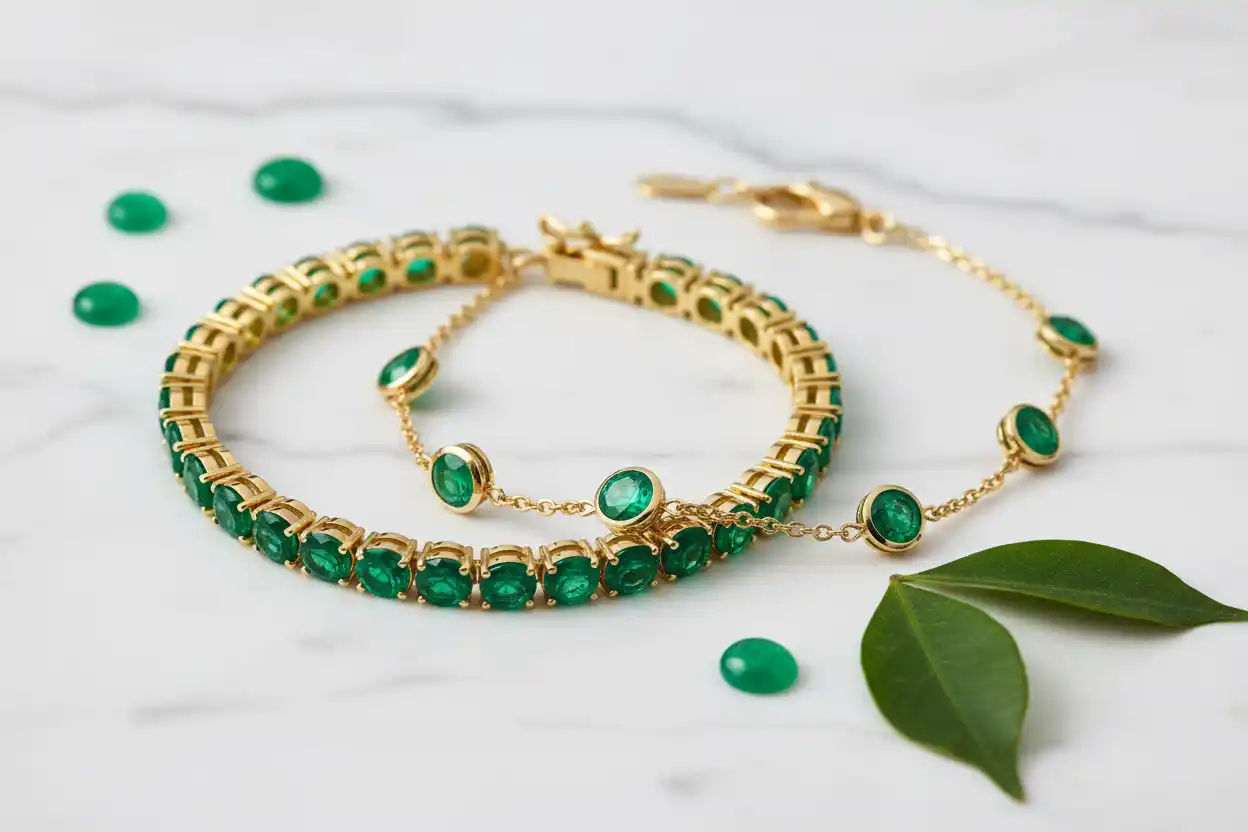
Emerald Bracelets: How to Choose, Wear and Care for Them
An emerald bracelet places one of the world’s most recognizable green gemstones in one of jewelry’s more demanding formats. Emerald is reasonably hard at about 7.5 to 8 on the Mohs scale, but natural fissures and common clarity enhancement mean bracelets need protection from impact, chemicals, heat and aggressive cleaning.
The best emerald bracelet combines lively color, well-matched stones and secure low-profile construction. Because a bracelet regularly strikes desks, doors and other hard surfaces, design and setting quality matter as much as gemstone grade.
Emerald Bracelets at a Glance
| Factor | What to look for |
|---|---|
| Gem identity | Natural emerald, laboratory-grown emerald or clearly identified alternative |
| Color | Attractive green to bluish green with enough lightness to remain lively |
| Matching | Consistent tone, saturation, size and brightness |
| Clarity | Inclusions are expected; avoid structurally concerning fractures |
| Treatment | Clear disclosure of oil, resin, dye or other enhancement |
| Setting | Low-profile bezel, sturdy prongs or protective links |
| Bracelet fit | Comfortable without excessive sliding |
| Clasp | Secure closure with safety feature on valuable pieces |
| Best wear pattern | Careful regular or special-occasion wear |
| Main care concern | Impact, fracture filling, heat and chemicals |
Why Emerald Bracelets Need Extra Care
Bracelets receive more knocks than earrings and pendants because the wrist continually approaches hard surfaces.
Emerald itself offers reasonable scratch resistance, but hardness alone does not describe durability. Natural emerald commonly contains fissures and inclusions, and many stones receive oil, resin or another filler to reduce the visibility of surface-reaching fractures.
Heat, strong chemicals and unsuitable cleaning can affect those fillers.
Therefore, an emerald bracelet should not be treated like a diamond tennis bracelet even when both designs look similar.
The completed emerald buying guide explains how color, inclusions, enhancement and provenance affect loose-stone quality.
Emerald Tennis Bracelets
An emerald tennis bracelet presents a continuous line of green stones around the wrist.
Matching becomes critical because every emerald is viewed beside another. Slight natural variations can create character, but obvious differences in brightness or tone may interrupt the design.
Inspect the bracelet flat and curved around the wrist. Links should articulate smoothly rather than become stiff or twisted.
Because each setting moves repeatedly, secure prongs and adequate metal thickness are essential.
For a valuable piece, a box clasp with an additional safety mechanism offers useful protection against accidental opening.
Emerald Station Bracelets
Station bracelets space emeralds along a chain.
They use fewer stones and reduce the amount of gemstone exposed to impact. A bezel around each emerald can create an especially practical design.
Check whether the stations remain face-up rather than constantly rotating.
The chain must also be strong enough for the value and weight of the stones. An extremely fine chain can become the weakest part of an otherwise well-made bracelet.
Station designs suit buyers who want visible emerald color without a continuous row.
Emerald Bead Bracelets
Emerald beads offer a different appearance from faceted jewelry.
Material used for beads is often more included or opaque than fine faceted emerald. That is not inherently a problem when identity and treatment are represented accurately.
Inspect drill holes because fractures may begin or widen around them.
Elastic bracelets are convenient but should not be used indefinitely without replacing worn cord. A professionally strung clasp bracelet may offer stronger long-term construction for valuable beads.
Be cautious with unusually vivid inexpensive strands, which may be dyed, heavily treated or composed of another green material.
Emerald Bangle Bracelets
A rigid emerald bangle may contain several set stones or one decorative emerald section.
Hinged bangles make fitting easier and need a secure closure. Non-hinged designs must pass over the hand without requiring force.
Emeralds should sit in protected positions rather than projecting far beyond the metal.
The bangle itself can strike surfaces repeatedly, so substantial construction matters.
Do not bend a rigid bangle at home to improve fit. Metal movement can disturb settings and place stress on included stones.
Emerald Cuffs
Emerald cuffs combine a broader metal structure with gemstone accents.
Low bezels work particularly well because they protect the emeralds and keep the surface relatively smooth.
A cuff opening should fit correctly without repeated squeezing. Constantly bending the metal to put it on can fatigue the bracelet and disturb the stone settings.
Wide cuffs may feel warmer and heavier than line bracelets, so comfort should be evaluated before purchase.
A decorative statement piece is often best reserved for deliberate wear rather than manual work.
Color: The Most Important Visual Factor
Fine emerald typically ranges from green to bluish green.
Strong saturation is desirable, but a stone can become too dark to display attractive transparency and life. Pale stones may be pleasant but generally receive less market demand.
For a bracelet, matching matters almost as much as the individual color grade.
Examine the complete row under diffuse daylight-equivalent and ordinary indoor light. Jewelry-store spotlights can make stones appear brighter than they will during everyday wear.
A bracelet containing several moderately saturated but well-matched emeralds may look more coherent than one containing individual higher-quality stones with obvious color differences.
Emerald Clarity
Inclusions are expected in natural emerald.
The internal appearance is sometimes called jardin, the French word for garden, because crystal inclusions and fissures can create branching natural patterns.
The goal is not necessarily an inclusion-free stone. Instead, look for enough transparency and structural integrity for the intended jewelry.
A surface-reaching fracture near a girdle or setting point may deserve more concern than a visually interesting internal inclusion.
Eye-clean natural emeralds of fine color are uncommon and can command substantial premiums.
Emerald Treatments
Fracture filling is common in emerald.
Oils, waxes and resins may be introduced into surface-reaching fissures to reduce their visibility and improve apparent clarity. Some emeralds may also be dyed.
Treatment amount and stability matter.
A buyer should ask:
- Is the emerald natural?
- Has clarity enhancement been detected?
- How extensive is the filling?
- Is dye present?
- Is the seller providing laboratory documentation?
The completed guide to treated and synthetic emerald explains why enhancement and laboratory-grown origin are separate issues.
Natural vs Laboratory-Grown Emerald Bracelets
Laboratory-grown emerald has essentially the same mineral species as natural emerald but forms through a controlled growth process rather than geological formation.
It may provide stronger apparent clarity and larger matched stones at a lower cost than comparable fine natural emerald.
The completed lab emerald buying guide explains growth origin, inclusions and purchasing questions.
A bracelet containing laboratory-grown emerald should be represented clearly as such.
Synthetic origin is not the same as imitation. Glass or another green stone designed to resemble emerald has different material properties.
Matching Multiple Emeralds
Bracelet matching requires attention to:
- Hue
- Tone
- Saturation
- Transparency
- Face-up dimensions
- Cut outline
- Setting height
Perfect uniformity is unnecessary, particularly when the design intentionally uses natural variation.
However, one noticeably yellowish, dark or cloudy stone may look out of place.
Matching also contributes to price because assembling numerous attractive emeralds with compatible appearance can require significant sorting.
Emerald Cuts for Bracelets
Rounds and ovals work well because they avoid sharp exposed corners.
Traditional emerald cuts use beveled corners that reduce vulnerability compared with a simple rectangle. Smaller emerald cuts can create elegant geometric line bracelets when the settings protect their edges.
Cabochons suit more included or translucent material and may create a smoother bracelet surface.
The ideal cut should balance color, weight retention and durability rather than maximizing carat weight alone.
Poorly cut emeralds may show large windows that make the color look weak.
Choosing a Protective Setting
Bezels provide excellent protection around an emerald’s edge and reduce snagging.
Low-profile prong settings create a more open appearance and allow easier cleaning access, but the prongs must remain robust.
Shared-prong arrangements can create a delicate visual line but require greater maintenance because a single worn prong may affect neighboring stones.
Channel settings may protect calibrated stones, although repair can become difficult when the channel bends.
For everyday practicality, lower profiles are generally preferable to highly exposed stones.
Choosing the Metal
Yellow gold creates warm contrast with emerald’s green and is a classic combination.
White gold and platinum emphasize cooler blue-green tones and pair naturally with diamond accents.
Rose gold produces stronger color contrast and can suit contemporary designs.
The exact metal also affects weight, maintenance and allergy considerations.
Ask for fineness and alloy information. White gold may contain nickel unless another formulation is specified.
The metal should be substantial enough to protect the emeralds rather than minimized only to reduce cost.
Emerald and Diamond Bracelets
Diamonds create bright contrast beside green emerald.
However, diamond is considerably harder than emerald. Poorly designed settings may allow diamond girdles or exposed edges to rub against emeralds.
Check separation between stones and articulation between links.
Cleaning also needs to follow emerald requirements rather than diamond requirements. A method that is safe for an untreated diamond may damage an oil- or resin-filled emerald.
Treat the bracelet according to its most sensitive component.
Bracelet Fit
An emerald bracelet should move comfortably but should not slide excessively across the hand.
Too much movement increases impact against tables and door frames. A bracelet that is too tight strains links and settings.
Measure the wrist and compare the actual interior length.
Try ordinary hand and wrist movements to check comfort.
When resizing a line bracelet, use a jeweler experienced with colored stones because soldering heat and setting work require protection of the emeralds and their fillers.
Choosing a Clasp
A valuable emerald line bracelet needs a reliable closure.
Box clasps are common and may include safety latches. Lobster clasps work well for station chains when appropriately sized.
Test the mechanism repeatedly before purchase. It should engage clearly without excessive looseness.
Inspect the connection between clasp and bracelet because a strong central closure cannot prevent loss if the connecting link is worn.
Clasp maintenance deserves the same attention as gemstone settings.
How to Buy an Emerald Bracelet
Begin with written disclosure of gemstone identity and treatment.
Examine the bracelet in several lighting environments. Compare matching and look for obvious fractures near stone edges.
Check every prong, link and clasp.
For a significant natural emerald bracelet, independent gemological documentation may be appropriate, especially when origin or limited enhancement carries a premium.
The completed real versus fake emerald guide explains why visual appearance alone cannot always distinguish natural, synthetic and imitation material.
Origin Claims
Colombia, Zambia, Brazil, Pakistan, Afghanistan and other regions produce emeralds.
Specific origins may influence market demand, but origin should not be inferred solely from color.
An emerald described as Colombian or Zambian at a significant premium should have appropriate evidence when locality materially affects value.
Origin also does not replace quality. A beautiful emerald from a less prestigious source may be more attractive than a weak stone carrying a famous location name.
The completed types of emerald guide covers color and source-related varieties without treating locality as a quality grade.
Emerald Bracelet Pricing
Price depends on color, transparency, enhancement, individual stone size, total carat weight, matching, origin, metal and craftsmanship.
Large matched stones increase cost rapidly because the bracelet requires numerous emeralds of compatible quality.
A less expensive bracelet may use smaller stones, heavier enhancement, laboratory-grown emerald or more included material.
The completed emerald price guide explains value factors in greater depth.
Compare bracelets with similar disclosure rather than total carat weight alone.
How to Wear an Emerald Bracelet
Put the bracelet on after applying lotion, sunscreen, perfume and other cosmetics.
When practical, wear it on the non-dominant wrist to reduce repetitive contact with hard surfaces.
Remove it before:
- Exercise
- Gardening
- Cleaning
- Showering
- Swimming
- Cooking
- Home repairs
- Manual work
Do not wear an emerald bracelet tightly beside diamond jewelry that may repeatedly strike or abrade the stones.
Cleaning Emerald Bracelets
Warm, mild soapy water with gentle brushing is the safest general method for most emerald jewelry.
Avoid steam and ultrasonic cleaners because heat and vibration may affect surface-reaching fissures and their fillers.
Do not use harsh chemicals, acetone or aggressive jewelry dips.
The completed guide to cleaning emerald jewelry safely provides detailed care for enhanced stones and settings.
Clean over a bowl rather than an open drain and dry the bracelet carefully.
Storage
Lay the bracelet flat in a padded compartment.
Keep it separate from diamonds and sapphires that can scratch emerald and from jewelry that might strike the settings.
Fasten the clasp before storage to reduce tangling.
Avoid hot windows, direct heater exposure and harsh chemical environments.
Laboratory reports, appraisals and purchase documents should be stored separately.
Professional Maintenance
Have the bracelet inspected if a stone moves, a prong catches, a link becomes stiff or the clasp behaves differently.
Emerald filler may also require professional assessment over time when its appearance changes.
Do not expose the stone to heat in an attempt to restore oil or improve clarity at home.
A qualified jeweler or gemologist can determine whether the problem involves the stone, filler or setting.
Conclusion
Emerald bracelets reward careful selection because a strong design combines beautiful green color with complex engineering. Look for compatible stones, secure low-profile settings, smooth articulation and a dependable clasp.
Natural inclusions are normal, while fracture filling is common and should be disclosed. Because bracelets receive frequent impacts, protection and maintenance matter more than maximizing visible carat weight.
For everyday practicality, choose a well-fitted bracelet and remove it during activities that expose the emeralds to hard blows, chemicals or heat.
Frequently Asked Questions
1. Is emerald suitable for a bracelet?
Yes, but bracelets expose emeralds to repeated impacts, so protective settings and careful wear are important.
2. What is the best emerald bracelet style for everyday wear?
A low-profile bezel or securely prong-set station bracelet generally offers greater protection than tall exposed settings.
3. Are emerald inclusions normal?
Yes. Natural emerald commonly contains visible inclusions and fissures. Excessive or surface-reaching fractures may still affect durability.
4. Are emeralds commonly treated?
Yes. Many natural emeralds receive oil, resin or another fracture-filling treatment to improve apparent clarity.
5. Is laboratory-grown emerald real emerald?
Laboratory-grown emerald is synthetic emerald with essentially the same mineral species as natural emerald, but its origin must be disclosed.
6. Can emerald bracelets be worn every day?
Careful regular wear is possible, but the bracelet should be removed for exercise, cleaning, gardening and other impact-heavy activities.
7. What color emerald is best?
Fine emerald generally shows attractive green to bluish green with strong saturation and enough lightness to remain lively.
8. Can emerald bracelets contain diamonds?
Yes, but the design should prevent harder diamonds from rubbing against emeralds.
9. How should an emerald bracelet fit?
It should move comfortably without sliding excessively across the hand or straining the links.
10. Can an emerald bracelet go in an ultrasonic cleaner?
No. Ultrasonic cleaning is unsafe for commonly fracture-filled emeralds.
11. How should emerald bracelets be cleaned?
Use warm mild soapy water and gentle brushing, then rinse briefly and dry carefully.
12. Should an expensive emerald bracelet have laboratory documentation?
Documentation is advisable when natural identity, treatment amount or claimed geographic origin materially affects the price.