How to Clean Emerald Jewelry Safely: Rings, Lab Emeralds & Care
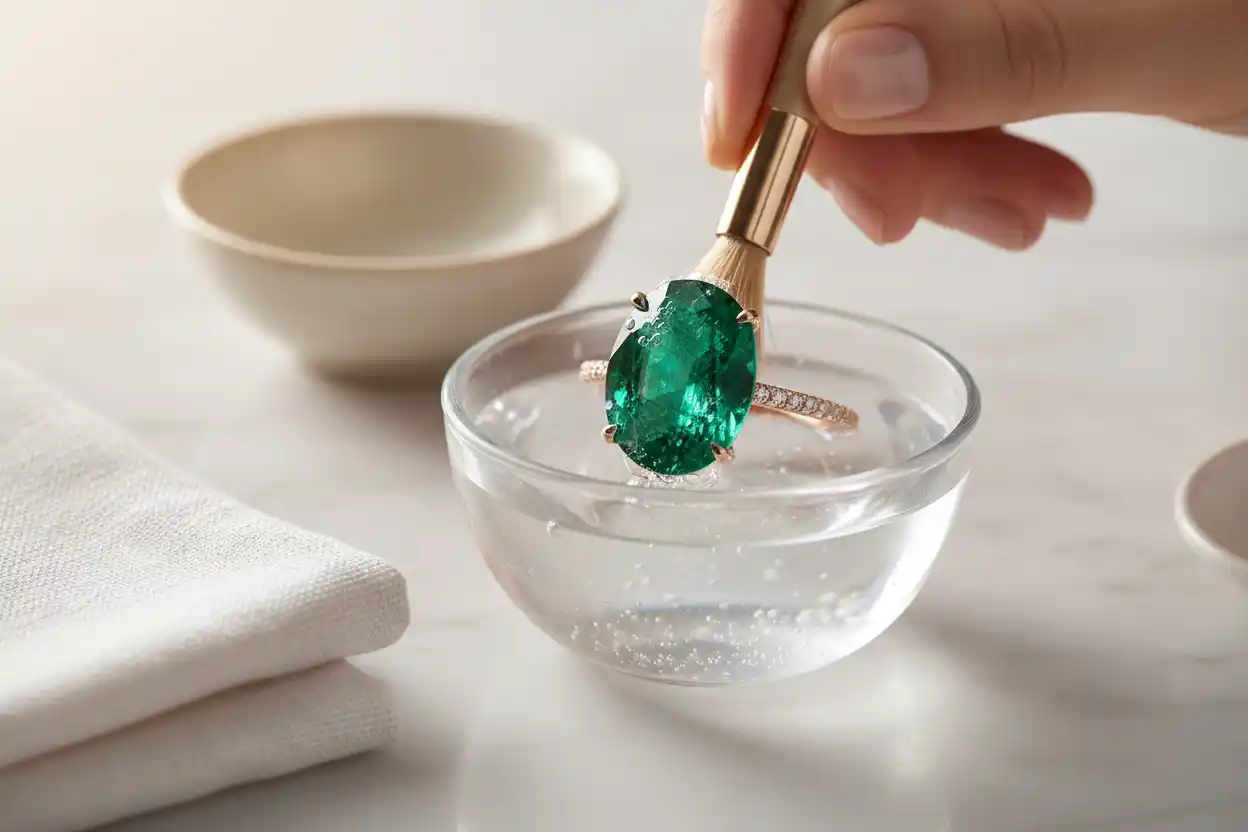
Knowing how to clean emerald jewelry correctly matters because emerald combines good scratch resistance with much greater sensitivity to fractures, heat and treatments than its Mohs hardness might suggest. For most natural and laboratory-grown emerald jewelry, the safest home method is brief cleaning with lukewarm water, a small amount of mild liquid soap and an exceptionally soft brush, followed by gentle rinsing and room-temperature drying.
Avoid ultrasonic cleaners and steam as a default. Natural emeralds frequently contain surface-reaching fissures that may have been filled with oil, resin or another transparent substance. Laboratory-grown emeralds can also contain fractures or receive post-growth filling, so synthetic origin does not automatically make machine cleaning safe.
The key to how to clean emerald jewelry is therefore not scrubbing harder. It is understanding the individual stone, its treatment history, its setting and every other material in the piece.
How to Clean Emerald Jewelry at a Glance
| Situation | Safest approach |
|---|---|
| Sound natural emerald | Lukewarm water, mild soap, very soft brush |
| Lab-grown emerald | Same conservative hand-cleaning approach |
| Oiled emerald | Brief gentle cleaning; avoid prolonged soaking |
| Resin-filled emerald | Gentle hand cleaning; avoid heat and solvents |
| Unknown treatment | Assume conservative care |
| Emerald ring | Clean briefly and inspect setting closely |
| Emerald earrings | Wipe and gently clean posts, backs and stone |
| Emerald necklace | Minimize perfume, cosmetics and chain abrasion |
| Emerald bracelet | Support the whole piece while cleaning |
| Antique emerald jewelry | Professional assessment may be safest |
| Ultrasonic cleaning | Avoid as a general rule |
| Steam cleaning | Avoid |
| Toothpaste or abrasives | Do not use |
| Alcohol or solvents | Avoid |
| Bleach, chlorine or ammonia | Avoid |
The correct method for how to clean emerald jewelry should preserve both appearance and treatment rather than pursuing maximum short-term brightness.
Why Emerald Jewelry Needs Gentle Cleaning
Emerald is the green to bluish-green variety of beryl. The broader emerald guide explains its geology, color, properties, natural and laboratory-grown origins, symbolism and buying characteristics.
Emerald ranks approximately 7.5 to 8 on the Mohs scale. That sounds highly durable, but hardness measures resistance to scratching rather than resistance to fracture.
Many natural emeralds contain fissures, mineral inclusions, fluid inclusions and other internal features. Some fractures reach the surface.
These openings matter enormously when deciding how to clean emerald jewelry.
Oil, resin or another filler may have been introduced into those fissures to reduce their visibility. Heat, strong chemicals, prolonged soaking or ultrasonic vibration can disturb the filler or worsen an existing fracture.
Laboratory-grown emerald does not eliminate these concerns. Synthetic emerald is genuine beryl grown under controlled conditions, but some stones contain growth features, fractures or post-growth filling that also require gentle care.
Why Emeralds Are Commonly Oiled
Natural emerald often develops with visible internal fissures.
When a fracture reaches the polished surface, its contrast may reduce transparency. A transparent substance can be introduced into the opening so that light passes through it more evenly.
Colorless oils have a long history in emerald enhancement. Modern fillers can also include resins and polymers.
The treated emerald guide explains these enhancements in greater detail.
An important point when learning how to clean emerald jewelry is that filler does not repair the crystal.
A filled fracture remains a fracture.
The treatment improves appearance rather than restoring the stone’s original structural strength.
That is why an emerald can look clean and attractive yet still require conservative handling.
Natural Emerald and Lab-Grown Emerald Need Similar Basic Care
Natural emerald and laboratory-grown emerald differ fundamentally in origin.
Natural emerald forms through geological processes.
Lab-grown emerald crystallizes through controlled hydrothermal or flux growth.
Both are beryl. Both generally rank around 7.5 to 8 on the Mohs scale. Both can be brittle. Both can contain internal features that influence durability.
This is important because how to clean emerald jewelry does not change simply because a stone was laboratory grown.
A clear lab-grown emerald should not automatically be placed in an ultrasonic cleaner.
A synthetic emerald may contain fractures, flux-related inclusions, seed-related structures or other growth features. Some lab-grown emeralds may also receive oil, resin or another post-growth clarity treatment.
The safest assumption is therefore:
Natural emerald — clean gently.
Lab-grown emerald — clean gently.
Only move to more aggressive professional methods when the actual stone, treatment and setting have been evaluated appropriately.
Inspect the Jewelry Before Cleaning
Before deciding how to clean emerald jewelry, examine the piece under bright indirect light.
Look at every prong, bezel and setting edge.
Check whether the emerald moves.
Do not deliberately twist the stone to test it.
Look for chipped corners, damaged facet edges, obvious surface-reaching fractures or a setting that catches on fabric.
Examine accent stones too.
If an emerald ring contains diamonds, for example, a small diamond may become loose even when the emerald itself looks secure.
Antique jewelry deserves additional caution because it may contain old solder, glue, enamel, foil-backed elements or previous repairs.
If anything appears loose or unstable, do not continue cleaning.
Have the piece inspected first.
Knowing when not to clean is an important part of understanding how to clean emerald jewelry safely.
What You Need to Clean Emerald Jewelry
A basic home-cleaning setup is enough for most sound pieces.
You need:
- Two small bowls
- Lukewarm water
- A few drops of mild liquid dish soap
- A very soft jewelry brush or soft toothbrush
- A lint-free cloth
Do not clean directly over an open sink.
An emerald or accent stone that unexpectedly comes loose can disappear into a drain.
Prepare one bowl for washing and another for rinsing.
Use only a small amount of soap. Strong detergent concentrations provide no meaningful advantage.
How to Clean Emerald Jewelry Step by Step
The following method is the safest general approach for how to clean emerald jewelry when the piece is structurally sound.
1. Use Lukewarm Water
Fill a small bowl with lukewarm water.
The water should feel comfortable rather than hot.
Avoid sudden temperature changes.
An emerald containing existing fractures does not benefit from thermal stress.
2. Add a Small Amount of Mild Soap
Add a few drops of mild liquid dish soap.
Mix gently.
Avoid products containing bleach, ammonia, abrasive particles, strong acids or aggressive degreasers.
When learning how to clean emerald jewelry, simple chemistry is preferable to a powerful household cleaner.
3. Avoid Long Soaking
Do not leave emerald jewelry submerged for hours.
Brief contact with lukewarm water is different from prolonged soaking.
A short wash is normally sufficient to loosen skin oils and ordinary residue.
Extended immersion can be unnecessary for an emerald whose surface-reaching fissures contain oil or another filler.
4. Brush With Very Light Pressure
Dip the soft brush into the cleaning solution.
Clean the front, back and setting using light strokes.
Pay particular attention to the pavilion and metal immediately beneath the emerald, where skin oil and cosmetics commonly collect.
Do not scrub aggressively into a visible fissure.
Do not try to push the bristles deeply into fractures.
The objective is to remove residue from surfaces—not force water and detergent into the gemstone.
5. Clean the Setting Carefully
Emerald may be harder than gold, but the setting can still bend or scratch.
Brush around prongs rather than forcing the brush underneath them.
Do not insert needles, pins, knives or dental tools around the gemstone.
A stubborn piece of dirt is not worth loosening the setting.
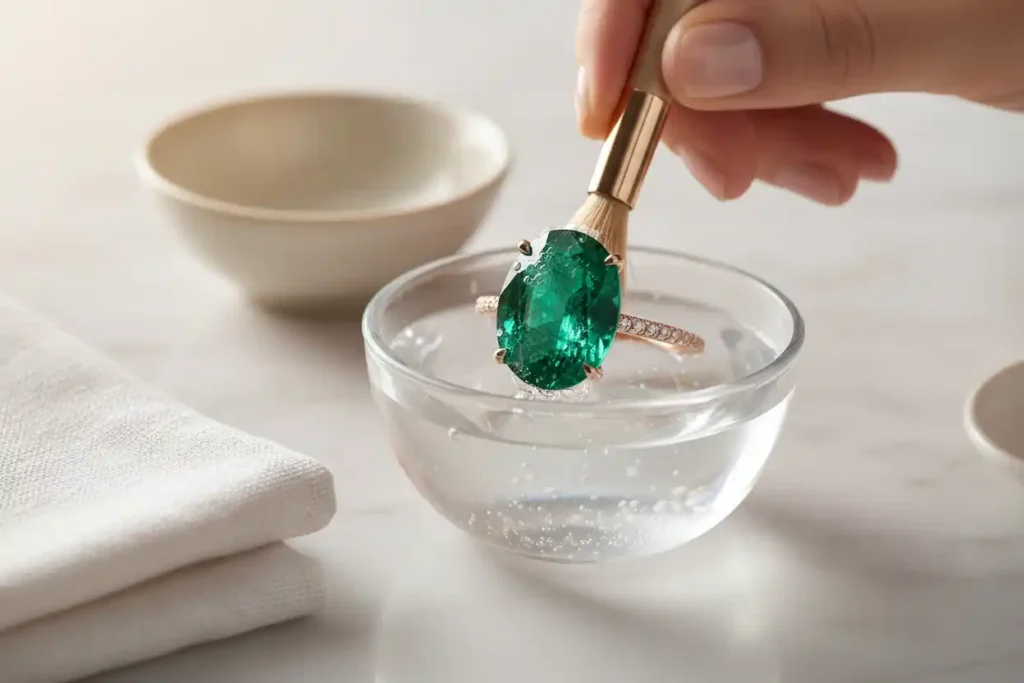
6. Rinse Briefly
Use the second bowl of clean lukewarm water to remove soap.
Alternatively, a clean damp cloth may be preferable for particularly sensitive antique or extensively filled pieces.
Keep the rinse temperature similar to the wash temperature.
Avoid suddenly moving the emerald between hot and cold water.
7. Blot and Air Dry
Blot the jewelry gently with a lint-free cloth.
Allow moisture in the setting to evaporate naturally at room temperature.
Do not use a hair dryer.
Do not place the jewelry on a radiator.
Do not leave it in strong direct sunlight to accelerate drying.
That completes the safest general method for how to clean emerald jewelry.
How to Clean Lab-Grown Emerald Jewelry
The same lukewarm-water method should be the default when learning how to clean emerald jewelry made with laboratory-grown stones.
Prepare mild soapy water.
Clean briefly with a very soft brush.
Rinse gently.
Dry at room temperature.
The fact that a stone was grown hydrothermally or by a flux process does not make aggressive cleaning necessary.
Why Lab-Grown Emerald Still Needs Caution
Laboratory-grown emerald can look much cleaner than natural material, which sometimes creates the impression that it must also be tougher.
Appearance alone is not enough.
Synthetic emerald can contain fractures and growth-related internal features.
More importantly, a laboratory-grown emerald can receive treatment after crystallization.
For example, a surface-reaching fissure may be filled with oil or resin.
Therefore, two questions should be kept separate:
Was the emerald grown naturally or in a laboratory?
Was the finished emerald subsequently treated or filled?
The first describes origin.
The second affects care.
The lab-grown versus natural gemstones comparison explains why synthetic origin and treatment should not be treated as the same category.
Hydrothermal Emerald Care
Hydrothermal emerald grows from a controlled solution under elevated temperature and pressure.
The resulting crystal can have good color and transparency, but finished hydrothermal stones may still contain growth features or fractures.
Use the same gentle method when deciding how to clean emerald jewelry containing hydrothermal material.
Do not assume that a bright, clean-looking stone can automatically tolerate ultrasound.
Flux-Grown Emerald Care
Flux-grown emerald crystallizes from a molten chemical medium.
Flux inclusions, wispy veils, growth features and occasional fractures may occur.
Again, hand cleaning is the safer default.
A flux-grown emerald does not require a stronger cleaning solution simply because it is synthetic.
Filled Lab-Grown Emerald
Some laboratory-grown emeralds may contain filled fissures.
When oil, resin or polymer is present, avoid:
- Strong solvents
- Alcohol
- Ultrasonic cleaning
- Steam
- Excessive heat
- Aggressive detergents
- Prolonged soaking
A filled lab-grown emerald should be treated at least as conservatively as a similarly filled natural emerald.
Can You Use an Ultrasonic Cleaner on Emerald?
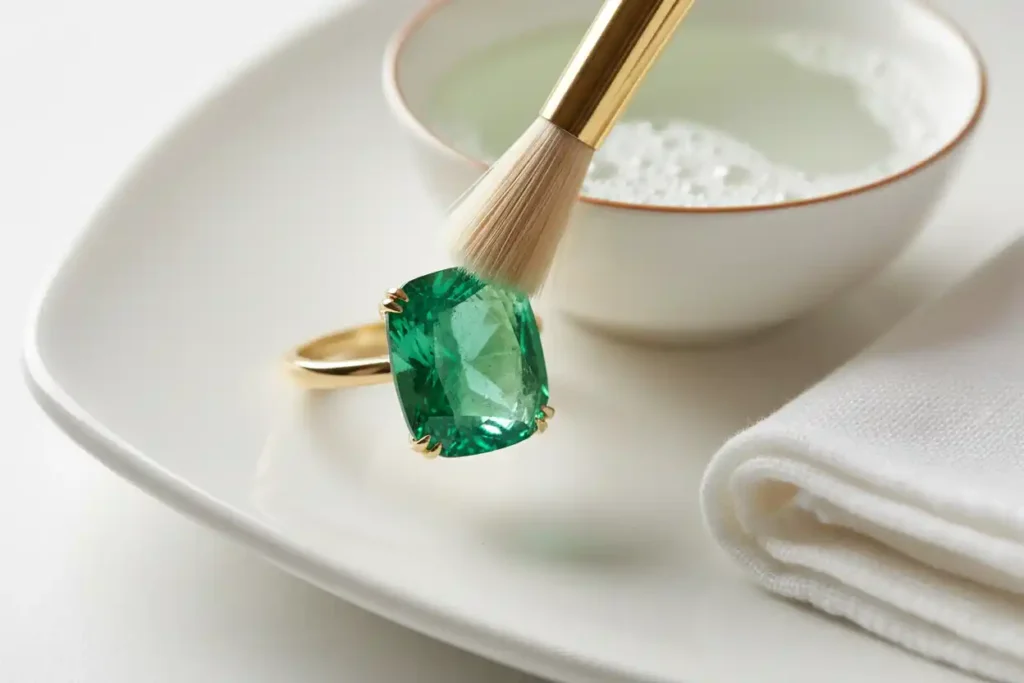
Avoid ultrasonic cleaning as a general rule.
Ultrasonic machines generate high-frequency vibration in a cleaning liquid.
That vibration can loosen debris effectively, but it can also interact badly with a fractured or filled gemstone.
For emerald, possible problems include:
fracture extension,
movement or deterioration of filler,
loosening of a setting,
and damage to other materials in the jewelry.
The broader gemstones in ultrasonic cleaners guide explains why mineral identity alone does not determine whether machine cleaning is appropriate.
A transparent emerald should not automatically be assumed safe.
Neither should a laboratory-grown emerald.
When how to clean emerald jewelry can be answered successfully with soap, water and a soft brush, there is little reason to introduce ultrasonic risk at home.
Can You Steam Clean Emerald Jewelry?
Steam cleaning should also be avoided.
Steam combines high temperature with pressure.
Heat can affect oil, resin or polymer inside surface-reaching fractures.
Existing fissures may also respond poorly to thermal stress.
Jewelry construction adds another layer of risk. Steam can affect adhesives, previous repairs, enamel or another gemstone in the piece.
An emerald set in platinum does not automatically become steam safe just because the metal itself can withstand high temperatures.
How to clean emerald jewelry should be based on the gemstone and treatment, not merely the mounting metal.
How to Clean an Emerald Ring
Emerald rings require particularly careful maintenance because hands experience frequent impacts and exposure to products.
Lotion, soap, sanitizer, cosmetics, sunscreen and natural skin oil can collect underneath the stone.
To clean an emerald ring, inspect the setting first.
Then use lukewarm soapy water and an extremely soft brush.
Clean gently through gallery openings, but do not force bristles against visible fractures.
Rinse briefly and dry carefully.
An emerald engagement ring worn frequently should also receive periodic setting inspections.
Remove the ring before:
washing dishes,
cleaning with chemicals,
gardening,
weightlifting,
contact sport,
swimming,
and other impact-heavy activities.
Preventing damage is more valuable than repeatedly learning how to clean emerald jewelry after avoidable exposure.
How to Clean Emerald Earrings
Emerald earrings experience less impact than rings but still accumulate skin oil, makeup, sunscreen and hair products.
Remove the backs before cleaning.
Use mild soapy water on modern securely set earrings when appropriate.
Brush the emerald and metal gently.
Clean posts and earring backs separately without soaking delicate antique parts.
The emerald earrings guide explains common setting and buying differences.
Avoid applying alcohol-based disinfectant directly to the emerald.
Alcohol may affect filler, adhesives, coatings or sensitive parts of the jewelry.
If the posts need separate sanitation, keep the chosen product away from the gemstone whenever treatment is uncertain.
How to Clean an Emerald Necklace or Pendant
Emerald necklaces often collect perfume, makeup, sunscreen and body oils along the back of the pendant and surrounding metal.
Apply cosmetics before putting the jewelry on whenever practical.
Allow perfume and skincare products to dry.
When deciding how to clean emerald jewelry in necklace form, support the pendant and chain separately so the chain does not scrape against the emerald.
The emerald necklace guide covers pendant settings, treatment and durability in more depth.
Large carved or heavily included emerald pendants may need even less moisture and pressure than transparent faceted stones.
How to Clean an Emerald Bracelet
Bracelets are exposed constantly to desks, tables, doorways and hard surfaces.
They also contain multiple links, hinges, clasps and settings.
Lay an emerald bracelet flat on a soft surface before cleaning.
Inspect every stone.
Support the bracelet while washing so its own weight does not pull against the links or settings.
Clean one section at a time.
Rinse briefly.
Dry every hinge and clasp.
A bracelet with many emeralds deserves particular caution because one vulnerable stone or damaged setting determines the safe cleaning method for the whole piece.
How to Clean Antique Emerald Jewelry
Antique jewelry can be considerably more complicated than a modern solitaire.
An old emerald piece may contain:
foil-backed stones,
closed-back settings,
glue,
enamel,
fragile solder,
earlier repair work,
or unidentified companion gemstones.
Do not automatically immerse antique emerald jewelry.
A soft dry cloth may be preferable until the construction has been assessed.
For historically significant or valuable jewelry, professional conservation-oriented cleaning is safer than experimenting at home.
The oldest stone in the piece may not actually be the most vulnerable component.
How to Clean an Emerald Surrounded by Diamonds
Diamond is much harder than emerald.
That difference requires caution when the stones are mounted close together.
Do not allow loose diamonds to rub directly against an emerald.
During cleaning, avoid pushing one stone against another.
A diamond halo may tolerate cleaning conditions that the emerald center stone does not, so the emerald remains the limiting material.
Use the mild emerald-safe method for the entire piece.
The same principle applies to mixed-gem jewelry generally:
Clean according to the most sensitive component.
Products You Should Never Use on Emerald Jewelry
A surprisingly large number of household cleaning recommendations are unsuitable for emerald.
Toothpaste
Do not use toothpaste.
It can contain abrasive ingredients that affect metal polish, fillers and facet edges.
Baking Soda
Do not scrub emerald with baking soda.
Abrasive particles provide no advantage over mild soap for normal skin residue.
Vinegar
Avoid vinegar and other household acids.
They provide no useful benefit for emerald cleaning and may affect treatments or metal components.
Lemon Juice
Lemon juice is acidic and unnecessary.
A gemstone-cleaning routine is not improved by substituting one kitchen ingredient for another.
Bleach
Do not use bleach.
Strong oxidizing cleaners can affect metal alloys, solder and treatments.
Ammonia
Ammonia-based cleaners should not be treated as a standard emerald-cleaning solution.
The potential benefit does not justify the uncertainty around fillings, companion materials and settings.
Rubbing Alcohol
Avoid rubbing alcohol directly on emerald.
It may affect oils, resins, adhesives, coatings or other parts of the jewelry.
Acetone and Other Solvents
Solvents are particularly concerning when fracture filling may be present.
Do not attempt to “deep clean” an emerald with acetone, paint thinner or similar chemicals.
Can Emerald Jewelry Go in Water?
Brief contact with lukewarm water is usually acceptable for many securely set emeralds.
That does not mean prolonged soaking is desirable.
When learning how to clean emerald jewelry, separate these questions:
Can the mineral survive brief water exposure?
and
Is prolonged immersion appropriate for this treated piece?
The answer to the first may be yes while the answer to the second is no.
Surface-reaching fractures and fillers are the main concern.
Keep washing brief and controlled.
Do not use emerald jewelry in a bath, swimming pool or hot tub simply because it tolerated a short cleaning.
Why Prolonged Soaking Is Unnecessary
Ordinary jewelry residue sits mostly on the surface and around the setting.
It does not require hours of immersion to remove.
Prolonged soaking can allow liquid and detergent to interact repeatedly with surface-reaching fissures.
A stone containing unstable filler may begin to look different afterward.
The safest approach to how to clean emerald jewelry is short exposure combined with gentle brushing.
More time does not automatically create better cleaning.
Why an Emerald May Look Cloudy After Cleaning
Several possibilities exist.
Soap residue may remain behind the stone.
A filler may have shifted or changed appearance.
Oil may have been reduced in a surface-reaching fracture.
Moisture may temporarily remain in the setting.
Existing fissures may simply be easier to see after surface grease has been removed.
A stone may also have suffered physical damage unrelated to the cleaning session.
Do not respond by scrubbing harder.
Rinse carefully once more if soap residue is plausible.
If the cloudy appearance remains, have the piece assessed.
Should You Re-Oil an Emerald at Home?
No.
Do not apply olive oil, baby oil, cooking oil, cosmetic oil, mineral oil or another household product to an emerald.
Professional clarity enhancement is controlled more carefully than simply coating a stone with oil.
An inappropriate material can discolor, attract dirt, fill fractures unevenly or complicate later examination.
If an emerald that was previously attractive begins looking dry, visibly fissured or cloudy, consult someone experienced with emerald treatment.
Re-oiling can improve appearance when professionally appropriate, but it does not make fractures structurally disappear.
How Often Should You Clean Emerald Jewelry?
There is no fixed schedule.
Clean when visible residue affects the stone’s appearance.
A ring worn daily may require more frequent attention than an occasional pendant.
Gentle wiping after wear can reduce the need for washing.
Frequent deep cleaning is unnecessary.
When you understand how to clean emerald jewelry correctly, the emphasis shifts from calendar frequency to preventing residue and damage.
How to Keep Emerald Jewelry Cleaner
Apply hand cream, perfume, hairspray, sunscreen and cosmetics before putting emerald jewelry on.
Remove rings before applying hand sanitizer when practical.
Do not wear emerald jewelry while cleaning the house.
Avoid swimming with it.
Take rings and bracelets off during exercise or manual work.
Wipe pieces gently after wear.
These habits reduce exposure to oils, chemicals and impact.
Good prevention usually protects emerald better than frequent cleaning.
How to Store Emerald Jewelry
Store emerald separately from harder gemstones.
Diamond, ruby and sapphire can scratch emerald.
Emerald itself can scratch softer materials.
A lined individual compartment or soft jewelry pouch is preferable to a loose mixed jewelry box.
Do not allow an emerald pendant to rub repeatedly against its own chain.
Store pieces away from extreme heat.
For valuable jewelry, retain laboratory reports, treatment information and receipts because that documentation can help a future jeweler choose the correct care method.
Does Emerald Treatment Need to Be Disclosed?
Yes, treatment information can materially affect care and value.
Natural emerald commonly receives fracture filling.
A report may describe the apparent extent of clarity enhancement as minor, moderate or significant.
The gemstone treatments guide explains why treatment should be considered separately from natural identity.
Likewise, a laboratory-grown emerald should be disclosed as laboratory grown even when it has no post-growth treatment.
If a lab-grown stone also contains filler, both facts matter.
Knowing how to clean emerald jewelry becomes much easier when the seller provides accurate treatment information from the beginning.
Identification Is Not a Cleaning Test
Do not use cleaning reactions to determine whether an emerald is real.
Natural emerald, laboratory-grown emerald, glass and other green materials can respond differently to treatments and chemicals, but deliberately exposing jewelry to potentially damaging conditions is not a reliable identification strategy.
The real vs fake emerald guide separates natural emerald, synthetic emerald and simulants without relying on destructive experiments.
If valuable jewelry has uncertain identity, professional examination is safer than testing it with solvents, heat, scratches or ultrasound.
Buying Information That Affects Future Cleaning
Care begins before purchase.
Ask whether the emerald is natural or laboratory grown.
Ask whether fracture filling has been detected.
If natural origin matters to the price, request appropriate documentation.
If the seller describes a laboratory-grown emerald as untreated, clarify whether that statement refers only to the color or also to post-growth fracture filling.
Check the setting.
A highly exposed emerald may require more maintenance than a protected stone.
The emerald buying guide explains color, clarity, cut, enhancement and durability, while the emerald price guide shows how treatment and condition can affect value.
Buying a suitable stone is part of learning how to clean emerald jewelry because heavily fractured or extensively filled material may require more conservative care for its entire lifetime.
When to Use Professional Cleaning
Professional attention is appropriate when:
the emerald moves,
a prong is bent,
a stone has suffered impact,
a fracture looks different,
the treatment is unknown,
the piece is antique,
there is significant visible filling,
the jewelry contains multiple sensitive materials,
the emerald remains cloudy after appropriate cleaning,
or residue cannot be removed without aggressive scrubbing.
Explain any known treatment history before the jeweler cleans or repairs the piece.
A professional should also know that a laboratory-grown emerald is synthetic rather than assuming a clear-looking green stone can automatically withstand ultrasonic or steam cleaning.
Frequently Asked Questions
What is the safest way to clean emerald jewelry?
The safest general method for how to clean emerald jewelry is brief washing with lukewarm water, a small amount of mild liquid soap and an extremely soft brush. Rinse gently and dry at room temperature.
How do you clean emerald jewelry at home?
Inspect the setting, prepare mild lukewarm soapy water, gently brush surface residue, rinse briefly in clean lukewarm water and blot with a lint-free cloth.
How do you clean lab-grown emerald jewelry?
Use the same conservative method used for natural emerald. Lukewarm water, mild soap and a soft brush are appropriate for many sound stones. Laboratory origin does not automatically make ultrasonic or steam cleaning safe.
Is lab-grown emerald safe in an ultrasonic cleaner?
Not automatically. Lab-grown emerald can contain fractures, growth-related internal features or post-growth filling. Gentle hand cleaning is the safer default.
Can emerald jewelry be soaked in water?
Brief washing is normally preferable to prolonged soaking. Many emeralds contain oil or resin in surface-reaching fissures, so extended immersion is unnecessary.
Can emeralds go in an ultrasonic cleaner?
Avoid ultrasonic cleaning as a general rule. Vibration may extend fractures, disturb fillers or loosen settings.
Can emerald jewelry be steam cleaned?
Steam should generally be avoided because heat and pressure can affect fractures, oils, resins and other jewelry components.
Is dish soap safe for emeralds?
A few drops of mild liquid dish soap in lukewarm water are generally suitable for routine hand cleaning. Avoid harsh degreasers and strongly formulated household cleaners.
Can I clean an emerald with rubbing alcohol?
Avoid applying rubbing alcohol to emerald jewelry. Alcohol may affect filler, adhesives, coatings or other components.
Can I use toothpaste on emerald jewelry?
No. Toothpaste can be abrasive and may damage metal surfaces, filler or polished facet edges.
Can baking soda clean an emerald?
Baking soda is unnecessary and potentially abrasive. Mild soap and gentle brushing are safer.
Can vinegar clean emerald jewelry?
Vinegar is not recommended. Acidic household cleaners provide no useful advantage and may create unnecessary treatment or metal risks.
Why did my emerald become cloudy after cleaning?
Possible causes include soap residue, changed or reduced filler, moisture, visible fissures or physical damage. Do not continue with stronger chemicals or scrubbing if gentle rinsing does not restore the appearance.
Should I oil my emerald myself?
No. Do not apply household oils to an emerald. If treatment maintenance is required, have the stone evaluated by someone experienced with emerald fracture filling.
Are natural and laboratory-grown emeralds cleaned differently?
Not fundamentally. Both should receive conservative hand cleaning unless their individual treatment, fracture condition and setting are known to tolerate another method.
Can a lab-grown emerald be fracture filled?
Yes. Laboratory growth and post-growth treatment are separate issues. A synthetic emerald can contain surface-reaching fissures that have been filled with oil, resin or another substance.
Is lab-grown emerald more durable than natural emerald?
A relatively clean lab-grown stone may have fewer problematic fractures than a heavily included natural emerald, but origin alone does not determine durability. Individual fractures, cutting and setting remain important.
Can an emerald ring be cleaned every week?
Gentle cleaning can be performed when residue requires it, but there is no need to follow a fixed weekly schedule. Frequent wiping and preventive removal can reduce the need for washing.
How should an emerald engagement ring be cleaned?
Inspect the center stone and prongs first, then clean briefly with lukewarm mild soapy water and a very soft brush. Avoid ultrasound, steam and aggressive chemicals.
Can emerald jewelry be worn while washing dishes?
It is better to remove it. Dishwashing exposes the emerald to impact, detergent, temperature changes and prolonged water contact.
Can I swim while wearing emerald jewelry?
Remove emerald jewelry before swimming. Pools and hot tubs expose the piece to chemicals, while open-water swimming also creates a substantial loss risk.
Should expensive emerald jewelry have a laboratory report?
Documentation is useful when natural or laboratory origin, treatment amount or geographic-origin claims materially affect price. A report can also help guide future care.
When should emerald jewelry be professionally cleaned?
Professional attention is appropriate for loose settings, antique pieces, unknown or significant treatments, valuable stones, visible structural changes or dirt that cannot be removed gently.
Keeping Natural and Lab-Grown Emeralds Beautiful
The safest answer to how to clean emerald jewelry is intentionally uncomplicated.
Inspect the stone first.
Use lukewarm water.
Add only a small amount of mild soap.
Brush with very light pressure.
Rinse briefly.
Dry naturally.
Avoid ultrasonic machines, steam, harsh chemicals, abrasives and prolonged soaking unless a qualified professional has established that a specific piece can tolerate something different.
The same basic rules apply to laboratory-grown emerald. Synthetic emerald is genuine beryl, but growth origin does not eliminate fractures, brittleness or possible post-growth filling. Treat the finished gemstone according to its actual physical condition rather than assuming “lab-grown” means maintenance-free.
Most importantly, remember that emerald’s 7.5–8 Mohs hardness tells only part of the durability story. Natural fissures, clarity enhancement, brittleness, setting condition and everyday impact usually matter more when deciding how to clean emerald jewelry safely.
Gentle maintenance preserves both the stone and the treatment—and usually restores all the beauty an emerald needs without exposing it to unnecessary risk.