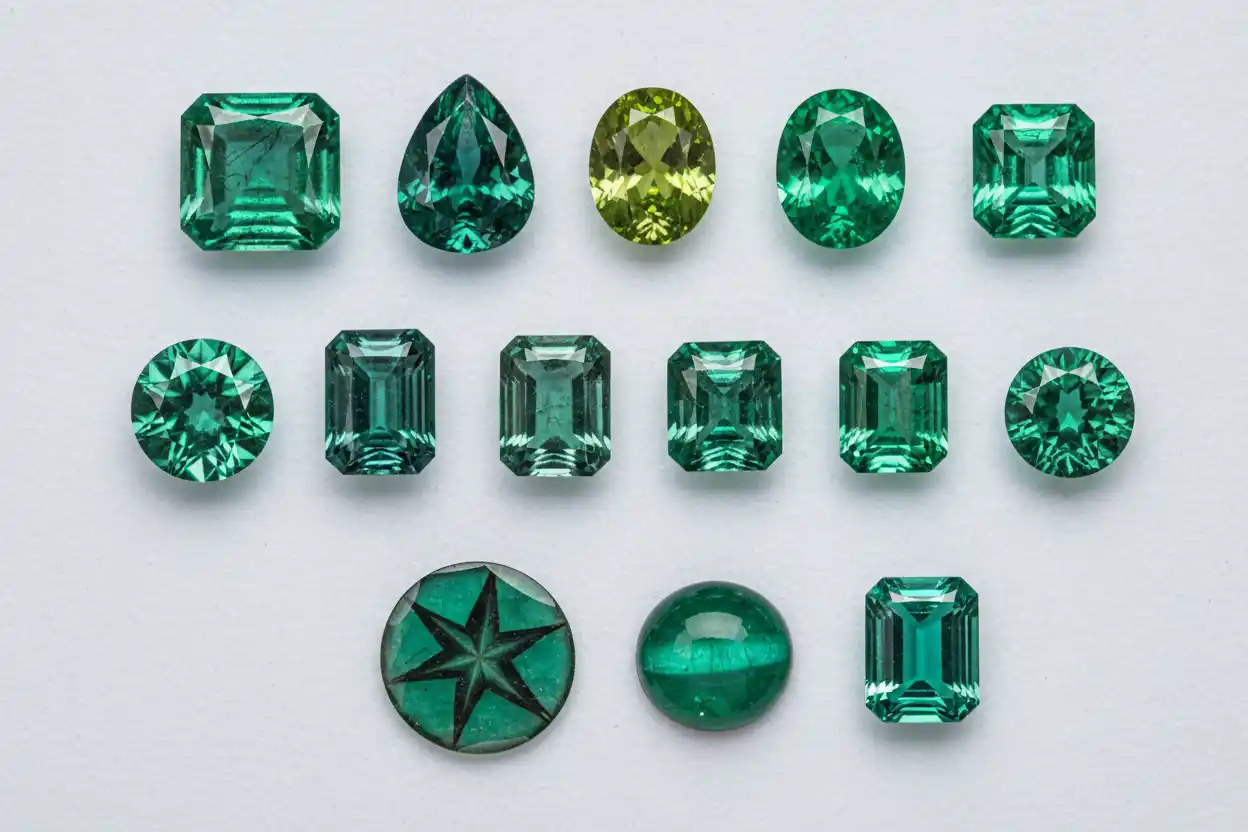
Types of Emerald: Colors and Varieties Explained
Emerald is the green-to-bluish-green gem variety of Beryl, colored primarily by chromium, vanadium or both. Within that definition, the market recognizes several meaningful categories based on geographic origin, color appearance, unusual growth structure and natural or laboratory-grown formation.
These categories do not function like separate mineral species. Colombian Emerald and Zambian Emerald are geographic descriptions, while trapiche Emerald refers to a distinctive growth pattern. Cat’s-eye Emerald displays an optical phenomenon, and laboratory-grown Emerald is classified by growth method.
Treatment creates another layer but does not normally define a separate variety. An oiled Colombian Emerald remains Colombian Emerald, while a hydrothermal synthetic is laboratory-grown regardless of whether its color resembles a famous natural source.
Emerald Types at a Glance
| Type or category | Defining feature | Important caution |
|---|---|---|
| Colombian Emerald | Origin in Colombian deposits | Origin cannot be proved by color alone |
| Zambian Emerald | Origin in Zambian deposits | Dark bluish green is common but not universal |
| Brazilian Emerald | Origin in Brazilian deposits | Quality and geology vary among deposits |
| Ethiopian Emerald | Origin in Ethiopia | Inclusion scenes can overlap other sources |
| Afghan Emerald | Commonly associated with Panjshir | Some resemble Colombian material |
| Pakistani Emerald | Includes Swat Valley material | Laboratory origin testing is important |
| Russian Emerald | Primarily associated with the Ural region | Less common in the market |
| Zimbabwean Emerald | Historically important Sandawana material | Fine stones are often small |
| Trapiche Emerald | Six-sector spoke-like growth pattern | Not the same as a star or surface carving |
| Cat’s-eye Emerald | Chatoyant band in a cabochon | Rare and commonly included |
| Star Emerald | Asterism from oriented inclusions | Extremely rare and distinct from trapiche |
| Laboratory-grown Emerald | Produced by flux or hydrothermal growth | Must be disclosed as laboratory grown |
What Qualifies as Emerald?
Emerald belongs to the Beryl mineral family.
Beryl also includes Aquamarine, Morganite, Heliodor, Goshenite and Red Beryl. The completed Beryl guide explains the parent mineral.
Not every green Beryl is automatically called Emerald. Laboratories evaluate whether the hue, tone and saturation are sufficient for the Emerald name.
Material that is too pale or weakly saturated may be reported as green Beryl.
This boundary is not based on one universal numeric color threshold used by every laboratory. Consequently, borderline stones may receive different descriptions depending on professional criteria.
The Emerald meaning guide provides the complete mineral profile.
Emerald Classification by Origin
Geographic names describe where an Emerald formed.
They do not guarantee quality, color, treatment or price.
Colombia, Zambia and Brazil remain major commercial sources, while Ethiopia, Afghanistan, Pakistan, Russia, Zimbabwe and Madagascar also produce important material.
Origin determination requires more than matching a stone to a stereotypical shade. Laboratories combine microscopic inclusions, ultraviolet-visible and infrared spectra, trace-element chemistry and reference databases.
A stone that looks Colombian may come from Afghanistan, China or another deposit with overlapping features.
Colombian Emerald
Colombian Emerald is associated with deposits such as Muzo, Chivor and Coscuez.
The geological environment differs from many schist-hosted Emerald deposits. Colombian material commonly forms in hydrothermal veins connected with black shale and carbonate-bearing systems.
Fine stones are often valued for vivid green to slightly bluish-green color with comparatively low iron content.
Three-phase fluid inclusions containing liquid, gas and a crystal are famously associated with Colombian Emerald. However, similar inclusions can occur in material from Afghanistan, China, Zambia and other sources.
A Colombian origin should therefore be supported by laboratory evidence rather than color or one inclusion alone.
Muzo Emerald
Muzo is one of Colombia’s best-known Emerald districts.
Material associated with the area may show rich green color and internal scenes containing carbonates, pyrite, fluids and other minerals.
“Muzo green” is sometimes used loosely as a color description. This wording does not prove that a stone came from the Muzo district.
A premium attached to Muzo origin should rely on a recognized origin report and reliable provenance.
The name should not be used as a substitute for evaluating color, clarity, treatment and cutting.
Chivor Emerald
Chivor is another historically important Colombian source.
Emeralds from the region may show bright green to bluish-green color and characteristic inclusion scenes associated with their geological environment.
Visual overlap with other Colombian districts and foreign deposits prevents reliable unaided origin identification.
A seller may describe an old estate stone as Chivor based on family history. Such provenance can be meaningful, but it differs from a modern laboratory origin conclusion.
District names should be treated as geographic claims rather than quality grades.
Coscuez Emerald
Coscuez has produced important Colombian Emeralds, including large and notable crystals.
The material can overlap in appearance with Muzo and other Colombian sources.
Color, inclusion density and crystal size vary within the deposit.
A Coscuez label does not guarantee untreated status or exceptional quality.
Origin, filler level, color and value should be assessed separately.
Zambian Emerald
Zambia is one of the most important Emerald-producing countries.
The Kafubu area is especially significant. Emerald mineralization commonly occurs where pegmatitic fluids interacted with chromium-bearing metamorphic rocks.
Zambian stones are often described as cooler, darker or more bluish green than Colombian material because their iron content can be higher.
That description is a tendency rather than a rule. Fine Zambian Emerald can be vivid, bright and comparable in beauty with material from any source.
Blocky or irregular multiphase inclusions and particular trace-element patterns can support an origin determination.
Brazilian Emerald
Brazil contains several Emerald-producing regions with different geological environments.
Commercial material can range from pale or yellowish green to vivid bluish green. Clarity and crystal size also vary substantially.
The phrase “Brazilian Emerald” is therefore too broad to predict one visual appearance.
Some deposits produce stones whose inclusions and chemistry overlap with Zambian, Ethiopian or Russian material.
A Brazilian origin does not make a stone automatically less valuable than Colombian Emerald. Quality remains individual.
Ethiopian Emerald
Ethiopia became a significant modern source of Emerald, particularly through deposits in the southern part of the country.
Some stones show attractive bright green to bluish-green color and useful transparency.
Inclusion scenes can overlap with Brazilian, Russian and Zambian Emerald, complicating geographic identification.
The market position of Ethiopian material continues to depend on consistent production, cutting and documented origin.
A seller should not use “new source” language as proof of rarity or untreated quality.
Afghan Emerald
Afghanistan’s Panjshir Valley produces important Emerald.
Some Panjshir stones show low iron, vivid color and inclusions that can resemble Colombian material.
Jagged multiphase or three-phase fluid inclusions may occur, making origin determination difficult when microscopy is used alone.
Trace-element chemistry and spectroscopy help laboratories separate overlapping sources.
Afghan origin can carry collector interest, but ethical sourcing and chain-of-custody documentation may also influence purchasing decisions.
Pakistani Emerald
Pakistan produces Emerald in areas including the Swat Valley.
Swat Emerald can show vivid green color, distinctive inclusions and, in rare cases, trapiche-like growth patterns.
Some inclusion scenes overlap Afghan, Colombian or other material.
The terms Pakistani and Swat should describe origin rather than a guaranteed color or grade.
Reliable testing becomes important when a premium is attached to locality.
Russian Emerald
Russian Emerald is primarily associated with deposits in the Ural Mountains.
The region has a long mining history and has produced crystals in a broad range of sizes and green shades.
Russian material is less dominant in the modern market than Colombian or Zambian Emerald.
Inclusions and chemistry may overlap with Brazilian, Ethiopian and other schist-hosted sources.
A Russian label should be supported by provenance or laboratory analysis.
Zimbabwean Emerald
Zimbabwe is known particularly for the Sandawana deposits.
Sandawana Emeralds are often small but can show strong, saturated green color.
Fine material may contain distinctive internal features, although origin should not be assumed from size and color alone.
Because larger clean stones are uncommon, small gems can still carry considerable value.
Zimbabwean Emerald may be especially suitable for calibrated accents and small fine-jewelry centers.
Madagascan Emerald
Madagascar has produced Emerald from multiple geological settings.
Color, transparency and inclusion character vary.
Some material can overlap visually and chemically with other metamorphic-hosted sources.
Madagascar is better viewed as an origin category than a predictable Emerald “look.”
A reliable report is useful when geographic provenance affects the purchase.
Colombian Versus Zambian Emerald
Colombian and Zambian Emeralds are frequently compared.
Colombian stones are often associated with warmer or purer green and lower iron, while Zambian material is commonly described as cooler, darker or more bluish.
Fine examples from either source can fall outside these tendencies.
Origin should not be chosen solely from color preference. A vivid Zambian stone may provide stronger beauty than a weak Colombian gem, and the reverse can also be true.
The Emerald buying guide explains how to evaluate the individual stone rather than relying on country reputation.
Trapiche Emerald
Trapiche Emerald displays a spoke-like pattern with six growth sectors arranged around a central core.
Dark arms or separation zones divide the green sectors, producing an appearance sometimes compared with a wheel.
The term comes from a type of grinding wheel historically used in sugar processing.
Trapiche structure develops during crystal growth. It is not a carved pattern, surface coating or ordinary star effect.
Colombia is especially famous for trapiche Emerald, although related material has also been documented elsewhere, including Pakistan.
These stones are commonly cut as cabochons or slices to show the full pattern.
Trapiche Versus Star Emerald
A trapiche Emerald has visible structural sectors even when it is not moving under a point light source.
Star Emerald displays asterism caused by oriented inclusions reflecting light from a cabochon.
The two phenomena have different origins.
A trapiche stone may show six dark spokes without a mobile reflected star. A star Emerald produces rays that change with the light or viewing angle.
Rare specimens can show unusually complex or overlapping effects, but the terms should not be used interchangeably.
Cat’s-Eye Emerald
Cat’s-eye Emerald displays a moving band of reflected light called chatoyancy.
Parallel tubes, fibers or inclusions create the effect when the stone is cut as a cabochon.
The eye may be broad and soft rather than as sharp as the line in fine cat’s-eye Chrysoberyl.
Cat’s-eye Emerald is rare and commonly included.
The gemstone should show the band from a natural face-up direction rather than only when tilted into one exact position.
Treatment and natural or synthetic origin still require separate evaluation.
Star Emerald
Star Emerald displays asterism, usually as intersecting rays on a cabochon.
The phenomenon requires oriented inclusions and correct cutting.
Star material is much rarer than ordinary faceted or cabochon Emerald.
The rays should move across the surface as the light changes.
A stationary pattern painted, carved or trapped beneath a coating is not natural asterism.
Laboratory testing is advisable because synthetic and assembled materials can reproduce phenomenal appearances.
Color-Zoned Emerald
Emerald crystals can show uneven color distribution or growth zoning.
One area may be vivid green while another appears pale, yellowish or nearly colorless.
Cutters orient the rough to retain the strongest face-up color while managing fractures and weight.
Color zoning is not a separate mineral variety, but it can influence cutting, appearance and value.
A shallow coating should not be confused with internal natural zoning.
Bluish-Green Emerald
Bluish-green Emerald contains a visible blue modifier while remaining within the accepted Emerald color range.
The appearance is common in discussions of Zambian and some other sources, although it is not exclusive to any country.
A cool color can look vivid in white metal.
Excessive blue combined with pale saturation may move the material toward another Beryl description rather than fine Emerald.
Laboratory nomenclature depends on the complete hue, tone and saturation.
Yellowish-Green Emerald
Yellowish-green Emerald has a warm modifier.
Some Colombian, Brazilian, Pakistani and other stones can show this appearance.
A slight yellow component does not make the gemstone Peridot or green Tourmaline.
However, weak saturation may cause a laboratory to describe the stone as green Beryl rather than Emerald.
The Peridot versus Emerald guide covers one common identification comparison.
Light Emerald and Green Beryl
Pale green Beryl sits near the commercial boundary of the Emerald name.
A stone may contain chromium or vanadium yet remain too light or weakly saturated for a particular laboratory’s Emerald criteria.
Sellers sometimes use phrases such as light Emerald, mint Emerald or pale Emerald.
These terms should not override a professional identification report.
Green Beryl can be attractive, but it should not automatically carry the same rarity or price expectations as fine Emerald.
Dark Emerald
Dark Emerald can show rich color but may lose transparency and brilliance.
Some stones appear nearly black in ordinary indoor light despite looking vivid beneath a concentrated lamp.
Excessive depth, iron content, inclusions and cutting orientation can all contribute to darkness.
Dark tone is not a distinct variety.
The stone should be judged face-up in realistic lighting rather than valued by saturation language alone.
Natural Emerald
Natural Emerald formed geologically and was mined from the earth.
It may still be treated after mining.
The word natural therefore describes origin, not necessarily untreated status.
Many natural Emeralds contain surface-reaching fractures filled with oil, wax, resin or polymer.
A report should state natural origin and disclose detectable clarity enhancement separately.
The treated Emerald guide explains fillers and synthetic separation in detail.
Untreated Emerald
Untreated Emerald has no detectable artificial clarity enhancement or other treatment.
Such stones exist but are less common than filled material.
Untreated status does not guarantee high quality. A heavily fractured untreated gem may be less attractive or durable than a lightly enhanced stone.
The level of filling, color, cut, clarity and size should be evaluated together.
A recognized report is the safest support for an untreated claim.
Oiled Emerald
Oil is introduced into surface-reaching fractures to reduce their visibility.
Cedarwood oil is widely associated with the trade, although other oils may also be used.
The treatment can improve apparent clarity without healing the fracture.
Oil may dry, migrate or require maintenance over time.
An oiled Emerald remains a natural Emerald but should receive gentle cleaning and heat protection.
Resin-Filled Emerald
Artificial resins and polymers can also fill fractures.
Some are more durable than traditional oils, while others may discolor or react to heat and chemicals.
The quantity of filler can range from insignificant to significant.
Laboratories may report the degree of clarity enhancement and, depending on their service, characterize the filler category.
Resin-filled Emerald should not be exposed to steam, ultrasonic cleaning or jewelry-repair heat without specialist assessment.
Laboratory-Grown Emerald
Laboratory-grown Emerald shares the essential composition and crystal structure of natural Emerald but was produced by people.
The two main commercial growth families are flux and hydrothermal synthesis.
Laboratory-grown Emerald is not glass or cubic zirconia.
It can offer vivid color and high clarity at a lower price than comparable natural material.
The completed Lab Emerald guide explains the material, while the lab Emerald buying guide and lab Emerald price guide cover purchasing and value.
Flux-Grown Synthetic Emerald
Flux growth dissolves nutrient material in a molten chemical solution and allows Emerald crystals to develop slowly.
Flux-grown stones may contain wispy veils, fingerprint-like inclusions, flux residue and metallic platelets associated with the growth apparatus.
Different manufacturers produce different internal features.
A clean synthetic cannot be identified safely from appearance alone.
Laboratory microscopy, spectroscopy and chemistry separate flux-grown Emerald from natural stones.
Hydrothermal Synthetic Emerald
Hydrothermal growth uses hot water-based solutions under high temperature and pressure.
Seed plates, chevron growth zoning, nail-head spicules, parallel tubes and distinctive chemical signatures can provide clues.
Hydrothermal synthetic Emerald can look convincingly natural and may contain intentional-looking inclusions.
The phrase “created Emerald” should still be accompanied by clear laboratory-grown disclosure.
The broader lab-grown versus natural gemstones guide explains the terminology.
Emerald Doublets and Imitations
An Emerald doublet joins two or more layers.
A thin natural Emerald section may be attached to glass, Beryl or another material. Green cement can also contribute to the appearance.
Joining planes, glue bubbles and mismatched luster may appear under magnification.
Green glass, synthetic Spinel, YAG and other materials can imitate Emerald without sharing its mineral identity.
The real-versus-fake Emerald guide owns the complete identification workflow.
Emerald Versus Tsavorite
Tsavorite is green Grossular Garnet rather than Beryl.
It commonly shows greater brilliance, higher density, no cleavage and fewer routine treatment concerns.
Emerald has a lower refractive index and frequently displays a visible internal jardin.
The Tsavorite versus Emerald guide provides the full comparison.
Neither stone should be identified from green color alone.
Emerald Versus Ruby and Sapphire
Ruby and Sapphire are varieties of Corundum.
They have greater hardness and toughness than Emerald and different treatment practices.
Emerald provides a distinctive green color and historical market identity, while Sapphire occurs in green and many other colors.
The Sapphire versus Emerald versus Ruby guide compares the three major colored-gem families.
Emerald Cuts
The rectangular step cut known as the Emerald cut was developed to protect corners and display color through broad facets.
Rounds, ovals, cushions and pears are also used.
Heavily included material may be cut as a cabochon or bead.
Trapiche, star and cat’s-eye Emerald require cabochon or slice cutting to show their patterns.
Cut is not a type of Emerald, but it affects how each variety and phenomenon appears.
Emerald Jewelry Types
The Emerald bracelet guide addresses line construction, fit and impact.
The Emerald earrings guide focuses on pair matching and low-impact wear.
The Emerald necklace guide covers pendants, strands, chains and bails.
The Emerald ring guide and Emerald engagement-ring guide address protective settings and daily hand wear.
May Birthstone
Emerald is the modern birthstone for May.
The completed May birthstone guide explains its history and symbolism.
The May birthstone jewelry guide compares gift formats.
A birthstone label does not identify origin, treatment or natural versus laboratory-grown status.
Buying Different Types of Emerald
Begin by deciding which category matters: geographic origin, unusual phenomenon, natural versus laboratory-grown formation or color appearance.
Then evaluate the individual stone.
A country name cannot compensate for weak color, excessive filling or poor cutting.
Trapiche and cat’s-eye stones should display their patterns clearly. Laboratory-grown material should be disclosed explicitly.
The Emerald price guide owns the detailed value discussion and avoids reducing origin types to a simple price ranking.
Laboratory Reports
A colored-stone report can identify natural or laboratory-grown origin and disclose detectable treatment.
Origin reports may provide a geographic conclusion when the evidence is sufficient.
The report does not establish mine ownership history, ethical sourcing or artistic provenance.
A report should correspond to the exact stone rather than a sample from the same parcel.
Important natural-origin, untreated, trapiche and phenomenal stones often justify professional documentation.
Emerald Care
Use warm water, mild soap and a soft brush.
Avoid steam and ultrasonic cleaners because fractures and fillers can react to heat and vibration.
Do not expose the stone to sudden temperature changes, solvents or jewelry-repair heat without specialist assessment.
The Emerald jewelry-cleaning guide provides the detailed procedure.
Store Emerald away from Diamond, Sapphire and other harder stones.
Final Perspective
Emerald types are best understood through a clear hierarchy. Geographic names describe origin, trapiche and cat’s-eye identify structural or optical phenomena, and flux or hydrothermal terms describe laboratory growth.
Color descriptions such as bluish green, yellowish green or dark green help explain appearance but do not create separate mineral species. Treatments such as oil and resin modify clarity without changing the stone’s geographic type.
The strongest purchase uses precise terminology and evaluates the individual gemstone. A famous origin or rare pattern adds context, but color, structural condition, treatment, cutting and documentation determine whether the Emerald deserves its description.
Frequently Asked Questions
1. How many types of Emerald are there?
There is no fixed number. Emeralds can be categorized by geographic origin, color appearance, growth pattern, optical phenomenon and natural or laboratory-grown formation.
2. What is the most valuable type of Emerald?
Fine Colombian Emerald is highly prized, but value depends on color, clarity, size, treatment, cut and documentation rather than origin alone.
3. What is the difference between Colombian and Zambian Emerald?
Colombian material is often lower in iron and associated with vivid green, while Zambian stones commonly appear cooler or more bluish. These are tendencies, not universal rules.
4. What is trapiche Emerald?
It is Emerald with a natural six-sector spoke-like growth pattern arranged around a central core.
5. Is trapiche Emerald the same as star Emerald?
No. Trapiche structure is visible as growth sectors, while star Emerald displays moving asterism from oriented inclusions.
6. Does cat’s-eye Emerald exist?
Yes. Rare included Emerald can show a moving chatoyant band when cut as a cabochon.
7. Is light green Emerald the same as green Beryl?
A pale stone may be classified as green Beryl when its color is not sufficiently saturated for a laboratory’s Emerald criteria.
8. Is oiled Emerald a separate type?
No. Oiling is a clarity treatment applied to natural Emerald; it does not create a new mineral variety.
9. Does laboratory-grown Emerald count as real Emerald?
It has Emerald’s essential composition and structure, but it must be disclosed as laboratory grown rather than natural.
10. What is the difference between flux and hydrothermal Emerald?
They are two laboratory-growth methods using different chemical environments and producing different growth features.
11. Can Emerald origin be identified by color?
No. Color and inclusions overlap among deposits, so reliable origin determination uses multiple laboratory methods.
12. Which Emerald type is best for jewelry?
A well-cut stone with attractive color, manageable fractures and appropriate treatment disclosure is more important than choosing one country or trade category.