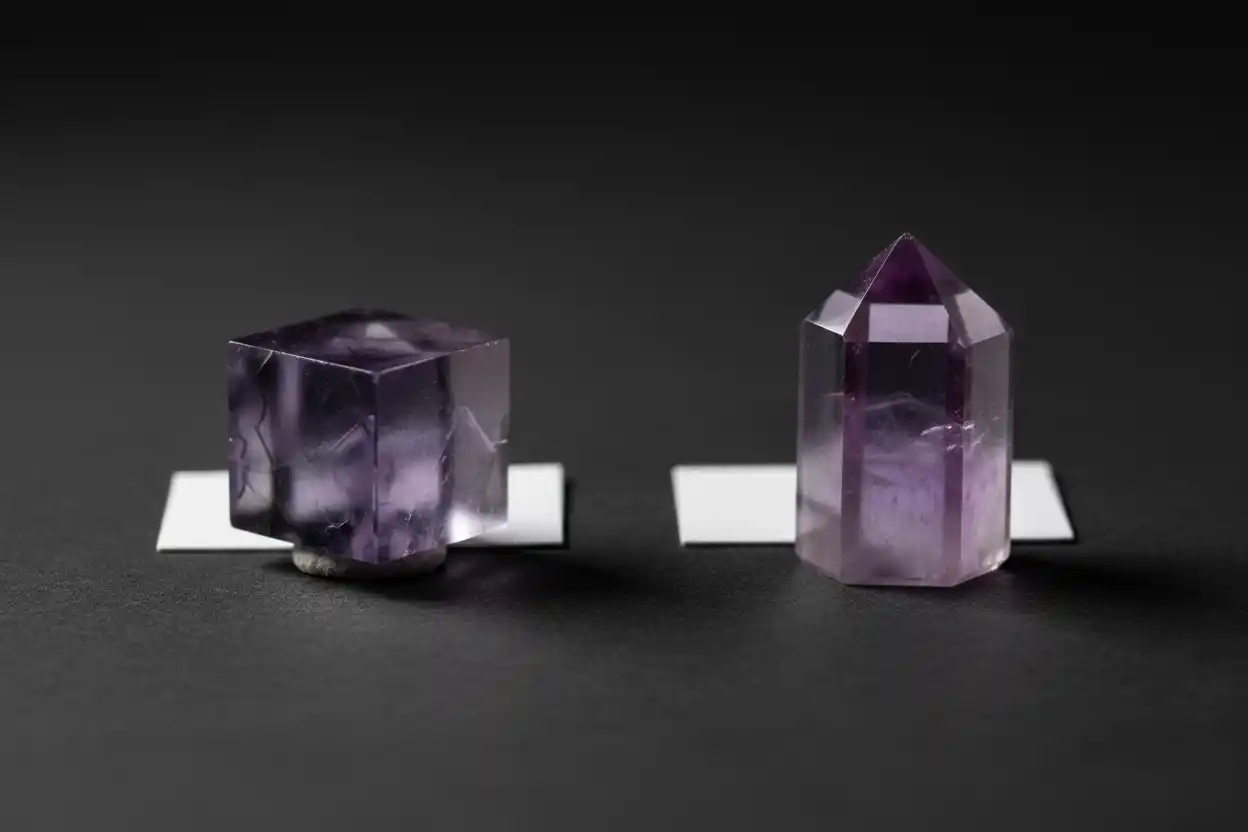
Fluorite vs Amethyst: Key Differences & How to Choose
Fluorite vs amethyst can look like a simple purple-stone comparison until physical properties are considered. Purple fluorite and amethyst can overlap strongly in hue, transparency, zoning, polished appearance, and collector appeal, but they are fundamentally different minerals. Fluorite is calcium fluoride, CaF₂, with cubic crystallography, Mohs hardness around 4, perfect octahedral cleavage, comparatively high density, and singly refractive optical behavior. Amethyst is the purple variety of crystalline quartz, SiO₂, with trigonal crystallography, Mohs hardness 7, no cleavage, lower density, and doubly refractive optical behavior.
Those differences matter far beyond identification. Amethyst is substantially more resistant to scratching and generally better suited to jewelry that receives regular wear. Fluorite is softer and much more vulnerable to splitting along cleavage planes, making fine crystals especially appropriate for careful collecting and protected display. At the same time, fluorite can offer crystal forms, multicolored zoning, fluorescence, and locality-specific specimen qualities that amethyst does not reproduce in the same way.
A good fluorite vs amethyst decision therefore should not begin with “Which purple crystal has the stronger meaning?” It should begin with what you intend to do with the material. Identification, jewelry durability, specimen collecting, optical interest, treatment disclosure, price, and personal aesthetic preference can all lead to different answers. Similar evidence-first comparisons are grouped in the Identification section.
Fluorite vs Amethyst at a Glance
| Property | Fluorite | Amethyst |
|---|---|---|
| Mineral identity | Calcium fluoride | Purple crystalline quartz |
| Formula | CaF₂ | SiO₂ |
| Crystal system | Cubic / isometric | Trigonal |
| Common purple appearance | Lavender, violet, deep purple, often with green or other zoning | Pale lilac through deep violet, commonly zoned |
| Mohs hardness | About 4 | 7 |
| Cleavage | Perfect octahedral cleavage | No cleavage |
| Typical fracture | Subconchoidal to uneven; cleavage commonly dominates breakage | Conchoidal |
| Specific gravity | About 3.18 | About 2.65 |
| Refractive index | About 1.43 | About 1.54–1.55 |
| Optical character | Singly refractive in ideal crystal orientation | Doubly refractive / uniaxial |
| Common crystal habits | Cubes, octahedra, combinations | Six-sided prismatic quartz crystals with terminations |
| Fluorescence | Can occur strongly in some fluorite; highly variable | Usually not a primary identification feature |
| Jewelry durability | Relatively delicate | Generally much better |
| Collector appeal | Strong for color zoning, crystal form, fluorescence, locality | Strong for crystal form, color, clusters, phantoms, locality |
| Major testing caution | Cleavage makes destructive testing especially undesirable | Hardness testing can still damage valuable surfaces |
| Best default choice for frequent jewelry | Usually amethyst | Usually amethyst |
| Best default choice for cubic crystal collecting | Often fluorite | Not applicable to normal amethyst morphology |
The most immediately useful distinction in fluorite vs amethyst is hardness combined with cleavage. Fluorite’s softness means quartz itself can scratch it, while amethyst is quartz. In principle, an amethyst could therefore scratch fluorite. In practice, intentionally scratching either specimen is poor identification practice when nondestructive methods are available.
The Core Difference: They Are Unrelated Mineral Species
Fluorite and amethyst share purple coloration but little else chemically. Fluorite is a halide mineral consisting principally of calcium and fluorine. Amethyst is a silicate mineral variety whose host structure is quartz. Their atomic arrangements, chemical bonds, density, refractive behavior, cleavage, hardness, and geological occurrence follow from those different structures.
This distinction explains why purple color has little taxonomic value by itself. Mineral identification does not work by assigning one species to one hue. Purple also occurs in minerals such as charoite, lepidolite, scapolite, spinel, sapphire, tourmaline, and several others. Even within quartz, violet intensity can vary from barely perceptible lilac to very dark purple.
Fluorite vs amethyst identification becomes much more reliable when a series of independent observations converge on the same answer. Crystal form can provide the first clue, hardness and cleavage can reinforce it, density can provide another separation, and optical measurements can confirm what appearance suggested.
Crystal Shape: Often the Fastest Clue in Rough Material
Natural crystal habit can make fluorite vs amethyst surprisingly easy when specimens retain well-developed faces. Fluorite commonly crystallizes as cubes. Octahedra and modified cube-octahedron combinations also occur, while penetration twins, stepped faces, etched surfaces, and complex growth forms can make collector specimens highly distinctive.
Amethyst normally follows quartz morphology. Well-formed crystals are typically six-sided prisms terminated by rhombohedral faces, although individual crystals can be short, elongated, sceptered, twinned, clustered, or integrated into geodes and drusy surfaces.
A sharp purple cube is therefore much more consistent with fluorite than amethyst. A classic six-sided violet quartz point is much more consistent with amethyst than fluorite.
Problems arise once material has been polished. A fluorite sphere and an amethyst sphere no longer preserve their original habits. A cabochon likewise removes most crystallographic clues. At that stage, color becomes tempting but insufficient, and physical or optical observations become more important.
The same problem—cutting removing useful natural evidence—appears in many stone comparisons. The logic used in clear quartz vs selenite is similar: visual overlap becomes less informative when diagnostic crystal form is absent.
Hardness Creates a Major Practical Difference
Amethyst has Mohs hardness 7 because it is quartz. Fluorite defines Mohs hardness 4. The numerical difference may look modest, but it is substantial in ownership.
Everyday mineral dust commonly contains quartz. A polished amethyst surface therefore resists many incidental abrasives considerably better than fluorite. Fluorite can accumulate fine scratches, edge wear, and loss of polish from contact with harder minerals, gritty surfaces, or careless storage.
This gives amethyst a decisive advantage for frequent jewelry wear. Earrings and protected pendants can reduce the mechanical demands placed on fluorite, but rings and bracelets encounter repeated contact with desks, door frames, tools, countertops, and other jewelry. Those exposures are much less forgiving for hardness 4 material.
Hardness should not be treated as a home test recommendation. Scratching a polished fluorite with quartz may distinguish materials, but it also permanently damages the softer specimen. Nondestructive gemological observations are preferable.
Cleavage May Matter Even More Than Hardness
Fluorite has perfect octahedral cleavage. Its structure contains directions along which the crystal can split much more readily than along others. A sharp impact in an unfavorable orientation can therefore cause a fluorite crystal or faceted stone to break along smooth cleavage planes.
Amethyst has no cleavage. When quartz breaks, it commonly develops conchoidal fracture instead of following predetermined flat cleavage planes.
This difference has major consequences. A fluorite gemstone can be visually clean and still contain structural vulnerability inherent to the species. Amethyst is not indestructible—it can chip, crack, or fracture under impact—but it lacks fluorite’s perfect cleavage weakness.
For collectors, this means fluorite cubes and octahedra should be handled over padded surfaces and stored so they cannot knock against neighboring minerals. For jewelry, it means a fluorite setting needs more protection from impact than an equivalent amethyst setting.
The distinction also explains why simplistic statements such as “both are crystals, so durability is similar” fail. Mineral structure determines mechanical behavior.
Density Provides a Useful Nondestructive Separation
Fluorite is noticeably denser than amethyst. Typical fluorite has a specific gravity around 3.18, while quartz is around 2.65.
If two loose stones have exactly the same external dimensions, fluorite will generally weigh more. Conversely, two stones with exactly the same carat weight will generally occupy somewhat different volumes.
Specific-gravity testing can therefore be useful for loose stones when performed correctly. It is less practical for mounted gems, porous specimens, matrix material, or objects containing multiple minerals. Measurements also need sufficient precision because careless weighing can generate misleading conclusions.
Density is especially valuable because it separates the species without scratching or breaking them.
Refractive Index Gives a Strong Gemological Answer
The refractive-index difference in fluorite vs amethyst is substantial. Fluorite is around 1.43, while amethyst falls around 1.54–1.55.
A trained gemologist using an appropriate refractometer can therefore separate many polished loose stones efficiently. The gap is large enough that the two should not be confused when reliable readings are obtained.
Amethyst is also doubly refractive. In suitable examination, quartz’s birefringence produces two refractive-index values and characteristic optical behavior. Fluorite belongs to the cubic crystal system and is ideally singly refractive.
These measurements offer far stronger evidence than comparing purple saturation. Similar optical logic is useful in other colored-gem decisions such as citrine vs yellow sapphire and heliodor vs citrine, where superficially similar colors can mask major differences in refractive properties.
Mounted stones, unusual cuts, very small gems, poor surface polish, or instrument limitations can complicate testing. No single instrument reading should be interpreted outside the conditions under which it was obtained.
Original Fluorite vs Amethyst Decision Matrix
This matrix focuses on actual ownership decisions rather than asking which mineral is universally “better.”
| Your priority | Better default choice | Why | Important exception |
|---|---|---|---|
| Everyday ring | Amethyst | Higher hardness and no cleavage | Any gem can chip under severe impact |
| Occasional pendant | Amethyst, with fluorite possible | Both can work, but amethyst tolerates wear better | Protected fluorite can be attractive for careful use |
| Earrings for occasional wear | Either | Lower impact exposure | Fluorite still scratches more easily |
| Mineral display | Either | Choice becomes aesthetic and locality-driven | Fluorite needs more careful handling |
| Cubic crystal forms | Fluorite | Natural cubic crystallography | Amethyst does not normally form cubes |
| Traditional quartz points | Amethyst | Characteristic quartz crystal habit | Cut fluorite can imitate general polished shapes |
| Strong multicolor zoning | Often fluorite | Purple-green and other combinations are common | Amethyst can show zoning, but usually within violet intensity |
| UV-response collecting | Often fluorite | Some specimens fluoresce strongly | Fluorescence varies and is not guaranteed |
| Better scratch resistance | Amethyst | Mohs 7 versus about 4 | Scratch resistance is not toughness |
| Easier polishing longevity | Amethyst | Harder surface retains polish better | Condition and use still matter |
| Low-risk beginner jewelry purchase | Amethyst | More forgiving physically | Verify material identity and treatment |
| Specialist locality collecting | Either | Important specimens exist for both minerals | Provenance matters more than generic species |
| Lowest identification uncertainty from rough habit | Depends on specimen | Cubes favor fluorite; quartz points favor amethyst | Broken or massive material needs more evidence |
| Symbolic use only | Personal choice | Symbolism is subjective | Neither has proven medical powers |
| Choosing purely by purple color | Neither | Hue alone is insufficient | Compare under identical neutral lighting first |
The matrix deliberately separates “best for use” from “best mineral.” Fluorite can be the better collector specimen even when amethyst is the better ring stone. Amethyst can be more practical for daily wear while fluorite offers more unusual cubic morphology or multicolor zoning.
A Same-Light Side-by-Side Observation Protocol
A useful fluorite vs amethyst visual comparison should eliminate as many photography variables as possible. Place both specimens on the same neutral gray or white background. Photograph them at the same distance and scale, with the same camera, white balance, exposure, and diffuse daylight source. Include one image in reflected light and, for translucent material, another with controlled transmitted light.
Then record four observations separately:
| Observation | Fluorite | Amethyst |
|---|---|---|
| Body hue | Purple may lean blue, violet, reddish, or gray and can occur with green/yellow zoning | Purple commonly ranges lilac to violet and reddish violet |
| Crystal form | Cubic or octahedral clues if natural faces remain | Quartz prism and termination clues if natural faces remain |
| Surface/break features | Cleavage planes can appear smooth and planar | Fractures tend to be conchoidal rather than cleavage-controlled |
| Color zoning | Can be sharp, multicolored, layered, or complex | Often violet zoning linked to crystal growth |
This protocol does not establish species by photography alone. Its value is consistency. Comparing one fluorite photographed in cool studio light with an amethyst photographed under warm sunlight can create artificial differences that disappear under controlled conditions.
Purple Color Alone Is a Weak Identifier
Both minerals can range from pale lavender to deep violet. Fluorite may also show blue-purple, green-purple, yellow-purple, or nearly colorless zoning. Amethyst can show intense violet, reddish violet, smoky-violet combinations, or alternating pale and dark growth zones.
Saturation is therefore a quality observation, not a species test.
Commercial photography complicates the problem further. Purple is particularly sensitive to white balance and sensor processing. A camera can move violet toward blue or magenta, while image editing can deepen saturation dramatically. Background choice also changes apparent color.
The same warning applies to many comparisons. An orange-red stone in carnelian vs red jasper cannot be identified responsibly from hue alone, just as green materials in aventurine vs jade require more than a visual color match.
Fluorescence Can Help—but Cannot Decide the Question Alone
Fluorite is historically associated with fluorescence because some specimens emit visible light under ultraviolet radiation. Responses can be strong or weak and can vary with ultraviolet wavelength, trace elements, defects, and locality.
Amethyst can show luminescence behavior too, but fluorescence is generally not the first-line distinction most people should use between ordinary purple fluorite and amethyst.
A strong fluorescent response can contribute evidence in a broader fluorite examination. No fluorescence does not rule fluorite out. Likewise, fluorescence of an unusual color should not be converted automatically into a locality identification.
UV examination also requires eye-safe equipment and appropriate procedures. Looking directly into high-intensity ultraviolet sources is not necessary for gemstone identification.
Cleavage Faces Versus Quartz Fracture
Broken rough material can reveal one of the strongest visual distinctions in fluorite vs amethyst.
Fluorite may expose flat cleavage planes that intersect according to its octahedral cleavage geometry. Pieces created by controlled cleavage can take striking octahedral forms. Those flat surfaces reflect the crystal structure rather than ordinary random breakage.
Amethyst tends to break like other quartz, producing curved conchoidal fractures. Fresh breaks may resemble broken glass more than fluorite’s characteristic planar cleavage.
This can occasionally create confusion with glass itself, particularly when examining polished purple objects with no visible crystal form. The broader identification issues involved in distinguishing manufactured vitreous materials are explained in glass vs crystal.
Again, intentionally breaking a specimen simply to inspect fracture is unnecessary when other evidence is available.
Treatments: Amethyst and Fluorite Need Different Questions
Treatment is part of a fluorite vs amethyst comparison, but the relevant treatments and commercial context differ.
Amethyst is well known for its response to heating. Heat can alter the color centers responsible for purple coloration and, in suitable material, produce yellow-to-orange quartz sold as heated citrine. Certain treatments can also produce green quartz marketed as prasiolite. Amethyst itself can be sold natural-colored or treated depending on the material and purpose.
Fluorite colors can also be modified by irradiation, heating, coating, or other processes, although treatment patterns in collector fluorite markets differ from the mass jewelry market surrounding quartz. Some fluorite color can also be sensitive to prolonged strong light or heat depending on the defect system involved.
Disclosure matters more than fear. A treated stone is not automatically worthless or fake. The correct question is whether the treatment was identified accurately, disclosed appropriately, and incorporated into the price comparison. A broader treatment framework is available in gemstone treatments explained.
Synthetic, Assembled, and Imitation Risks
Natural fluorite and amethyst can both be imitated by glass or other colored materials. Synthetic quartz also exists, and hydrothermal growth can produce laboratory-created quartz suitable for many technical and gem uses. Synthetic fluorite has specialized technical applications as well.
The important identification distinction is not “natural-looking versus fake-looking.” Well-made manufactured materials can look extremely convincing.
Assembled stones introduce another possibility. Doublets and triplets use multiple layers to create an appearance that a single homogeneous gem would not have. These structures are more relevant to some gem categories than ordinary fluorite or amethyst, but the general inspection principles in gemstone doublets and triplets remain useful whenever layer boundaries, glue planes, or backing materials appear suspicious.
Magnification around girdles, facet junctions, fractures, and color boundaries can reveal clues that a top-down photograph misses.
Jewelry Durability: Amethyst Wins Clearly
For frequent jewelry, the practical fluorite vs amethyst comparison strongly favors amethyst. Hardness 7 gives it materially better abrasion resistance, while the absence of cleavage reduces one major route of catastrophic damage.
That does not make amethyst indestructible. Quartz can still chip at facet junctions, crack along existing fractures, or break after a strong impact. But the baseline durability is substantially more forgiving.
Fluorite is better regarded as a collector gem or an occasional-wear stone when mounted. Pendants, brooches, and earrings generally expose it to fewer knocks than everyday rings. Protective designs can improve survivability, but they cannot change the mineral’s hardness or cleavage.
When deciding between an amethyst ring and a fluorite ring of similar beauty, amethyst is normally the more rational long-term choice.
Collecting: Fluorite Can Be the More Structurally Diverse Choice
The jewelry conclusion should not be mistaken for a universal verdict.
For mineral collecting, fluorite can offer extraordinary diversity: cubes, octahedra, penetration twins, stepped growth, etched forms, intense color zoning, multiple colors in one specimen, fluorescence, inclusions, and associations with many hydrothermal minerals. Famous localities can produce highly distinctive combinations of form and color.
Amethyst has a different collecting appeal. Crystals can form dramatic points, clusters, geodes, scepters, phantoms, inclusions, and deeply colored zones. Locality, crystal habit, luster, damage, color distribution, and associated minerals can all create important collector distinctions.
If the goal is a natural crystal display rather than jewelry, the better choice becomes specimen-specific rather than species-specific.
Value: Species Name Alone Does Not Set the Price
Neither “fluorite” nor “amethyst” provides a useful standalone valuation.
Commercial amethyst can be widely available, while exceptional specimens or gems with unusual color, size, provenance, crystal form, or historical importance can command much more. Fluorite also ranges from inexpensive cleaved pieces and small crystals to highly collectible locality specimens whose aesthetic quality and provenance matter substantially.
For faceted gems, amethyst generally benefits from a much broader jewelry market because of its durability and established consumer recognition. Fine faceted fluorite is less suited to everyday jewelry and is often appreciated as a collector stone instead.
For mineral specimens, crystal perfection, damage, associated minerals, matrix composition, color zoning, size, rarity of habit, and documented locality can matter more than nominal mineral species. A modest purple fluorite cube from an ordinary commercial source should not be priced like an exceptional historic locality specimen merely because both are fluorite.
The same value principle appears in comparisons such as citrine vs yellow topaz: mineral identity is only the beginning of valuation, not the final number.
Should You Choose Fluorite or Amethyst for a Collection?
Choose fluorite when cubic geometry, multicolor zoning, octahedral cleavage forms, fluorescence, unusual locality specimens, or hydrothermal mineral associations are central to what you want to collect.
Choose amethyst when quartz crystal morphology, durable handling, clusters, points, geodes, phantoms, stronger surface resistance, or a broad range of jewelry-compatible material is more important.
For a mixed mineral collection, there is little reason to treat them as substitutes. Their overlap in purple color makes the contrast educational: one display can demonstrate how two chemically unrelated minerals arrive at similar visual outcomes.
That makes fluorite vs amethyst a particularly useful teaching pair.
Should You Choose Fluorite or Amethyst for Jewelry?
For an everyday ring, amethyst is the better default.
For a bracelet that may contact desks or other hard surfaces, amethyst again has the practical advantage.
For occasional earrings or a protected pendant, fluorite becomes more realistic if the owner understands its vulnerability and is comfortable treating the piece carefully.
For a collector pendant containing an unusual natural fluorite crystal, aesthetic significance may outweigh durability considerations—but that is a conscious tradeoff rather than evidence that fluorite suddenly becomes as robust as quartz.
A good jewelry choice is therefore based on intended wear, not only appearance.
Should You Choose Based on Symbolic Meaning?
Modern crystal culture often gives fluorite and amethyst overlapping symbolic themes such as clarity, calm, protection, focus, or spiritual awareness. Those similarities are not surprising because symbolic systems frequently assign meanings based on color, cultural associations, and repeated modern traditions rather than mineral chemistry.
There is no scientific evidence that either mineral treats anxiety, depression, neurological conditions, sleep disorders, hormonal conditions, cardiovascular disease, or another medical problem. Neither should replace qualified healthcare.
If a person wants one as a reflective object, choice can be entirely personal. Fluorite’s geometric forms might serve as a reminder of organization. Amethyst’s quartz points might serve as a visual cue for a meditation or journaling routine. The practical effect comes from the chosen practice rather than a proven therapeutic emission.
The site’s broader evidence boundary is explained in the Disclaimer.
When Visual Comparison Is Not Enough
A polished purple stone with no crystal form may remain ambiguous after ordinary inspection. At that point, continuing to compare shades of violet is unlikely to help.
A gemologist can use refractive index, specific gravity, optic character, microscopic examination, and other nondestructive methods. The difference between fluorite’s RI around 1.43 and amethyst’s roughly 1.54–1.55 is especially useful.
For unusual high-value material, laboratory analysis can answer questions about identity, treatment, synthetic origin, or other properties beyond casual observation. The role and limitations of reports are explained in gemstone certification.
Comparable testing logic applies elsewhere in gem identification. In heliodor vs citrine, for example, optical and physical evidence is far stronger than deciding which yellow looks “warmer.”
No laboratory should be assumed to have reviewed a specimen unless an actual report is available.
Fluorite vs Amethyst: A Practical Choice Sequence
For a reader deciding between them, this sequence avoids unnecessary complexity.
First decide whether the object is for jewelry or mineral collecting. If frequent jewelry wear is the goal, amethyst normally starts with a major durability advantage.
Next examine natural crystal form if rough material is involved. Cubes and octahedral forms support fluorite; conventional quartz prisms support amethyst.
Then consider wear risk. A hardness-4 cleavable mineral demands more protection than quartz.
After that, evaluate the feature you actually value: violet saturation, color zoning, fluorescence, crystal shape, clarity, locality, matrix, or symbolic preference.
Finally, if identity affects price and the available evidence remains ambiguous, obtain an appropriate test rather than paying a premium for a guess.
That method is more reliable than choosing whichever seller description sounds more persuasive.
Common Fluorite vs Amethyst Mistakes
One common mistake is treating dark purple as proof of amethyst. Fluorite can be intensely purple too.
Another is assuming a smooth octahedron must be a naturally grown fluorite crystal. Some fluorite octahedra are produced by cleavage from larger material.
A third is using scratch testing on valuable specimens. The result may distinguish hardness while permanently reducing value.
A fourth is assuming UV fluorescence proves fluorite. Fluorescence is variable and occurs in many materials.
A fifth is assuming amethyst is always untreated because purple is its natural color. Natural purple amethyst exists, but treatment and synthetic-material questions still deserve appropriate disclosure when commercially relevant.
The general lesson is the same across citrine vs yellow topaz: one attractive visual clue rarely replaces a complete identification.
What Fluorite vs Amethyst Can Reliably Tell You
A grounded fluorite vs amethyst comparison can establish that the two minerals differ decisively in chemistry, crystallography, hardness, cleavage, density, refractive index, optical character, crystal habit, durability, and common use. Those differences make amethyst generally more suitable for regular jewelry while giving fluorite distinctive advantages for collectors interested in cubic forms, color zoning, cleavage morphology, and fluorescence.
The comparison cannot authenticate a locality from purple color, prove treatment status from photographs, establish value from species alone, or determine an ambiguous polished stone reliably when diagnostic data are unavailable. Visual examination is a screening tool, not a substitute for appropriate testing when the stakes are high.
Gems Lore’s broader approach to material identity and evidence limits is described on About Gems Lore. Readers with laboratory evidence, documented corrections, or a specimen whose identification illustrates an important exception can submit supporting context through Contact Gems Lore; submitted information is handled according to the Privacy Policy.
FAQ
What is the main difference between fluorite and amethyst?
The main fluorite vs amethyst difference is mineral identity. Fluorite is calcium fluoride with cubic crystallography, hardness around 4, and perfect cleavage. Amethyst is purple quartz with trigonal crystallography, hardness 7, and no cleavage.
Which is harder, fluorite or amethyst?
Amethyst is much harder. It has Mohs hardness 7, while fluorite has hardness 4. This makes amethyst substantially more resistant to everyday scratching.
Which is better for an everyday ring?
Amethyst is normally the better choice because it combines higher hardness with no cleavage. Fluorite can be mounted in jewelry, but frequent ring wear exposes its softer surface and perfect cleavage to greater risk.
Can fluorite and amethyst be the same shade of purple?
Yes. Their color ranges overlap enough that purple hue alone cannot distinguish them reliably. Pale lavender, medium violet, and deep purple material can occur in both.
How can I tell rough fluorite from rough amethyst?
Natural crystal habit is often useful. Fluorite commonly forms cubes and octahedra, while amethyst commonly forms six-sided quartz prisms with characteristic terminations. Broken or massive material may need additional testing.
Can I use a scratch test to separate fluorite and amethyst?
Their hardness difference could separate them in principle, but deliberately scratching a gemstone or collectible specimen is destructive and unnecessary when nondestructive measurements such as refractive index, density, crystallography, or expert examination are available.
Does fluorite fluoresce while amethyst does not?
Some fluorite specimens fluoresce strongly under ultraviolet radiation, but others respond weakly or not obviously. Fluorescence is therefore supporting evidence rather than a definitive fluorite vs amethyst test.
Is fluorite heavier than amethyst?
For the same volume, fluorite is generally heavier because its specific gravity is around 3.18 compared with approximately 2.65 for amethyst.
Which is more valuable, fluorite or amethyst?
Neither species is automatically more valuable. Commercial quality, size, color, clarity, crystal form, condition, provenance, locality, treatment, cut, and market context determine value. Fine collector fluorite can be worth more than ordinary amethyst, and exceptional amethyst can be worth more than ordinary fluorite.
Is fluorite rarer than amethyst?
That question is too broad to answer meaningfully at species level. Both occur in many deposits. Particular colors, crystal habits, localities, specimen qualities, or combinations of features can be much rarer than common commercial material.
Are fluorite and amethyst both healing crystals?
They are both used in modern crystal traditions, but “healing crystal” is a cultural or commercial category rather than a scientific mineral property. Neither has scientifically established medical powers from being worn or held.
Which should I choose for meditation or symbolism?
Either can be chosen according to personal preference. If the purpose is reflective rather than gemological, color, shape, personal association, and handling preference can guide the decision. The symbolic choice does not establish a scientifically measurable difference in health effects.
Choosing Between Fluorite and Amethyst Comes Down to Use
Fluorite vs amethyst is not a contest with one universal winner. Their similar purple color hides a large material divide. Fluorite is softer, denser, cubic, perfectly cleavable, and capable of striking multicolored zoning and fluorescence. Amethyst is harder, trigonal, cleavage-free quartz with substantially better resistance to routine abrasion and a much stronger default case for everyday jewelry.
For identification, crystal form, density, refractive index, cleavage, and optical character are more useful than shade. For jewelry, durability usually points toward amethyst. For mineral collecting, fluorite’s geometry and zoning may make it the more compelling choice in a particular specimen. For value, individual quality and provenance matter more than the species name alone.
That is the useful conclusion: choose amethyst when practical wear resistance is the priority, fluorite when its distinctive mineral character is the attraction, and neither solely because one seller describes purple symbolism more persuasively. The best choice follows the evidence and the way the stone will actually be used.