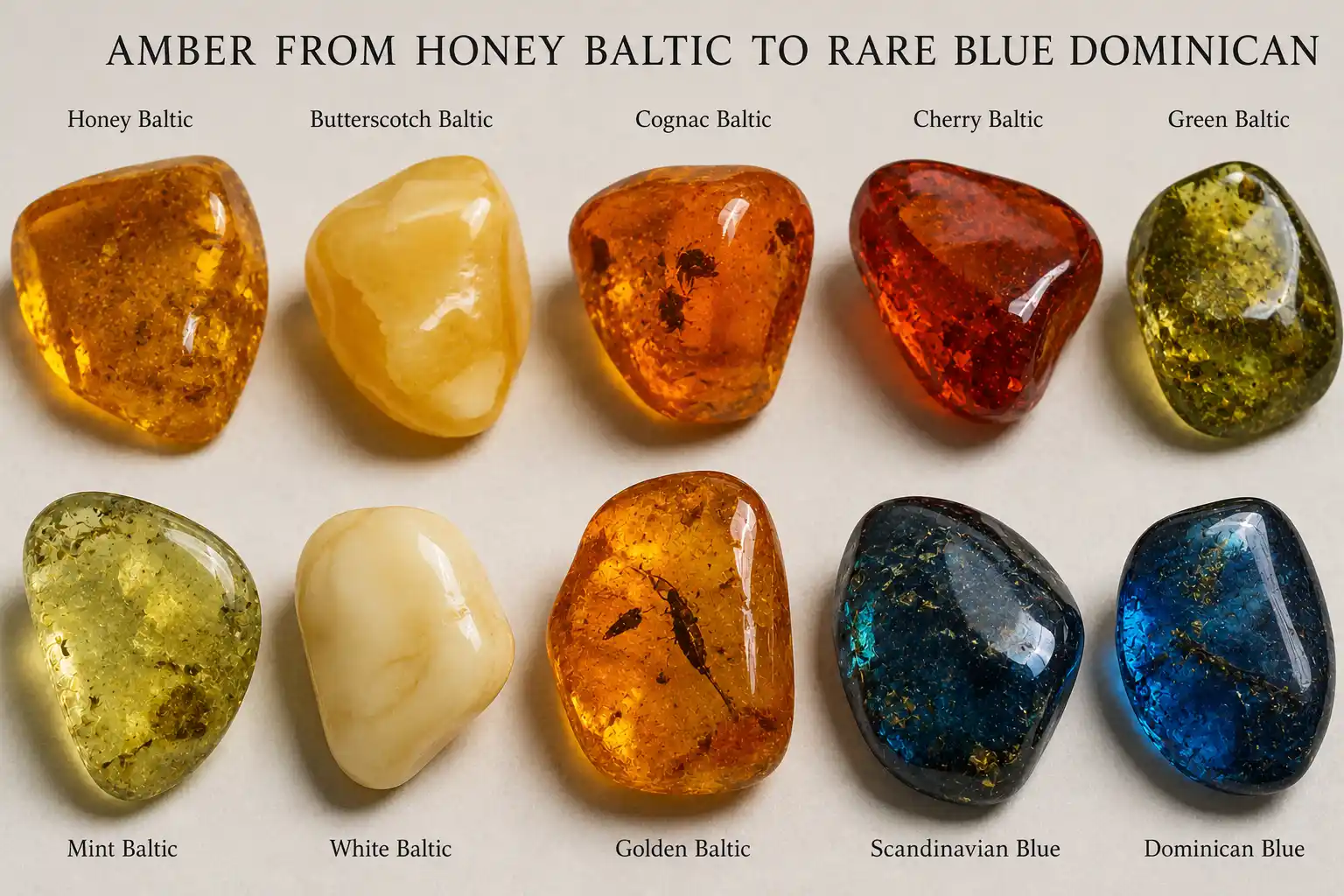
Amber Price: Value Guide, Quality, Treatments & Availability
Amber price varies far more than its familiar golden appearance might suggest because amber is not priced by weight alone. Natural amber is fossilized plant resin rather than a mineral crystal, and its market value depends on a combination of material identity, color, transparency, natural inclusions, treatment history, construction, origin, condition, workmanship, size, and provenance. GIA notes that ordinary amber cabochons without noteworthy inclusions can cost only a few dollars per piece, while specimens containing clearly visible or complete plant or animal inclusions may sell for thousands of dollars. That enormous range shows why a single amber price per carat cannot describe the market accurately.
A buyer also needs to distinguish whole natural amber from pressed or reconstructed material, treated amber, younger copal, composites, and imitations before attempting a value comparison. A beautiful transparent bead may have been clarified by heat, a vivid green piece may owe its appearance to heat and pressure, and an impressive insect can occur in a manufactured imitation. GIA specifically advises independent laboratory examination for significant amber purchases because testing can confirm natural amber and help determine whether an inclusion was added later. Price makes sense only after the material itself has been correctly understood.
Amber Price at a Glance
| Amber Factor | Typical Influence on Value |
|---|---|
| Natural material identity | Whole natural amber generally commands more than reconstructed or imitation material of comparable appearance |
| Transparency | Transparent natural amber is generally more valuable than ordinary cloudy material |
| Biological inclusions | Clearly visible, complete, unusual, or scientifically interesting inclusions can add substantial value |
| Color | Attractive reddish, unusual fluorescent, or otherwise desirable natural appearances can command premiums |
| Treatment | Heat, pressure, dye, clarification, or other enhancement may reduce collector premiums when compared with equivalent untreated material |
| Origin | Baltic, Dominican, Burmese, and other origins can influence demand when provenance is credible |
| Size | Larger pieces can cost more, but amber’s low density means large dimensions are not automatically rare |
| Condition | Cracks, crazing, chips, oxidation, repairs, and surface deterioration can reduce value |
| Reconstruction | Pressed or reconstructed amber usually sells for less than comparable non-consolidated natural pieces |
| Craftsmanship | Fine carving, matched beads, historical workmanship, or signed jewelry can add value beyond the raw amber |
| Provenance | Documented age, collection history, archaeological relevance, or notable ownership can create a separate premium |
| Laboratory documentation | Independent testing can support higher-value transactions by reducing uncertainty |
These factors interact rather than operating independently. A large transparent piece may have modest value if heavily treated, while a much smaller natural specimen containing a rare, well-preserved inclusion can be substantially more desirable. Similarly, antique or designer amber jewelry may derive much of its price from history, metalwork, authorship, or provenance rather than from the raw resin alone.
Why Amber Price Has Such a Wide Range
Amber occupies several markets simultaneously. It is sold as inexpensive bead jewelry, polished cabochons, carved decorative objects, collectible fossil specimens, archaeological material, antique jewelry, signed designer pieces, and scientifically significant inclusions. Those categories cannot be compared using one universal price table because the reason buyers value each object is different.
GIA identifies color, clarity, cut, and carat weight as basic amber quality factors, while emphasizing that interesting plant or animal inclusions can overturn the normal relationship between clarity and price. Transparent amber generally commands more than cloudy amber, yet an included specimen can be much more valuable if the inclusion itself is desirable. This is one of the most important differences between amber and many transparent mineral gemstones.
The market also contains extensive treatment and reconstruction. Processing can improve transparency, deepen color, create red or green appearances, or manufacture internal “sun spark” effects. Once treatment enters the comparison, visual beauty alone no longer explains amber price.
What Natural Amber Actually Is
Amber is fossilized resin produced by ancient plants and subsequently transformed through geological processes. It is an organic gem material rather than a crystalline mineral, with a specific gravity around 1.08 and a Mohs hardness of approximately 2 to 2.5. Those properties explain why amber feels unusually light for its size and why large beads or pendants may remain comfortable to wear.
Its low density also means size should not be treated as proof of rarity. A visually large piece of amber can weigh far less than a quartz, sapphire, garnet, or other mineral gemstone of comparable dimensions. GIA specifically notes that amber’s light weight makes relatively large jewelry pieces practical. Buyers should therefore compare dimensions, condition, quality, treatment, and construction alongside weight rather than assuming that a large gram or carat figure automatically justifies a major premium.
Material identity comes before every other value factor because copal, plastic, reconstructed amber, and composites can resemble natural amber closely.
There Is No Universal Amber Price per Carat
A single amber price per carat sounds convenient but often creates false precision. GIA’s own quality guidance illustrates the problem: ordinary cabochons without insect inclusions can sell for only a few dollars each, while specimens with easily visible or complete biological inclusions may reach thousands of dollars. Two pieces of identical weight can therefore sit at completely different market levels.
Carat calculations become even less useful with carved objects, antique beads, archaeological pieces, or signed jewelry. A carving may derive value from artistic skill, while an antique necklace may command a premium for provenance and historical significance. Designer pieces can add brand and workmanship premiums that have little to do with the underlying amber weight.
For readers specifically comparing weight-based quotations, the planned Gems Lore guide to amber price per carat should be treated as a separate calculation topic rather than a substitute for evaluating quality.
Broad Amber Price Benchmarks
The safest broad benchmark comes from GIA rather than from arbitrary online price charts. GIA states that simple amber cabochons without noteworthy insect inclusions may cost only a few dollars per piece, whereas specimens containing visible or complete plant or animal material can sell for thousands of dollars. That range reflects ordinary commercial material at one end and collectible inclusion specimens at the other.
Auction records show that jewelry can move beyond those material-only benchmarks when design, age, provenance, precious metals, other gemstones, or recognized makers contribute to value. Sotheby’s offered a large natural Baltic amber necklace with indications of heat treatment at an estimate of £3,000–5,000, while another historical amber-and-jadeite court necklace received an HK$100,000–150,000 estimate. These examples should not be interpreted as raw amber price guides because the objects differed radically in age, design, cultural significance, and construction.
The useful lesson is that market category matters as much as weight.
Color Can Influence Amber Value
Amber commonly appears yellow, golden, orange, white, and reddish brown, although unusual optical effects can create bluish or greenish appearances. GIA notes that reddish amber is generally valued more highly than ordinary golden material, which in turn can command more than common yellow amber. Rare specimens showing attractive blue or green fluorescence may be especially valuable.
Color must still be evaluated together with treatment. Amber can be heated, dyed, oxidized, clarified, or subjected to pressure to modify its appearance. A rich red surface may be treatment-created, while bright green material can result from heat-and-pressure processing rather than naturally occurring green bodycolor. GIA specifically identifies bright yellow-green “green amber” as treated material.
Natural color therefore deserves a different market interpretation from an equivalent-looking treated color when collectors place a premium on unmodified material.
Why Red Amber May Command a Premium
Reddish amber attracts strong consumer interest because deeper warm colors can appear richer and less common than ordinary pale yellow material. GIA’s quality guidance places reddish amber above golden and yellow material in broad value preference when other characteristics are comparable. That statement does not mean every red piece is more valuable than every yellow one.
Heat treatment can create red or dark reddish surfaces. GIA research on Baltic amber demonstrated that controlled oxidation at elevated temperature can transform specimens from yellow or golden material into red to blackish-red products. Longer processing can deepen the resulting color.
A naturally attractive reddish piece with strong provenance, good condition, and no major treatment may therefore occupy a different collector category from heavily processed commercial material. Buyers should ask how the color developed before assuming that redness itself establishes rarity.
Green Amber Requires Careful Interpretation
Green amber is one of the categories most vulnerable to misunderstanding. Naturally occurring material can show greenish optical effects, but bright commercial green products may have been modified using heat and pressure. GIA research found that so-called green amber can be produced by treating either amber or copal in an autoclave, significantly altering the material’s appearance.
This has direct implications for price. A seller may charge a rarity premium because a piece looks green, yet that premium is not necessarily justified if the appearance was intentionally manufactured. Treatment does not make the object worthless, but it changes the value proposition.
Lighting also matters. Strong fluorescence can produce greenish or blue effects that differ greatly from ordinary daylight bodycolor. Buyers should compare an object under normal illumination before paying for an unusual-color description.
Blue Amber Can Occupy a Distinct Collector Market
Some amber, particularly material associated with the Dominican Republic, can display striking blue fluorescence or blue-related optical effects. GIA notes that rare pieces showing attractive bluish or greenish fluorescence can be highly valuable. This effect can create substantial collector interest when it is strong and visually appealing.
“Blue amber” should not automatically be interpreted as a piece that remains vividly blue under every lighting condition. Ordinary bodycolor may still appear yellow, golden, or brownish, while the blue effect becomes pronounced under particular illumination or against a dark background.
Photography can exaggerate these effects, so online price comparisons should use images taken under ordinary light as well as any fluorescence-enhancing conditions. An expensive specimen should be valued for what it actually displays, not for one dramatic photograph.
Transparency Usually Adds Value
GIA states that transparent amber is generally more valuable than cloudy material when other factors remain comparable. Transparency allows color, internal structures, and biological inclusions to be seen more clearly, which helps explain the market preference.
Amber clarity behaves differently from diamond clarity, however. Internal bubbles, flow structures, plant debris, fractures, and other features may be natural components of the material rather than defects in a conventional sense. An inclusion can even increase value dramatically when it is unusual or scientifically interesting.
Treatment further complicates transparency. Heating amber in oil can improve apparent clarity and create circular internal structures commonly called sun spangles. Buyers should therefore distinguish naturally clear material from clarified amber when that difference affects price.
Biological Inclusions Can Transform the Value
Few amber characteristics affect price as dramatically as a notable biological inclusion. Resin could trap insects, plant fragments, flowers, feathers, and other organisms before fossilization. GIA states that easily visible or complete plant and animal inclusions can raise amber value dramatically, with some pieces reaching thousands of dollars while ordinary clean cabochons remain inexpensive.
The inclusion’s quality matters. Visibility, completeness, rarity, position, preservation, scientific interest, and the surrounding amber all influence desirability. A common tiny insect in cloudy material should not automatically receive the same premium as a rare organism that is clearly visible and unusually complete.
Authenticity becomes crucial because modern insects can be embedded in plastic or other resin. GIA warns specifically that perfect-looking insect inclusions deserve caution and recommends laboratory testing for important purchases.
A Perfect Insect Is Not Automatically More Valuable
Commercial listings often emphasize a perfectly positioned insect because it photographs well, but nature does not organize inclusions for display. Genuine ancient organisms may be incomplete, distorted, obscured, fragmented, or surrounded by bubbles and debris. An unusually pristine insect centered theatrically in flawless transparent material deserves verification before it receives a high collector premium.
GIA notes that imitations containing modern insects are common. The stronger the seller’s claim and the higher the price, the stronger the need for independent evidence.
An exceptional genuine inclusion certainly can be complete and attractive. The correct response is not to assume that perfection proves fakery, but to recognize that appearance alone cannot establish antiquity.
Rare Inclusions Can Outweigh Ordinary Clarity Preferences
For most amber jewelry, transparency is desirable because it improves visual brightness and color. An important inclusion changes the evaluation. A slightly cloudy specimen containing an unusual complete insect or plant structure may command far more than a perfectly transparent but biologically unremarkable bead.
GIA explicitly states that interesting inclusions can add value even though transparent material normally receives a clarity premium. This makes amber valuation unusually context-dependent.
Scientific significance may create another layer of demand. A specimen valuable to a specialist collector or researcher cannot always be compared with ordinary jewelry stock, even if both pieces weigh the same number of grams.
Baltic Amber Often Carries Strong Market Recognition
Baltic amber has one of the best-known commercial identities in the market. GIA states that Baltic amber is generally more expensive than Dominican amber in broad market comparisons. That reputation reflects the region’s long history of production, substantial trade infrastructure, material characteristics, and consumer recognition.
Origin should not replace quality evaluation. An ordinary Baltic bead with heavy treatment, reconstruction, cracks, or weak appearance does not automatically exceed the value of an exceptional specimen from another source. Dominican amber with a rare inclusion or dramatic fluorescence can occupy a much higher collector tier.
When “Baltic” adds a meaningful premium, the seller should have credible provenance or gemological support rather than using the term as a synonym for attractive yellow amber.
Dominican Amber Can Command High Prices for Special Features
Dominican amber often attracts interest for transparency, biological inclusions, and unusual fluorescence. Although GIA broadly notes that Baltic amber tends to be priced more highly than ordinary Dominican material, it also emphasizes that rare blue or green fluorescent specimens can be highly valuable.
This illustrates why origin-based price rankings have limits. A common Baltic bead and an exceptional Dominican inclusion specimen do not belong in the same comparison. The characteristics of the individual object remain more important than a country name used in isolation.
Collectors should also distinguish normal bodycolor from fluorescence. A dramatic blue photograph does not necessarily represent how the amber appears during ordinary wear or display.
Burmese Amber Belongs to a Specialized Market
Amber from Myanmar, often described as Burmese amber or burmite, can attract specialist interest because of its geological age, color, provenance, and biological inclusions. Its value may overlap with fossil collecting, paleontology, Asian decorative arts, and jewelry rather than following ordinary Baltic bead pricing.
For such material, documentation becomes especially important when age, locality, or scientific significance drives the asking price. The value of a specimen with a notable inclusion cannot be established simply by weighing it and applying a commercial jewelry rate.
Legal provenance, export history, ethical considerations, and collection history can also influence whether a buyer or institution is willing to acquire a particular object. Those issues exist alongside gemological quality rather than replacing it.
Pressed and Reconstructed Amber Usually Sells for Less
Small pieces of natural amber can be consolidated under heat and pressure to produce larger objects. GIA states that pressed, consolidated, or reconstructed amber generally sells for less than comparable non-consolidated pieces. This material can still be attractive and suitable for jewelry when accurately disclosed.
The value difference reflects construction rather than an assumption that every reconstructed piece is visually inferior. A finely made reconstructed necklace may be attractive, but it lacks the same intact natural formation history as a comparable piece fashioned from one continuous mass of amber.
Because modern reconstruction can be difficult to identify visually, substantial purchases may justify professional testing. Price comparisons should place reconstructed amber alongside other reconstructed material rather than untreated whole amber.
Treated Amber Should Be Valued as Treated Amber
Treatment is common enough in amber that buyers should ask about it explicitly. Heat can improve transparency, deepen color, create red surfaces, and generate “sun spark” effects. GIA’s experimental work produced golden, red, flower-patterned, and beeswax-like material through controlled heating, pressure, oxidation, and cooling.
Treatment is not automatically deceptive. Many jewelry buyers knowingly prefer a treated appearance, just as treatments occur in numerous other gem markets. The pricing problem arises when processed material is represented as naturally occurring rare color or natural clarity.
A fair comparison places treated amber against similarly treated goods. Untreated material may command a collector premium when natural appearance, rarity, and provenance are important.
Heat Clarification Can Change Both Appearance and Value
Cloudy amber can be clarified through heat treatment. GIA notes that immersion in hot oil may darken the bodycolor, make the material appear clearer, and create rounded spangle-like internal features. These effects can make jewelry more visually appealing to buyers who favor transparent golden material.
A treatment-created clarity improvement should not be valued exactly like naturally transparent material when untreated condition carries a premium. The same principle applies to deliberately manufactured internal effects.
Treatment disclosure therefore protects both sides of the transaction. The buyer knows what produced the appearance, while the seller can price the object according to the correct market category.
Sun Spangles Do Not Automatically Prove Natural Untreated Amber
Round or disc-like internal features in amber are often marketed romantically as “sun spangles.” Some can form through heat-related treatment when internal gas or liquid inclusions expand and create stress structures. GIA specifically documents spangled inclusions produced during heating.
This makes them poor standalone evidence of untreated status. Their appearance may still be attractive, and treated spangle amber can make beautiful jewelry, but the visual effect should not be misrepresented as proof of an untouched ancient internal structure.
Buyers evaluating premium transparent amber should therefore consider the pattern together with the broader treatment evidence rather than assigning extra value automatically.
Dyed Amber May Have Lower Collector Appeal
Amber can also be dyed to alter or intensify color. GIA notes that amber color may be modified by dyeing and that dyes used in red and green amber can change or fade under certain conditions.
A stable-looking color at the point of purchase does not guarantee that it will remain unchanged indefinitely. Treatment disclosure affects both value and care because some buyers prefer naturally colored material and because fading risk matters in jewelry exposed to light.
Dyed amber can still have decorative value. Its price should reflect the enhanced condition rather than implying that an unusual hue arose naturally.
“Beeswax” Appearance Can Be Natural or Manufactured
Opaque creamy yellow amber is often marketed with trade descriptions such as beeswax amber. Natural opaque material exists, but treatment can also modify transparency and internal appearance. GIA research has demonstrated commercial heat-treatment processes capable of producing or altering beeswax-like material.
A trade name therefore does not establish treatment history. Two creamy yellow pieces may look similar while having very different formation and processing histories.
Collectors paying a strong premium for supposedly natural old beeswax amber should seek more evidence than color and opacity alone. Ordinary jewelry buyers may care less about the distinction, provided the material is accurately represented and priced accordingly.
Size Matters Less Simply Than Many Buyers Expect
Larger amber pieces can cost more because they contain more usable material and can support impressive carvings or statement jewelry. Yet size does not create the steep rarity curve associated with some transparent mineral gems. Amber’s specific gravity is only about 1.08, so visually large pieces remain relatively light.
Quality must therefore accompany size. A large reconstructed or heavily treated pendant with numerous cracks may be inexpensive compared with a small natural specimen containing an exceptional inclusion.
When comparing large amber, use dimensions and weight together. Thickness, usable transparency, condition, construction, and carving quality often explain price better than grams alone.
Condition Can Change Amber Price Substantially
Amber is soft and has poor toughness. GIA places it at approximately 2 to 2.5 on the Mohs scale and warns that it scratches readily, can burn at relatively low temperatures, may darken with prolonged light exposure, and can suffer chemical damage. Those properties make condition especially important in vintage and antique pieces.
Fine surface scratches may be expected in older jewelry, but deep cracking, severe crazing, chips, broken drill holes, adhesive repairs, and structural weakness can reduce usability and market appeal. Antique collectors may accept stable age-related patina that would be undesirable in newly manufactured jewelry.
Restoration also affects value. A repaired historic carving can remain important, yet the repair should be disclosed because condition is part of the object’s market identity.
Oxidation Can Alter Appearance Over Time
Polished amber gradually oxidizes and may darken, especially after cutting removes or thins the more weathered exterior surface. GIA explains that fine translucent yellow or orange amber can progressively turn reddish brown and eventually much darker as oxidation continues.
This natural aging can be attractive to some collectors, particularly in antique beads and carvings. Others prefer bright freshly polished material. Neither preference creates a universal value rule.
Artificial heating can also darken amber, so a deep aged-looking surface should not be treated as proof of antiquity. Provenance and construction matter more than color alone when an age claim contributes significantly to price.
Cut and Polish Affect Commercial Amber Value
Amber is usually fashioned into beads, cabochons, free-form shapes, or carvings rather than precision faceted gems. GIA notes that faceting is comparatively rare and generally reserved for especially transparent material.
Commercial quality depends on even polishing, attractive shape, careful drilling, sensible weight distribution, and the preservation of desirable color or inclusions. A poorly drilled bead can crack near the hole, while deep scratches or an uneven polish can reduce an otherwise attractive piece’s value.
Cutters may intentionally preserve irregular natural shapes to retain weight or protect an inclusion. As a result, symmetry is not always the goal. The workmanship should be judged according to the object being created rather than through a diamond-cutting standard.
Carvings Can Be Worth More Than the Raw Amber
Fine amber carving adds labor, artistic skill, design quality, and sometimes historical significance. A carved object should therefore not be priced solely by its gram weight. The reputation of the artist, age, cultural context, complexity, condition, and provenance can all influence value.
The same principle applies to signed jewelry. Sotheby’s estimated an amber, enamel, and diamond demi-parure by David Webb at CHF26,000–35,000, illustrating how recognized design, precious metals, diamonds, and maker attribution can lift an amber jewel far beyond ordinary bead pricing.
That estimate does not establish a benchmark for natural loose amber. It demonstrates that once amber becomes part of an important jewelry object, material weight may be only one component of the final market value.
Antique Amber Can Occupy a Completely Different Price Category
Historical amber objects can command prices based on age, cultural importance, documented ownership, and craftsmanship. A Qing-period amber and jadeite court necklace offered by Sotheby’s carried an estimate of HK$100,000–150,000. Such a figure cannot be reduced sensibly to an amber price per gram because the object is evaluated as historical decorative art.
Antique amber may also show oxidation, restringing, repairs, surface wear, or modifications that would be considered defects in new commercial jewelry. In the antique market, those characteristics need to be interpreted in relation to authenticity and historical integrity.
Buyers comparing antique auction results with newly manufactured amber jewelry are therefore comparing different markets.
Matching Beads Can Add Value
A high-quality amber necklace requires more than a collection of individually attractive beads. Color, transparency, dimensions, shape, polish, and surface condition should work together across the strand. Finding large groups of naturally harmonious pieces can require considerable sorting.
Matched material may therefore command more than an equivalent weight of unrelated amber pieces. Graduated necklaces also require planning so that changes in bead dimensions appear deliberate and visually balanced.
The clasp, stringing, knotting, repairs, and metal components contribute additional value or cost. A strand should be assessed as a complete jewelry object rather than by dividing total price by amber weight.
Availability Differs Dramatically by Quality Tier
Amber itself is widely available in commercial jewelry, beads, cabochons, carvings, and specimens. High-quality natural material with desirable transparency, attractive natural color, confirmed origin, excellent condition, and unusual biological inclusions is much less abundant. GIA research on commercial heat treatment notes strong consumption of amber alongside scarcity and expense for higher-quality natural material in major markets.
This distinction explains how inexpensive amber jewelry and costly collector specimens can coexist. The market has abundant ordinary material and treated or reconstructed products, while exceptional natural objects occupy a much thinner supply category.
Availability should therefore be discussed in terms of quality rather than simply asking whether amber is rare.
Is Amber Rare?
Amber as a general gem material is not so scarce that every piece deserves a rarity premium. Commercial amber jewelry is widely available, and reconstructed or treated products further expand supply. What becomes rare is a specific combination of attributes: exceptional natural color, unusually large intact pieces, important inclusions, strong fluorescence, notable origin, untreated condition, historical significance, or outstanding craftsmanship.
Sellers sometimes use the word rare for ordinary variations because scarcity supports higher pricing. A responsible valuation asks exactly what feature is rare and what evidence supports that claim.
The presence of natural amber alone does not make an object investment-grade, museum-grade, or uniquely collectible.
Market Demand Is Highly Segmented
Different buyers pursue different forms of amber. Jewelry buyers may prioritize warm color, comfort, polish, and design. Fossil collectors may focus on insects, plants, feathers, or other inclusions. Antique specialists may value provenance and period workmanship, while mineral and gem collectors may seek unusual optical effects or documented origin.
These groups can produce very different prices for objects of similar weight. A transparent inclusion-free pendant may appeal strongly to a jewelry buyer while attracting limited interest from a fossil specialist. A cloudy specimen containing an unusual biological inclusion may create the opposite response.
Understanding the likely buyer category helps explain market value much better than generic statements that amber is either cheap or expensive.
Retail Price and Resale Value Are Not the Same
A retail amber price includes seller sourcing, sorting, labor, inventory, overhead, marketing, jewelry manufacture, and profit. A private owner reselling the same item usually enters a different market where dealers, auction houses, or individual buyers need room for their own costs and risk.
This means an amber necklace purchased at retail may not immediately resell for the original amount even if the material itself remains unchanged. Signed jewelry, important antiques, documented fossil specimens, and exceptional collector pieces can follow different resale patterns because demand and rarity differ.
An insurance appraisal can also exceed likely cash resale value because replacement cost and secondary-market value answer different questions.
Online Amber Price Charts Need Caution
Online tables often assign fixed prices to yellow, red, green, blue, Baltic, Dominican, or insect amber. Such charts can be useful as broad orientation, but they frequently hide critical differences in treatment, reconstruction, condition, inclusion quality, provenance, and market venue.
A treated green bead and a naturally unusual fluorescent specimen should not share one green-amber price. Likewise, one insect inclusion may be common and poorly preserved while another is rare, complete, and scientifically important.
GIA’s far broader benchmark—from inexpensive ordinary cabochons to specimens worth thousands because of inclusions—better reflects how variable the material can be. Exact valuation requires comparison with genuinely similar objects.
Laboratory Documentation Can Support Higher-Value Amber
Independent testing becomes increasingly useful as amber price rises. GIA recommends obtaining a laboratory report for significant purchases because testing can confirm natural amber and investigate whether an inclusion was added later.
A laboratory report should not be confused with an appraisal. Gemological analysis addresses material identity and characteristics, while an appraisal addresses economic value for a specific purpose.
Documentation is especially helpful when the asking price depends on claims such as untreated condition, rare inclusion, whole natural material rather than reconstruction, or a particular origin. A seller-created authenticity card may still be useful as a record of the seller’s representation, but it is not independent evidence.
For practical purchasing checks, the Gems Lore guide to buy amber covers material identity, treatments, documentation, and seller questions in more detail.
Treatment Disclosure Can Change Price Expectations
A treatment may improve amber’s commercial appearance while reducing its desirability among collectors seeking naturally formed color and clarity. Heat-treated transparent material, dyed red beads, pressure-treated green amber, and reconstructed products therefore need appropriate disclosure.
GIA documents heat treatments capable of producing golden, red, flower-patterned, and beeswax-like appearances from starting material with different colors and transparency. Such processing expands the supply of visually attractive amber but also makes visual-only valuation less reliable.
Price should reflect what the object is now and how it reached that state. Attractive treated jewelry can represent good value when sold honestly; undisclosed treatment creates a different problem.
Natural Does Not Automatically Mean Untreated
A piece can consist of natural amber and still have been heated, dyed, clarified, oxidized, pressed, or otherwise modified. The term natural may describe the starting material without describing treatment history.
This distinction is essential when comparing price. An untreated whole piece and a treated whole piece are both fundamentally amber, but collectors may value them differently. Reconstructed amber introduces another step because multiple natural fragments have been consolidated into a new object.
Precise descriptions such as “natural Baltic amber, heat treated” communicate far more than the vague phrase “100% natural amber.”
Amber Quality Grades Are Not Universally Standardized
Commercial sellers may use grades such as A, AA, AAA, premium, royal, collector grade, or museum grade. These labels are not a universally standardized amber grading system administered by GIA. GIA instead evaluates amber through observable quality factors such as color, clarity, cutting, carat weight, inclusions, and treatment-related considerations.
One retailer’s highest grade may therefore overlap another retailer’s middle grade. Buyers should ask what measurable attributes the label represents rather than paying for the grade name itself.
A useful amber description states material type, color, transparency, dimensions, weight, treatment, construction, inclusions, origin evidence, condition, and workmanship.
How to Compare Two Amber Prices Properly
Begin by confirming that both pieces belong to the same material category. Whole natural amber should be compared with whole natural amber rather than reconstructed material or copal. Treatment status should then be aligned because untreated and enhanced examples may occupy different collector markets.
Next compare color, transparency, inclusions, condition, size, craftsmanship, and origin. If one specimen contains an important insect while the other does not, their weight becomes a secondary consideration. For jewelry, compare metal, maker, setting quality, age, and design as well.
Finally, compare the same market level. A dealer retail price, private-sale asking price, auction estimate, auction result, and insurance valuation may all differ even for the same object.
Amber Jewelry Price Includes More Than the Amber
A finished amber ring, necklace, bracelet, or pair of earrings includes manufacturing costs, findings, precious metal, design, labor, and potentially brand value. A heavy silver setting or recognized designer can contribute significantly to the final retail amount.
This explains why dividing a finished jewelry price by the amber’s carat weight can produce a meaningless result. A signed piece may command a premium even if the underlying amber is not exceptionally rare.
For unsigned commercial jewelry, construction quality still matters. Secure settings, clean drill holes, durable clasps, good polish, and thoughtful matching all influence what a consumer receives for the price.
Amber Care Can Protect Its Value
Amber’s softness and poor toughness make careful handling important. GIA recommends cleaning only with warm water and mild soap and warns that heat, prolonged light, and chemicals can damage the material.
Storage should keep amber away from harder gems and abrasive metal edges. Rings and bracelets typically experience more impacts than earrings and pendants, so surface condition can deteriorate faster when jewelry receives frequent contact.
Treated color may require even more caution because dyes can fade or change. Good care cannot increase inherent gemological quality, but it can preserve condition and prevent avoidable loss of value.
Does Amber Increase in Value with Age?
Amber itself is already geological material, so simply owning a piece for another decade does not automatically make it meaningfully rarer. Market value can rise or fall according to demand, provenance, scarcity within a category, fashion, collector interest, and the condition of the object.
Antique jewelry can gain significance because of craftsmanship, historical context, maker attribution, or documented ownership, not merely because the amber became older. At the same time, amber may oxidize, darken, crack, or suffer surface deterioration with exposure.
No reliable claim can be made that ordinary amber will automatically appreciate. Buyers seeking investment returns should evaluate the object as a collectible market asset rather than assuming that geological age guarantees financial growth.
Is Amber a Good Investment?
Exceptional amber can be collectible, particularly when it combines verified natural identity, an important inclusion, unusual optical behavior, strong provenance, historical significance, or high artistic quality. However, there is no guaranteed amber investment return.
Transaction costs, retail markup, auction commissions, condition, documentation, buyer demand, and specialist market access all influence resale. Ordinary commercial beads may be widely available and therefore have limited scarcity-based upside.
A purchase is easier to justify when the buyer values the object for its beauty, history, fossil content, or craftsmanship independent of future financial performance.
What Makes Amber Expensive?
Expensive amber usually combines several value factors rather than one. A high-value specimen might contain a clearly visible rare inclusion, show exceptional natural transparency, display unusual fluorescence, come from a desirable documented locality, remain in excellent condition, and have credible laboratory verification.
A different high-priced object may have ordinary amber but extraordinary historical provenance, carving, design, or maker attribution. The Sotheby’s examples involving designer jewelry and historical court necklaces illustrate how non-material factors can dominate the final estimate.
The word expensive therefore needs context. Some buyers are paying for amber; others are paying for the entire object.
What Makes Amber Inexpensive?
Ordinary polished amber without rare inclusions is not necessarily costly. GIA notes that simple cabochons without insect inclusions may cost only a few dollars per piece. Abundant commercial material, small size, common color, cloudiness, reconstruction, treatment, mass-produced workmanship, or low collector demand can all contribute to modest prices.
An inexpensive price does not prove the piece is fake. Genuine natural amber exists across a broad commercial range.
Suspicion becomes more appropriate when a low price accompanies several exceptional claims at once, such as enormous size, flawless transparency, a perfect rare insect, completely untreated condition, prestigious origin, and unusual natural color.
Conclusion
Amber price cannot be reduced to a single dollar-per-carat figure because the market contains everything from inexpensive polished cabochons to scientifically important inclusion specimens, historical artifacts, elaborate carvings, and signed designer jewelry. GIA identifies color, clarity, cut, weight, and inclusions as central value factors while noting that ordinary pieces may cost only a few dollars and exceptional inclusion-bearing specimens can reach thousands.
The most reliable valuation begins with material identity. Whole natural amber, reconstructed amber, treated material, copal, composites, and imitations should never be priced as though they were identical. After identity comes color, transparency, biological inclusions, treatment, origin, condition, craftsmanship, provenance, and availability within the relevant quality tier. A strong amber price comparison therefore uses genuinely similar material and the same market context instead of relying on an oversimplified chart or an unsupported quality grade.
Frequently Asked Questions About Amber Price
How much is amber worth?
Amber can range from inexpensive commercial material to costly collector specimens. GIA notes that ordinary cabochons without insect inclusions may cost only a few dollars each, while pieces with clearly visible or complete plant or animal inclusions can sell for thousands of dollars. Exact value depends on identity, color, transparency, inclusion quality, treatment, construction, origin, condition, size, and workmanship.
Why is some amber so cheap?
Genuine amber does not have to be rare or expensive. Small pieces, common colors, ordinary commercial grades, reconstructed material, treated products, mass-produced beads, and specimens without important inclusions can all be affordable. Low price by itself does not establish that a piece is fake.
Why is some amber so expensive?
Exceptional amber can combine rare biological inclusions, desirable natural color, unusual fluorescence, transparency, large intact size, strong provenance, excellent condition, important craftsmanship, or historical significance. GIA specifically notes that interesting inclusions can raise prices from ordinary commercial levels into the thousands of dollars.
Is Baltic amber expensive?
Baltic amber has strong market recognition, and GIA states that it is generally more expensive than Dominican amber in broad comparisons. Individual quality still matters, so ordinary or heavily treated Baltic amber may be worth less than exceptional material from another source.
Is Dominican amber valuable?
Yes, especially when it contains attractive biological inclusions or displays strong blue or greenish fluorescence. GIA notes that unusual fluorescent amber can be highly valuable. Ordinary Dominican material should still be evaluated according to its individual quality.
Is blue amber expensive?
Fine blue-fluorescent amber can command strong collector interest because the optical effect is unusual. Price depends on the strength of the phenomenon, natural identity, transparency, condition, origin, size, and treatment. A dramatic photograph alone does not establish high value.
Is green amber expensive?
It can be attractive and commercially valuable, but bright green amber is often treatment-produced. GIA states that bright yellow-green material can result from heat and pressure, and laboratory research has documented the treatment of both amber and copal to create this appearance. Treatment disclosure should therefore be considered before paying a rarity premium.
Is red amber more valuable than yellow amber?
GIA broadly notes that reddish amber is more valued than golden amber, which is generally valued above ordinary yellow material when comparable quality is considered. Red color can also be produced or intensified through treatment, so natural color and treatment history remain important.
Is transparent amber more valuable?
Generally, yes. GIA states that transparent amber is typically more valuable than cloudy material when other characteristics are similar. A significant biological inclusion can reverse that relationship because included amber may carry strong collector value.
Does an insect always make amber expensive?
No. The inclusion must be evaluated for visibility, completeness, rarity, preservation, authenticity, and scientific or aesthetic interest. A common tiny insect may add only modest interest, while an unusual complete specimen can transform value. Artificially inserted or modern insects should not receive the same premium as genuine ancient inclusions.
How much is amber with an insect worth?
There is no fixed amount. GIA states that amber containing easily visible or complete insects or plants can sell for thousands of dollars, while ordinary pieces may cost only a few dollars. The biological inclusion itself must be authenticated and assessed before a reliable value can be estimated.
Does a perfect insect make amber more valuable?
Potentially, but perfection should prompt careful authentication because modern imitation material can contain deliberately inserted organisms. GIA warns that perfect-looking insect inclusions deserve caution and recommends laboratory testing for significant purchases.
Is pressed amber worth less than natural amber?
GIA states that pressed, consolidated, or reconstructed amber generally sells for less than comparable non-consolidated pieces. Pressed amber can still make attractive jewelry when its construction is accurately disclosed.
Is treated amber worth less?
Treatment can reduce collector premiums when compared with otherwise similar untreated material, but there is no automatic percentage discount. Attractive treated amber still has commercial value. Price depends on the type of treatment, stability, appearance, disclosure, and market segment.
Does heat treatment affect amber price?
It can. Heat can clarify amber, darken it, create red surfaces, or produce sun-spangle and other effects. GIA has reproduced several commercially encountered appearances through controlled heat treatment. Untreated natural characteristics may command stronger collector interest when all else is equal.
Are sun spangles valuable?
They can be visually attractive, but they should not automatically receive a natural-rarity premium. GIA documents rounded spangle-like features that can develop during heat treatment. Their presence therefore needs to be interpreted together with treatment evidence.
Is dyed amber valuable?
Dyed amber can be decorative and commercially saleable, but dyed color normally belongs to a different category from equivalent natural color. GIA notes that dyes can fade or change under certain conditions. Disclosure and stability should be considered when comparing price.
Does amber have an official AAA grading system?
No universally standardized GIA AAA grading system exists for amber. Commercial labels such as AAA, premium, royal, and museum grade are seller-defined unless accompanied by a clear grading methodology. GIA discusses amber through specific quality factors rather than a universal alphabetic grade.
Is large amber always expensive?
No. Amber has very low density, so large dimensions are not automatically exceptional. Large pieces gain stronger value when they also have desirable natural color, transparency, inclusions, condition, whole-material construction, craftsmanship, or provenance.
Is amber priced by gram or carat?
Both units may be used depending on the market, but amber is often sold as complete pieces, beads, carvings, strands, specimens, or jewelry. Weight-based comparison is meaningful only when material type and quality are similar.
Can I calculate amber value from weight alone?
No. Weight ignores treatment, transparency, color, inclusions, condition, reconstruction, origin, workmanship, and provenance. Two pieces of identical weight can have radically different values.
Does origin change amber price?
It can. Baltic amber enjoys strong market recognition, Dominican material can command premiums for special inclusions or fluorescence, and other origins may attract specialist collectors. Origin matters most when it is credible and connected with a quality or rarity feature that buyers value.
Is antique amber worth more than new amber?
Sometimes, but not merely because it is older as a piece of jewelry. Antique value can come from maker, craftsmanship, provenance, cultural context, rarity, and historical significance. Damage, repairs, poor condition, or uncertain attribution can reduce that premium.
Does amber become more valuable as it gets darker?
Not automatically. Amber naturally oxidizes and can darken over time, but heat treatment can also deliberately deepen its color. Dark color should therefore be evaluated together with age, provenance, treatment, condition, and appearance.
Can amber appreciate in value?
Exceptional collectible amber may rise in market value, but appreciation is not guaranteed. Supply, demand, condition, documentation, provenance, market access, and transaction costs all affect resale. Ordinary commercial amber should not be presented as a guaranteed investment.
Is amber jewelry worth more than loose amber?
It can be because a finished jewel includes design, craftsmanship, precious metal, clasps, matching, brand value, and sometimes historical significance. A signed designer necklace may therefore cost far more than its underlying amber would as loose material.
Does a laboratory report increase amber value?
A report does not automatically make amber better, but it can reduce uncertainty about material identity and important inclusions. GIA recommends independent laboratory examination for significant purchases. Strong documentation can make an expensive object easier to evaluate and potentially easier to resell.
How can I tell whether an amber price is fair?
First confirm whether the material is whole natural amber, reconstructed amber, treated amber, copal, composite material, or an imitation. Then compare color, transparency, inclusions, condition, size, treatment, origin, craftsmanship, and documentation with genuinely similar pieces. Market venue also matters because retail, auction, private-sale, and resale values are not interchangeable.
What is the biggest mistake when estimating amber value?
The biggest mistake is starting with weight or color before confirming material identity and treatment. A large green piece, perfect insect specimen, or “AAA Baltic amber” listing may look valuable while belonging to a treated, reconstructed, or imitation category. Identify what the object actually is first; only then does the amber price become meaningful.