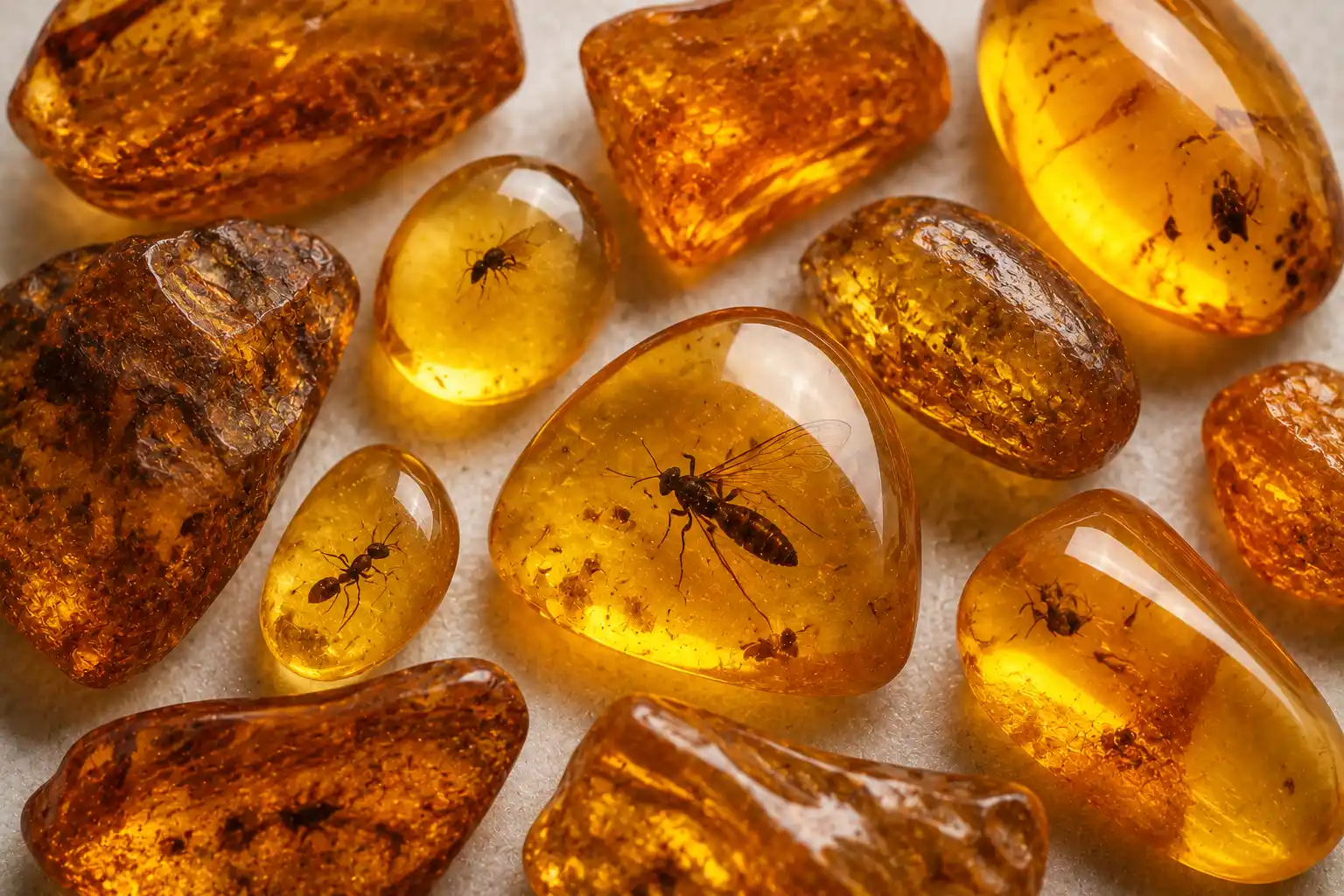
Buy Amber: Purchase Checklist, Price, Quality & Documentation
If you want to buy amber confidently, start by confirming what the material actually is before comparing color, inclusions, size, or price. Amber is an organic gem material formed from fossilized plant resin rather than a mineral crystal, and it is substantially softer and lighter than many conventional gemstones. GIA lists amber at about 2 to 2.5 on the Mohs hardness scale, with a specific gravity near 1.08, which helps explain why surprisingly large amber pieces can feel light in the hand. Those characteristics make amber distinctive, but they also mean that durability, treatment disclosure, reconstruction, imitation, and correct identification deserve more attention than they might with a harder transparent gemstone.
A good amber purchase should answer several questions clearly. Is the material natural amber rather than younger copal or a plastic imitation? Has it been heated, dyed, clarified, reconstructed, pressed, coated, or combined with another material? Are insect or plant inclusions genuinely ancient and naturally enclosed? Does the seller describe origin accurately? Is the color natural or modified? Finally, does the price reflect the actual material, quality, treatment history, craftsmanship, and documentation rather than an attractive story alone? Those questions create a much stronger buying framework than relying on terms such as “premium Baltic amber,” “museum grade,” or “healing amber.”
Amber Buying Checklist at a Glance
| Buying Factor | What to Look For | What Deserves Caution |
|---|---|---|
| Material identity | Natural fossilized resin identified as amber | Plastic, resin composites, copal, or vague “amber-like” wording |
| Natural vs reconstructed | Clear disclosure of whole natural material or reconstructed amber | Pressed material sold simply as natural amber |
| Color | Attractive yellow, golden, orange, red-brown, white, or other documented natural appearance | Bright green or unusually uniform color with no treatment disclosure |
| Transparency | Clear, translucent, cloudy, or opaque appearance honestly described | Artificial clarification presented as naturally transparent |
| Inclusions | Irregular natural plant, insect, fluid, gas, or debris inclusions | Perfect-looking insects positioned theatrically in flawless material |
| Treatment | Heat, dye, pressure, clarification, coating, or other enhancement disclosed | “100% natural” used without explaining treatment |
| Origin | Specific locality supported by credible evidence when financially important | “Baltic,” “Dominican,” or “Burmese” used only as a marketing claim |
| Construction | Single natural piece, reconstructed material, or composite clearly stated | Mixed amber and polymer material sold as a solid natural specimen |
| Durability | Appropriate use for a soft organic gem | Rings or exposed settings marketed as maintenance-free |
| Documentation | Independent gemological testing for important pieces | Seller-created cards treated as independent laboratory proof |
| Return policy | Written inspection and return terms | Expensive inclusion specimen sold as final sale without verification |
Natural amber can occur in yellow, golden, white, orange, reddish brown, and other appearances, while treatments can substantially alter color and transparency. GIA also notes that transparent amber is generally valued more highly than cloudy material unless interesting inclusions change the equation, and unusual plant or animal inclusions can add significant collector interest.
Understand What Amber Actually Is Before Buying
Amber is fossilized plant resin, not hardened tree sap in the casual sense and not a mineral species. Ancient resin underwent chemical and structural changes during burial and geological aging, eventually producing the organic gem material recognized as amber. GIA classifies it as an organic gem and describes material from major deposits as having formed millions of years ago. This organic origin explains several practical properties that matter to buyers, including low hardness, low density, sensitivity to heat and chemicals, and the possibility of preserved biological inclusions.
The distinction matters because amber can visually overlap with plastics, modern resins, copal, reconstructed amber, and treated resin products. A honey-colored bead that looks convincing in a photograph is not automatically amber. Likewise, a specimen containing an insect is not automatically ancient. Modern organisms can be deliberately embedded in polymer resin, while genuine amber fragments may also be incorporated into composite products. Laboratory identification becomes especially valuable when the purchase price depends heavily on natural identity, rarity, an inclusion, or a claimed geological source.
Amber and Copal Are Not the Same Buying Category
Copal is closely related to amber because both originated as plant resin, but the materials represent different degrees of geological maturity. GIA describes copal as much younger than amber and explains that fossilization changes resin progressively over time. Gemological laboratories can distinguish these materials through chemical and spectroscopic evidence rather than appearance alone.
The distinction becomes important when an attractive resin specimen is priced as ancient amber. Heat and pressure treatments can modify younger resin and make some copal visually resemble more mature material. GIA research has shown that treated copal can acquire appearances associated with amber, which means color and surface appearance alone do not establish age or identity. A buyer should therefore treat “old resin,” “young amber,” and similar informal phrases cautiously unless the seller defines exactly what material is being offered.
Home tests are not a substitute for laboratory analysis. Some traditional tests involve solvents, heat, needles, salt solutions, or ultraviolet light, but they can damage the object or produce ambiguous results. Significant specimens are better evaluated through professional gemological methods such as microscopy and infrared spectroscopy.
Natural Amber, Reconstructed Amber, and Composite Amber Need Separate Disclosure
A single piece of natural amber differs from reconstructed material made by processing smaller amber particles or fragments under heat and pressure. Gem-A describes reconstructed amber as a recognized identification challenge because modern manufacturing can reduce obvious fragment boundaries and imitate the internal appearance of whole natural material. Microscopy remains especially important for detecting fine-grained reconstruction, while ultraviolet behavior and other standard observations can provide supporting evidence.
Composite products create another category. GIA has documented specimens combining natural amber with polymer resin, including examples where both natural and artificial-looking inclusions appeared within the same object. Infrared spectroscopy identified the different materials in that study. A composite may still be decorative and desirable, but it should not command the same assumptions as a solid piece of natural amber when construction materially affects price.
Pressed or reconstructed amber is not inherently worthless or fraudulent. The problem arises when manufacturing history is hidden. Ask whether the piece consists of one naturally formed mass, reconstructed natural amber, a composite, copal, synthetic polymer, or another resin product before comparing prices.
Color Is Important, but Treatment Can Change What You See
Amber is strongly associated with honey-yellow and golden colors, yet natural material spans a broader range. GIA lists white, yellow, orange, and reddish-brown appearances and notes that rare pieces can display bluish or greenish optical effects. Reddish amber may command more interest than ordinary golden or yellow material, although overall value still depends on transparency, inclusions, condition, treatment, origin, craftsmanship, and market preference.
Color alone cannot reveal treatment history. Heat can darken amber, alter transparency, change surface color, or create internal optical effects. Dye can produce or strengthen colors, while heat-and-pressure processing can produce bright yellow-green to green material sold as “green amber.” GIA specifically cautions that bright green amber can result from treatment rather than a naturally occurring green bodycolor.
A seller should therefore distinguish natural bodycolor from modified color. Descriptions such as “natural Baltic amber, heat treated for clarity” communicate much more than simply labeling the object “natural amber.”
Bright Green Amber Requires Particular Caution
Green amber attracts attention because the color is visually unusual, but not every green appearance has the same origin. Some amber can exhibit greenish or bluish effects related to fluorescence or optical interactions, while vivid yellow-green products can also result from controlled heat and pressure. GIA research documented treated “green amber” produced from natural resin through autoclave processing and showed that both amber and copal could serve as starting materials.
That distinction matters when sellers charge a rarity premium. A naturally unusual optical effect and a treatment-created bodycolor should not be represented as equivalent simply because both look green in photographs. Ask whether the color results from natural bodycolor, fluorescence, backing, heat, pressure, coating, dye, or another process.
Photography can further complicate the issue. Strong ultraviolet illumination, dark backgrounds, color editing, and intense directional lighting can exaggerate green or blue effects. Request ordinary daylight images along with any dramatic fluorescence photographs before deciding how unusual the piece really is.
Transparency and Clarity Influence Amber Quality
Transparent amber often commands more value than cloudy material when all other characteristics are similar, but amber does not follow a diamond-style clarity system. Natural cloudiness, internal flow structures, tiny bubbles, plant debris, fractures, and other inclusions can be part of the material’s character. GIA notes that transparent material is generally valued more highly, yet interesting plant or animal inclusions can significantly increase the value of otherwise included amber.
This creates an important exception to the usual idea that cleaner always means better. A transparent piece with no noteworthy inclusions may appeal primarily as jewelry material, whereas a less clear specimen containing a scientifically or aesthetically interesting inclusion may attract collectors for completely different reasons.
Artificial clarification complicates comparison. GIA documents heating amber in oil as a method that can increase apparent clarity and may create characteristic disc-like internal features often called sun spangles. Treated transparency should therefore be disclosed rather than priced as though it developed naturally.
Insect Amber Can Be Valuable, but It Is Also Easy to Misrepresent
Amber containing preserved organisms has fascinated collectors because resin could trap insects, plant fragments, feathers, and other biological material before fossilization. Genuine inclusions can provide scientific information about ancient ecosystems, but the commercial popularity of insect amber has also encouraged imitation. GIA specifically advises buyers to be cautious with perfect-looking insect inclusions and notes that imitations containing modern organisms are common.
Natural inclusions often look less theatrical than manufactured examples. Ancient insects may be incomplete, distorted, decomposed, surrounded by irregular debris, positioned awkwardly, or accompanied by natural flow structures and bubbles. An unusually large, perfectly centered, flawless insect suspended in crystal-clear material should invite verification rather than automatic excitement.
This does not mean a complete inclusion must be fake. Exceptional natural specimens exist. The stronger the biological rarity and the higher the price, however, the more important independent examination becomes. GIA recommends a laboratory report for significant amber purchases because testing can confirm natural amber and help determine whether an inclusion was added later.
Do Not Pay a Premium for an Inclusion Until It Is Verified
A visible insect can increase asking price dramatically, but the organism itself should not become proof of authenticity. GIA has documented composite specimens in which natural amber and artificial polymer resin occurred together, with different inclusions associated with different portions of the object. This demonstrates why an impressive-looking inclusion cannot establish the nature of the surrounding material.
For an inexpensive souvenir, independent testing may cost more than the purchase warrants. Collector specimens, unusually complete organisms, rare vertebrate remains, scientifically significant botanical inclusions, or expensive jewelry deserve a different standard.
Ask whether the seller provides independent identification of both the amber and the inclusion. If a rare insect species forms the main basis of value, specialist paleontological expertise may also be appropriate because gemological identity and biological classification answer different questions.
Heat Treatment Is Common Enough to Ask About
Amber can be heated for several purposes, including altering color, improving transparency, or creating internal visual effects. GIA explains that heated oil can darken amber, improve apparent clarity, and produce spangled disc-like inclusions. Experimental research has also documented more complex controlled heating and pressure processes capable of producing red surfaces, transparent material, “sun spark” effects, and opaque or beeswax-like appearances.
Treatment does not automatically make amber undesirable. Many buyers may appreciate treated pieces when the appearance appeals to them and the price reflects the treatment. Disclosure is the important issue because the same visual characteristic can carry a different value when natural rather than manufactured.
Written disclosure also helps with care. Some treatments can create colors or structures that respond differently to heat, chemicals, or prolonged light exposure. Ask the seller to state any known enhancement on the invoice rather than relying on a verbal explanation that disappears after the transaction.
Dyed Amber Needs Careful Disclosure
Dyes can modify amber’s appearance and may be used to create stronger red, green, or other colors. GIA notes that dyes used on amber can fade or change and that treated material may require additional care. Newer techniques can be harder to recognize visually; GIA researchers have documented steam-dyed amber in which color was introduced through high-temperature and pressure processing.
A bright, saturated color should therefore be evaluated together with treatment information rather than assumed natural. Dyed amber may still make attractive jewelry, but its price should reflect what it actually is.
Ask whether the color penetrates the material, sits near the surface, results from coating, or was created through another enhancement. Precise treatment terminology may require laboratory examination, yet the seller should still disclose known processing instead of using “natural amber” to imply untreated condition.
“Beeswax Amber” Can Be Natural or Treatment-Modified
Opaque yellow and creamy amber varieties are often sold under trade names involving beeswax or similar descriptive language. Some naturally opaque amber contains abundant microscopic structures that scatter light, but modern processing can also create or intensify this appearance. GIA research documents hydrothermal treatment designed to introduce tiny bubbles and produce a milky or beeswax-like appearance from clearer starting material.
This distinction matters because appearance alone may not reveal how the material reached its current state. Roasting or further heating can also deepen yellow colors and imitate aged-looking surfaces.
Buyers should treat trade names as descriptions rather than proof of natural formation. If an opaque yellow bracelet carries a substantial premium because it is represented as naturally occurring “old beeswax amber,” professional identification becomes more useful than relying on color, surface texture, or seller terminology alone.
Baltic Amber Is Important, but the Name Should Mean Something Specific
The Baltic region remains one of the world’s best-known sources of amber, and material from the Baltic coast has a long history in jewelry and decorative arts. GIA identifies the Baltic coast bordering Germany, Poland, and Russia as an important amber source. Baltic amber is commonly associated with succinite-type fossil resin and can be identified through characteristic spectroscopic features in appropriate material.
Market reputation can produce a premium, but “Baltic amber” should describe provenance or material characteristics rather than function as a generic synonym for high quality. GIA notes that Baltic amber can command higher prices than some Dominican material in ordinary comparisons, while unusual Dominican blue fluorescence or exceptional inclusions can create entirely different value relationships.
Origin should therefore be one factor, not a universal ranking system. A poor Baltic piece does not automatically outperform an exceptional amber specimen from another locality.
Dominican Amber Has Different Strengths
Dominican amber is especially well known for transparent material, biological inclusions, and specimens capable of striking blue fluorescence under certain lighting. GIA describes rare amber with attractive bluish or greenish fluorescence as potentially highly valuable. Those optical effects make some Dominican material highly collectible even when broad market generalizations place Baltic amber above ordinary Dominican pieces.
A buyer should distinguish fluorescence from bodycolor. Some specimens can appear yellow or golden under ordinary light and exhibit strong blue effects only under particular illumination. Describing such material simply as “blue amber” without showing daylight appearance can create unrealistic expectations.
When paying a significant premium for unusual fluorescence, request photographs and video under ordinary daylight-type lighting and under the specific ultraviolet or dark-background conditions used to show the blue effect. That comparison reveals what the piece will look like during normal wear.
Burmese Amber Can Appeal to Collectors for Different Reasons
Amber from Myanmar, often called Burmese amber or burmite, is another recognized material in gemological and paleontological research. GIA studies have examined Burmese amber specimens with distinctive inclusions and used standard gemological testing plus infrared spectroscopy to confirm natural amber identity.
Collectors may value Burmese material for color, age, origin, biological inclusions, or scientific interest, but these factors require separate evaluation. A locality name alone does not establish that a specimen contains a rare inclusion or deserves an exceptional price.
Ethical, legal, archaeological, and export considerations may also affect material from sensitive regions. Buyers seeking high-value collector specimens should understand provenance and applicable trade requirements rather than evaluating the object solely through gemological characteristics.
Amber Price Should Follow Identity and Quality
When you buy amber, price should come after material identity, treatment disclosure, and quality assessment. GIA lists color, clarity or transparency, cut, and weight among amber quality factors while emphasizing the special influence of biological inclusions. Unlike standardized diamond pricing discussions, amber value can also depend heavily on carving, craftsmanship, matching, historical provenance, specimen significance, and whether the object is natural, reconstructed, treated, or composite.
A simple transparent cabochon without unusual inclusions belongs to a very different market from a specimen preserving an attractive complete organism. Large amber does not automatically deserve a dramatic rarity premium because the material has low density and can occur in substantial pieces. GIA notes that amber’s light weight makes large jewelry designs practical.
Avoid using one price-per-carat number across every amber type. A more useful comparison considers material category, color, transparency, treatment, inclusion quality, origin evidence, condition, craftsmanship, and seller credibility together.
Size Can Be Misleading Because Amber Is Extremely Light
A large amber pendant may look visually substantial while weighing much less than a similarly sized quartz, sapphire, or other denser gemstone. GIA lists amber’s specific gravity around 1.08 and notes that its low density allows large beads and carvings to remain relatively lightweight. Buyers should therefore avoid equating visual size with extraordinary rarity.
Weight still matters because more usable material can support larger carvings or statement jewelry, but size premiums depend on quality. A large opaque treated piece with ordinary appearance should not automatically command a collector-level price simply because its dimensions are impressive.
Compare millimeter measurements, weight, transparency, treatment, and construction together. Reconstructed material can also be manufactured in larger forms, making identity particularly important when size becomes a major selling point.
Cut and Craftsmanship Matter Differently with Amber
Most amber is fashioned as beads, cabochons, free-form polished pieces, carvings, or pendants rather than precision-faceted stones. GIA notes that faceted amber exists but remains comparatively uncommon. The material’s softness and organic nature make polish quality, surface condition, shape, drilling, symmetry, and carving skill especially relevant.
A well-polished cabochon should show an even surface without unnecessary deep scratches, chips, or poorly finished drill holes. Carved pieces deserve evaluation for artistic quality as well as the underlying amber. Fine workmanship can add substantial value, particularly when the cutter or artist preserves an interesting natural inclusion or rough shape.
Over-polishing can also remove weathered surfaces and expose fresh amber to oxidation. GIA notes that cutting and polishing can make material more susceptible to future surface change because protective exterior layers may be reduced.
Condition Is Especially Important with Older Amber
Amber can darken and change through oxidation over time. Antique material may develop surface crazing, cracks, patina, or deeper color, and these changes can either contribute historical character or reduce structural integrity depending on the object and the buyer’s goals. Prolonged light and heat can accelerate darkening, while chemicals can damage the surface.
Inspect older beads and carvings for cracks around drill holes, chips at edges, loose settings, repaired breaks, and areas where the surface has become unusually brittle. Existing wear is not automatically a defect in an antique object, but restoration and condition should affect price.
Avoid aggressive polishing merely to make antique amber look new. Removing an aged surface can change appearance, erase evidence of age, and expose softer material underneath. Professional conservation is preferable for historically important pieces.
Jewelry Design Should Respect Amber’s Low Hardness
Amber ranks only about 2 to 2.5 on the Mohs scale and has poor toughness according to GIA, so it scratches much more easily than quartz, topaz, corundum, or diamond. That does not prevent amber from functioning beautifully in jewelry, but setting type and wear pattern matter.
Earrings, pendants, necklaces, and brooches generally expose amber to fewer knocks than rings or bracelets. A ring can still work if the wearer accepts extra care and the setting protects the piece from impact.
Do not let a seller equate softness with low quality. Softness is an inherent property of amber rather than a defect. The practical question is whether the design protects the material appropriately and whether the buyer understands the maintenance that comes with wearing an organic gem.
Inspect Amber Beads Carefully Before Buying a Strand
A necklace may contain dozens of pieces, so the quality of the strand depends on more than its best bead. Check whether color and transparency are intentionally matched or attractively graduated. Examine drill holes for cracks, rough edges, chipping, or visible residue. Look at the cord, clasp, knotting, and spacing because poorly finished components can shorten the life of otherwise good amber.
Consistency can also provide clues about manufacture. Perfectly identical beads with highly uniform color and transparency are not automatically artificial, but unusual uniformity deserves context when a seller claims completely untreated natural material.
A mixed strand may contain amber of several treatments, reconstructed pieces, or even non-amber substitutes. For valuable necklaces, testing a representative selection may provide more confidence than examining only one convenient bead.
Check Metal Settings and Adhesives in Amber Jewelry
Amber is frequently mounted in silver or gold-colored metal, sometimes with adhesives rather than solely mechanical settings. Inspect bezels, prongs, bails, and glued joints for looseness. Because amber reacts poorly to heat, jewelry repairs that involve soldering should be planned carefully so the organic material is not exposed to a jeweler’s torch.
Adhesives create another complication in antique or repaired pieces. A crack filled with glue may look less obvious, yet the repair changes condition and potentially value. Residue near drill holes or settings may also indicate prior reconstruction.
Ask whether the piece has been repaired when condition materially affects price. For an inexpensive fashion item, a stable repair may be acceptable. For an important collectible or antique object, documentation of restoration becomes much more significant.
Avoid Destructive Home Authenticity Tests
Online guides often recommend scratching amber, heating a needle, exposing it to flame, applying acetone, rubbing it intensely, or placing it in concentrated salt water. Some of these observations have historical gemological value, but several can permanently alter polish, leave marks, dissolve younger resin, damage treatments, contaminate surfaces, or create misleading results.
Professional laboratories use combinations of microscopy, spectroscopy, refractive observations, fluorescence, and other controlled methods. Gem-A identifies microscopy as especially useful for separating reconstructed amber, while GIA research relies heavily on infrared spectroscopy for distinguishing resin types and composites.
A non-destructive independent examination is the safer approach when authenticity matters. The point of testing is to learn what the object is, not to damage it while trying to prove that it is genuine.
UV Fluorescence Can Help, but It Is Not a Standalone Proof
Amber can fluoresce under ultraviolet light, and fluorescence patterns can contribute useful information. Natural materials from different deposits may respond differently, while reconstructed and treated specimens can show uneven or modified behavior. Gem-A notes that ultraviolet fluorescence can assist examination but should not be relied upon alone to separate modern reconstructed amber from whole natural material.
A household UV flashlight therefore cannot authenticate amber by itself. Plastics, coatings, copal, treatments, and natural resins can all produce reactions that confuse inexperienced observers.
Use fluorescence as one observation among several rather than a pass-or-fail test. If a seller’s entire authenticity claim rests on a photograph under UV light, ask for stronger evidence.
Laboratory Documentation Makes Sense for Significant Purchases
GIA specifically recommends an independent laboratory report when purchasing important amber because professional examination can confirm natural material and investigate whether a biological inclusion was inserted after formation. Documentation becomes increasingly useful when a seller charges a substantial premium for natural identity, rare inclusions, unusual color, geographic origin, or untreated condition.
A seller-generated “certificate of authenticity” should not automatically be treated as independent evidence. Check who issued the document, whether the organization operates a gemological laboratory, what methods were used, whether the report describes the exact item, and whether report information can be independently verified.
Documentation also needs to answer the right question. Confirmation that an object is amber does not automatically prove a seller’s locality claim, prove that every inclusion is natural, or establish market value. Read what the report actually concludes rather than assuming that a laboratory logo validates every statement in the listing.
Origin Claims Need Evidence When They Affect Price
Amber is found in several geological regions, and material from different sources can have different ages, chemistry, colors, inclusions, and market reputations. The Baltic region, Dominican Republic, Myanmar, and other localities all produce recognized amber types. A seller may accurately know a piece’s origin through a documented supply chain, but appearance alone does not always establish locality reliably.
Laboratories can sometimes use spectroscopic characteristics and reference data to support identification of particular resin groups. Gem-A notes that Baltic amber shows characteristic infrared features often described as the Baltic shoulder, which can aid separation from copal and other resins.
If origin creates a major price premium, ask how it was established. “Purchased near the Baltic” and “scientifically consistent with Baltic succinite” are different types of evidence.
Ask What “Natural Amber” Means in the Listing
The word natural can become ambiguous when a piece started as natural amber but later received heat, pressure, dye, clarification, reconstruction, coating, or another enhancement. A seller may use “natural” only to distinguish the starting material from plastic, while a buyer may interpret it as completely untreated whole amber.
Resolve that ambiguity before purchase. Ask whether “natural” means natural resin identity, untreated condition, unreconstructed material, natural color, or all of those characteristics.
GIA emphasizes treatment disclosure because enhancements can change appearance, value, and care requirements. A precise invoice might say “natural amber, heat treated” or “reconstructed natural amber” rather than relying on one broad adjective.
Be Skeptical of Undefined Quality Grades
Amber sellers may use labels such as AAA, AAAAA, royal, premium, collector grade, jewelry grade, investment grade, or museum quality. These terms do not function like an internationally standardized amber grading scale. Without a published methodology, one seller’s “AAA” may describe something entirely different from another seller’s highest tier.
A more useful description explains color, transparency, dimensions, weight, treatment, construction, inclusions, origin, condition, and workmanship. Those characteristics allow comparison even when the sellers use different marketing language.
Museum-quality wording deserves particular caution when attached to ordinary commercial jewelry. Museums acquire objects for scientific, historical, cultural, or artistic reasons, so the term does not establish a measurable commercial grade.
Ask for Photos That Reveal Rather Than Sell
Good product photography should help you inspect an amber object rather than merely create a dramatic impression. Request front and back views, edge views, images against both light and dark neutral backgrounds, close-ups of inclusions, and photographs of drill holes or settings when relevant.
Strong backlighting can make ordinary transparent amber appear exceptionally luminous, while color editing can intensify reds, greens, or blues. Conversely, dark backgrounds may strengthen the appearance of fluorescence.
Video can be especially useful because rotation reveals surface scratches, internal flow structures, cracks, clarity differences, and optical effects that one photograph can hide. Ask whether images show the exact piece rather than a representative example when natural variation affects the purchase.
Compare Measurements Alongside Weight
Because amber is light, weight alone provides an incomplete impression of visual size. Request millimeter dimensions for pendants, cabochons, beads, and collector specimens. Two pieces with similar weight may have very different thickness, surface area, or proportions.
Measurements also help verify documentation. If the report describes a substantially different size from the item supplied, investigate before accepting the purchase.
For necklaces, compare bead diameter and strand length rather than using total carat or gram weight alone. A lighter necklace may simply use smaller or thinner beads rather than lower-quality amber.
The Seller’s Return Policy Is Part of the Purchase Quality
Amber can look very different in person because transparency, fluorescence, color, inclusions, and surface condition respond strongly to lighting and viewing angle. Online photographs cannot reproduce every characteristic accurately, so an inspection period provides meaningful protection.
Read whether returns are allowed after independent gemological examination. A policy that becomes void as soon as a laboratory examines the object can reduce the practical value of offering a return at all.
For high-value inclusion specimens, clarify what happens if independent testing identifies copal, reconstruction, treatment, an inserted inclusion, or a material inconsistent with the listing. Written terms are much stronger than verbal promises.
Questions to Ask Before You Buy Amber
A reliable seller should be able to answer direct questions without replacing evidence with stories about rarity or mystical qualities. Before purchasing a meaningful piece, clarify the material, construction, treatment, documentation, and return conditions.
Useful questions include:
Is this whole natural amber, reconstructed amber, copal, composite material, or another resin?
Has it been heated, clarified, dyed, pressurized, coated, filled, or otherwise treated?
Is the visible color natural to the material or produced by treatment?
If an insect or plant inclusion is present, has an independent laboratory examined it?
What evidence supports the claimed geographic origin?
What are the exact dimensions and weight?
Has the piece been repaired or restored?
Is the listing showing the exact object that will be shipped?
Does an independent gemological report accompany it?
What is the inspection and return period?
Will material identity and treatment disclosure appear on the invoice?
These questions establish facts that remain relevant after the marketing description is forgotten.
Red Flags When Buying Amber Online
An unusually low price does not automatically indicate fake amber because ordinary natural amber can be affordable. The stronger warning appears when a listing combines multiple extraordinary claims: very large size, flawless transparency, a perfectly preserved insect, rare color, prestigious origin, untreated condition, and a surprisingly modest price.
Another warning sign is confused terminology. Listings that shift between amber, copal, resin, Baltic stone, synthetic amber, pressed amber, and “amber crystal” without explaining differences may conceal uncertainty or misrepresentation.
Be cautious when sellers refuse to discuss treatment, rely exclusively on salt-water or UV demonstrations, use the same inclusion photograph for multiple products, supply unverifiable certificates, or claim that all reconstructed amber is fake while simultaneously selling processed material as completely natural. Clear terminology is usually a better sign than dramatic authenticity claims.
Amber Is Not a Crystal in the Mineralogical Sense
Retailers and metaphysical communities sometimes call amber a crystal, but that is not its mineralogical identity. Amber is organic fossilized resin rather than a crystalline mineral. GIA explicitly classifies it among organic gem materials.
This distinction does not reduce its beauty or historical importance. It simply keeps scientific identity separate from informal market language.
Any symbolic or spiritual meanings associated with amber belong to cultural, personal, or metaphysical traditions rather than measured physical properties. Such beliefs should not influence claims about authenticity, treatment, durability, or value.
Amber Symbolism Should Not Be Used as Proof of Quality
Amber has accumulated cultural associations over centuries, and a buyer may value a piece for family tradition, aesthetics, symbolism, or personal ritual. Those meanings are separate from gemological quality.
Claims that one amber color is “more powerful,” that ancient inclusions increase healing energy, or that a particular origin guarantees protection have no role in determining whether the material is natural, treated, reconstructed, or correctly priced. Gemological evaluation depends on observable properties and testing.
A seller can discuss cultural symbolism responsibly while still disclosing material facts. Problems arise when metaphysical claims substitute for evidence or justify inflated pricing without corresponding rarity or quality.
Amber Jewelry Requires Gentle Care from the Beginning
Buying decisions should account for future maintenance because amber is soft and relatively fragile. GIA places amber at 2 to 2.5 on the Mohs scale and describes its toughness as poor. Heat can burn or damage it, chemicals may attack the surface, prolonged light can darken it, and dyes can fade.
Store amber separately from harder gemstones and metal edges that might scratch it. Avoid ultrasonic cleaners because GIA specifically advises against using them on organic gems such as amber. Steam, strong solvents, household cleaners, perfumes, hairspray, and high heat should also stay away from the material.
Warm water with mild soap is GIA’s recommended conservative cleaning approach. Dry the piece gently rather than scrubbing it with an abrasive cloth.
Amber Rings Need More Protection Than Pendants or Earrings
Because hands routinely strike desks, doorframes, tools, and other hard surfaces, rings expose amber to greater scratching and impact than pendants or earrings. A protective bezel or deeply recessed design can help, but it does not make the material resistant to abuse.
Large unsupported amber surfaces are particularly vulnerable. Inspect a ring for chips around the girdle, stress near prongs, and scratches across the dome before buying used jewelry.
Someone who wants daily-wear amber may find earrings, a necklace, or a pendant easier to maintain. Choosing a lower-impact jewelry format is often more practical than expecting a soft organic material to behave like sapphire or spinel.
Antique Amber Needs Separate Evaluation from New Jewelry
Antique amber can carry historical, artistic, or provenance value beyond the raw material itself. Age-related surface oxidation, hand carving, old stringing patterns, documented ownership, or regional workmanship may matter more than modern ideas about maximum transparency.
At the same time, age claims need evidence. Amber itself is ancient regardless of when it was fashioned, so an old-looking surface does not prove that the jewelry was made centuries ago. Modern treatments can deliberately darken surfaces or create aged appearances.
When significant antique value is involved, consider both gemological examination and expertise in historical jewelry or decorative arts. One specialist identifies the material; another may be needed to evaluate age, workmanship, provenance, and cultural context.
Should You Buy Rough Amber?
Rough amber can appeal to collectors, cutters, and people who prefer natural surfaces, but buying rough introduces uncertainties. Weathered exterior material can hide internal fractures, cloudiness, inclusions, color, or thin usable zones. The apparent size of a rough piece therefore does not predict the amount of attractive polished material it will yield.
Untouched surfaces can also preserve useful geological or provenance information. Aggressive polishing immediately after purchase may remove features that a collector or researcher would have preferred to retain.
If the goal is jewelry, buying already polished amber offers more certainty about final appearance. Rough material makes more sense when the buyer understands cutting loss, internal structure, and the possibility that the finished result may differ substantially from the exterior.
Should You Buy Amber with an Insect?
Buy insect amber because you value the specimen, not because an insect automatically guarantees rarity. Common small insects occur more frequently than spectacular listings imply, while truly unusual, well-preserved, scientifically important organisms belong to a different collector category.
Evaluate the amber first, then the inclusion. Confirm natural resin identity, look for evidence of reconstruction or composite construction, and consider independent examination when the inclusion drives a significant premium.
GIA’s buyer guidance specifically recommends caution with unusually perfect insects and suggests laboratory reporting for important specimens. That advice is especially valuable because a convincing inclusion can distract buyers from asking whether the surrounding material itself is genuine.
Should You Buy Treated Amber?
Treated amber can be an entirely reasonable purchase when the treatment is disclosed and the appearance suits your preferences. Heat may improve transparency or deepen color, while other processes can create green, red, opaque, or internally patterned effects. GIA research demonstrates that amber treatment technology can be sophisticated and capable of producing appearances that imitate naturally desirable varieties.
The buying question is therefore not simply “treated or untreated.” Consider whether the seller disclosed the treatment, whether it is stable enough for the intended use, whether special care is required, and whether the price appropriately reflects enhancement.
Untreated material may deserve a premium in some collector markets, but treatment should never be inferred from appearance alone. Laboratory analysis provides stronger evidence when that distinction materially affects value.
Should You Buy Reconstructed Amber?
Reconstructed amber offers a way to use natural amber material in larger or more uniform pieces, and it can make attractive jewelry. It should simply be priced and described as reconstructed rather than represented as a single naturally formed piece.
Modern reconstruction can be difficult to identify without magnification and laboratory experience. Gem-A notes that newer reconstructed products may use fine particles and post-processing techniques that deliberately obscure conventional identifying features.
For inexpensive fashion jewelry, disclosure may be more important than extensive laboratory testing. For a costly strand, carving, antique claim, or collector specimen, determining whether the material is whole or reconstructed can meaningfully influence value.
Is Amber a Good Choice for Everyday Jewelry?
Amber’s light weight makes it comfortable for large earrings, necklaces, and statement designs. GIA specifically highlights this advantage because even substantial pieces can remain wearable. Softness remains the tradeoff.
Everyday wear works best when the design limits scraping, impact, chemical exposure, and heat. Earrings and pendants usually present fewer durability problems than rings or tightly worn bracelets.
Buyers who appreciate natural surface changes may accept gradual oxidation and darkening as part of amber’s aging process. Those seeking an unchanged polished appearance should recognize that organic material can evolve over time even with good care.
How Much Documentation Do You Need?
Documentation should match the financial and scientific significance of the purchase. An inexpensive bead bracelet from a trustworthy seller may not justify laboratory fees. A costly specimen containing an unusual insect, a premium piece represented as untreated Baltic amber, or a significant antique deserves stronger evidence.
Independent testing can answer questions about identity, treatment, reconstruction, and sometimes inclusion integrity that photographs cannot resolve. GIA specifically recommends laboratory reporting for important amber purchases.
Keep reports, invoices, appraisals, provenance records, and treatment disclosures together. Those records make future insurance, resale, inheritance, or re-examination easier.
A Practical Step-by-Step Way to Buy Amber
Begin by deciding what you actually want: wearable jewelry, a decorative carving, a biological inclusion specimen, rough material, antique jewelry, or a rare color or fluorescence effect. Each category has different value drivers, so comparing them under one quality standard creates confusion.
Next establish material identity and construction. Determine whether the object is whole natural amber, reconstructed amber, copal, composite resin, or another imitation. After that, evaluate color, transparency, inclusions, craftsmanship, condition, size, treatment, and provenance. Only then compare price.
For higher-value pieces, review independent documentation before the return period expires. This order prevents an emotionally compelling inclusion, dramatic color, or large size from overshadowing the more fundamental question of what the object actually is.
Conclusion
The safest way to buy amber is to prioritize identity and disclosure before beauty and price. Natural amber is fossilized organic resin with distinctive but relatively delicate physical properties. It can occur in many colors and transparency levels, contain scientifically fascinating inclusions, and support impressive jewelry because of its low density. Yet the same market also includes copal, reconstructed amber, treated material, composites, dyed pieces, plastics, and artificially inserted inclusions.
A strong purchase therefore rests on precise terminology, realistic quality assessment, known treatment history, sensible durability expectations, credible origin information, and appropriate documentation. Treatment or reconstruction does not automatically make an object undesirable, but undisclosed processing changes what the buyer is actually purchasing. For significant pieces, independent examination offers far more protection than home tests, marketing grades, perfect-looking inclusions, or broad claims of authenticity.
Frequently Asked Questions About Buying Amber
What should I look for when I buy amber?
Start with material identity, then evaluate natural versus reconstructed construction, treatment, color, transparency, inclusions, condition, workmanship, origin evidence, documentation, and return terms. Amber’s low hardness also makes jewelry design and surface condition important. GIA lists color, clarity, cut, and weight among its main quality factors while noting that interesting natural inclusions can substantially increase value.
How can I know whether amber is real?
Visual inspection alone cannot establish authenticity reliably because plastic, copal, reconstructed amber, composites, and treated resin can resemble natural amber. Professional examination may use microscopy, fluorescence, and infrared spectroscopy. Gem-A and GIA research show that spectroscopic and microscopic methods can distinguish materials that ordinary consumer tests may miss.
Is amber a mineral?
No. Amber is an organic gem material formed from fossilized plant resin rather than a crystalline mineral. GIA classifies it as organic and lists its Mohs hardness around 2 to 2.5.
Is copal the same as amber?
No. Copal is younger and less geologically mature fossil or subfossil resin. GIA distinguishes it from amber by age and material maturity, while laboratory spectroscopy can help separate the two.
Is pressed amber fake?
Not necessarily. Pressed or reconstructed amber can consist substantially or entirely of natural amber material that has been processed into a new form. It becomes misleading when sold as a single naturally formed piece without disclosure. Modern reconstructed amber can require microscopy and additional testing to identify confidently.
What is reconstructed amber?
Reconstructed amber is manufactured from amber fragments or particles that are combined through heat, pressure, or related processing. The finished product can resemble whole natural amber closely. Gem-A notes that newer reconstructed material may display only subtle grain boundaries, making professional examination valuable.
Is bright green amber natural?
Some amber can display unusual greenish optical effects, but vivid bright green commercial material can result from heat-and-pressure treatment. GIA research has documented treated green material produced from both amber and copal. Ask specifically how the green appearance was produced before paying a rarity premium.
Is blue amber real?
Natural amber can display striking blue fluorescence or blue-related optical effects, particularly in certain material from the Dominican Republic. GIA notes that rare pieces with attractive bluish or greenish fluorescence can be highly valued. Buyers should still examine the specimen under ordinary lighting because fluorescence is not identical to permanent blue bodycolor.
Is Baltic amber better than other amber?
Not automatically. Baltic amber has major historical and commercial importance, and GIA notes that Baltic material often commands higher prices than ordinary Dominican amber. Exceptional inclusions, rare fluorescence, condition, treatment, and craftsmanship can reverse broad generalizations for individual pieces.
How do I know whether amber is Baltic?
Appearance alone is not always enough. Infrared spectroscopy can identify characteristic features associated with Baltic amber, including the so-called Baltic shoulder in appropriate succinite material. When Baltic origin materially affects price, laboratory evidence or reliable provenance is preferable to a seller’s visual opinion.
Is amber with an insect more valuable?
It can be. GIA notes that interesting plant or animal inclusions may increase value substantially. Value depends on the inclusion’s visibility, preservation, rarity, authenticity, scientific interest, and the quality of the surrounding amber. A common or artificially inserted insect should not receive the same premium as an exceptional natural specimen.
How can I tell whether an insect in amber is genuine?
No simple visual rule works in every case. GIA warns that imitations containing modern insects are common and recommends independent laboratory examination for significant purchases. Professional microscopy and material analysis can reveal evidence that photographs or casual inspection miss.
Does a perfect insect mean the amber is fake?
Not automatically, but an unusually flawless, perfectly positioned insect deserves careful verification. Natural inclusions have undergone ancient entrapment and preservation processes and may appear incomplete, distorted, or accompanied by irregular debris. GIA specifically advises caution with perfect-looking specimens because modern imitations are common.
Is treated amber still real amber?
It can be. Natural amber remains amber after many enhancement processes, but treatment changes its condition and may influence value and care. Heat, pressure, dye, or clarification should therefore be disclosed rather than hidden behind the word natural.
How is amber commonly treated?
Heat can darken or clarify amber and can create disc-like internal effects. Dyeing can modify color, while heat and pressure may produce green, opaque, red, or other appearances. GIA has documented several treatment processes, including oil heating, controlled oxidation, hydrothermal treatment, and steam dyeing.
What are sun spangles in amber?
Sun spangles are disc-like internal features that can form when gas or liquid inclusions react to heat and pressure changes. GIA documents treatment methods that deliberately create these internal structures. Their presence should therefore not automatically be interpreted as proof of completely untreated natural amber.
Can amber be dyed?
Yes. Amber can be dyed, and GIA notes that dyes may fade or change over time. Treatment disclosure is important because dyed color may affect value and require more cautious care.
Is transparent amber always more valuable?
GIA states that transparent amber is generally more valuable than cloudy material when other characteristics are similar. An exceptional biological inclusion can make cloudy or included amber much more valuable than an ordinary transparent piece, so transparency is not the only consideration.
Is darker amber more valuable?
Not automatically. Reddish amber may attract higher values than ordinary golden or yellow material, but treatment, transparency, inclusions, origin, condition, and craftsmanship all affect the final price. Artificially darkened material should not be evaluated as though the color were necessarily natural.
Does large amber mean it is rare?
Not by itself. Amber has low density and can produce visually large pieces that remain relatively lightweight. GIA lists its specific gravity around 1.08. Large size becomes more important when combined with desirable color, transparency, natural construction, inclusions, provenance, or exceptional craftsmanship.
Is amber measured in carats?
Amber can be weighed in carats, grams, or other units depending on the market and object. Weight alone is less useful than it is for some gemstones because amber is very light and frequently sold as beads, carvings, specimens, or finished jewelry. Dimensions should be considered alongside weight.
Is amber suitable for everyday wear?
Amber can be worn regularly with care, especially as earrings, necklaces, pendants, or protected designs. Its Mohs hardness of about 2 to 2.5 and poor toughness make it vulnerable to scratches and impacts. Rings and exposed bracelets generally require more caution.
Can amber be cleaned in an ultrasonic cleaner?
No. GIA advises against ultrasonic cleaning for organic gems such as amber. Warm water with mild soap is the safer general cleaning method.
Can amber go in hot water?
High heat should be avoided because amber can soften, burn, darken, or suffer other damage. GIA specifically advises keeping amber away from heat and recommends only gentle warm soapy water for cleaning.
Does sunlight damage amber?
Prolonged light exposure can contribute to darkening and aging of the material, while some dyes may fade. Store valuable amber away from prolonged intense light when it is not being worn or displayed intentionally.
Should I get a laboratory report before buying amber?
For a significant purchase, unusual inclusion specimen, rare color, expensive antique, or piece carrying a major origin premium, independent testing can be worthwhile. GIA specifically recommends a laboratory report when doubt exists about a valuable amber purchase or inclusion.
Is a seller’s certificate enough?
Not necessarily. A certificate issued by the seller may simply restate the seller’s own claims. Independent evidence is stronger when the issuing laboratory has recognized gemological expertise, describes the exact object, and states what testing established.
Can a laboratory determine whether an insect was added later?
Professional examination can investigate whether an inclusion is naturally enclosed or artificially introduced. GIA’s amber buyer guidance specifically states that an independent laboratory report can help confirm natural amber and whether an inclusion was added later.
Should I buy untreated amber instead of treated amber?
Choose according to your goals. Collectors may prefer untreated natural material because treatment history influences rarity, while jewelry buyers may happily choose treated amber for its appearance. The critical requirement is accurate disclosure and appropriate pricing.
Is reconstructed amber worth buying?
Yes, if you like the piece and understand what it is. Reconstructed amber can make attractive jewelry, but it should not be priced or represented as though it were an untouched single natural mass. Clear disclosure allows buyers to make that decision knowingly.
What is the biggest mistake when buying amber?
The biggest mistake is paying for an attractive story before establishing material identity. A rare color, perfect insect, impressive size, Baltic claim, or “premium grade” label has little value if the object is actually copal, reconstructed material, composite resin, or heavily treated amber sold without disclosure. Confirm what the material is first, then evaluate beauty and price.