Buy Amethyst: How to Evaluate Stones, Price, Quality & Documentation
If you want to buy amethyst intelligently, judge the stone by color, face-up appearance, clarity, cut, treatment disclosure, natural or laboratory-grown origin, durability, and price rather than by a seller-created grade. Amethyst is the purple variety of quartz, with the chemical composition SiO₂, a refractive index of about 1.544 to 1.553, specific gravity near 2.66, and Mohs hardness of 7. Its widespread availability makes good material accessible in sizes that would be unusually expensive in many other colored gemstones, but that does not mean all amethyst has equal quality or value.
Color should usually receive the greatest attention. GIA describes the finest amethyst as strong reddish purple to purple without obvious brownish or bronze modifiers and without distracting face-up color zoning. Stones that become excessively dark can look almost black in weak lighting, while pale material usually occupies a lower commercial tier. A beautiful amethyst therefore needs more than deep color. It should retain brightness, display its purple evenly, and have a cut that allows light to return attractively through the crown.
Buying Amethyst at a Glance
| Buying Factor | What to Look For | What Deserves Caution |
|---|---|---|
| Identity | Purple quartz correctly identified as amethyst | Purple glass, synthetic quartz, dyed quartz, or vague “amethyst crystal” descriptions |
| Color | Strong purple to reddish purple with good brightness | Brownish tint, grayness, excessive darkness, or weak pale color sold as premium |
| Color zoning | Even face-up color or attractive intentional zoning | Strong patchiness that remains obvious from the top |
| Clarity | Eye-clean appearance in most faceted stones | Distracting fractures or inclusions in otherwise ordinary material |
| Cut | Even brilliance, useful symmetry, good polish, minimal windowing | Large transparent window, heavy extinction, poor polish, or weight-retaining proportions |
| Carat weight | Choose size after color and cut | Paying a large premium simply because the stone is big |
| Natural vs synthetic | Written disclosure when origin matters | “Created,” “hydrothermal,” or “lab amethyst” presented as natural |
| Treatment | Clear disclosure of heat, dye, filling, or other known enhancement | “Untreated” stated without evidence on a high-value purchase |
| Origin | Treat mine or country claims as secondary to quality | Paying heavily for “Siberian,” “Zambian,” or Brazilian wording alone |
| Documentation | Independent report for an unusually significant stone | Seller-issued cards presented as independent gemological certification |
| Jewelry use | Secure setting suited to quartz hardness and toughness | Claims that amethyst is scratch-proof or indestructible |
| Price | Compare stones of similar color, cut, clarity, origin status, and treatment | Unsupported AAA or “investment grade” premiums |
GIA emphasizes color as amethyst’s dominant quality feature and notes that large sizes do not show the dramatic per-carat price increases seen in some rarer colored stones. This makes amethyst particularly suitable for buyers who want substantial visual size without assuming that a large carat weight automatically indicates extraordinary rarity.
Confirm That the Stone Is Actually Amethyst
Amethyst is not a separate mineral species from quartz. It is the purple variety of quartz, so its basic gemological properties are those of crystalline quartz. GIA lists its characteristic purple color, Mohs hardness of 7, specific gravity around 2.66, and refractive index from approximately 1.544 to 1.553. These measurable properties help distinguish it from glass and other purple materials when proper gemological testing is used.
Color alone cannot confirm identity. Purple glass can imitate amethyst, synthetic quartz can have essentially the same basic chemical and physical properties as natural quartz, and lower-quality pale quartz can be dyed to appear more intensely purple. GIA specifically notes that light-colored quartz and pale amethyst may be dyed to produce stronger purple coloration. For inexpensive jewelry, seller disclosure may provide adequate practical assurance. A financially significant purchase deserves stronger evidence.
Natural and Laboratory-Grown Amethyst Are Different Market Categories
Laboratory-grown amethyst is genuine synthetic quartz rather than purple glass. It has essentially the same fundamental chemistry and many of the same physical and optical characteristics as natural amethyst, but humans grow it under controlled conditions rather than recovering it from a geological deposit. GIA explains that synthetic quartz, including amethyst, became widely available through hydrothermal growth technology and later entered the jewelry market.
The distinction matters because geological origin contributes to value. Natural and synthetic stones may look extremely similar, and laboratory-grown material can be clean, evenly colored, and attractive. A buyer who mainly wants purple quartz jewelry may be perfectly satisfied with disclosed synthetic amethyst, while a collector seeking natural geological material should require a different level of verification.
Hydrothermal synthetic amethyst can be challenging to identify because both natural and synthetic quartz may be relatively clean. GIA research notes that Brazil-law twinning commonly helps identify natural material, while laboratory spectroscopy and other gemological observations may also be required. Visual inspection by an untrained buyer cannot reliably resolve every case.
Color Is the Most Important Quality Factor
GIA identifies strong reddish purple to purple as the most desirable amethyst color, provided the stone does not become so dark that brightness suffers. Brownish or bronze-colored modifiers lower desirability, while visible color zoning can also reduce value. For a buyer, this means a stone should be judged in ordinary viewing conditions rather than only beneath intense jewelry-store lighting.
A dark stone can look luxurious under strong spotlights yet appear almost black in a restaurant, office, or dim room. Conversely, very pale amethyst may look lively but lack the saturation associated with finer quality. The best balance usually combines noticeable purple saturation with enough brightness for the facets to remain visible.
Side-by-side comparison is one of the simplest buying tools. GIA specifically recommends comparing different amethyst colors so buyers can see the difference between pale material and more strongly saturated reddish purple stones. Photographs alone make this comparison harder because camera processing and screen settings can alter saturation and tone.
Do Not Confuse Darkness with Quality
A very dark purple stone is not automatically better. GIA warns that excessively dark amethyst can appear black under dim lighting. When most of the crown becomes opaque-looking or nearly black, the stone may lose the lively appearance that makes faceted amethyst attractive.
Strong saturation and excessive darkness are different characteristics. Fine color should remain recognizably purple while still returning light through the crown. A stone that looks vivid from several angles usually offers more visual interest than one that depends on a narrow lighting setup.
Buyers should therefore examine amethyst away from concentrated display lights. Move the stone near a window, under normal indoor lighting, and in slightly dimmer conditions if possible. The goal is not to create a scientific color grade but to learn how the gem will actually look during normal wear.
Reddish Purple Often Commands the Strongest Interest
The most highly regarded amethyst colors often include a reddish component rather than leaning toward dull blue, gray, or brown. GIA describes strong reddish purple to purple as the finest color range and notes that brownish or bronze tints lower value. This preference explains why two equally clean stones can have very different prices.
The term “red flash” sometimes appears in retail descriptions, but it should not substitute for evaluating the whole stone. A few red-purple flashes under one light source do not automatically establish top quality if the gem is otherwise too dark, poorly cut, or strongly zoned.
Color preference still contains a personal component. Someone may genuinely prefer violet, lavender, or cooler purple shades. The important point is to understand when a seller is charging a premium for conventional fine-color characteristics and decide whether those characteristics are visible enough to justify the price.
Color Zoning Can Lower Value
Amethyst often develops uneven color distribution during crystal growth. GIA notes that many stones contain lighter and darker purple zones and that visible zoning can lower value. One useful examination method is to look through the pavilion against a white background because zoning becomes easier to see that way.
Not every zoned stone is unattractive. Skilled cutting can orient rough so that uneven color becomes less noticeable face-up, and some designer cuts intentionally use zoning for visual effect. The commercial issue arises when a supposedly high-quality faceted stone shows obvious pale and dark patches across the crown.
When comparing two stones, rotate each one rather than inspecting it from a fixed position. Look for sections that suddenly become colorless, unusually dark, or sharply different from adjacent areas. Mild zoning may be acceptable if the overall appearance remains balanced and the price reflects it.
Clarity Is Usually Easy to Evaluate in Faceted Amethyst
Much of the faceted amethyst sold in the jewelry market is eye-clean, meaning inclusions are not visible without magnification. GIA notes that visible inclusions therefore matter more in pale material, while richly colored stones may remain attractive even when minor inclusions are present.
This abundance of clean material means buyers generally do not need to accept major distracting inclusions in an ordinary faceted amethyst. A prominent dark crystal, fracture, cloudy zone, or surface-reaching crack should be considered in the price unless the stone has unusually fine color or another compelling feature.
Natural inclusions can also provide useful gemological evidence. GIA has documented features such as hematite needles in natural amethyst, while synthetic quartz may show growth-related characteristics associated with laboratory production. These observations are most useful to trained gemologists, not as simple consumer authenticity rules.
Eye-Clean Does Not Mean Natural
One common mistake is assuming that an exceptionally clean amethyst must be synthetic or, conversely, that visible inclusions prove natural origin. Neither rule is reliable. Natural amethyst can be very clean, and synthetic material can contain inclusions or growth features.
GIA research emphasizes that separating natural from synthetic amethyst can require twinning observations, microscopy, infrared spectroscopy, and other analytical evidence. The difficulty is especially relevant because synthetic quartz may share the same refractive index, hardness, and general appearance as natural material.
For an ordinary modestly priced ring or pendant, extensive laboratory testing may not be economically sensible. If a seller asks a substantial premium for a large supposedly natural, untreated, exceptional-quality stone, independent verification becomes much more reasonable.
Cut Has a Major Effect on Beauty
GIA advises buyers not to compromise on amethyst cut because poor cutting can reduce brilliance and marketability. A well-cut stone should return light attractively and evenly rather than appearing lifeless across broad sections of its face.
Windowing is one of the easiest problems to notice. If you can see straight through a large central area of the stone, the pavilion may be too shallow to return light effectively. A pronounced window can make even strong purple color look washed out.
Heavy extinction creates the opposite appearance. Large dark areas remain black or inactive as the gem moves. Some extinction occurs in many faceted stones, but a premium-priced amethyst should not look predominantly dark and unresponsive.
Symmetry and polish matter as well. Uneven facets, poor junctions, obvious scratches, or a lopsided outline may indicate hurried cutting and should be reflected in the price.
Large Size Does Not Guarantee High Value
Amethyst differs from gemstones where fine material becomes exponentially rarer at larger sizes. GIA states that large amethyst is readily available and that larger stones are not priced dramatically higher per carat than smaller ones. This availability makes amethyst especially appealing for substantial pendants, cocktail rings, earrings, and statement designs.
A 20-carat amethyst should therefore not impress you merely because of the number on the scale. Color, brightness, zoning, clarity, and cut remain more important. A smaller stone with vivid reddish purple color and excellent cutting can be more desirable than a much larger pale or heavily windowed gem.
The same principle applies to rough crystals and geodes. GIA notes that amethyst crystals can reach very large sizes. Size becomes valuable when combined with aesthetics, crystal form, color, condition, provenance, or exceptional specimen quality rather than simply existing on its own.
Amethyst Price Should Be Compared by Quality, Not Weight Alone
Amethyst is generally more accessible than many precious colored stones because good natural material is comparatively plentiful. GIA describes it as widely available and suitable for both mass-market and designer jewelry. The broad supply also means retail prices can vary widely according to jewelry design, seller positioning, color, cut, and craftsmanship.
A useful comparison places stones with similar color, cut quality, clarity, treatment status, natural or synthetic origin, and carat weight beside one another. Comparing an ordinary pale commercial stone with a strongly saturated reddish purple gem tells you little even if both weigh five carats.
Avoid treating an online per-carat number as an appraisal. Amethyst does not have a universal exchange price, and finished jewelry adds metal, setting, labor, branding, taxes, and retail margin. The workbook’s separate amethyst price topic can address market valuation in more depth once that page is published.
AAA Amethyst Is Not a Universal Gemological Grade
Retailers frequently use labels such as A, AA, AAA, AAAA, premium, royal, super fine, or investment grade. GIA explicitly states that no standard quality-grading scale exists for amethyst, even though individual companies may create their own internal grades.
This makes cross-store comparisons difficult. One dealer’s AAA material may resemble another dealer’s AA stock, while a third seller may apply AAA to nearly every strongly colored stone. The label has meaning only if the seller defines measurable criteria.
Instead of paying for a letter grade, ask what the stone actually looks like. Evaluate color, zoning, clarity, cut, dimensions, weight, treatment, and natural or synthetic origin. These features travel with the gemstone after the marketing terminology has been forgotten.
“Siberian Amethyst” Does Not Automatically Mean Russian Origin
The word Siberian has a complicated history in the amethyst trade. It may refer to desirable reddish purple color rather than documented modern geographic origin, depending on how a seller uses the term. A buyer should therefore ask whether the wording describes actual provenance or simply a color style.
GIA states that country of origin by itself does not add value to amethyst and specifically notes that quality, especially color, is what determines value. A buyer might expect material described as Siberian or Zambian to have certain color characteristics, but origin alone does not make it superior to amethyst from Brazil or another locality.
This is especially important because GIA’s standard geographic-origin report service does not list amethyst among the colored stones for which it routinely provides geographic-origin determinations. Its origin service is limited to specified gem varieties such as ruby, sapphire, emerald, alexandrite, and certain others.
Zambian, Brazilian, Uruguayan, and Other Origins Should Be Judged Stone by Stone
Different mining regions can produce recognizable commercial tendencies, but no country label guarantees fine quality. GIA notes that some African amethyst, especially Zambian material, may show highly saturated raspberry-purple color and can contain more inclusions than some Brazilian material. Strong color may make those inclusions acceptable in the market.
Brazil is a major source of quartz and can produce amethyst in very large crystals and geodes. Other regions also supply attractive material with varying tone, crystal habit, zoning, and inclusion characteristics. These geological differences are interesting, yet a buyer still needs to evaluate the actual stone rather than purchasing a country name.
If a seller charges heavily for an origin story, ask what documentation supports it. Provenance from a trustworthy mining source may be meaningful, but it is different from a laboratory-determined origin opinion.
Understand Amethyst Treatments Before Paying a Premium
Amethyst is not among the most heavily treated gems, but treatment does occur. GIA notes that heat can lighten very dark amethyst, while pale amethyst and other light-colored quartz may be dyed purple. Fracture filling can also occur, although it is uncommon enough that GIA describes amethyst as rarely treated in ordinary buyer guidance.
Treatment disclosure matters because it affects value and care. A dyed stone should not be represented as naturally intense purple, and a fracture-filled gem may require gentler cleaning.
Heat can also transform amethyst into other quartz colors. GIA notes that most commercial citrine results from heating amethyst. That process changes the gem’s market identity from purple amethyst to yellow-to-orange citrine rather than creating a superior form of amethyst.
Heat Treatment Is Not the Same as Synthetic Origin
Treatment and laboratory growth answer different questions. A natural amethyst may be heated after mining, while a synthetic amethyst may be grown entirely in a laboratory. These categories should not be combined into the vague idea of a “fake” stone.
A heat-treated natural quartz began as geological material. Synthetic amethyst formed through a manufacturing process designed to reproduce quartz growth. An imitation such as purple glass belongs to a third category because it is not quartz at all.
Clear seller terminology should distinguish these situations. Ask whether the stone is natural or laboratory-grown first, then ask whether any treatment has been detected or disclosed. That sequence prevents ambiguous descriptions such as “real amethyst” from obscuring origin.
Purple Color Does Not Prove the Stone Is Untreated
Strong purple is possible naturally, but color intensity alone cannot establish untreated status. GIA documents dyeing of pale material and heat treatment that can alter tone in amethyst. A richly colored gem might be natural and untreated, natural and treated, or synthetic.
For ordinary commercial amethyst, treatment history may have limited economic significance compared with beauty and price. For a premium collector stone, untreated status may matter more and deserves stronger documentation.
Statements such as “color guaranteed natural because it is dark” or “untreated because there are inclusions” are not reliable gemological conclusions. Laboratory examination provides a much stronger basis when the distinction affects value.
Ask Whether the Amethyst Is Dyed
Dyeing is particularly relevant in low-quality pale material. GIA notes that light-colored amethyst and even light-colored quartz can be dyed to create a purple appearance. Color may concentrate in fractures or porous areas, although consumer inspection alone is not always enough to reach a secure conclusion.
Dyed material can still be decorative, but its description and price should reflect enhancement. Strong purple color created through dye does not carry the same natural color rarity as equivalent untreated material.
Care requirements may also change. GIA advises extra caution with treated stones and notes that ultrasonic cleaning is not recommended when amethyst is dyed or fracture-filled. Warm soapy water remains the conservative option.
Documentation Is Most Useful for Significant Purchases
GIA recommends obtaining an independent laboratory report when confirming natural amethyst is important to the buyer. The institute offers Colored Stone Identification Reports that identify the material, indicate whether it is natural or synthetic, and list detectable treatments. These reports also include characteristics such as shape, cutting style, weight, measurements, color, and a photograph.
Most ordinary amethyst jewelry does not come with an independent report because the cost of laboratory testing may represent a large percentage of the stone’s commercial value. GIA acknowledges that amethyst reports are less commonly requested for that reason.
A report becomes more reasonable when the stone is unusually large, expensive, represented as exceptional natural quality, historically important, or sold with claims that materially affect the price.
A Laboratory Report Does Not Give Amethyst a Universal Quality Grade
An identification report answers questions about what the material is. It should not be interpreted as a standardized AAA quality certificate. GIA states that there is no standard quality-grading scale for amethyst.
A report may describe color and physical characteristics without declaring that one purple shade is commercially “AAA.” Buyers still need to evaluate appearance and price.
This distinction is important when sellers advertise “GIA-certified AAA amethyst.” GIA may identify an amethyst through a Colored Stone Identification Report, but the AAA terminology belongs to the seller unless some other documented grading system is clearly identified.
Verify the Report Against the Exact Stone
If an amethyst comes with laboratory documentation, compare the report details with the gemstone in front of you. Shape, weight, measurements, cutting style, color, and photograph should correspond reasonably to the item being sold. GIA’s colored-stone reports include those descriptive features.
A genuine report can still be misused if it belongs to another stone. Report verification therefore means more than checking whether a report number exists.
When possible, verify information directly through the issuing laboratory’s own report-check system rather than relying solely on a screenshot or seller-provided image. For high-value transactions, documentation should remain with the stone after purchase.
Loose Amethyst Is Easier to Evaluate Than Mounted Amethyst
A loose gemstone allows better inspection of the pavilion, girdle, color zoning, depth, windowing, surface condition, and exact weight. Mounted jewelry can hide sections of the stone and make measurements or weight estimates less precise.
A finished piece can still be an excellent purchase. GIA accepts both loose and mounted materials for its colored-stone identification service. The buying process simply requires more attention to the setting because metalwork and construction become part of the total value.
Check prongs, bezel edges, scratches, chips, repair history, and whether the stone sits securely. A good gemstone in a weak setting can become an expensive loss if the mounting fails.
Amethyst Is Durable but Not Indestructible
Amethyst ranks 7 on the Mohs hardness scale and has good toughness, making it suitable for many jewelry types, including rings. Mohs hardness measures resistance to scratching rather than overall resistance to every form of damage.
Quartz can still scratch during years of wear, particularly because ordinary dust may contain quartz particles of similar hardness. GIA notes that amethyst used in rings can eventually require repolishing. Strong impacts may also chip facet junctions or damage exposed edges.
A protective setting makes sense for frequently worn rings. Pendants and earrings generally experience less impact and can accommodate larger stones with fewer durability concerns.
Amethyst Can Fade Under Intense Light
Amethyst is reasonably stable in normal jewelry conditions, but GIA warns that prolonged exposure to intense light can cause some stones to fade. Abrupt temperature changes may also lead to fracturing.
This does not mean amethyst must be kept permanently in darkness. Normal wear is generally compatible with the gem’s use in jewelry. The practical concern is sustained intense exposure, such as leaving a valuable specimen for long periods in strong direct sunlight.
Collectors displaying crystals or geodes should take the same issue into account. A dramatic window display may look attractive but can expose the material to more light and temperature fluctuation than necessary.
Safe Cleaning Is Simple
Warm soapy water is the safest general cleaning method for amethyst. GIA states that ultrasonic cleaners are usually safe for untreated stones but should not be used when the amethyst is dyed or fracture-filled. Steam cleaning is not recommended, and excessive heat should be avoided.
A soft brush can remove residue around the setting, provided the jewelry does not contain another material that needs different care. Rinse gently and dry with a soft cloth.
Avoid assuming that harder cleaning means better cleaning. Household chemicals, extreme temperature changes, and steam create unnecessary risk for a gem that can normally be maintained with mild soap and water.
Amethyst Rings Need More Scrutiny Than Pendants
Rings receive frequent impact, abrasion, soap exposure, hand lotion, and contact with hard surfaces. An amethyst ring should therefore combine a well-cut stone with a secure setting and sensible protection around exposed edges.
GIA considers amethyst suitable for everyday wear but notes that its Mohs hardness of 7 means wear can become visible over time. Someone choosing an amethyst engagement ring should understand that periodic inspection and eventual repolishing may be necessary.
The verified Gems Lore page on amethyst rings can provide jewelry-specific context once readers move from loose-stone evaluation to setting choices.
Buying an Amethyst Crystal Specimen Is Different from Buying a Faceted Gem
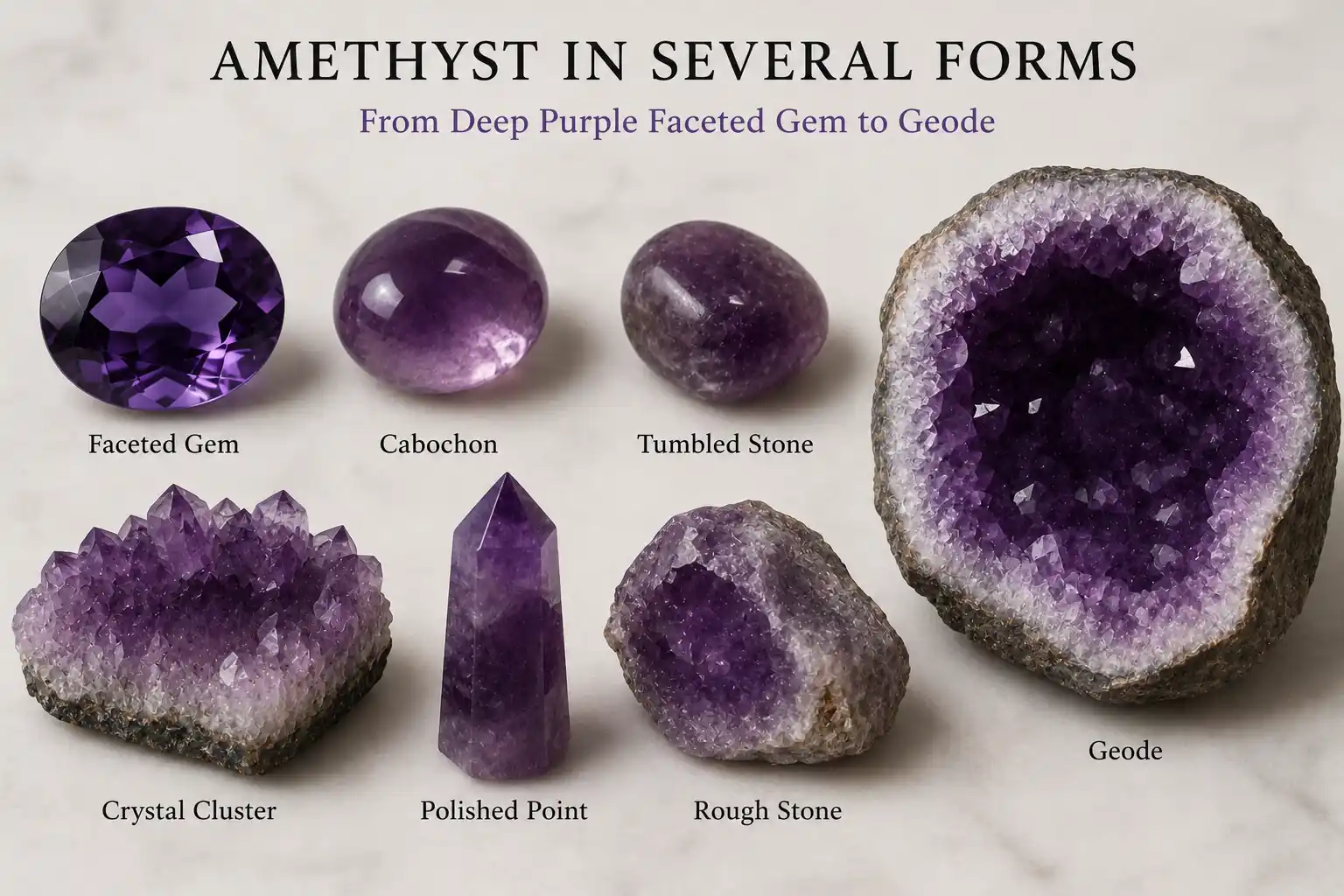
Crystal clusters, points, geodes, and mineral specimens require a different quality framework. Faceted-stone buyers prioritize face-up color, brilliance, eye-clean clarity, and cut, while specimen collectors may focus on crystal form, termination quality, luster, matrix association, provenance, condition, natural surfaces, and overall aesthetics.
Large size is especially poor as a standalone value signal in specimens because amethyst can occur in enormous geodes and crystals. GIA notes that amethyst forms very large crystal-lined cavities in locations such as Brazil.
Look for repaired points, glued crystals, dyed surfaces, chips, polished bases, and undisclosed restoration. A cut base may be perfectly acceptable for display, but it should not be confused with an untouched natural surface.
Chevron Amethyst Should Not Be Priced Like Fine Faceted Amethyst
Chevron amethyst is patterned quartz showing purple and white or pale banding, often associated with intergrown amethyst and lighter quartz zones. Its appeal comes from pattern, contrast, shape, polishing, and specimen aesthetics rather than the same clarity and even-color standards used for fine faceted amethyst.
A highly patterned cabochon may be desirable precisely because it is zoned. That would be considered a defect in a premium transparent faceted amethyst if the zoning disrupted face-up color.
Buyers should therefore compare like with like. A carved chevron amethyst tower, a transparent faceted stone, and a natural geode belong to different markets even though all contain amethyst quartz.
Be Careful with “Investment Grade” Amethyst
Amethyst can be collectible and historically significant, but sellers should not imply guaranteed financial appreciation. Its broad natural supply and availability in large sizes make the economics different from exceptionally scarce gemstones.
GIA describes amethyst as abundant enough that large stones do not usually experience a dramatic per-carat price jump. That does not prevent exceptional stones, historic jewelry, fine designer pieces, or important mineral specimens from becoming valuable. It does mean that ordinary retail amethyst should not automatically be marketed as an investment simply because it is purple, large, or labeled AAA.
Buy for beauty, craftsmanship, collectibility, provenance, or personal significance first. Future resale should be treated as uncertain unless independent market evidence supports a specific investment thesis.
Country of Origin Is Less Important Than Color
Buyers frequently encounter claims that Brazilian, Uruguayan, Zambian, or “Siberian” material is automatically superior. GIA directly rejects that kind of blanket value rule, stating that origin alone does not add value to amethyst and that color remains the most important factor regardless of where the gem was mined.
Regional reputation can still help describe typical material. Some deposits may be known for dark saturation, crystal size, geode formation, or inclusion patterns. Those tendencies should never substitute for inspecting the individual stone.
A beautiful amethyst from a less fashionable locality does not become inferior because of geography. Conversely, a poorly cut or overly dark stone does not become fine simply because its seller attaches a prestigious location name.
Evaluate Price After Evaluating Quality
The most efficient buying order starts with natural or synthetic identity, then moves to color, cut, clarity, treatment, size, durability, and documentation. Price becomes meaningful after those characteristics are understood.
A large inexpensive stone may represent excellent value if its lighter color suits the buyer. A smaller deeply saturated stone may justify a much higher price because strong reddish purple color commands greater demand. GIA specifically notes that pale material is more affordable than stronger reddish purple amethyst.
Neither purchase is automatically better. Value depends on whether the buyer receives the characteristics being paid for and whether the seller describes them accurately.
Questions to Ask Before You Buy Amethyst
A trustworthy seller should be able to answer clear factual questions without relying exclusively on marketing grades. Ask about identity, origin status, treatment, return rights, and any documentation before paying a premium.
Useful questions include:
Is the stone natural amethyst or laboratory-grown amethyst?
Has any treatment been detected or disclosed?
Has the material been dyed, fracture-filled, heated, coated, or otherwise altered?
Is the color evenly distributed when viewed face-up?
Are the photographs of the exact gemstone?
What are the carat weight and millimeter dimensions?
Does the stone show obvious windowing or extinction?
What does the seller’s AAA or other quality grade actually mean?
Is any claimed country or mine origin documented?
Does an independent gemological report accompany the stone?
What is the return and inspection period?
Will natural or laboratory-grown origin and treatments appear on the invoice?
These questions convert a vague sales description into information that can be compared across sellers.
Red Flags When Buying Amethyst
One warning sign is an unusually high price justified only by an undefined AAAA or “investment grade” label. GIA confirms that no standardized universal grading scale exists for amethyst. A premium should therefore correspond to visible color, superior cutting, provenance, documentation, craftsmanship, or another defensible characteristic.
Another warning sign is contradictory origin language. A listing that simultaneously calls the stone natural, synthetic, hydrothermal, mined, and lab-created may indicate that the seller does not understand the material or is using keywords indiscriminately.
Be cautious when photographs show intensely saturated purple but the seller refuses to provide neutral-light images. Extreme editing can hide zoning and darkness. A refusal to disclose treatment or return terms creates additional risk, particularly when the stone carries a high premium.
Buy the Exact Stone When Quality Matters
Natural amethyst varies from one stone to another. Listings that use one photograph for dozens of pieces may be acceptable for inexpensive calibrated commercial stones, but they provide limited information when color and zoning drive value.
For a higher-quality purchase, ask whether you will receive the exact photographed gem. Request a short video showing the stone turning under neutral indoor lighting and daylight-type illumination. This reveals brightness, extinction, zoning, windowing, and surface condition more effectively than a single still image.
Dimensions also matter. Two stones of equal carat weight can face up very differently when one is cut deep and the other has more efficient proportions. Millimeter measurements help show whether weight is contributing to visible size or sitting beneath the setting.
A Practical Amethyst Buying Sequence
Begin by deciding what you are buying: a loose faceted stone, finished jewelry, a crystal specimen, a geode, a carving, or patterned material such as chevron amethyst. Each category has different quality priorities, and comparing them under one standard creates confusion.
Next establish natural or laboratory-grown origin if that distinction matters to you. Examine color before size, then inspect zoning, clarity, cut, surface condition, and treatment disclosure. Compare dimensions with weight and consider how the stone will be worn.
Only after those checks should you compare price. For an unusually valuable natural stone, review an independent laboratory report during the return period. This sequence prevents marketing language, large carat weight, or a prestigious origin name from overshadowing the qualities that actually determine appearance.
How Much Documentation Do You Really Need?
A modest commercial amethyst does not always justify the expense of independent laboratory analysis. GIA acknowledges that amethyst reports are available but less commonly requested because the report cost can be substantial relative to the gemstone’s value.
Documentation becomes more useful as financial risk rises. A very large, strongly colored stone sold as natural and untreated at a substantial premium may justify independent identification. A historically significant jewel or collection specimen may also benefit from testing.
Remember that a seller’s “certificate” is not necessarily independent. Determine who issued it, whether the issuer is a recognized gemological laboratory, and what conclusions the document actually provides.
What a Useful Laboratory Report Can Establish
GIA’s Colored Stone Identification Report can identify the gemstone type, state whether the material is natural or synthetic, and list detectable treatments. It also provides descriptive information including weight, measurements, shape, cutting style, color, and a photograph.
The report does not create a standardized AAA grade for amethyst, and GIA’s standard origin-report service does not list amethyst among the stones for which geographic-origin reporting is routinely offered.
This means a laboratory report is most useful for confirming material identity and treatment-related facts. Commercial quality and retail price still require separate judgment.
Responsible Symbolism Does Not Determine Gem Quality
Amethyst has a long history of cultural and symbolic associations, and many people buy it for birthstone, spiritual, decorative, or personal reasons. Those traditions are separate from measurable quality.
A seller’s claim that one stone is more calming, protective, spiritually powerful, or energetically pure does not establish better color, natural origin, treatment status, or higher market value. No gemological laboratory grades amethyst according to metaphysical strength.
Someone may still choose a stone because its symbolism is personally meaningful. That choice can coexist with accurate gemology as long as symbolic interpretations are not presented as medical effects, guaranteed outcomes, or scientific measurements.
Conclusion
To buy amethyst well, focus first on color and overall appearance rather than size or marketing grades. Fine amethyst typically shows strong purple to reddish purple color, good brightness, minimal distracting zoning, acceptable clarity, and competent cutting. GIA identifies color as the most important quality factor and confirms that no universal AAA grading system exists for amethyst.
Natural and laboratory-grown amethyst should be disclosed as different origin categories, while dyeing, heat, fracture filling, and other treatments deserve separate consideration. Large size is readily available, so carat weight should not overshadow color and cut. For a significant purchase, an independent identification report can verify natural or synthetic origin and detectable treatments. A careful buyer therefore pays for visible quality and credible evidence rather than vague grades, oversized carat numbers, or unsupported origin claims.
Frequently Asked Questions About Buying Amethyst
What should I look for when I buy amethyst?
Start with color, then evaluate zoning, clarity, cut, natural or laboratory-grown origin, treatment, weight, dimensions, and seller documentation. GIA considers strong reddish purple to purple with minimal visible zoning the most desirable color range. A well-cut stone should also remain bright and lively rather than showing a large window or excessive darkness.
What color amethyst is considered the best?
GIA describes the finest color as strong reddish purple to purple without brownish or bronze modifiers and without noticeable face-up zoning. Extremely dark material can look nearly black in weak lighting, so deeper color is not always better.
Is dark purple amethyst more valuable?
Often, but only when saturation remains attractive and the stone retains brightness. GIA warns that overly dark amethyst may look black under dim illumination. A slightly lighter stone with better brilliance can therefore be more attractive than an excessively dark one.
Is pale amethyst real amethyst?
Yes. Amethyst occurs across a range from pale violet to strongly saturated purple. GIA notes that pale colors are generally more affordable than strong reddish purple material. Pale color affects market quality, not whether the quartz can be natural amethyst.
What does AAA amethyst mean?
AAA is usually a retailer-created quality description rather than a universal gemological grade. GIA states that no standardized quality-grading scale exists for amethyst. Ask the seller to explain exactly what AAA means in terms of color, clarity, cut, zoning, treatment, and origin.
Does GIA grade amethyst?
GIA offers identification services for amethyst, but there is no standardized GIA quality grade comparable with the diamond grading system. A GIA Colored Stone Identification Report can identify the material, distinguish natural from synthetic origin, and list detectable treatments.
Does amethyst need a certificate?
Not usually for ordinary commercial jewelry. GIA notes that amethyst reports are less frequently requested because laboratory fees can be significant compared with the value of many stones. A report becomes more useful for a costly, unusual, historically important, or heavily marketed natural stone.
Can GIA tell whether amethyst is natural or synthetic?
Yes. GIA’s colored-stone identification reports state whether the submitted material is natural or synthetic and list detectable treatments. Laboratory separation may require advanced observations because synthetic quartz can closely resemble natural amethyst.
Is laboratory-grown amethyst real amethyst?
Laboratory-grown amethyst is synthetic quartz with essentially the same basic chemical and physical identity as natural quartz, but humans grow it rather than geological processes forming it. GIA describes synthetic quartz, including amethyst, as widely available. It should be disclosed as laboratory-grown rather than sold as natural.
Can synthetic amethyst look better than natural amethyst?
Yes. Synthetic material can be clean, strongly colored, and well cut. Appearance therefore does not prove geological origin. GIA research shows that separating natural and synthetic amethyst may require examination of twinning, inclusions, and spectroscopy.
Can amethyst be dyed?
Yes. GIA notes that lower-quality pale amethyst and light-colored quartz can be dyed purple. Dyed material can still be decorative, but the treatment should be disclosed and should not be represented as naturally intense color.
Is amethyst usually treated?
GIA describes amethyst as rarely treated in its consumer guidance, although heat, dyeing, and fracture filling are possible. Ask for written disclosure whenever treatment matters to your purchase.
Can heat change amethyst?
Yes. Heat can lighten some dark amethyst, and stronger heating can transform certain amethyst into yellow-to-orange quartz sold as citrine. GIA notes that most citrine in the market is produced by heat treating amethyst.
Is heat-treated amethyst fake?
No. A natural amethyst can remain natural quartz even after treatment, although treatment changes its disclosure category and may alter color. Laboratory-grown amethyst and imitations are separate issues.
Is Brazilian amethyst better than Zambian amethyst?
Not automatically. GIA states that origin alone does not add value to amethyst; quality, particularly color, matters more. Zambian material can show strongly saturated raspberry-purple color, while Brazilian material can also produce excellent stones.
Is Siberian amethyst the best?
The term can be used commercially to describe desirable color rather than proving Russian origin. GIA states that amethyst value depends on quality rather than country of origin. Buyers should therefore judge the stone itself and ask what the origin terminology actually means.
Does amethyst origin affect value?
GIA specifically says that country of origin alone does not add value to amethyst. Color, cut, clarity, overall appearance, treatment, and the individual object’s provenance generally provide more useful buying information.
Is large amethyst rare?
Fine amethyst can occur in very large crystals and fashioned stones. GIA notes that large sizes are readily available and that larger stones do not experience the same dramatic per-carat increases seen in some rarer gems. Size should therefore be judged together with quality.
Is a 10-carat amethyst valuable?
It can be valuable, but ten carats alone does not establish high quality. Strong color, brightness, minimal distracting zoning, good clarity, competent cutting, treatment status, and natural or synthetic origin all matter. Large amethyst is sufficiently available that weight alone does not create an exceptional rarity premium.
Is eye-clean amethyst better?
For ordinary faceted material, eye-clean appearance is generally desirable because much market amethyst lacks eye-visible inclusions. A strongly colored stone may remain attractive despite minor inclusions, while obvious inclusions in pale material can reduce value more significantly.
Do inclusions prove amethyst is natural?
No. Some natural inclusions can support natural origin, but inclusion presence alone is not proof. GIA research shows that natural-versus-synthetic amethyst identification may require twinning analysis and laboratory techniques.
What is color zoning in amethyst?
Color zoning means the purple color is distributed unevenly through the crystal. GIA notes that obvious lighter and darker purple zones can lower value and may become easier to see when a loose stone is examined pavilion-up or against a white background.
What is windowing in an amethyst?
Windowing is a transparent-looking central area caused by cutting proportions that allow light to pass through rather than return toward the viewer. It can make the stone look washed out and reduce apparent brilliance. GIA advises buyers not to compromise on cut because cutting quality has a major effect on beauty and marketability.
Is amethyst suitable for a ring?
Yes. GIA rates amethyst at Mohs hardness 7 with good toughness and considers it suitable for rings when worn with reasonable care. Years of daily use can still create scratches and may eventually require repolishing.
Is amethyst suitable for an engagement ring?
It can be, provided the wearer accepts its durability limits. GIA considers amethyst appropriate for everyday wear but notes that a Mohs hardness of 7 means visible wear can develop over time. A protective setting and periodic inspection are sensible for long-term daily use.
Can amethyst scratch?
Yes. Mohs hardness 7 makes amethyst reasonably durable, but it is not scratch-proof. GIA notes that quartz-containing dust and other materials can contribute to wear, particularly in frequently used jewelry.
Can amethyst fade in sunlight?
Some amethyst can fade after prolonged exposure to intense light. GIA also warns against abrupt temperature changes because they may cause fracturing. Normal jewelry wear is generally manageable, but extended intense display lighting is best avoided for valuable pieces.
How should I clean amethyst?
Warm soapy water is the safest general method. GIA states that ultrasonic cleaning is usually acceptable for untreated amethyst but not when the stone is dyed or fracture-filled, while steam cleaning is not recommended.
Should I buy a loose amethyst or finished jewelry?
Loose stones are easier to inspect for zoning, cut quality, pavilion depth, surface condition, and exact measurements. Finished jewelry provides immediate wearability but requires evaluation of the setting, metal, workmanship, and stone together. Either option can be appropriate when the description is accurate.
Why are some amethysts inexpensive despite being large?
Large amethyst is relatively available, so size does not create the steep rarity premium found in some other colored gemstones. GIA states that larger amethyst is not priced dramatically higher per carat than smaller stones. Color and cutting can therefore matter much more than weight.
How can I tell if an amethyst price is fair?
Compare stones with similar natural or synthetic origin, color saturation, zoning, clarity, cut, carat weight, dimensions, treatment status, and jewelry setting. Ignore undefined AAA labels unless the seller explains them. A fair price reflects the qualities actually visible and documented rather than the strongest marketing phrase.
What is the biggest mistake when buying amethyst?
The biggest mistake is paying for size, darkness, an origin name, or an unsupported AAA grade before evaluating the actual gemstone. Fine amethyst should combine attractive purple color, brightness, competent cutting, sensible clarity, and accurate disclosure. Establish what the stone is and how it looks first; compare price afterward.