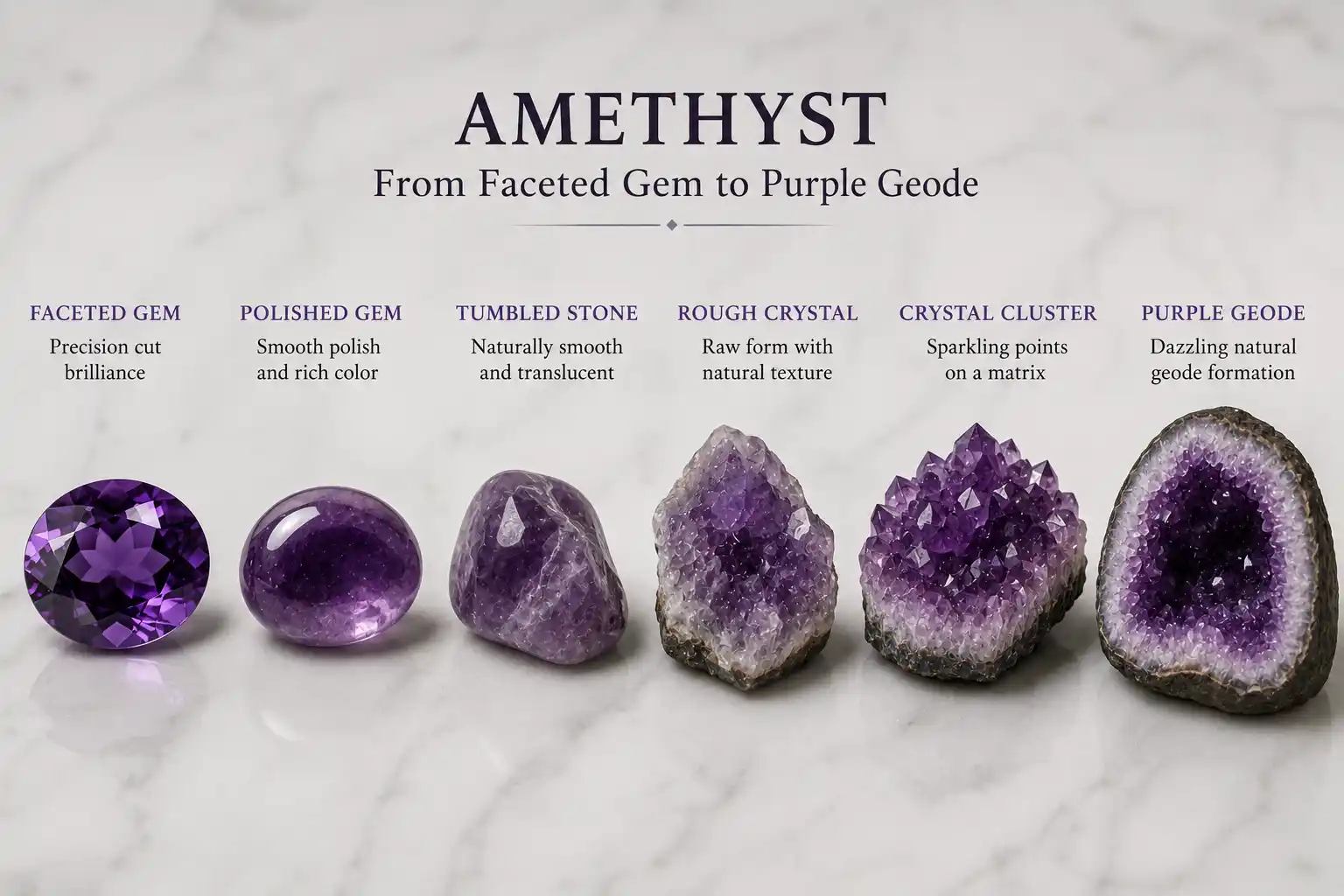
Amethyst Price: Market Benchmarks, Quality, Treatments & Availability
Amethyst is generally an affordable natural gemstone, but its price varies sharply with color, transparency, cutting, size, specimen quality, treatment, and how it is sold. Commercial faceted stones can cost only a few dollars per carat, attractive jewelry-quality amethyst commonly reaches the single digits to several tens of dollars per carat, and unusually fine, precision-cut, collectible, or specialty pieces can exceed those ordinary ranges.
Published retail guides illustrate how wide the market can be. One current seller guide places commercial grades from about $1 per carat at the low end to roughly $80 per carat at its highest stated grade, while other retail examples place many faceted stones around $6 to $30 per carat depending on size and quality. These are retailer benchmarks rather than universal market standards, and grade labels such as AAA or AAAA are not consistent between sellers.
Color is usually the strongest individual value factor. Rich violet to reddish-purple stones with attractive saturation, good brightness, and little distracting color zoning generally command stronger prices than pale, grayish, brownish, or excessively dark material. Large sizes are much more available in amethyst than in many rare colored gemstones, so price per carat does not necessarily rise dramatically just because a stone becomes larger.
Amethyst Price At a Glance
| Amethyst type | Broad market pattern |
|---|---|
| Pale or commercial faceted material | Often around $1 to $6 per carat |
| Attractive jewelry-quality amethyst | Commonly around $6 to $20 per carat |
| Richly colored higher-quality material | Often around $20 to $80 per carat |
| Precision-cut or specialty stones | Can exceed ordinary commercial ranges |
| Small polished stones and beads | Often inexpensive by piece or strand |
| Large clusters and geodes | Usually priced by specimen, size, appearance, and weight |
| Exceptional collector specimens | Can reach hundreds or thousands of dollars |
These ranges overlap significantly because amethyst is sold through very different markets. A mass-produced calibrated gemstone, precision-cut collector stone, cathedral-sized geode, historic mineral specimen, and handmade jewelry piece cannot be valued by the same formula.
Color Has the Greatest Influence on Amethyst Price
Amethyst is valued primarily for purple color.
Pale lilac material can be attractive and inexpensive, while stronger violet and reddish-purple colors generally bring higher prices when the stone remains bright enough to display its color clearly.
The best-looking amethyst usually balances saturation and tone.
A stone that is too pale may lack visual intensity. A stone that is too dark can appear almost black except under strong lighting, which reduces the amount of visible purple across the face.
Current gemological buying references similarly emphasize color as the central value factor and note that highly saturated reddish-purple material with limited visible zoning generally commands stronger interest.
The wider range of purple crystals can help put amethyst’s color in context, but amethyst remains especially accessible because strong purple color occurs in a gemstone that is available in relatively large transparent crystals.
Color Zoning Can Lower Value
Natural amethyst frequently contains uneven color distribution.
Some parts of a crystal may be dark purple while other areas are pale or nearly colorless. This is normal geological behavior and does not mean the stone is fake.
The effect on price depends on how visible the zoning is after cutting.
A well-cut gemstone may position natural zoning so the face-up color looks relatively even. Poor orientation can leave one side dark and another noticeably pale, creating a patchy appearance.
Strong zoning is often less important in natural mineral specimens because it can contribute visual character.
For faceted jewelry stones, buyers usually prefer a balanced appearance.
The details behind amethyst quality grading therefore need to consider both the natural crystal and how effectively the cutter handled its color distribution.
Clarity Usually Has a Smaller Price Effect Than Color
Transparent amethyst commonly occurs with good clarity.
That availability means an eye-clean stone does not necessarily receive the enormous clarity premium seen in gemstones where clean examples are much scarcer.
Instead, heavily included material usually receives a discount.
Large fractures, obvious clouds, dark inclusions, or internal features that interfere with brilliance can reduce the price of a faceted amethyst.
Minor inclusions matter less when the color is excellent and the overall appearance remains attractive.
Mineral specimens again follow different rules.
Phantoms, growth zones, inclusions, hematite-related effects, matrix associations, or unusual crystal structures can increase collector interest rather than reduce it.
The form of amethyst being valued must therefore be established before clarity becomes meaningful.
Cut Can Create a Large Difference Between Similar Stones
Amethyst rough is sufficiently available that buyers generally do not need to tolerate severe cutting problems in ordinary jewelry-quality stones.
Windowing is one of the easiest problems to notice.
A shallow stone can develop a transparent-looking center instead of reflecting light evenly. Excessive depth creates the opposite problem, hiding weight underneath the face of the gem while making the apparent size smaller than expected.
Dark extinction can also reduce value when large areas appear nearly black.
Precision cutting can justify a price premium because skilled cutting improves symmetry, light return, face-up size, and color presentation while requiring additional labor.
This is why two amethysts with identical weights can have very different prices.
One may simply contain more quartz.
The other may make much better use of it.
Amethyst Price Per Carat Does Not Rise Like Ruby or Alexandrite
Many gemstone buyers expect the price per carat to rise sharply with size.
That pattern is much weaker in amethyst.
Large amethyst crystals are sufficiently available that cutters can produce substantial faceted stones without entering the same rarity levels seen in large ruby, sapphire, emerald, or alexandrite.
Industry references specifically note that amethyst’s price per carat tends to rise gradually rather than exponentially because larger material is readily available.
The amethyst price per carat therefore becomes most useful when color, clarity, cut, and treatment are already comparable.
A 10-carat stone is not automatically ten times as desirable as a 1-carat stone.
In some cases, the smaller gem may have far better color and cutting.
Large Amethyst Can Still Be Valuable
Saying that large amethyst is available does not mean all large pieces are inexpensive.
A very large faceted stone with exceptional color, high transparency, precision cutting, and impressive visual presence can still command a substantial total price.
The same applies to mineral specimens.
Large crystals with clean terminations, rich color, attractive matrix, little damage, documented locality, or exceptional formation can become highly collectible.
Geodes and cathedral specimens are another separate market.
Their prices can depend on overall size, crystal coverage, color intensity, structural condition, transport costs, base preparation, aesthetics, and whether the specimen requires specialized installation.
Weight alone does not determine these prices.
A large unattractive geode and an unusually beautiful smaller specimen may belong to very different value levels.
Brazilian, Uruguayan and African Amethyst Can Be Priced Differently
Amethyst occurs in many countries, with major commercial supplies coming from regions in South America and Africa.
Brazil is particularly important for large quantities of amethyst and large geodes. Uruguay is known in the market for richly colored material, while Zambia and other African sources can produce strongly saturated transparent crystals.
Origin can influence buyer expectations, but it should not replace direct quality evaluation.
Color characteristics overlap between deposits, and appearance alone is generally insufficient to determine exact geographic origin reliably. Gemological guidance also warns against assuming origin purely from color.
A superior stone from a less heavily marketed source can be more valuable than a mediocre stone from a famous locality.
Origin premiums make the most sense for documented mineral specimens and collector material where locality itself is part of the appeal.
“Siberian” Amethyst Does Not Necessarily Mean Russian Origin
The word Siberian can cause confusion in amethyst pricing.
Historically, Russian material developed a reputation for desirable deep purple color with red and blue flashes.
In modern trade usage, however, “Siberian” is frequently used as a color description rather than proof that a gemstone was mined in Siberia. Gemological references specifically distinguish this trade usage from geographic origin.
A seller asking a premium for “Siberian quality” should therefore explain what the term means.
If it refers to color, judge the color.
If it refers to actual geographic origin, ask what evidence supports the locality claim.
Marketing language should never substitute for provenance.
Treatment Can Affect Amethyst Value
Amethyst can be altered through heat and other processes.
Heating can lighten purple color or change the appearance of certain quartz into yellow, orange, greenish, or other colors depending on the starting material and conditions.
This is particularly relevant because much commercial citrine is produced by heating amethyst.
Treatment does not automatically make quartz undesirable.
The main pricing issue is disclosure.
A naturally attractive purple amethyst and a strongly modified quartz product should not be represented as equivalent if treatment status materially affects the seller’s rarity claim.
Coatings and artificial surface color can also appear in the crystal market.
Unnaturally intense or metallic-looking finishes usually belong to decorative products rather than naturally colored amethyst.
Synthetic Amethyst Usually Belongs to a Different Value Category
Laboratory-grown quartz can be produced with purple coloration.
Synthetic amethyst has essentially the same fundamental quartz identity as natural amethyst but forms under controlled laboratory conditions instead of geological ones.
Because natural amethyst is already widely available, synthetic material generally does not have the rarity premium associated with natural crystals.
The problem arises when synthetic material is represented as naturally mined amethyst.
Basic identification principles from how to tell if a crystal is real can identify some obvious imitations, but natural and synthetic quartz can be difficult to separate reliably without proper gemological examination.
A highly clean synthetic stone should not receive a natural-origin premium simply because it looks attractive.
Jewelry Prices Can Be Much Higher Than Loose-Stone Prices
A loose amethyst gemstone and an amethyst ring should not be compared using the gemstone’s carat price alone.
Finished jewelry includes precious metal, setting labor, accent stones, design, manufacturing, retail margin, and sometimes brand value.
A relatively inexpensive amethyst can therefore appear in a costly gold or platinum piece.
The opposite can also happen.
A large commercial amethyst may make a ring look visually substantial while representing only a modest portion of the final retail price.
When comparing jewelry, separate the components mentally.
Ask what the center stone would be worth as a loose gem, then evaluate what the setting and craftsmanship add.
This produces a much clearer view of whether the finished price is reasonable.
Mineral Specimens Use Different Pricing Rules
Collectors purchasing natural amethyst crystals are not primarily paying for faceting quality.
They may care about crystal shape, luster, color zoning, termination quality, matrix association, locality, damage, aesthetics, and provenance.
A specimen with several sharp undamaged crystals arranged attractively on matrix can command much more than loose broken crystals of equal weight.
Historic locality also matters.
Material from a mine that no longer produces specimens can attract stronger collector interest even when its raw mineral composition is ordinary quartz.
This is why gemstone pricing and mineral specimen pricing should remain separate.
A price per carat formula that makes sense for a faceted gem is usually meaningless for a ten-kilogram cluster.
Geodes and Cathedrals Are Priced by Visual Impact as Well as Weight
Large amethyst geodes occupy a decorative and collector market of their own.
Height and total weight matter because they influence shipping and physical presence, but internal crystal quality often matters more than simple bulk.
Deep purple crystal coverage, attractive cavity shape, minimal structural damage, balanced proportions, and good preparation can increase the asking price.
Cut and polished rims may also influence retail presentation.
Very large pieces involve substantial logistics, including packing, freight, reinforcement, and display support. Those costs can become part of the final retail price even though they do not make the quartz itself rarer.
When comparing large geodes, ask whether the difference in price reflects better crystals or simply greater size and shipping complexity.
Amethyst Documentation Usually Matters Only at Higher Values
Most inexpensive amethyst does not require a laboratory report.
The gemstone is abundant enough that testing costs can exceed the value of ordinary pieces.
Documentation becomes more useful when a seller makes claims about natural versus synthetic origin, unusual treatment status, rare locality, important provenance, or exceptionally high value.
The principles behind gemstone certification still apply.
A gemological report helps identify and characterize the gemstone.
An appraisal estimates monetary value for a particular purpose.
Provenance documents establish history or ownership.
These are different functions.
For ordinary commercial amethyst, seller transparency and a reasonable return policy are often more practical than expensive paperwork.
Amethyst Is Durable Enough for Most Jewelry
Quartz has a Mohs hardness of 7, which gives amethyst useful resistance to everyday scratching.
It is still capable of chipping or fracturing from hard impact.
Color stability also deserves attention.
Some amethyst can fade or change after prolonged exposure to intense light or excessive heat. The practical concerns around crystals in the sun matter especially for valuable faceted stones and display specimens kept near strong windows.
Ordinary indoor wear is not the same as leaving a specimen in harsh sunlight for months.
Simple precautions can preserve color without making amethyst difficult to own.
Does Amethyst Hold Its Value?
Most commercial amethyst should be bought for beauty, jewelry use, collecting, or personal enjoyment rather than assumed investment appreciation.
Abundant supply limits the scarcity premium on ordinary stones.
Retail markups also mean a consumer may not recover the original purchase price when reselling a standard ring, bead strand, or faceted gemstone.
Exceptional mineral specimens, important locality pieces, precision cuts, historic jewelry, or documented high-end objects can behave differently.
The wider question of whether gemstones hold value always depends on purchase price, rarity, condition, provenance, demand, and access to appropriate buyers.
Value retention is possible.
It is not guaranteed simply because the gemstone is natural.
How to Compare Amethyst Prices Correctly
Compare stones from the same market segment.
A precision-cut gem should not be compared with a mass-produced calibrated stone purely by carat weight. A crystal cluster should not be compared with a faceted oval. A geode should not be compared with loose jewelry material.
For faceted gemstones, align color, tone, transparency, cut, zoning, dimensions, and treatment status first.
Then compare price.
The buying criteria in buy amethyst become especially useful when two listings use completely different grade terminology.
Ignore AAA labels initially.
Compare what the stones actually look like.
A retailer can invent a grade name.
It cannot invent genuinely better saturation, symmetry, polish, or brilliance without the photographs revealing the difference.
When an Amethyst Price Looks Too High
An expensive amethyst should have an understandable reason for its premium.
Exceptional color can justify more. Precision cutting can justify more. Unusual size combined with exceptional quality can justify more. Important provenance, rare specimen formation, historical value, or skilled carving can justify more.
Generic rarity claims do not.
Large size by itself is particularly weak justification because amethyst occurs in substantial crystals.
Descriptions such as royal quality, super premium, investment grade, master healer, or museum quality have little pricing value unless tied to measurable or documented characteristics.
Ask what specifically makes the item different from a less expensive example.
If the answer remains vague, comparison shopping is usually worthwhile.
Conclusion
Amethyst price depends primarily on color, followed by transparency, cut, zoning, size, treatment, form, provenance, and the market in which the stone is sold. Commercial faceted amethyst can cost only a few dollars per carat, while richly colored higher-quality stones commonly move into the tens of dollars per carat and specialized collector pieces can cost substantially more. Because large amethyst is readily available, size alone should never justify an extreme premium. The best value comes from comparing genuinely similar stones and paying for visible quality rather than grade labels or marketing language.
FAQs
How much does amethyst cost per carat?
Commercial faceted amethyst can begin around a few dollars per carat, while attractive higher-quality material commonly reaches the single digits or tens of dollars per carat. Exceptional specialty stones can exceed ordinary ranges.
What color amethyst is most valuable?
Rich violet to reddish-purple amethyst with strong saturation, good brightness, and limited distracting zoning is generally among the most desirable.
Is dark purple amethyst more expensive?
Often, but only when the stone remains bright enough to show attractive purple color. Excessively dark stones can appear black and may be less desirable.
Does amethyst become more expensive as carat weight increases?
Usually not dramatically. Large crystals are comparatively available, so amethyst’s per-carat price generally rises much more gradually than that of rarer gemstones.
Why are some large amethysts inexpensive?
Amethyst forms in large crystals and commercial deposits supply substantial quantities. A large stone can therefore remain affordable when color or cutting is ordinary.
Is Brazilian amethyst cheaper?
Brazil produces large quantities of amethyst, including large crystals and geodes, but individual prices depend on quality rather than country alone.
Is Uruguayan amethyst more valuable?
Some Uruguayan material is prized for strong purple color, but origin does not automatically make every specimen more valuable. Color, condition, size, formation, and provenance remain important.
Does treatment affect amethyst price?
It can. Treatment should be disclosed when known, particularly if the seller charges a premium based on claims of natural color or rarity.
Is synthetic amethyst worth less?
Synthetic amethyst generally belongs to a lower value category because it lacks the geological rarity of naturally formed material.
Are amethyst geodes expensive?
Small geodes can be affordable, while large richly colored cathedrals and exceptional specimens can cost hundreds or thousands of dollars depending on size, crystal quality, condition, preparation, and logistics.
Does amethyst hold its value?
Ordinary retail amethyst should not be assumed to appreciate. Exceptional specimens, important provenance, fine craftsmanship, and unusual collector pieces can attract stronger resale interest.
How can I tell whether an amethyst price is fair?
Compare the stone with amethyst of similar color, transparency, cut, zoning, size, treatment status, specimen type, and provenance rather than relying on seller grade labels alone.
Disclaimer: Amethyst prices vary with quality, treatment, origin claims, craftsmanship, seller margins, specimen type, and market conditions, so broad price ranges are reference points rather than guaranteed buying or resale values.