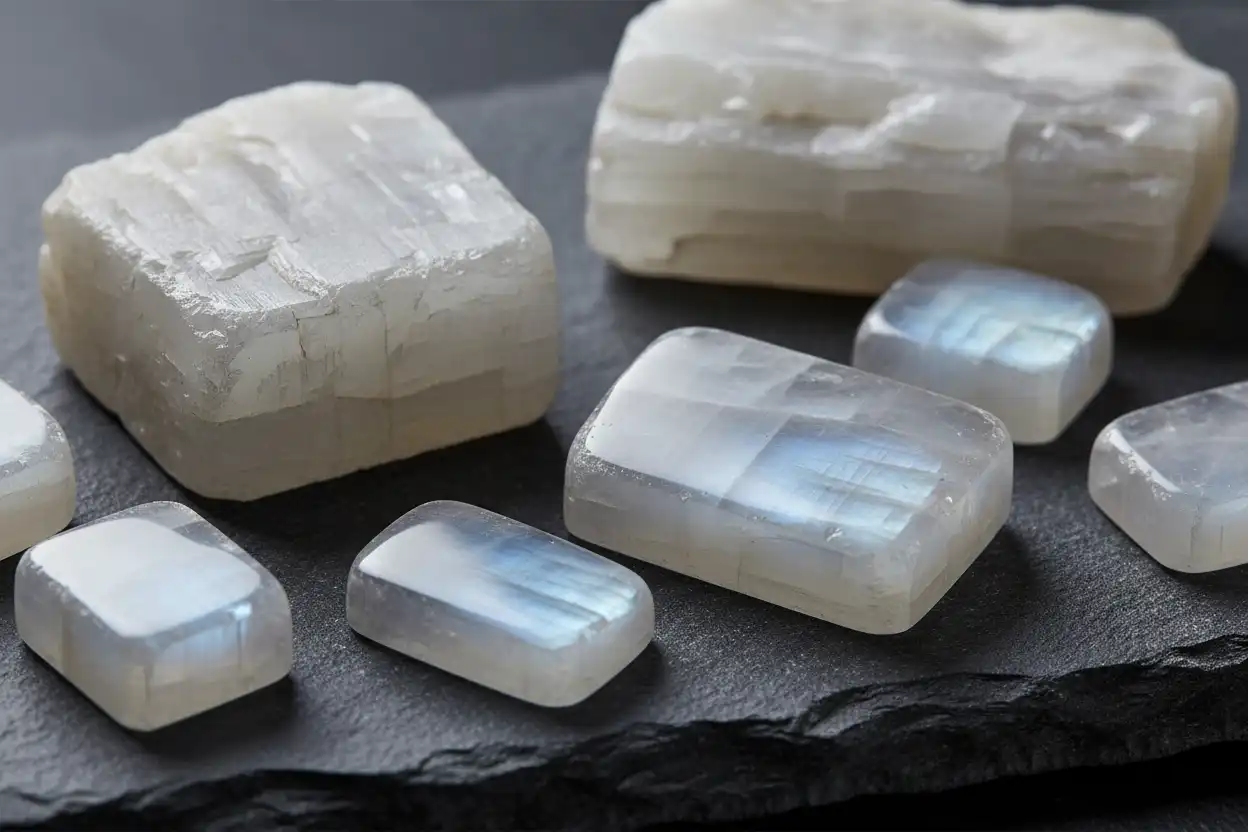
Albite Meaning: Sodium Feldspar, Twinning and Uses
Albite is the sodium-rich end member of the plagioclase feldspar series, with the ideal chemical formula NaAlSi₃O₈. It is one of the most widespread rock-forming minerals, occurring in igneous, metamorphic, hydrothermal and sedimentary environments. Most albite is white, colorless or gray, although pale blue, greenish, yellowish, pinkish and iridescent material also occurs.
Albite meaning is commonly connected with clarity, organization, adaptability and gradual change. These interpretations reflect the stone’s pale appearance, layered twinning and role in rocks rather than scientifically demonstrated powers. Albite’s measurable identity is established through composition, triclinic structure, cleavage, twinning, optical properties and geological context.
Albite mineral identity
| Property | Albite |
|---|---|
| Mineral class | Tectosilicate |
| Mineral group | Feldspar group |
| Mineral series | Sodium-rich end of the plagioclase series |
| Ideal formula | NaAlSi₃O₈ |
| Mineral symbol | Ab |
| Crystal system | Triclinic |
| Common colors | Colorless, white, gray, pale blue, greenish or pinkish |
| Transparency | Transparent to opaque |
| Luster | Vitreous; commonly pearly on cleavage surfaces |
| Mohs hardness | 6–6.5 |
| Cleavage | Perfect in one direction and good in another |
| Cleavage angle | Close to, but not exactly, 90 degrees |
| Fracture | Uneven to partly conchoidal |
| Specific gravity | Commonly around 2.60–2.65 |
| Refractive indices | Approximately 1.528–1.542 |
| Optical character | Biaxial |
| Common habits | Tabular, blocky, granular, massive and thin bladed crystals |
| Diagnostic feature | Fine parallel striations produced by repeated twinning |
| Main jewelry concern | Cleavage and brittle edges |
Albite is not merely another name for any white feldspar. Potassium feldspars, calcium-rich plagioclase and pale quartz can resemble it in hand specimens. A defensible identification requires several agreeing properties rather than color alone.
Where albite belongs in the feldspar family
The feldspar mineral group contains framework aluminosilicates dominated by potassium, sodium, calcium or less commonly barium. Its members share related structures, similar hardness and two prominent cleavage directions, yet their compositions and optical behavior vary.
Albite anchors the sodium-rich end of the plagioclase series. At the opposite end is anorthite, whose ideal formula is CaAl₂Si₂O₈. Natural plagioclase commonly falls between these end members because sodium and calcium substitute through a coupled chemical change involving silicon and aluminum.
The conventional plagioclase sequence is albite, oligoclase, andesine, labradorite, bytownite and anorthite. Albite occupies compositions with approximately zero to ten percent anorthite component, while oligoclase begins as the calcium component increases. These divisions are useful, but composition changes continuously rather than jumping across visible boundaries.
Albite also participates in intergrowths with potassium feldspar. It may occur as thin sodium-rich lamellae within perthite, while microscopic albite and potassium-feldspar layers can contribute to optical effects in some gem materials. This relationship does not make albite and orthoclase the same mineral.
Why the formula matters
Albite’s ideal formula contains one sodium atom, one aluminum atom, three silicon atoms and eight oxygen atoms. Silicon and aluminum occupy tetrahedral sites surrounded by oxygen, and the tetrahedra share oxygen atoms to create a continuous three-dimensional framework. Sodium occupies larger spaces within that framework and balances the electrical charge created when aluminum replaces part of the silicon.
The formula represents an ideal end member. Natural albite can contain small amounts of calcium, potassium and trace elements, while structural ordering can differ according to formation conditions and later thermal history. Minor deviations therefore do not automatically disqualify a specimen from being albite.
The abbreviation “Ab” is used when describing feldspar composition. A label such as Ab95An5 indicates a plagioclase dominated by the albite component with a small anorthite component. This compositional notation is more precise than judging the mineral from white color or crystal shape.
Albite twinning and visible striations
Repeated twinning is one of albite’s most useful identifying features. Under the albite twin law, many narrow crystal domains form in alternating orientations. Where these domains meet a suitable crystal or cleavage surface, they can create closely spaced parallel lines called striations.
True twin striations are orderly structural features. They tend to remain straight, parallel and consistently oriented across the appropriate surface. Random scratches usually vary in direction, depth and spacing, while growth lines may follow crystal edges differently.
The name “albite twinning” describes a crystallographic law rather than proving that the host mineral is pure albite. Oligoclase, andesine, labradorite and other plagioclase compositions can display the same form of repeated twinning. Striations therefore support identification as plagioclase but do not determine the exact sodium-to-calcium ratio.
In thin section under crossed polarizers, repeated twin lamellae can appear as alternating light and dark stripes. A petrologist may combine their extinction behavior with refractive index, rock context and composition to classify the plagioclase more precisely.
Cleavelandite is a form of albite
Cleavelandite is a thin, platy or bladed habit of albite commonly associated with granitic pegmatites. Individual plates can form fan-shaped, rosette-like or stacked aggregates with white, colorless or pale surfaces. The plates may be translucent and can show a vitreous to pearly luster.
Cleavelandite is not a separate mineral species and does not have a different chemical formula simply because its crystals are thin. The name describes habit. A reliable label should therefore read “albite variety cleavelandite” or “cleavelandite habit albite” rather than treating cleavelandite as an unrelated crystal.
Fine cleavelandite provides an attractive matrix for tourmaline, beryl, spodumene, quartz and mica. These associations can support a pegmatite origin, but they do not prove the exact locality stated on a seller’s label.
How albite forms
Albite crystallizes in many silica-rich igneous rocks, including granite, granodiorite and pegmatite. Sodium-rich residual melt and fluid can support large, well-developed crystals during the later stages of magmatic crystallization. In pegmatites, albite may form blocky masses, thin cleavelandite plates or replacement textures around earlier feldspar.
Metamorphic albite develops when minerals recrystallize under changing pressure, temperature and fluid conditions. Sodium-rich plagioclase is particularly common in certain lower-grade metamorphic assemblages. Its presence, composition and relationship with associated minerals can help geologists reconstruct the conditions under which a rock changed.
Hydrothermal fluids can create albite by replacing earlier feldspar or other minerals in a process known as albitization. Sodium-bearing fluid moves through fractures, grain boundaries and permeable rock, dissolving part of the original material while albite forms in its place. Replacement may preserve the external shape of an earlier crystal even though its internal chemistry has changed.
Albite also survives erosion and can become part of sand and sandstone. It is less resistant to chemical weathering than quartz, however, and eventually breaks down into clay minerals and dissolved components. Chalky, etched or altered surfaces on an old specimen may record this weathering rather than poor polishing.
What determines albite color?
Chemically ideal albite is colorless, while light scattering, microscopic inclusions, structural defects and alteration commonly make natural crystals appear white or cloudy. Gray, cream and pale pink material can result from dispersed inclusions or staining. Greenish or bluish colors may reflect included minerals, trace elements or optical effects rather than a new feldspar species.
Color should not be used as a stand-alone identification. White albite overlaps visually with quartz, calcite, orthoclase and many other common minerals. Pale green or blue material can be confused with other feldspars or trade-named stones, while surface staining can mask the mineral’s actual body color.
Amazonite is blue-green microcline, a potassium feldspar, rather than blue albite. A seller should not use “albite amazonite” merely because a feldspar specimen has a pale green tint. Composition and structure remain more important than visual similarity.
Peristerite and iridescent albite
Peristerite is a sodium-rich plagioclase with microscopic exsolution lamellae capable of producing light blue, pale yellow, pink or multicolored iridescence. As the feldspar cools and its structure becomes more ordered, slightly different compositions can separate into thin intergrowths. When their spacing is comparable with visible wavelengths, reflected light interferes and creates color.
Pure low albite is normally the dominant phase in peristerite, with minor oligoclase-rich intergrowths. The resulting effect can resemble moonstone, but the underlying textures and optical orientation differ. Polysynthetic albite-twin lamellae provide an important identification clue.
Moonstone is an appearance-based gem name associated with a floating white or blue sheen. Traditional moonstone commonly involves intergrowths of albite and potassium feldspar, whereas peristerite belongs to sodium-rich plagioclase. Similar appearance does not make every iridescent albite ordinary moonstone.
The distinction becomes clearer in the labradorite and moonstone comparison. Labradorite is significantly richer in the anorthite component and can produce broader, more saturated labradorescence. Material sold as rainbow moonstone is commonly transparent-to-translucent labradorite rather than albite.
Albite, moonstone and sunstone labels
| Commercial or mineral name | Defensible meaning | Common source of confusion |
|---|---|---|
| Albite | Sodium-rich plagioclase mineral | White color alone does not prove identity |
| Cleavelandite | Thin, platy habit of albite | Sometimes presented as a separate species |
| Peristerite | Iridescent sodium-rich plagioclase with exsolution texture | Frequently called moonstone from appearance alone |
| Traditional moonstone | Feldspar displaying adularescence, commonly involving alkali-feldspar intergrowths | The name is applied broadly to pale iridescent feldspar |
| Rainbow moonstone | Commercial name commonly used for light labradorite | It is usually not albite or traditional orthoclase moonstone |
| Sunstone | Feldspar with warm color, aventurescence or both | The name can describe several feldspar compositions |
| Oregon sunstone | Copper-bearing plagioclase from Oregon | Locality and composition require evidence |
Sunstone is not one fixed feldspar species. Some sunstone belongs to oligoclase, some to labradorite and some to other feldspar compositions. Oregon sunstone is commonly copper-bearing plagioclase and should not be relabeled as albite merely because both belong to the broader feldspar family.
This label audit prevents a visible sheen from overriding mineral composition. A correct description can include both facts, such as “iridescent sodium-rich plagioclase identified as peristerite,” instead of relying on the less precise word “moonstone.”
An evidence ladder for identifying albite
| Evidence | What to examine | What it can establish |
|---|---|---|
| Color and luster | White to colorless body with vitreous or pearly surfaces | Consistent with albite but weak evidence |
| Habit | Blocky, tabular or thin bladed crystals | Supports a feldspar or cleavelandite habit |
| Cleavage | Two directions meeting close to a right angle | Strong feldspar evidence |
| Striations | Fine parallel lines on appropriate cleavage surfaces | Supports plagioclase twinning |
| Hardness | Approximately 6–6.5 | Separates albite from softer calcite |
| Specific gravity | Commonly near 2.62 | Consistent with sodium-rich plagioclase |
| Refractive index | Values in the low 1.53 to low 1.54 range | Helps distinguish sodium-rich from calcium-rich plagioclase |
| Polarized microscopy | Polysynthetic twins and extinction behavior | Narrows feldspar composition |
| Chemical analysis | Sodium, calcium, potassium, aluminum and silicon proportions | Places the sample within feldspar series |
| Raman or X-ray analysis | Structural match with reference data | Confirms mineral structure |
No observation in the first row proves albite. Confidence grows when cleavage, twinning, density, refractive behavior and composition agree. The general crystal identification process applies the same principle to other minerals.
Albite compared with common lookalikes
Quartz can occur beside albite in pegmatites and may share a white or colorless appearance. Quartz is slightly harder and lacks feldspar’s two-direction cleavage. It normally breaks conchoidally rather than into blocky fragments.
Calcite is much softer and has rhombohedral cleavage rather than two feldspar cleavages near a right angle. Acid reaction can identify calcite in controlled geological work, but acid should not be placed on a finished specimen or jewelry item.
Orthoclase and microcline are potassium feldspars. Their hardness and cleavage can overlap albite, while colors are unreliable. Fine parallel polysynthetic striations favor plagioclase, whereas microcline may show cross-hatched twinning under polarized light. Instrumental analysis is appropriate when exact species matters.
Separating albite from oligoclase can be harder because the two are adjacent parts of one continuous plagioclase series. Increasing calcium content generally raises refractive indices and specific gravity, but accurate classification may require optical measurements or chemical analysis.
A specimen and photograph checklist
Photograph the entire specimen under neutral light before cleaning it. Include the front, back, cleavage surfaces, attachment points and matrix. A scale should appear in at least one image, while close photographs should show striations, luster and any iridescence.
Rotate an iridescent specimen through several angles and record where the effect appears strongest. A single highly lit photograph can make ordinary reflection look like a persistent optical phenomenon. Video or a sequence of fixed-angle images provides better evidence of movement and orientation.
Record whether “albite,” “cleavelandite,” “peristerite” or “moonstone” appeared on the original label. Preserve the wording rather than silently replacing one term with another. Add weight, dimensions, reported locality, previous ownership and any laboratory results.
For pegmatite specimens, document which crystals physically contact the albite and which were merely placed beside it for display. A loose tourmaline resting on cleavelandite is not the same as a naturally intergrown association.
Albite uses
Most albite is not cut as a gemstone. Its greatest geological importance comes from being a widespread component of rocks, while feldspar-rich raw materials are used in ceramics, glass and industrial fillers. Sodium-bearing feldspar can act as a flux, helping ceramic mixtures melt and form a stronger vitreous body.
Transparent albite is occasionally faceted for collectors, although pale color, cleavage and modest brilliance limit the commercial jewelry market. Iridescent peristerite is more likely to be cut as a cabochon because a curved surface can display its optical effect.
Cleavelandite is primarily valued as a mineral specimen, particularly when it forms clean white plates around contrasting tourmaline, beryl, quartz or spodumene. Specimen value depends on crystal definition, condition, composition, association and credible locality information rather than size alone.
Albite durability and jewelry suitability
Albite has a Mohs hardness of approximately 6–6.5, making it harder than many household surfaces but softer than quartz, topaz, sapphire and diamond. The gemstone hardness chart provides the relevant scratch-resistance comparison.
Its two cleavage directions and brittle tenacity create a different problem. A hard impact can split a stone even when its polished surface remains relatively unscratched. The distinction between gemstone hardness and toughness is therefore especially important for albite.
Pendants, earrings, brooches and protected collector jewelry are safer than exposed rings or bracelets. A bezel can support cabochon edges, while prongs should not press directly over fractures or cleavage-reaching inclusions. Transparent faceted stones need careful setting because facet corners can chip.
Cleaning and storage
Clean albite with lukewarm water, mild soap and a soft cloth or brush. Work gently around thin cleavelandite plates, matrix contacts, open fractures and repaired areas. Dry the specimen carefully instead of leaving moisture in cracks or between crystals.
Ultrasonic vibration can exploit cleavage, fractures and weak crystal attachments. The guide to gemstones in ultrasonic cleaners explains why moderate hardness does not guarantee ultrasonic safety. Steam and abrupt temperature changes should also be avoided.
Store cut albite separately from harder gems and prevent loose specimens from striking one another. Thin cleavelandite sprays need a rigid box with support beneath the matrix rather than pressure against crystal tips. The safe crystal storage reference covers separation, padding and light exposure.
Ordinary brief washing does not dissolve albite, but prolonged soaking can affect altered matrix, adhesives, coatings or associated minerals. The discussion of crystals and water should not be treated as approval for gemstone drinking water.
Safe handling
Finished albite gems and intact specimens can be handled normally. Cutting, grinding and polishing create mineral dust containing silicate particles, so lapidary work should use wet methods, local extraction, controlled cleanup and suitable respiratory protection.
Do not dry-sweep cutting dust or use compressed air to spread it through a workspace. Wash finished pieces after lapidary work and keep cutting operations separate from living areas.
Albite should not be powdered, ingested or placed in drinking water. Its sodium content is structurally bound within a feldspar framework and does not make the mineral a dietary source of sodium.
Albite meaning and symbolism
Modern albite meaning commonly includes mental clarity, organization, adaptability and calm adjustment to change. The associations are understandable metaphors for a pale framework mineral that participates in complex solid solutions, intergrowths and replacement processes.
The name comes from a word meaning white, reflecting the mineral’s common appearance. That etymology can support modern symbolism involving simplicity or clarity, but it does not prove that all earlier cultures assigned albite the same spiritual role.
Albite has not been scientifically demonstrated to improve memory, regulate emotions, balance hormones, treat sleep disorders or produce physical healing. It may serve as a personal object for reflection without being presented as medicine.
A practical symbolic use is to associate the specimen with one observable behavior: organizing evidence before making a decision, separating assumptions from measurements or adapting a plan when new information appears. The value comes from the practice, not an invisible force attributed to the feldspar.
Frequently asked questions
What is albite?
Albite is the sodium-rich end member of the plagioclase feldspar series. Its ideal chemical formula is NaAlSi₃O₈.
Is albite a feldspar?
Yes. Albite belongs to the feldspar group and forms the sodium-rich end of the plagioclase series.
Is albite a gemstone?
Transparent and iridescent albite can be cut as a collector gemstone. Most albite is valued as a rock-forming mineral, industrial raw material or mineral specimen.
What is cleavelandite?
Cleavelandite is a thin, platy or bladed habit of albite. It is not a separate mineral species.
Is albite the same as moonstone?
No. Some iridescent sodium-rich plagioclase can resemble moonstone, and albite may participate in feldspar intergrowths associated with moonstone. The terms are not universally interchangeable.
What is peristerite?
Peristerite is iridescent sodium-rich plagioclase containing microscopic exsolution lamellae. Pure low albite commonly forms its dominant phase.
How can albite be recognized?
Look for two cleavage directions close to a right angle, fine parallel twin striations, hardness around 6–6.5 and properties consistent with sodium-rich plagioclase. Laboratory testing may be required for exact composition.
Is albite the same as oligoclase?
No. They occupy adjacent parts of the plagioclase series. Albite contains less calcium, while oligoclase has a higher anorthite component.
Is amazonite a type of albite?
No. Amazonite is blue-green microcline, a potassium feldspar.
Can albite be worn in a ring?
It can be set in a protected ring, but cleavage and brittle edges make exposed or frequent-impact wear risky. Pendants and earrings are safer choices.
Can albite go in an ultrasonic cleaner?
Ultrasonic cleaning is not recommended because vibration can exploit cleavage, fractures, repairs or weak matrix attachments.
What does albite symbolize?
Modern symbolism associates albite with clarity, organization, adaptability and deliberate change. These meanings are cultural or personal interpretations rather than scientific effects.