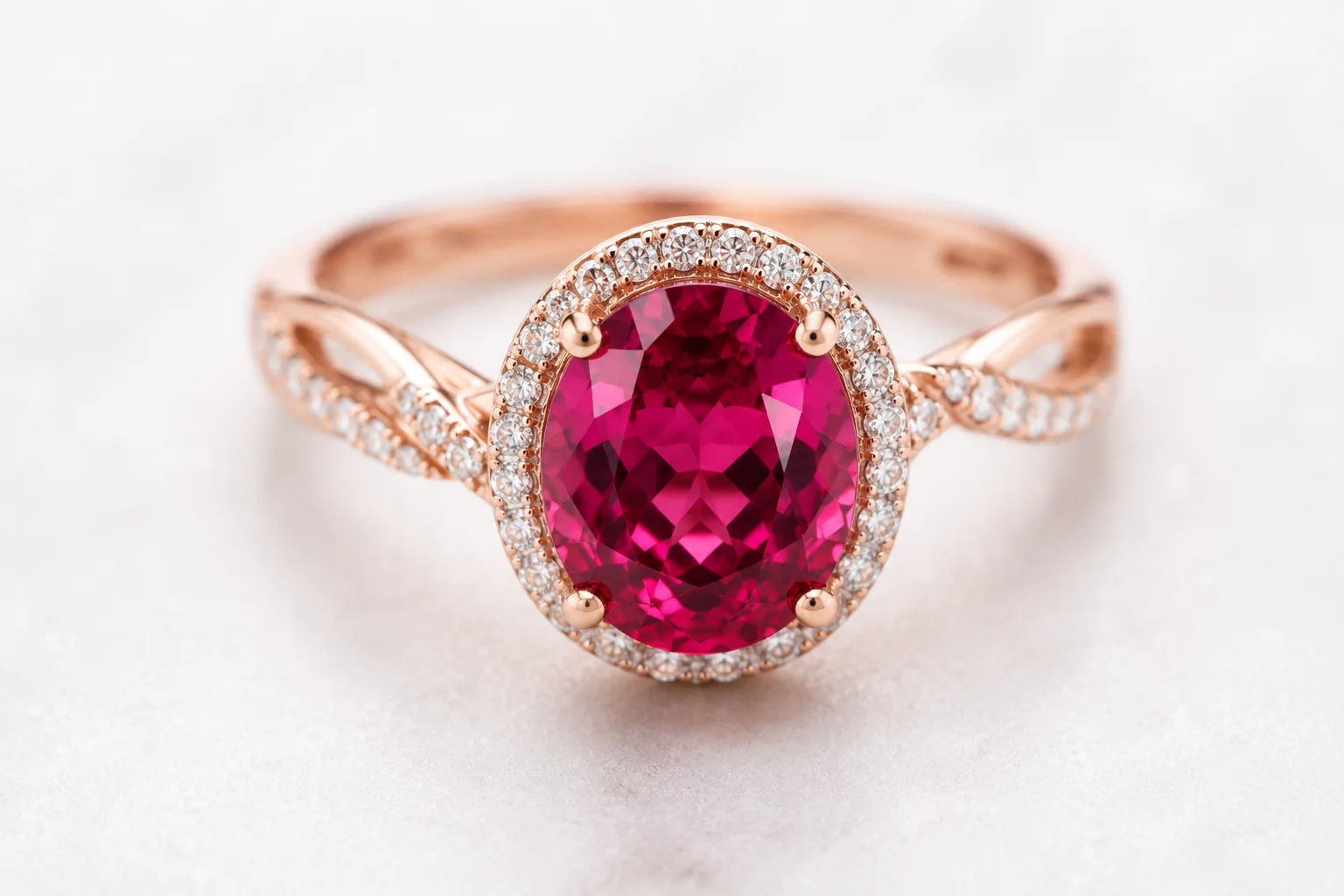
Rhodolite Garnet Rings: Styles, Settings and Buying Tips
Rhodolite garnet rings combine saturated red with raspberry, rose and purple modifiers. The stone is often brighter than ordinary dark-red garnet, yet it remains more affordable than fine ruby or red spinel of comparable visual size.
Rhodolite belongs to the pyrope–almandine garnet series. Its hardness and lack of perfect cleavage make it suitable for rings, although it remains brittle and can chip when struck against a hard surface.
Ring construction is therefore critical. A well-cut stone in a protective setting can withstand regular wear, while a fractured rhodolite mounted high above the finger may be vulnerable regardless of its carat weight.
This guide focuses on ring styles, setting protection, engagement-ring suitability, sizing, metal selection and purchase decisions. Detailed loose-stone evaluation remains within the rhodolite garnet buying guide, while current value factors remain within the completed rhodolite garnet price guide.
Rhodolite Ring Styles at a Glance
| Style | Appearance | Practical strength | Main concern |
|---|---|---|---|
| Solitaire | One principal stone | Easy to inspect and clean | Exposed center can receive impact |
| Bezel | Metal surrounds the girdle | Strong edge protection | Can darken a deep stone |
| Halo | Center stone with small accents | Larger visual footprint | Many small prongs need inspection |
| Three-stone | Central rhodolite with two side stones | Balanced and symbolic | Side stones can rub the center |
| Cluster | Several smaller gems | Strong color at moderate cost | Residue and small-setting maintenance |
| Vintage-inspired | Milgrain, engraving and decorative accents | Distinctive and detailed | Fine metalwork can wear |
| Cathedral | Raised center with arching shoulders | Elegant profile and wedding-band clearance | High position increases impact exposure |
| Low-profile | Stone sits close to the finger | Practical for frequent wear | May restrict light or band pairing |
| East–west | Elongated stone set horizontally | Modern and visually broad | Ends need protection |
| Signet or gypsy setting | Stone recessed into substantial metal | Excellent protection | More metal and less light entry |
Why Choose Rhodolite for a Ring?
The completed rhodolite garnet meaning guide explains the stone’s composition and symbolism.
Rhodolite offers a recognizable red gemstone appearance without the price structure associated with fine ruby.
Its purple-red color also distinguishes it from common brown-red almandine and orange-red spessartine.
Transparent material is frequently eye-clean and available in standard sizes. Jewelers can therefore match it with existing ring settings more readily than many rare garnet varieties.
Rhodolite is softer than sapphire and ruby, but it has no perfect cleavage. With reasonable care, it can work in rings worn regularly rather than only for special occasions.
The broader garnet ring guide covers styles across the entire mineral group rather than rhodolite’s specific color and wear considerations.
Solitaire Rhodolite Rings
A solitaire keeps attention on one stone.
Round brilliants are easy to set securely and return light evenly. Ovals and cushions create a larger-looking colored surface, while pears and marquises add length.
A four-prong setting exposes more of the gem. Six prongs provide additional security and create a traditional outline.
For pears and marquises, the points should receive V-prongs or protective bezels.
The setting should hold the girdle evenly without placing excessive pressure on a fracture.
A low solitaire is more practical for daily wear. A high basket can admit more light but catches on clothing and increases the risk of impact.
Bezel-Set Rhodolite Rings
A bezel surrounds the stone and protects its perimeter.
It is one of the strongest choices for an active wearer and works particularly well with rounds, ovals and cushions.
A full bezel creates a smooth modern surface but can deepen a medium-dark stone if the setting blocks light.
Open-backed construction helps preserve brightness. A partial bezel offers more light and visible gemstone while protecting the most exposed sides.
The metal rim should be even and continuous. Gaps, ripples or areas where the stone moves indicate weak workmanship.
Halo Rings
A halo surrounds rhodolite with diamonds, white sapphires or other small gems.
The border increases apparent size and strengthens contrast.
White accents can make the center look redder or more purple. Rose-gold halos create a softer tonal appearance.
The center should sit high enough to remain visible but not so high that it becomes vulnerable.
Inspect each accent stone and shared prong. A halo introduces many small components, and one damaged setting can affect several gems.
Cleaning access is important because lotion and soap accumulate beneath the center and halo.
Three-Stone Rings
Three-stone rings often represent past, present and future.
A rhodolite center can be paired with diamonds, white sapphires, smaller rhodolites or complementary pink gems.
The side stones should not press directly against the center’s exposed girdle. A metal separator or carefully designed shared setting reduces abrasion.
Graduated proportions usually work best, with the center visibly larger than the sides.
A three-stone design can provide broad finger coverage without requiring one extremely large rhodolite.
The stones should share compatible depth so the ring does not tilt or feel top-heavy.
Cluster Rings
Cluster rings create a substantial appearance from several small garnets.
They may use floral, starburst or geometric layouts.
Small rhodolites can show strong color because the design allows light to enter between the stones.
Shared prongs reduce metal but increase maintenance requirements. One worn support may loosen two neighboring gems.
Clusters also trap residue. Open galleries and accessible backs make cleaning easier.
A cluster is often more affordable than one large, evenly colored, well-cut stone.
Vintage-Inspired Rhodolite Rings
Rhodolite suits Victorian, Edwardian, Art Deco and revival designs because garnet has a long jewelry history.
Milgrain, engraving, filigree and mixed gemstone accents add texture.
Rose gold creates a romantic tonal effect, while white metal and geometric detailing produce a sharper Art Deco appearance.
Fine decorative metal eventually wears, particularly along bead-set edges and engraved shoulders.
Antique rings may also contain foil-backed stones, glass doublets or altered settings. A specialist should inspect valuable period jewelry before purchase or resizing.
East–West Rings
An east–west setting positions an oval, marquise or emerald-shaped rhodolite horizontally across the finger.
This creates broad visual coverage and a modern profile.
The design can also sit lower than a traditional vertical solitaire.
Both ends of an elongated stone need protection. Partial bezels or strong end prongs work well.
Check neighboring-finger comfort. A wide setting may rub when the fingers close, particularly if side galleries project outward.
Signet and Flush-Set Designs
A substantial signet or gypsy-style ring can recess rhodolite into the metal.
This protects the girdle and reduces snagging.
The design works best with smaller rounds, ovals or cabochons because a very large stone requires excessive metal thickness.
A deep recessed setting may reduce light entry. Select a bright medium-tone rhodolite rather than an already dark stone.
Flush-set gems must be seated precisely. Cracks in the surrounding metal or gaps around the stone indicate poor work.
Rhodolite Engagement Rings
Rhodolite can be used in an engagement ring, but the wearer should understand its durability.
It is harder than opal, pearl and many ornamental stones, and it lacks perfect cleavage. However, it is less scratch-resistant than sapphire, ruby, moissanite and diamond.
A bezel, low halo or protected six-prong setting improves suitability for frequent wear.
Remove the ring during exercise, housework, gardening and manual tasks.
The broader best gemstones for engagement rings guide places durability alongside beauty and budget.
Rhodolite is a good choice for someone who accepts routine care and prefers a distinctive purple-red center over maximum scratch resistance.
Choosing Rhodolite Color
Fine rhodolite should show raspberry, rose-red, purplish-red or reddish-purple color.
Medium to medium-dark tone usually provides the best balance between richness and brightness.
An excessively dark stone may look black once mounted. Metal around the pavilion can deepen that effect further.
Brown or orange modifiers move the appearance away from classic rhodolite, although those stones may still be natural pyrope–almandine garnets.
View the loose stone or ring under neutral daylight-equivalent and warm indoor light.
A bright jewelry-store spotlight can disguise extinction that becomes obvious in everyday conditions.
Clarity
Rhodolite is commonly eye-clean.
Small internal crystals or needles are acceptable when they do not disrupt brightness or weaken the gem.
Avoid significant surface-reaching fractures, especially near a prong, point or thin edge.
A stone that looks cloudy or gray beside a transparent comparison gem may have excessive inclusions or poor polish.
A completely clean rhodolite is not automatically synthetic. High clarity is normal for many red garnets.
Cut Quality
Good cutting is essential because red garnet absorbs significant light.
A deep pavilion may make the center appear black. A shallow pavilion can create a pale transparent window.
Look for balanced brightness across the face rather than one bright edge around a dark center.
Ovals and pears may show bow-tie extinction. A moderate bow tie can be acceptable, but it should not divide the stone into two bright ends and one black band.
The outline should be symmetrical and the table centered.
A well-cut smaller rhodolite often looks more impressive than a heavier poorly proportioned stone.
Choosing the Shape
Round brilliants offer consistent sparkle and are easy to protect.
Ovals create a larger-looking face and flatter many hand shapes without requiring rigid styling rules.
Cushions combine broad color flashes with protected corners.
Pears and marquises elongate the finger visually but need point protection.
Emerald and step cuts emphasize clarity and color zoning rather than sparkle. They suit transparent material but expose windowing readily.
Cabochons offer a softer appearance and can work with included or translucent rhodolite, though they are less common than faceted stones.
Carat Weight and Face-Up Size
Rhodolite’s density means it may look smaller than a lower-density gem of equal carat weight.
Compare millimeter dimensions instead of relying on weight alone.
The completed carat-versus-millimeter size chart provides density-based context.
A halo, side stones or broad bezel can increase visual coverage without increasing the center’s carat weight substantially.
Setting height also affects perceived size. A high-mounted stone may look prominent from the side but does not necessarily have a larger face-up area.
Choosing the Metal
Yellow gold warms rhodolite and emphasizes red.
Rose gold strengthens raspberry and pink tones.
White gold and platinum create contrast that can make purple modifiers more noticeable.
Sterling silver offers an accessible option but tarnishes and is generally softer than gold or platinum.
Metal choice should also account for alloy sensitivity. Some white gold contains nickel.
The ring’s total durability depends on both gemstone and metal. A hard stone in thin worn prongs is not secure.
Prong Settings
Four prongs maximize visible stone but provide less redundancy.
Six prongs offer additional security and are useful for larger rounds and ovals.
Double prongs create a decorative or antique appearance and protect corners well when made correctly.
Prong tips should cover the girdle without appearing bulky.
Run a fingertip lightly over the ring. A sharp or catching prong needs professional attention.
Do not press the stone to test whether it moves. Any clicking sound or visible movement requires immediate repair.
Ring Height and Profile
A low-profile ring is less likely to catch on clothing or strike hard surfaces.
High cathedral settings provide dramatic side views and can allow a wedding band to sit underneath, but they expose the center more.
Consider daily activities rather than appearance alone.
A person who wears gloves, works at a keyboard or handles equipment may prefer a lower bezel or compact halo.
The underside should feel smooth without sharp galleries pressing into neighboring fingers.
Wedding-Band Compatibility
Straight wedding bands may not sit flush beside a wide basket or low halo.
A curved, contoured or open band can accommodate the engagement-ring profile.
Try the two rings together before purchase rather than assuming standard compatibility.
Direct rubbing between settings can wear prongs and scratch metal.
A spacer band can reduce contact but adds width.
If the rhodolite setting is delicate, soldering the rings together may reduce independent movement, though it also limits future flexibility.
Ring Sizing
Measure the finger at different times because temperature and activity affect size.
Wide bands feel tighter than narrow bands and may require a slightly larger measurement.
Some eternity, pavé and heavily engraved settings have limited resizing range.
Rhodolite should be removed before soldering or heating unless the jeweler can protect it appropriately. Filling or unknown treatment increases risk.
A ring that spins constantly may strike surfaces more frequently. Proper fit improves both comfort and durability.
Rhodolite and Other Garnets
Rhodolite is related to pyrope and almandine through continuous chemical mixing.
The complete types of garnet guide explains the broader family.
Compared with common almandine, rhodolite generally appears brighter and more purple.
Compared with orange spessartine or green grossular varieties, its color remains within the traditional red-garnet range.
A seller should identify the variety rather than calling every transparent red garnet rhodolite.
Coordinating Rhodolite Jewelry
A ring can be paired with rhodolite garnet earrings for formal coordination.
A rhodolite garnet necklace repeats the color farther from the hand, while a rhodolite garnet bracelet creates a stronger matching set.
Exact stone color does not need to be identical across separate pieces. Repeating metal, cut shape or general hue is usually sufficient.
Avoid wearing the ring directly beside diamond eternity bands with exposed girdles. Diamond can abrade garnet over time.
Treatments and Imitations
Most rhodolite is untreated.
Rare fracture filling may improve surface-reaching breaks, while coatings or assembled constructions can occur.
Red glass, synthetic spinel and synthetic corundum may imitate the color.
The gemstone treatments guide explains enhancement terminology, while the real-versus-fake garnet guide covers identification.
A laboratory report can confirm garnet identity for a significant purchase. The gemstone certification guide explains when documentation is useful.
Buying a Rhodolite Ring
Start with intended wear frequency.
Choose a low bezel, halo or strong prong setting for regular use. A taller decorative design may suit occasional wear better.
Check color in ordinary light, inspect clarity and confirm that the stone returns light across its face.
Request millimeter dimensions, carat weight, treatment disclosure, metal fineness and ring size.
Inspect the setting under magnification when possible.
For remote purchases, follow how to buy gemstones online and use the return period to evaluate fit, profile and color.
Avoid unsupported rarity claims and vague grades such as investment quality.
Cleaning and Maintenance
Use warm water, mild soap and a soft brush.
Clean beneath the setting, rinse briefly and dry thoroughly.
Avoid steam. Ultrasonic cleaning should be avoided when fractures, filling or delicate pavé are present.
The completed rhodolite garnet jewelry cleaning guide provides the complete care procedure.
Have the ring inspected whenever a prong catches, the stone moves or the shank becomes visibly thin.
Store it separately from diamonds, sapphires and rubies.
Frequently Asked Questions
1. Is rhodolite durable enough for a ring?
Yes. It has reasonable hardness and no perfect cleavage, but it remains brittle and should be protected from impact.
2. Can rhodolite be used in an engagement ring?
Yes, particularly in a bezel, low halo or secure prong setting. It requires more care than sapphire or diamond.
3. What is the best rhodolite ring setting for daily wear?
A low full or partial bezel offers the strongest protection against edge impact and snagging.
4. What color should a good rhodolite show?
Look for lively raspberry, rose-red or purplish-red color with limited brown and minimal black extinction.
5. Is an eye-clean rhodolite suspicious?
No. Red garnets, including rhodolite, are commonly eye-clean.
6. Which cut makes rhodolite look brightest?
Well-proportioned rounds, ovals and cushions commonly perform well, although individual cut quality matters more than shape alone.
7. Does a higher carat weight mean a larger-looking ring?
Not necessarily. Millimeter dimensions and setting design determine face-up size more accurately.
8. Does rhodolite look better in yellow or white gold?
Yellow and rose gold emphasize warmth, while white gold and platinum create stronger contrast.
9. Is rhodolite usually treated?
Most rhodolite is untreated, although rare fracture filling and other alterations can occur.
10. Can rhodolite scratch easily?
It resists ordinary scratching reasonably well but can be scratched by harder gems such as sapphire and diamond.
11. Can a rhodolite ring be cleaned ultrasonically?
Only when the stone is unfilled, free from significant fractures and the setting is suitable. Warm soapy water is safer.
12. Is rhodolite a January birthstone?
Yes. It belongs to the garnet family, represented in the January birthstone guide.
A rhodolite ring should be chosen as a complete object rather than as a loose gemstone attached to any available mounting. Bright purple-red color, balanced cutting and sound clarity establish the stone’s appeal, while profile, prongs, metal thickness and fit determine whether that appeal survives daily wear.
Rhodolite is indexed in Crystals That Start With R and Gemstones That Start With R.