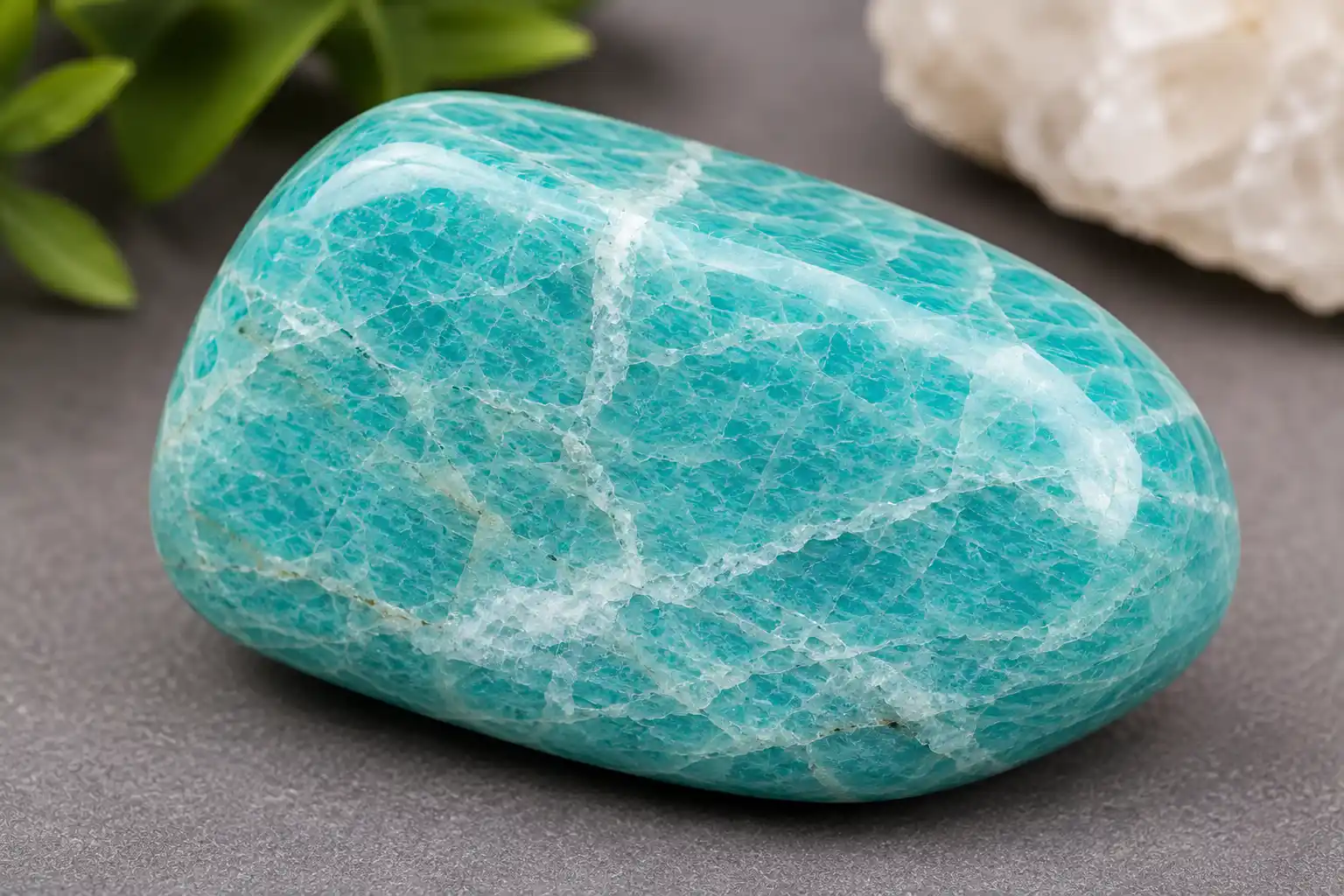
Amazonite Meaning: Mineral Identity, History & Symbolism
Amazonite is the blue-green to green variety name applied mainly to microcline, a potassium-rich feldspar with the ideal composition KAlSi₃O₈. Its distinctive color is not evidence of copper, turquoise, jade, or an unexplained “energy”; research on classic amazonite shows that lead-related color centers, structurally bound water, irradiation, and the structural state of the feldspar can work together to produce its blue-green appearance.
That mineral identity is the most useful starting point for amazonite meaning. Amazonite belongs to the feldspar family, one of Earth’s major rock-forming mineral groups, and much of the material encountered as polished stones, beads, carvings, cabochons, and mineral specimens is microcline rather than a separate mineral species called “amazonite.”
Its color and long history as an ornamental material later encouraged symbolic associations with calm communication, balance, truth, confidence, and emotional steadiness. Those interpretations can have cultural or personal value, but they should remain separate from mineralogical facts and from unsupported claims that amazonite treats disease or alters human biology.
Readers who want the wider mineral-family context can compare amazonite with the broader feldspar meaning guide, while symbolic crystal material is organized separately within the Healing Crystal section.
Amazonite Identity at a Glance
| Property | Amazonite |
|---|---|
| Material identity | Green to blue-green potassium feldspar variety |
| Most common host species | Microcline |
| Ideal microcline formula | KAlSi₃O₈ |
| Mineral group | Alkali feldspar |
| Crystal system of microcline | Triclinic |
| Common colors | Pale green, blue-green, turquoise-green, vivid bluish green |
| Typical transparency | Translucent to opaque; occasionally more transparent |
| Luster | Vitreous, sometimes pearly on cleavage surfaces |
| Mohs hardness | About 6–6.5 |
| Specific gravity | Approximately 2.54–2.57 |
| Refractive indices | Approximately 1.514–1.539 across the three principal indices |
| Optical character | Biaxial negative |
| Cleavage | Perfect in two directions meeting close to a right angle |
| Tenacity | Brittle |
| Typical structure | Commonly perthitic, with albite intergrowths possible |
| Major color mechanism | Lead- and water-associated color centers activated through irradiation |
| Common geological setting | Granites and granite pegmatites; other feldspar-bearing rocks also occur |
| Identification limit | Blue-green color alone cannot establish amazonite |
The word “amazonite” therefore needs a little precision. Mineralogical references commonly describe it as green to blue-green potassium feldspar, usually microcline, although the name has sometimes been applied more broadly to similarly colored orthoclase.
For a consumer-facing gem reference, the safest interpretation is simple: most recognized amazonite is microcline feldspar, but the variety name describes color and mineral context rather than establishing a separate mineral species.
That distinction becomes especially useful when comparing it with albite, which is a sodium feldspar with a different ideal composition even though albite and microcline frequently occur together.
How Amazonite Forms
Amazonite inherits its fundamental geology from potassium feldspar. Microcline is common in silica-rich intrusive rocks such as granite and is especially familiar from coarse-grained granite pegmatites, where slow crystallization and late-stage magmatic fluids can produce unusually large feldspar, quartz, mica, tourmaline, and other crystals.
Pegmatites are particularly important to collectors because they can create open cavities and coarse crystals large enough to preserve striking amazonite specimens. Classic associations include smoky quartz, albite, cleavelandite, and dark tourmaline, although the exact assemblage depends on locality and geological history.
The blue-green color does not simply appear because any microcline crystal happens to grow in a pegmatite. The host feldspar must also acquire the trace chemistry and structural conditions capable of developing amazonite coloration.
Some deposits demonstrate how specific that combination can be. One part of a feldspar crystal may be strongly blue-green while another part remains pale or nearly white, recording changes in trace-element availability, structural state, fluid interaction, or color-center development during crystallization and later geological history.
Amazonite can also occur outside the stereotypical granitic pegmatite environment. Potassium feldspar itself is found in several plutonic, metamorphic, hydrothermal, and sedimentary contexts, and amazonitic material has been reported from geological settings influenced by unusual lead availability.
This is why a statement such as “amazonite always forms in pegmatites” is too absolute. Pegmatites are highly important sources, but geological context should be established from the actual locality rather than inferred from the color of a loose stone.
What Actually Makes Amazonite Blue-Green?
Amazonite’s color is one of the strongest examples of why gemstone color cannot always be explained by naming a single trace element.
A well-supported model developed from spectroscopic work on lead-bearing potassium feldspar found that amazonite color requires both lead impurities and structurally bound water, with natural irradiation helping transform the lead into electronically active color centers. Different absorption features can produce relatively blue, relatively green, or intermediate blue-green appearances.
In simplified form:
lead provides a necessary impurity component + structurally bound water influences the color center + irradiation activates the electronic state that absorbs particular wavelengths of visible light.
The result is much more accurate than saying merely “lead makes amazonite green.”
Researchers have also documented complexity beyond this basic model. Structural ordering, trace chemistry, and in some green potassium feldspars potentially iron-related coloration can influence what observers see. Not every pale green feldspar should therefore be assigned to the same color mechanism without analytical evidence.
This color science has an important practical consequence: amazonite does not contain blue-green pigment distributed through the crystal like paint. Its appearance emerges from electronic interactions within the feldspar structure.
That also explains why amazonite should not be confused with the light-source-dependent color change described for alexandrite. Amazonite may photograph differently under warm and cool light, but a routine photographic shift is not an alexandrite-style color-change phenomenon.
White Streaks and Patches in Amazonite
Many polished amazonites contain white streaks, grids, patches, or irregular pale areas. These markings are often treated commercially as decorative features, but they can also preserve useful information about feldspar structure.
Microcline commonly contains perthitic intergrowths created when sodium-rich and potassium-rich feldspar components separate during cooling. Albite-rich material can occur as fine lamellae or more conspicuous pale intergrowths within potassium feldspar.
Cleavage, fractures, alteration, and associated minerals can add further pale markings.
Consequently, a white stripe in a blue-green stone should not automatically be described as “quartz veining.” Some specimens certainly contain quartz, but feldspar intergrowths and structural features provide other explanations.
A photograph can document the pattern. Identifying what actually produces that pattern may require microscopy, optical examination, chemistry, or diffraction.
Diagnostic Characteristics of Amazonite
Amazonite’s recognizable color makes visual identification tempting, yet blue-green appearance is one of the least secure ways to establish its identity. Turquoise, chrysoprase, dyed quartz, dyed magnesite, glass, serpentine, jade materials, and other stones can overlap in color.
Microcline’s physical properties provide much stronger constraints.
Triclinic Feldspar Structure
Microcline belongs to the triclinic crystal system. Well-developed crystals may form blocky habits, while twinning and feldspar intergrowths can create internal patterns not visible in every polished piece.
A particularly useful microscopic feature of microcline is the characteristic cross-hatched or “tartan” twinning that can develop from intersecting albite- and pericline-law twins. It is highly informative when clearly observed in suitable material, but a polished opaque cabochon may not reveal it.
Perfect Cleavage
Microcline has two excellent cleavage directions intersecting close to a right angle. This contributes to its blocky appearance and explains an important practical weakness: amazonite is moderately hard but not exceptionally resistant to sharp impact.
Cleavage should never be deliberately produced on a finished stone for identification.
Hardness
A Mohs hardness around 6–6.5 means amazonite is harder than materials such as calcite but softer than quartz. That is sufficient for many beads, pendants, carvings, and protected jewelry designs, yet routine contact with quartz-bearing dust or harder gemstones can scratch polished surfaces over time.
Scratch testing is still a poor home identification method because numerous materials overlap this hardness range and the test permanently damages the object.
Density and Optical Properties
Microcline has a density near 2.56 and is biaxial negative, with refractive indices extending roughly from 1.514 to 1.539 depending on orientation and composition.
These values can help separate suitable transparent or translucent material from lookalikes, although routine refractometer examination becomes difficult on irregular, opaque, heavily included, or strongly curved surfaces.
A gemologist interprets several properties together rather than declaring amazonite from one number.
Amazonite Versus Turquoise Is More Than a Color Question
Blue-green amazonite can resemble turquoise closely enough that visual descriptions overlap, especially in tumbled stones and beads. Mineralogically, however, the materials are unrelated.
Amazonite is primarily potassium feldspar. Turquoise is a hydrated copper aluminum phosphate mineral. Their chemistry, hardness, density, structure, porosity, typical textures, treatments, and geological origins differ.
The dedicated amazonite vs turquoise comparison handles the identification decision in detail. For this meaning reference, the essential point is that turquoise-like color does not make amazonite a type of turquoise.
The same caution applies to the misleading expression Amazon jade.
Is “Amazon Jade” Actually Jade?
No. Amazonite is not jadeite and it is not nephrite.
The expression “Amazon jade” is a trade or historical misnomer based largely on visual resemblance. Jadeite belongs to the pyroxene mineral group, while nephrite is an amphibole aggregate. Amazonite is feldspar.
Those materials differ substantially in mineral structure and toughness even when polished pieces share green or blue-green hues.
Calling amazonite “jade” therefore adds no useful mineralogical information and can actively confuse a buying decision.
A label stating “Amazon jade” should be read as a reason to ask what material is actually being sold, not as evidence that the object belongs to either accepted jade material.
An Evidence Table for Common Amazonite Claims
The following source-reconciliation framework separates statements supported by mineralogical evidence from claims that require qualification.
| Claim | Evidence-based interpretation | What should not be assumed |
|---|---|---|
| “Amazonite is a mineral species” | Amazonite is chiefly a blue-green variety of microcline or K-feldspar | It has a separate ideal species formula from microcline |
| “Amazonite is jade” | Some specimens resemble jade in color | Amazonite is jadeite or nephrite |
| “Amazon jade” | Historical or commercial misnomer | A recognized mineralogical jade variety |
| “The color comes from copper” | Older explanations sometimes proposed copper; established amazonite research strongly supports Pb/H₂O-related color centers | Every blue-green mineral owes its color to copper |
| “Lead makes it blue” | Lead is important, but water, irradiation, electronic state, and structure also matter | Lead concentration alone predicts exact color |
| “All amazonite is microcline” | Most recognized amazonite is microcline | The name has never been applied to other K-feldspar |
| “It comes from the Amazon River” | The name was attached historically to an area described as near the Amazon | A confirmed classic amazonite deposit exists beside the river |
| “Amazonite is turquoise” | The colors can overlap | The materials share chemistry or structure |
| “Amazonite detoxifies the body” | A contemporary metaphysical claim | A demonstrated physiological effect |
| “Amazonite water is safe because it is natural” | Natural origin says nothing about ingestion safety | Mineral-infused drinking water is automatically safe |
| “Blue-green color proves authenticity” | Color is compatible with amazonite | Color identifies microcline or proves untreated status |
| “Untreated because it is inexpensive” | Price does not establish treatment | Low-value stones cannot be dyed, coated, filled, or impregnated |
This table matters because several of the most repeated amazonite statements combine a true observation with an unsupported conclusion.
The stone really is commonly blue-green. That does not make it turquoise.
Its color really is linked to lead. That does not mean casual observation reveals the lead concentration or exact color-center chemistry.
It really has a name connected with the Amazon. That does not establish a mine beside the Amazon River.
A Specimen and Photo Evaluation Checklist
Photographs cannot confirm amazonite with laboratory certainty, but a structured photo record can distinguish useful evidence from assumptions.
| Evaluation step | What to record | Why it helps |
|---|---|---|
| Photograph the full specimen | Matrix, crystal shape, broken surfaces, attached minerals | Preserves geological context |
| Add a scale | Dimensions in millimeters or centimeters | Prevents misleading size impressions |
| Use a neutral background | Gray or neutral white rather than strongly colored material | Reduces reflected color contamination |
| Photograph under neutral white light | Overall hue, saturation and pattern | Produces a reproducible baseline |
| Keep an unedited original | Before saturation, contrast or white-balance adjustments | Preserves stronger visual evidence |
| Photograph cleavage or natural broken surfaces | Flat planes and near-right-angle relationships where visible | Can support feldspar interpretation |
| Photograph pale intergrowths closely | White grids, patches, lamellae and boundaries | Helps document perthitic or associated material |
| Record transparency at thin edges | Opaque, translucent or locally transparent | Improves material description |
| Photograph associated smoky quartz or albite | Only when physically attached to the specimen | Adds geological context without proving locality |
| Record the original label | Locality, collector information and previous names | Protects provenance evidence |
| Separate coating from body color | Inspect fractures, drill holes and worn surfaces | Can expose suspicious surface coloration |
| Do not scratch the specimen | Use non-destructive observations first | Avoids damage without producing definitive identification |
| Escalate valuable material to testing | RI, microscopy, spectroscopy, chemistry or diffraction as appropriate | Converts a plausible identification into stronger evidence |
The checklist creates information gain without pretending that an online photograph substitutes for gemological examination.
A specimen that passes every visual check is still “consistent with amazonite” until its physical or analytical properties support the identification.
Where Did the Name Amazonite Come From?
The modern name was introduced by mineralogist Johann Friedrich August Breithaupt and connected to an unspecified area described as near the Amazon River. The awkward part of that history is that no classic or well-established source of amazonite is known along the river itself.
Consequently, the name preserves a geographic tradition more confidently than it preserves a verified type locality.
This is a good example of why historical gemstone names need to be read in context. Early mineral descriptions often depended on appearance, trader reports, incomplete locality information, and classification systems that preceded modern crystallography, spectroscopy, and chemical analysis.
The name survived even as mineralogical understanding became more precise.
A responsible history of amazonite should therefore avoid repeating the appealing but unsupported shortcut that “amazonite was discovered in the Amazon River.”
Amazonite in Ancient Material Culture
Green feldspar recognizable as amazonite has a documented archaeological history much older than its modern mineral name. It was worked into beads, inlays, amulets, and other objects in ancient Egypt, and geological research has identified ancient extraction areas associated with amazonite-bearing feldspar in Egypt’s Eastern Desert.
Museum scholarship also provides an important caution: blue-green ancient stones were historically misidentified surprisingly often when researchers relied principally on visual appearance.
Turquoise, green feldspar, glass, faience, and other materials could occupy similar color roles within an object. Modern compositional and structural analysis can therefore revise an old museum identification.
That observation is especially valuable for understanding amazonite meaning. Ancient use is documented, but the existence of an ancient green bead does not automatically prove the object is amazonite, nor does the identification of amazonite prove that every modern spiritual meaning attributed to it was held by the ancient owner.
Material identification and cultural interpretation remain separate evidence problems.
Amazonite Meaning in Modern Symbolism
Modern amazonite meaning commonly centers on calm communication, truth, emotional balance, self-expression, confidence, and reducing interpersonal tension. The stone’s soft blue-green appearance makes those associations intuitively understandable, particularly in contemporary color symbolism.
They are not measurable properties of microcline.
A person can nevertheless use amazonite symbolically in a coherent way. For example, its intersecting feldspar structure and contrasting blue-green and white patterns can serve as a personal reminder that a complicated issue may contain more than one component. Its durable but cleavable structure can become a metaphor for being resilient while recognizing personal limits.
The actual geology provides another possible metaphor. Amazonite can crystallize in coarse pegmatitic environments where large mineral grains develop from complex late-stage magmatic systems, so someone may choose to associate the specimen with clarity emerging from complexity.
None of those interpretations requires claiming that the mineral emits communication energy or changes another person’s behavior.
Broader symbolic traditions are discussed in the site’s healing crystals guide, while collections organized by appearance can be explored through blue crystals and green crystals.
Amazonite also appears naturally within alphabetical mineral collections such as crystals that start with A, where the short description should remain consistent with the feldspar identity established here.
Does Amazonite Have Healing Properties?
There is no established medical evidence that wearing, carrying, sleeping near, meditating with, or placing amazonite on the body treats disease.
Claims involving anxiety disorders, thyroid function, hormones, cellular healing, calcium metabolism, trauma, infection, blood pressure, or other medical outcomes should therefore not be presented as scientifically demonstrated amazonite properties.
Personal ritual is a different claim.
Holding a familiar object while journaling, breathing slowly, meditating, preparing for a difficult conversation, or setting an intention can be meaningful to an individual. The scientifically defensible explanation is that the person is performing a reflective or behavioral practice using the stone as a cue or focus.
The mineral itself has not thereby been shown to deliver medical treatment.
The same evidence boundary applies to other symbolic pages such as amber healing properties: traditional or personal interpretations should be labeled as such rather than blended with material science.
Amazonite Contains Lead—What Does That Mean for Ownership?
Lead plays an important role in the established color-center model for many amazonites, so the subject deserves a proportionate safety explanation rather than either panic or dismissal.
The presence of lead inside a feldspar crystal does not mean ordinary intact jewelry automatically behaves like loose industrial lead. Exposure depends on chemical form, route, duration, surface condition, particle size, and environmental conditions.
At the same time, “natural” does not mean suitable for ingestion.
Laboratory work on amazonite under acidic conditions has demonstrated that lead can be released from the material. The most defensible precaution is therefore to keep amazonite out of the mouth and avoid using it to prepare so-called direct crystal water, drinking-water infusions, powders, or ingestible preparations.
Cutting, grinding, drilling, or sanding creates another exposure route because those activities produce mineral dust. Lapidary work should use appropriate wet-working methods, ventilation, dust control, eye protection, and occupational hygiene rather than treating gemstone dust as harmless.
A polished necklace or specimen sitting on a shelf presents a fundamentally different scenario from swallowing a stone, soaking it in acidic liquid for consumption, or generating airborne cutting dust.
That distinction keeps safe ownership evidence-based rather than alarmist.
Treatments and Surface Improvements
Amazonite can be treated. Polymer or wax impregnation may be used to fill fractures or improve appearance and stability, while coatings, dyes, and irradiation-related color modification have also been reported.
This matters because attractive color is not proof of untreated status.
A polished specimen with unusually concentrated color inside fractures, drill holes, cavities, or damaged surfaces deserves closer inspection. Likewise, a resin-treated stone may behave differently around heat and chemicals than untreated feldspar.
The dedicated treated amazonite guide owns the detailed treatment and detection problem rather than duplicating it here.
Treatment is also separate from authenticity. A treated natural amazonite can still be natural feldspar, while a blue-green imitation may not contain amazonite at all.
Safe Everyday Ownership
Amazonite’s hardness of roughly 6–6.5 provides moderate scratch resistance, but its perfect cleavage and brittle character require more caution than the hardness number alone suggests.
A pendant, bead necklace, carving, or protected cabochon can perform well when treated reasonably. Rings and exposed bracelets encounter more direct impacts, which increases the chance of edge damage or cleavage-related breakage.
Clean intact amazonite conservatively with lukewarm water, mild soap, a soft cloth or soft brush, and limited immersion. Avoid aggressive acids and strong household chemicals, particularly when treatment status is unknown.
Ultrasonic and steam cleaning introduce unnecessary risk for heavily fractured, impregnated, included, or unknown material. Simple manual cleaning provides greater control.
Store amazonite separately from harder gemstones where possible because quartz, corundum, and other harder materials can scratch its polished surfaces.
These precautions follow from feldspar durability rather than from spiritual beliefs.
Buying Context Without Turning This Into a Buying Guide
For a stone presented as amazonite, the useful questions begin with material identity: Is it actually feldspar? Is the coloration natural or modified? Is the seller using misleading names such as Amazon jade? Has resin, wax, dye, coating, or another treatment been disclosed?
Those questions define the evidence boundary.
Seller selection, marketplace comparison, return policies, pricing strategy, and transaction-specific red flags belong on the separate where to buy amazonite page.
A meaning reference should not duplicate that commercial decision process.
What Amazonite Meaning Ultimately Describes
Amazonite meaning has three layers, and keeping them separate produces a more useful understanding of the material.
Mineralogically, amazonite is predominantly blue-green microcline or closely defined potassium feldspar with an ideal microcline chemistry of KAlSi₃O₈. It is triclinic, biaxial negative, moderately hard, brittle, strongly cleavable, and commonly associated with granitic or pegmatitic geological environments.
Optically, its characteristic color is best explained by a sophisticated color-center system involving lead, structurally bound water, irradiation, and feldspar structure rather than by the simplistic statement that the stone merely “contains blue pigment.”
Historically and symbolically, green feldspar has been used as an ornamental material for a very long time, while the modern name carries an imperfect geographic association with the Amazon. Contemporary symbolism commonly connects the stone with communication, calmness, truth, and balance, but those concepts remain human interpretations rather than laboratory properties or medical treatments.
That separation is central to responsible amazonite meaning.
Amazonite is already unusual without attaching unsupported powers to it. Its apparently simple blue-green color records interactions among trace elements, water, radiation, and crystal structure; its white patterns can preserve feldspar intergrowths; its archaeological history demonstrates how long humans have valued colored minerals; and even its familiar name preserves an unresolved piece of mineralogical history.
Gems Lore’s approach to separating verifiable material facts from cultural interpretation is described on the About page. Health, spiritual, and informational boundaries are covered in the Disclaimer, and factual corrections or source questions can be submitted through Contact.