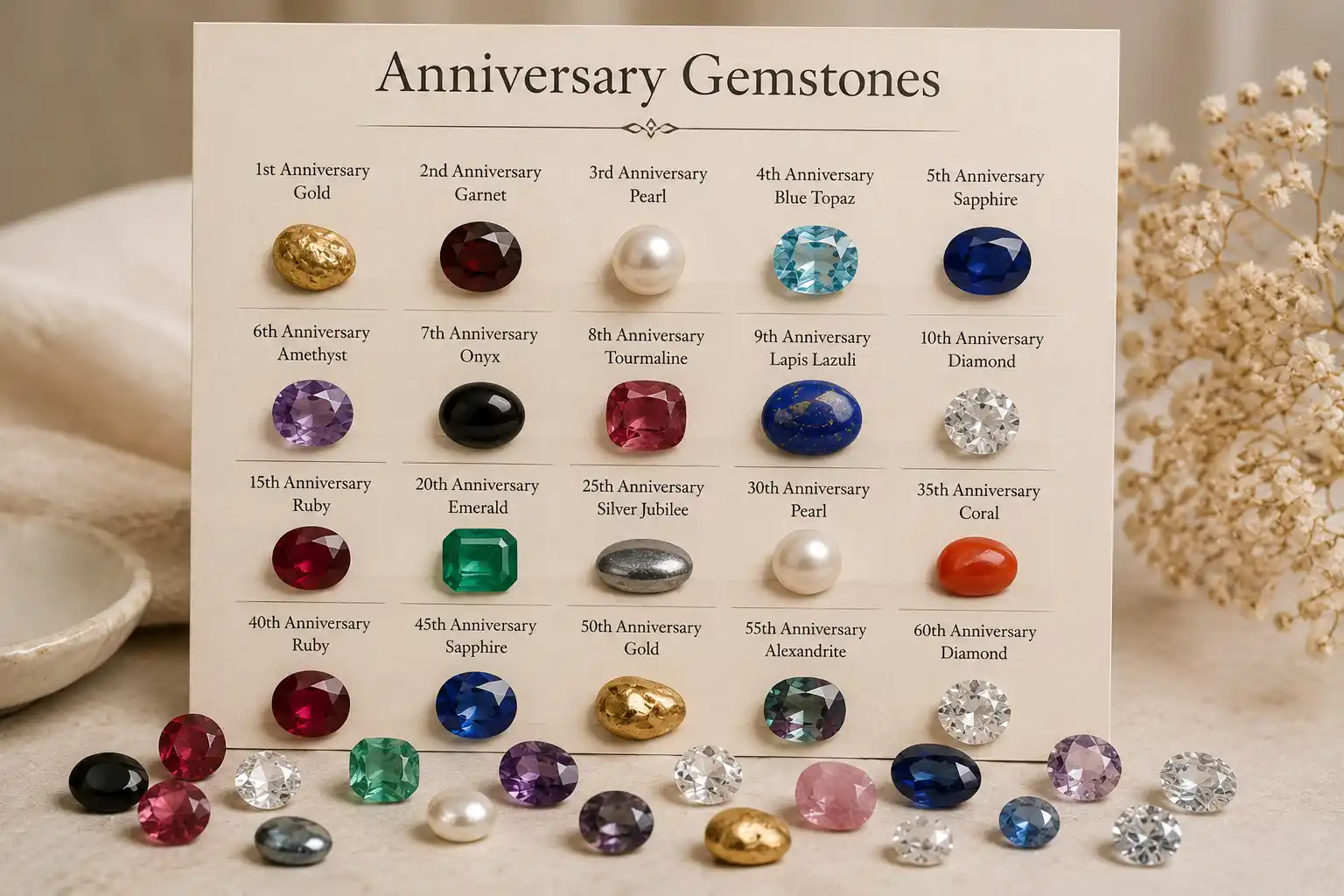
Anniversary Gemstones by Year: Properties, Uses & Guide
Anniversary gemstones by year offer a way to connect a wedding milestone with a particular gemstone, precious metal, or piece of jewelry, but the tradition is less rigid than many simplified charts suggest. Different historical and commercial lists exist, and even the Gemological Institute of America notes that there is no single universally authoritative wedding-anniversary gemstone list, while Jewelers of America publishes a widely used jewelry-anniversary list for the U.S. trade.
That distinction makes anniversary gemstones by year more useful when treated as a gifting tradition rather than an immutable rule. The established sequence includes familiar gemstones such as garnet, sapphire, diamond, ruby, emerald, and alexandrite, but it also includes gold, silver, and watches, so “anniversary gemstones” is convenient shorthand rather than a technically perfect description of every entry.
The best anniversary gift should also work for the person who will actually wear or keep it. A beautiful opal intended for an exposed everyday ring requires very different care from sapphire, a pearl necklace presents different maintenance concerns from a diamond pendant, and a fine alexandrite can justify far more authentication work than an inexpensive amethyst.
Anniversary Gemstones by Year at a Glance
The following anniversary gemstones by year follow the jewelry-anniversary sequence published by Jewelers of America, including the non-gem materials assigned to several milestones.
| Anniversary | Gemstone or Material | Practical Character |
|---|---|---|
| 1st | Gold | Precious metal; durable when alloy and construction suit the jewelry |
| 2nd | Garnet | Broad color range; generally practical for jewelry |
| 3rd | Pearl | Organic gem; soft and sensitive to chemicals |
| 4th | Blue Topaz | Hard but strongly cleavable; blue is normally treated |
| 5th | Sapphire | Excellent everyday durability |
| 6th | Amethyst | Quartz variety; durable for many jewelry forms |
| 7th | Onyx | Usually chalcedony; much black material is dyed |
| 8th | Tourmaline | Wide color range; good jewelry stone with sensible care |
| 9th | Lapis Lazuli | Opaque ornamental rock; softer and treatment-sensitive |
| 10th | Diamond | Exceptional scratch resistance; still capable of chipping |
| 11th | Turquoise | Porous, relatively soft, commonly treated |
| 12th | Jade | Jadeite or nephrite; famous for toughness |
| 13th | Citrine | Yellow-to-orange quartz; much commercial material is heat treated |
| 14th | Opal | Play-of-color gem requiring careful wear and storage |
| 15th | Ruby | Red corundum; excellent durability |
| 16th | Peridot | Bright yellowish green; suitable with reasonable protection |
| 17th | Watches | Jewelry/timepiece tradition rather than a gemstone |
| 18th | Cat’s-Eye Chrysoberyl | Valuable when chatoyancy is sharp and well centered |
| 19th | Aquamarine | Blue to greenish blue beryl; practical in many settings |
| 20th | Emerald | Valuable green beryl; inclusions and clarity enhancement are common |
| 21st | Iolite | Pleochroic blue-violet gem; cleavage requires care |
| 22nd | Spinel | Durable gem occurring in many colors |
| 23rd | Imperial Topaz | Premium topaz color designation; cleavage remains important |
| 24th | Tanzanite | Blue-violet zoisite; beautiful but less suited to rough wear |
| 25th | Silver | Precious metal milestone |
| 30th | Pearl | Classic organic gem |
| 35th | Emerald | Green beryl |
| 40th | Ruby | Red corundum |
| 45th | Sapphire | Corundum in colors other than red |
| 50th | Gold | Precious metal milestone |
| 55th | Alexandrite | Rare color-change chrysoberyl |
| 60th | Diamond | Highly durable gemstone milestone |
One reason to use a clearly identified reference list is that anniversary gemstones by year become inconsistent once commercial websites begin extending assignments beyond well-established milestones. Rather than inventing a gemstone for every possible anniversary, it is more useful to acknowledge where widely recognized trade lists stop or leave gaps.
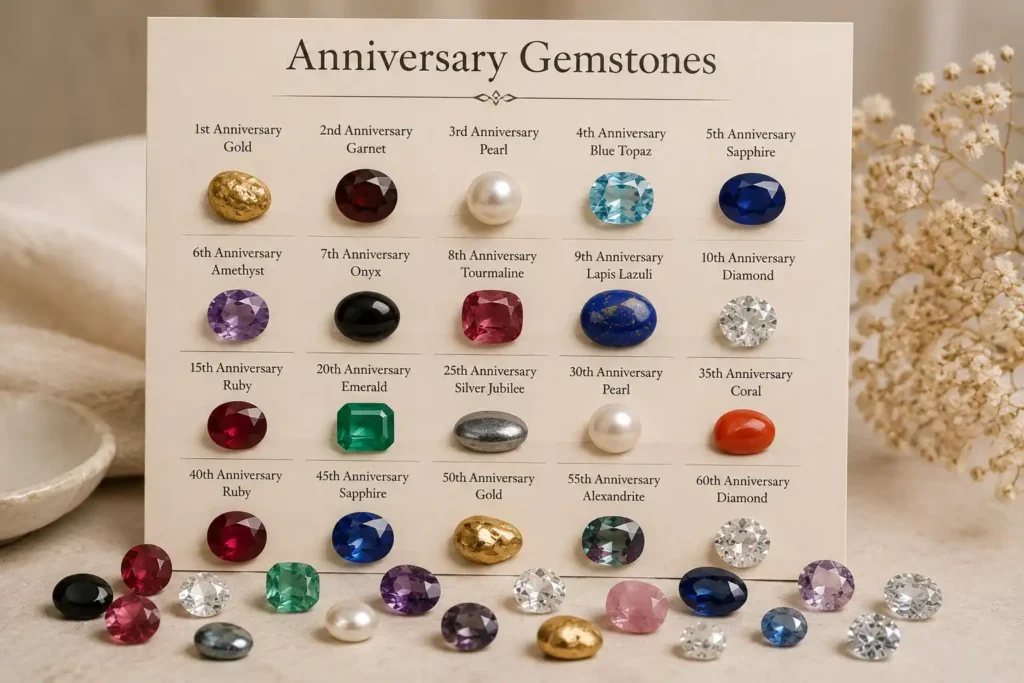
1st Anniversary: Gold
The first entry in anniversary gemstones by year is gold, technically a precious metal rather than a gemstone. Its resistance to corrosion and long history in jewelry make it an intuitive material for a piece intended to be kept for decades.
Pure gold is very soft, so most wearable gold jewelry uses an alloy. Karat, alloy composition, construction, and whether the item is solid gold, plated, filled, or vermeil affect durability and price substantially.
A first-anniversary gift can therefore be a gold band, necklace, bracelet, earrings, or a piece incorporating a gemstone with personal significance.
2nd Anniversary: Garnet
Garnet is the second-anniversary gemstone, and the name describes a mineral group rather than one uniformly dark-red stone.
Red almandine and pyrope are familiar choices, but garnets also occur in orange, green, pinkish, purplish, and other colors depending on species and composition. Their generally useful hardness and absence of easy cleavage make many garnets practical for frequently worn jewelry.
For anniversary gemstones by year, garnet is particularly flexible because the buyer can personalize the gift through color without abandoning the traditional assignment.
3rd Anniversary: Pearl
Pearl marks the third anniversary and differs fundamentally from crystalline gemstones because it is an organic gem produced by mollusks.
Cultured pearls dominate the modern jewelry market and include freshwater, akoya, Tahitian, and South Sea varieties. Their value depends on factors such as luster, surface quality, shape, color, size, nacre quality where applicable, and how well multiple pearls are matched.
Pearls are far softer than sapphire or diamond and are sensitive to perfume, hairspray, cosmetics, acids, and abrasion. Earrings and necklaces usually provide more forgiving wear than rings.
4th Anniversary: Blue Topaz
Blue topaz occupies the fourth position in anniversary gemstones by year. Topaz has Mohs hardness 8, which sounds highly durable, but its perfect cleavage means a sharp impact in an unfavorable direction can split the stone.
Natural strongly blue topaz is uncommon. Most blue topaz in jewelry begins as pale or colorless material that receives irradiation followed by appropriate processing to produce the familiar blue colors seen commercially.
Treatment is normal for this material rather than automatically undesirable, provided it is accurately represented.
5th Anniversary: Sapphire
Sapphire is one of the strongest options in the anniversary gemstones by year sequence for jewelry intended to withstand regular use.
Sapphire is corundum, the same mineral species as ruby, and has Mohs hardness 9 with excellent toughness and no easy cleavage. Blue is the best-known color, but sapphire occurs in pink, yellow, orange, green, purple, colorless, and parti-colored forms.
Someone choosing a blue anniversary ring can compare sapphire with other durable and less durable blue options in the guide to blue gemstones for engagement rings.
6th Anniversary: Amethyst
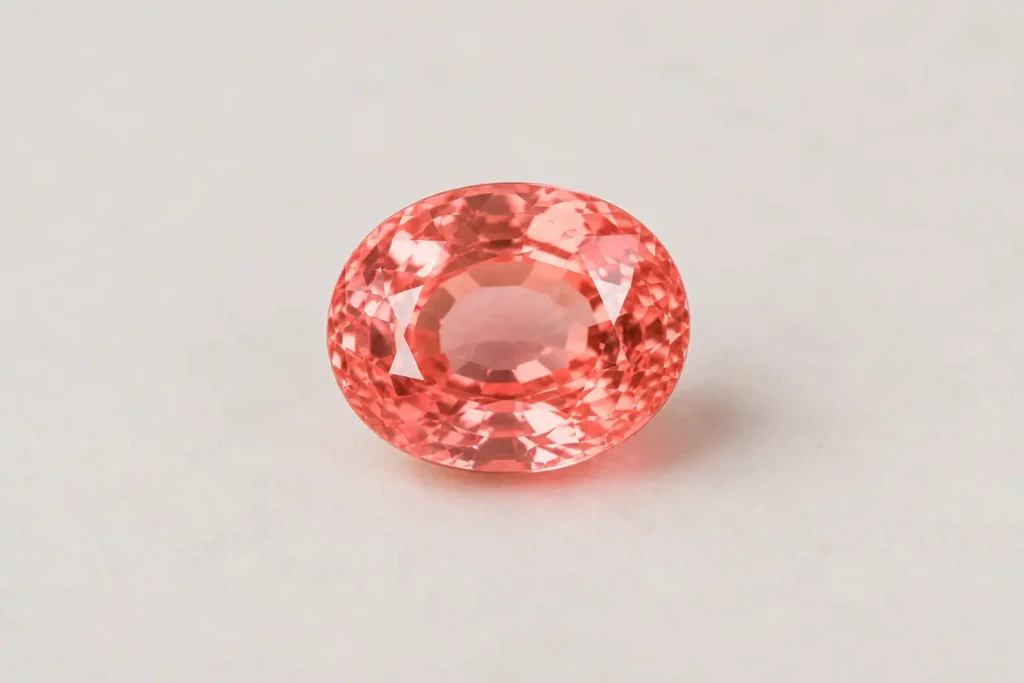
Amethyst represents the sixth anniversary. It is the purple variety of quartz and combines attractive color with Mohs hardness 7, widespread availability, and enough durability for many earrings, pendants, bracelets, and carefully worn rings.
Color quality usually matters more than sheer size because large amethyst crystals are available. Rich, evenly distributed purple with attractive brilliance generally creates a more compelling gem than a large but excessively dark or visibly zoned stone.
Some amethyst can also lose color or change appearance with inappropriate heat, so jewelry should not be exposed casually to high-temperature repair or cleaning processes.
7th Anniversary: Onyx
Onyx is assigned to the seventh anniversary, although commercial naming deserves attention.
Mineralogically, onyx is banded chalcedony with relatively straight, parallel layers. Much jewelry marketed as black onyx is dyed black chalcedony rather than naturally uniformly black onyx, and this treatment is well established in the trade.
The material works especially well for cabochons, signet rings, beads, carvings, and contrasting black-and-metal designs.
8th Anniversary: Tourmaline
Tourmaline brings one of the widest color ranges to anniversary gemstones by year. Depending on species and trace chemistry, gem tourmaline may be green, pink, red, blue, yellowish, multicolored, or nearly colorless.
Rubellite, indicolite, green tourmaline, and bicolored stones create very different visual possibilities for the same anniversary.
Tourmaline is practical for many jewelry forms, although thin stones, included gems, and pieces exposed to sudden temperature changes require sensible handling.
9th Anniversary: Lapis Lazuli
Lapis lazuli represents the ninth anniversary and is a rock composed principally of lazurite with varying proportions of calcite, pyrite, and other minerals.
Fine lapis is valued for an attractive blue body color. Pyrite may appear as small gold-colored flecks, while excessive pale calcite can reduce the evenness of the blue.
Because lapis is softer and more porous than conventional transparent gems, rings and bracelets need more care than pendants, beads, cuff links, earrings, or decorative objects.
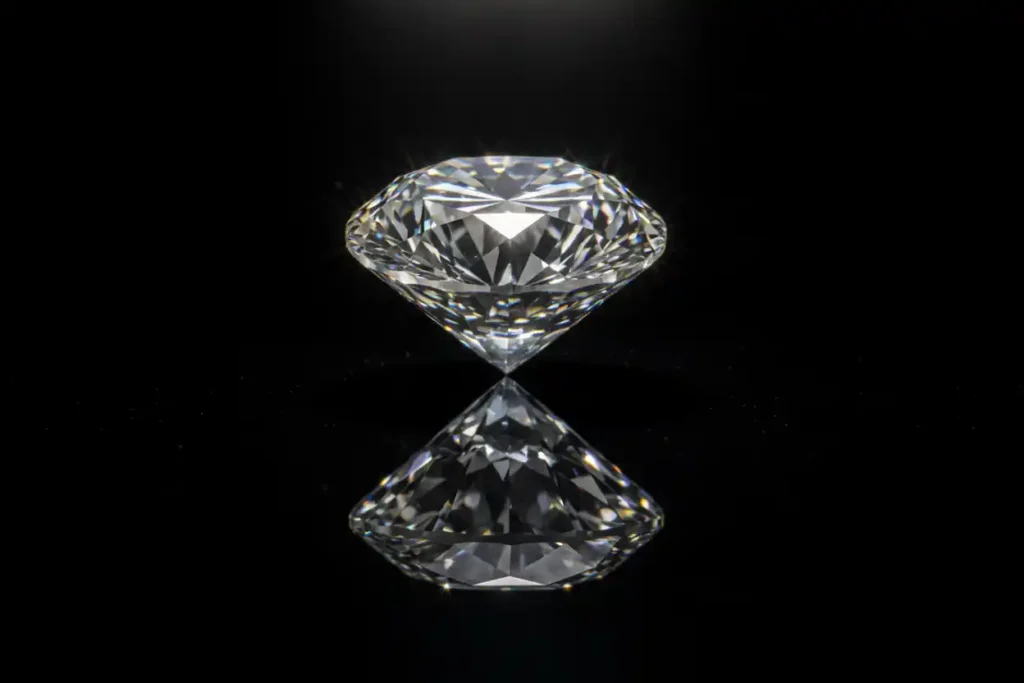
10th Anniversary: Diamond
Diamond marks the tenth anniversary and returns for the sixtieth.
Its Mohs hardness of 10 gives diamond exceptional scratch resistance, but hardness should not be mistaken for indestructibility. Diamond has cleavage and can chip under a sufficiently sharp impact, particularly around vulnerable corners, girdles, or inclusions.
That distinction between scratching and actual breakage is examined more closely in gemstone toughness vs hardness.
A diamond anniversary gift can also take the form of an anniversary band, pendant, studs, bracelet, or an updated ring rather than another engagement-style solitaire.
11th Anniversary: Turquoise
Turquoise is the eleventh-anniversary gemstone and is one of the more care-sensitive materials in anniversary gemstones by year.
It is relatively soft and often porous. Natural turquoise can also be stabilized, impregnated, dyed, backed, or reconstructed, with treatment affecting value and care.
Perfume, cosmetics, oils, acids, and household chemicals can alter vulnerable turquoise, so the complete construction and treatment disclosure matter more than appearance alone.
12th Anniversary: Jade
Jade represents the twelfth anniversary, but “jade” refers primarily to two different gem materials: jadeite and nephrite.
Their chemistry and crystal structure differ, yet both can show exceptional toughness because of their interlocking microscopic textures. This toughness explains why jade has been carved into bangles, beads, plaques, tools, ornaments, and intricate sculptures.
Jadeite may also be bleached, polymer impregnated, dyed, or otherwise treated, making seller disclosure especially important for higher-value purchases.
13th Anniversary: Citrine
Citrine marks the thirteenth anniversary and is the yellow-to-orange variety of quartz.
Natural citrine is comparatively uncommon, while much commercial citrine results from heating amethyst or related quartz material. Heat treatment can produce stable, attractive color and should be understood rather than automatically treated as a defect.
With Mohs hardness 7 and no easy cleavage, citrine works in many jewelry styles at prices that are often accessible compared with rarer yellow gems.
14th Anniversary: Opal
Opal is one of the most visually distinctive anniversary gemstones by year because precious opal can display play-of-color—moving flashes of spectral color created by its internal structure.
Not every opal displays the same durability. Solid Australian opal, Ethiopian hydrophane opal, doublets, triplets, treated material, and assembled jewelry require different care considerations.
Heat, extreme dryness, impact, abrasion, and unsuitable chemicals can damage particular opals. A pendant or earrings can therefore be a more forgiving anniversary gift than a ring for someone who prefers jewelry that requires little maintenance.
15th Anniversary: Ruby
Ruby marks the fifteenth and fortieth anniversaries.
Ruby is red corundum, with chromium playing the principal role in producing its red color. Its combination of Mohs hardness 9, excellent toughness, rarity, and intense color makes fine ruby exceptionally well suited to meaningful long-term jewelry.
Treatment disclosure is important because heating is common, while some rubies may also have fracture filling, diffusion-related treatment, or other enhancements that can influence value and care.
16th Anniversary: Peridot
Peridot represents the sixteenth anniversary and is the gem variety of olivine.
Its characteristic yellowish green to green color is intrinsic to the material rather than produced by routine color enhancement. Peridot can make an attractive pendant, earrings, or carefully designed ring, although its durability is lower than sapphire or spinel.
For couples drawn to green anniversary gemstones by year, the practical differences among peridot, emerald, sapphire, spinel, and other green stones are explored in green gemstones for engagement rings.
17th Anniversary: Watches
The seventeenth entry demonstrates why anniversary gemstones by year is shorthand rather than literal mineralogy: Jewelers of America assigns watches rather than a gemstone.
A watch can be chosen around mechanical or quartz movement, case material, bracelet or strap, water resistance, serviceability, style, and the recipient’s actual wearing habits.
Gem-set watches are an option, but gemstones are not necessary for the tradition.
18th Anniversary: Cat’s-Eye Chrysoberyl
The eighteenth-anniversary assignment is cat’s eye, most precisely interpreted in fine-gem usage as cat’s-eye chrysoberyl.
The optical phenomenon is called chatoyancy. When properly oriented and cut as a cabochon, parallel inclusions or structural features reflect a narrow band of light that appears to move across the gem as the stone or light source moves.
A fine cat’s-eye should show a sharp, centered eye and an attractive body color. Natural chrysoberyl cat’s eye can also command substantial prices, making reputable identification important.
19th Anniversary: Aquamarine
Aquamarine represents the nineteenth anniversary.
It is the blue to greenish blue variety of beryl, the same mineral family that includes emerald. Aquamarine generally has useful hardness and is often much cleaner than emerald, allowing cutters to produce bright faceted stones in larger sizes.
Heat treatment is commonly used to reduce greenish components and produce a purer blue appearance.
20th Anniversary: Emerald
Emerald marks both the twentieth and thirty-fifth anniversaries in the widely used list.
It is green beryl colored principally by chromium and/or vanadium, with iron also influencing some stones. Natural emerald is commonly included, and fractures reaching the surface are frequently filled with oil or other clarity-enhancing substances.
A fine emerald can be extraordinarily valuable, but its inclusions and common treatments require more careful handling than the Mohs hardness value of 7.5–8 might suggest.
21st Anniversary: Iolite
Iolite is the gem variety of cordierite and represents the twenty-first anniversary.
Its strongest visual characteristic is pleochroism. A well-cut iolite can show blue-violet in one crystallographic direction while appearing much paler or yellowish from another, so cutting orientation has a major influence on finished color.
Iolite is affordable relative to many sapphire-like blue gems, but cleavage and moderate durability make protective settings sensible for rings.
22nd Anniversary: Spinel
Spinel represents the twenty-second anniversary and is one of the more durable colored gems in anniversary gemstones by year.
Natural spinel occurs in red, pink, orange, violet, blue, gray, and other colors. Historically, important red spinels were sometimes mistaken for ruby before modern mineral identification distinguished the species.
Gem spinel usually has good durability and Mohs hardness around 8, making it suitable for rings as well as lower-impact jewelry.
23rd Anniversary: Imperial Topaz
Imperial topaz is assigned to the twenty-third anniversary.
The word “imperial” is a trade designation rather than a separate mineral species, and its exact color boundaries are not universally defined. Fine material is typically associated with highly desirable warm yellow-orange, orange, pinkish-orange, or reddish-orange topaz colors.
Regardless of color, topaz retains perfect cleavage, so setting and wear habits matter for a valuable stone.
24th Anniversary: Tanzanite
Tanzanite is the blue-to-violet gem variety of zoisite and marks the twenty-fourth anniversary.
Its geographic origin is unusually restricted, with commercial tanzanite associated with northern Tanzania. Much material is heated to develop or stabilize the blue-violet appearance expected in the jewelry market.
Tanzanite is beautiful but not an ideal stone for unrestricted daily ring wear because of its moderate hardness and cleavage. Earrings and pendants reduce impact exposure substantially.
25th Anniversary: Silver
Silver marks the twenty-fifth anniversary, another reminder that anniversary gemstones by year also include precious metals.
Sterling silver contains 92.5% silver and is more practical for jewelry than very soft pure silver. Tarnish is normal and results from surface chemical reactions rather than proving poor quality.
The design, construction, clasp, chain, setting, and maintenance requirements are more important than simply choosing something silver-colored.
30th Anniversary: Pearl
Pearl returns for the thirtieth anniversary.
A significant pearl gift can emphasize quality rather than simply size. High luster, attractive surface, harmonious color, good matching, and suitable shape are central considerations.
Because pearls are vulnerable to abrasion and chemicals, they should generally be put on after cosmetics and removed before bathing, swimming, cleaning, or applying fragrance.
35th Anniversary: Emerald
Emerald returns for the thirty-fifth anniversary, creating an opportunity for a different format from an earlier emerald gift.
Someone who received an emerald ring for the twentieth anniversary might choose earrings or a pendant later, reducing repeated impact while allowing the stones to be larger or more included without creating the same practical problem.
For an expensive emerald, ask about natural versus laboratory-grown origin and the type and extent of clarity enhancement.
40th Anniversary: Ruby
Ruby returns at the fortieth anniversary.
Because significant natural ruby can be expensive, documentation becomes increasingly important as value rises. Natural or laboratory-grown origin, treatment, weight, dimensions, and sometimes geographic origin may all matter to the purchase.
A laboratory-grown ruby can also be a legitimate jewelry material when it is clearly disclosed and priced accordingly.
45th Anniversary: Sapphire
Sapphire marks the forty-fifth anniversary, providing one of the strongest combinations of color variety and durability among anniversary gemstones by year.
A buyer is not restricted to blue. Pink, yellow, green, orange, purple, white, and parti-colored sapphires allow the gift to reflect personal taste while retaining the same mineral species.
Treatment is common in sapphire, particularly heat, so documentation and disclosure become more significant as price rises.
50th Anniversary: Gold
The fiftieth is the gold anniversary.
For a substantial jewelry gift, consider the entire object rather than focusing only on karat. Metal weight, construction, hollow versus solid components, chain strength, clasps, soldering, gemstone settings, and the alloy all affect long-term wear.
People with known metal sensitivity should also consider alloy composition. The guide to gemstones and metals for sensitive skin explains why the metal can matter more than the gemstone for contact reactions.
55th Anniversary: Alexandrite
Alexandrite makes the fifty-fifth milestone one of the most gemologically interesting anniversary gemstones by year.
Natural alexandrite is the color-change variety of chrysoberyl. Fine stones can appear green to bluish green under daylight-equivalent illumination and shift toward purplish red, reddish purple, or related colors under warmer illumination.
Natural fine alexandrite is rare, and laboratory-grown material and simulations are common enough that significant purchases deserve careful documentation. The Alexandrite buying guide explains color change, origin claims, laboratory reports, and seller evidence in greater depth.
60th Anniversary: Diamond
Diamond returns for the sixtieth anniversary, making it the most prominent repeated transparent gem in the standard milestone sequence.
A sixtieth-anniversary diamond does not need to duplicate an engagement ring. Eternity bands, necklaces, earrings, bracelets, three-stone designs, redesigned heirloom jewelry, and colored diamonds can all mark the milestone.
For inherited or older diamonds, resetting may be possible, but the original stone should be inspected for chips, fractures, previous repairs, and setting wear before work begins.
Why Anniversary Gemstone Lists Sometimes Disagree
Anyone comparing anniversary gemstones by year across several websites will eventually find conflicting assignments.
There are several reasons. Anniversary traditions evolved over time rather than appearing as one ancient universal system, trade organizations have standardized some lists, jewelry companies have created or repeated their own variations, and gemstone-focused charts sometimes substitute a stone for years traditionally associated with metals or other gifts.
GIA explicitly describes the anniversary gemstone tradition as lacking one single authoritative source, while Jewelers of America publishes an endorsed jewelry-anniversary list with defined assignments through selected milestone anniversaries.
For practical use, consistency matters more than pretending every competing list is historically identical. Choose one established reference, understand that alternatives exist, and select a gift that suits the recipient.
How to Choose Between Tradition and Personal Preference
Anniversary gemstones by year should make a gift more personal, not turn it into an obligation.
If the assigned stone is a color the recipient dislikes, causes maintenance concerns, exceeds the available budget, or simply does not fit their jewelry style, there is no reason to force the choice. A partner’s birthstone, a stone connected with a shared place, an heirloom, a favorite mineral, or a gemstone already associated with the relationship can carry more personal significance.
The broader crystal gifts guide explores occasion, recipient, jewelry form, symbolism, durability, and non-jewelry alternatives.
The anniversary tradition gives you a starting point. The relationship supplies the actual meaning.
Durability Matters When the Gift Is Meant to Last
The emotional idea behind anniversary gemstones by year emphasizes longevity, but not every assigned gem has equal physical durability.
Sapphire and ruby are highly practical for everyday rings. Diamond provides unparalleled scratch resistance but can still chip. Spinel is also durable. Garnet and aquamarine offer useful everyday performance when sensibly set.
Pearl, turquoise, opal, lapis lazuli, and tanzanite require more deliberate care. Topaz has high scratch resistance but perfect cleavage. Emerald is hard but commonly fractured and clarity enhanced.
This means the safest jewelry format may change with the anniversary. A delicate gemstone that is questionable for an exposed ring can be excellent in earrings or a protected pendant.
Natural, Lab-Grown, Treated, and Simulated Anniversary Gems
A meaningful anniversary gift does not have to be untreated natural material, but the seller should tell you what you are buying.
Natural gemstones formed geologically. Laboratory-grown gemstones are manufactured but can share essentially the same composition and crystal structure as their natural counterparts. Simulants merely imitate another gem’s appearance.
Treatments are another separate category. Heat is common in ruby and sapphire, irradiation is fundamental to most blue topaz on the market, oils and other fillers are widespread in emerald, black chalcedony sold as onyx is commonly dyed, and turquoise may be stabilized or otherwise enhanced.
Jewelers of America emphasizes that buyers should be informed whether gemstones are natural, treated, enhanced, or laboratory-created, particularly where treatment affects value, permanence, or care.
Disclosure matters more than the simplistic idea that “treated” always means bad.
Buying an Expensive Anniversary Gem
The financial significance of anniversary gemstones by year varies enormously. An amethyst gift can be attractive without major documentation, while a fine natural alexandrite, ruby, emerald, sapphire, or diamond may justify an independent laboratory report.
Ask what the material actually is, whether it is natural or laboratory-grown, which treatments are present, whether the stone is assembled or composite, the metal fineness, exact gemstone dimensions, weight where relevant, and whether the seller provides a meaningful return period.
For online purchases, edited photographs and vague descriptions deserve particular caution. Ethical or responsible sourcing claims should also be specific enough to evaluate rather than accepted as marketing shorthand; the ethical crystal sourcing guide explains how to evaluate those claims.
Never pay a premium simply because a seller says an anniversary gemstone has stronger love, loyalty, prosperity, fertility, protection, or spiritual energy.
Caring for Anniversary Gemstone Jewelry
There is no universal cleaning method for anniversary gemstones by year.
Diamond, sapphire, pearl, turquoise, emerald, opal, lapis lazuli, and tanzanite cannot safely be treated as though they have identical stability, porosity, inclusions, treatments, and settings. Even two pieces containing the same gemstone may require different care when one is untreated and the other contains filler, adhesive, dye, or a delicate antique mounting.
When treatment status is uncertain, begin conservatively with methods appropriate to that exact material and avoid aggressive chemicals, steam, or ultrasonic cleaning until suitability is established.
Storage matters as well. Harder stones can scratch softer anniversary gems when jewelry is thrown into one box, while chains can tangle around prongs and fragile stones can chip against metal. Safe crystal and gemstone storage starts with separation, padding, stable conditions, and material-specific care.
What Do Anniversary Gemstones Symbolize?
Anniversary gemstones by year are primarily cultural and jewelry traditions rather than scientifically established forces acting on relationships.
Ruby is often associated with passion, sapphire with loyalty, emerald with renewal, pearl with wisdom or maturity, and diamond with endurance. Those interpretations can add meaning to a gift, particularly when the symbolism reflects something the couple has genuinely experienced together.
They should not be turned into promises.
A sapphire cannot guarantee fidelity. Ruby cannot preserve romantic attraction. Emerald cannot repair a damaged relationship. Diamond cannot ensure that a marriage lasts.
At Gems Lore, anniversary gemstone symbolism works best when it describes the meaning people choose to attach to a milestone rather than assigning supernatural responsibility to the material itself.
Frequently Asked Questions
What are anniversary gemstones by year?
Anniversary gemstones by year are gemstones, precious metals, and in at least one case a type of jewelry or timepiece traditionally associated with particular wedding anniversaries. Widely used U.S. jewelry lists begin with gold for the first anniversary, garnet for the second, pearl for the third, and continue through selected major milestones.
Are anniversary gemstone lists official?
There is no single universal historical list accepted everywhere. Jewelers of America publishes an endorsed jewelry-anniversary list, while GIA has explicitly noted that multiple anniversary-gem traditions exist.
What gemstone is for the 5th anniversary?
Sapphire is the widely recognized fifth-anniversary gemstone. Its Mohs hardness of 9 and excellent toughness also make it one of the most practical anniversary gemstones for frequently worn jewelry.
What is the 10th anniversary gemstone?
Diamond represents the tenth anniversary. It also appears again for the sixtieth milestone.
What gemstone is for the 15th anniversary?
Ruby is assigned to the fifteenth anniversary. Ruby is red corundum and combines excellent hardness and toughness with high value in fine natural material.
What gemstone represents 20 years of marriage?
Emerald represents the twentieth anniversary and appears again at the thirty-fifth. Natural emerald commonly contains inclusions and fractures, and clarity enhancement is widespread, so treatment disclosure is important.
What is the 25th anniversary gemstone?
The traditional jewelry material for the twenty-fifth anniversary is silver rather than a gemstone. This is why anniversary gemstones by year should be understood as a jewelry-milestone tradition rather than a list consisting exclusively of minerals.
What is the 40th anniversary gemstone?
Ruby returns for the fortieth anniversary. A couple can choose a different ruby jewelry form from an earlier milestone rather than repeating the same type of piece.
What is the 50th anniversary gemstone?
Gold marks the fiftieth anniversary. Like the first anniversary, this milestone uses a precious metal rather than a gemstone.
What gemstone is for the 55th anniversary?
Alexandrite is the fifty-fifth-anniversary gemstone. Fine natural alexandrite displays a pronounced change in apparent color under different illumination and can be exceptionally rare and valuable.
What is the gemstone for a 60th wedding anniversary?
Diamond is the standard sixtieth-anniversary gemstone. Earrings, bands, pendants, bracelets, heirloom resets, and other jewelry forms can mark the occasion without recreating an engagement ring.
Does every wedding anniversary have an official gemstone?
No. Established jewelry lists assign gemstones or materials to many early anniversaries and selected later milestones, but they do not provide one universally accepted gemstone for every possible anniversary. Lists that extend a unique stone through every later year should therefore be treated as particular commercial or editorial traditions rather than automatically universal standards.
Can I choose a different gemstone from the traditional anniversary stone?
Yes. Anniversary gemstones by year are traditions, not requirements. A birthstone, favorite color, heirloom, durable everyday gem, or stone linked with a shared memory may make a more personal gift.
Are lab-grown gemstones appropriate for anniversaries?
Yes, when they are accurately disclosed. Laboratory-grown diamond, ruby, sapphire, emerald, alexandrite, and other gems can provide the same basic material identity as their natural equivalents, although rarity, origin, pricing, and collectability differ.
Which anniversary gemstones are best for everyday rings?
Sapphire, ruby, diamond, and spinel are among the stronger options in the anniversary gemstones by year sequence. Other gems may still work in rings when the setting, treatment, inclusions, cleavage, and wearer’s habits are taken into account.
Which anniversary gemstones need the most careful handling?
Pearl, turquoise, opal, lapis lazuli, tanzanite, emerald, and cleavage-prone topaz deserve additional attention. Their risks differ, so “delicate” should not be treated as one universal care instruction.
Anniversary gemstones by year are most valuable as a framework for choosing rather than a rule for buying. The traditional assignment can start the conversation, but the recipient’s taste, jewelry habits, gemstone durability, treatment, authenticity, budget, sourcing preferences, and the meaning of the relationship should determine the final gift.