Best Gemstones for Men: Design Ideas, Buying Tips & Care
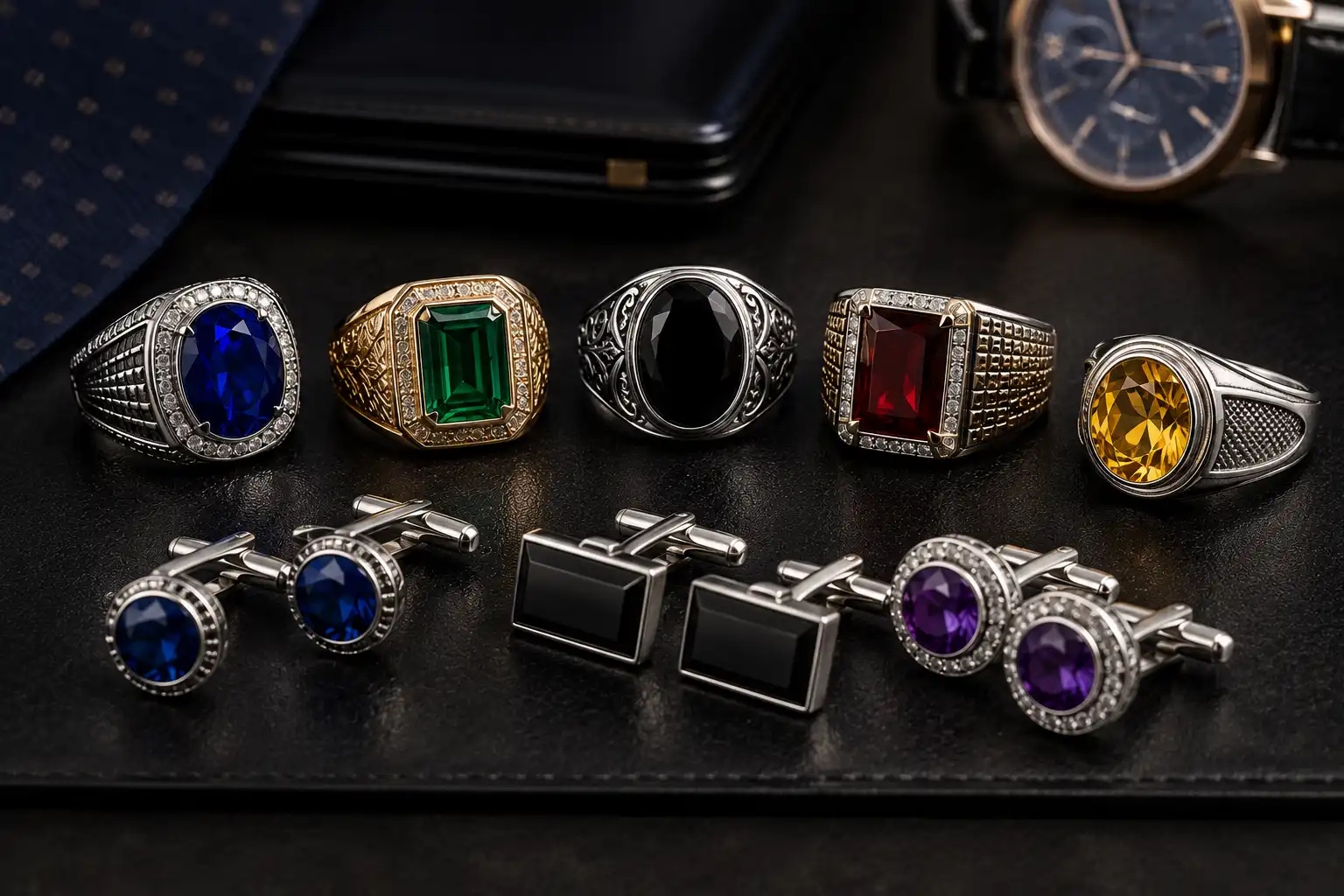
The best gemstones for men are not defined by a special mineral category or a rule that certain colors belong to one gender. The phrase is most useful as a jewelry-shopping shortcut for stones that work particularly well in signet rings, substantial bands, cuff links, bracelets, pendants and other designs commonly marketed toward men, while the same gemstones can be worn by anyone.
Sapphire and spinel are excellent choices when durability and frequent ring wear matter. Black onyx works especially well in architectural signets and cuff links, tiger’s eye adds a moving chatoyant band to brown and bronze designs, lapis lazuli provides saturated blue for protected cabochons, jade offers exceptional toughness, garnet supplies colors from dark red to vivid green, while hematite creates a distinctive metallic appearance in beads and cabochons.
Choosing the best gemstones for men should therefore begin with the person and jewelry format rather than stereotypes about masculinity. Consider whether the wearer prefers polished or matte metal, transparent or opaque stones, dark neutrals or vivid color, understated proportions or larger statement pieces, and whether the jewelry will be worn occasionally or through routine daily activity.
Best Gemstones for Men at a Glance
| Gemstone | Approx. Mohs hardness | Visual character | Strong jewelry uses | Main buying consideration |
|---|---|---|---|---|
| Sapphire | 9 | Blue, black, gray, green, yellow and many other colors | Daily rings, signets, bands, cuff links | Treatment, color zoning and natural/lab-grown disclosure |
| Spinel | 8 | Black, gray, blue, red, purple and more | Rings, bracelets, cuff links, pendants | Natural vs synthetic identity |
| Diamond | 10 | Colorless, black, brown and fancy colors | Rings, bands, bracelets, pendants | Cut, color origin, treatment and lab-grown disclosure |
| Black onyx | About 6.5–7 | Smooth opaque black | Signets, cuff links, pendants, beads | Commercial black material is commonly dyed |
| Tiger’s eye | About 7 | Golden-brown, bronze, red or blue-gray chatoyancy | Signets, bracelets, pendants, cuff-style jewelry | Strength and orientation of the moving eye |
| Jadeite / nephrite | About 6–7 | Green, black, white and other colors | Signets, bangles, pendants, carvings | Jade type and treatment must be identified |
| Garnet | About 6.5–7.5 | Red, orange, green, purple, brown and more | Rings, cuff links, pendants | Species, darkness and inclusions vary |
| Lapis lazuli | About 5–6 | Intense blue with possible pyrite and calcite | Signets, cuff links, pendants, bracelets | Dye, wax/oil treatment and edge protection |
| Hematite | About 5–6.5 | Steel-gray metallic luster | Beads, signets, pendants | Brittleness and manufactured magnetic substitutes |
| Turquoise | About 5–6 | Blue to greenish blue, often with matrix | Signets, pendants, cuff links | Stabilization, dye and reconstruction |
| Obsidian | About 5–5.5 | Glassy black or patterned | Pendants, cabochons, beads | Brittle glass structure and sharp chips |
| Smoky quartz | 7 | Gray-brown to deep brown | Rings, pendants, cuff links | Dark stones can lose brightness indoors |
There is no requirement to stay within dark blue, black or brown. Pink sapphire, green garnet, purple spinel, yellow diamond or any other gemstone can be the right choice if it suits the wearer.
Start With the Wearer, Not a “Men’s Color” List
The best gemstones for men are the gemstones a particular wearer will actually enjoy.
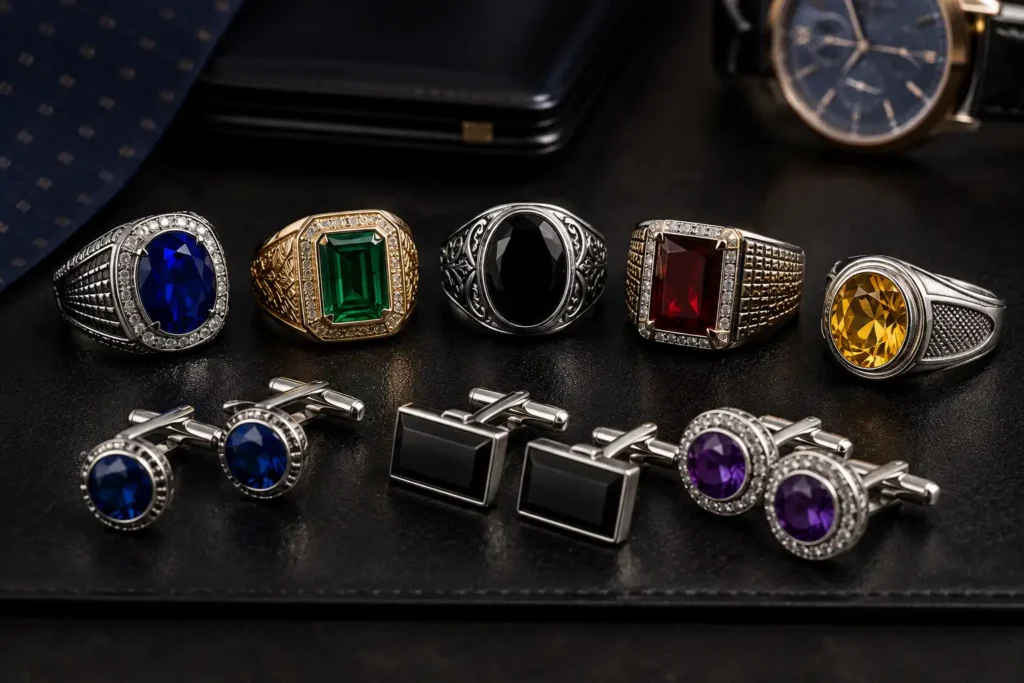
Some people prefer a nearly black cabochon in a heavy silver signet. Others prefer a bright faceted blue sapphire in white gold, a small green tsavorite in a minimal ring, a tiger’s eye bracelet, or a diamond stud.
Design usually determines whether jewelry reads as restrained, formal, rugged, vintage, contemporary or highly decorative more strongly than gemstone color alone.
A dark stone can look ornate in a heavily engraved setting.
A vivid ruby can look minimal in a clean low bezel.
A pale gemstone can look substantial when cut as a wide tablet.
Consequently, use gendered merchandising labels as navigation rather than rules.
The broader black gemstones collection is useful when the preference is specifically for dark jewelry, while brown gemstones includes tiger’s eye, smoky quartz, brown sapphire and other earth-toned options.
1. Sapphire: Best Overall for Durable Colored Rings
Sapphire is one of the strongest best gemstones for men when the jewelry will be worn frequently.
Corundum ranks Mohs 9, has excellent toughness and no cleavage, making sapphire particularly effective in signet rings, wedding-style bands, conventional faceted rings and cuff links that may receive regular handling.
Blue is only one option.
Sapphire can also be:
- Black
- Gray
- Green
- Teal
- Yellow
- Orange
- Pink
- Violet
- Colorless
- Parti-colored
Very dark blue and black sapphire can create a restrained appearance in broad metal settings, while brighter blue or teal stones can become the visual center of the design.
Best Sapphire Designs
A faceted cushion or oval works well when brilliance matters.
A dark cabochon fits naturally into a signet.
Star sapphire can add an optical feature without the conventional sparkle of a faceted stone.
For everyday rings, a low bezel or substantial prong structure limits unnecessary exposure while allowing corundum’s durability to do most of the work.
Treatment Matters
Heating is common in sapphire and generally stable.
Diffusion, fracture filling, dyeing and laboratory growth are separate issues that should be disclosed correctly.
A seller should tell you what the stone is rather than relying on vague terms such as “genuine blue gem.”
Among the best gemstones for men who want a colored daily ring with relatively straightforward care, sapphire is difficult to beat.
2. Spinel: Best Underused Alternative to Sapphire
Spinel ranks Mohs 8 and has good toughness, making it durable enough for rings and other jewelry exposed to regular wear.
Black spinel is particularly common in men’s jewelry because it provides a clean dark surface with stronger scratch resistance than onyx, obsidian, lapis lazuli or hematite.
However, restricting spinel to black misses much of the appeal.
Natural spinel occurs in:
red, pink, gray, violet, blue, purple, orange and several intermediate shades.
A transparent gray spinel can create a subtle modern ring, while rich red or blue material provides much more visual intensity.
GIA notes that spinel is durable enough for daily-wear mountings, which places it securely among the best gemstones for men who want a less conventional natural gem.
Synthetic spinel is widely manufactured, so natural origin should be stated rather than assumed.
3. Black Onyx: Best for Classic Signet Rings
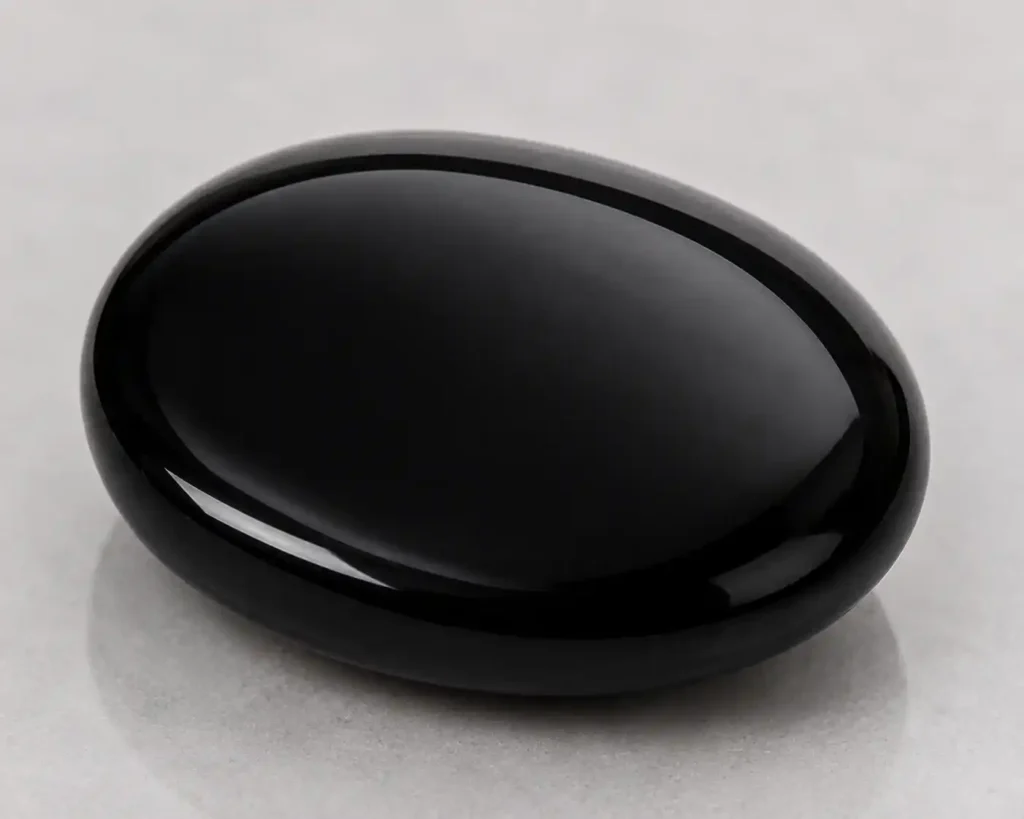
Black onyx is one of the most recognizable best gemstones for men because its uniform dark surface works exceptionally well in signets, cuff links, engraved pieces and geometric jewelry.
Mineralogically, onyx is a form of chalcedony traditionally associated with relatively parallel bands.
Uniform black onyx in modern jewelry is commonly chalcedony whose color has been darkened through dyeing.
That treatment is not automatically a problem.
A well-cut dyed chalcedony signet can be attractive, durable enough for regular wear and reasonably priced. The important point is that the seller should not use the uniform black color to imply exceptional natural rarity.
Black onyx ranks around the quartz-family range of Mohs 6.5–7.
It resists ordinary wear reasonably well but can still scratch or chip, particularly at exposed cabochon edges.
A recessed signet or bezel is therefore preferable to a very high, thinly protected setting.
If a black stone could instead be volcanic glass, the onyx vs obsidian comparison explains why color alone cannot distinguish the two.
4. Tiger’s Eye: Best for Brown, Bronze and Chatoyant Jewelry
Tiger’s eye is one of the best gemstones for men when the wearer wants an earthy palette with visible movement rather than transparent brilliance.
The material is quartz-rich and contains aligned fibrous structures that create chatoyancy—a moving reflected band resembling an eye.
Golden-brown tiger’s eye is the familiar form.
Blue-gray hawk’s eye and reddish material provide other looks, although treatment becomes increasingly important as colors become more unusual.
The types of tiger’s eye guide explains how golden, blue, red and altered colors relate to fiber structure, oxidation and treatment.
What Makes Good Tiger’s Eye?
Do not buy tiger’s eye based only on body color.
Rotate the stone beneath one concentrated light source.
The eye should move clearly across the cabochon.
A strong centered light band usually has more visual impact than a dark polished stone showing only vague sheen.
Tiger’s eye works particularly well in broad oval, cushion or rectangular signets because the larger polished face gives the optical band room to move.
It also suits bead bracelets and understated pendants.
5. Lapis Lazuli: Best for Saturated Opaque Blue
Lapis lazuli provides a blue that looks completely different from transparent sapphire.
It is a rock rather than one mineral species, consisting mainly of lazurite along with variable calcite, pyrite and other minerals.
Fine lapis usually emphasizes rich medium-to-dark blue or violetish blue.
Small pyrite flecks can add attractive contrast, while abundant white calcite may interrupt the blue field.
Lapis typically falls around Mohs 5–6 depending on composition, so it requires more protection than sapphire or spinel.
For rings, a low bezel or recessed signet is far more practical than an exposed tablet held at its corners.
The lapis lazuli ring guide explains why a signet setting can protect the stone’s perimeter and why thin tablets or visible calcite veins require particular attention.
Treatment Is Common
Lapis may be dyed to improve color.
Wax or oil may also enhance surface appearance.
These treatments can be legitimate when disclosed, but solvents, heat and aggressive cleaning can damage treated surfaces.
Among the best gemstones for men who want deep blue without faceted sparkle, lapis is a strong choice for protected jewelry.
6. Jade: Best for Tough Cabochons, Signets and Bangles
Jade demonstrates why hardness alone cannot determine the best gemstones for men.
Jadeite and nephrite have only moderate Mohs hardness, yet their tightly interlocking structures give them exceptional toughness.
That structural toughness makes jade excellent for:
signet rings, cabochons, bangles, pendants, beads and carved jewelry.
Green is famous, but jade can also appear white, lavender, gray, yellow, orange, brown or nearly black depending on material.
A dark jade signet can look restrained and architectural, while translucent green material can be substantially more vivid.
The principal buying issue is identification and treatment.
“Jade” should mean jadeite or nephrite, not serpentine, aventurine, dyed quartz or another material carrying an informal jade trade name.
Jadeite may also be bleached, polymer-impregnated or dyed.
A high-value piece deserves precise disclosure.
7. Garnet: Best for Red, Orange and Green Without One Fixed Style
Garnet is a mineral group containing several species and varieties rather than one dark-red gemstone.
That makes garnet one of the most flexible best gemstones for men.
Almandine and pyrope-rich material can provide dark wine-red or red-brown stones for traditional rings.
Rhodolite offers brighter raspberry and purple-red color.
Spessartine can produce orange.
Tsavorite provides intense green.
Demantoid combines green with unusually high dispersion.
Many garnets have sufficient hardness and toughness for regular jewelry, although the exact physical properties and inclusions depend on the particular type.
Dark red garnet can work well in yellow gold, silver or oxidized metal, while green garnet creates a much more vivid statement.
Choose by actual color and cut rather than assuming every garnet should look like a traditional birthstone.
8. Hematite: Best for Metallic Gray Jewelry
Hematite creates a visual effect that few conventional gemstones reproduce.
Polished material can show a dark steel-gray to silver-gray metallic surface and feels unusually heavy because hematite has high density.
That makes it popular in beads, pendants and polished cabochons.
The hematite meaning and properties guide explains that hematite is Fe₂O₃ and commonly ranks around Mohs 5–6.5.
The material is brittle.
Large thin pieces can chip or break from impact, and a polished hematite ring should not be expected to retain its surface as well as sapphire or spinel.
Be Careful With “Magnetic Hematite”
Strongly magnetic polished beads are often sold as magnetic hematite.
Natural hematite is not normally a powerful permanent magnet.
Highly magnetic manufactured products may instead be ferrite-based materials sometimes marketed as hematine.
That distinction is particularly important when buying hematite bracelets or bead strands.
The best gemstones for men should be identified by their actual material rather than whichever name creates the strongest sales pitch.
9. Diamond: Best for Maximum Scratch Resistance
Diamond remains one of the best gemstones for men when durability, brilliance and long-term surface wear are priorities.
It ranks Mohs 10.
Colorless diamonds work well in understated studs, wedding bands and solitaire rings, but darker categories can produce very different designs.
Black diamond creates a more opaque appearance.
Brown or cognac-colored diamond can provide warm neutral tones.
Fancy colors can become much more vivid and expensive.
Black diamonds deserve particular attention because many commercial examples receive treatment to create or improve a uniform dark appearance. Natural black color, treated color and laboratory-grown origin should not be merged into one description.
Diamond also has cleavage, so Mohs 10 does not mean indestructible.
A sharp impact can chip an exposed edge.
10. Turquoise: Best for Blue-Green Southwestern and Heritage-Inspired Designs
Turquoise works particularly well in substantial silver rings, belt-style jewelry, bracelets, cuff links and pendants because its opaque blue-to-green surface can support large shapes without relying on faceted brilliance.
The material is considerably softer than sapphire.
Porosity and stability also vary.
Stabilization with polymer is common and can make lower-density turquoise stronger and easier to polish.
Dyed, reconstructed and imitation material also occurs.
Treatment does not automatically make a piece undesirable.
A stabilized turquoise ring can be entirely appropriate for regular careful wear when represented accurately and priced accordingly.
For untreated fine turquoise, avoid cosmetics, oils, aggressive household cleaners and unnecessary soaking.
The metalwork can also contribute much more to a finished piece’s value than the raw stone itself.
Black Stones Are Not Interchangeable
Several of the best gemstones for men can appear black while having almost nothing else in common.
Black sapphire is corundum at Mohs 9.
Black spinel is a different mineral at Mohs 8.
Onyx is chalcedony around 6.5–7.
Obsidian is volcanic glass around 5–5.5.
Hematite is iron oxide with a metallic luster and much greater density.
Black tourmaline is commonly schorl and can show crystal striations.
The black gemstones comparison separates these materials by identity, durability and treatment.
Do not buy a black stone purely because it matches a preferred color.
Choose the material according to how the jewelry will be worn.
Best Gemstones for Men’s Signet Rings
Signet rings are among the easiest ways to use opaque or cabochon gemstones.
Their broad metal surface can surround and protect the stone while giving the design substantial visual weight.
Strong choices include:
Black sapphire for maximum colored-stone durability.
Black spinel for a durable dark natural gem.
Onyx for classic smooth black.
Tiger’s eye when a moving golden-brown band is desirable.
Jade when toughness and carving tradition matter.
Lapis lazuli for rich blue in a protected recess.
Hematite for metallic gray.
Rounded ovals and cushions generally protect corners more easily than very thin rectangles or sharp geometric tablets.
For softer materials, a recessed setting is particularly valuable.
Best Gemstones for Men’s Bracelets
Bracelets experience more impact and abrasion than necklaces because the wrist repeatedly contacts desks, doorways and other objects.
Beaded designs also allow neighboring stones to knock against one another.
Tiger’s eye works well because the moving band remains visible across rounded beads.
Jade is excellent structurally because of its exceptional toughness.
Onyx provides a uniform black appearance.
Hematite provides dense metallic beads but creates a noticeably heavier bracelet.
Sapphire or spinel can work in fine-jewelry link bracelets, though cost increases rapidly when multiple matched stones are required.
Construction matters as much as the stones.
Stretch cord, clasps, drill holes, metal links and stringing can fail before a durable gemstone does.
Best Gemstones for Men’s Cuff Links
Cuff links experience relatively little impact compared with rings, which expands the range of usable gemstones.
Onyx is a classic option.
Lapis provides strong blue.
Tiger’s eye creates movement.
Malachite can provide dramatic banding when carefully protected.
Mother-of-pearl offers a softer lustrous surface.
Sapphire, spinel and diamond create more conventional fine-jewelry interpretations.
Because cuff links are worn as pairs, matching matters.
The two stones should coordinate in color, pattern, dimensions and polish without needing to be unnaturally identical.
For naturally patterned materials such as tiger’s eye or lapis, complementary character can look better than forced uniformity.
Best Gemstones for Men’s Pendants
Pendants impose fewer durability demands than rings or bracelets.
That allows softer stones such as lapis lazuli, turquoise and obsidian to become more practical.
Large cabochons also work well because weight is supported by the chain rather than sitting high above a finger.
Check the bail carefully.
A heavy gemstone needs a substantial attachment and a chain strong enough for the complete pendant weight.
A thin decorative jump ring can become the weakest point in an otherwise durable piece.
The best gemstones for men in pendants therefore include almost any stable material the wearer likes, provided the hardware is proportionate to its weight.
Transparent vs Opaque Gemstones
Transparent and opaque stones create different design languages.
Faceted sapphire, spinel, diamond and garnet rely on internal light return.
Cut quality therefore affects brilliance, extinction and visible color.
Onyx, lapis, jade, turquoise, tiger’s eye and hematite are usually selected for surface color, texture, pattern or optical effects.
Carat weight also matters differently.
A large opaque cabochon may be inexpensive relative to a much smaller fine sapphire because availability and valuation systems are completely different.
Do not compare these materials by carat price as though they belonged to one market.
Choose Metal Based on the Complete Design
Metal affects both appearance and structural performance.
Yellow Gold
Yellow gold emphasizes warm brown, red, green and black gemstones particularly well.
Tiger’s eye, red garnet, black onyx and green jade can all create strong contrasts.
White Gold and Platinum
White metals produce a cooler architectural look around black, gray and blue gemstones.
Sapphire, spinel, lapis and diamond work particularly well.
Sterling Silver
Silver is widely used for onyx, tiger’s eye, turquoise, lapis and other opaque materials.
It can provide substantial visual mass without the price of equivalent gold or platinum.
The trade-off is tarnish and generally lower metal value.
Rose Gold
Rose gold can soften the appearance of smoky quartz, garnet, black spinel or even blue sapphire.
There is no reason to exclude it because a ring is being marketed to men.
The best metal is the one the wearer will actually use.
Ring Size and Proportion Matter
A gemstone ring must fit the hand rather than only look appealing in enlarged product photography.
Broad signets fit differently from narrow bands.
A wide ring can feel tighter than a thin ring at the same nominal size because it contacts more skin.
Large top-heavy centers may rotate around the finger if the shank is too narrow.
A substantial gemstone therefore benefits from enough metal underneath to balance the top.
When buying as a surprise, resizing potential matters.
Simple gold signets may allow adjustment, while full eternity designs, complex inlay or certain alternative metals can be far less flexible.
Ask before buying.
Hardness Is Not the Same as Toughness
A numerical hardness comparison helps predict surface wear, but it does not answer every durability question.
Hardness measures resistance to scratching.
Toughness concerns breaking, chipping and cracking.
Cleavage creates preferred splitting directions in certain crystalline materials.
Treatment can introduce still more limitations.
The gemstone toughness vs hardness guide explains why a moderate-hardness jade can be extraordinarily tough while harder materials can remain vulnerable to specific impacts.
For the best gemstones for men intended for rings or bracelets, the complete durability profile matters much more than a single Mohs number.
Treatments to Ask About
Treatment varies by gemstone.
Black onyx is commonly dyed.
Black diamond may be treated to create a uniform dark appearance.
Sapphire can be heated, diffusion treated, filled or dyed.
Lapis may be dyed, waxed or oiled.
Turquoise may be stabilized, dyed or reconstructed.
Tiger’s eye colors can be altered through heat or dye.
Jadeite may be bleached, polymer impregnated or dyed.
Spinel can be laboratory grown and less commonly treated.
A treatment can be entirely acceptable when it is stable, disclosed and appropriately priced.
The problem is misrepresentation.
An invoice should identify the gemstone accurately enough that future cleaning, repair and resale decisions do not depend on guessing.
Natural, Lab-Grown and Imitation Are Different
A laboratory-grown sapphire is corundum produced in a manufacturing environment.
Synthetic spinel is spinel created artificially.
Laboratory-grown diamond is diamond.
Glass made to resemble onyx is an imitation rather than laboratory-grown onyx.
Fiber-optic glass can imitate tiger’s eye chatoyancy but is not tiger’s eye.
These categories carry different implications for rarity and value, although any of them can make attractive jewelry when sold honestly.
The best gemstones for men do not need to be rare.
They need to be accurately identified and appropriate for the intended use.
Buying Online
Online photographs often exaggerate saturation, hide scratches and make a stone look much larger than it actually is.
Request exact millimeter dimensions.
For rings, confirm:
- Finger size
- Band width
- Shank thickness
- Stone dimensions
- Setting height
- Metal and alloy
- Natural or laboratory-grown status
- Treatments
- Repairs
- Return terms
For tiger’s eye, request video showing the eye move.
For lapis, inspect both sides and ask about dye, backing and reconstruction.
For jade, treatment disclosure can be critical.
For hematite, determine whether strongly magnetic beads are natural hematite or a manufactured product.
For transparent faceted gems, look for large windows, excessive darkness and poorly protected corners.
Avoid Generic “Masculine Gemstone” Pricing
Marketing language does not create mineral value.
Terms such as masculine stone, power stone, executive stone, warrior stone or luxury men’s crystal are not standardized gemological quality grades.
Likewise, labels such as AAA or premium may be defined only by the individual seller.
Pay for measurable characteristics:
material identity, color, transparency when relevant, chatoyancy, pattern, cutting, treatment, size, condition, metal quality and workmanship.
The best gemstones for men can be inexpensive or exceptionally valuable depending on the material and piece.
A well-made onyx signet does not need to pretend the stone is rare to be good jewelry.
Care Depends on the Gemstone
There is no universal cleaning method for men’s gemstone jewelry.
Sapphire and spinel tolerate ordinary wear well, but treatment and fractures still matter.
Lapis should be cleaned conservatively with warm soapy water and should not be exposed casually to steam or ultrasonic cleaning.
Onyx is generally straightforward but dyed material should still be kept away from harsh chemicals.
Tiger’s eye should be hand-cleaned when treatment, filler or fractures are uncertain.
Jade care depends partly on treatment.
Turquoise should be protected from oils, cosmetics and harsh chemicals.
Hematite should be protected from hard impacts.
A good default is a soft cloth and gentle hand cleaning appropriate to the known gemstone and treatment.
Store Dark Stones Separately Too
A box filled with black stones does not mean all the materials have equal hardness.
A sapphire can scratch onyx, obsidian, hematite and lapis.
Diamond can scratch nearly every other jewelry gemstone.
Metal edges can also damage soft polished surfaces.
Store important pieces in separate compartments or pouches rather than allowing rings and bracelets to rub together.
This matters especially with opaque polished stones because fine scratches can turn an originally mirror-like surface visibly dull.
Symbolism Is Optional, Not a Buying Requirement
Some of the best gemstones for men also carry long-established or modern symbolic associations.
Onyx may symbolize composure or boundaries.
Tiger’s eye is often associated with confidence and discernment.
Hematite commonly represents grounding.
Lapis has been associated with status, truth and wisdom.
Jade can symbolize continuity, virtue or prosperity in different cultural traditions.
Sapphire has traditions involving loyalty and integrity.
These interpretations can make a gift more personal, but they are cultural or symbolic meanings rather than scientifically demonstrated powers.
A gemstone does not create courage, guarantee protection, increase wealth or determine masculinity.
At Gems Lore, the most useful symbolism for men’s jewelry comes from the meaning a wearer intentionally attaches to a piece, while the gemstone’s durability, treatment and material identity remain matters of physical evidence.
Frequently Asked Questions
What are the best gemstones for men?
The best gemstones for men include sapphire, spinel, diamond, onyx, tiger’s eye, jade, garnet, lapis lazuli, hematite and turquoise. The best choice depends on jewelry type, durability needs, preferred color, treatment and personal style rather than gender alone.
Are there gemstones that are specifically for men?
No gemstone is inherently restricted to men. “Men’s gemstones” is mainly a retail and design category referring to stones commonly used in signets, cuff links, substantial bands, bracelets and other styles often marketed toward male buyers.
What is the best gemstone for a men’s everyday ring?
Sapphire is one of the strongest natural colored choices because corundum combines Mohs hardness 9, excellent toughness and no cleavage. Spinel is another durable option, while diamond and moissanite work well for colorless or dark contemporary designs.
What is the best black gemstone for men?
Black sapphire and black spinel are strong choices for demanding rings. Onyx provides the classic smooth black signet appearance at lower cost, while hematite offers a metallic surface and obsidian provides a glassy black look with more demanding care.
Is black onyx good for men’s rings?
Yes. Onyx works particularly well in recessed signets and bezels. Commercial uniform black onyx is commonly dyed chalcedony, so treatment should be understood rather than interpreted as rare natural black color.
Is tiger’s eye suitable for men’s jewelry?
Yes. Tiger’s eye works well in signets, bead bracelets, pendants and cuff-style pieces. Look for a sharp moving chatoyant band and ask about heat, dye or other treatments when the color is unusual.
Is lapis lazuli durable enough for a men’s ring?
It can be used successfully in a protected signet or bezel. Lapis is only around Mohs 5–6 and may contain softer calcite or receive dye and wax treatment, so an exposed high-set ring requires substantially more care than sapphire.
Is hematite good for men’s bracelets?
Hematite works well visually in dense metallic bead bracelets, but it is brittle and heavier than many similar-size stones. Strongly magnetic “hematite” beads may be manufactured ferrite products rather than ordinary natural hematite.
Is jade good for men’s jewelry?
Yes. Jadeite and nephrite have exceptional toughness and work particularly well for signets, pendants, beads, bangles and carvings. Buyers should verify whether the material is true jadeite or nephrite and ask about treatment.
What gemstone works best for men’s cuff links?
Onyx, lapis lazuli, tiger’s eye, sapphire, spinel and diamond are strong choices. Because cuff links experience relatively little impact, somewhat softer opaque materials can work well when securely mounted.
What gemstones suit men’s bracelets?
Tiger’s eye, onyx, jade and hematite are popular bead choices, while sapphire, spinel and diamond can be used in higher-value link bracelets. Construction quality and clasp or string strength matter as much as gemstone durability.
Can men wear bright gemstones?
Yes. Ruby, emerald, tsavorite garnet, yellow sapphire, pink sapphire, tourmaline and other vivid stones can all work in men’s jewelry. Metalwork, proportion and setting style generally influence the overall aesthetic more than color alone.
Is sapphire better than onyx for daily wear?
Sapphire is substantially more scratch-resistant and generally more durable for an exposed daily ring. Onyx can still perform well in a recessed signet or bezel and provides a very different opaque appearance.
What are the best gemstones for men who prefer brown jewelry?
Tiger’s eye, smoky quartz, brown sapphire, brown spinel, brown diamond, andalusite and patterned jasper are useful choices. Their durability differs, so ring stones should be selected more carefully than pendant materials.
Which gemstone is best for a men’s signet ring?
Sapphire and spinel provide the strongest durability, while onyx gives the classic black appearance. Tiger’s eye adds chatoyancy, jade adds exceptional toughness, and lapis creates saturated blue when protected by the metal.
Are natural stones always better than lab-grown gemstones?
No. Natural and laboratory-grown describe origin rather than whether the jewelry is attractive or functional. Lab-grown sapphire, spinel and diamond can be legitimate choices when their origin is disclosed accurately.
Does gemstone treatment matter in men’s jewelry?
Yes. Dye, heating, filling, stabilization, coating and polymer treatment can affect value and sometimes care. Ask about treatment regardless of whether the piece is marketed as men’s, women’s or unisex jewelry.
How should men’s gemstone rings be cleaned?
Cleaning depends on the actual gemstone and treatment. Warm soapy water is suitable for many durable stones, while treated lapis, turquoise, filled gemstones and other sensitive materials require gentler care. Do not assume ultrasonic or steam cleaning is universally safe.
What metal works best with dark gemstones?
Yellow gold creates warm contrast, while platinum and white gold create a cooler modern look. Sterling silver is especially common with onyx, turquoise, tiger’s eye and lapis. The best choice depends on design, budget and the wearer’s existing jewelry.
Are expensive gemstones necessary for good men’s jewelry?
No. A well-cut tiger’s eye, onyx or garnet in a substantial well-made setting can produce excellent jewelry without an expensive center stone. Metal construction, fit, setting quality and finishing can matter more than gemstone rarity.
What should I check before buying the best gemstones for men online?
Confirm the exact gemstone identity, treatment, natural or laboratory-grown origin, dimensions, ring or bracelet size, metal composition, setting construction, condition and return policy. For optical stones such as tiger’s eye, request video; for expensive sapphire, spinel, diamond or jade, appropriate independent documentation may also be worthwhile.
What matters most when choosing the best gemstones for men?
Choose the wearer first, then the jewelry form and gemstone. Durability, treatment, fit, color, setting, metal and care requirements should support the person’s real lifestyle. A gemstone is successful because the wearer likes and uses it—not because marketing assigns it to one gender.