Brown Gemstones: Benefits, Uses & Practical Guidance
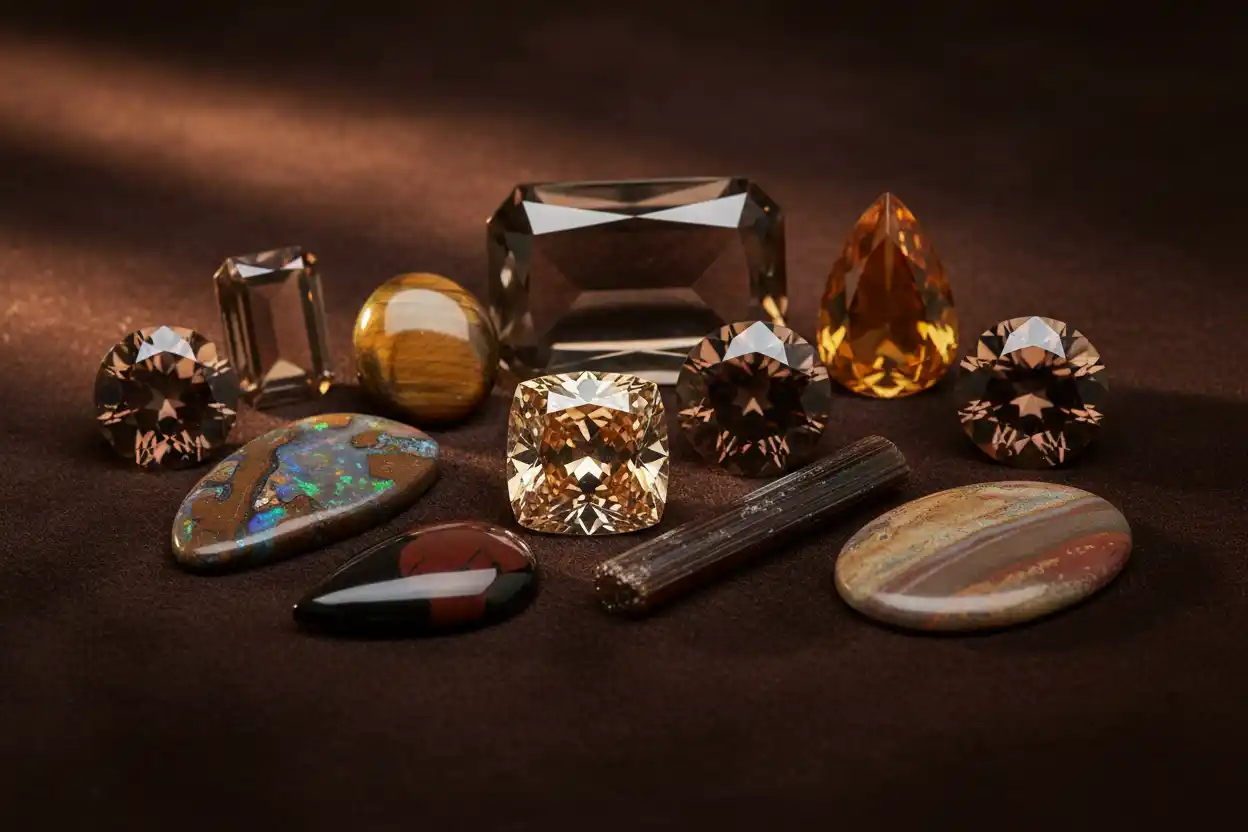
Brown gemstones range from highly brilliant transparent diamonds, zircon, topaz, sapphire, spinel, tourmaline, and andalusite to patterned cabochon materials such as tiger’s eye and boulder opal. Their colors include pale champagne, honey, cognac, bronze, caramel, reddish brown, smoky gray-brown, chocolate, coffee, and tones so deep they approach black.
What makes brown gemstones useful to compare is not simply their shared color. A brown diamond can tolerate severe surface abrasion yet still chip along cleavage, while smoky quartz is softer but has no true cleavage and is available in much larger clean sizes. Brown topaz combines excellent scratch resistance with perfect basal cleavage, whereas brown zircon produces remarkable brilliance but can abrade along facet edges. Tiger’s eye is valued primarily for chatoyancy rather than transparency, and boulder opal depends on the visual relationship between precious opal and natural ironstone.
Consequently, choosing brown gemstones requires more than selecting the shade that looks best in a photograph. Species, natural or treated color, hardness, toughness, cleavage, structural condition, optical properties, cutting, setting protection, rarity, documentation, and intended jewelry use all matter.
This is also what separates brown gemstones from the broader brown crystals category. Crystal collections can include specimens, rocks, fossil material, volcanic glass, and symbolic-use objects, while this guide concentrates on gem materials selected for jewelry, lapidary quality, durability, treatment, value, and buying decisions.
Brown Gemstones at a Glance
| Brown gemstone | Material identity | Mohs hardness | Main jewelry concern | Important disclosure issue | Strong uses |
|---|---|---|---|---|---|
| Brown diamond | Crystalline carbon | 10 | Cleavage and chipped girdles | Natural, treated, or laboratory-grown color | Rings, earrings, pendants, bracelets |
| Brown sapphire | Corundum | 9 | Fractures or vulnerable cut areas | Heat, diffusion, filling, laboratory growth | Frequent-wear rings and most jewelry |
| Brown spinel | Magnesium aluminum oxide | 8 | Hard impact | Natural vs synthetic origin | Rings, earrings, pendants |
| Brown topaz | Aluminum fluorosilicate | 8 | Perfect basal cleavage | Irradiation, heating, coating where applicable | Pendants, earrings, protected rings |
| Brown tourmaline | Tourmaline-group mineral | About 7–7.5 | Brittleness and fractures | Species identity, heating, filling in some material | Rings with care, pendants, earrings |
| Andalusite | Aluminum silicate | About 6.5–7.5 | Brittleness and cleavage | Correct identity and color orientation | Rings with care, earrings, pendants |
| Smoky quartz | Quartz | 7 | Impact and dark cutting | Natural or artificial irradiation | Rings, pendants, earrings, large gems |
| Brown zircon | Zirconium silicate | About 6–7.5 | Brittle edges and abrasion | Heat treatment | Earrings, pendants, careful rings |
| Brown garnet | Garnet-group material | About 6.5–7.5 | Fractures and individual species differences | Correct garnet species and treatment | Rings, earrings, pendants |
| Tiger’s eye | Chatoyant quartz-rich material | About 6.5–7 | Impact and weak fiber zones | Dye, heating, glass imitation | Signets, cabochons, beads, pendants |
| Boulder opal | Natural opal in ironstone | About 5–6.5 for opal | Scratching, cracking, exposed seams | Natural boulder vs assembled doublet | Pendants, earrings, protected rings |
| Brown chrysoberyl | Chrysoberyl | 8.5 | Brittle impact damage | Correct identity and color description | Rings, earrings, pendants |
These numbers describe only part of jewelry durability. The gemstone hardness chart compares scratch resistance, but a complete jewelry decision must also consider toughness, cleavage, stability, inclusions, treatment, and setting construction.
What Makes a Gemstone Brown?
Brown gemstones do not share one universal color mechanism.
Brown can result from structural defects, trace elements, microscopic inclusions, radiation-related color centers, iron-bearing components, or combinations of several processes.
Brown diamond provides one of the clearest examples of structural color. Many natural brown diamonds owe their appearance to deformation within the diamond lattice, where geological stress changes how the crystal absorbs light. Brown can range from faint warmth to strong champagne, cognac, orangy brown, reddish brown, or dark coffee tones.
Smoky quartz develops differently. Its brown-to-gray color is associated with irradiation interacting with aluminum-related defects in the quartz structure.
In tourmaline, iron and complex compositional substitutions contribute to many brown and dark-brown colors.
Andalusite can display brown together with green, yellow, orange, and reddish directions because of strong pleochroism.
Topaz and zircon involve still different defect and trace-element relationships, and their color can also be modified through treatment.
This is why brown gemstones cannot be identified from hue alone.
Two stones that appear nearly identical in a jewelry photograph may have completely different composition, durability, treatment history, and value.
Brown Diamond
Diamond is the most scratch-resistant option among brown gemstones.
Brown diamond consists of crystalline carbon and ranks 10 on the Mohs scale, but hardness should not be confused with impossibility of breakage. Diamond has perfect cleavage along octahedral directions, and exposed girdles, pointed corners, or structural weaknesses can still chip after a sufficiently unfavorable impact.
Brown colors range from subtle champagne through cognac, amber, orangy brown, reddish brown, and deep chocolate-like shades.
Commercial names such as champagne, cognac, coffee, and chocolate can be useful visually, but they are not substitutes for a laboratory color description.
Natural, Treated, and Laboratory-Grown Brown Diamond
These categories should be separated clearly.
Natural-color brown diamond formed geologically with the color-producing structural characteristics already present.
Some natural diamonds can have their color changed or lightened through high-pressure, high-temperature treatment or other processes.
Laboratory-grown brown or brownish diamonds are manufactured rather than mined, even though the resulting material remains diamond.
The visual difference may be impossible to establish confidently by eye.
When natural origin or natural color contributes substantially to price, an appropriate laboratory report is far more useful than seller terminology.
Buying Brown Diamond
Cut remains critical.
A poorly cut diamond can appear dull regardless of color or clarity. Brown stones should still return light across the face rather than displaying a large dead center, excessive darkness, or severe leakage.
Color should be judged face-up as well as from the side because setting metal and cutting style can change the apparent warmth considerably.
Yellow and rose gold can complement warm brown diamonds, while white metals may emphasize contrast.
For engagement rings and frequent wear, brown diamond offers one of the strongest durability profiles in the entire category.
Brown Sapphire
Sapphire is corundum, Al₂O₃, and ranks 9 on the Mohs scale.
Brown sapphire is less commercially prominent than blue, pink, yellow, or padparadscha material, yet it can offer excellent jewelry durability in warm bronze, golden-brown, gray-brown, reddish-brown, or dark earthy tones.
Sapphire has no true cleavage, which gives it a practical advantage over topaz for demanding ring wear.
Sound material can therefore perform exceptionally well in rings, bracelets, earrings, and pendants.
What Gives Brown Sapphire Value?
Color remains the primary aesthetic factor.
A stone that simply appears dark and muddy may be less desirable than one showing warm bronze, golden, reddish, or subtly mixed tones.
Transparency also matters in faceted material.
Some brown sapphire may contain silk, crystals, zoning, healed fractures, or other inclusions. These features are not automatically negative, but surface-reaching fractures can affect durability.
Heat treatment is common across the sapphire market and should be disclosed when known. Diffusion, filling, coating, and laboratory growth belong to different commercial categories.
For expensive brown gemstones represented as natural untreated sapphire, laboratory documentation may materially reduce uncertainty.
Brown Spinel
Spinel provides another durable option for brown gemstones in rings.
The mineral commonly has hardness around 8, no prominent cleavage, and generally good practical durability when structurally sound.
Brown spinel can appear cinnamon, bronze, gray-brown, orange-brown, reddish brown, or very dark.
Its market value depends heavily on whether the color is attractive rather than merely dark.
Fine transparency, strong cutting, pleasing secondary hues, and adequate brightness can make an understated brown spinel much more appealing than a stone whose deep tone eliminates most face-up brilliance.
Synthetic spinel is widely known, so natural-origin disclosure matters.
A buyer should not assume that a low-priced clean brown faceted stone is natural merely because spinel occurs naturally in that color family.
Smoky Quartz
Smoky quartz is one of the most accessible transparent brown gemstones.
Quartz ranks 7 on the Mohs scale and lacks true cleavage, making well-cut material practical for many jewelry formats.
Large transparent crystals are relatively available, so a buyer can obtain substantial carat weight without the steep rarity premiums associated with fine diamond or sapphire.
Color ranges from pale smoky gray through tea brown, warm chocolate, and nearly black morion-like material.
What Makes Smoky Quartz Attractive?
The best cut stones remain lively.
Very dark rough can become nearly opaque after faceting if the pavilion is too deep or the stone is excessively saturated.
A good cutter considers color concentration and chooses proportions that allow enough light to return through the face.
Because clear smoky quartz rough can be large, exceptional clarity alone does not usually create an extreme premium.
Cut, color, transparency, unusual crystal provenance, and designer workmanship often matter more.
Artificial irradiation can produce or intensify smoky color.
That treatment does not turn quartz into an imitation, but disclosure is appropriate when known.
Brown Zircon
Zircon is a natural zirconium silicate and should never be confused with cubic zirconia.
Brown zircon can show exceptional brilliance and strong dispersion.
Warm honey, cinnamon, reddish-brown, orange-brown, and deeper earthy stones can be visually impressive when well cut.
Zircon’s high refractive index produces substantial brilliance, while double refraction can create visible facet-edge doubling in suitable orientations.
Durability of Brown Zircon
The main weakness is brittleness.
Zircon can develop abraded facet junctions and chipped edges more readily than sapphire or spinel.
Older stones sometimes show noticeably worn facet lines even when they have avoided major breakage.
For this reason, earrings and pendants are particularly comfortable uses.
A carefully protected ring is possible, but the wearer should understand that repeated hard contact can damage the stone.
Heat treatment is important in the broader zircon market because heating can alter color in suitable material.
Brown material may be natural-color, a starting material for treatment, or part of another color history depending on the stone.
Brown Topaz
Topaz occurs naturally in several brown, yellow-brown, orange-brown, and sherry-like tones.
It ranks 8 on the Mohs scale, which gives it good resistance to ordinary scratching.
However, topaz has perfect basal cleavage.
That hidden weakness is more important for jewelry decisions than the hardness number alone.
A hard strike or unfavorable setting pressure can split a topaz along a structural plane.
The mechanics are explained further in gemstone cleavage.
Brown Topaz in Jewelry
Pendants and earrings are easy applications because they encounter relatively little impact.
Rings require more thoughtful protection.
A bezel or another design that shields vulnerable edges can reduce exposure, while high settings and sharp corners increase risk.
Large brown topaz is possible because sizable clean crystals occur naturally.
Therefore, a large carat weight does not automatically indicate exceptional rarity.
Color, natural-versus-treated status, origin when documented, cutting, clarity, and workmanship remain more important.
Brown Tourmaline and Dravite
Brown tourmaline occupies a particularly diverse section of the brown gemstones category.
The tourmaline group is chemically complex, and several members can show brown coloration.
Dravite is the best-known brown tourmaline species and is magnesium-rich, although brown color alone does not prove that an unknown cut tourmaline is dravite.
The broader tourmaline family includes substantial variation in composition and color.
Brown tourmaline can range from pale honey or golden-brown through cinnamon, olive-brown, reddish brown, and almost black.
Some stones show pleochroism, changing from lighter to darker or showing different secondary hues according to viewing direction.
Jewelry Use
Tourmaline generally ranks around 7–7.5 on the Mohs scale.
That provides useful scratch resistance, but tourmaline remains brittle.
Long emerald cuts, exposed corners, surface-reaching fractures, and high rings deserve particular attention.
Well-cut brown tourmaline can work in rings, earrings, and pendants, although sapphire and spinel offer greater durability for demanding wear.
Treatment in tourmaline varies by color and material. Heating and clarity-related treatments can occur, so significant purchases should include sensible disclosure.
Andalusite
Andalusite is one of the most visually distinctive brown gemstones because of strong pleochroism.
One faceted stone may display olive green, golden yellow, orange, red-brown, and chocolate-brown directions simultaneously.
Those colors arise because light is absorbed differently along different crystallographic axes.
Cutting orientation is therefore critical.
A skilled cutter can blend several attractive colors across the face. Poor orientation may produce a stone dominated by dark brown extinction or an uneven patchwork.
Andalusite for Jewelry
Andalusite offers moderate-to-good hardness for jewelry but remains brittle and has cleavage considerations.
Rings are possible with reasonable protection.
Earrings and pendants impose less impact risk and are particularly suitable for larger or strongly pleochroic stones.
Because the stone is less familiar to many buyers, accurate identification matters.
Brown tourmaline, smoky quartz, chrysoberyl, and other gems can overlap visually.
Pleochroism is an important clue but does not by itself prove identity.
Brown Garnet
Several garnet species can produce brown or brown-influenced gems.
Hessonite, a grossular garnet variety, commonly appears cinnamon, honey-orange, brownish orange, or reddish brown.
Some almandine and other garnets may become sufficiently dark or brownish to overlap visually with this category.
Garnets generally have no cleavage and offer useful jewelry durability, though exact hardness and toughness vary somewhat with composition.
Hessonite
Hessonite is particularly recognizable for warm cinnamon and honey colors.
Some stones contain a characteristic roiled or heat-wave-like internal appearance caused by inclusions and growth features.
That feature can help distinguish hessonite from certain cleaner orange-brown lookalikes, although it should never be treated as a universal test.
Well-cut brown garnets can work in rings, earrings, pendants, and bracelets.
As always, individual fractures and setting construction matter.
Brown Chrysoberyl
Chrysoberyl is one of the strongest less-obvious choices among brown gemstones.
With hardness around 8.5 and generally good practical durability, it can perform well in frequent-wear jewelry.
Brown, yellow-brown, olive-brown, and greenish-brown stones occur.
Some material may be visually understated compared with brighter yellow or green chrysoberyl, yet an attractive mixed hue combined with strong cutting can produce excellent jewelry.
Chrysoberyl should not be confused with beryl.
The names sound similar, but they are separate minerals with different compositions and structures.
For frequent-wear rings, brown chrysoberyl can be substantially more practical than smoky quartz, zircon, opal, or many uncommon collector gems.
Tiger’s Eye
Tiger’s eye represents a different type of beauty among brown gemstones.
It is normally cut as a cabochon rather than faceted for transparency.
Aligned fibrous structures within the quartz-rich material create chatoyancy, producing the moving silky band that resembles an eye.
Golden-brown material is the most familiar.
Quality depends strongly on how sharp, bright, continuous, and mobile that eye appears.
Choosing Tiger’s Eye Jewelry
A good cabochon should show a distinct band that moves as the stone rotates beneath one light source.
Poor cutting orientation can produce diffuse sheen rather than a convincing eye.
Signet rings work especially well because the broad cabochon surface displays the phenomenon clearly.
Bezel settings protect the perimeter while maintaining a smooth profile.
Dye, heating, reconstructed material, and fiber-optic glass imitation may occur in related markets.
Extremely uniform color and unnaturally perfect optical structure deserve closer inspection.
Boulder Opal
Boulder opal shows how broadly brown gemstones can differ from transparent faceted stones.
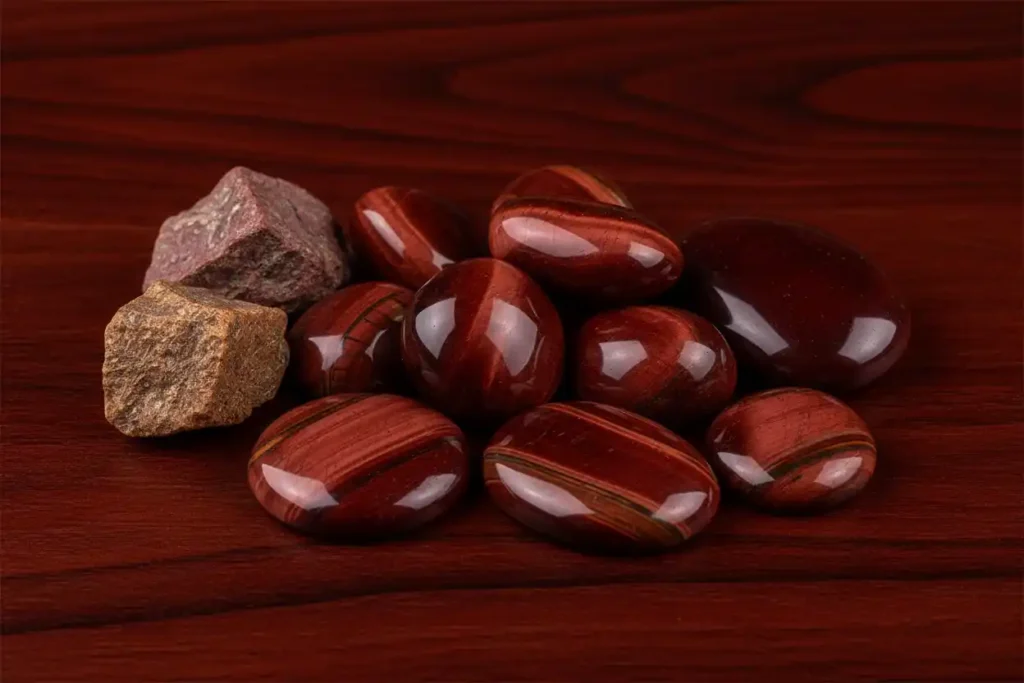
Natural opal forms within brown ironstone, and cutters preserve part of that host material because the valuable opal often occurs in thin irregular seams.
The ironstone can dominate the face, frame the opal, or create intricate matrix patterns.
Brown is therefore part of the design rather than merely a body color.
Play-of-color remains one of the strongest quality factors in precious material.
Natural Boulder vs Assembled Opal
The ironstone attached to natural boulder opal formed with the opal geologically.
A doublet is different.
In a doublet, a thin opal layer is intentionally glued to a separate backing.
Both products can be beautiful, but they belong to different construction and value categories.
Opal has lower hardness than quartz, sapphire, or diamond and can also crack or craze depending on the material.
Pendants and earrings are safer than heavily exposed rings.
The Best Brown Gemstones for Rings
For frequent-wear rings, durability should narrow the list before color does.
Brown diamond is the strongest option for scratch resistance, followed by brown sapphire and chrysoberyl.
Spinel also performs well.
Brown tourmaline and andalusite can work when the stone is sound and the setting is sensible.
Smoky quartz is usable but will scratch more readily over long wear.
Tiger’s eye works particularly well in substantial cabochon settings.
Topaz requires protection from cleavage-related impacts.
Zircon needs protection from abrasion and brittle edges.
Boulder opal is best reserved for careful wear.
The distinction between scratch resistance and actual resistance to breakage is explored in gemstone toughness vs hardness.
Best Brown Gemstones for Earrings and Pendants
Earrings and pendants greatly expand the available choices because they experience less repeated abrasion and impact.
This is where zircon, topaz, andalusite, boulder opal, smoky quartz, and more delicate collector gems become easier to use.
Large brown gemstones can also make more visual sense in pendants because face-up size can be appreciated without creating an impractically large ring.
A well-cut smoky quartz pendant can provide dramatic size at modest cost.
Brown zircon can offer far more brilliance.
Andalusite can display complex pleochroic color during movement.
Boulder opal brings natural pattern and play-of-color.
The best material therefore depends on whether the priority is brilliance, color complexity, optical phenomenon, rarity, durability, or scale.
Brown Gemstones for Bracelets
Bracelets are more demanding than many buyers expect.
A wrist regularly contacts desks, doors, countertops, and furniture, so stones encounter repeated impact and abrasion.
Brown diamond, sapphire, spinel, and carefully set chrysoberyl are particularly strong choices.
Quartz-family materials and tiger’s eye can also perform reasonably well in substantial protective designs.
Topaz, zircon, and opal deserve more caution.
A bracelet with several individually exposed stones multiplies the number of vulnerable edges and setting points, so structural inspection matters as much as the material’s nominal hardness.
Understanding Hardness, Toughness, and Cleavage
One of the most common mistakes when comparing brown gemstones is ranking them solely by Mohs hardness.
Hardness measures resistance to scratching.
It does not tell the complete story of breakage.
Diamond ranks 10 yet has perfect cleavage.
Topaz ranks 8 yet also has perfect cleavage.
Quartz is only 7 but lacks easy cleavage.
Jade is softer than many transparent gemstones yet can be exceptionally tough because of its interlocking structure.
Brown gemstones therefore need to be evaluated across several properties:
Surface hardness determines how easily polish and facet edges wear.
Toughness describes resistance to chipping and breaking.
Cleavage identifies preferred structural splitting directions.
Stability describes response to heat, light, chemicals, and environmental change.
Inclusions and treatments modify all of those practical expectations for an individual gemstone.
How Setting Design Changes Durability
A good setting can reduce exposure but cannot change the mineral itself.
Bezel settings protect girdles and can be particularly useful for tiger’s eye, smoky quartz, topaz, boulder opal, and other stones where edge protection matters.
Prongs expose more of the gem to light but leave portions of the girdle vulnerable.
Pointed shapes require special attention.
Pear tips, marquise points, princess corners, and other sharp areas can concentrate impact.
This matters even for hard brown gemstones.
Setting height matters as well.
A low ring is less likely to strike objects than a tall basket carrying the same center stone.
Protective design should be matched to the actual stone rather than chosen only for appearance.
Treatments in Brown Gemstones
Brown gemstones may be natural-color, treated, laboratory-grown, assembled, filled, coated, or altered in other ways depending on the species.
Treatment should be considered material by material.
Brown diamond can be natural, treated, or laboratory grown.
Smoky quartz color may be intensified artificially through irradiation.
Topaz can have a treatment history involving irradiation or heating depending on the material.
Zircon is commonly heat treated in portions of the commercial market.
Sapphire may be heated or receive more specialized treatment.
Tourmaline can be heated or clarity treated in some cases.
Opal can be filled, impregnated, smoked, dyed, or assembled depending on the type.
Treatment is not automatically a defect.
The important question is whether the description accurately states what is being sold and whether the price reflects the correct category.
Natural vs Laboratory-Grown Brown Gemstones
Laboratory growth is particularly important for diamond, sapphire, and spinel.
A laboratory-grown gemstone is not automatically an imitation.
Laboratory-grown diamond is diamond produced through manufacturing rather than geological formation.
Laboratory-grown sapphire is synthetic corundum with the fundamental composition and crystal structure of sapphire.
The major commercial distinction is origin.
Natural material carries geological rarity.
Laboratory-grown material can provide similar visual and physical performance at a different market position.
For a buyer who primarily wants a brown gemstone for jewelry appearance, laboratory-grown material may be completely appropriate.
For someone paying for natural rarity, correct origin documentation becomes essential.
Color Trade Names and Marketing
Brown gemstones have accumulated numerous attractive commercial color descriptions.
Champagne and cognac are widely associated with brown diamond.
Sherry appears in topaz terminology.
Cinnamon is common with hessonite garnet.
Chocolate, coffee, caramel, honey, bronze, and tobacco may appear across several materials.
These terms can communicate appearance effectively.
They do not constitute universal independent laboratory grades.
One seller’s cognac can overlap another seller’s dark champagne.
A stone marketed as chocolate does not automatically possess greater rarity.
Judge the actual hue, tone, saturation, transparency, and overall beauty rather than assuming the trade name creates value.
Why Cut Matters So Much
Dark brown gemstones can easily lose brilliance when cut too deeply.
The problem is extinction.
If large areas return little visible light, a richly colored stone may look almost black face-up.
A shallower cut is not automatically better, because excessive shallowness can produce windowing where the center becomes transparent and lifeless.
The best cut balances body color with light return.
This is especially important for smoky quartz, zircon, topaz, tourmaline, garnet, spinel, and andalusite.
Andalusite adds another complication because the cutter must manage several pleochroic colors simultaneously.
With tiger’s eye and boulder opal, cutting priorities change completely: optical phenomenon, natural pattern, and orientation matter more than conventional facet brilliance.
Does Carat Weight Determine Value?
No.
A large smoky quartz can be affordable because substantial clean rough is available.
The same carat weight in fine natural brown diamond could belong to an entirely different market.
Large topaz is also comparatively available in many ordinary colors.
A large fine spinel, chrysoberyl, or exceptionally transparent andalusite may become substantially less common.
Boulder opal complicates weight further because natural ironstone contributes to the total mass.
Therefore, brown gemstones should be compared within the same species, treatment category, quality level, and approximate size.
Carat weight is meaningful only after the material itself has been established.
What Determines Brown Gemstone Value?
There is no universal value formula for brown gemstones.
Each species has its own market.
However, several recurring factors matter.
Color should be attractive rather than merely dark.
Transparency matters for stones normally faceted as transparent gems.
Cut should produce good brightness, appropriate face-up size, and visual balance.
Inclusions should be judged according to whether they affect beauty, rarity, or structural integrity.
Treatment and origin should be disclosed accurately.
Natural-versus-laboratory-grown status can materially affect market value.
Size matters according to how rapidly rarity increases in the specific species.
Optical phenomena such as chatoyancy, pleochroism, dispersion, or play-of-color require their own quality criteria.
Provenance matters most where a famous locality or natural-color claim carries a premium.
Brown Gemstones and Symbolism
Brown gemstones are commonly associated symbolically with reliability, stability, practicality, patience, responsibility, and appreciation for gradual progress.
Those associations come from cultural interpretations of earth tones rather than measurable effects of gemstone chemistry.
A brown diamond may represent enduring commitment.
Tiger’s eye may symbolize careful observation.
Smoky quartz can represent perspective.
Andalusite can symbolize seeing several sides of one problem.
Boulder opal can represent creativity within real constraints.
These meanings can add personal significance to jewelry without implying that brown gemstones automatically create stability, improve finances, control emotions, guarantee relationships, or change another person’s behavior.
The most useful symbolism is attached to an action rather than a promised outcome.
Choosing Brown Gemstones by Budget
For accessible transparent size, smoky quartz is difficult to beat.
Brown topaz can also provide substantial size, although cleavage deserves consideration.
Tiger’s eye offers striking optical movement in a generally affordable cabochon market.
Brown garnet and some tourmaline provide a middle ground where individual quality can vary substantially.
Fine spinel, chrysoberyl, sapphire, and natural brown diamond move into more specialized markets depending on size, treatment, natural origin, and quality.
Boulder opal is especially difficult to rank by simple budget because pattern and play-of-color can create enormous differences among similarly sized stones.
Budget comparisons should therefore begin inside a species rather than across the entire brown gemstones category.
Buying Brown Gemstones Online
Online buying requires extra care because brown tones are easy to distort through lighting and editing.
Bright light can make a dark stone appear more transparent.
A black background can intensify saturation.
Warm lighting can push gray-brown toward orange or cognac.
Image processing can increase contrast and make pleochroism or play-of-color look stronger than it appears naturally.
Request photographs or continuous video of the actual gemstone under more than one neutral lighting condition.
Ask for dimensions as well as weight.
Ask directly about:
Natural or laboratory-grown origin.
Known treatment.
Natural or modified color.
Cracks, chips, repairs, fillers, or coatings.
Laboratory documentation.
Return conditions.
The broader safeguards in buying gemstones online are particularly useful for expensive stones or purchases where the seller’s description carries a substantial price premium.
When a Gem Lab Report Matters
A laboratory report is most valuable when uncertainty could materially change the value or buying decision.
Natural versus laboratory-grown diamond is an obvious example.
Natural-color versus treated-color diamond can also create a major pricing difference.
Sapphire origin, treatment, and natural-versus-synthetic status may justify documentation in higher-value purchases.
A report can also help identify an unusual brown faceted stone when visual appearance overlaps among tourmaline, andalusite, zircon, garnet, topaz, chrysoberyl, and other possibilities.
The gem lab report should be read for what it actually states.
A report identifying a stone is not necessarily an appraisal.
It may not assign monetary value.
Likewise, an appraisal with a large replacement figure is not proof that a dealer or private buyer would pay the same amount in resale.
Asking Price vs Real Market Value
A seller’s asking price is evidence of what the seller wants.
It is not automatically evidence of what comparable brown gemstones actually sell for.
This matters especially for uncommon brown colors marketed with dramatic names.
Compare stones with the same species, approximate size, treatment status, quality, and documentation.
Completed transactions can provide stronger evidence than unsold listings, although auction fees, dealer margins, geographic market, and individual demand still affect results.
Insurance replacement value is a different concept again.
A gemstone can have a high retail replacement appraisal and a much lower immediate resale value without either number being fraudulent, because the transactions answer different questions.
How to Clean Brown Gemstones
Brown color does not determine cleaning method.
Species does.
Diamond, sapphire, spinel, smoky quartz, tiger’s eye, zircon, topaz, tourmaline, and boulder opal should not automatically be placed into the same cleaning machine.
A conservative hand-cleaning method works for many stable untreated stones:
Use lukewarm water, mild soap, and a soft brush or cloth.
Rinse briefly.
Dry carefully.
However, treatment and structural condition can change the recommendation.
Fracture-filled, coated, assembled, heavily included, repaired, or delicate material deserves more caution.
Opal requires especially conservative care.
Topaz should be protected from abrupt heat and cleavage-related pressure.
Zircon should not be scrubbed aggressively along abraded facet edges.
When identity is uncertain, gentle manual cleaning is safer than steam or ultrasonic equipment.
How to Store Brown Gemstone Jewelry
Separate jewelry according to hardness and fragility.
Diamond and sapphire can scratch many other brown gemstones.
Topaz can scratch quartz.
Quartz can scratch opal and several softer materials.
Abrasive contact inside one jewelry box can dull polished surfaces even when nothing visibly breaks.
Individual pouches or divided compartments work well.
Protect rings from hard knocks rather than assuming a high hardness number guarantees survival.
Inspect settings periodically.
A loose stone can strike its own metal mounting repeatedly and eventually chip.
Storage should protect both the gemstone and the setting that holds it.
Frequently Asked Questions
What are brown gemstones?
Brown gemstones are natural or laboratory-grown gem materials displaying brown, champagne, cognac, honey, bronze, smoky, cinnamon, reddish-brown, or similar earthy colors. They include diamond, sapphire, spinel, quartz, zircon, topaz, tourmaline, andalusite, garnet, tiger’s eye, chrysoberyl, and boulder opal.
What are the best brown gemstones for everyday rings?
Brown diamond and sapphire offer the strongest overall durability, while chrysoberyl and spinel are also excellent choices. Tourmaline and andalusite can work with sensible settings, while opal and zircon require more cautious wear.
What is the hardest brown gemstone?
Brown diamond is the hardest at Mohs 10. Hardness measures scratch resistance, however, and diamond can still chip along cleavage directions after an unfavorable impact.
What is the most affordable transparent brown gemstone?
Smoky quartz is generally one of the most accessible options because large clean crystals are widely available. Brown topaz can also provide considerable size without the rarity premiums of fine diamond or sapphire.
Are brown diamonds natural?
Natural brown diamonds exist, but treated and laboratory-grown brown diamonds also exist. When natural origin or natural color affects price significantly, laboratory documentation is appropriate.
What is a champagne diamond?
Champagne is a commercial description for certain brown diamonds. The term communicates appearance but is not a universal mineral species or independent gemological grading system.
What is a cognac diamond?
Cognac is another commercial term for richer brown diamond colors, commonly suggesting stronger orange or reddish-brown warmth. Exact usage varies among sellers.
Is smoky quartz naturally brown?
Natural smoky quartz exists, with color produced through radiation-related color centers in the quartz structure. Artificial irradiation can also create or intensify smoky color.
Is brown topaz suitable for a ring?
It can be used in a ring, but topaz has perfect basal cleavage despite its hardness of 8. Protective settings and avoidance of sharp impact are important.
Is brown zircon the same as cubic zirconia?
No. Zircon is a natural zirconium-silicate mineral. Cubic zirconia is a manufactured zirconium-oxide material with different structure and physical properties.
Is tiger’s eye a brown gemstone?
Yes. Golden-brown tiger’s eye is widely used as an ornamental gemstone, especially in cabochons, signets, beads, and pendants. Its primary visual feature is chatoyancy.
Which brown gemstone has the most interesting color change with direction?
Andalusite is one of the strongest choices because of pronounced pleochroism. One gemstone can show brown, green, yellow, orange, and reddish directions according to orientation.
Are brown gemstones treated?
Some are. Treatments depend on the species and may include irradiation, heat, filling, coating, diffusion, or other processes. Other stones may be laboratory grown or assembled. Disclosure should identify the relevant category.
Are brown gemstones valuable?
They can range from very inexpensive to extremely valuable. Species, natural origin, treatment, color, cut, clarity, size, optical phenomena, rarity, condition, and documentation determine value far more than brown color alone.
Are brown gemstones good for engagement rings?
Some are excellent choices. Brown diamond and sapphire are particularly suitable for frequent-wear engagement rings. Spinel and chrysoberyl can also perform well, while topaz, zircon, quartz, and opal require progressively more consideration of setting protection and wear habits.
What is the difference between brown crystals and brown gemstones?
Brown crystals form a broader specimen and spiritual-use category that can include minerals, rocks, volcanic glass, fossils, and aggregates. Brown gemstones are evaluated primarily as gem materials for jewelry, with emphasis on cutting, durability, treatment, value, setting, buying, and care.
Which metal looks best with brown gemstones?
Yellow and rose gold often complement warm champagne, cognac, cinnamon, and reddish-brown colors. White gold, platinum, and silver create stronger contrast and can emphasize gray or smoky components. The best choice depends on the actual stone rather than a universal color rule.
How can I tell whether a brown gemstone is real?
Color alone cannot prove identity. Mineral species may require refractive-index testing, density, microscopy, spectroscopy, optical testing, or laboratory analysis. Avoid destructive home scratch testing on valuable jewelry.
Choosing Brown Gemstones by Material, Not Marketing Name
Brown gemstones offer far more gemological variety than their shared earthy color suggests.
A brown diamond may combine exceptional scratch resistance with natural structural color and high-value origin questions. Sapphire and spinel provide strong frequent-wear alternatives. Smoky quartz delivers substantial transparent size at an accessible price. Zircon provides intense brilliance, while topaz combines useful hardness with an important cleavage weakness. Tourmaline expands the palette into honey, olive, cinnamon, and deep brown, and andalusite can display several colors at once through pleochroism.
Tiger’s eye changes the decision completely by replacing transparency with a moving chatoyant band, while boulder opal builds its appeal around precious color interacting with natural brown ironstone.
These differences are why brown gemstones should never be selected through color or a commercial name alone.
First identify the material. Then consider natural versus laboratory-grown origin, treatment, hardness, toughness, cleavage, structural condition, cut, optical performance, setting design, and how frequently the jewelry will actually be worn.
After those questions are answered, color becomes much easier to appreciate for what it contributes: warmth, subtlety, contrast, and a broad spectrum of jewelry possibilities that extend far beyond the idea of brown as merely a secondary gemstone color.