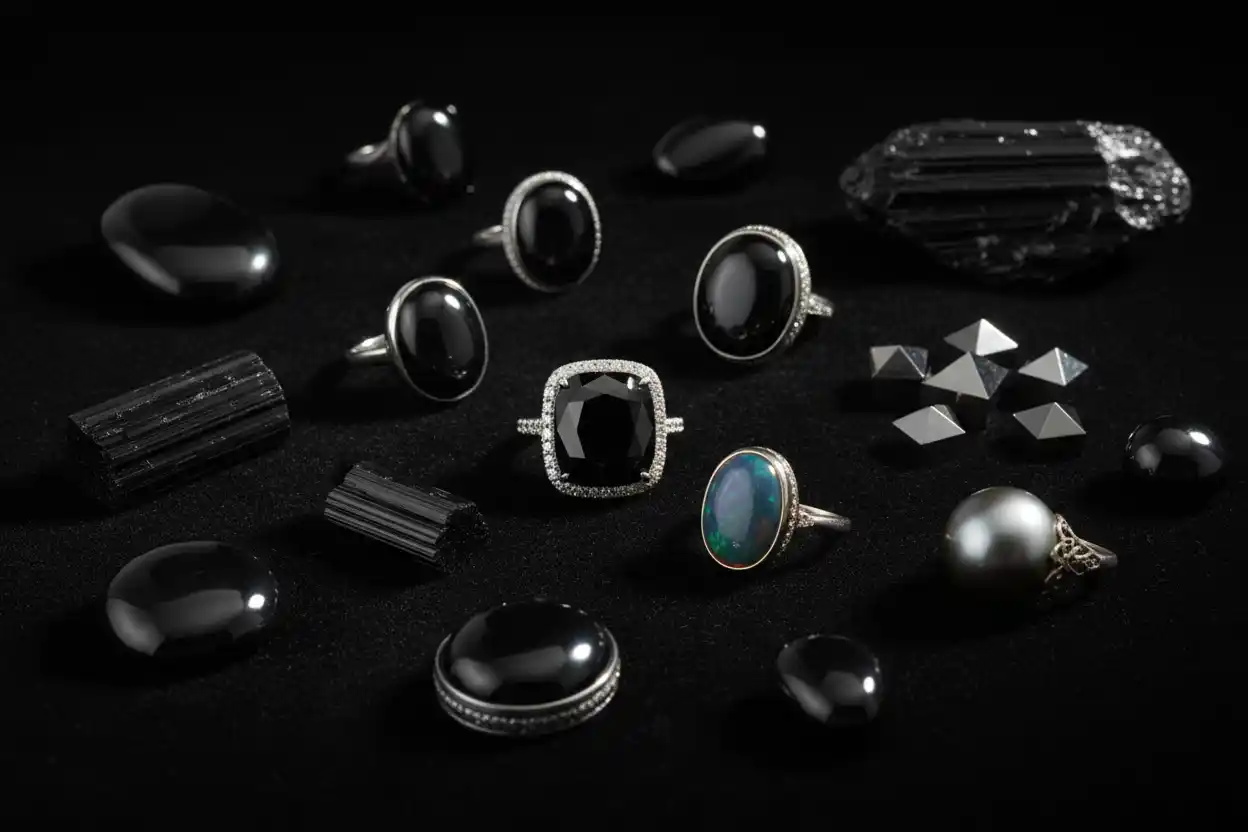
Black Gemstones: Benefits, Uses & Practical Guidance
Black gemstones include some of the hardest materials used in fine jewelry, several softer ornamental gems, volcanic glass, organic materials and stones whose apparent black color is actually extremely dark blue, green, brown or gray. Black diamond, sapphire and spinel can withstand demanding jewelry use particularly well, while onyx, jade and melanite garnet occupy a practical middle ground, and black opal, obsidian, jet, pearl and moonstone require progressively more deliberate care.
What connects black gemstones is appearance rather than shared mineralogy. Diamond is crystalline carbon, sapphire is corundum, spinel is an oxide mineral, onyx is chalcedony, obsidian is volcanic glass, jet is altered organic material and cultured black pearl develops through biological processes inside a mollusk, so two stones that look equally dark can differ dramatically in hardness, toughness, treatment, rarity and value.
For buyers, those differences matter more than generalized meanings attached to the color black. The strongest black gemstones for a daily ring are not necessarily the stones best suited to earrings, carved signets, necklaces or collectible cabochons, while an expensive black material is not automatically more durable than an inexpensive alternative.
Black Gemstones at a Glance
| Black gemstone | Material identity | Approx. Mohs hardness | Strong jewelry uses | Main buying concern |
|---|---|---|---|---|
| Black diamond | Crystalline carbon | 10 | Rings, earrings, pendants, bracelets | Natural color vs treated color vs lab-grown |
| Black sapphire | Corundum | 9 | Daily rings, signets, bands, earrings | Very dark bodycolor, treatment and synthetic origin |
| Black spinel | Magnesium aluminum oxide | 8 | Rings, earrings, bracelets, pendants | Natural vs synthetic material |
| Black tourmaline | Usually iron-rich schorl | 7–7.5 | Pendants, beads, earrings, protected rings | Fractures, brittleness and rough-vs-polished material |
| Black onyx | Chalcedony | About 6.5–7 | Signets, cuff links, beads, cabochons | Uniform black material is commonly dyed |
| Black jade | Jadeite or nephrite with dark coloration | About 6–7 | Bangles, signets, carvings, cabochons | True jade identity and treatment |
| Melanite garnet | Titanium-rich black andradite garnet | About 6.5–7 | Rings, earrings, beads, antique-style jewelry | Species confirmation and surface wear |
| Dark smoky quartz | Quartz, including very dark morion | 7 | Rings, earrings, pendants | Natural vs irradiation-darkened color |
| Black zircon | Zircon | About 6–7.5 | Earrings, pendants, occasional rings | Brittleness, facet abrasion and treatment |
| Black star diopside | Diopside showing asterism | About 5.5–6.5 | Cabochon rings and pendants | Star quality and moderate durability |
| Black opal | Dark-body opal | About 5.5–6.5 | Pendants, earrings, protected rings | Solid vs doublet/triplet, treatment and stability |
| Hematite | Iron oxide | About 5–6.5 | Beads, signets, cabochons | Brittleness and magnetic imitations |
| Obsidian | Natural volcanic glass | About 5–5.5 | Pendants, beads, carvings, protected cabochons | Scratching and sharp conchoidal chips |
| Black moonstone | Dark feldspar showing adularescence | About 6–6.5 | Pendants, earrings, protected rings | Cleavage, surface wear and trade-name misuse |
| Jet | Organic gem material derived from ancient wood | About 2.5–4 | Earrings, necklaces, beads, carvings | Softness, imitation and antique condition |
| Black pearl | Cultured or natural pearl with dark bodycolor | About 2.5 | Earrings, necklaces, pendants | Natural/cultured origin, dye and delicate nacre |
This range shows why black gemstones cannot be assigned one universal care routine, durability grade or price expectation.
What Counts as a Black Gemstone?
A gemstone does not have to be transparent, crystalline or faceted to function as a gem material, which is why the category includes opaque minerals, rocks, natural glass and organic materials alongside conventional crystalline stones. The distinction between these categories is explained more broadly in crystals vs gemstones, where visual appeal and lapidary use are separated from strict crystallographic terminology.
Some black gemstones are genuinely opaque, while others only appear black because their bodycolor is extraordinarily deep.
A black sapphire may reveal navy, greenish or brown undertones beneath strong transmitted light. Dark smoky quartz can look nearly opaque from ordinary viewing distance but reveal brown transparency at thin edges, while black pearl frequently shows gray, green, blue, purple or copper overtones instead of neutral black.
Black opal represents another category entirely because the dark background may support vivid spectral play-of-color.
This means “black” should be treated as the beginning of identification rather than the conclusion.
How Black Gemstones Get Their Color
There is no universal cause of black color in gemstones.
Dense Inclusions
Natural black diamond commonly contains large populations of dark inclusions, graphitized fractures or related structural features that absorb light and make the stone appear opaque or nearly opaque.
Iron-Rich Chemistry
Iron can produce very dark colors in several mineral groups, including schorl tourmaline, spinel and some sapphires, although the exact optical mechanism differs from one mineral to another.
Extremely Dark Bodycolor
Some black gemstones are technically dark blue, green, purple or brown materials whose tone becomes so deep that little color remains visible under normal illumination.
Carbon-Rich Composition
Jet derives its dark appearance from carbon-rich organic material created through geological alteration of wood.
Surface or Internal Treatment
Treatment also creates many commercial black gemstones. Chalcedony can be dyed to produce uniform black onyx, diamonds can be treated to appear black, pearls may be dyed, and quartz can be irradiation-darkened.
Color alone therefore cannot establish whether black gemstones are untreated, rare or valuable.
1. Black Diamond
Black diamond occupies the hardest end of the black gemstones category, defining Mohs 10 and resisting surface abrasion better than every other conventional jewelry stone.
Natural black diamonds usually derive their appearance from concentrations of graphite, pyrite, hematite or other dark inclusions, as well as graphitized fractures and structural features distributed through the diamond. The actual diamond body beneath those features may not itself possess a perfectly neutral black color.
The larger diamond mineral guide explains why hardness should not be confused with complete resistance to damage, because diamond has perfect octahedral cleavage and can chip from a concentrated impact.
Natural vs Treated Black Diamond
This is one of the most important distinctions when buying black gemstones.
Many commercial black diamonds have been treated to produce a more uniform dark appearance. High-temperature annealing can graphitize internal fractures and inclusions, while irradiation can produce extremely dark green color that appears black to the eye.
Treated black diamond remains diamond.
However, its color origin and market value differ from naturally colored black diamond.
Laboratory-grown black diamond forms another separate category and should be disclosed accordingly.
A significant purchase deserves a reputable gemological report when natural color is part of the price.
Best Uses
Black diamond is particularly well suited to rings, earrings, bracelets and pendants when the individual stone is structurally sound and securely set.
Its reflective faceted surfaces create a sharper, more metallic appearance than the broad waxy polish of onyx or the glassy surface of obsidian.
2. Black Sapphire
Black sapphire provides one of the strongest combinations of durability, accessibility and dark appearance among natural black gemstones.
Sapphire is corundum and ranks Mohs 9, while its excellent practical toughness and lack of easy cleavage make it particularly suitable for rings expected to receive frequent wear.
Many black sapphires are actually extremely dark blue, greenish or grayish corundum. Dense inclusions can also reduce transparency until the gem appears opaque.
The broader sapphire color guide explains how black-looking sapphire fits within corundum’s much wider color range.
Black Star Sapphire
Some dark sapphires contain oriented inclusions that create asterism when the material is cut as a correctly aligned cabochon.
A good star should appear reasonably sharp, move smoothly across the dome under a concentrated light source and sit near the center when illumination is directly above the stone.
Star quality can matter more than absolute darkness.
Treatment
Sapphire may be heated, diffusion treated, filled or dyed, while laboratory-grown material is also commercially available.
Ordinary heating is a different treatment category from extensive filling or diffusion, so a seller should state more than simply “treated sapphire.”
3. Black Spinel
Black spinel is one of the most underused black gemstones for durable everyday jewelry because it combines Mohs hardness 8, good toughness and no prominent easy cleavage with a smooth opaque surface capable of taking a strong polish.
Spinel is magnesium aluminum oxide, ideally MgAl₂O₄, and crystallizes in the cubic system.
Iron-rich material can become very dark or effectively black.
The spinel mineral profile explains how black spinel belongs to the same species as transparent red, pink, violet, gray and blue gem spinel while deriving its appearance from a different compositional balance.
Jewelry Advantages
Black spinel resists scratches substantially better than onyx, obsidian, jet or hematite, which makes it suitable for rings, bracelets and other formats that receive regular abrasion.
It can be faceted for sharper reflections or fashioned into cabochons for a broader polished surface.
Natural vs Synthetic Spinel
Synthetic spinel has existed for many decades.
Laboratory-grown material can still be attractive and durable, but natural origin should be established before paying a natural-gem premium.
4. Black Tourmaline
Black tourmaline used as a gem or ornamental stone is usually schorl, the iron-rich tourmaline species familiar from dark prismatic mineral crystals.
Schorl commonly forms strongly striated crystals and can be polished into cabochons, beads and carvings.
Tourmaline generally ranks around Mohs 7–7.5, providing useful scratch resistance, although its toughness is only fair and natural crystals frequently contain fractures.
For this reason, black gemstones made from tourmaline are usually more convincing in pendants, beads, earrings and protected rings than in thin exposed rough-crystal designs.
Rough vs Polished Black Tourmaline
A complete terminated mineral crystal may be more valuable as a specimen than as cutting rough.
Polished commercial black tourmaline is valued mainly for appearance, durability and workmanship, while fine natural crystals can also be evaluated by locality, termination, luster and mineral associations.
These are different markets and should not be priced identically.
5. Black Onyx
Black onyx is one of the classic black gemstones used in signet rings, cuff links, cameos, beads and engraved jewelry.
Onyx is chalcedony, a microcrystalline quartz-family material traditionally characterized by relatively straight parallel bands. Uniform commercial black onyx, however, is commonly chalcedony whose color has been darkened through dyeing.
The structural distinction between onyx and visually similar volcanic glass is examined in onyx vs obsidian.
Is Dyed Black Onyx Bad?
No.
A stable dyed chalcedony cabochon can make excellent jewelry and has been part of the gem trade for generations.
The issue is representation.
Dyed material should not be marketed as an exceptionally rare naturally jet-black stone, and its price should reflect the material rather than a story built around artificial rarity.
Jewelry Use
At approximately Mohs 6.5–7, onyx works particularly well in recessed signets and bezel settings where its broad polished face receives some protection from direct impact.
Surface scratches will accumulate faster than they would on sapphire or spinel.
6. Black Jade
Black jade can refer to genuinely dark jadeite or nephrite, although the jade name is frequently applied loosely to other minerals in commercial markets.
True jade includes jadeite and nephrite, two different materials that share exceptional toughness despite moderate hardness.
Jadeite generally ranks around Mohs 6.5–7, while nephrite is around 6–6.5.
Their interlocking structures make both remarkably resistant to breaking, which is why jade can perform well in bangles, signet rings, carvings and substantial cabochons even though harder black gemstones resist scratches more effectively.
Treatment Matters
Jadeite can be bleached, polymer impregnated, dyed, waxed or otherwise treated.
The commonly used trade classification distinguishes relatively untreated or traditionally waxed material from polymer-impregnated and dyed jadeite categories.
Black color does not eliminate the need for treatment disclosure.
Value
Fine jade value depends on more than darkness.
Texture, translucency, evenness, treatment status, craftsmanship and cultural market demand can matter substantially, while an ordinary opaque black carving occupies a different market from fine translucent jadeite.
7. Melanite Garnet
Melanite is a black titanium-bearing variety of andradite garnet, making it one of the less obvious natural black gemstones for buyers who want a genuine mineral rather than dyed chalcedony or treated diamond.
Andradite belongs to the garnet group and typically falls around Mohs 6.5–7.
Melanite can appear opaque black with a strong polish, and its historical use in jewelry makes it particularly appropriate for antique-inspired rings, pendants and mourning-style designs.
The stone should not be confused automatically with black spinel or onyx.
Professional identification through refractive properties, density and other gemological observations provides much stronger evidence than color.
8. Dark Smoky Quartz and Morion
Smoky quartz ranges from pale grayish brown to extremely dark material traditionally called morion.
Quartz ranks Mohs 7 and has no cleavage, making dark smoky quartz a practical option among moderately durable black gemstones.
Unlike truly opaque onyx or spinel, dark smoky quartz can reveal brown, gray or smoky transparency when the material is thin or strongly illuminated.
This creates more visual depth in faceted stones.
Natural vs Treated Color
Smoky color forms when radiation interacts with aluminum-related defects in quartz.
Natural geological irradiation can create the effect, but commercial quartz can also receive artificial irradiation.
A very dark color does not therefore prove rarity or natural color origin.
9. Black Zircon
Natural zircon should not be confused with cubic zirconia.
Zircon is zirconium silicate and has high refractive index and dispersion, giving transparent stones impressive brilliance when appropriately cut.
Very dark zircon may appear black or nearly black, sometimes with brown, green or other undertones.
The material’s durability requires more caution than its appearance suggests because zircon can be brittle, and facet junctions can abrade with repeated wear.
Black zircon is therefore easier to recommend for earrings and pendants than for an exposed daily ring.
Treatment history can also affect color, so unusual commercial black material deserves appropriate disclosure.
10. Black Star Diopside
Black star diopside is normally fashioned as a cabochon to reveal asterism created by oriented inclusions within the gem.
The bodycolor is typically dark green to black, while the star can show four distinct rays under a concentrated light source.
At roughly Mohs 5.5–6.5, diopside is considerably softer than sapphire or spinel.
Its appeal lies in the optical phenomenon rather than maximum durability.
A low bezel or protective cabochon setting is therefore preferable for rings, while pendants provide an easier wear environment.
When evaluating these black gemstones, rotate the stone under one small light source and watch whether the star moves naturally across the surface.
A stationary painted or surface-applied pattern is not a genuine asterism phenomenon.
11. Black Opal
Black opal is among the most valuable black gemstones when exceptional natural material combines a dark body tone with intense play-of-color.
It is not a separate mineral species.
Black opal is opal whose dark background provides strong contrast for spectral flashes, which can include red, orange, green, blue and violet.
The complete black opal profile explains why body tone, play-of-color, pattern, origin, treatment and construction must be considered together.
Solid, Doublet and Triplet
A solid black opal contains natural opal throughout the relevant gem body, although natural potch or host material may remain attached.
A doublet combines a thin opal layer with a dark backing.
A triplet adds a transparent protective cap.
Doublets and triplets can create beautiful jewelry at more accessible prices, but they should not be represented or valued as equivalent to comparable solid natural black opal.
Durability
Opal generally ranks around Mohs 5.5–6.5 and is brittle.
Heat, extreme dryness, impact and—in assembled pieces—prolonged moisture can create problems.
Black opal is therefore one of the black gemstones best suited to earrings, pendants and deliberately protected rings rather than unrestricted daily wear.
12. Hematite
Hematite is iron oxide, Fe₂O₃, and can appear steel gray, silver-gray or almost black with a metallic polish.
Its most distinctive identification clue is the red to reddish-brown powdered streak produced by genuine hematite, despite its dark exterior.
The hematite mineral guide explains how that physical property contributed to the mineral’s long historical association with blood and red pigment.
Hematite typically ranks around Mohs 5–6.5 and is brittle.
It works particularly well in beads, cabochons and signet-style jewelry where its density and metallic luster become part of the design.
Magnetic Hematite Warning
Natural hematite is not normally a strongly permanent magnetic material.
Highly magnetic polished beads marketed as “magnetic hematite” may instead be manufactured ferrite products sometimes called hematine.
A strong magnet response is therefore an identification clue rather than proof of high-quality natural hematite.
13. Black Obsidian
Black obsidian is one of the most familiar black gemstones in ornamental jewelry, although technically it is natural volcanic glass rather than a crystalline mineral.
Its glassy structure creates conchoidal fracture, allowing broken edges to become extremely sharp.
Obsidian commonly ranks around Mohs 5–5.5 and therefore scratches more readily than quartz-family black gemstones.
Polished cabochons, beads and carvings can still be attractive when protected from hard impact.
Jewelry Limitations
A chipped obsidian ring can create a physical hazard as well as cosmetic damage.
This makes pendants and earrings easier long-term choices than thin exposed rings.
A deep bezel can improve protection but cannot change the brittle nature of volcanic glass.
14. Black Moonstone
Black moonstone is a commercial name applied to dark feldspar material that shows moonstone-like adularescence, commonly with gray, brown, peach or silvery areas rather than a perfectly uniform neutral black.
Moonstone belongs to the feldspar family and generally ranks around Mohs 6–6.5.
Its cleavage makes it more vulnerable to impact than quartz, spinel or sapphire.
The best black moonstone cabochons display a visible floating light effect when moved beneath a light source.
A dark feldspar with no meaningful adularescence should not automatically receive a moonstone premium simply because of its trade label.
Black moonstone works particularly well in pendants and earrings, while rings benefit from low protective settings.
15. Jet
Jet occupies a completely different category from mineral black gemstones because it is an organic gem material formed from altered ancient wood.
It is lightweight, warm to the touch compared with many minerals, capable of taking a smooth black polish and historically important in carved and mourning jewelry.
Jet is relatively soft, generally around Mohs 2.5–4, and can be scratched easily by most other gemstones.
It is also brittle.
Antique jet jewelry may have additional vulnerabilities from old string, pins, adhesives or repairs, making conservative care especially important.
Jet vs Glass and Plastic
Glass imitations generally feel heavier and colder, while plastics can vary widely.
Destructive hot-needle or flame tests should not be used on valuable jewelry.
Microscopy, density and expert inspection are safer.
16. Black Pearl
The term black pearl usually refers to dark cultured pearls, particularly Tahitian cultured pearls, although their colors frequently range through gray, green, blue, purple, bronze and peacock overtones rather than pure neutral black.
Pearl differs from mineral black gemstones because its nacre is produced biologically.
Its Mohs hardness is only about 2.5, making it especially vulnerable to scratches.
Perfume, hairspray, cosmetics, acids and perspiration can also affect the surface.
Natural Color vs Dye
Dark pearl color can be natural to the cultured pearl type, but pearls can also be dyed, coated, irradiated or otherwise processed.
A dark pearl’s value depends strongly on cultured-pearl type, size, luster, surface quality, shape, matching and natural versus treated color.
Pearls work particularly well in earrings and necklaces because those formats expose them to less abrasion than rings.
Which Black Gemstones Are Best for Rings?
Rings create the most demanding environment because the hand repeatedly encounters hard surfaces.
For frequent wear, black gemstones can be grouped approximately by practical durability.
Strongest choices: black sapphire, black spinel and appropriately selected black diamond.
Good with normal care: dark smoky quartz, melanite garnet and securely set black jade.
Better with protection: black onyx, tourmaline and black star diopside.
Higher-maintenance choices: black opal, obsidian, moonstone, hematite, jet and pearl.
The distinction between hardness and resistance to breakage is essential here, and gemstone toughness vs hardness explains why a single Mohs number cannot predict every type of ring damage.
Which Black Gemstones Are Best for Earrings?
Earrings receive far less impact than rings, so almost every stable black gem becomes easier to use.
Black pearl is particularly successful because the delicate nacre remains away from tabletops and tools.
Black opal can display dramatic color without the constant impact risk of a ring.
Jet’s low weight makes it comfortable even in relatively large designs.
Black diamond, sapphire and spinel remain excellent choices when the earrings are intended for frequent use and minimal maintenance.
For earrings, post metal and total weight may matter more to comfort than gemstone hardness.
Which Black Gemstones Are Best for Pendants?
Pendants allow broad freedom because direct abrasion remains relatively limited.
Black tourmaline, obsidian, onyx, opal, moonstone, hematite, jet and dark quartz can all work well.
Large specimens need strong bails and chains because material density varies substantially.
Hematite is much heavier than jet at comparable dimensions.
A dramatic stone on an underbuilt bail can fail even when the black gemstone itself remains undamaged.
Which Black Gemstones Are Best for Signet Rings?
Signet designs suit opaque black gemstones particularly well because broad flat or domed surfaces can sit within substantial protective metal.
Black sapphire provides excellent abrasion resistance.
Black spinel offers a highly polished durable surface.
Onyx provides the classic traditional appearance.
Jade adds exceptional toughness.
Hematite creates a metallic alternative.
Obsidian can work when recessed deeply enough to protect its brittle glass edges.
For carving-oriented signets, the material differences covered in gemstones for carving become particularly important because grain, fracture and toughness influence how a broad dark stone responds during cutting.
Hardness Does Not Rank Black Gemstone Durability by Itself
A black gemstone can be hard and still contain structural weaknesses.
Diamond is Mohs 10 but has cleavage.
Jade is much softer yet possesses extraordinary toughness because its crystals or fibers form tightly interlocking structures.
Opal lacks cleavage but is brittle and environmentally more sensitive.
Obsidian has no cleavage in the crystalline sense because it is glass, yet it can break into extremely sharp conchoidal fragments.
Black gemstones should therefore be judged through:
hardness + toughness + cleavage + stability + inclusions + treatments + setting + wear frequency
This framework is more useful than deciding that every stone above Mohs 7 is automatically suitable for every piece of jewelry.
Treatments Are Especially Important With Black Gemstones
Dark color can conceal treatments more effectively than transparency would, making disclosure particularly important.
Black Diamond
High-temperature treatment and irradiation are common methods for producing black appearance in commercial diamonds.
Black Onyx and Chalcedony
Dyeing has a long history and remains widespread.
Black Pearl
Dye, coating and other treatments can create or modify dark colors.
Black Jade
Jadeite can be dyed, bleached and polymer impregnated.
Black Opal
Smoke treatment, dye, impregnation and assembled constructions may occur depending on source and product.
Smoky Quartz
Artificial irradiation can create or deepen dark smoky color.
Treatment does not automatically make black gemstones poor purchases. The key questions are whether the treatment is stable, disclosed and reflected appropriately in price.
Natural, Laboratory-Grown and Imitation Are Different
A natural black gemstone formed geologically or biologically without laboratory crystal growth.
A laboratory-grown gemstone has been manufactured with essentially the same gem identity as its natural counterpart where a true synthetic exists.
An imitation is a different material chosen to resemble another gem.
Laboratory-grown diamond is diamond.
Synthetic spinel is spinel produced artificially.
Black glass sold to imitate onyx is an imitation.
Cubic zirconia sold to resemble black diamond is also an imitation rather than laboratory-grown diamond.
These categories should be kept separate because origin, rarity, durability and market value differ.
Identifying Black Gemstones
Opaque black gemstones can be difficult to identify visually because darkness hides inclusions, color zoning and optical details that would otherwise provide clues.
Start non-destructively.
Look at luster.
Diamond can show a strong adamantine surface, while onyx tends toward waxy-to-vitreous polish and obsidian looks strongly glassy.
Consider weight.
Jet is unusually light, while hematite is conspicuously dense.
Inspect thin edges.
Obsidian can transmit brownish or grayish light, while extremely dark sapphire may reveal a blue or green undertone.
Observe optical phenomena.
Star sapphire and star diopside should show moving rays beneath a concentrated light, while black opal’s play-of-color changes with angle.
Then use professional gemological measurements when value warrants them.
Refractive index, specific gravity, microscopy, spectroscopy and other laboratory methods are considerably more useful than damaging scratch, flame or acid experiments.
Why Destructive Home Tests Are a Bad Idea
Internet identification advice often recommends scratching black gemstones, heating them, using acids, breaking an edge or dragging the stone across an abrasive streak plate.
Those methods can permanently damage a legitimate gem.
They can also produce misleading results because coatings, treatments, settings, surface contamination and mixed materials interfere with observations.
A destructive result rarely justifies the value lost from the test.
Use visual evidence and professional testing instead.
What Makes Black Gemstones Valuable?
There is no single black-gemstone price scale.
Value factors change by species.
Diamond
Natural versus treated color, natural versus laboratory-grown origin, size, condition, cutting and documentation matter strongly.
Sapphire and Spinel
Durability alone does not create a premium. Natural origin, unusual optical phenomena, cutting, size and treatment matter.
Black Opal
Body tone, brightness, color range, pattern, size, condition, origin and whether the gem is solid or assembled drive value.
Jade
Texture, translucency, treatment status, workmanship and cultural demand can dominate.
Jet
Fine antique carving, provenance and historic workmanship may matter more than raw material weight.
Pearl
Luster, surface quality, size, shape, matching, cultured-pearl type and color origin determine quality.
Onyx and Obsidian
Material itself is generally accessible, so craftsmanship, metal value, age, designer attribution or exceptional carving can contribute more to a finished piece than raw-stone rarity.
A high retail price therefore does not automatically mean the underlying black gemstone is rare.
Buying Black Gemstones Online
Begin with the exact species or material.
“Natural black stone” is not sufficiently specific.
Ask whether color is natural or treated, whether the material is natural or laboratory grown, and whether the piece contains a composite, backing, coating or filler.
Compare millimeter dimensions as well as carat weight because black gemstones have different densities.
Request video in ordinary light.
A photograph edited for deep contrast can make dark blue sapphire, brown quartz or gray pearl appear neutral black.
For expensive black diamond, sapphire, spinel, opal or jade, appropriate independent documentation can be worthwhile when treatment or origin materially affects price.
Return terms are particularly important for opaque gems because subtle differences in luster, surface quality and undertone may be difficult to judge on a screen.
Cleaning Black Gemstones
The safest cleaning method follows the exact material rather than the color.
Sound untreated sapphire, spinel, diamond and quartz can generally tolerate gentle warm soapy water well, provided their settings are secure and no vulnerable treatment is present.
Onyx should be cleaned conservatively rather than exposed unnecessarily to harsh chemicals.
Black jade is safest with warm soapy water when treatment status is uncertain.
Opal deserves protection from excessive heat and harsh environmental conditions, while doublets and triplets require particular caution around prolonged moisture.
Pearls should be wiped after wear and kept away from acids, perfume, hairspray and aggressive cleaning.
Jet needs gentle handling because it is soft.
Obsidian should be protected from scratches and hard impact.
Hematite should not be treated as an indestructible piece of metal simply because it looks metallic.
One cleaning method cannot safely cover every black gemstone.
Storing Black Gemstones
Store stones according to hardness rather than color.
Diamond can scratch essentially every other common jewelry gemstone.
Sapphire can scratch quartz, onyx, jade, tourmaline, opal, pearl and jet.
Spinel can also damage many softer materials.
Pearls and jet deserve particularly soft separate storage.
Black opal should not be allowed to strike harder gems.
Obsidian pieces with chipped edges should be isolated until repaired, replaced or safely discarded.
Individual compartments or soft pouches prevent black gemstones that look visually compatible from damaging one another physically.
Practical Benefits of Black Gemstones
The most reliable benefits of black gemstones are material and design benefits rather than supernatural claims.
Black is visually versatile and can create strong contrast with yellow, white or rose-colored metals.
Opaque materials hide ordinary inclusions that would be visually distracting in transparent gems.
Dark cabochons can support large graphic surfaces in signet rings and cuff links.
Black sapphire and spinel provide excellent durability for people who want dark jewelry without choosing diamond.
Onyx provides an accessible traditional carving material.
Jade combines smooth polish with extraordinary toughness.
Jet creates substantial visual size at very low weight.
Black opal provides an optical spectacle unlike any uniformly black stone.
These are observable advantages that help explain why black gemstones have remained useful across fine jewelry, mourning jewelry, signets, contemporary design and ornamental carving.
Black Gemstone Symbolism
Black gemstones have carried symbolic associations involving authority, remembrance, restraint, boundaries, resilience and protection across different periods and traditions.
Jet became closely connected with mourning jewelry.
Onyx has long been used in seals, cameos and signets.
Modern black diamond can symbolize unconventional commitment because it reverses the visual expectations of the conventional colorless diamond ring.
Black sapphire, spinel and tourmaline are frequently associated with resilience or boundaries in contemporary crystal traditions.
Those meanings can make jewelry personally significant, but they are interpretations rather than scientifically measurable powers.
A black gemstone does not guarantee protection, change another person’s behavior, cure illness or determine personality.
The value of the symbolism lies in what the wearer intentionally connects with the object.
Black Gemstones vs Black Crystals
These categories overlap, but they are most useful when they serve different purposes.
A black-crystal collection may include rough mineral specimens, meditation objects, volcanic glass, shungite and other materials selected partly for spiritual tradition or specimen interest.
Black gemstones are better evaluated through jewelry-oriented questions:
What material is this?
How hard is it?
How tough is it?
Has it been treated?
Can it survive a ring?
How should it be set?
How difficult is it to replace?
What determines value?
That difference keeps black gemstones focused on gemology and jewelry rather than simply repeating a list of dark spiritual stones.
Frequently Asked Questions
What are black gemstones?
Black gemstones are dark gem materials used for jewelry, carving or ornamentation, including minerals such as diamond, sapphire, spinel and hematite, chalcedony such as onyx, natural volcanic glass such as obsidian, and organic gem materials such as jet and pearl.
What are the most durable black gemstones?
Black diamond, black sapphire and black spinel provide the strongest overall scratch resistance for demanding jewelry. Sapphire and spinel also have particularly useful practical toughness for frequent wear.
What is the best black gemstone for an everyday ring?
Black sapphire is one of the strongest overall choices because corundum combines Mohs hardness 9, excellent toughness and no easy cleavage. Black spinel is another strong option, while black diamond provides maximum scratch resistance but still requires attention to inclusions and cleavage.
Are black diamonds naturally black?
Some are naturally black because of dense inclusions, graphitized fractures and related structural features, while many commercial black diamonds receive treatment to produce a more uniform dark appearance.
Are treated black diamonds real diamonds?
Yes, when the starting material is diamond. Treatment changes the color appearance rather than converting diamond into another mineral, but treated color should be disclosed because it affects market classification and value.
Is black sapphire naturally black?
Some sapphire appears naturally black or effectively black because of extremely dark bodycolor or dense inclusions. Treatment and laboratory-grown material also occur, so color alone does not establish origin.
Is black spinel good for jewelry?
Yes. Black spinel ranks Mohs 8, has good toughness and no prominent easy cleavage, making it one of the most practical black gemstones for rings, bracelets, earrings and pendants.
Is black onyx naturally black?
Uniform commercial black onyx is commonly dyed chalcedony. The treatment can produce attractive durable jewelry, but it should be disclosed and should not be marketed as unusually rare natural black color.
Is black jade real jade?
It can be. Both jadeite and nephrite can occur in dark colors, but many unrelated materials have historically been marketed with jade trade names. Valuable pieces should be identified specifically as jadeite or nephrite and checked for treatment.
Is black opal naturally black?
Natural black opal exists and has a dark body tone, although treated dark opal and assembled doublets or triplets are also available. The exact construction and treatment have major effects on value and care.
Are black pearls really black?
Many cultured pearls described as black are actually dark gray, green, blue, bronze or purple with colorful overtones. Some colors are natural to the cultured-pearl type, while dye and other treatments can also produce dark pearls.
Is obsidian a black gemstone?
Obsidian is widely used as a black gem material, although it is natural volcanic glass rather than a crystalline mineral. It is softer and more brittle than sapphire, spinel or quartz.
Is hematite a black gemstone?
Hematite is an iron oxide mineral commonly polished for beads and cabochons. Its surface may appear steel gray to black, while its powdered streak is characteristically red to reddish brown.
Is jet a mineral?
No. Jet is an organic gem material formed from altered ancient wood, which makes it fundamentally different from mineral black gemstones such as sapphire or spinel.
What is black star diopside?
Black star diopside is dark diopside containing oriented inclusions that can produce a four-rayed star when the stone is cut as a properly oriented cabochon.
What is the difference between black sapphire and black spinel?
Black sapphire is corundum with Mohs hardness 9, while black spinel is magnesium aluminum oxide with Mohs hardness 8. Both can make durable jewelry, although sapphire generally provides greater scratch resistance.
What is the difference between black onyx and obsidian?
Onyx is microcrystalline quartz-family chalcedony, while obsidian is amorphous volcanic glass. Onyx is generally harder and more resistant to surface abrasion, whereas obsidian can chip into exceptionally sharp edges.
Which black gemstones are best for signet rings?
Black sapphire, black spinel, onyx and jade are particularly useful because they can support broad cabochon or tablet forms while providing different balances of hardness, toughness and cost.
Which black gemstones need the most care?
Pearl, jet, black opal, obsidian and moonstone need considerably more careful handling than sapphire, spinel or diamond because of softer surfaces, brittleness, cleavage, environmental sensitivity or organic structure.
Are black gemstones expensive?
Some can be, but black color alone does not make a gem expensive. Fine natural-color black diamond, exceptional black opal or important jade can command high prices, while onyx, obsidian, hematite and many commercial black stones are widely available.
Are all black gemstones untreated?
No. Dyeing, irradiation, heating, polymer impregnation, coating and other treatments occur across the category. Treatment should be evaluated according to the individual material.
Can laboratory-grown black gemstones be good jewelry?
Yes. Laboratory-grown diamond and synthetic spinel can provide useful physical properties and attractive appearance when their manufactured origin is disclosed accurately and the price reflects that category.
How can I identify a black gemstone?
Begin with luster, transparency at thin edges, density, crystal form, optical effects and known treatment information, then use gemological measurements such as refractive index, specific gravity, microscopy or spectroscopy when identity materially affects value. Avoid destructive scratch, flame and acid tests.
How should black gemstones be cleaned?
Cleaning must follow the material. Gentle warm soapy water works for many durable untreated stones, while pearl, opal, jet, treated jade and assembled gems require greater caution. Do not choose a cleaning method simply because every stone in the jewelry looks black.
Do black gemstones have protective powers?
Protection associations belong to cultural and contemporary spiritual symbolism rather than scientifically established gemological properties. Black gemstones can serve as meaningful reminders of boundaries or resilience, but they do not create a proven invisible protective field.
What should I check before buying black gemstones?
Confirm the exact material, natural or laboratory-grown origin, color treatment, other enhancements, dimensions, condition, jewelry durability and documentation appropriate to the price. Black appearance alone provides too little information to establish identity, rarity or value.