Lapis Lazuli Rings: Styles, Durability and Buying Tips
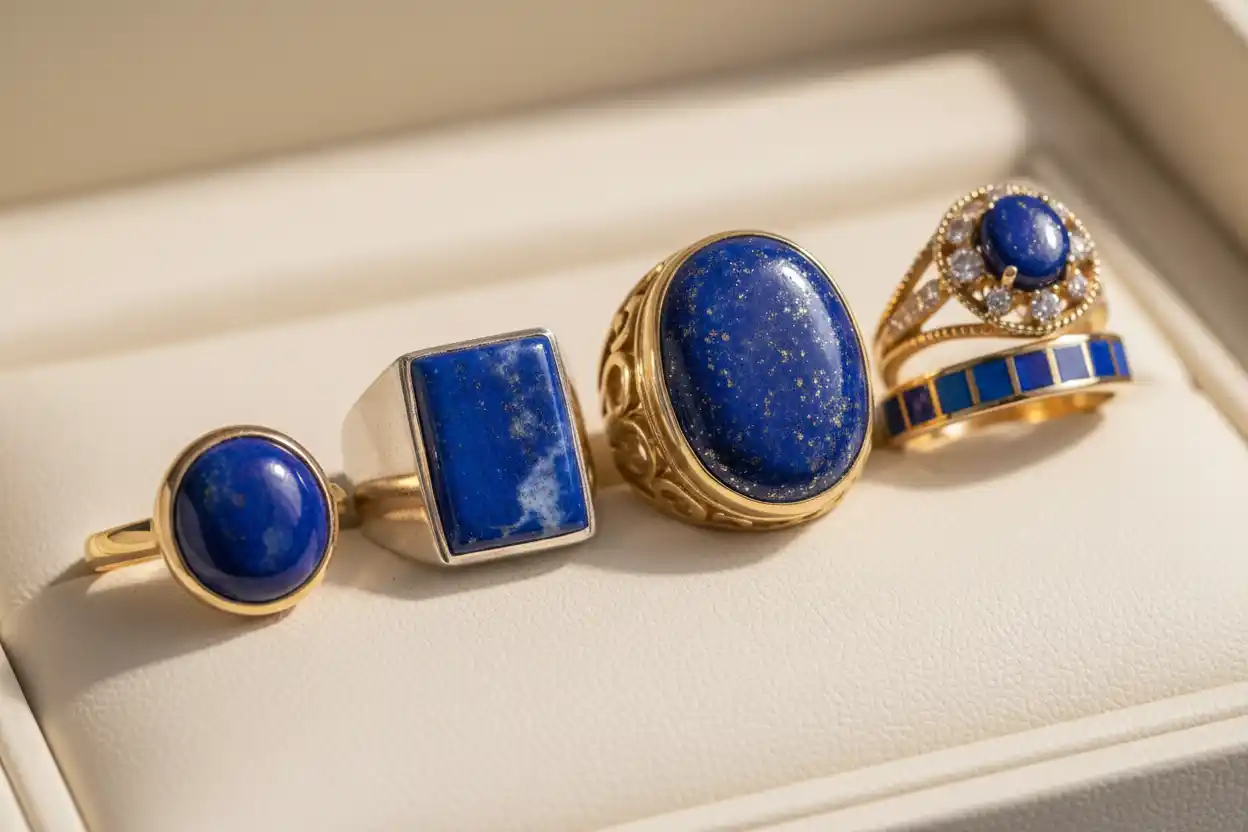
Lapis lazuli rings create a bold field of opaque royal, indigo, or violetish blue on the hand. Some stones appear almost uniformly blue, while others include small gold-colored pyrite flecks, white calcite veins, or mottled natural texture.
Rings are also the most demanding way to wear lapis. The material is a multi-mineral rock with hardness around 5–6, fair toughness, and variable structural behavior. It can scratch, chip, abrade, or separate along weak mineral boundaries when worn without protection.
Treatment adds another layer of risk. Dye, wax, oil, resin, coating, and reconstructed construction may all be encountered. Heat, solvents, moisture, or polishing can affect these enhancements even when the stone survives the impact itself.
The broader lapis lazuli guide explains its composition, history, symbolism, and uses. This page focuses on ring settings, quality, sizing, construction, treatment, wear, buying, and repair.
Are Lapis Lazuli Rings Practical?
Lapis rings are practical for controlled or occasional wear, especially when the stone sits in a low bezel or recessed signet.
They are not ideal for unrestricted daily use during manual work, exercise, gardening, cleaning, cooking, or other activities involving impact and chemicals.
The material’s hardness varies because it contains several minerals. Lazurite-rich blue areas, softer calcite veins, pyrite, and other components do not necessarily wear at the same rate.
The gemstone hardness chart provides numerical context. Gemstone Toughness vs Hardness explains why even an opaque stone with no obvious cleavage can still chip or abrade under ring-level use.
A successful lapis ring usually has:
- A low profile
- Protected edges
- A thick enough stone
- No major open fracture
- A substantial shank
- Stable treatment
- Correct sizing
- Realistic removal habits
Lapis Lazuli Ring Styles Compared
| Ring style | Protection | Main advantage | Main concern |
|---|---|---|---|
| Full bezel | High | Protects most of the edge | Closed back may hide treatment |
| Recessed signet | High | Low profile and strong metal support | Surface abrasion |
| Partial bezel | Moderate to high | Shows more of the stone | Exposed sides remain vulnerable |
| Four-prong setting | Moderate to low | Open appearance | Edge exposure and pressure points |
| Halo ring | Moderate | Adds contrast and visual spread | Hard accents can scratch lapis |
| Cocktail ring | Variable | Displays a large stone | Height and impact leverage |
| Tablet ring | Moderate | Bold geometric surface | Chipped corners |
| Inlay ring | Variable | Smooth decorative design | Thin stone and adhesive failure |
| Three-stone ring | Variable | Combines complementary materials | Stone-to-stone contact |
| Vintage ring | Variable | Historical character | Worn settings and past repairs |
| Intaglio or carved signet | High when recessed | Detailed personalized design | Surface wear and thin carving |
| Adjustable ring | Low to moderate | Flexible sizing | Repeated bending distorts the setting |
Bezel-Set Lapis Rings
A full bezel generally offers the best protection.
The metal surrounds the stone’s perimeter and reduces direct impact to the edge. It also creates a smooth profile that catches less easily on clothing.
The bezel must fit the stone evenly. Look for:
- Gaps
- Folded or rippled metal
- Glue seepage
- A moving stone
- Crushed corners
- Pressure over a calcite vein
- Uneven metal height
- A damaged or lifted edge
A closed back may provide structural support. It can also conceal a thin lapis tablet, dark backing, resin, glue, or a doublet.
Ask whether the visible stone is a solid cabochon, backed slab, reconstructed product, or inlay component.
Recessed Signet Rings
A signet is one of the strongest ring styles for lapis.
The stone can sit flush or slightly below a broad metal surface, protecting the edges from many side impacts.
Oval, cushion, rectangular, shield, and tablet shapes work particularly well. Carved intaglios can add personal or historical styling.
The ring should contain enough metal around and beneath the stone. A very thin signet face can flex and crack a tablet.
Lapis signets are commonly marketed toward men, although the design suits any wearer. The best gemstones for men guide provides other materials for substantial rings.
Prong-Set Lapis Rings
Prongs expose more of the stone but protect less of its perimeter.
Rounded cabochons may be secured with four or six prongs. Rectangles, tablets, and angular shapes need additional corner support.
The stone should rest inside a basket rather than balance above the finger.
One prong should not press directly on a visible fracture or calcite vein. Uneven tightening can cause localized chipping.
Prong-set lapis is better suited to occasional wear than a low bezel or signet.
Halo Lapis Rings
A halo surrounds the lapis with smaller stones.
White accents can create strong contrast with royal blue. Common choices include diamonds, lab diamonds, sapphires, moissanite, cubic zirconia, and white topaz.
A low halo may protect the center from some lateral impacts, but the harder accent stones must not touch the lapis.
Diamond, sapphire, and topaz can scratch it. Flexible settings that allow girdles to rub together create long-term damage.
Every accent material should be identified rather than described only as crystals.
Lapis Lazuli Cocktail Rings
Large lapis cabochons and tablets are widely available, making statement rings accessible.
A large stone increases the ring’s visible presence but also increases impact risk. Width, height, and leverage all matter.
A practical cocktail ring should use:
- A low bezel
- A split or substantial shank
- Support beneath the stone
- Protected corners
- Enough metal to prevent twisting
- A balanced fit that limits spinning
Statement rings are best reserved for dinners, events, photography, and other controlled settings.
Tablet Rings
A flat lapis tablet creates a clean architectural surface.
Tablets may be oval, rectangular, square, shield-shaped, or custom cut. Their corners and edges are more vulnerable than those of rounded cabochons.
A complete metal frame provides stronger protection than isolated prongs.
Thin tablets can crack if the ring flexes or if pressure is applied from beneath. Ask whether the stone is solid or backed.
A uniform face-up blue may conceal calcite or treatment on the reverse, particularly in closed settings.
Lapis Inlay Rings
Inlay uses thin lapis pieces fitted into channels or mosaic patterns.
It can produce geometric bands, stripes, symbols, and combinations with turquoise, shell, coral, onyx, malachite, or metal.
The surface should feel smooth and continuous. Look for:
- Gaps
- Lifting edges
- Cloudy glue
- Missing fragments
- Uneven polish
- Color mismatch
- Cracks crossing seams
- Raised sections
- Replaced material
Inlay rings should not be soaked, steamed, or ultrasonically cleaned.
The wearer should also avoid resizing that places heat or mechanical force near the inlay.
Vintage and Antique Lapis Rings
Lapis has been used in revivalist, Egyptian-inspired, Art Deco, mid-century, and modernist jewelry.
An older ring may have value through age, design, maker, provenance, and metalwork rather than material grade alone.
Inspect for:
- Worn bezels
- Soft solder
- Replaced stones
- Recut cabochons
- Glue
- Filled chips
- Resized shanks
- Missing inlay
- Surface repolishing
- Dye applied during restoration
An antique-looking design may also be newly made. Style does not prove age.
Choosing the Best Blue
Fine lapis is usually saturated medium-dark blue to slightly violetish blue.
Very dark material should remain visibly blue rather than black. Pale, gray, or greenish material generally carries lower commercial value.
Large white calcite patches interrupt the color and may create softer areas that wear differently.
A perfectly uniform blue can be natural, but it can also result from dye. Color alone does not establish treatment status.
The Lapis Lazuli Buying Guide owns the full quality framework.
Pyrite in a Ring
Small pyrite flecks can add attractive metallic contrast.
They are not gold and should not be marketed as precious-metal inclusions.
Large pyrite veins may create uneven polishing, disrupt the blue, or become visually dominant.
A ring with heavy metallic content may also show more textural variation after repeated wear.
Pyrite cannot prove natural origin because imitations can contain added metallic particles.
Calcite and Wear
Calcite appears white and is softer than lazurite-rich areas.
A calcite vein may abrade faster, producing an uneven surface. It can also become a structural weakness when it crosses a thin corner or exposed edge.
Visible calcite does not make lapis fake. It affects quality, appearance, and durability.
A stone with deliberate white patterning may suit a casual or artistic ring, but it should not be priced as uniform high-grade blue material.
Surface Quality
Examine the ring under diffused side lighting.
Look for:
- Scratches
- Cloudy abrasion
- Chips
- Pits
- Undercut calcite
- Raised pyrite grains
- Open fractures
- Coating wear
- Resin-filled cavities
- Glue around the setting
- Uneven repolishing
A waxed or oiled surface may initially appear glossy. Heat, solvents, and wear can change that finish.
Treatments
Dye
Dye is used to deepen pale blue and conceal calcite.
It can collect in fractures, pores, drill holes, and pale areas. Unstable color may transfer to skin or cloth or react with alcohol, acetone, perspiration, and cosmetics.
Wax and Oil
Wax and oil deepen color and improve luster. Their stability is only fair.
Resin and Plastic
Resin may stabilize porous material, fill cavities, or seal dye. Surface coatings can scratch or peel.
Reconstruction
Lapis fragments or powder may be bound with resin and shaped into a cabochon or tablet.
The treated lapis lazuli guide owns the complete treatment and synthetic-material boundary.
Treatment should be disclosed because it changes care and value.
Imitations and Lookalikes
Common substitutes include dyed howlite, dyed magnesite, dyed marble, sodalite, glass, ceramic, resin, reconstructed material, and synthetic blue products.
The Real vs Fake Lapis Lazuli guide owns the broader authenticity process.
Sodalite is a natural blue mineral with white veining that can resemble pyrite-free lapis. The direct Lapis Lazuli vs Sodalite guide explains that distinction.
Avoid scratch, acid, flame, hot-needle, and solvent tests. A ring can be damaged without producing a conclusive result.
Metal Choices
Yellow gold creates a strong historical contrast with blue and visually echoes pyrite.
Sterling silver, white gold, and platinum produce a cooler appearance. Oxidized silver can create dramatic contrast.
Rose gold may soften the combination but can warm greenish-blue material.
The shank needs enough metal to resist bending. A thin band can distort and loosen the stone even when the lapis itself remains intact.
The guide to gemstones and metals for sensitive skin explains alloy, nickel, plating, and solder issues.
Ring Sizing and Balance
Correct sizing reduces rotation and impact.
A loose top-heavy ring spins around the finger and strikes surfaces more frequently. A tight ring becomes uncomfortable and can be difficult to remove when the hand swells.
Wide bands generally fit more tightly than narrow bands of the same nominal size.
Sizing beads, a broader lower shank, or an internal stabilizer can balance a large cabochon.
Ask whether the ring can be resized. Full bezels, inlay, carvings, eternity patterns, and intricate galleries may limit alteration.
Heat and chemicals used during resizing can affect dye, wax, oil, resin, glue, and coating. The stone may need to be removed first.
Price and Value
The lapis lazuli price guide owns detailed valuation.
Ring price can reflect:
- Color saturation
- Calcite content
- Pyrite distribution
- Surface quality
- Stone size
- Treatment
- Carving
- Inlay labor
- Metal weight
- Designer workmanship
- Historical significance
- Origin evidence
- Brand
Large lapis material is available, so size alone does not establish rarity.
In gold, platinum, antique, or designer rings, the metal and workmanship may be worth much more than the stone.
Buying Online
Follow the safeguards in How to Buy Gemstones Online Without Getting Scammed.
Request:
| Buying detail | What to confirm |
|---|---|
| Material | Natural lapis lazuli or disclosed substitute |
| Treatment | Dye, wax, oil, resin, coating, or reconstruction |
| Stone dimensions | Length, width, and thickness |
| Construction | Solid cabochon, tablet, inlay, backing, or doublet |
| Setting | Bezel, prongs, halo, glue, or channel |
| Metal | Alloy, hallmark, plating, and shank thickness |
| Ring size | Current size and resizing limits |
| Condition | Chips, scratches, fractures, and previous repair |
| Origin | Evidence for Afghan, Chilean, or Russian claims |
| Returns | Time for non-destructive inspection |
A report may be useful for an expensive antique, disputed treatment, or important origin claim. The gemstone certification guide explains what it can establish.
Wearing a Lapis Lazuli Ring
Wear the ring on the non-dominant hand when practical.
Remove it before:
- Exercise
- Gardening
- Cleaning
- Cooking
- Swimming
- Showering
- Mechanical work
- Applying lotions or perfume
- Lifting luggage
- Sleep
Do not stack it beside diamond, sapphire, topaz, or hard-edged metal rings.
For lower-impact alternatives, lapis lazuli earrings and a lapis lazuli necklace protect the material better.
A lapis lazuli bracelet faces similar exposure to impact and chemicals.
Cleaning and Storage
Follow How to Clean Lapis Lazuli Jewelry Safely.
Use lukewarm water, mild soap, and a soft cloth or brush only after confirming that the color is stable.
Do not use ultrasonic or steam cleaning. Avoid acid, acetone, alcohol, bleach, jewelry dips, abrasives, and heat.
Do not soak inlay, backed, glued, dyed, waxed, or resin-treated rings.
Dry promptly and store the ring in a separate padded compartment away from harder gemstones.
The Crystals That Start With L and Gemstones That Start With L directories provide the wider alphabetical context.
Repair and Maintenance
Inspect the bezel, prongs, shank, inlay seams, glue, and stone surface regularly.
Stop wearing the ring if the stone moves, an inlay lifts, the shank bends, or a crack expands.
Tell the jeweler that the material is lapis and disclose all known treatments. Heat and solvents used in ordinary repair can remove color or damage fillers and coatings.
A chipped cabochon may sometimes be repolished, but the process can alter its dimensions, surface treatment, and fit.
Frequently Asked Questions
1. Can a lapis lazuli ring be worn every day?
It is better suited to controlled or occasional wear because the material is relatively soft and may be dyed, waxed, or resin-treated.
2. What is the safest ring setting?
A low full bezel or recessed signet generally offers the strongest edge protection.
3. Is lapis suitable for an engagement ring?
It can carry personal meaning, but it is much less durable than diamond, sapphire, ruby, or spinel and requires frequent removal.
4. What is the best lapis ring color?
Fine material is usually saturated medium-dark blue to violetish blue with little visible calcite.
5. Are pyrite flecks desirable?
Small, attractively distributed flecks can add interest. Heavy pyrite may interrupt color and polish.
6. Does white calcite mean the ring is fake?
No. Calcite is a natural component, although large white areas generally reduce value and can affect wear.
7. Are lapis rings often dyed?
Yes. Dye is common in commercial material and should be disclosed.
8. Can a backed stone still be natural lapis?
Yes, but backing may enhance contrast or conceal thin construction, so it should be explained.
9. Can lapis rings be resized?
Some can, but full bezels, inlay, treatment, and heat sensitivity can make resizing difficult.
10. Can lapis be set with diamonds?
Yes, but diamond accents must not rub against the lapis because they can scratch it.
11. Can a lapis ring be cleaned ultrasonically?
No. Ultrasonic cleaning can damage the stone, treatments, inlay, glue, and setting.
12. What should I do if the stone becomes loose?
Stop wearing the ring and have it inspected by a jeweler familiar with treated opaque gemstones.
A strong lapis lazuli ring depends on protection rather than hardness. A low setting, substantial metal, stable treatment, accurate sizing, and careful removal habits preserve the blue surface far better than a high exposed design. The most attractive stone cannot compensate for weak construction or undisclosed enhancement.