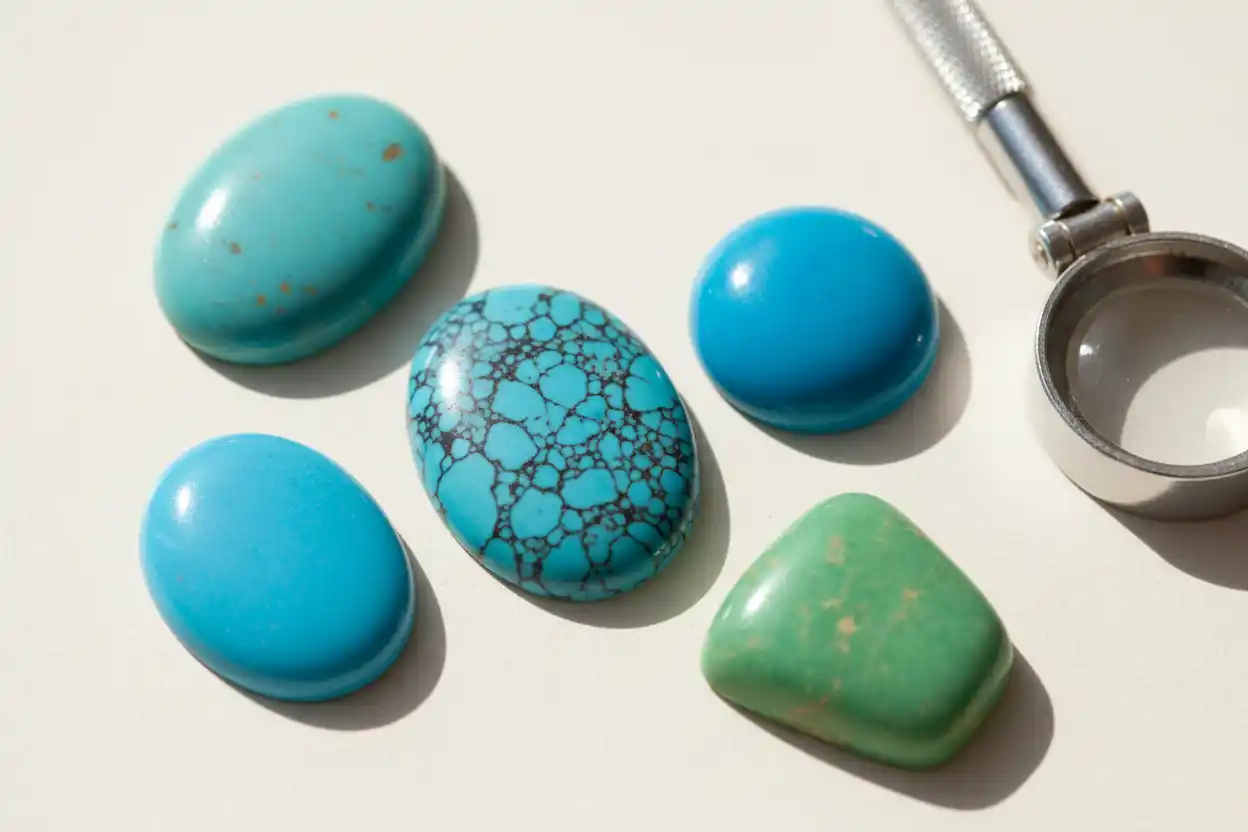
Buy Turquoise: Smart Buying Tips & Red Flags
When you buy turquoise, the most important question is not whether the stone is blue enough or whether a famous mine name appears in the description. Two cabochons can look almost identical from the front while belonging to completely different commercial categories: one may be dense untreated natural turquoise, another may be porous natural material stabilized with resin, a third may be dyed and impregnated, and a fourth may be reconstructed particles held together by polymer or an imitation made from dyed howlite, magnesite, ceramic, glass, or resin.
That hidden difference is why a strong decision to buy turquoise starts with material category and treatment before price per carat. Turquoise is usually opaque, so conventional transparent-gem criteria such as brilliance, pavilion light return, and microscopic clarity are much less important than color, texture, density, matrix pattern, polish, structural integrity, treatment, construction, provenance, and craftsmanship.
Color still matters enormously. Fine even medium blue remains one of the classic high-demand appearances, while blue-green, green, lime-green, spiderweb, matrix-rich, and locality-characteristic turquoise can also command serious collector interest. A clean robin’s-egg-blue cabochon is therefore not automatically better than an exceptional natural spiderweb stone, and green turquoise is not automatically lower grade.
Treatment creates the biggest practical dividing line when you buy turquoise. Stabilization can turn porous natural material into a durable and attractive jewelry stone, while dye can intensify weak color and reconstruction can turn fragments or powder into a manufactured composite. Each category can be appropriate at the right price when disclosed accurately, but they should not be valued as though they represent the same geological rarity.
The best way to buy turquoise is to determine exactly what the product is, judge the visible quality appropriate to that category, investigate treatment and construction, inspect the back as carefully as the front, evaluate mine and artist claims separately, and then decide whether the asking price reflects the actual material rather than the story attached to it.
What Should You Judge First When You Buy Turquoise?
When you buy turquoise, use a hierarchy designed for an opaque, frequently treated gemstone rather than borrowing a diamond or sapphire checklist. Begin with natural-versus-manufactured structure, then determine treatment, color, texture, matrix, polish, physical integrity, construction, provenance, dimensions, and documentation.
Turquoise is a hydrated copper-aluminum phosphate that normally forms as compact masses, vein fillings, nodules, and crust-like material rather than large transparent crystals. Copper contributes much of the characteristic blue coloration, while iron, hydration, porosity, associated minerals, and alteration can move the appearance toward green. Its broader mineral identity, geology, history, physical properties, and symbolic traditions are covered in turquoise meaning.
For purchasing, however, the critical distinction is commercial structure. A solid untreated cabochon, stabilized natural stone, dyed stabilized stone, backed turquoise tablet, reconstructed composite, and blue ceramic imitation can all occupy the same jewelry showcase while having very different value.
| Priority | What to evaluate | Stronger choice | Main concern |
|---|---|---|---|
| 1 | Material category | Solid natural turquoise represented accurately | Vague “real turquoise” wording |
| 2 | Treatment | Untreated, waxed, stabilized, dyed, filled, or reconstructed status disclosed | “Natural” used to avoid treatment details |
| 3 | Color | Attractive blue, blue-green, or green appropriate to the category | Chalky, blotchy, artificially intense, or weak color priced as premium |
| 4 | Texture | Dense, compact material capable of a strong polish | Porous or crumbly texture hidden by treatment |
| 5 | Matrix | Attractive, structurally sound, naturally integrated pattern | Painted, repeated, weak, or unstable webbing |
| 6 | Polish | Smooth, even surface with appropriate luster | Plastic-like coating, pits, scratches, dullness |
| 7 | Construction | Solid, backed, inlaid, or composite structure clearly described | Hidden backing or assembled material |
| 8 | Provenance | Mine or regional claim supported when it changes value | Famous mine assigned from color alone |
| 9 | Dimensions | Useful face-up size and sensible thickness | Excessive backing or hidden mass |
| 10 | Documentation | Evidence proportional to treatment and provenance premium | Seller card presented as independent proof |
Using this order every time you buy turquoise prevents a famous mine name, perfectly blue photograph, or unusually low price from controlling the decision before you know what you are purchasing.
Turquoise Is Usually Judged by Color, Texture, and Matrix
Transparent gemstones are often judged through color, clarity, cut, and carat weight. Turquoise requires a different framework.
When you buy turquoise, the three most important visible factors are usually color, texture, and matrix. Cut and polish still matter, but the cutter is revealing an opaque surface rather than creating a pavilion designed for brilliance.
Texture is especially important because naturally dense turquoise can take a smooth, attractive polish and resist ordinary wear better than soft, chalky material. Porous turquoise can absorb oils and chemicals more readily and may need stabilization before it becomes practical jewelry material.
Matrix can either reduce or increase value depending on its pattern, structural stability, and collector preference.
This explains why the main commercial categories in types of turquoise should be understood before comparing prices.
Color Is the First Visible Quality Factor
When you buy turquoise, color is normally the feature you notice first and one of the strongest drivers of demand.
Natural turquoise ranges through:
- Light sky blue.
- Medium blue.
- Robin’s-egg blue.
- Greenish blue.
- Blue-green.
- Teal.
- Green.
- Yellow-green.
- Gray-green.
Historically, an even medium blue has received especially strong international demand. However, the modern market also values green, blue-green, spiderweb, and strongly locality-characteristic material.
A good buy turquoise decision should therefore separate traditional market preference from personal preference.
If you genuinely prefer green Nevada material or dramatic black spiderweb, paying extra for matrix-free robin’s-egg blue simply because a generic grading chart ranks it higher may make little sense.
Even Medium Blue Remains a Classic Premium Appearance
Fine turquoise with an even, saturated, medium blue surface remains one of the most widely recognized quality categories.
When you buy turquoise in this style, inspect whether the color remains consistent across the cabochon rather than shifting into chalky white patches, gray zones, or obviously dyed-looking concentrations.
Uniformity can be valuable, particularly in matching earrings, bead strands, and multi-stone jewelry.
However, perfect uniformity does not prove natural untreated material. Stabilization, dye, reconstruction, ceramic, resin, and manufactured composites can all produce extremely even blue.
Color establishes appeal.
It does not establish authenticity.
Robin’s-Egg Blue Is a Color Description, Not an Origin
Robin’s-egg blue is widely used for clean medium blue turquoise.
When you buy turquoise described this way, treat the phrase as a visual description rather than proof of one mine or country.
Similar-looking material can come from Iran, the United States, China, or another source, and treatment can also create a convincing even blue appearance.
A color name should tell you what the seller thinks the stone looks like.
It should not silently become a provenance certificate.
“Persian Blue” Does Not Automatically Mean Persian Turquoise
This distinction matters greatly when you buy turquoise at a premium.
Persian blue is often used as a trade color term for an even medium-to-strong blue historically associated with Iranian material. Persian turquoise, by contrast, implies geographic origin.
The two descriptions should not be treated as interchangeable.
A turquoise cabochon from another source can legitimately resemble the classic Persian-blue appearance. That does not make it Iranian.
If the seller charges extra specifically because the stone is represented as Persian or Iranian, provenance needs stronger support than color resemblance.
Green Turquoise Can Be Completely Natural
A common beginner misconception is that authentic turquoise must be blue.
When you buy turquoise, remember that genuine natural material can be blue-green, green, olive-green, yellow-green, or gray-green.
Iron and other compositional and structural factors can shift the color away from pure blue, while long-term exposure to oils, dehydration, and alteration can affect some material further.
Green color therefore does not automatically prove dye, damage, or imitation.
Some green turquoise has significant collector demand because the hue and matrix are characteristic of particular deposits.
Blue-Green and Teal Turquoise Have Their Own Market
When you buy turquoise with an aqua, teal, or blue-green appearance, evaluate the saturation and texture rather than penalizing the stone simply for containing green.
A dense blue-green cabochon with exceptional polish and attractive matrix can be a strong gemstone.
Contemporary jewelry often uses these colors deliberately because they pair well with both warm and cool metals.
The correct question is whether the color looks attractive and natural for the material—not whether it exactly matches an old-fashioned robin’s-egg standard.
Very Pale Turquoise Needs More Treatment Scrutiny
Pale blue, chalky, and grayish material is often naturally more porous and lower in density.
When you buy turquoise that appears unusually pale yet has a very glossy, saturated surface, ask whether stabilization, dye, impregnation, coating, or another treatment has changed its appearance.
Low-density turquoise can be made much more useful through stabilization.
That is not inherently a problem.
The problem appears when porous material is transformed substantially and then priced as naturally dense untreated turquoise.
Color Concentration Can Reveal Treatment Clues
When you buy turquoise beads, carvings, or fractured cabochons, inspect areas where dye could collect:
- Drill holes.
- Surface pits.
- Fractures.
- Matrix boundaries.
- Recessed carving details.
- Undersides.
- Chipped edges.
Unusually dark blue concentrated in these areas can suggest dye.
However, natural staining and mineral variation can create localized color too, so one visual clue does not prove treatment.
Use suspicious color distribution as a reason to ask better questions or obtain testing.
Matrix Is Not Automatically a Defect
Matrix is the host-rock or associated material visible within turquoise.
When you buy turquoise, matrix may appear:
- Black.
- Brown.
- Tan.
- Gray.
- Golden.
- Reddish.
- Cream.
- Mixed.
Some global markets traditionally favor clean blue with little matrix, while many collectors actively seek strongly patterned material.
The presence of matrix therefore should not be converted automatically into a discount.
Its value depends on pattern, contrast, stability, provenance, and personal preference.
Spiderweb Turquoise Can Command a Strong Premium
Spiderweb turquoise contains fine intersecting matrix lines forming a web-like pattern.
When you buy turquoise in this category, look for a balanced pattern that complements the body color without overwhelming it.
Fine dark webbing across vivid blue or green can be highly collectible.
The web should also be structurally stable. A line that looks attractive in a photograph may actually be a deep open fracture filled with weak host material.
Pattern and integrity must be evaluated together.
Natural Spiderweb Should Look Integrated With the Stone
When you buy turquoise with premium spiderweb matrix, inspect whether the lines appear naturally connected to the surrounding material.
Suspicious signs can include:
- Repeated nearly identical patterns across many cabochons.
- Painted-looking black lines.
- Matrix color that sits only on the surface.
- Perfect geometric webbing.
- Resin-rich gaps.
- A pattern that changes abruptly at a polished edge.
- Multiple stones with clone-like designs.
None of these signs alone proves reconstruction.
They simply justify closer examination.
Manufacturers can deliberately create attractive matrix-like patterns in composites because buyers associate spiderweb with valuable natural material.
Large Matrix Patches Are a Different Aesthetic
Some turquoise contains broad areas of host rock rather than delicate webbing.
When you buy turquoise in free-form, ribbon, or boulder-style material, these larger matrix areas can be intentionally preserved as part of the design.
Judge whether the colored turquoise vein and host rock create an attractive composition.
A gemstone does not need to maximize the percentage of blue material if the natural pattern is the reason for the cut.
However, crumbly matrix, unstable edges, and weak bonding between host rock and turquoise deserve discounts regardless of artistic appearance.
Ribbon Turquoise Should Be Judged as a Lapidary Design
Ribbon turquoise typically preserves a relatively narrow turquoise seam through a larger portion of surrounding matrix.
When you buy turquoise in this format, carat weight can be especially misleading because much of the finished piece may be host rock.
Evaluate visible design, polish, structural stability, and craftsmanship instead.
A dramatic natural blue ribbon through attractive brown matrix can make an excellent pendant even though the object contains much less turquoise than a solid blue cabochon of equal weight.
Texture Is One of the Most Underappreciated Quality Factors
Dense natural turquoise tends to take a strong, smooth polish and is generally less absorbent than chalky porous material.
When you buy turquoise, examine whether the surface looks compact and cohesive.
Fine dense material may show a waxy to near-porcelain-like polish, depending on the stone and finishing. Lower-density material can look chalky, powdery, pitted, or dull unless stabilization improves it.
Texture matters because it influences:
- Durability.
- Polish.
- Color stability.
- Porosity.
- Treatment need.
- Wearability.
- Value.
Two stones with similar color can therefore belong to different quality tiers because one is naturally dense while the other depends heavily on resin.
“Porcelain” Turquoise Can Describe Dense High-Luster Material
Some markets use porcelain terminology for dense turquoise capable of taking a strong smooth polish.
When you buy turquoise under such a description, treat it as a texture and quality concept rather than a separate mineral species.
Ask whether porcelain refers to naturally dense material or to a particular enhancement process.
The terminology can become confusing because treatment methods also exist that reduce porosity and improve compactness.
Precise disclosure is more useful than a dramatic label.
Natural Turquoise Needs a Precise Definition
The word natural is one of the most ambiguous terms you will encounter when you buy turquoise.
Some sellers use natural to mean the material began as genuine turquoise, even if it was stabilized afterward.
Others use natural to mean untreated—cut and polished without resin, dye, wax, oil, or reconstruction.
Those are not the same category.
Before you buy turquoise described as natural, ask specifically:
Is it stabilized?
Is it dyed?
Is it waxed?
Is it oiled?
Is it impregnated with polymer or resin?
Is it reconstructed?
Is it backed?
Has any surface coating been applied?
Specific answers are much more useful than one reassuring adjective.
Untreated Turquoise Is the Highest-Rarity Material Category
Dense untreated turquoise that can be cut, polished, and worn without structural reinforcement generally receives the strongest geological rarity premium.
When you buy turquoise in this category, look for naturally compact material, strong polish, attractive color or matrix, and disclosure that distinguishes it from stabilized products.
Untreated does not automatically mean fine quality.
A chalky pale stone can be untreated while remaining commercially weak.
A beautiful stabilized stone may make much better everyday jewelry.
Treatment category and visual quality must be considered independently.
Stabilized Turquoise Is Still Genuine Turquoise
Stabilization introduces resin or polymer into porous natural turquoise to improve durability, compactness, polish, and sometimes apparent color.
When you buy turquoise for ordinary wearable jewelry, stabilized material can be a very practical choice.
The underlying piece began as natural turquoise rather than a pile of manufactured blue resin.
The treatment can allow softer rough to survive cutting and everyday handling that might otherwise be impractical.
Stabilized turquoise should usually cost less than comparable naturally dense untreated material because part of its performance depends on introduced polymer.
Disclosure—not moral judgment—is the key issue.
Stabilized Does Not Mean Reconstructed
This distinction is essential when you buy turquoise.
A stabilized cabochon generally begins as one continuous natural piece of turquoise. Resin penetrates pores and reinforces the stone.
Reconstructed turquoise begins with fragments, chips, powder, or small pieces that are bonded together into a larger manufactured mass.
Both may contain genuine turquoise.
Only one remains a single naturally formed piece.
That structural difference can have a major effect on collector value.
Resin Impregnation Can Change More Than Durability
Polymer or resin treatment can reduce porosity, improve polish, deepen the apparent color, and make weak material easier to process.
When you buy turquoise described as stabilized, ask whether the resin is colorless or whether colorants were also introduced.
Stabilization and dyeing can occur together.
A seller who discloses stabilization but omits dye may still be leaving out commercially important information.
The treatment categories are examined more closely in treated turquoise.
Waxing Is a Lighter Treatment Category
Turquoise can be treated with wax to enhance surface appearance, reduce porosity, and help limit discoloration.
When you buy turquoise represented as waxed, understand that this is generally a less invasive modification than deep polymer stabilization.
Wax can wear or respond to heat and solvents.
It can also slightly deepen or enrich the surface appearance.
Whether waxed turquoise is acceptable depends on the collecting context and disclosure.
For ordinary jewelry, the treatment may be entirely reasonable.
For a collector paying a premium for strictly untreated material, it matters.
Oiling Can Temporarily Improve Appearance
Oil can enter superficial pores and fissures, reducing white-looking dry areas and creating a richer surface appearance.
When you buy turquoise with an unusually saturated freshly polished look, ask whether oil has been used.
Oil may change with time and can attract dirt.
Because turquoise itself can absorb skin oils during wear, an older stone may also have changed appearance naturally through contact.
Distinguishing deliberate treatment from wear history can require expertise.
Dyeing Changes the Color Category
Dye can intensify pale blue, green, or weakly colored turquoise and may be applied alone or together with stabilization.
When you buy turquoise that has been dyed, value it according to disclosed treated material rather than naturally saturated color.
Dye can collect in pores and fractures, yet modern treatments are not always obvious visually.
A bright blue cabochon can be genuine natural-color turquoise.
A similarly bright stone can also be dyed.
Appearance alone cannot establish color origin.
Reconstructed Turquoise Is a Composite Product
Reconstructed turquoise is manufactured by combining turquoise particles, fragments, or powder with resin or another binder.
When you buy turquoise in reconstructed form, the product can still be attractive and useful for affordable jewelry, inlay, beads, and carvings.
The problem arises when it is represented as one naturally formed solid turquoise stone.
Repeated patterns, highly uniform color, resin-rich texture, and extremely consistent batches can raise questions.
The price should reflect composite construction.
“Block Turquoise” May Contain Little Natural Turquoise
Block turquoise is a broad trade term often used for manufactured blue-green material.
Depending on the product, it may contain turquoise powder, other mineral material, resin, pigment, or virtually no genuine turquoise.
When you buy turquoise from inexpensive fashion or craft suppliers, ask whether block means reconstructed natural turquoise or simply a turquoise-colored manufactured material.
The word itself does not tell you enough.
Mojave or Copper Turquoise Is Often Composite
Products sold under names such as Mojave turquoise or copper turquoise can contain turquoise fragments, dyed material, resin, and metallic-colored matrix assembled into a decorative composite.
These products can be visually striking.
When you buy turquoise of this type, the important issue is accurate labeling.
It should not be confused with a natural solid turquoise cabochon containing native metallic matrix simply because both designs show blue and copper-colored lines.
Backed Turquoise Is Not Automatically Fake
Backing is common in some turquoise jewelry traditions.
A thin or valuable turquoise cabochon may be adhered to a darker backing material to improve stability, make setting easier, or increase the stone’s height within a bezel.
When you buy turquoise with backing, ask what the backing is and whether it is permanent.
Backing differs from stabilization because the material is attached to the underside rather than impregnated through the stone.
It also differs from reconstruction because the face may still be a single natural turquoise piece.
Backing Can Hide Thickness
When you buy turquoise already mounted, one important question is how much of the apparent thickness actually belongs to the turquoise.
A thick dark backing can add considerable height and weight beneath a thin colored face.
That does not automatically make the jewelry poor quality, but it complicates comparisons based on carat or total stone thickness.
If the piece is expensive because the seller claims an unusually large natural cabochon, backing should be disclosed clearly.
Doublets and Assembled Products Need Disclosure
A thin turquoise layer can potentially be attached to another material for structural or decorative reasons.
When you buy turquoise in an assembled product, ask whether the colored surface is solid through the entire stone or laminated onto another layer.
Inspect the edge under magnification where possible.
A visible junction line can indicate construction, although a bezel may hide it.
Assembled turquoise can be durable and attractive when labeled accurately.
It should not receive the same value as a comparable solid untreated cabochon.
Dyed Howlite Is One of the Most Common Imitations
Howlite is naturally white or pale and frequently contains gray veining. Because it accepts dye readily, it can be transformed into a convincing turquoise-colored material with matrix-like lines.
When you buy turquoise, dyed howlite deserves particular attention in inexpensive bead strands and cabochons.
Possible clues include:
- Very bright artificial blue.
- Gray webbing characteristic of howlite.
- Dye concentration near drill holes.
- White material exposed at chips.
- Unusually porous surface structure.
None of these clues is absolute.
Correct identification should rely on more than appearance when value matters.
Dyed Magnesite Is Another Major Imitation
Magnesite is another light-colored porous mineral that can absorb blue or green dye.
When you buy turquoise, magnesite can imitate both clean and matrix-rich material.
Dyed magnesite beads can be attractive and inexpensive when labeled properly.
The issue is paying natural turquoise prices for them.
Weight, texture, magnification, and professional testing can help separate the materials.
Variscite Can Resemble Green Turquoise
Variscite is a phosphate mineral that can occur in green, blue-green, and matrix-bearing material closely resembling some turquoise.
When you buy turquoise in green, visual identification becomes particularly unreliable.
Variscite is a legitimate collector and jewelry stone with its own market.
Misrepresentation becomes a problem only when it is sold specifically as turquoise.
A high-value green cabochon deserves identification rather than assumption.
Chrysocolla Can Overlap With Blue-Green Turquoise
Chrysocolla and chrysocolla-rich materials can resemble turquoise in blue and green colors, sometimes occurring in similar copper-mineral environments.
When you buy turquoise, a blue-green copper-associated appearance is therefore not sufficient to establish the phosphate mineral.
Chrysocolla can vary greatly in hardness depending on its composition and associated silica.
A proper identification protects you from applying turquoise durability or value expectations to a different material.
Amazonite Can Cause Confusion
Amazonite is blue-green microcline feldspar and can overlap with turquoise in color.
However, the two differ in mineral structure, transparency, cleavage, texture, hardness, and typical matrix.
The differences are covered in amazonite vs turquoise.
When you buy turquoise in pale blue-green material, identification should follow mineral properties rather than color names such as aqua, teal, or robin’s egg.
Larimar Is Another Blue Lookalike
Larimar is blue pectolite and often displays soft white cloud-like or fibrous patterning.
When you buy turquoise, some pale blue Larimar can overlap visually with turquoise, particularly when photographs suppress texture.
Turquoise more commonly displays host-rock matrix, opaque compact texture, and different physical properties.
Both are legitimate gemstones.
Neither should be sold as the other.
Ceramic Can Look Remarkably Convincing
Glazed ceramic can reproduce clean robin’s-egg blue, green, or matrix-style turquoise appearances.
When you buy turquoise at low prices, ceramic is worth considering because modern finishing can be extremely smooth.
A chipped area may expose a different-colored ceramic body beneath the glaze, while molded repetition across many stones can also suggest manufacture.
Do not intentionally chip a product to test it.
Glass and Resin Can Imitate Clean Turquoise
Opaque glass, plastic, and resin can reproduce turquoise color easily.
When you buy turquoise, these materials may appear unnaturally uniform, unusually lightweight or glassy, or contain bubbles and molded features.
However, some imitations are sophisticated enough that simple visual tests become unreliable.
A perfectly clean blue surface is not proof either way.
Fine natural turquoise can also be extremely even.
Synthetic Turquoise Exists but Is Not the Only Fake Category
True laboratory-produced turquoise-like material can exist, but the imitation market is much broader than synthetic counterparts alone.
When you buy turquoise, distinguish:
- Natural untreated turquoise.
- Natural treated turquoise.
- Reconstructed turquoise composite.
- Laboratory-created turquoise.
- Natural gemstone imitation.
- Glass, ceramic, resin, or plastic imitation.
The word fake hides too many materially different categories to be useful by itself.
Do Not Use Scratch Tests
Turquoise ranks roughly 5–6 on the Mohs scale, depending on density and material quality.
When you buy turquoise, scratching the surface to test hardness is a poor authentication strategy.
You can damage the polish, expose porous material, scratch a treatment, or weaken a collectible stone without proving much.
Howlite, magnesite, variscite, glass, and other potential substitutes overlap enough in practical behavior that one scratch test is rarely decisive.
Use nondestructive examination.
Do Not Use Acetone as a Casual Home Test
Some buyers recommend rubbing turquoise with acetone or another solvent to see whether blue dye comes off.
This can damage dyes, wax, resin, adhesives, backing, coatings, polish, or antique construction.
When you buy turquoise, do not destroy a treatment simply to prove that treatment exists.
If treatment affects significant value, laboratory analysis is the safer solution.
Do Not Use a Hot Needle
A hot needle can melt resin or plastic, but it can also damage a composite, backing, adhesive, coating, or setting.
When you buy turquoise, destructive odor and melting tests are not appropriate for a finished gemstone.
The fact that an item is inexpensive does not make damaging it a good identification method.
A Blacklight Is Not a Complete Authentication Tool
Turquoise and its treatments can show variable fluorescence, while resins, dyes, backing materials, and imitations may fluoresce too.
When you buy turquoise, ultraviolet response can provide supporting information but should never be treated as a universal pass-fail test.
Professional gemological analysis combines multiple observations rather than depending on one lamp.
Fine Texture Should Support a Good Polish
When you buy turquoise, inspect how smoothly the stone has been polished.
A good cabochon should generally show:
- Even polish.
- No deep scratches.
- No major pits.
- Clean edges.
- Stable matrix.
- A balanced dome.
- No powdery sections.
- No peeling surface film.
A naturally dense stone may display an especially satisfying smooth luster.
A stabilized stone can also polish beautifully.
The difference lies in treatment category and rarity, not whether only untreated material can look good.
Plastic-Like Luster Is a Clue, Not Proof
Heavily impregnated or reconstructed turquoise can sometimes appear unusually glossy or plastic-like.
When you buy turquoise, use that appearance as one clue among several.
Excellent polish on dense natural material can also produce a strong surface luster.
The difference may require magnification or spectroscopy rather than visual certainty.
Cabochon Shape Should Serve the Material
Turquoise is commonly cut as oval, round, pear, free-form, rectangular, shield, tablet, and irregular cabochons.
When you buy turquoise, do not assume calibrated symmetry is always superior.
A free-form cut can preserve exceptional spiderweb, an unusual color boundary, or rare mine material that would be wasted by forcing it into a standard oval.
The best cut uses the rough intelligently while maintaining sufficient structural integrity.
Dome Height Affects Appearance and Durability
A turquoise cabochon can be nearly flat or significantly domed.
When you buy turquoise, a balanced dome can give the stone attractive presence while maintaining enough thickness for durability.
An extremely thin tablet may crack more easily during setting or impact.
An unnecessarily thick cabochon can add hidden weight without improving the visible surface.
For premium pieces, ask for side photographs.
Face-Up Dimensions Matter More Than Carat Weight
Turquoise is opaque and commonly sold as cabochons, slabs, beads, carvings, and inlay.
When you buy turquoise, millimeter dimensions and visible surface area often tell you more than carat weight.
A thick-backed cabochon may weigh substantially more without looking larger from above.
A matrix-rich piece may include a large proportion of host rock.
A carving may be valued primarily for artistic workmanship rather than weight.
Do not reduce every turquoise purchase to price per carat.
Matching Matters in Earrings and Multi-Stone Jewelry
When you buy turquoise as a pair or suite, matching becomes an additional quality factor.
Compare:
- Body color.
- Matrix density.
- Matrix orientation.
- Visible size.
- Shape.
- Dome height.
- Polish.
- Treatment category.
Perfectly identical natural stones can be difficult to obtain, especially with spiderweb patterns.
Small natural differences can add character.
The important point is that the pair looks intentional.
Turquoise earrings require particularly careful matching because both stones are viewed together.
Mine Names Can Affect Value Dramatically
Named-mine turquoise has a strong collector market, especially when deposits are historically important, limited, depleted, or known for distinctive material.
When you buy turquoise with a mine premium, the name may refer to places such as:
- Sleeping Beauty.
- Kingman.
- Bisbee.
- Number Eight.
- Lander Blue.
- Lone Mountain.
- Royston.
- Carico Lake.
- Pilot Mountain.
- Morenci.
- Other American and international sources.
The challenge is that a polished cabochon often cannot be scientifically assigned to one exact mine from appearance alone.
Provenance becomes critical.
Sleeping Beauty Turquoise Should Not Be Identified From Color Alone
Sleeping Beauty material became famous for relatively clean, bright blue turquoise with limited visible matrix.
When you buy turquoise represented under this mine name, do not accept clean blue color as proof.
Other natural turquoise can look similar, and stabilized or manufactured material can imitate the appearance easily.
Old dealer records, miner documentation, parcel history, artist records, or a trustworthy chain of custody provide stronger evidence than visual resemblance.
Kingman Is a Source, Not a Treatment Grade
Kingman turquoise appears in clean blue, blue-green, green, and matrix-bearing forms.
When you buy turquoise from this source, remember that both untreated and stabilized material can circulate.
The mine name therefore does not answer whether the stone has been treated.
Ask both questions independently:
Where is it claimed to come from?
What treatment has it received?
Bisbee Provenance Can Carry a Collector Premium
Bisbee turquoise is particularly associated with rich blue colors and characteristic matrix in collector markets.
When you buy turquoise under this name, provenance becomes important because high-value mine names are easy to misuse.
A stone that merely resembles a classic Bisbee appearance should not automatically inherit the mine premium.
Nevada Spiderweb Can Be Highly Collectible
Nevada deposits have produced numerous highly collectible turquoise styles, including vivid blue, green, lime, brown-matrix, and fine spiderweb material.
When you buy turquoise with a specific Nevada mine attribution, evaluate both the stone and the documentation.
An exceptional natural spiderweb pattern can justify a strong premium even when it contains more matrix than a classic clean-blue stone.
This demonstrates again why matrix is not universally negative.
Lander Blue and Other Rare-Mine Claims Need Strong Evidence
Some mine names command particularly high collector prices because known production was limited.
When you buy turquoise under one of these premium names, provenance should become proportionately stronger.
A handwritten label can be useful, especially when it belongs to an old documented collection, but it should not be treated as scientific proof in isolation.
The higher the mine premium, the stronger the chain of custody should be.
Persian Turquoise Should Indicate Geographic Provenance
Persian turquoise historically refers to Iranian material, particularly from renowned mining regions.
When you buy turquoise sold specifically as Persian, ask whether the term identifies origin or merely a clean blue color.
Fine Iranian material can be highly desirable, but the country name should not be assigned from color alone.
A medium blue matrix-free cabochon can come from more than one region.
Chinese Turquoise Spans Low to Exceptional Quality
When you buy turquoise from China, avoid the assumption that Chinese material must be inexpensive, dyed, or stabilized.
China produces a very broad range, from porous commercial rough requiring treatment to dense natural blue and green turquoise with highly collectible spiderweb patterns.
Treatment disclosure matters more than a simplistic country hierarchy.
A fine natural Chinese spiderweb stone can be far more desirable than a weak untreated piece from a more fashionable locality.
Cultural Provenance and Mineral Provenance Are Different
Turquoise jewelry can acquire substantial value from the artist, metalwork, cultural context, age, design, and documented ownership in addition to the gemstone itself.
When you buy turquoise in an important signed or historic jewel, do not try to reduce the entire piece to the loose-stone value.
Similarly, the artist or region where a piece was made does not necessarily establish the geological source of the turquoise.
Mineral provenance and jewelry provenance are related but separate questions.
Artist Marks Should Be Evaluated Separately From the Stone
A signed handmade jewel can be valuable even when the turquoise is stabilized.
When you buy turquoise jewelry, assess:
- Stone quality.
- Treatment.
- Metal quality.
- Construction.
- Artist attribution.
- Hallmarks.
- Design.
- Condition.
- Provenance.
A famous maker cannot turn reconstructed turquoise into untreated mine-grade material, but exceptional craftsmanship can still make the finished jewel valuable.
Laboratory Reports Are Not Necessary for Every Turquoise
Most inexpensive stabilized cabochons, bead strands, and fashion jewelry do not justify costly individual laboratory reports.
When you buy turquoise at modest value, strong seller disclosure, actual-item photography, inspection, and reasonable returns may provide enough confidence.
Testing becomes much more useful when:
- Untreated status creates a large premium.
- Dye is uncertain.
- Stabilization is disputed.
- Natural versus reconstructed structure matters.
- A composite may be present.
- The stone carries a rare-mine premium.
- The piece is historically important.
- A high-value provenance claim affects price.
- The material may be howlite, magnesite, variscite, or another imitation.
The threshold should follow the cost of being wrong.
A Laboratory Can Often Identify Treatment Better Than Mine Origin
When you buy turquoise at significant value, a competent laboratory may be able to identify the mineral and detect many forms of polymer impregnation, dye, resin, wax, reconstruction, or other modification.
Exact mine origin is often much harder.
Two deposits can produce visually and chemically overlapping material, while treatment can further alter measurable characteristics.
This means documentation and chain of custody often matter more than laboratory locality assignment for famous mine claims.
Do not expect a laboratory report to solve every provenance question.
Report Versus Appraisal
A gemological report and an appraisal perform different functions.
When you buy turquoise, a report can investigate material identity, natural or manufactured structure, and detectable treatments.
An appraisal estimates monetary value for a stated purpose.
A high insurance valuation does not prove that a cabochon is untreated Sleeping Beauty, Persian, Bisbee, or Lander Blue material.
Likewise, a laboratory identification does not establish that the seller’s asking price is fair.
Match Documentation to the Exact Stone
Before you buy turquoise with a report, compare the document with the gemstone.
Useful matching details can include:
- Dimensions.
- Weight.
- Shape.
- Color.
- Matrix pattern.
- Photographs.
- Report number.
- Treatment description.
Matrix-rich turquoise can sometimes be matched visually with unusual precision because the natural pattern acts almost like a fingerprint.
A report for one stone from a parcel does not authenticate every other cabochon in the parcel.
Seller Certificates Need Context
A dealer may provide a certificate stating mine, treatment, grade, and authenticity.
When you buy turquoise, ask whether that document reflects independent laboratory testing or the seller’s own representation.
A reputable seller’s invoice can be valuable provenance, particularly for mine-linked material, but it should not be confused automatically with an independent scientific report.
The type of evidence should match the claim being made.
Actual-Stone Photography Is Essential
Because color and matrix vary from piece to piece, stock photographs are weak evidence for individually priced turquoise.
When you buy turquoise online, request actual-item photographs showing:
- Full face.
- Side profile.
- Back.
- Matrix close-up.
- Edge.
- Drill holes where applicable.
- Setting junctions.
- Neutral background.
- Ordinary indoor lighting.
A high-value stone should not be documented only from its most attractive front angle.
Always Ask to See the Back
The back can reveal more about turquoise than the polished face.
When you buy turquoise loose or in an open-backed setting, inspect for:
- Backing.
- Resin.
- Different underlying color.
- Reconstruction.
- Drill damage.
- Open cracks.
- Pits.
- Matrix.
- Thickness.
- Saw marks.
- Glued assemblies.
- Dye concentration.
A closed bezel may hide this information in finished jewelry, which increases the importance of seller disclosure.
Side Views Reveal Thickness
A cabochon can look substantial from above while being extremely thin.
When you buy turquoise, ask for a profile showing the actual turquoise layer rather than relying on total stone or setting height.
Thin material can be completely appropriate for inlay and some backed jewelry.
The concern is only misrepresentation.
Neutral Lighting Helps Prevent Color Manipulation
When you buy turquoise online, color should be shown against neutral white or gray whenever possible.
Warm light can move green toward yellow or make matrix appear richer. Cool light can push blue-green toward a cleaner blue.
Digital saturation can transform weak chalky material into intense robin’s-egg blue.
Look at surrounding skin, metal, and white objects for signs that the entire photograph has been shifted.
Compare Several Images of the Same Stone
One photograph can make turquoise look much cleaner and more saturated than it appears in ordinary use.
When you buy turquoise remotely, compare multiple actual-item views under different normal lighting conditions.
If the stone changes from muted greenish blue to intensely saturated sky blue depending on the photograph, ask why.
Some variation is normal.
Extreme inconsistency deserves clarification.
Be Suspicious of Clone-Like Matrix Patterns
Natural spiderweb turquoise varies.
When you buy turquoise from a seller offering dozens of stones with almost identical black webbing, investigate whether the material is reconstructed, printed, painted, molded, or otherwise manufactured.
Natural batches can share a recognizable character, so similarity does not prove imitation.
Exact repetition is more concerning.
Check Bead Drill Holes Carefully
Beads create several additional opportunities to evaluate treatment.
When you buy turquoise bead strands, examine the drill holes for:
- Dark dye concentration.
- White or pale interior.
- Resin buildup.
- Chipping.
- Powdery material.
- Cracks radiating from the hole.
- Inconsistent color through the bead.
Drill holes also indicate workmanship quality.
Poor drilling can weaken otherwise attractive beads.
Matching Bead Strands Can Be Heavily Processed
An exceptionally uniform strand can be desirable, but perfect matching across many beads may require intensive sorting or treatment.
When you buy turquoise beads, ask whether the strand is natural-color, stabilized, dyed, reconstructed, or another category.
Perfect uniformity should not be treated automatically as evidence of elite untreated rough.
Carvings Need Different Quality Standards
When you buy turquoise carvings, evaluate artistic execution as well as stone quality.
Look for:
- Crisp details.
- Stable thin sections.
- No hidden glued breaks.
- Smooth polish.
- Appropriate treatment disclosure.
- Natural or reconstructed structure.
- Balanced use of matrix.
- Artist provenance where relevant.
Weight can become much less important than craftsmanship.
Inlay Jewelry Should Be Evaluated as Construction
Turquoise inlay may use very small pieces fitted precisely into channels or mosaics.
When you buy turquoise inlaid jewelry, ask whether the pieces are solid natural turquoise, stabilized material, reconstructed product, or another blue stone.
Well-made stabilized inlay can be excellent because durability and consistent color are useful in the construction.
Judge fit, adhesive condition, gaps, chips, metalwork, and treatment disclosure.
Turquoise Is Relatively Soft
Turquoise generally ranks around Mohs 5–6, although density and treatment can influence practical durability.
When you buy turquoise for jewelry, expect greater susceptibility to scratching than quartz, topaz, spinel, sapphire, or diamond.
Surface abrasion matters because turquoise’s beauty depends heavily on its polish.
A deeply scratched cabochon can become dull even when the underlying body color remains attractive.
Porosity Is as Important as Hardness
A porous stone can absorb oils, cosmetics, perfume, cleaning products, and environmental contamination.
When you buy turquoise, this means durability is not simply a question of whether another object can scratch it.
Untreated porous turquoise may gradually darken through contact with skin oils.
Stabilized material may resist absorption better, but resin introduces its own sensitivity to strong solvents and heat.
Treatment changes the care profile.
Rings Create the Highest Wear Risk
Turquoise rings encounter desks, door handles, sinks, cosmetics, handwashing, cleaners, sweat, and physical impact far more often than earrings or pendants.
When you buy turquoise for a ring, prioritize:
- Dense or appropriately stabilized material.
- Good structural condition.
- Protective setting.
- Sufficient thickness.
- No major open fractures.
- Treatment-aware care.
A full or substantial bezel often provides useful edge protection.
Earrings Are a Lower-Risk Format
Earrings avoid much of the direct abrasion and chemical exposure that affects rings and bracelets.
When you buy turquoise that is particularly porous, historically important, delicately matrixed, or difficult to replace, earrings can offer a practical way to wear it while reducing impact.
Hair products and perfume can still reach the stone, so they are not maintenance-free.
Pendants Also Protect the Stone Well
A pendant generally experiences less contact with hard surfaces than a ring.
When you buy turquoise for a pendant, inspect the bail and setting as carefully as the stone because a large cabochon can be surprisingly heavy.
The mounting should prevent the stone from striking hard metal edges repeatedly as it moves.
Bracelets Need More Care
Bracelets contact desks, clothing, water, and surrounding objects frequently.
When you buy turquoise for a bracelet, stabilized material can sometimes provide a practical durability advantage over very porous untreated stone.
This is one example where untreated rarity and everyday wearability do not necessarily point toward the same purchase.
Cosmetics Can Change Turquoise
Perfume, lotion, makeup, sunscreen, hairspray, oils, and skin products can affect turquoise appearance, particularly when the material is porous.
When you buy turquoise jewelry, plan to apply cosmetics before putting the jewelry on.
Avoid rubbing perfume or metal polish directly against the stone.
Repeated exposure can change color gradually rather than causing one dramatic event.
Skin Oils Can Darken Natural Turquoise
Untreated porous turquoise can absorb oils during wear.
When you buy turquoise that will rest continuously against skin, understand that its color may evolve.
Some antique beads and cabochons show substantial surface changes associated with long wear.
This patina can be historically interesting, but it should not be confused with the original color of the stone.
Do Not Soak Turquoise
Prolonged water exposure is unnecessary and can be problematic for porous, backed, dyed, filled, stabilized, or glued material.
When you buy turquoise, plan on minimal-moisture cleaning rather than soaking.
The complete treatment-aware method appears in how to clean turquoise jewelry.
Avoid Ultrasonic Cleaning
Ultrasonic vibration is inappropriate as a general turquoise cleaning method.
It can interact badly with fractures, backing, resin, adhesives, inlay, and composite construction.
When you buy turquoise, assume gentle hand cleaning unless a specialist examining the exact piece has a compelling reason to advise otherwise.
Avoid Steam Cleaning
Steam adds high heat and moisture to a material whose color, treatment, resin, wax, glue, and porosity may all be heat-sensitive.
When you buy turquoise jewelry, do not treat steam cleaning as normal maintenance.
The potential benefit is small.
The potential treatment or structural damage is unnecessary.
Avoid Acids and Harsh Chemicals
Household acids, bleach, ammonia, jewelry dips, solvents, alcohol-heavy cleaners, and aggressive metal-polishing compounds should be kept away from turquoise.
When you buy turquoise, remember that the mineral and its treatments can respond differently to chemicals.
Even if the turquoise itself appears unaffected initially, resin or backing adhesive may not be.
Heat Can Damage Both Stone and Treatment
High heat can alter turquoise color, dehydrate the material, damage wax, soften or discolor resin, and weaken adhesives.
When you buy turquoise jewelry that may need repair, inform the jeweler about the stone and any known treatment before soldering or other heat-intensive work.
Turquoise often needs to be protected or removed from the immediate repair area.
Value Trade-Off: Untreated Versus Stabilized
Suppose one cabochon is dense untreated turquoise with excellent color, while another has equally attractive appearance but required resin stabilization.
When you buy turquoise for collecting, the untreated stone may deserve a substantial rarity premium.
When you buy turquoise for frequent wearable jewelry, the stabilized stone may offer better affordability and practical durability.
Neither choice is inherently wrong.
What matters is knowing which category you are paying for.
Value Trade-Off: Clean Blue Versus Spiderweb
A clean robin’s-egg-blue cabochon and a fine spiderweb stone can both occupy premium categories.
When you buy turquoise, decide which aesthetic matters more to you.
The clean stone emphasizes color and polish.
The spiderweb stone emphasizes the relationship between color and natural matrix.
Do not automatically discount the second because it contains more host material.
Value Trade-Off: Famous Mine Versus Better Stone
Suppose one mediocre cabochon has strong documentation from a famous mine while another stone without a prestigious mine name has exceptional color, texture, and spiderweb.
When you buy turquoise for locality collecting, the documented mine stone may be more important.
When you buy turquoise primarily for jewelry beauty, the superior-looking stone may provide more satisfaction.
Choose the market you actually care about.
Value Trade-Off: Provenance Versus Treatment
A famous mine name does not make stabilization irrelevant.
When you buy turquoise from Kingman, Sleeping Beauty, Bisbee, or another named source, ask treatment and provenance questions independently.
A genuine mine-origin stabilized stone and a genuine untreated stone from the same source belong to different treatment categories.
The mine name answers where it allegedly came from.
It does not answer what happened afterward.
Value Trade-Off: Large Stone Versus Dense Material
Large turquoise can be impressive, but size alone does not determine value.
When you buy turquoise, a smaller dense naturally saturated cabochon can be more desirable than a large chalky stone whose stability and color depend heavily on resin and dye.
The relationship among treatment, color, provenance, size, and collector demand is examined more closely in turquoise price.
Value Trade-Off: More Matrix Versus More Turquoise
A ribbon or boulder-style stone may contain more host rock than turquoise.
When you buy turquoise in this category, value it as an artistic natural composition rather than by calculating what percentage of the cabochon is blue.
If your objective is maximum turquoise material for the money, choose a different style.
If your objective is unusual natural pattern, the matrix may be exactly what you are paying for.
Value Trade-Off: Natural Color Versus Dyed Color
A dyed stone can provide intense blue at a low price.
When you buy turquoise for inexpensive fashion jewelry, that can be entirely reasonable if the treatment is disclosed and the color suits you.
For collector material, natural saturation deserves a much stronger premium.
Do not let visual similarity erase the geological difference.
Value Trade-Off: Solid Versus Reconstructed
Reconstructed turquoise can be highly uniform, affordable, and practical for commercial jewelry.
When you buy turquoise for collecting or long-term provenance, a single solid natural piece will usually be more desirable.
A composite should compete on design and price rather than pretending to offer the rarity of intact natural rough.
Value Trade-Off: Stone Value Versus Jewelry Craftsmanship
In important handmade or signed turquoise jewelry, the metalwork and authorship can contribute as much value as the turquoise itself.
When you buy turquoise jewelry, do not assume replacing the cabochon with another stone of similar size would preserve the total value.
Design, technique, cultural context, age, hallmark, and provenance can make the finished object collectible independently of the loose gemstone market.
Resale Expectations Depend Heavily on Treatment and Provenance
Commercial stabilized and reconstructed turquoise usually has different resale dynamics from fine untreated mine-grade material.
When you buy turquoise for collecting, future buyers may ask for:
- Treatment disclosure.
- Mine provenance.
- Original seller records.
- Artist information.
- Dimensions.
- Weight.
- Condition history.
- Laboratory testing.
- Repair history.
A famous mine name with no supporting chain of custody can lose much of its premium during resale.
Do Not Buy Turquoise Solely as an Investment
Rare untreated material from historically important deposits can have strong collector demand.
That does not make every turquoise product an investment asset.
When you buy turquoise, retail price may include dealer margin, silver or gold work, artist reputation, branding, restoration, and provenance research.
A secondary buyer may value those components differently.
Purchase primarily because the stone or jewelry has qualities you understand and want to own.
Practical Buy Turquoise Decision Matrix
| Factor | Strong candidate | Reasonable compromise | Serious concern |
|---|---|---|---|
| Material | Solid natural turquoise | Stabilized natural turquoise disclosed accurately | Imitation or composite sold as solid natural |
| Color | Attractive, saturated, believable blue or green | Paler or greener material priced accordingly | Chalky material digitally intensified |
| Texture | Dense and capable of strong polish | Porous material improved through disclosed stabilization | Powdery material hidden by treatment |
| Matrix | Attractive and structurally stable | Broad matrix chosen for design | Painted, clone-like, crumbly, or unstable pattern |
| Stabilization | None, or clearly disclosed | Stabilized jewelry chosen deliberately | Resin omitted from description |
| Dye | Natural color or disclosed dye | Dyed fashion material at appropriate price | Dyed color sold as naturally rare |
| Reconstruction | Solid stone | Composite chosen knowingly | Reconstructed block sold as one natural piece |
| Backing | None or clearly described | Functional backing used in jewelry | Thick hidden backing used to exaggerate stone size |
| Mine claim | Credible chain of custody | Source unimportant to purchase | Famous mine assigned from appearance |
| Polish | Smooth and consistent | Minor natural pits | Peeling coating, deep scratches, resin-rich surface |
| Dimensions | Good visible area and sensible thickness | Thin backed material disclosed | Excess hidden thickness or unknown construction |
| Photos | Exact stone, front, side, and back | Clear actual-item images | Stock image or front only |
| Report | Appropriate where treatment or provenance premium is high | No report for low-value commercial piece | Seller card used as conclusive laboratory proof |
| Jewelry | Construction appropriate to material | Stabilized stone used for durability | Porous fractured stone exposed to heavy wear |
| Returns | Meaningful inspection opportunity | Reasonable disclosed restrictions | High-value final sale with weak documentation |
This matrix is not another proprietary grade. It is a way to make each buy turquoise trade-off visible before you commit to the purchase.
Stone-Specific Red Flags When You Buy Turquoise
One of the strongest warning signs is the phrase “100% natural turquoise” with no explanation of stabilization, dye, wax, oil, reconstruction, or backing. When treatment affects value this strongly, vague terminology is not enough.
Another red flag is a famous mine name based solely on color or matrix. Sleeping Beauty, Bisbee, Kingman, Lander Blue, Number Eight, Persian, and other valuable names require provenance rather than resemblance.
Be cautious with perfectly uniform intense blue sold very cheaply as untreated mine-grade material. Fine natural uniform turquoise exists, but inexpensive large quantities of nearly identical cabochons deserve treatment or imitation scrutiny.
Spiderweb also requires care. Fine natural webbing can be valuable, but repeated clone-like black networks across multiple stones can indicate reconstructed or manufactured material.
Other buy turquoise warning signs include:
- Blue dye concentrated around bead holes.
- Pale material exposed beneath a bright surface.
- Matrix lines that look painted.
- Thick unexplained black backing.
- A cabochon whose visible blue layer is extremely thin.
- Resin visible in cavities.
- Plastic-like odor or surface—without using destructive heat tests.
- Reconstructed material called natural stone.
- Goldstone, howlite, magnesite, ceramic, or resin sold as turquoise.
- “African turquoise” described as a genuine turquoise variety without clarification.
- “White turquoise” or “yellow turquoise” used vaguely for another mineral.
- Perfectly matched beads with no treatment disclosure.
- A high-value stone photographed only from the front.
- No dimensions or thickness supplied.
- Mine provenance that disappears from the written invoice.
- A laboratory report for another stone.
- An appraisal used as proof of mine origin.
- Final-sale terms on expensive untreated or rare-mine material.
A Better Way to Buy Turquoise
Start your buy turquoise comparison by placing every candidate into the correct material category.
Separate solid untreated turquoise from stabilized natural turquoise, dyed turquoise, reconstructed composites, backed material, and imitations. Do not compare them through one generic price-per-carat number.
Next, judge body color under neutral lighting. Decide whether you actually prefer clean medium blue, blue-green, green, or matrix-rich material. Remove stones whose color looks chalky, artificially intensified, or inconsistent with the asking price.
Then evaluate texture and polish. Fine naturally dense turquoise should feel visually compact and accept a satisfying surface finish. Stabilized material can also polish beautifully, but the treatment should be reflected in the commercial category.
After that, study matrix. Determine whether it enhances the stone aesthetically, whether it appears structurally stable, and whether a spiderweb or mine-associated pattern is being used to justify a premium.
Turn the stone over. When you buy turquoise, the back can reveal treatment, backing, construction, thickness, dye, cracks, resin, and matrix that the front hides.
Next, investigate provenance only if it matters financially. A rare mine name should come with a chain of custody that survives reasonable questioning.
For expensive untreated or rare-mine material, consider independent laboratory examination to clarify mineral identity, stabilization, dye, reconstruction, and other detectable treatments. Do not expect laboratory testing alone to prove every mine claim.
Finally, evaluate the complete jewelry object. Treatment, setting, backing, artist attribution, metalwork, condition, and craftsmanship can all influence whether the transaction represents good value.
The wider Buying & Value collection applies the same evidence-first principles across many gemstones, but the strongest way to buy turquoise is specifically to separate natural quality from treatment-created appearance and provenance-based storytelling.
Frequently Asked Questions
What should I check first when I buy turquoise?
When you buy turquoise, first determine whether the material is solid natural turquoise, stabilized natural turquoise, dyed material, reconstructed composite, backed stone, or an imitation. Then evaluate color, texture, matrix, polish, provenance, and construction.
What turquoise color is considered best?
Even saturated medium blue remains one of the classic premium appearances, but fine blue-green, green, spiderweb, and locality-characteristic turquoise can also be highly desirable.
Is robin’s-egg blue the best turquoise?
It is one of the most traditionally prized colors, but personal preference and collector markets vary. Fine spiderweb or green mine material can be equally compelling.
Does Persian blue mean the stone came from Iran?
No. Persian blue can be used as a color description. When you buy turquoise represented specifically as Persian or Iranian, geographic provenance should be supported separately.
Is green turquoise real?
Yes. Natural turquoise can be blue-green, green, olive, yellow-green, and gray-green. Green color alone is not evidence of treatment or imitation.
Does matrix lower turquoise value?
Not automatically. Fine spiderweb and characteristic mine matrix can increase collector demand, while unstable, coarse, or unattractive matrix can lower value.
What is spiderweb turquoise?
Spiderweb turquoise contains fine intersecting matrix lines forming a web-like pattern. When you buy turquoise in this style, pattern quality, natural integration, body color, and structural condition all matter.
Can spiderweb matrix be fake?
Yes. Painted patterns, reconstructed material, resin composites, and other manufactured products can imitate natural spiderweb.
What is stabilized turquoise?
Stabilized turquoise begins as natural turquoise and receives resin or polymer impregnation to improve durability, polish, and often apparent color.
Is stabilized turquoise real?
Yes. The base material is genuine turquoise, but it has been treated. When you buy turquoise for geological rarity, stabilized material belongs to a different category from comparable untreated turquoise.
Is stabilized turquoise bad?
No. Stabilization can make porous natural material much more practical for everyday jewelry. The issue is disclosure and appropriate pricing.
Is stabilized turquoise the same as reconstructed turquoise?
No. Stabilized turquoise generally remains one continuous natural piece impregnated with resin. Reconstructed turquoise is made from fragments, particles, or powder bonded together.
What is reconstructed turquoise?
It is a manufactured composite containing turquoise fragments or powder combined with resin or another binder. When you buy turquoise in reconstructed form, it should be identified as composite rather than one solid natural stone.
What is block turquoise?
Block turquoise generally refers to manufactured turquoise-colored material. Depending on the product, it may contain turquoise powder, other minerals, resin, pigments, or little genuine turquoise.
Can turquoise be dyed?
Yes. Pale or porous turquoise can be dyed blue, green, or another shade, sometimes together with stabilization.
Can turquoise be waxed?
Yes. Waxing can improve surface appearance and reduce porosity. It is generally a lighter treatment than deep polymer impregnation but should still be disclosed when treatment status matters.
Can turquoise be oiled?
Yes. Oil can temporarily enrich color and reduce the appearance of dry superficial flaws. It may change with wear and time.
Can turquoise be resin filled?
Yes. Resin can fill pores or fractures, improve durability, and change the appearance. Laboratory analysis may be needed to characterize sophisticated treatment.
What is backed turquoise?
Backed turquoise has another material adhered to its underside for support, height, or setting convenience. When you buy turquoise with backing, the backing should be disclosed.
Is backed turquoise fake?
No. The visible face can still be genuine natural turquoise. Backing is a construction feature rather than proof of imitation.
Can backing affect value?
Yes. It can hide the actual thickness of the turquoise and complicate weight comparisons. Important pieces should describe backing accurately.
Is dyed howlite turquoise?
No. Howlite is a different mineral commonly dyed blue to imitate turquoise.
How can dyed howlite look like turquoise?
Howlite is naturally porous and can contain dark veining, so blue dye can create a convincing matrix-bearing turquoise appearance.
Is dyed magnesite turquoise?
No. Magnesite is a separate mineral that can also absorb blue dye and imitate turquoise.
Is variscite turquoise?
No. Variscite is a different phosphate mineral, although green and blue-green examples can look similar to turquoise.
Is chrysocolla turquoise?
No. Chrysocolla belongs to a different mineral/material category even though some blue-green specimens can resemble turquoise.
Is amazonite turquoise?
No. Amazonite is feldspar. When you buy turquoise, mineral identification rather than blue-green color separates them.
Is African turquoise real turquoise?
The trade name African turquoise commonly refers to jasper or another patterned material rather than the turquoise mineral. The label should be clarified rather than interpreted literally.
Is white turquoise real?
Products called white turquoise are frequently howlite, magnesite, or another pale material. Very pale genuine turquoise can exist, but white appearance should not be used as proof.
Is yellow turquoise real?
Some genuine turquoise can be yellow-green, but products called yellow turquoise often belong to other mineral or trade categories. When value matters, identify the material.
What is copper turquoise?
Products marketed as copper or Mojave turquoise are often composites made with turquoise fragments, resin, color, and metallic-looking matrix. They should not be confused with solid untreated natural turquoise.
Does turquoise need a laboratory report?
Most inexpensive commercial material does not. When you buy turquoise with a large untreated, rare-mine, natural-versus-composite, or historic premium, laboratory testing can become worthwhile.
Can a laboratory detect stabilization?
Many resin and polymer treatments can be detected through appropriate analysis. The precise ability depends on the treatment and laboratory methods.
Can a laboratory detect dye?
Many dyes can be identified or strongly indicated through spectroscopy, microscopy, or other testing.
Can a laboratory prove the exact turquoise mine?
Exact mine origin is often much more difficult than mineral and treatment identification. Provenance and chain-of-custody records frequently matter more for mine claims.
Is Sleeping Beauty turquoise identified by its blue color?
No. Other turquoise can show a similar clean blue. When you buy turquoise under a Sleeping Beauty premium, provenance is important.
Is Kingman turquoise always natural and untreated?
No. Both treated and untreated material can circulate from the same broader source. Mine origin and treatment are separate characteristics.
Is Chinese turquoise low quality?
Not automatically. Chinese turquoise ranges from porous treated commercial material to dense natural collector-quality spiderweb stones.
Is Persian turquoise more valuable?
Fine documented Persian material can command collector interest, but visible quality and treatment remain important. Persian should indicate provenance rather than simply a blue color.
Does turquoise have to be matrix-free to be valuable?
No. Fine matrix-free blue and exceptional natural spiderweb can both occupy premium categories.
Should turquoise be shiny?
Fine dense turquoise can accept a strong smooth polish, while lower-density material may appear waxier or duller. Extremely plastic-like gloss can justify treatment questions but does not prove resin by itself.
How hard is turquoise?
Turquoise is approximately Mohs 5–6, with practical durability influenced strongly by porosity, density, treatment, and construction.
Is turquoise good for rings?
It can be, particularly when the material is dense or properly stabilized and the setting protects it. Rings expose turquoise to more impact, chemicals, water, and cosmetics than earrings or pendants.
What setting is best for turquoise rings?
Full or substantial partial bezels are commonly useful because they protect the edges of cabochons. The setting should also avoid trapping damaging chemicals or placing pressure on fractures.
Are turquoise earrings safer than rings?
Generally yes. Earrings experience much less impact, water exposure, and surface abrasion.
Can turquoise change color from wear?
Yes. Porous untreated turquoise can absorb skin oils and other substances, which may gradually darken or alter the surface appearance.
Does stabilized turquoise change color?
It may be more resistant to absorption, but resin, dye, environmental exposure, chemicals, heat, and wear can still affect appearance.
Can I soak turquoise in water?
Prolonged soaking is best avoided, particularly when treatment, backing, dye, filler, or adhesive is present.
Can turquoise go in an ultrasonic cleaner?
No ultrasonic cleaning should be used as a routine method for turquoise. Vibration can damage fractures, backing, adhesives, inlay, and treated material.
Can turquoise be steam cleaned?
Steam should be avoided because heat and moisture can damage the mineral or its treatments and adhesives.
How should turquoise be cleaned?
Use minimal moisture, mild soap when appropriate, and gentle hand cleaning. Avoid prolonged soaking, harsh chemicals, steam, ultrasonic equipment, and abrasive cleaning.
Should I remove turquoise before applying lotion or perfume?
Yes. Cosmetics, skin products, perfume, and chemicals can affect porous turquoise and treatments.
Should I buy turquoise by carat weight?
Not primarily. When you buy turquoise, visible dimensions, thickness, color, texture, matrix, treatment, construction, craftsmanship, and provenance often matter more than weight alone.
Why can two similar-looking turquoise stones have very different prices?
One may be dense untreated mine-grade material while another is stabilized, dyed, reconstructed, backed, or imitation. Provenance, matrix quality, craftsmanship, and rarity can also create major price differences.
Does turquoise hold its value?
Fine untreated material, strong provenance, exceptional rare-mine stones, and important signed jewelry can attract collector demand. Commercial stabilized and reconstructed material generally has different resale expectations.
Is turquoise a good investment?
Rare documented material can have collector value, but appreciation is not guaranteed. When you buy turquoise, prioritize verifiable quality and provenance rather than financial promises.
What is the biggest red flag when I buy turquoise?
A major warning is a high premium based on an imprecise claim: “100% natural” without treatment details, a famous mine name based only on color, reconstructed material sold as solid stone, or perfectly saturated blue shown without the back, treatment disclosure, provenance, or meaningful return rights.
Final Buy Turquoise Checklist
Before you buy turquoise, identify the commercial material category clearly. Determine whether you are purchasing solid untreated turquoise, waxed or oiled material, resin-stabilized turquoise, dyed turquoise, backed stone, reconstructed composite, laboratory-created material, or an imitation.
Judge color only after that distinction is understood. Fine medium blue remains a classic premium appearance, yet green, blue-green, matrix-rich, and spiderweb turquoise can also be highly desirable. Do not treat robin’s-egg blue as the only legitimate natural color.
Evaluate texture and polish. When you buy turquoise, naturally dense material capable of a smooth strong polish generally belongs to a different rarity tier from porous material that requires heavy stabilization. A stabilized stone can still make excellent jewelry when the treatment is disclosed and priced appropriately.
Study matrix as part of the design rather than assuming every dark line is a defect. Fine natural spiderweb can create substantial collector appeal, while weak host rock, open fractures, painted lines, and clone-like manufactured patterns deserve caution.
Turn the gemstone over. The back may reveal backing, resin, thickness, matrix, pale underlying material, reconstruction, drill-hole color concentration, or fractures hidden from the face-up photograph.
Separate stabilization from reconstruction. Stabilized turquoise typically remains one natural piece reinforced with resin, whereas reconstructed turquoise is manufactured from fragments or powder held together by a binder. These categories should not receive identical pricing.
Ask specifically about dye, wax, oil, resin, backing, coating, filling, and composite construction instead of accepting the vague word natural. Treatment terminology should describe exactly what happened to the stone.
When you buy turquoise with a famous mine, country, or old-stock premium, require provenance proportionate to the price. Sleeping Beauty, Kingman, Bisbee, Lander Blue, Number Eight, Persian, and other source terms cannot be established reliably from blue color or matrix pattern alone.
Use laboratory testing when the cost of misidentification becomes meaningful, particularly for expensive untreated material, disputed stabilization or dye, natural-versus-reconstructed questions, or significant collector jewelry. Understand that treatment identification is generally easier than proving one precise mine origin.
When you buy turquoise online, request actual-item photographs under neutral light, front and back views, side profiles, close-ups of matrix and edges, bead-hole images where relevant, dimensions, thickness, treatment disclosure, and return terms that allow meaningful inspection.
Finally, consider the complete jewelry object. A stabilized stone in exceptional handmade metalwork can be a better purchase than an untreated stone in weak construction, while a historically significant signed jewel can derive substantial value from craftsmanship and provenance beyond the loose turquoise itself.
The strongest way to buy turquoise is to pay first for accurately represented material, attractive color, appropriate texture, stable matrix, strong polish, sound construction, transparent treatment disclosure, and credible provenance. Famous mine names, flawless blue color, huge weight, proprietary grades, spiderweb terminology, and rarity stories should increase the price only after the exact stone—and the evidence behind its description—has genuinely earned that premium.