Turquoise Meaning: Properties, Healing Traditions, Uses & Care
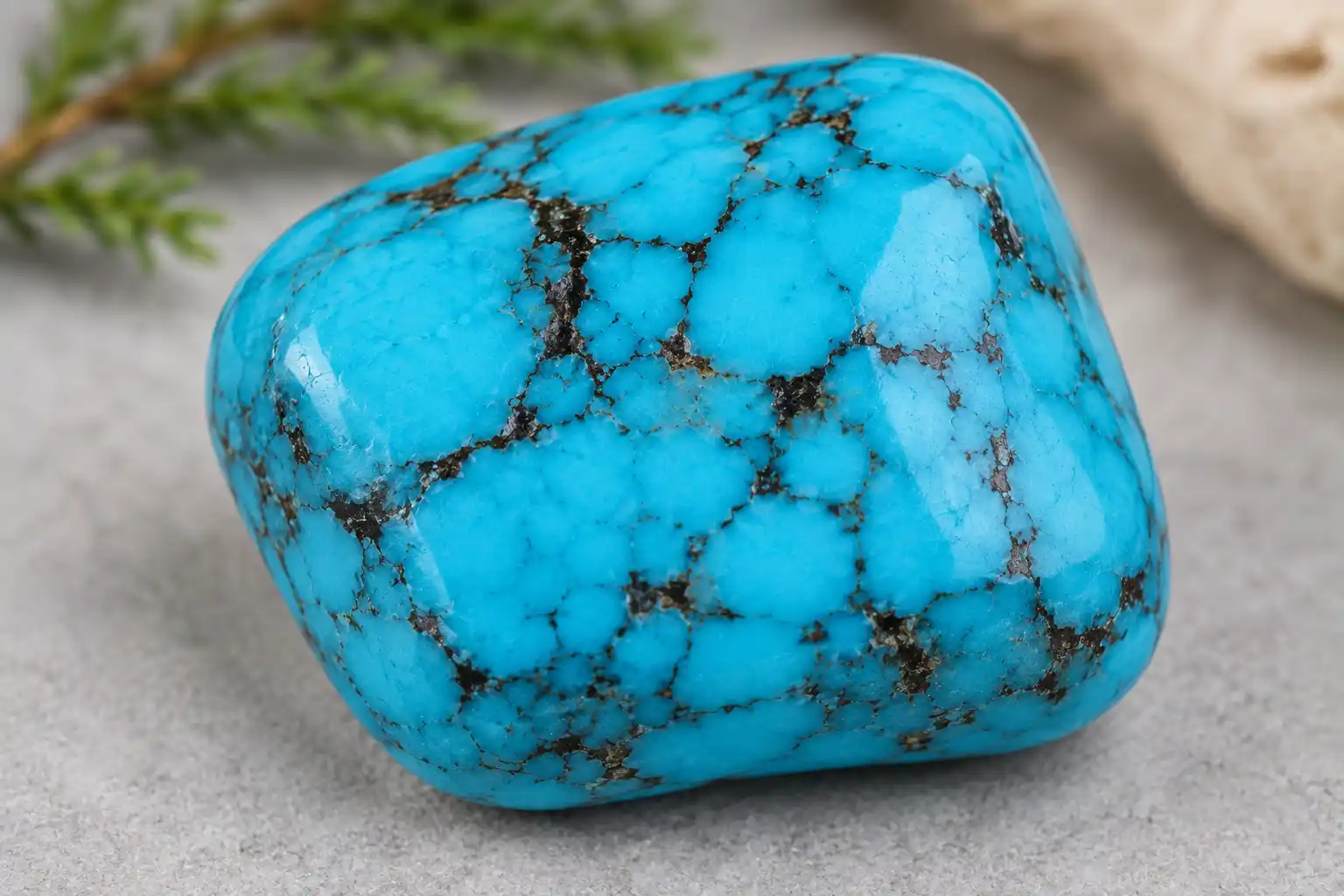
Turquoise is an opaque blue-to-green hydrated copper-aluminum phosphate prized for its distinctive color, natural matrix patterns and exceptionally long history in jewelry and personal adornment. Its colors can range from clear sky blue through blue-green to apple and olive green, while brown, black, tan, gray or golden host-rock matrix may cross the stone in irregular veins or delicate spiderweb patterns. Turquoise meaning developed across many different cultures and historical periods, and modern traditions most often associate the stone with communication, protection, friendship, wisdom, travel, confidence and connection to place.
The mineral itself tells a different but equally interesting story. Turquoise generally forms in dry environments where copper-bearing groundwater interacts with aluminum- and phosphorus-containing rocks. Its blue color comes largely from copper, while iron and other chemical variations can push the appearance toward green. These physical processes explain the gemstone’s identity; turquoise meaning belongs to human history, cultural interpretation and personal practice rather than a scientifically demonstrated healing force.
Understanding turquoise meaning is therefore most useful when symbolism, mineralogy and practical ownership remain connected but distinct. A turquoise pendant may symbolize honest communication without treating a throat condition. A travel stone may remind someone to prepare carefully without preventing an accident. A friendship gift can represent loyalty without controlling another person’s behavior. This grounded approach preserves the richness of turquoise meaning while respecting what the gemstone can and cannot physically do.
Turquoise at a Glance
| Property | Turquoise |
|---|---|
| Mineral class | Phosphate |
| Idealized composition | CuAl₆(PO₄)₄(OH)₈·4H₂O |
| Crystal system | Triclinic |
| Common colors | Sky blue, blue, greenish blue, blue-green and green |
| Typical habit | Massive, nodular, vein-filling and crust-like |
| Transparency | Opaque to rarely semitranslucent |
| Luster | Waxy to subvitreous when polished |
| Mohs hardness | Approximately 5–6 |
| Toughness | Fair to good, strongly influenced by porosity and treatment |
| Common cuts | Cabochons, beads, tablets, carvings and inlay |
| Common treatments | Waxing, oiling, polymer stabilization, dye and reconstruction |
| Common imitations | Dyed howlite, magnesite, glass, ceramic, resin and plastic |
| Birthstone | December |
| Main care concerns | Cosmetics, oils, solvents, prolonged moisture, heat and abrasion |
| Common symbolic themes | Communication, protection, friendship, wisdom, travel and grounded confidence |
What Is Turquoise?
Turquoise is a hydrated copper-aluminum phosphate mineral. Unlike transparent faceted gemstones whose beauty depends heavily on brilliance and light return, turquoise is generally opaque. Cutters therefore emphasize body color, matrix, surface polish, shape and craftsmanship.
The stone usually develops as compact masses, nodules and vein fillings rather than large transparent crystals. Fine material may be dense enough to accept a smooth, attractive polish, while lower-grade material can be chalky, porous or structurally weak.
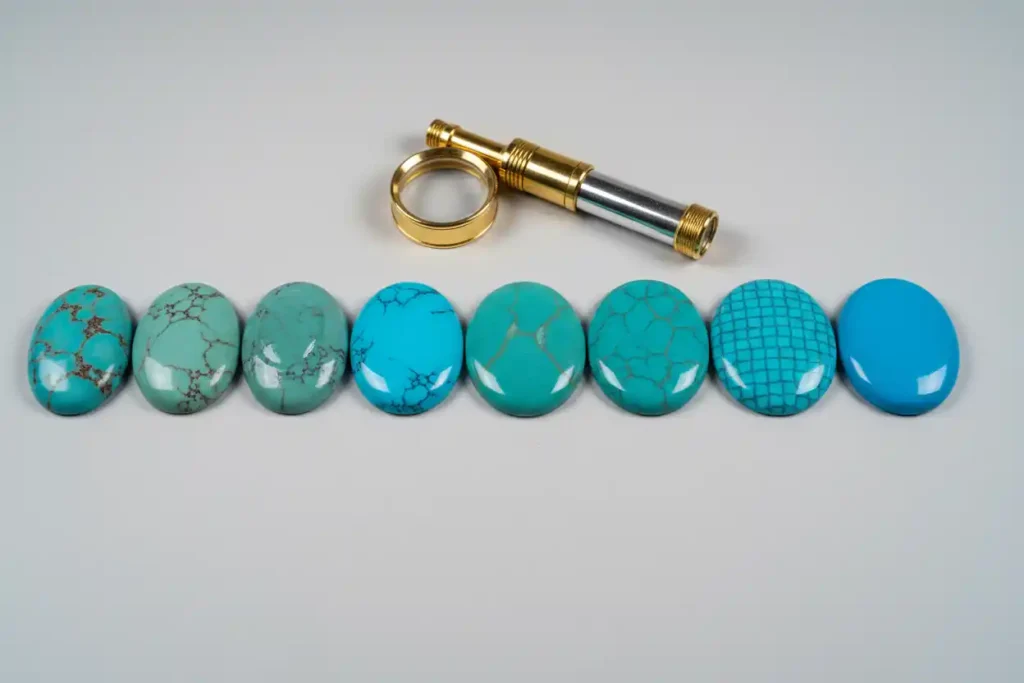
The types of turquoise range from relatively clean sky-blue material to strongly matrixed spiderweb stones and greener varieties. These visual differences can influence modern turquoise meaning, but color and matrix are first physical characteristics rather than evidence of different healing powers.
The idealized chemical formula is commonly written as CuAl₆(PO₄)₄(OH)₈·4H₂O, although natural turquoise varies chemically. Copper is central to its blue coloration. Iron substitution and other compositional changes can move the color toward green.
This chemistry is why turquoise meaning should never be used to identify the mineral. A blue stone associated with communication is not automatically turquoise.
How Turquoise Forms
Turquoise forms mainly as a secondary mineral in arid and semi-arid environments.
Copper-bearing groundwater moves through weathered rock and encounters sources of aluminum and phosphorus. Under suitable chemical conditions, turquoise precipitates within cavities, seams, fractures and porous zones.
This formation process explains why turquoise is closely associated with copper deposits and dry landscapes. Weathering later exposes or concentrates the material close enough to the surface for mining.
Turquoise deposits occur in Iran, the southwestern United States, China and numerous other regions. Individual deposits can produce distinctive combinations of color, density and matrix, although appearance alone usually cannot establish a specific mine.
The physical relationship with dry landscapes also contributes indirectly to turquoise meaning. Modern symbolism sometimes connects the gemstone with sky, earth, travel and place. Those interpretations can have personal value, but the geological environment itself does not give turquoise supernatural protective properties.
Why Turquoise Is Blue or Green
Copper produces much of turquoise’s characteristic blue.
Iron and other chemical or structural variables can shift the stone toward green, while hydration, porosity, associated minerals and later alteration can affect appearance further.
This means green turquoise can be completely natural.
The assumption that only bright robin’s-egg blue is “real” overlooks a substantial portion of natural turquoise. Green, blue-green and strongly matrixed material can be desirable in their own right.
The wider blue gemstones and green gemstones collections show how turquoise occupies an unusual position between these two color families.
Color also influences turquoise meaning. Blue material is especially associated with communication and spaciousness, while greener material is often linked symbolically with friendship, renewal and heart-centered reflection.
Those color associations are contemporary interpretations rather than scientifically measurable energetic differences.
Turquoise Matrix and Spiderweb Patterns
Matrix is the host-rock or associated mineral material visible within or around turquoise.
It may appear brown, black, gray, tan or golden. Some cabochons display large irregular patches, while others develop fine interconnected lines commonly called spiderweb matrix.
Spiderweb turquoise can be highly desirable when the webbing is natural, visually balanced and supported by structurally sound material.
Matrix is not automatically a flaw.
For some jewelry traditions and collecting markets, the pattern is central to the stone’s identity. In other contexts, clean blue material receives the strongest demand.
Artificial matrix can also be introduced into reconstructed or manufactured products. Painted, molded or unusually repetitive patterns deserve scrutiny, although visual appearance alone is not enough to prove imitation.
Turquoise meaning should not turn matrix into a mystical quality scale. A clean blue stone is not spiritually purer, and a heavily patterned stone is not automatically more grounded or powerful.
Turquoise Meaning and Symbolism
The most common turquoise meaning today centers on communication, protection, friendship, wisdom, travel and calm confidence.
These themes make visual and historical sense. The stone’s blue color naturally evokes sky and open space. Its long history in personal adornment helped attach ideas of protection and identity. Its presence in trade networks and culturally important jewelry reinforced associations with connection, travel and relationship.
A grounded turquoise meaning practice converts those symbolic themes into observable behavior.
Communication becomes speaking accurately and listening carefully.
Protection becomes preparation, awareness and boundaries.
Friendship becomes reciprocity and maintenance rather than trying to attract or control another person.
Wisdom becomes learning from experience and updating assumptions.
Travel becomes planning rather than assuming supernatural immunity from risk.
This interpretation keeps turquoise meaning useful without claiming that the mineral changes reality on its own.
Turquoise Meaning for Communication
Communication is one of the strongest parts of turquoise meaning.
Blue turquoise is frequently associated with clear speech, truthful expression and attentive listening. Contemporary chakra systems reinforce the connection through the stone’s relationship with throat-chakra symbolism.
A practical turquoise meaning exercise begins before the conversation.
Write the main point in one sentence. Then decide whether that sentence contains an observable fact, an interpretation, a feeling or a request.
Those categories are often mixed together during conflict.
For example, “You ignored me because you don’t care” combines an observation with an assumption about motive. A clearer message might identify the behavior first and then explain its effect.
Turquoise meaning can serve as a reminder to make communication specific enough that another person can actually respond to it.
The stone itself does not improve speech, hearing or language ability.
Turquoise Meaning for Listening
Communication is not simply speaking confidently.
Turquoise meaning also works well as a symbol for listening without immediately preparing a rebuttal.
A listener can ask whether they understood the other person’s actual statement or only the part that confirmed an expectation.
This does not mean agreeing with everything another person says. Listening accurately can reveal that disagreement remains necessary.
A turquoise object may serve as a simple cue: hear the complete point, clarify uncertainty and then respond.
That is a stronger interpretation of turquoise meaning than assuming the stone gives supernatural knowledge about what another person truly thinks.
Turquoise Meaning for Calm Expression
Turquoise is often described as a calming stone.
The mineral has not been scientifically shown to regulate the nervous system, chemically reduce stress or treat anxiety disorders.
A grounded interpretation of turquoise meaning connects calm with creating a pause.
During an intense conversation, the stone can act as a visual reminder not to let the first emotional impulse become the entire message. Naming the feeling can help: anger, disappointment, fear, embarrassment or uncertainty.
Then decide what needs to be communicated.
A short statement such as “I need some time before I answer this properly” may be more useful than reacting immediately.
This version of turquoise meaning keeps emotional regulation in the realm of behavior rather than crystal medicine.
Turquoise Meaning for Confidence
Turquoise meaning also includes confidence, particularly confidence in communication.
The useful form of confidence is not domination or certainty about everything.
It means being able to state what is known, acknowledge what remains uncertain and ask clearly for missing information.
Before a meeting, interview or presentation, turquoise meaning can be connected with preparation. Write the purpose, strongest evidence, likely questions and requested next action.
A stone on the desk or in a pocket can mark that routine.
The preparation does the work.
Turquoise cannot guarantee persuasive speaking, promotions, successful negotiations or favorable interviews.
Turquoise Meaning for Public Speaking
Public speaking fits naturally within turquoise meaning because of the stone’s strong communication symbolism.
The most practical ritual is preparation rather than magical confidence.
Practice the opening aloud. Verify factual claims. Identify where the audience may become confused. Prepare the final point so the talk ends intentionally rather than simply running out of material.
A small turquoise object can become a visual reminder to slow down and speak clearly.
Turquoise meaning does not replace rehearsal, accessibility support, speech therapy or professional help for severe performance anxiety.
Its symbolism is most useful when it reinforces those real preparations.
Turquoise Meaning for Protection
Turquoise has one of the strongest protective traditions among blue-green gemstones.
Historical and modern beliefs have associated it with travelers, personal safety and protection from misfortune. These ideas belong to cultural tradition rather than established physics.
The most responsible turquoise meaning for protection is preparation.
Before travel, check identification, reservations, route information, weather, emergency contacts, required medication and communication plans.
Before a difficult meeting, review the facts, personal boundaries and available exit options.
Before a major purchase, verify seller claims and return terms.
The stone does not prevent theft, accidents, violence or illness. Turquoise meaning becomes practical when protective symbolism triggers protective behavior.
Turquoise Meaning for Travel
Travel is a distinctive part of turquoise meaning.
Rather than treating the stone as a supernatural travel shield, use it as a reminder to prepare and remain attentive.
A turquoise pendant might sit beside a packing list while documents, medication, chargers, emergency numbers and local conditions are checked.
During travel, turquoise meaning can represent respect for the destination as well as concern for personal safety.
That includes understanding local laws, cultural expectations and restrictions surrounding culturally important objects.
A travel tradition is meaningful when it increases attentiveness, not when it encourages unnecessary risk because someone believes the stone guarantees protection.
Turquoise Meaning for Friendship
Friendship gives turquoise meaning a warmer social dimension.
Modern traditions commonly associate turquoise with loyalty, reciprocal support and honest communication.
The stone cannot attract a particular friend or force someone to remain loyal.
A practical friendship ritual instead focuses on maintenance.
Answer a message that has been neglected. Acknowledge an important event. Apologize accurately when appropriate. Ask what kind of support would actually be useful rather than assuming.
Reciprocity matters.
Turquoise meaning should never be used to romanticize one-sided relationships in which respect and effort consistently flow in only one direction.
Turquoise Meaning in Relationships and Boundaries
Turquoise meaning in relationships emphasizes communication that preserves dignity.
A useful exercise is to identify a recurring misunderstanding and ask whether an expectation has remained unspoken.
Convert the expectation into a request rather than an accusation.
Then listen to the answer.
The other person does not have to agree simply because the request was expressed clearly.
Boundaries are equally important. A boundary describes what the speaker will do, not what another person is allowed to feel.
“I will end the conversation if insults continue” is a boundary.
“You are not allowed to be angry” attempts to control another person’s internal experience.
This distinction makes turquoise meaning particularly useful when communication and protection symbolism overlap.
Turquoise Meaning for Emotional Reflection
Turquoise meaning is sometimes framed as emotional balance.
The stone does not medically regulate emotion. Instead, its symbolism can support a simple reflection process.
Write three things: the feeling, the immediate urge and the result that will matter later.
A person may feel angry and want to send an impulsive message, while the desired long-term result is a clear resolution. Recognizing that difference makes another response possible.
An emotion can be valid without every action produced by it being useful.
Turquoise meaning can therefore represent the space between feeling something and choosing what to do about it.
Persistent anxiety, panic, depression, trauma symptoms or significant emotional dysregulation deserve appropriate professional support rather than crystal-based treatment.
Turquoise Meaning for Wisdom and Integrity
Wisdom within turquoise meaning is not supernatural knowledge.
It is the ability to learn from experience, recognize uncertainty and revise an assumption when evidence changes.
Integrity adds another layer.
A person’s words, stated values and actions should not constantly contradict one another.
A turquoise object can serve as a reminder to check that alignment.
If someone says a relationship matters, what behavior supports it? If transparency is important at work, is relevant information actually being communicated? If financial responsibility is a goal, are purchases consistent with that goal?
Turquoise meaning becomes more useful when abstract values are converted into measurable behavior.
Turquoise Meaning for Creativity
Turquoise also carries contemporary symbolism involving self-expression and creativity.
The communication connection makes this especially relevant to writing, design, art and other forms in which an idea must eventually leave the creator’s mind and become visible.
A grounded turquoise meaning practice can focus on completing one imperfect version.
Write one paragraph. Make one sketch. Record one rough melody. Produce one design study.
The stone does not create talent.
It can symbolize the decision to give an idea physical form before demanding perfection.
Turquoise Meaning and the Throat Chakra
Blue turquoise is closely associated with the throat chakra in contemporary spiritual traditions.
Within this framework, turquoise meaning emphasizes communication, listening, truth, expression and boundaries.
The throat chakra meaning guide explains the wider symbolism, while throat chakra crystals places turquoise alongside other stones used in similar practices.
Chakras are spiritual concepts rather than scientifically established anatomical structures.
Turquoise does not treat thyroid disease, throat infections, hearing problems, speech disorders or other medical conditions.
A throat-centered practice is most grounded when it asks practical communication questions: What needs to be said? What needs to be heard? What boundary needs to be stated clearly?
Turquoise Meaning and the Heart Chakra
Green and blue-green turquoise are also associated with heart-centered symbolism in some contemporary traditions.
In this context, turquoise meaning often shifts toward friendship, compassion, reciprocity and communication within relationships.
The broader heart chakra meaning framework can help distinguish symbolic reflection from medical claims.
Compassion does not require unlimited access.
Someone can care deeply about another person while still creating distance, maintaining consequences or leaving an unsafe situation.
That distinction is especially important when turquoise meaning is used in relationship practices. A spiritual stone should never become a reason to tolerate abuse, stalking, coercion or repeated boundary violations.
Meditation With Turquoise
Turquoise can be used as a simple visual meditation object.
Choose a clean, comfortably handled cabochon, bead or polished stone. Notice the exact body color, matrix lines, changes in polish and natural variation rather than immediately assigning every feature a message.
Then introduce one question.
What do I need to communicate accurately?
Which assumption needs verification?
What practical precaution have I avoided?
Which relationship needs repair or a clearer boundary?
Write one response and turn it into an action that can be reviewed later.
This keeps turquoise meaning connected with reflection rather than divination.
The stone does not need to deliver a supernatural answer.
Journaling With Turquoise
A useful turquoise meaning practice divides a journal page into four categories:
facts, interpretations, feelings and requested actions.
This structure is particularly effective for communication problems.
Facts describe observable events. Interpretations explain what the person thinks those events mean. Feelings describe the emotional reaction. Requested actions describe what could happen next.
Keeping these categories separate prevents assumptions from being presented as confirmed facts.
Another turquoise meaning exercise is to draft a difficult message and remove language included only to punish, provoke or humiliate.
Clarity does not mean avoiding strong statements. It means making the actual issue understandable.
Turquoise Meaning at Work
Turquoise meaning also translates naturally into professional settings because communication and accountability matter in nearly every workplace.
Before a meeting, write down the decision that needs to be made, the strongest supporting information and who has authority to act.
During disagreement, distinguish criticism of an idea from an attack on personal worth.
After the meeting, record commitments, owners and deadlines.
A turquoise object can mark that routine, but it does not create career success independently.
Professional outcomes depend on competence, relationships, opportunity, communication and follow-through.
Turquoise meaning is most useful when it reinforces those behaviors rather than promising promotions or guaranteed business success.
Blue and Green Turquoise Meaning
Blue and green material can carry somewhat different symbolic emphasis.
Blue turquoise meaning commonly focuses on communication, truth, spaciousness, calm confidence and attentive listening.
Green turquoise meaning tends to emphasize renewal, friendship, adaptability and heart-centered communication.
Blue-green material can naturally bridge both interpretations.
Color does not create a measurable difference in healing power.
It also may not be entirely natural. Dye can alter or intensify turquoise color, which means symbolism and gemological treatment must remain separate questions.
A dyed green or blue stone may still have personal turquoise meaning while requiring different care and carrying a different market value from fine untreated material.
Turquoise in Ancient and Historical Contexts
Turquoise has been used for thousands of years across multiple regions.
Ancient Egyptian jewelry and decorative objects incorporated turquoise, including material historically connected with Sinai. Blue-green color was visually important in Egyptian art, although turquoise should not be confused with blue faience and other materials that created similar colors.
Ancient Near Eastern and Iranian contexts also document significant turquoise use. Iranian deposits, particularly around Nishapur, developed an enduring reputation for fine blue material.
Turquoise also appears in Central Asian, Tibetan and Chinese jewelry and decorative traditions.
These histories contribute substantially to turquoise meaning, but they should not be collapsed into one claim that “ancient people believed” exactly the same thing everywhere.
Meanings differed by place, period, community, religion and use.
Turquoise and Southwestern Indigenous Jewelry
Turquoise has deep importance in the art and jewelry traditions of distinct Indigenous communities of the American Southwest.
Diné, Zuni, Hopi, Pueblo and other artists have developed different approaches to silverwork, inlay, cluster settings, beads and contemporary design.
These traditions should not be treated as interchangeable.
The cultural significance of turquoise meaning in one community cannot simply be generalized to another, and living artistic traditions should not be reduced to generic “tribal crystal energy.”
When an artist-made piece has known attribution, identify the maker and community accurately.
Provenance can also influence monetary and cultural value far beyond the raw cabochon’s price.
Respectful turquoise meaning recognizes that appreciation does not automatically grant ownership of another community’s restricted ceremony, symbolism or identity.
Persian Turquoise
Persian turquoise traditionally refers to material from Iran, especially the historically important Nishapur region.
Fine material has long been associated with saturated sky-blue to medium-blue color, sometimes with little visible matrix.
The term should refer to supported geographic provenance rather than functioning as a generic synonym for “high-quality blue turquoise.”
Not every Iranian turquoise is clean blue, and similarly colored material occurs elsewhere.
For turquoise meaning, Persian origin may add historical or personal context, but it does not automatically make a stone more spiritually powerful.
Origin matters primarily for provenance, collecting and value.
Southwestern and American Mine Turquoise
The western United States contains many historically or commercially important turquoise deposits.
Mine names such as Sleeping Beauty, Bisbee, Kingman, Number Eight, Lone Mountain, Royston, Carico Lake and others can carry strong collector interest.
Color and matrix differ widely.
Some material is known for relatively clean blue, while other mines are celebrated for spiderweb patterns, green tones or distinctive host-rock matrix.
Mine-name claims require caution. Once turquoise moves through cutting and resale channels, visually proving a precise deposit can be difficult.
The turquoise buying guide is more useful than accepting an expensive locality claim based on appearance alone.
Turquoise meaning cannot authenticate mine provenance.
Natural Turquoise
The word “natural” can cause confusion.
Some sellers use natural simply to mean the material was mined rather than manufactured. Under that definition, stabilized natural turquoise may still be described as natural.
Other sellers use natural to mean untreated.
For an important purchase, ask for specific treatment disclosure rather than relying on the word alone.
Fine compact untreated material can accept a strong polish without polymer impregnation and often commands a premium.
However, untreated does not automatically mean better for every purpose. Chalky untreated material may be less durable and less attractive than well-stabilized turquoise used honestly in everyday jewelry.
Turquoise meaning should never be used to create a false hierarchy in which untreated stones are described as spiritually pure and treated stones as energetically worthless.
Stabilized Turquoise
Stabilization introduces resin, polymer or another substance into porous turquoise.
The process strengthens weak material and can improve polish and apparent color.
Stabilized turquoise remains based on natural mined mineral material, but it has been treated.
This distinction matters significantly for value.
Comparable fine untreated material generally receives a greater rarity premium, while stabilization can make commercial rings and bracelets more practical.
The detailed treated turquoise guide explains stabilization, dye, wax, oil, reconstruction and other enhancement categories.
Treatment changes the physical and commercial history of a stone. It does not scientifically change turquoise meaning.
Dyed, Waxed and Oiled Turquoise
Dye can deepen pale blue or green material and make color more uniform.
It may be combined with stabilization.
Possible clues include concentrated color in fractures, pores, matrix areas and drill holes, although modern dye can be difficult to confirm visually.
Wax and oil can deepen color, reduce visible porosity and improve surface luster.
These lighter treatments may change with wear, heat, detergents and solvents.
A treated stone can still be attractive and useful jewelry.
The key issue is disclosure.
Turquoise meaning should not be used to distract buyers from whether the material has been dyed, impregnated or otherwise altered.
Reconstructed and “Block” Turquoise
Reconstructed turquoise combines fragments or powder with a binder to create material that can be cut into beads, cabochons and carvings.
It may contain genuine turquoise particles, but the finished product is a manufactured composite rather than one continuous naturally formed stone.
“Block turquoise” can refer to resin or plastic products and may contain little or no natural turquoise.
Terminology varies, making seller disclosure especially important.
These products can have decorative value when represented honestly.
They should not be priced as rare untreated turquoise.
Personal turquoise meaning can still be attached to a composite object, but emotional significance does not change its material category.
Synthetic Turquoise and Imitations
Laboratory-manufactured turquoise materials exist, although the word synthetic has sometimes been used loosely in the market.
A true synthetic material should reproduce the essential mineral characteristics of natural turquoise.
Many inexpensive “synthetic turquoise” products are actually better classified as imitations or composites.
Dyed howlite and magnesite are particularly common mineral substitutes. Glass, ceramic, resin and plastic can also reproduce turquoise color and artificial matrix.
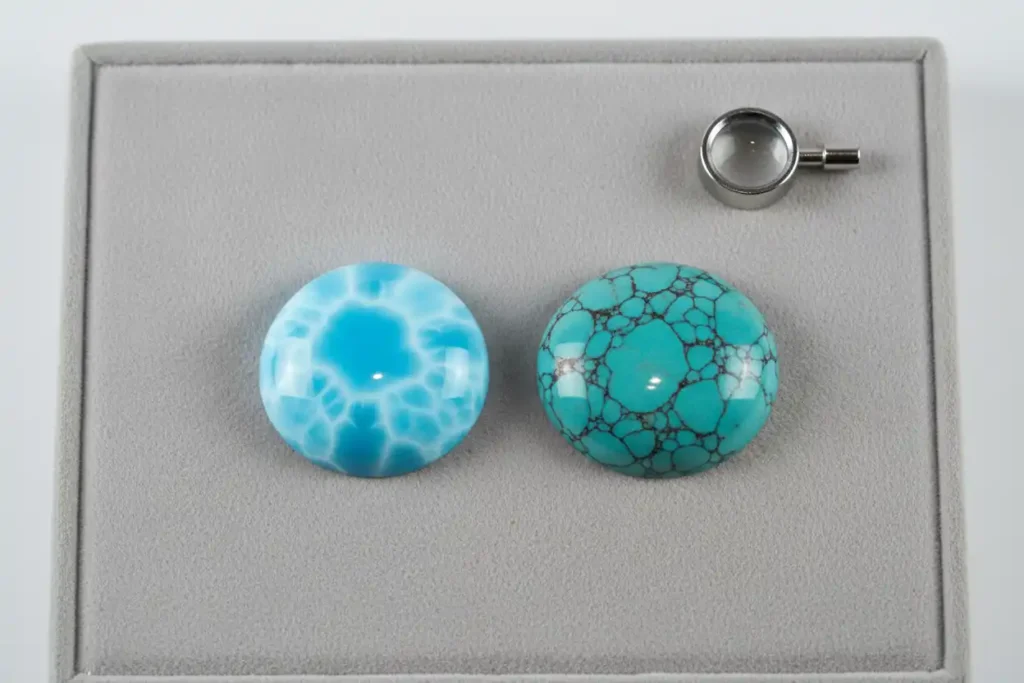
Natural amazonite and larimar may overlap visually but have entirely different mineral identities. The larimar vs turquoise comparison demonstrates why blue color alone is unreliable.
Turquoise meaning cannot distinguish these materials.
How to Tell if Turquoise Is Real
The real vs fake turquoise process should begin with disclosure rather than destructive testing.
Inspect the stone under realistic lighting. Look around drill holes, fractures, chipped areas, matrix boundaries and the reverse.
Concentrated dye, a pale interior, resin-rich texture, bubbles, mold seams or identical repeated patterns can provide useful clues.
However, none proves identity in every case.
Professional techniques such as spectroscopy and diffraction may be necessary for valuable or complicated material.
The wider how to identify crystals framework explains why multiple non-destructive observations are stronger than one dramatic home test.
Avoid scratch, acid, solvent, flame and hot-needle testing. These methods can permanently damage real turquoise and may still produce ambiguous results.
Turquoise Hardness and Durability
Turquoise generally ranks about 5–6 on the Mohs scale.
The gemstone hardness chart shows that quartz, topaz, sapphire and diamond can scratch it.
Hardness is only part of durability. The gemstone toughness vs hardness distinction is particularly relevant to turquoise because porosity, fractures, matrix and treatment can affect practical strength substantially.
Dense compact turquoise can be reasonably durable.
Chalky untreated material can be porous and fragile.
Stabilization may improve the durability of otherwise weak rough, which is why treatment is not automatically negative in jewelry intended for frequent wear.
The symbolic strength attached to turquoise meaning has no effect on its physical resistance to abrasion or impact.
Turquoise Jewelry
Turquoise works naturally in cabochons, beads, carvings, tablets, mosaic inlay and silver or gold jewelry.
Because the stone is opaque, it does not require an open-backed faceted setting to show brilliance.
A protective bezel often works especially well.
Turquoise earrings are among the safer formats because they encounter less repeated impact and water exposure than hand jewelry.
A turquoise necklace or pendant also protects the stone reasonably well while allowing larger cabochons, beads or carvings to remain visible.
A turquoise ring experiences much greater exposure to desks, doors, cosmetics and handwashing, so a strong protective setting is especially important.
Turquoise meaning may influence the form someone chooses. A pendant can symbolize communication, while a ring can become a visible reminder of boundaries or a commitment.
The jewelry construction still determines practical durability.
Turquoise Beads and Inlay
Beads reveal useful information around drill holes.
Chips, concentrated color and pale interiors may expose weaknesses or treatment clues. Matched strands should also be compared for diameter, matrix, polish and color.
Inlay presents different risks.
Thin turquoise pieces are fitted into recessed designs and often depend heavily on adhesive and backing. Water, solvents and aggressive polishing can therefore damage the construction even when the turquoise itself initially appears unaffected.
Artist-made inlay may carry substantial value through design, precision and provenance.
Turquoise meaning should not reduce sophisticated jewelry to the value of its mineral alone.
How to Judge Turquoise Quality
There is no single best turquoise appearance.
Fine even blue remains highly recognized, but attractive green material and natural spiderweb matrix can also command strong collector interest.
Color should be appealing and reasonably stable.
The surface should accept an appropriate polish without obvious powdery areas, lifting filler or serious fractures.
Matrix should be judged aesthetically and structurally. A beautiful web pattern may add value, while an unstable open crack is a durability problem.
Treatment matters significantly.
Fine dense untreated material generally receives a higher rarity premium than stabilized, dyed or reconstructed material of comparable appearance.
Provenance and craftsmanship can also add substantial value.
The turquoise price guide focuses on these market distinctions rather than using turquoise meaning as a value factor.
Buying Turquoise
A good purchase begins with a simple question: what exactly is being sold?
Ask whether the stone is untreated, waxed, oiled, stabilized, dyed, reconstructed, synthetic or imitation.
Then ask separately about geographic provenance.
Inspect front, side and back whenever possible.
Check matrix, surface condition, drill holes, backing and fractures.
For online purchases, request realistic photographs or video rather than relying solely on highly saturated promotional images.
A high price should be supported by material quality, treatment disclosure, provenance or exceptional craftsmanship.
Claims that a turquoise possesses unusually strong protection or healing energy do not establish rarity.
The turquoise buying guide provides the practical evaluation process.
Turquoise Value and Provenance
Turquoise value depends heavily on color, density, treatment, matrix, size, cut, mine attribution and workmanship.
Untreated compact material can carry a substantial premium.
Stabilized commercial turquoise is much more widely available, while reconstructed and imitation products usually occupy lower material-value categories.
Documented mine provenance can matter strongly for collector stones.
Artist-made jewelry adds another layer. In significant Southwestern pieces, the silversmith or lapidary work, maker attribution and cultural provenance may contribute more value than the cabochon’s raw weight.
Turquoise meaning may contribute personal value to the owner, but personal symbolism and resale value are different concepts.
Turquoise as a December Birthstone
Turquoise is one of the recognized December birthstones, together with tanzanite and zircon.
This gives turquoise meaning an additional personal dimension for December birthdays.
A birthstone association is a cultural jewelry tradition rather than a biological relationship between a mineral and a person’s birth month.
Someone born in December can wear turquoise because the association feels meaningful, while someone born in another month can wear exactly the same gemstone without physical disadvantage.
For gifts, December birthstone jewelry compares turquoise with transparent alternatives such as tanzanite and zircon.
Birthstone status does not prove a turquoise stone is untreated or even natural.
Spiritual Cleansing and Turquoise Meaning
Some owners use symbolic cleansing as part of turquoise meaning practices.
Because turquoise can be porous and treated, conservative dry methods are preferable.
Sound, visualization and placement on a clean dry cloth can mark the end of one intention and beginning of another without exposing the stone to unnecessary moisture or chemicals.
The dedicated guide to cleansing and charging turquoise explains material-aware methods.
There is no scientifically required cleansing schedule.
Turquoise does not become physically dangerous because it has absorbed emotional negativity.
Perform a ritual when it helps reset an intention, not because fear-based claims say a stone becomes contaminated without frequent cleansing.
Can Turquoise Go in Water?
Turquoise should not be soaked.
Brief controlled contact during careful cleaning may be acceptable for some sound stones, but porosity and treatment vary too widely to treat prolonged water exposure casually.
Water may penetrate porous untreated material.
It can also affect dye, wax, polymer, glue, cord or inlay construction.
Do not prepare direct drinking-water crystal elixirs with turquoise.
Commercial stones may carry treatment materials, polishing residues or surface contamination, and putting a gemstone into drinking water provides no established medical benefit.
Turquoise meaning can be included in a symbolic water ritual with the stone kept completely outside the drinking vessel.
Turquoise, Sunlight and Heat
Prolonged intense sunlight is unnecessary for turquoise.
Heat can affect wax, oil, resin, dye, adhesives and other treatments, while environmental exposure may alter the surface over time.
Do not leave valuable turquoise on a hot windowsill, dashboard or outdoor surface for ritual charging.
Indirect light or dry indoor placement is safer.
A spiritual practice does not become more effective because the gemstone is exposed to conditions that may damage it.
How to Clean Turquoise
Turquoise benefits more from prevention than aggressive cleaning.
Put jewelry on after lotion, sunscreen, cosmetics, perfume and hairspray have dried.
After wear, wipe the stone gently with a clean soft cloth.
When the specific material and setting allow, use minimal lukewarm water, a very small amount of mild soap and a soft cloth or brush. Keep contact brief and dry the piece promptly.
The turquoise jewelry cleaning guide covers the process in detail.
Avoid steam, ultrasonic equipment, bleach, ammonia, acids, alcohol, acetone, abrasive cleaners and prolonged soaking.
Skin oils and cosmetics can gradually alter porous turquoise, sometimes producing permanent discoloration.
How to Store Turquoise
Store turquoise separately in a clean padded compartment.
Quartz, topaz, sapphire, diamond and rough metal surfaces can scratch it.
Do not place heavy jewelry on thin inlay, carved pieces or large cabochons.
Keep treated turquoise away from strong heat, chemical fumes and prolonged intense sunlight.
Fasten chains and bracelets before storage so metal components do not repeatedly scrape the stone.
These physical precautions matter regardless of turquoise meaning.
A stone associated symbolically with protection still needs practical protection itself.
Turquoise also appears naturally among crystals that start with T and gemstones that start with T for readers comparing related names and mineral identities.
How Turquoise Meaning Fits With the Real Gemstone
Turquoise meaning becomes strongest when its symbolism grows from the real stone without replacing mineral science.
Blue color can symbolize communication.
A long history of travel and trade can support journey symbolism.
Jewelry exchanged between people can represent friendship.
Traditional amulet use can inspire protection themes.
Matrix can symbolize the way place and environment remain visible within an object.
These interpretations are meaningful precisely because humans create associations around objects, color, history and memory.
They do not require turquoise to cure illness, prevent accidents or control other people.
At Gems Lore, turquoise meaning is most useful when it leads back to grounded action. Communication should become clearer speech and better listening. Protection should become preparation and boundaries. Friendship should become reciprocity. Travel should become attentiveness. Wisdom should become the willingness to revise an assumption when new evidence appears.
The mineral itself deserves equally careful attention.
Natural, stabilized, dyed, reconstructed and imitation turquoise can look surprisingly similar. Treatment affects value and care. Provenance can influence collector importance. Artist attribution can transform the significance of finished jewelry.
Keeping those physical facts distinct from turquoise meaning allows both to remain credible.
Frequently Asked Questions
What is the main turquoise meaning?
The main turquoise meaning centers on communication, protection, friendship, wisdom, calm confidence, travel and connection to place. These themes come from historical, cultural and contemporary spiritual traditions rather than scientifically established healing effects.
What does turquoise symbolize spiritually?
Spiritual turquoise meaning commonly emphasizes truthful expression, attentive listening, protection symbolism, friendship and thoughtful travel. Different traditions interpret the gemstone differently, so there is no single universal ancient meaning.
What are turquoise healing properties?
Turquoise healing properties are spiritual or symbolic interpretations. The gemstone has not been scientifically shown to treat anxiety, depression, pain, inflammation, respiratory disease, thyroid conditions or other medical problems.
Can turquoise reduce stress or anxiety?
Turquoise does not medically treat stress or anxiety disorders. A stone can be used as a reminder to pause, breathe normally and choose a response deliberately, while persistent or severe symptoms deserve appropriate professional support.
Is turquoise a protection stone?
Protection is one of the strongest traditional themes in turquoise meaning. A grounded interpretation connects that symbolism with preparation, awareness, boundaries and real safety measures rather than an invisible guarantee against harm.
Is turquoise good for communication?
Communication is central to turquoise meaning. A stone may serve as a reminder to speak accurately, listen carefully and distinguish facts from interpretations. It does not directly change speech or communication ability.
What chakra is turquoise associated with?
Blue turquoise is most commonly associated with the throat chakra. Green and blue-green material may also appear in heart-chakra traditions. Chakras are spiritual concepts rather than scientifically established anatomical structures.
What does green turquoise mean?
Green turquoise meaning commonly emphasizes renewal, friendship, adaptability and heart-centered communication. Green turquoise can also be completely natural; blue is not the only genuine color.
What does turquoise mean in friendship?
Turquoise meaning in friendship emphasizes loyalty, reciprocity, honest communication and maintaining relationships through action. The stone cannot attract or control a particular person.
What does turquoise mean for travelers?
Turquoise has longstanding travel-protection symbolism. A practical interpretation uses the stone as a reminder to check documents, routes, weather, medication, contacts and other real preparations before a journey.
Is turquoise good for relationships?
Turquoise meaning can support themes of communication, reciprocal respect and clear boundaries. It cannot guarantee compatibility, reconciliation or loyalty from another person.
Is turquoise a December birthstone?
Yes. Turquoise is one of December’s recognized birthstones, together with tanzanite and zircon.
What makes turquoise blue?
Copper contributes strongly to turquoise’s characteristic blue color. Iron substitution and other chemical or structural factors can shift the material toward blue-green or green.
Is green turquoise real?
Yes. Natural turquoise can be blue, greenish blue, blue-green or green. Treatment can also modify color, so authenticity and treatment should be evaluated separately.
What is turquoise matrix?
Matrix is host-rock or associated mineral material that remains within or around turquoise. It may appear brown, black, tan, gray or golden and can form patches, veins or spiderweb patterns.
Is matrix in turquoise bad?
Not necessarily. Natural matrix can create highly desirable patterns and may contribute to a stone’s visual identity. Open fractures or unstable areas are durability concerns, but matrix itself is not automatically a defect.
Is stabilized turquoise real?
Yes. Stabilized turquoise begins as naturally mined turquoise, but polymer, resin or another substance is introduced to improve strength and polish. It is treated natural material rather than untreated turquoise.
Is dyed turquoise real?
Dyed natural turquoise can still contain genuine turquoise mineral, but its color has been enhanced and the treatment should be disclosed. Dyed howlite or magnesite is different because those stones are imitations rather than turquoise.
What is reconstructed turquoise?
Reconstructed turquoise combines turquoise fragments or powder with a binder. The resulting stone is a manufactured composite rather than one continuous piece of naturally formed turquoise.
Does synthetic turquoise exist?
Yes, although commercial terminology is inconsistent. Some products described as synthetic are true laboratory-manufactured analogues, while many others are better classified as composites or imitations.
How can I tell if turquoise is real?
Inspect disclosure, surface texture, matrix, fractures, drill holes, chipped areas and the back of the piece. Dye concentration, resin, bubbles or repeated manufactured patterns can provide clues. Important stones may require professional gemological testing.
Is Persian turquoise always more valuable?
No. Genuine Iranian provenance can contribute to value, particularly with fine material, but quality, treatment, condition and documentation still matter. The phrase Persian turquoise should not be used simply as a quality label for any clean blue stone.
Is turquoise good for everyday jewelry?
It can be worn regularly with care, especially when dense or stabilized material is placed in protective settings. Earrings and necklaces generally receive less impact than rings and bracelets.
Can turquoise go in water?
Brief controlled cleaning may be appropriate for some turquoise, but soaking is not recommended because porosity, dye, stabilization, wax, glue and jewelry construction vary.
Can turquoise be used in drinking water?
Direct turquoise crystal elixirs are not recommended. Keep the gemstone outside drinking water because treatments, residues and contamination are possible and there is no established medical benefit from gemstone-infused water.
How should turquoise be cleaned?
Use a soft cloth and, only when appropriate for the stone and setting, a small amount of mild soap with minimal lukewarm water. Do not soak turquoise or use ultrasonic, steam, acid, solvent or abrasive cleaning.
How should turquoise be stored?
Store turquoise dry in a padded compartment away from harder gemstones, rough metal, strong heat, chemical fumes and prolonged intense sunlight.
Turquoise combines unusual mineral chemistry, vivid color, distinctive matrix and an exceptionally broad human history. Those qualities help explain why turquoise meaning has accumulated themes of communication, protection, friendship, wisdom and travel across modern spiritual practice.
The most useful turquoise meaning does not depend on claims that the stone cures illness, guarantees safe journeys or controls relationships. Instead, it can symbolize behaviors that genuinely matter: communicate accurately, listen carefully, prepare before taking risks, maintain reciprocal relationships and respect both personal boundaries and the cultural context of the objects we wear.
That grounded approach also leaves room to appreciate turquoise as a gemstone. Its color may be natural or enhanced, its structure untreated or stabilized, its form a solid cabochon or reconstructed composite, and its jewelry significance may include artistry and provenance far beyond the stone itself. Turquoise meaning becomes richer when those distinctions are understood rather than hidden.
Turquoise meaning, chakra associations, protection traditions, emotional-healing practices and travel symbolism belong to cultural, historical, spiritual or personal interpretations rather than scientifically established medical or protective effects. Turquoise should not replace healthcare, mental-health treatment, emergency assistance or real safety planning. Do not ingest turquoise or use it in direct drinking-water crystal elixirs, and protect porous or treated stones from prolonged water exposure, cosmetics, solvents, heat and abrasion.