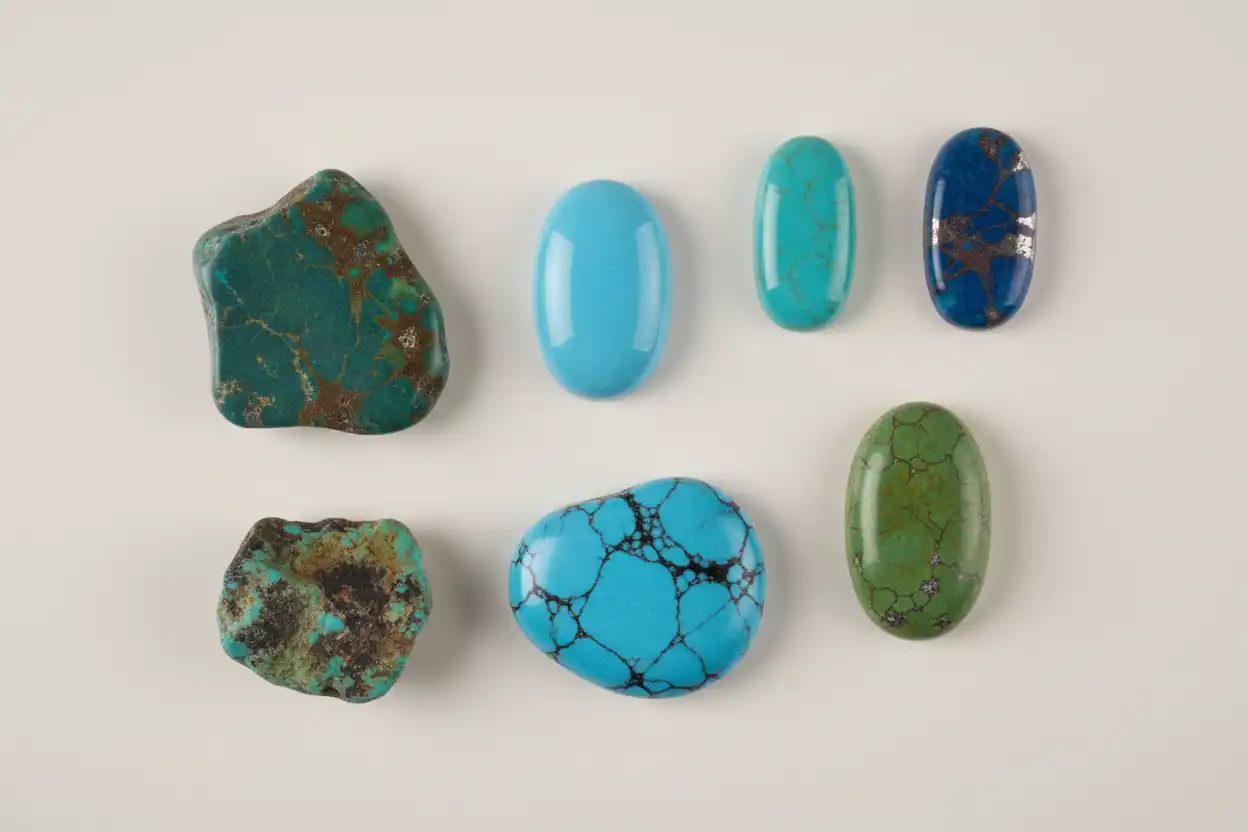
Types of Turquoise: Colors and Varieties Explained
Turquoise is one mineral species, but the market divides it into many “types” according to color, texture, matrix pattern, mine, region and treatment. Unlike a gem family with numerous mineral species, turquoise varieties are usually commercial or locality-based classifications rather than formally distinct minerals.
This guide explains those boundaries while leaving symbolism to the turquoise meaning guide and broader material classification to the types of gemstones guide.
Turquoise at a Glance
| Property | Turquoise |
|---|---|
| Mineral group | Turquoise group; phosphate mineral |
| Chemical composition | CuAl₆(PO₄)₄(OH)₈·4H₂O |
| Crystal system | Triclinic |
| Typical colors | Sky blue, medium blue, blue-green, green, gray-green and yellow-green |
| Crystal habit | Usually massive, cryptocrystalline, nodular or vein-filling; visible crystals are extremely rare |
| Luster | Waxy to subvitreous |
| Transparency | Opaque; occasionally semitranslucent in thin material |
| Refractive index | Approximately 1.610–1.650, usually measured by spot reading |
| Specific gravity | Commonly around 2.60–2.90, with treatment and porosity causing variation |
| Mohs hardness | 5–6 |
| Cleavage | Present in crystals but generally not evident in massive gem material |
| Tenacity | Brittle |
| Common cuts | Cabochons, beads, tablets, inlay pieces, carvings and free-form shapes |
| Main care concern | Porosity allows oils, cosmetics, chemicals and treatment-sensitive fillers to alter the stone |
What Does “Type of Turquoise” Mean?
Turquoise names generally describe one of four things: color, visible matrix, geographic origin or treatment condition. A robin’s-egg-blue cabochon and a green spiderweb cabochon can both be genuine turquoise with essentially the same mineral identity.
Mine names such as Kingman and Bisbee identify claimed sources. Persian blue describes a prized color and may not prove Iranian origin, while stabilized turquoise identifies treatment rather than locality or color.
This terminology can be useful, but it also creates opportunities for misrepresentation. The dedicated treated turquoise guide should be consulted whenever a seller’s description includes stabilized, enhanced, reconstructed, block, backed or color-treated material.
Turquoise Colors
Sky-Blue Turquoise
Sky-blue turquoise displays a light to medium blue with little visible green. Copper produces the blue, while the balance of iron, hydration, structure and associated minerals can influence tone.
Fine sky-blue material with an even color and dense texture is valued internationally. However, pale chalky material may look similar in photographs after stabilization or dyeing, so color alone does not establish quality.
Robin’s-Egg-Blue Turquoise
Robin’s-egg blue is a saturated, even medium blue traditionally associated with fine Iranian turquoise. It remains one of the most commercially desired appearances.
The term describes color, not origin. Material from the United States, China or another source may be sold as robin’s-egg blue when it matches the appearance.
Persian-Blue Turquoise
Persian blue is a traditional trade description for even, medium to strong blue turquoise associated historically with the Nishapur region of Iran. Dealers also apply the name to similarly colored stones from other origins.
Therefore, Persian blue and Persian turquoise are not always interchangeable. The first may describe color, while the second implies Iranian origin and should be supported by reliable provenance.
Blue-Green Turquoise
Blue-green turquoise contains a visible green component, often because iron partially influences the color. It can range from soft aqua to saturated teal.
Although pure medium blue traditionally commands the highest broad-market demand, high-quality blue-green material can be highly desirable in contemporary jewelry. Even texture, durability and attractive matrix can outweigh a minor green modifier.
Green Turquoise
Natural turquoise can be green, grass green, olive green or yellowish green. Green color may become more prominent when iron substitutes into the mineral’s chemistry or when a stone changes through dehydration, oxidation, contamination or long-term exposure to oils.
Green turquoise is not automatically lower quality. Certain American and Chinese materials have strong collector markets, particularly when the color is vivid and the matrix forms an attractive pattern.
Yellow-Green Turquoise
Yellow-green material occurs naturally, but the label requires caution. Variscite, faustite, serpentine, dyed magnesite and other materials can resemble yellow-green turquoise.
A seller should not use yellow turquoise as a loose umbrella term for every yellow-green lapidary stone. Laboratory testing may be needed when mineral identity affects price.
Gray and Gray-Green Turquoise
Lower copper content, iron, porosity and host-rock influence can create muted gray-blue or gray-green material. Although these colors generally occupy lower commercial tiers, attractive matrix and artistic cutting can make them useful for designer jewelry.
Stabilization is common in porous examples because untreated rough may not withstand cutting or long-term wear.
Turquoise Texture and Matrix Types
Clean or Matrix-Free Turquoise
Clean turquoise shows little or no visible host rock. An even blue surface allows color and polish to dominate, which is why matrix-free material has long been preferred in many international markets.
Large, naturally dense pieces with uniform color are uncommon. Consequently, buyers should be cautious when large quantities of inexpensive, perfectly uniform blue material appear without treatment disclosure.
Matrix Turquoise
Matrix consists of remnants of the surrounding host rock or mineralized material that remained with the turquoise as it formed in veins, seams and nodules. It can appear brown, tan, gray, yellow, red or black.
Matrix is not automatically a flaw. Some collectors prefer distinctive patterns connected with a known mining district, while other buyers favor clean color.
Spiderweb Turquoise
Spiderweb turquoise contains a network of fine, intersecting matrix lines. High-contrast black or dark brown webs against vivid blue or green material can command a premium when the pattern is natural, balanced and attractive.
A web pattern alone does not prove a famous mine. Manufacturers can imitate spiderweb matrix with dyes, resin mixtures or reconstructed material, so microscopic and laboratory examination may be necessary.
Waterweb and Raindrop Patterns
Waterweb is a trade term often used for pale, fine or irregular networks within turquoise. Meanwhile, raindrop-pattern turquoise from parts of China can show spots, rings or cloudlike features created by structural and mineralogical variation.
Neither name is a separate mineral variety. Because these terms lack universal grading standards, photographs and a precise treatment description are more useful than the label alone.
Birdseye Turquoise
Birdseye turquoise shows rounded spots or eye-like matrix features. The pattern can occur naturally, but the name is descriptive and may be applied inconsistently.
Artificially constructed dots, painted matrix and resin-filled composites can mimic this appearance. Therefore, high prices require dependable provenance and treatment disclosure.
Ribbon or Boulder Turquoise
Ribbon turquoise consists of a narrow turquoise vein left attached to a larger amount of host rock and cut so the colored seam becomes the central design. Boulder turquoise uses a similar concept, with matrix occupying much of the polished surface.
These are lapidary styles rather than mineral varieties. Value depends on composition, visual balance, polish, stability and whether the turquoise seam is natural or assembled.
Locality and Mine-Linked Turquoise Names
Persian or Iranian Turquoise
Iran’s Nishapur district has supplied turquoise for centuries and remains associated with even sky-blue to robin’s-egg-blue material. Natural matrix can also occur, although clean blue stones dominate the classic commercial image.
The phrase Persian turquoise implies geographic provenance. Because similar colors occur elsewhere, origin should be supported by mining records, trustworthy chain of custody or laboratory work where technically possible.
Sleeping Beauty Turquoise
Sleeping Beauty turquoise comes from the Sleeping Beauty deposit near Globe, Arizona. It became famous for even, bright blue material with limited visible matrix.
Turquoise mining at the operation ceased in 2012 as the associated copper mine focused on copper production. As a result, old-stock untreated material has gained collector attention, while imitation and falsely attributed material have become common.
Sleeping Beauty is a mine name, not a mineral variety. A clean blue cabochon should not receive that label merely because it resembles material from the mine.
Kingman Turquoise
Kingman turquoise comes from the Kingman mining district in Arizona. Production has included clean blue, greenish-blue and matrix-bearing material, with black or brown web patterns appearing in some grades.
Both natural and stabilized Kingman material circulate in the market. Accordingly, the mine name does not answer the treatment question.
Bisbee Turquoise
Bisbee turquoise is associated with the historic Bisbee copper district in Arizona. Fine material is known for saturated blue color and dark brown or chocolate-colored matrix.
Production was limited and much material was recovered historically as a by-product of copper mining. Genuine high-grade Bisbee can be collectible, but the name is heavily misused because source verification is difficult after rough has moved through multiple hands.
Morenci Turquoise
Morenci turquoise comes from Arizona’s Morenci copper-mining district. It is known for blue color and may contain metallic pyrite or dark matrix.
The presence of pyrite can support a claimed appearance but does not independently prove origin. Other turquoise deposits can contain metallic inclusions.
Royston Turquoise
Royston turquoise refers to material from a group of Nevada deposits. It often shows blue, blue-green or green turquoise within tan or brown matrix.
The material is particularly suited to free-form cabochons that preserve the transition between turquoise and host rock. Royston is a geographic trade name rather than a standardized quality grade.
Number Eight Turquoise
Number Eight turquoise comes from a historic Nevada mine and is known for blue to blue-green material with brown, golden or black spiderweb matrix.
Because the mine is no longer a routine source, old stock receives strong collector interest. Nevertheless, sellers should document provenance rather than relying on pattern resemblance.
Carico Lake Turquoise
Carico Lake turquoise from Nevada is recognized for blue-green, green and occasionally vivid lime-green material. Zinc-bearing phosphate minerals associated with turquoise can complicate visual classification in this color range.
A green cabochon sold under the Carico Lake name should still be tested if precise mineral identity or high value is involved.
Pilot Mountain Turquoise
Pilot Mountain turquoise comes from Nevada and appears in blue, greenish-blue and matrix-bearing forms. Some material occurs in narrow veins that work well for ribbon-style cabochons.
As with other Nevada mine names, the term indicates claimed origin rather than a separate mineral variety.
Chinese Turquoise
China is a major source of commercial turquoise, especially Hubei Province. Material ranges from chalky, porous rough requiring stabilization to dense, high-quality blue and green turquoise with dark matrix.
The phrase Chinese turquoise is too broad to act as a quality grade. Some examples rival well-regarded American or Iranian material, while others are heavily treated.
Tibetan Turquoise
Tibetan turquoise is a market term applied to material traded through Himalayan and Tibetan cultural regions. It commonly shows greenish-blue color, visible matrix and surface changes from long wear.
However, trade routes do not always reveal geological origin. Antique beads may also have absorbed oils or undergone repairs, so cultural provenance and mineral provenance should be evaluated separately.
Egyptian and Sinai Turquoise
The Sinai Peninsula contains historically important turquoise deposits used in ancient Egypt. Archaeological material demonstrates a long tradition of mining and ornament use.
Modern stones described as Egyptian or Sinai turquoise require reliable provenance. Historical association alone does not authenticate a recently sold cabochon.
Misleading “Turquoise” Trade Names
African Turquoise
African turquoise is generally a trade name for patterned jasper or another opaque rock, not turquoise. It is often dyed or color-enhanced to create blue-green material with dark markings.
The name should always be presented as a trade label. Selling African turquoise as genuine turquoise without clarification is misleading.
White Turquoise
White turquoise is often howlite, magnesite or another pale porous material. Genuine turquoise can be extremely pale, but a white stone should not be assumed to be turquoise without testing.
Dyed howlite and magnesite are also among the most common blue turquoise imitations.
Yellow Turquoise
Yellow turquoise frequently refers to jasper, serpentine, variscite, dyed magnesite or a mixed rock rather than turquoise. Some genuine turquoise is yellow-green, but strong yellow material requires verification.
Mojave or Copper Turquoise
Products sold as Mojave turquoise or copper turquoise are often assembled from small turquoise fragments, dyed material and resin, sometimes with metallic-colored veining. The resulting product may contain genuine turquoise, but it is a composite rather than a natural solid turquoise cabochon.
Disclosure should identify the material as composite, reconstructed or resin-bound rather than implying an untreated natural variety.
Block Turquoise
Block turquoise is manufactured material, commonly made from resin, dyes and mineral powder. Some products contain little or no genuine turquoise.
It is an imitation or reconstructed product, not a natural turquoise variety.
Formation and Geology
Turquoise forms as a secondary mineral in arid and semi-arid environments. Oxygenated groundwater moves through copper-bearing rocks, becomes acidic and carries dissolved copper into fractures and porous zones.
When that fluid encounters aluminum- and phosphate-bearing minerals under suitable conditions, turquoise precipitates in veins, seams, nodules and fracture fillings. Iron-rich limonite, sandstone, shale and altered volcanic rock commonly remain as matrix.
Because the process occurs close to Earth’s surface, turquoise is often porous and fine-grained. Dense gem material represents the strongest portion of a deposit, while softer chalk-like rough may crumble unless stabilized.
The geology also explains why mine production can be inconsistent. A copper district may yield only narrow turquoise seams, and the highest-quality zones can be exhausted quickly.
Major Producing Regions
Important historical and modern sources include Iran, China, the southwestern United States, Egypt, Mexico and Chile. Smaller or less consistently documented production occurs in additional arid copper-bearing regions.
Iran is particularly associated with Nishapur blue turquoise. China, especially Hubei Province, has become one of the world’s largest commercial sources and produces a broad range of colors, textures and treatment grades.
Arizona and Nevada contain numerous famous American mines. Arizona is associated with Kingman, Sleeping Beauty, Bisbee, Morenci and other copper districts, while Nevada has produced Royston, Number Eight, Carico Lake, Pilot Mountain and many smaller mine-linked varieties.
Mine names can add collector interest, but quality still depends on color, texture, treatment, matrix, stability and workmanship. A mediocre stone does not become fine merely because it carries a famous locality label.
Internal Structure, Matrix and Inclusions
Turquoise is normally a cryptocrystalline aggregate rather than a transparent single crystal. Its microscopic grains, pores and mineral boundaries control texture, polish and treatment absorption.
Matrix can include limonite, iron oxides, sandstone, shale or other host-rock components. Small pyrite grains may produce metallic flashes in some American material.
Pores can absorb oils, waxes, dyes and polymer resins. Under magnification, treated stones may show concentrated color in fractures, unnatural color boundaries, surface residue, flattened bubbles or resin-filled voids.
However, advanced stabilization can be difficult to prove with a microscope alone. Fourier-transform infrared spectroscopy, Raman analysis, X-ray diffraction and chemical testing are among the laboratory methods used to separate natural, treated and imitation material.
Identifying Genuine Turquoise
A gemologist evaluates color, texture, spot refractive index, specific gravity, microscopic structure and spectroscopy. Genuine turquoise commonly gives a spot refractive-index reading around 1.61–1.65 and has a Mohs hardness of approximately 5–6.
The broader gemstone hardness chart provides context, but scratch testing should not be used on finished jewelry because it causes permanent damage and cannot reliably identify treatment.
Dyed howlite and magnesite often show dark dye accumulation in pores and cracks. Their natural white interiors may appear at drill holes, chips or worn surfaces.
Glass may contain rounded bubbles and a glassy fracture, while plastic can feel unusually light and warm. Ceramic imitations can display a highly uniform grain structure.
The real-versus-fake turquoise guide covers practical warning signs, while the broader crystal identification guide explains why a conclusive answer often requires laboratory equipment.
Amazonite can resemble blue-green turquoise when opaque or included, although its feldspar structure, cleavage and luster differ. The comparison is covered in amazonite versus turquoise.
Larimar can also overlap with turquoise in color, but it belongs to the pectolite mineral group and commonly has white cloudlike patterning. See larimar versus turquoise for the separate identification intent.
Treatments, Synthetic Material, Composites and Imitations
Waxing and Oiling
Wax or oil can deepen color and improve surface luster by filling shallow pores. This traditional enhancement is less structural than polymer stabilization, but heat and solvents may remove or alter it.
Stabilization
Stabilized turquoise has been impregnated with polymer or resin to reduce porosity and improve strength, polish and color. The underlying material is natural turquoise, but its durability and appearance depend partly on the filler.
Stabilization is common and can make otherwise unusable rough practical for jewelry. It should still be disclosed because treated material has a different market value and care profile from naturally dense, untreated turquoise.
Dyeing
Dye can intensify pale turquoise or change green and yellowish material toward a more marketable blue. Color may concentrate in fractures, pores and around drill holes.
Some turquoise is both dyed and stabilized, making visual detection more difficult. Laboratory analysis is advisable when treatment status materially affects price.
Zachery Treatment
The proprietary Zachery process reduces porosity and can improve polish and color without conventional polymer impregnation. Elevated potassium detected by chemical analysis can help identify many treated examples.
Because the treatment may not produce obvious visual evidence, seller disclosure remains important.
Porcelain and Inorganic Filling Treatments
Some modern treatments use inorganic binders or densifying agents to create a smoother, harder, porcelain-like surface. These processes can improve color, luster and apparent compactness.
Traditional infrared testing may not reveal every inorganic filler, so laboratories may combine spectroscopy with chemical and microscopic analysis.
Backed Turquoise
A thin turquoise cabochon may be glued to a dark backing material for support. Backing is common in Southwestern lapidary work and can protect thin natural seams.
The practice is not inherently deceptive when disclosed. However, the backing adds non-turquoise weight, so the stone should not be priced by total carat weight as though it were solid turquoise.
Reconstructed Turquoise
Reconstructed turquoise consists of small fragments or powder bound with resin into a larger block. It may contain genuine turquoise, but the material is manufactured and should not be described as solid natural turquoise.
Composite Turquoise
Composites can combine turquoise with quartz, resin, metal-colored material, backing or another stone. Joins, glue layers and different lusters may become visible under magnification.
The complete treatment framework remains with the gemstone treatments guide.
Synthetic and Imitation Turquoise
Manufactured materials historically described as synthetic turquoise have appeared in the trade, including Gilson products. Modern references may classify certain products as imitation because their composition and structure do not fully match natural turquoise.
More common imitations include dyed howlite, dyed magnesite, glass, plastic, ceramic products and resin blocks. The lab-grown versus natural gemstone guide explains why synthetic, reconstructed and imitation are not interchangeable terms.
Cutting and Polishing
Turquoise is usually cut as a cabochon because a smooth dome displays color, texture and matrix without requiring transparency. Beads, tablets, inlay pieces and carvings are also common.
Cutters must inspect rough for changes in hardness and porosity. A single piece can contain dense gem-quality zones beside chalky material that undercuts, crumbles or absorbs polishing compound.
Matrix can create attractive patterns, but weak host rock may break away from the turquoise. Backing thin cabs can reduce the risk of failure during setting and wear.
A high polish is desirable, yet an unnaturally glassy surface may indicate coating, resin impregnation or a manufactured imitation. Natural untreated turquoise typically has a waxy to subvitreous finish rather than the brilliance of transparent gems.
Durability and Jewelry Suitability
Turquoise has a Mohs hardness of 5–6 and is softer than quartz dust commonly present in the environment. Consequently, polished surfaces can scratch during everyday wear.
Pendants, necklaces and earrings protect the stone better than exposed rings. However, a well-made turquoise ring can remain wearable when it has a protective bezel and the owner removes it during manual work.
Turquoise also works well in bracelets, although beads and cabochons may contact skin oils, lotions and hard surfaces. Turquoise necklaces and turquoise earrings generally experience less impact.
Dense natural material can last for generations. Softer, highly porous or heavily treated stones require more conservative care.
Turquoise Prices in 2026
Turquoise pricing does not follow one standardized per-carat chart. Cabochons are often sold by piece, dimensions, mine attribution and visual quality rather than weight alone.
Reconstituted, block and heavily stabilized commercial material can cost less than $1 to about $5 per carat in bulk or low-cost retail settings. Better stabilized natural cabochons commonly fall around $3–$20 per carat.
Attractive natural or lightly treated mine-identified turquoise may retail around $10–$75 per carat, depending on color, matrix, density, cut and documentation. Fine untreated stones with strong color and a desirable spiderweb pattern can reach approximately $75–$250 per carat.
Exceptional old-stock Sleeping Beauty, Bisbee, Number Eight, Persian or high-grade Nevada material can exceed $250 per carat, particularly when provenance is credible and the stone is large, dense and beautifully patterned. Important collector cabochons may be priced substantially higher on a per-piece basis.
Because a famous mine name can be misapplied, the detailed turquoise price guide should be used for valuation rather than assuming that locality alone determines price.
Buying Turquoise Responsibly
Ask the seller to state whether the stone is untreated, waxed, stabilized, dyed, reconstructed, backed or composite. The word natural does not by itself mean untreated.
Request the actual dimensions, weight and backing status. A large cabochon may contain significant host rock or backing, making total carat weight a poor comparison tool.
For mine-attributed turquoise, ask how the seller established provenance. Pattern resemblance and verbal tradition can be useful context, but they are weaker than documented acquisition from a miner, cutter or established old collection.
Examine photographs for color concentration, exposed white material at drill holes, molded matrix, excessive uniformity and repeated patterns across multiple stones. Those signs may indicate dyeing, imitation or manufactured blocks.
The turquoise buying guide covers seller checks and quality assessment without duplicating that complete intent here.
Cleaning, Water, Heat, Sunlight and Storage
Use lukewarm water, mild soap and a soft damp cloth or brush for brief cleaning. Do not soak turquoise for extended periods, particularly when treatment and backing are unknown.
Although some crystal lists discuss stones that can go in water, turquoise should receive conservative treatment because pores, dyes, adhesives and fillers can react differently.
Never use ultrasonic or steam cleaners. The dedicated turquoise jewelry cleaning guide provides the complete procedure.
Avoid acids, bleach, ammonia, alcohol, jewelry dips, perfume, hairspray, sunscreen and metal polish. Apply cosmetics before putting on turquoise jewelry.
Turquoise is generally stable in ordinary light, but prolonged bright light combined with heat can dehydrate or discolor some material and can disturb waxes or treatments. The broader sunlight-fading guide provides additional context.
The separate turquoise cleansing guide addresses nonabrasive cultural and personal practices without replacing physical cleaning instructions.
Store turquoise in a dry, padded container away from harder gems. Avoid airtight storage if the stone has uncertain historical treatments, and inspect backed antique pieces periodically for adhesive deterioration.
Meaning, History and Symbolism
Turquoise has been used in jewelry and ceremonial objects in ancient Egypt, Iran, China, Mesoamerica and numerous Indigenous cultures of North America. These traditions are distinct and should not be combined into one universal belief system.
Modern wearers may associate turquoise with protection, communication, friendship, travel or personal calm. Such meanings are cultural, spiritual or personal interpretations rather than scientifically established properties.
The separate turquoise healing properties guide frames contemporary belief-based claims appropriately. Turquoise is also recognized as a December birthstone, although birthstone lists vary historically.
Frequently Asked Questions
1. Are Sleeping Beauty, Kingman and Bisbee formal turquoise varieties?
No. They are mine or locality names used for turquoise claimed to come from specific Arizona mining districts. The mineral remains turquoise.
2. Is Persian turquoise the same as Iranian turquoise?
Iranian turquoise identifies geographic origin. Persian blue can describe the traditional even blue color and is sometimes applied to material from other countries.
3. Why is Sleeping Beauty turquoise expensive?
The mine stopped producing turquoise in 2012, and clean old-stock material has limited availability. Strong demand and frequent false attribution also make documented provenance important.
4. Is spiderweb turquoise always more valuable?
No. A fine, balanced natural web pattern can add value, but muddy, weak or artificially created matrix can reduce it. Some markets prefer completely clean turquoise.
5. Can genuine turquoise be green?
Yes. Natural turquoise ranges from blue to green and yellow-green. Iron, composition, hydration and geological environment can influence the color.
6. Is African turquoise real turquoise?
Usually not. African turquoise is commonly a trade name for dyed or color-enhanced jasper and should be disclosed as such.
7. Is white or yellow turquoise genuine?
Some genuine turquoise can be very pale or yellow-green, but many products sold as white or yellow turquoise are howlite, magnesite, jasper, variscite, serpentine or manufactured material.
8. Is stabilized turquoise still natural?
The original mineral is natural turquoise, but polymer or resin has been added to improve durability and appearance. Therefore, it is natural treated turquoise, not untreated turquoise.
9. Is reconstructed turquoise the same as stabilized turquoise?
No. Stabilization impregnates a natural piece with resin. Reconstruction binds fragments or powder together to create a manufactured block.
10. How can dyed howlite be distinguished from turquoise?
Dye may concentrate in cracks and drill holes, while worn or chipped areas can reveal a white interior. Gemological testing of refractive index, structure and infrared spectra provides a more reliable answer.
11. Can turquoise be soaked in water?
Brief contact during gentle cleaning is usually acceptable for sound material, but soaking is not recommended because porous turquoise, dyes, adhesives and fillers may absorb water or deteriorate.
12. Which turquoise jewelry style is safest for frequent wear?
Pendants and earrings generally receive less impact and chemical exposure than rings or bracelets. A ring can still work when dense turquoise is protected by a substantial bezel.
Turquoise names preserve information about color, pattern, mining history and lapidary practice, but they should never substitute for mineral identity and treatment disclosure. A credible description explains what the stone is, what was done to it and how its claimed origin was established.
Turquoise appears in both Crystals That Start With T and Gemstones That Start With T.