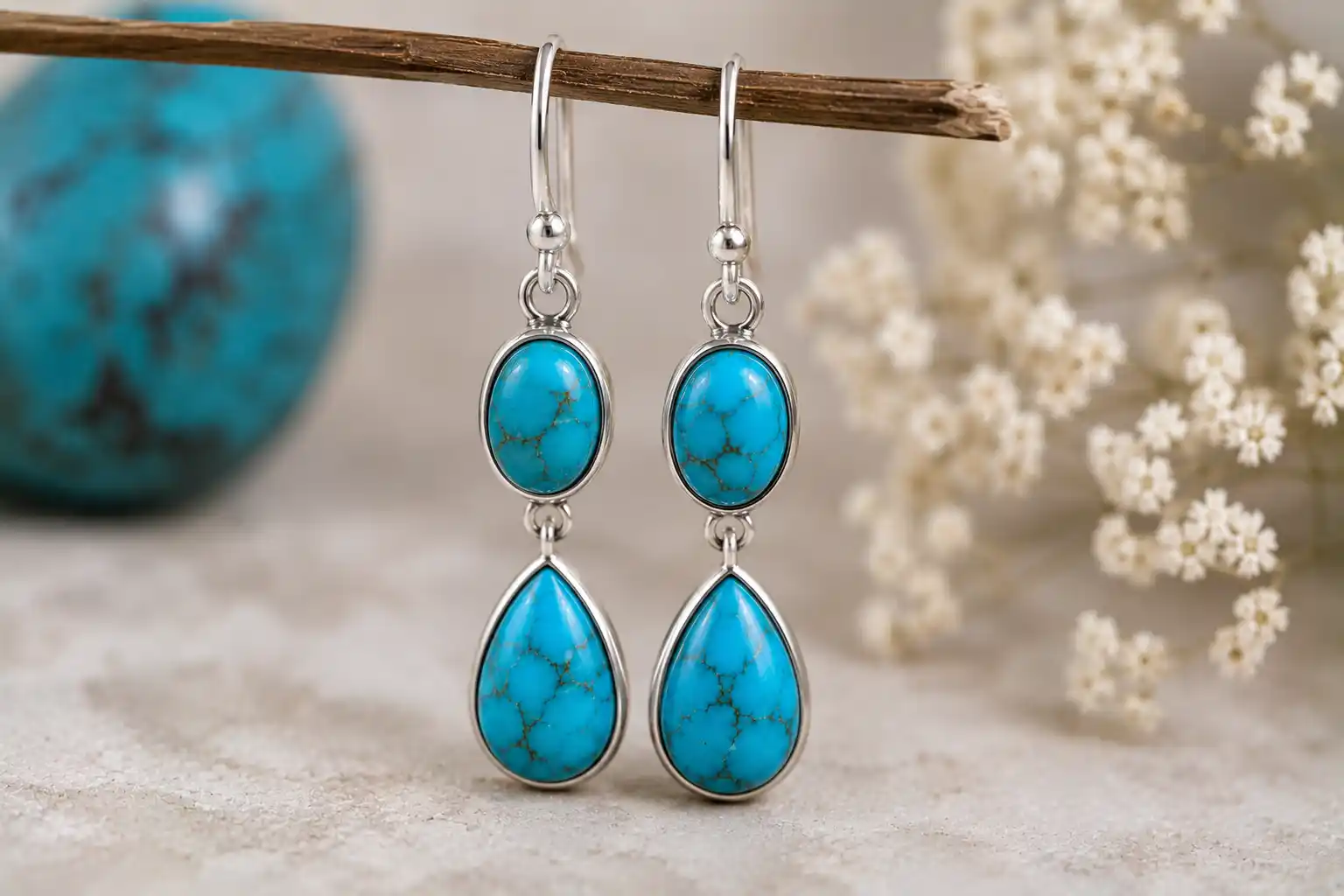
Turquoise Earrings: A Style Guide
Turquoise earrings range from small sky-blue studs to substantial silver clusters, bead drops, mosaic inlay, carved forms and contemporary gold-set designs. Because Turquoise is opaque, its appeal comes from color, matrix, shape, polish and craftsmanship rather than transparency or conventional gemstone brilliance.
Earrings are among the safest ways to wear Turquoise. They encounter less contact with desks, water, cosmetics and hard surfaces than rings or bracelets. However, treatment disclosure, matching, setting security, metal quality, backing strength and cultural attribution still determine whether a pair represents good value.
Turquoise Earrings at a Glance
| Feature | What to Consider |
|---|---|
| Mineral | Turquoise |
| Composition | Hydrated copper-aluminum phosphate |
| Typical colors | Blue, greenish blue, blue-green and green |
| Mohs hardness | Approximately 5–6 |
| Transparency | Opaque to rarely semitranslucent |
| Common earring styles | Studs, bezels, clusters, drops, hoops, inlay and bead earrings |
| Best protective setting | Full or substantial partial bezel |
| Important matching factors | Color, matrix, visible size, outline and polish |
| Common treatments | Waxing, oiling, dyeing, polymer stabilization and reconstruction |
| Main care concern | Cosmetics, skin oil, solvents, heat and abrasion |
| Safest cleaning | Gentle hand cleaning with minimal moisture |
| Birthstone connection | December |
What Are Turquoise Earrings?
Turquoise earrings contain cabochons, beads, inlay, carvings or natural-form pieces made from Turquoise or a material represented as Turquoise.
Natural Turquoise forms as a secondary mineral in dry geological environments. Copper contributes much of its blue color, while iron and other factors can shift it toward green.
A pair may contain fine untreated material, stabilized natural Turquoise, dyed stone, reconstructed composite or an imitation such as dyed Howlite or Magnesite. These categories can look similar in a product photograph but differ substantially in value and care.
The completed Turquoise bracelet guide owns bracelet construction and wrist wear. The canonical Turquoise meaning guide covers mineral identity, history and symbolism.
Why Turquoise Works Well in Earrings
The earring position protects Turquoise from many of the conditions that cause wear.
Earrings usually avoid repeated desk impact, household cleaners, handwashing and friction against other jewelry. This makes them suitable for softer, porous or artistically significant Turquoise that would need greater protection in a ring.
Opaque color also remains visible in small sizes. A modest cabochon can provide a strong blue or green accent without needing a faceted pavilion or open-backed setting.
The format does not make the stone maintenance-free. Hair products, perfume, cosmetics and skin oil can still reach the material, particularly in large drops and cluster earrings.
Turquoise Stud Earrings
Studs provide the most practical everyday format.
Round and oval cabochons create a clean, familiar appearance. Squares, triangles, freeforms and small carved forms offer more distinctive outlines.
A low bezel keeps the stone close to the earlobe and protects its edge. The back plate should support the complete cabochon rather than leaving a fragile stone exposed.
Large studs may tilt forward. A broad earring back or stabilizing disc can help the design sit flat.
The post should be centered according to the earring’s balance rather than simply placed in the geometric middle.
Bezel-Set Turquoise Earrings
A bezel is the most protective conventional setting for Turquoise.
The metal surrounds the cabochon’s edge and reduces chipping, snagging and direct contact with harder materials.
A good bezel follows the stone evenly. Gaps may allow movement, while irregular pressure can damage a thin or fractured cabochon.
The setting should not hide so much of the stone that the visible outline looks noticeably uneven.
Sterling silver produces strong contrast with blue and green Turquoise. Yellow gold gives the material a warmer, more formal presentation.
Prong-Set Turquoise Earrings
Prong settings are less common because opaque Turquoise does not need an open setting to transmit light.
Prongs may be used for unusual carvings, rough forms or designs intended to show more of the stone’s edge.
The claws should remain broad enough to hold the material without creating concentrated pressure.
A fractured or highly porous cabochon is usually better suited to a bezel.
Inspect prongs regularly because hair and fabric can catch them. One bent claw may allow the stone to move before the wearer notices a problem.
Turquoise Drop Earrings
Drop earrings suspend the gemstone beneath the lobe.
Pear-shaped cabochons, beads, carved drops and small framed inlays work naturally in a vertical design.
Movement makes color and matrix more visible but places additional demand on connecting rings. Every link should remain securely closed.
Short drops are easier to wear with scarves and high collars. Long designs can catch in hair or strike the neck.
Two lower stones should coordinate in visible weight and movement so one earring does not hang differently from the other.
Turquoise Dangle Earrings
Dangles may combine several cabochons, beads or metal elements.
A graduated design can move from a small upper stone to a larger lower piece. Clustered dangles may combine Turquoise with coral, shell, silver or other materials.
Harder gemstone components should not strike the Turquoise repeatedly.
The complete pair should remain comfortable for the intended wearing period. A large silver-and-stone construction can become heavy even when each individual cabochon is thin.
Check the reverse for rough solder, projecting wire or unfinished metal that may scratch the neck.
Turquoise Hoop Earrings
Turquoise can appear as bezel stations, bead wraps or removable charms on hoop earrings.
Front-facing stones offer the strongest visibility. Gems placed around the complete circumference add weight and increase the number of settings requiring inspection.
A hinged hoop should close with a distinct, secure click.
Removable charms need attachment loops that cannot slide over the open post. Their movement should not allow the cabochons to strike each other.
Small bezel charms are generally safer than thin drilled slabs.
Turquoise Cluster Earrings
Cluster earrings arrange several cabochons into floral, geometric or radiating patterns.
The stones may match closely or deliberately vary in blue, green and matrix.
Every bezel must remain secure. One loose stone can collect debris, shift or fall out.
A cluster’s back plate should distribute weight and keep the design stable on the lobe.
Large clusters often need broad supportive backs. They may be better for occasional wear than all-day use.
Turquoise Inlay Earrings
Inlay places thin pieces of Turquoise into a recessed metal or composite design.
The technique can create geometric patterns, landscapes, figures, channel work or mosaic arrangements.
The pieces should fit closely without obvious gaps or raised edges. Adhesive and backing quality are essential because the Turquoise may be extremely thin.
Do not soak inlay earrings. Water and solvents can affect glue, backing material and neighboring inlay stones.
Repair should be performed by someone familiar with lapidary inlay rather than by polishing the metal indiscriminately.
Turquoise Bead Earrings
Bead earrings may use rounds, barrels, disks, heishi-style elements or irregular nuggets.
Inspect drill holes for chips, fractures and concentrated dye.
The wire or headpin should fit the opening without excessive movement. A very thin pin can gradually enlarge a weak hole.
Bead drops need secure end loops and smooth metal components.
When thin disk beads are used, they should not strike one another with enough force to chip their edges.
Matching a Pair of Turquoise Earrings
Matching should be judged face-up.
The stones should coordinate in visible size, outline, body color, polish and overall matrix character. They do not need to be identical unless the design depends on strict symmetry.
One stone should not appear vividly blue while the other looks gray-green unless the contrast is intentional.
Matrix can be matched by amount, color and direction. A pair may look balanced even when the exact lines differ.
Photographs should show both earrings together under the same lighting. Separate edited images make comparison difficult.
Matching Color
Turquoise ranges naturally from blue through blue-green to green.
Fine sky blue remains highly recognized, but green and matrix-rich material can also be desirable.
Compare the pair in daylight-equivalent and ordinary indoor light. Digital enhancement may make blue appear cleaner or more saturated than it is.
A pair should not depend on one spotlight angle to look coordinated.
Treatment can also affect matching. Two stabilized or dyed stones may look uniform initially but age differently if their processes were inconsistent.
Matching Matrix
Matrix is the host-rock or mineral material crossing or surrounding the Turquoise.
One earring may show a fine spiderweb pattern while the other has one broad brown patch. Both may be natural, but the pair can look mismatched.
Successful matching can use similar matrix density without requiring identical lines.
In asymmetrical artist-designed earrings, different matrix patterns may form part of the concept.
Artificial matrix can be painted, molded or introduced into composite material. Repeated identical webbing across many stones deserves scrutiny.
Natural Versus Stabilized Turquoise Earrings
Untreated Turquoise has not been intentionally waxed, dyed, impregnated or reconstructed.
Stabilized Turquoise contains polymer, resin or another substance introduced into its pores to improve strength and polish.
Stabilization can make earrings more practical and does not make the host mineral an imitation. However, it should be disclosed and priced below fine untreated material of similar appearance.
Because earrings receive less skin oil than bracelets, fine untreated Turquoise may retain its appearance well when kept away from cosmetics and moisture.
The drafted treated Turquoise guide explains enhancement categories in detail.
Dyed and Reconstructed Material
Dye may deepen pale Turquoise or create a more marketable blue.
Possible clues include concentrated color in fractures, pores and drill holes. A chipped edge may expose a lighter interior.
Reconstructed Turquoise combines mineral fragments or powder with a binder.
The product may contain genuine Turquoise, but it is a composite rather than one naturally formed cabochon.
Both can be attractive when disclosed. Neither should be sold as fine untreated natural material.
Turquoise Imitations in Earrings
Dyed Howlite and Magnesite are common substitutes.
Glass, ceramic, resin and plastic may also reproduce blue color and artificial matrix.
Bubbles, mold seams, repeated patterns and pale chipped interiors can provide clues, but visual appearance is not always conclusive.
The completed real-versus-fake Turquoise guide owns the complete authentication workflow.
The planned Amazonite versus Turquoise guide and completed Larimar versus Turquoise guide cover two natural lookalikes.
Artist-Made Southwestern Turquoise Earrings
Turquoise jewelry is created within distinct Diné, Zuni, Hopi, Pueblo and other Southwestern artistic traditions.
These traditions differ in stone setting, metalwork, inlay, symbolism, community history and individual artistic practice. They should not be grouped into one interchangeable style.
When an earring is attributed to an artist, nation or community, ask for a maker’s mark, provenance or seller documentation.
Buying directly from artists, tribally affiliated businesses and transparent galleries helps preserve accurate attribution.
A generic “tribal” label without an identified maker or community provides little reliable information.
Zuni Inlay and Cluster Work
Zuni artists are particularly recognized for sophisticated stone inlay, needlepoint, petit point and cluster arrangements, although individual makers work in many styles.
A genuine attribution should be based on the artist and provenance rather than appearance alone.
Mass-produced imitation jewelry may copy visual elements without community connection.
Examine the precision of stone fitting, metal finishing and reverse construction.
Avoid treating a living artistic tradition as merely a decorative category.
Diné Silver and Turquoise Earrings
Diné artists have produced diverse silver and Turquoise jewelry, including substantial cabochons, stamped metalwork, clusters, bead designs and contemporary forms.
There is no single Diné earring style.
Maker attribution matters because artistic value may exceed the raw gemstone value.
Inspect stamps, signatures and seller records, but remember that marks can be copied. Provenance and expert assessment may be needed for significant pieces.
Use the artist’s preferred identification whenever it is available.
Hopi Overlay and Contemporary Work
Hopi jewelry is often associated with silver overlay, though Hopi artists also create gold, stone-set, inlaid and contemporary designs.
Turquoise may be incorporated as an accent or center material.
A silver-overlay appearance alone does not prove Hopi authorship.
Ask for the maker’s identity and documentation rather than inferring cultural origin from one technique.
Distinct community traditions deserve the same care in attribution as fine-art authorship.
Choosing the Metal
Sterling silver provides strong contrast and has a long history in Southwestern jewelry.
Yellow gold creates a warmer luxury presentation. Rose gold may emphasize greenish Turquoise, while oxidized silver can make pale blue stones appear brighter.
The metal should be evaluated for construction quality rather than color alone.
Thin bezels, weak posts and open connecting rings undermine even expensive metal.
People with nickel sensitivity should ask about posts, backings, solder and plated components.
Choosing Earring Size
Small studs provide subtle color and easy daily wear.
Medium cabochons make matrix and color more visible without becoming excessively heavy.
Large clusters, slabs and drops create a statement but need supportive backs and realistic wearing times.
Millimeter dimensions and total earring weight are more useful than gemstone carat weight for opaque Turquoise.
Try the earrings long enough to evaluate pulling, forward tilt and irritation before the return period ends.
Earring Backings
Friction backs suit small studs when they remain tight.
Broad disc backs support larger cabochons and clusters.
Screw backs provide security but may be slower to use and uncomfortable for some wearers.
Locking backs combine a broad support surface with a release mechanism.
Lever backs suit drops. Open hooks should use silicone stoppers when loss is a concern.
The backing should match the total earring weight rather than the gemstone size alone.
December Birthstone Earrings
Turquoise is one of December’s birthstones, together with Tanzanite and Zircon.
The planned December birthstone guide explains the calendar tradition.
Earrings make practical gifts because they do not require ring or wrist sizing.
The planned December birthstone jewelry guide compares Turquoise earrings with other gift formats.
A birthstone description does not confirm that a blue material is natural or untreated.
Styling Turquoise Earrings
Blue Turquoise pairs naturally with white, black, denim, brown, rust, coral and earth tones.
Green Turquoise works well with cream, olive, burgundy and warm metals.
Small studs can suit professional or casual clothing. Drops, clusters and large inlay earrings create stronger statements.
Allow culturally significant artist-made pieces to remain the visual focus rather than combining them with several competing motifs.
Matching jewelry does not need identical stones. Coordinated metal, scale and craftsmanship can connect pieces successfully.
Comparing Other Turquoise Jewelry
A Turquoise bracelet receives greater contact with skin oils, cosmetics and hard surfaces.
The planned Turquoise necklace guide can accommodate larger cabochons, bead strands and pendants.
The planned Turquoise ring guide will require maximum protection from impact.
Earrings generally provide the easiest combination of visible color, low abrasion and gift flexibility.
Cleaning Turquoise Earrings
Put the earrings on after applying perfume, hairspray, cosmetics and skincare products.
Wipe them with a clean soft cloth after wear.
When the material, treatment and construction permit, use a cloth or soft brush lightly dampened with warm mild soapy water. Do not soak the pair.
Avoid steam, ultrasonic cleaning, alcohol, acetone, bleach, ammonia, acids and abrasive compounds.
Dry the stones, settings, posts and backs immediately.
The completed Turquoise jewelry-cleaning guide owns the detailed procedure.
Storage
Store each earring separately with its backing.
Keep Turquoise away from Quartz, Topaz, Sapphire, Diamond and rough metal components that can scratch it.
Do not leave artist-made earrings compressed beneath heavy jewelry.
Avoid heat, direct prolonged sunlight and solvent fumes.
Turquoise appears in the blue gemstones guide, green gemstones guide, crystals beginning with T and gemstones beginning with T.
Final Perspective
A strong pair of Turquoise earrings balances the two stones without erasing their natural individuality. Color, matrix, shape and polish should coordinate, while settings and backs must support the complete design.
Material disclosure and attribution matter equally. Untreated, stabilized, dyed, reconstructed and imitation products occupy different market positions, while identified artist-made jewelry may carry cultural and artistic value far beyond the weight of its stones.
Frequently Asked Questions
1. Is Turquoise suitable for earrings?
Yes. Earrings protect Turquoise from much of the impact, water and chemical exposure experienced by rings and bracelets.
2. Which setting protects Turquoise earrings best?
A full or substantial partial bezel provides strong edge protection.
3. Must matched Turquoise earrings be identical?
No. They should coordinate in color, matrix, visible size, outline and polish, but natural variation can remain attractive.
4. Is stabilized Turquoise appropriate for earrings?
Yes. Stabilization improves strength and can provide practical jewelry, although it should be disclosed.
5. How can dyed Turquoise earrings be recognized?
Color concentrated around fractures, pores, drill holes and chipped edges can provide clues, but professional testing may be needed.
6. Are green Turquoise earrings lower quality?
Not automatically. Attractive natural green Turquoise has its own collector and design appeal.
7. Is matrix a defect?
No. Matrix can add character and value when the pattern, provenance and craftsmanship are desirable.
8. How can artist-made Indigenous earrings be authenticated?
Look for an identified maker, credible provenance, seller transparency and community-specific attribution rather than a generic style label.
9. Which metal looks best with Turquoise?
Sterling silver creates classic contrast, while yellow gold produces a warmer presentation. Construction quality matters more than metal color alone.
10. Can Turquoise earrings get wet?
Brief controlled cleaning may be acceptable, but soaking should be avoided because the stone, treatment, glue or inlay backing may be affected.
11. Can Turquoise earrings be cleaned ultrasonically?
No. Steam and ultrasonic cleaning should be avoided.
12. How should Turquoise earrings be stored?
Keep each earring separately in a padded compartment away from harder gemstones, cosmetics, heat and direct prolonged sunlight.