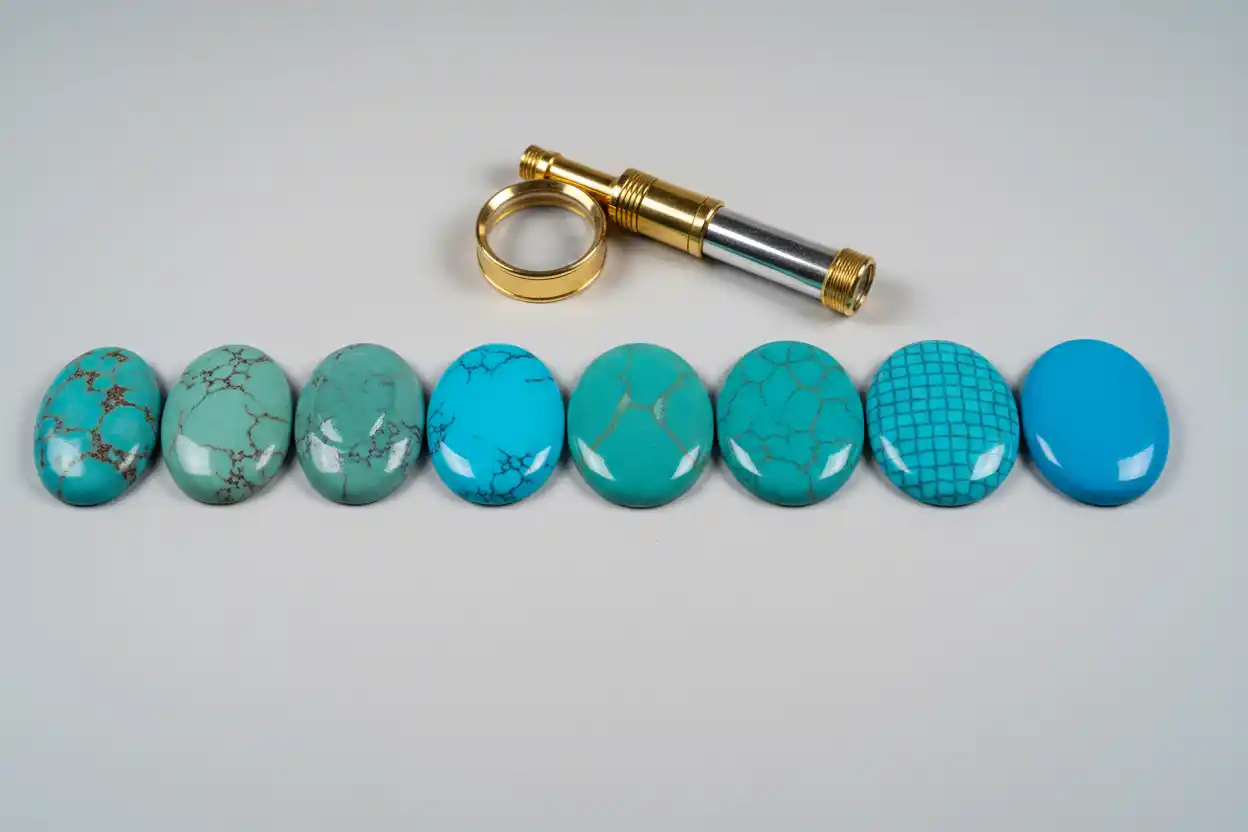
How to Spot Treated or Synthetic Turquoise
Turquoise is frequently treated because natural material can be porous, pale, chalky or structurally weak. Wax, oil, polymer, resin and chemical processes can strengthen the stone, deepen its color, improve polish or reduce its tendency to absorb skin oils.
Treatment does not necessarily make Turquoise fake. Stabilized natural Turquoise still contains mined Turquoise, although its pores have been filled with another substance. Dyed natural Turquoise is also genuine mineral material, but its color was enhanced artificially.
Synthetic Turquoise, reconstructed Turquoise and imitations belong to different categories. A true synthetic reproduces the mineral substantially in a laboratory, while reconstructed material combines powdered or fragmented Turquoise with a binder. Dyed Howlite, Magnesite, glass and plastic merely imitate the appearance.
Treated Turquoise at a Glance
| Material or treatment | What it means | Common identification issue |
|---|---|---|
| Natural untreated Turquoise | Mined material without intentional enhancement | Can be porous, variable and sensitive to oils |
| Waxed Turquoise | Surface pores filled or coated with wax | Temporary color and luster improvement |
| Oiled Turquoise | Oil reduces visible porosity and pale spots | Greasy residue or color change over time |
| Stabilized Turquoise | Polymer, resin or wax introduced to improve durability | Treatment may penetrate deeply |
| Dyed Turquoise | Natural material colored artificially | Dye concentrates in pores and fractures |
| Resin-filled Turquoise | Resin fills pores and improves color and polish | Fluorescence and infrared evidence may reveal polymer |
| Zachery-treated Turquoise | Proprietary chemical enhancement without conventional polymer impregnation | Often needs elemental analysis |
| Porcelain-treated Turquoise | Inorganic additive improves density, color and luster | Strong surface luster and altered chemistry |
| Reconstructed Turquoise | Powder or fragments combined with binder | Granular texture and polymer boundaries |
| Synthetic Turquoise | Laboratory-manufactured material resembling natural Turquoise structurally | Requires laboratory analysis |
| Turquoise imitation | Howlite, Magnesite, glass, resin or another substitute | Different physical and optical properties |
What Is Natural Turquoise?
Turquoise is a hydrated copper-aluminum phosphate that commonly forms in dry regions where copper-rich groundwater reacts with aluminum- and phosphorus-bearing minerals.
Its natural color ranges from blue and greenish blue to green. Brown, black, tan or golden matrix may cross the material.
Fine compact Turquoise can accept a strong polish without stabilization. Lower-grade material may be pale, chalky and highly porous.
The main Turquoise meaning guide owns the gem’s mineralogy, cultural history and symbolism. This article focuses on enhancement and synthetic identification.
Why Turquoise Is Treated
Porosity is the principal reason.
An untreated porous stone can absorb skin oil, cosmetics and moisture. Its color may darken or become uneven during wear.
Weak material may also crumble during cutting or fail to accept a high polish.
Treatment fills the pores, strengthens the structure or changes the way light scatters through the stone. This can make pale Turquoise look darker, more saturated and more valuable.
The degree of enhancement ranges from a light wax coating to complete polymer impregnation.
Natural, Treated, Synthetic and Imitation Turquoise
Natural treated Turquoise began as mined Turquoise.
Synthetic Turquoise is manufactured but designed to reproduce natural Turquoise’s essential characteristics, though some synthetic products can contain additional compounds.
Reconstructed Turquoise uses powdered or broken natural material combined with a binder. It is a composite rather than one naturally formed stone.
An imitation has a different identity. Dyed Howlite may look like matrix Turquoise, but it remains Howlite.
Precise terminology helps buyers compare price, durability and authenticity fairly.
The completed lab-grown versus natural gemstones guide explains these categories in wider gemological use.
Waxed Turquoise
Waxing is one of the oldest and least intensive enhancements.
Finished Turquoise is immersed in or coated with wax to improve luster, reduce surface porosity and temporarily deepen color.
Wax may collect in carved recesses, pits and drill holes. A newly treated piece can appear richer and smoother than it will after years of wear.
Heat, detergents and solvents can remove or redistribute wax.
Waxed material can still be attractive and wearable. The treatment should be disclosed because it affects care and may require future maintenance.
Oiled Turquoise
Oil can fill shallow pores, conceal white areas and deepen color.
Mineral or vegetable oils may be used. The effect can diminish as the oil migrates, dries or collects dust.
An oily sheen may appear in recessed areas, while heat can cause material to emerge from pores.
Oiling is less structurally strengthening than polymer stabilization.
A stone represented as untreated should not have its appearance maintained by added oil.
Stabilized Turquoise
Stabilization introduces polymer, resin or wax into porous material.
Vacuum or pressure may help the substance penetrate deeply.
The treatment increases durability and allows lower-grade rough to be cut, drilled and polished more successfully.
Stabilized Turquoise can be practical for everyday jewelry. However, it should not command the same price as fine untreated material of comparable appearance.
The polymer may affect repair, cleaning and laboratory readings.
A seller should identify the stone as stabilized rather than using vague phrases such as “enhanced for durability.”
Resin-Filled Turquoise
Resin filling reduces open pore space and improves color saturation.
Pale or chalky samples may become dramatically deeper and more uniform because less light is scattered by empty pores.
Uneven penetration can create artificial boundaries between darker porous areas and lighter compact zones.
Under long-wave ultraviolet light, some resins produce strong milky-blue fluorescence. Infrared spectroscopy can identify characteristic polymer absorption.
Microscopy may also reveal filled cavities, smooth artificial surfaces or bubbles.
These signs vary according to the resin and process, so laboratory testing remains more reliable.
Dyed Turquoise
Dye is used to strengthen or completely change color.
A pale stone may be dyed blue, while greenish material can be made to resemble a preferred sky-blue appearance.
Color often concentrates in pores, fractures and drill holes. Chipped edges may reveal a lighter interior.
Dye can also be mixed with polymer during stabilization, creating a treatment that changes color and durability simultaneously.
Some dyes remain stable, while others fade or bleed when exposed to solvents, heat or intense light.
A seller should disclose both dyeing and polymer treatment when both are present.
How Dye Appears Around Drill Holes
Beads often provide the clearest visual evidence.
The inside of a drill hole may appear darker than the polished surface because dye penetrated fractures created during drilling.
A chipped hole can reveal pale untreated material beneath a saturated blue exterior.
Stringing cord may also show blue transfer if an unstable dye was used.
Nevertheless, a clean drill hole does not prove the bead is untreated. Dyeing may have occurred before drilling or penetrated deeply.
Examine several beads under magnification instead of relying on one opening.
Zachery Treatment
The Zachery process is a proprietary enhancement developed to improve polish, color and resistance to discoloration.
Unlike conventional stabilization, it does not rely on ordinary polymer impregnation.
Treated material can retain gemological properties very similar to untreated Turquoise. Consequently, visual inspection and basic tests may not identify it.
Elevated potassium detected through chemical analysis is an important laboratory clue.
The process can reduce porosity and improve the stone’s ability to resist absorbing skin oils.
A seller should disclose the treatment even though the material remains natural Turquoise.
Porcelain Treatment
Porcelain-treated Turquoise uses an inorganic additive to improve low- or medium-quality material.
The process can create a denser-looking surface, strong luster and color resembling finer natural stone.
Laboratory studies have found altered chemistry, high silica levels and surface features that distinguish treated material.
The name does not mean that the object is ordinary ceramic porcelain. It describes a specific enhancement process applied to Turquoise.
Because the treatment is relatively sophisticated, appearance alone may be insufficient for confirmation.
Gel-Filled Turquoise
Low-temperature gel filling introduces a material that deepens color, increases uniformity and modifies porosity.
Treated pieces may develop a waxy luster and altered fluorescence.
Specific gravity may also change because the filler has a different density from the original stone.
Gel-filled material remains treated natural Turquoise if the host material is genuine.
The filler should be disclosed because it affects value, repair and cleaning.
Resin Impregnation Versus Resin Filling
The terms are related but not identical in some laboratory and trade systems.
Resin filling may describe introducing resin and hardener into accessible pores under ordinary conditions.
Impregnation commonly involves vacuum or pressure to force polymer deeper through the material.
Impregnation can produce more complete stabilization and a more uniformly altered structure.
Both treatments can improve color because filled pores scatter less light.
The invoice should use the terminology recognized by the seller’s market and laboratory rather than hiding the process under “natural.”
Reconstructed Turquoise
True reconstructed Turquoise uses powdered or finely divided Turquoise combined into a new solid product.
A polymer or other binder may hold the particles together.
Under magnification, reconstructed material may show granular fragments, repeated particles, binder boundaries and gas bubbles.
Some products historically marketed as reconstructed Turquoise have contained little or no actual Turquoise, making the label inaccurate.
The percentage and identity of natural material should therefore be stated when possible.
A reconstructed product can be attractive, but it is a manufactured composite rather than one natural stone.
Block Turquoise
“Block Turquoise” commonly refers to manufactured resin or plastic made to resemble Turquoise.
It may contain no natural Turquoise.
Color and matrix can be molded into large blocks that are then cut into beads and cabochons.
Repeated webbing patterns, mold features, bubbles and unusually low weight may provide clues.
The phrase should not be confused with a naturally mined block or slab of Turquoise.
Ask the seller whether the product contains any natural mineral.
Does Synthetic Turquoise Exist?
Yes. Synthetic Turquoise materials have been manufactured.
A true synthetic aims to reproduce natural Turquoise’s composition, structure and properties, although additional compounds may be present in some products.
The market terminology has not always been consistent. Certain well-known manufactured products have been described as synthetic in older sources but classified as imitations when their composition differs substantially from natural Turquoise.
A seller should identify the specific product rather than relying on “lab-created Turquoise” as a complete description.
Laboratory spectroscopy and diffraction may be needed for reliable separation.
Gilson Turquoise
Gilson introduced manufactured blue products intended to resemble Turquoise.
Modern gemological descriptions often classify the familiar Gilson product as an imitation rather than a true synthetic because its ingredients and properties do not correspond fully with natural Turquoise.
It can still imitate natural color and matrix convincingly.
A listing should identify it as Gilson imitation Turquoise rather than untreated natural material.
The brand or process name does not automatically establish that every blue manufactured product has the same composition.
Dyed Howlite
Howlite is naturally white or gray with dark veining and readily absorbs dye.
When dyed blue, it can resemble matrix-rich Turquoise.
Color may collect strongly in the veins and pores. The white interior can sometimes appear around chips or drill holes.
Howlite is softer and has different optical, chemical and spectroscopic properties.
A scratch or acid test should not be used on jewelry. Professional analysis provides a safer separation.
Dyed Magnesite
Magnesite is another pale porous mineral commonly dyed blue or green.
It may show brown or gray veining that resembles Turquoise matrix.
Magnesite is a carbonate and reacts differently from Turquoise during professional testing.
Some commercial beads contain an unnaturally uniform bright blue body with repeated dark lines.
Dyed Magnesite can be attractive when labeled honestly. It is not stabilized Turquoise, synthetic Turquoise or a natural Turquoise variety.
Glass and Ceramic Imitations
Glass can reproduce blue-green color and artificial matrix.
Rounded gas bubbles, curved flow structures and mold seams may appear under magnification.
Ceramic products can show a grainy surface, repeated matrix or a color that looks printed rather than mineralized.
Some imitation glass is dense and highly polished, while plastic products may feel lighter.
Subjective weight or temperature tests are unreliable. Instrumental testing is preferable.
The completed glass-versus-crystal guide provides wider material context.
Plastic and Resin Imitations
Plastic and resin can be molded into beads, carvings and cabochons.
Possible clues include mold seams, perfectly repeated matrix patterns, round bubbles and a surface that scratches or dents more easily than expected.
A hot-needle test is destructive, produces fumes and should never be used.
Some resin products contain powdered stone, making them composites rather than simple plastic.
The exact material description matters more than whether the object looks convincing in a photograph.
Natural Matrix Versus Artificial Matrix
Natural matrix represents portions of the host rock or mineral-filled fractures remaining within the Turquoise.
Its pattern can be irregular, localized and structurally connected to the stone.
Artificial matrix may be painted, injected or molded into repeated spiderweb designs.
Lines that stop abruptly at the surface, show uniform thickness or repeat across several beads deserve attention.
However, natural spiderweb Turquoise can also be remarkably regular.
Matrix appearance alone cannot establish origin or treatment.
Color Uniformity
Fine untreated Turquoise may have remarkably even color.
Therefore, uniform blue should not automatically be treated as proof of dye or synthetic origin.
Instead, evaluate whether the color looks natural within pores, matrix, drill holes and chipped areas.
An unnaturally saturated surface combined with pale internal areas is more suspicious than uniformity alone.
Lighting also matters. Photography and editing can make blue appear cleaner, brighter or more cyan than it looks in person.
Magnification
A loupe or microscope may reveal dye concentration, resin-filled pores, bubbles, binder boundaries and coating wear.
Untreated Turquoise commonly shows granular or microcrystalline texture rather than transparent crystal interiors.
Wax can collect in pits and carved recesses.
Reconstructed material may reveal fine particles held within a continuous polymer.
Sophisticated treatments can remain difficult to detect visually. The absence of obvious clues does not prove untreated status.
Ultraviolet Fluorescence
Ultraviolet response can provide evidence of resin or manufactured material.
Some polymer-filled Turquoise shows strong milky-blue fluorescence under long-wave UV, while untreated material may remain inert or weak.
Wax, oil, dye and different resin formulations can produce varied reactions.
Synthetic or imitation materials can also fluoresce.
UV response is therefore supportive evidence rather than a stand-alone diagnosis.
Infrared and Raman Spectroscopy
Infrared spectroscopy is particularly useful for detecting polymers, waxes and resins.
Raman spectroscopy can identify Turquoise and separate it from Magnesite, Howlite, glass and many other substitutes.
Spectra can also reveal whether a composite contains genuine Turquoise particles or only dyed filler material.
These methods usually require no destructive sampling.
The completed how-to-identify-crystals guide explains why laboratory methods outperform home acid and scratch tests.
X-Ray Diffraction and Chemical Analysis
X-ray diffraction identifies crystalline phases.
It can distinguish natural or synthetic Turquoise structures from gibbsite, carbonate imitations and other mineral mixtures.
Elemental analysis can reveal unusual potassium associated with Zachery treatment or high silica associated with certain porcelain processes.
No single instrument answers every question.
A laboratory may combine microscopy, infrared spectroscopy, Raman analysis, diffraction and chemical testing to identify material and treatment.
Buying Treated Turquoise
Ask whether the stone is untreated, waxed, stabilized, dyed, resin-filled, reconstructed, synthetic or imitation.
The word “genuine” only confirms that some natural material may be present; it does not guarantee untreated quality.
Request disclosure in writing, especially for high-value cabochons and named-mine material.
A locality claim does not automatically prove treatment status.
The completed Turquoise buying guide owns quality, provenance and seller evaluation. The completed Turquoise price guide explains how treatment influences value.
Treatment and Turquoise Types
The completed types-of-Turquoise guide explains natural colors, matrix patterns and commercial variety names.
A treatment should not be presented as a mine variety.
Likewise, a spiderweb pattern does not prove that the stone came from a particular location.
Named-mine Turquoise often commands a premium, making independent documentation more important when provenance is central to the price.
The completed real-versus-fake Turquoise guide owns the wider authenticity workflow.
Comparing Common Lookalikes
The completed Amazonite versus Turquoise guide separates blue-green feldspar from the phosphate gem.
The completed Larimar versus Turquoise guide compares Dominican Pectolite with Turquoise.
Howlite and Magnesite are particularly relevant when dye has been used.
Glass, ceramic and resin dominate lower-cost imitation products.
The seller should identify the material rather than relying on broad phrases such as “Turquoise style” or “created stone.”
Jewelry-Specific Considerations
A planned Turquoise bracelet will experience contact with skin oils, cosmetics and desks, making treatment disclosure especially relevant.
Planned Turquoise earrings expose the stone to less impact and fewer chemicals.
A planned Turquoise necklace can hold large cabochons or bead strands, while a planned Turquoise ring needs maximum protection.
Stabilized material may be more practical than untreated porous Turquoise for frequent wear. Its lower market value should still be reflected accurately.
December Birthstone Context
Turquoise is one of December’s birthstones, together with Tanzanite and Zircon.
The completed December birthstone guide explains the calendar tradition.
The completed December birthstone jewelry guide compares practical gift formats.
A birthstone label does not confirm that a blue bead is natural Turquoise.
Treatment and material identity should still appear in the product description.
Cleaning Treated Turquoise
Use a soft dry or slightly damp cloth for routine care.
When the treatment is known and stable, brief cleaning with mild soap may be acceptable. Prolonged soaking remains unnecessary.
Avoid steam, ultrasonic equipment, bleach, ammonia, acids, alcohol and acetone.
Solvents can remove wax, damage dye or soften polymer.
The completed guide to cleaning Turquoise jewelry provides the complete method.
Spiritual Cleansing
Spiritual cleansing does not reveal whether Turquoise is natural, synthetic or stabilized.
Sound, visualization and placement on a clean dry cloth are conservative choices.
Water, salt and sunlight can affect dye, wax, resin and porous material.
The completed guide to cleansing and charging Turquoise owns the separate spiritual-care intent.
The planned or treated status should come from disclosure and testing rather than ritual behavior.
Storage
Store Turquoise away from cosmetics, perfume and household chemicals.
Keep it in a separate padded compartment because Quartz, Topaz, Sapphire and Diamond can scratch it.
Do not store dyed stones against absorbent pale fabric when color transfer is suspected.
Avoid direct sunlight, heat and very dry conditions that may affect wax or filler.
Turquoise appears among the blue gemstones and green gemstones listed elsewhere on the site.
Final Perspective
Treatment is common in Turquoise because porosity and softness directly influence cutting, color and wear. Stabilization can turn fragile material into durable jewelry, while dye and resin can also make poor-quality rough appear much finer than it was naturally.
The most useful buying question is not simply “Is it real?” Instead, ask what percentage of the object is natural Turquoise, what treatments were used and whether the stated price reflects them.
Visual inspection can reveal obvious dye, resin and molded imitations, but sophisticated chemical enhancements require laboratory analysis.
Frequently Asked Questions
1. Is most Turquoise treated?
A substantial amount of commercial Turquoise is waxed, stabilized, dyed or otherwise enhanced, although fine untreated material is also available.
2. Is stabilized Turquoise real?
Yes. It contains natural Turquoise whose pores have been filled with polymer, resin or wax to improve durability.
3. How can dyed Turquoise be recognized?
Look for color concentrated in fractures, pores, drill holes and chipped areas. These clues are useful but not conclusive alone.
4. What is reconstructed Turquoise?
It is a manufactured composite made from powdered or fragmented Turquoise combined with a binder.
5. Does synthetic Turquoise exist?
Yes. Synthetic Turquoise materials exist, although market terminology varies and many manufactured products are more accurately classified as imitations.
6. Is Gilson Turquoise synthetic?
The familiar Gilson Turquoise product is commonly classified as an imitation because its composition and properties differ from natural Turquoise.
7. What is Zachery-treated Turquoise?
It is natural Turquoise enhanced through a proprietary chemical process that improves polish and may deepen color without conventional polymer impregnation.
8. What is porcelain-treated Turquoise?
It is Turquoise treated with an inorganic additive to improve density, color and surface luster.
9. Is dyed Howlite Turquoise?
No. Howlite is a different mineral dyed blue to imitate Turquoise.
10. Can acetone prove that Turquoise is dyed?
Some dyes and coatings react to solvents, but acetone can permanently damage the piece and should not be used as a home test.
11. Does treated Turquoise require special care?
Yes. Avoid prolonged soaking, heat, acids, solvents, steam and ultrasonic cleaning.
12. When is laboratory testing worthwhile?
Testing is useful when untreated status, named-mine origin, synthetic identity or treatment materially affects the price.