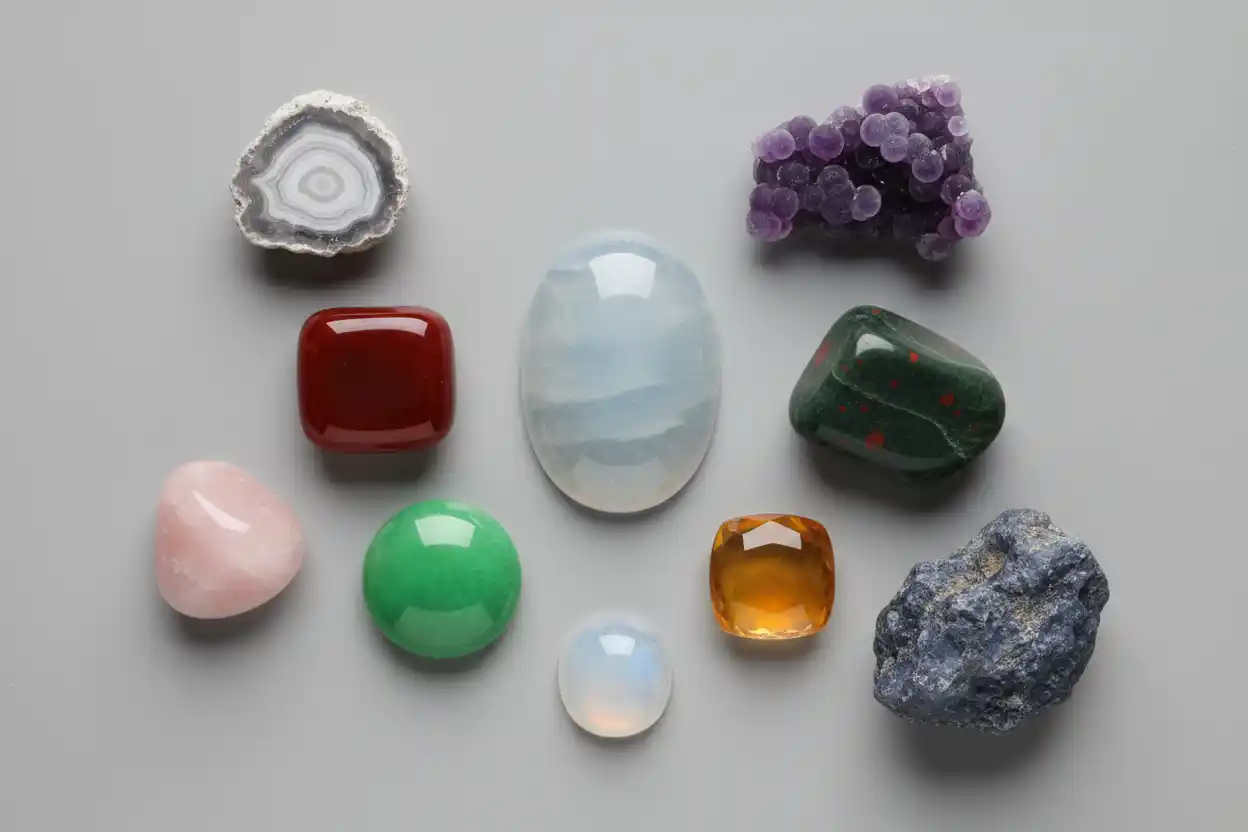
Types of Chalcedony: Colors and Varieties Explained
Chalcedony is the fine-grained side of the quartz family. Instead of forming the large visible crystals associated with rock crystal or amethyst, it grows as microscopic interlocking silica fibers and grains that create smooth, waxy, translucent, banded, mottled, or opaque gem materials.
The word can describe the broad microcrystalline quartz family or, in jewelry trade usage, the translucent single-color material covered in the main chalcedony meaning and properties guide. Understanding that difference explains why agate, carnelian, onyx, chrysoprase, bloodstone, and many jaspers may all sit within or near the chalcedony family.
Chalcedony at a Glance
| Property | Chalcedony |
|---|---|
| Composition | Silica, SiO₂; commonly microcrystalline quartz with variable moganite |
| Mineral group | Quartz and chalcedony group |
| Main colors | Colorless, white, gray, blue, lavender, pink, red, orange, brown, yellow, green, black, and multicolored |
| Crystal system or texture | Aggregate of microscopic trigonal quartz and variable monoclinic moganite rather than one visible crystal |
| Typical habit | Nodular, botryoidal, stalactitic, crusty, vein-filling, geode-forming, and massive |
| Luster | Waxy to dull when rough; vitreous to glossy when polished |
| Transparency | Transparent at thin edges, translucent, or opaque |
| Mohs hardness | Approximately 6.5–7 |
| Cleavage | None |
| Tenacity | Brittle, but relatively tough in carved forms because of its fine interlocking texture |
| Common uses | Cabochons, beads, cameos, seals, carvings, inlay, rings, pendants, and collector specimens |
| Main care concern | Undisclosed dye, heat alteration, fracture filling, thermal shock, and hazardous silica dust during cutting |
What Is Chalcedony Mineralogically?
Chalcedony consists primarily of extremely fine quartz, often intergrown with moganite. Individual crystallites are usually too small to see without advanced magnification.
This texture distinguishes chalcedony from macrocrystalline quartz, whose crystals can grow large enough to display recognizable prisms and terminations. Both are composed mainly of silica, but their growth structures create very different appearances and cutting behavior.
Chalcedony commonly grows from silica-rich fluids in volcanic cavities, fractures, weathered rock, sedimentary nodules, and hydrothermal veins. Layer-by-layer precipitation can produce banding, while included iron oxides, manganese oxides, clays, chlorite, amphiboles, nickel-bearing minerals, and other phases create color and pattern.
Chalcedony, Agate, and Jasper: Where the Names Overlap
The family’s terminology is not perfectly consistent.
In strict gemological usage, chalcedony may encompass a wide range of microcrystalline silica. In everyday trade usage, “chalcedony” commonly means translucent, relatively uniform material, especially blue, gray, lavender, white, or pink.
Agate usually refers to translucent chalcedony with visible banding, although many commercial agate names describe included or patterned material with weak bands. The types of agate guide owns the full agate classification.
Jasper normally refers to opaque microcrystalline silica colored by abundant mineral inclusions. Its boundaries with chalcedony, chert, and fine-grained silicified rock can be difficult to define. The planned types of jasper guide separates the main jasper trade varieties.
Common or Plain Chalcedony
Common chalcedony is translucent to semitranslucent material without the strong banding required for classic agate. White, gray, pale blue, lavender, pink, cream, and brown are typical.
Rough surfaces often have a waxy or dull luster, while a high polish can create a glassier appearance. Fine material seems to glow from within because light enters the dense microcrystalline aggregate and scatters softly.
Plain chalcedony is commonly cut into cabochons, beads, seals, cameos, and carvings. Even color, translucency, polish, and freedom from distracting fractures determine quality.
Blue Chalcedony
Blue chalcedony ranges from nearly colorless bluish gray to soft sky blue, periwinkle, lavender-blue, and stronger medium blue. The finest material has even color, good translucency, and a soft internal glow.
Its blue appearance may relate to microscopic scattering structures and trace inclusions rather than one universal chromophore. Consequently, blue chalcedony from different deposits can vary in tone, fluorescence, texture, and reaction to treatment.
Turkey, Namibia, parts of Africa, and the western United States have supplied notable material, although locality should be documented rather than guessed from color.
The blue chalcedony guide retains the variety-specific material, while the chalcedony color meaning guide owns symbolic comparisons among colors.
White and Gray Chalcedony
White chalcedony can be milky, translucent, porcelain-like, or nearly opaque. Gray varieties range from pale silver to smoky charcoal.
Fine gray chalcedony is used for cameos, minimalist jewelry, seals, and modern geometric cuts. Some stones show subtle blue or lavender undertones in daylight.
White and gray base material also receives dye readily. An unusually saturated color combined with pale fractures or drill holes should prompt questions about treatment.
Pink and Lavender Chalcedony
Natural pink and lavender chalcedony occurs, but the market also contains dyed material. Natural examples often show gentle, uneven, or softly distributed color rather than intense concentrations along cracks.
Pink chalcedony should not automatically be called rose quartz. Rose quartz is usually macrocrystalline or massive quartz with a different internal structure and typical color mechanism.
Lavender chalcedony may overlap in appearance with pale amethyst, lavender jadeite, dyed agate, glass, or opal. Standard gemological testing separates these materials.
Agate
Agate is chalcedony characterized principally by banding. Layers may be straight, curved, concentric, angular, lace-like, fortification-shaped, or arranged around a central cavity.
Each band records a stage of silica deposition. Differences in porosity, iron content, grain orientation, and included minerals create contrasting colors and textures.
Brazil and Uruguay are major commercial sources, while Mexico, the United States, India, Botswana, Madagascar, Germany, and many other regions produce distinctive agates.
Agate’s porosity makes treatment common. Dyeing, heating, sugar-acid darkening, and impregnation can alter appearance. The dedicated guide to treated or synthetic agate covers those identification issues.
Blue Lace Agate
Blue lace agate shows pale blue and white bands arranged in delicate loops, waves, or lace-like patterns. Material from Namibia established the name’s modern commercial identity.
Fine pieces display crisp banding, pleasing pale blue color, and enough translucency to create depth. Gray, brown, or heavily fractured areas reduce commercial value unless they enhance the composition.
The dedicated blue lace agate guide owns the variety-specific meaning and buying intent.
Onyx
Natural onyx is chalcedony with relatively straight, parallel bands. Classical examples may contain black and white, brown and white, or other contrasting layers.
Much of the uniform black “onyx” sold for jewelry is dyed chalcedony rather than naturally solid-black onyx. Dyeing does not make the material unusable, but it should be disclosed.
Parallel bands allow lapidaries to carve cameos, intaglios, and seals in which one colored layer forms the design and another forms the background. The onyx guide covers its modern jewelry and symbolism intent.
Sardonyx
Sardonyx is a parallel-banded variety combining sard, generally brownish red to dark orange-brown, with white or pale chalcedony layers.
Well-defined layers make sardonyx particularly suitable for cameos and signet-style carvings. Cutters orient the material so the design uses the contrast between bands.
The sardonyx guide addresses that variety’s mineralogical identity, historical use, and care.
Carnelian and Sard
Carnelian is translucent orange, red-orange, or reddish chalcedony. Iron oxides and hydroxides create its warm color.
Heating pale iron-bearing material can intensify orange and red tones. This practice has a long history, and the resulting color may be stable. Sellers should disclose modern treatment when known.
Sard overlaps with carnelian but is generally darker, browner, or less vivid. The boundary is based on appearance and tradition rather than a strict chemical division.
India has long been associated with carnelian cutting and heat enhancement, while Brazil, Uruguay, Madagascar, and other regions also supply rough.
Chrysoprase
Chrysoprase is apple-green to deeper green chalcedony colored by microscopic nickel-bearing minerals.
Fine chrysoprase combines vivid green color with translucency and minimal brown matrix. Pale, opaque, grayish, or heavily included pieces are less valuable, although patterned material may still suit carving.
Australia has supplied important gem-quality chrysoprase, while deposits also occur in Tanzania, Brazil, Poland, Kazakhstan, Madagascar, and elsewhere.
Dyed green chalcedony can imitate chrysoprase. Dye may concentrate in fractures, while natural chrysoprase’s color arises from dispersed nickel-bearing inclusions throughout the material.
Chrome Chalcedony and Mtorolite
Chrome chalcedony is green chalcedony colored by chromium-bearing material rather than the nickel-bearing inclusions associated with chrysoprase. Mtorolite from Zimbabwe is a well-known example.
Color ranges from pale to medium green and may resemble chrysoprase or jade. Laboratory spectroscopy can help identify the coloring mechanism.
Trade usage is inconsistent, so a seller should not use “chrysoprase,” “chrome chalcedony,” and “green agate” as interchangeable names.
Bloodstone
Bloodstone is traditionally dark green chalcedony or jasper marked with red, brown-red, or orange spots, commonly produced by iron oxides.
The finest classic material shows a strong dark green ground with distinct red markings. Some commercial pieces are mostly jasper, while others are more translucent chalcedony.
India has historically supplied important bloodstone, although similar material occurs in other regions. The name describes a visual variety rather than one narrowly defined microscopic texture.
Moss Agate
Moss agate contains branch-like, filamentary, cloud-like, or mossy inclusions in translucent chalcedony.
Despite the name, many pieces lack true agate banding. The “moss” consists of mineral inclusions—commonly iron or manganese compounds, chlorite, amphiboles, or related phases—not fossilized plants.
Cutters orient attractive inclusions beneath a smooth cabochon dome to create depth. Clear host chalcedony and well-composed patterns command higher prices than cloudy material with poorly defined inclusions.
Dendritic Agate and Dendritic Chalcedony
Dendritic agate contains branching inclusions that resemble trees, ferns, or frost patterns. Manganese and iron oxides commonly create these dendrites.
The inclusions grow along fractures or between layers as mineral-rich solutions move through the host. They are inorganic structures rather than preserved vegetation.
Landscape-like scenes can make individual cabochons highly collectible. Value depends on composition and contrast more than perfect uniformity.
Fire Agate
Fire agate is botryoidal chalcedony with thin iron-oxide layers that produce iridescent flashes.
Its colors may include red, orange, gold, green, violet, and blue. The effect comes from light interference within thin layers rather than ordinary body color.
Cutting fire agate requires following the irregular botryoidal contours without grinding through the color-producing layers. Skilled lapidary work therefore contributes substantially to value.
Important deposits occur in the southwestern United States and Mexico.
Grape Agate
Grape agate is a trade name for botryoidal chalcedony, commonly purple, lavender, gray, greenish, or bluish.
The rounded aggregates resemble clusters of grapes. However, most pieces do not have the banding expected of strict mineralogical agate, so “botryoidal chalcedony” is usually more precise.
Individual spheres may be coated with tiny quartz crystals, giving the surface a sparkling appearance. Attractive intact clusters are best retained as specimens rather than cut.
Jasper and Opaque Chalcedony
Jasper is usually opaque because abundant microscopic inclusions block light. Iron oxides create many red, yellow, and brown colors, while clay, chlorite, manganese oxides, and mixed mineral fragments produce additional patterns.
Some jaspers are nearly pure microcrystalline silica. Others are silicified sediment, volcanic ash, breccia, or fine-grained rock rather than a simple chalcedony mass.
For this reason, “jasper is chalcedony” is useful as a broad gemological shortcut but does not describe every jasper’s complete geology.
Formation of Chalcedony Varieties
Chalcedony frequently forms when silica-rich water enters cavities and fractures. Volcanic rocks are especially favorable because cooling lava can leave gas bubbles that later fill with silica.
Repeated deposition creates agate bands. More uniform precipitation creates plain chalcedony. Changes in fluid chemistry introduce iron, manganese, nickel, chromium, clay, or other materials that generate color and inclusions.
Sedimentary chalcedony can form as nodules in limestone, while silica replacement can preserve the structure of wood, shells, and other materials. Hydrothermal veins and weathering zones provide additional environments.
Major Localities and Mining Context
Brazil and Uruguay supply enormous quantities of agate geodes and nodules. Mining often involves quarrying weathered basalt and recovering nodules from surrounding soil.
India has a long-established carnelian cutting industry. Namibia is closely associated with blue lace agate, while Australia is an important source of fine chrysoprase.
Turkey has supplied blue chalcedony, and the United States and Mexico are important for fire agate and many locality-specific agates and jaspers.
Small-scale miners, lapidaries, specimen dealers, and industrial producers all participate in the chalcedony market. A low-priced bead strand and a one-of-a-kind landscape cabochon may therefore pass through completely different supply chains.
Inclusions and Internal Features
Chalcedony can contain iron oxides, manganese oxides, chlorite, amphiboles, clay, carbonaceous matter, metallic minerals, fluid-filled cavities, and remnants of earlier crystals.
Some geodes contain visible water or movable bubbles, although opening or drilling them can destroy the feature. Cavities may also be lined with druzy quartz.
Banding, dendrites, moss-like inclusions, plume structures, tubes, eyes, fortifications, and brecciation are growth or geological features rather than separate mineral species.
How Chalcedony Is Identified
Chalcedony generally has a waxy rough luster, hardness near 6.5–7, no cleavage, and conchoidal fracture. Its specific gravity and refractive index fall within the quartz-family range.
The fine texture may be visible under magnification, especially at thin edges. Dye concentration, surface-reaching pores, filled fractures, and color around drill holes can also appear under magnification.
The gemstone hardness chart helps separate chalcedony from softer calcite, fluorite, and many imitation carving materials.
Although chalcedony has no cleavage and handles impact better than many visibly crystalline gems, it remains brittle. The guide to gemstone toughness versus hardness explains why a hard stone can still chip.
Common Lookalikes
Chalcedony may resemble common opal, glass, jade, quartzite, feldspar, dyed howlite, magnesite, calcite, resin, and reconstructed stone.
Common opal is often slightly softer and has a different refractive response. Glass may contain bubbles, flow lines, mold marks, or unnatural uniformity. Dyed howlite and magnesite are softer and commonly show dark vein networks.
Green chrysoprase may resemble jade, while blue chalcedony can resemble opal, moonstone, or blue glass. Professional testing is appropriate when identity would materially affect price.
Treatments
Dyeing is widespread in chalcedony because microcrystalline material can contain pores and pathways that accept color. Black onyx, bright pink agate, cobalt-blue agate, purple agate, and vivid green material are frequently treated.
Heat can deepen or modify iron-related colors, particularly in carnelian and some agates. Sugar-acid treatment has historically been used to darken certain porous agate layers. Wax, oil, resin, or polymer may improve surface appearance or stabilize fractured material.
The general gemstone treatments guide explains why enhancement is not automatically unacceptable. Accurate disclosure and price are the important issues.
Synthetics and Imitations
True laboratory-grown chalcedony is technically possible, but it is not a major commercial jewelry category because natural material is abundant.
Imitations and altered materials are more relevant. These include colored glass, resin, reconstituted stone, dyed quartzite, dyed howlite, polymer-filled material, and assembled pieces.
A seller calling a stone “synthetic chalcedony” may actually mean imitation, reconstructed material, or dyed natural chalcedony. Ask for a precise description.
Cutting Behavior
Chalcedony’s fine interlocking texture makes it one of the most versatile lapidary materials. It can be sawn, carved, drilled, engraved, tumbled, or polished into cabochons.
Orientation is critical for patterned varieties. An agate band can disappear if cut at the wrong angle, while moss, dendritic, and plume inclusions require careful placement beneath the cabochon dome.
Onyx and sardonyx layers can be used for cameos. Fire agate demands contour cutting, and grape agate usually loses value if its botryoidal surface is ground away.
Hidden fractures, cavities, and differences in porosity can cause undercutting or breakage. A skilled cutter studies both faces of a slab before deciding where to place the design.
Durability and Jewelry Suitability
With hardness near 6.5–7 and no cleavage, chalcedony is generally suitable for rings, bracelets, beads, pendants, earrings, and carvings.
Facet junctions are uncommon because chalcedony is normally cut as a cabochon, but polished surfaces can still scratch against sapphire, topaz, or diamond. A hard blow may chip thin edges or break a stone across a hidden fracture.
Protective settings are advisable for valuable chrysoprase, fire agate, or one-of-a-kind included cabochons. Beaded bracelets should not be worn during impact-heavy work.
Chalcedony Prices in 2026
Common chalcedony remains affordable. Tumbled stones, ordinary rough, and simple beads often cost $1–$20, while commercial cabochons commonly sell for $5–$40.
Fine blue chalcedony cabochons may range from approximately $15–$100 or more, depending on color, translucency, size, origin, and cutting.
Chrysoprase has one of the broadest ranges. Pale or commercial material may cost only a few dollars per stone, while vivid translucent Australian material can sell around $5–$20 per carat. Exceptional “gel” quality, designer cutting, and documented origin may command $20–$50-plus per carat.
Distinctive dendritic, plume, iris, or landscape cabochons often sell for $30–$300, and major one-of-a-kind pieces can cost more. Fine fire agate also commands substantial premiums for strong iridescence and skillful contour cutting.
Carvings, cameos, historical objects, and collector specimens cannot be valued reliably by carat weight alone.
Buying Guidance
Confirm the exact variety before comparing prices. A dyed black onyx cabochon, natural sardonyx cameo, Australian chrysoprase, and botryoidal grape agate are different products despite sharing a broad family relationship.
Ask whether the color is natural, heated, dyed, impregnated, coated, reconstructed, or unknown. Examine photographs of the back, edge, and drill holes, where dye concentration and fillings may be easier to see.
Pattern should guide the purchase of agate, moss agate, dendritic material, and jasper. Look for a balanced composition rather than assuming stronger color is always better.
The dedicated chalcedony buying guide covers seller checks, while the blue chalcedony buying guide addresses that specific market. General transaction protection appears in the guide to buying gemstones online.
Cleaning Chalcedony
Most untreated chalcedony can be cleaned with lukewarm water, mild soap, and a soft brush. Rinse briefly and dry thoroughly.
Avoid harsh chemicals because dyes, surface coatings, fracture fillers, and metal settings may react even when the silica host remains stable. Prolonged soaking is unnecessary, particularly for porous, repaired, or treated pieces.
General water guidance appears in the article on crystals that can go in water. Strong direct sunlight can fade some dyes and overheat dark stones, so the sunlight-fading guide is relevant to treated material.
Ultrasonic cleaning may be safe for some solid untreated chalcedony, but it is unsuitable for heavily fractured, filled, glued, cameo, antique, or unknown-treatment pieces. Check the ultrasonic gemstone guide before using equipment.
Storage
Store finished chalcedony away from harder gemstones that can scratch its polish. Wrap valuable cabochons and carved cameos individually.
Keep dyed and treated material away from prolonged heat, strong solvents, and bright display windows. Antique pieces may contain adhesives or settings more fragile than the stone itself.
Specimens with delicate botryoidal surfaces or druzy coatings should be handled by the matrix rather than the crystal surface.
Meaning and Symbolism
Chalcedony has been used for beads, seals, amulets, carved figures, and decorative objects across many cultures. Modern spiritual traditions often associate the family with communication, composure, community, and emotional balance.
Specific varieties receive additional interpretations. Blue chalcedony is commonly linked with calm expression, carnelian with motivation, chrysoprase with renewal, onyx with steadiness, bloodstone with courage, and moss agate with growth.
These meanings reflect history, culture, color symbolism, and personal belief. They are not scientifically demonstrated effects of microcrystalline silica.
Frequently Asked Questions
1. Is chalcedony the same as quartz?
Chalcedony is a fine-grained form of silica composed mainly of microscopic quartz with variable moganite. It belongs to the quartz family but has a different texture from visible quartz crystals.
2. What is the difference between chalcedony and agate?
Agate is generally banded chalcedony. In trade usage, the unmodified word chalcedony usually describes translucent material with relatively uniform color and no obvious bands.
3. Is jasper a type of chalcedony?
Many jaspers are opaque microcrystalline silica and can be placed within the broad chalcedony family. However, some jaspers are complex silicified rocks with substantial non-silica components.
4. What is the most valuable chalcedony variety?
Fine chrysoprase, exceptional fire agate, important cameos, and one-of-a-kind included or landscape cabochons can reach the highest prices. Value depends on quality rather than variety name alone.
5. Is blue chalcedony naturally blue?
Natural blue chalcedony exists, but dyed blue material is also common. Even color, translucency, microscopic structure, and laboratory testing can help establish whether treatment is present.
6. What gives chrysoprase its green color?
Microscopic nickel-bearing minerals dispersed through the chalcedony create chrysoprase’s apple-green to deeper green color.
7. Is the moss in moss agate a fossilized plant?
No. The moss-like forms are mineral inclusions, commonly involving iron, manganese, chlorite, amphiboles, or related phases.
8. Is carnelian usually heat-treated?
Some carnelian is naturally red-orange, while pale iron-bearing chalcedony is commonly heated to strengthen its color. Treatment should be disclosed when known.
9. How can dyed chalcedony be recognized?
Possible clues include concentrated color in fractures, pores, drill holes, and surface pits; unnatural uniformity; surface residue; or unusual reactions under magnification and spectroscopy.
10. Is chalcedony suitable for everyday rings?
Solid untreated chalcedony generally performs well in rings because it has no cleavage and reasonable hardness. Protective settings remain useful for valuable or fracture-rich stones.
11. Can chalcedony go in water and sunlight?
Brief washing is normally safe for untreated solid material. Prolonged soaking and strong sunlight should be avoided when dye, filler, glue, repair, or treatment status is unknown.
12. Is synthetic chalcedony common?
No. Laboratory production is possible, but dyed natural chalcedony, glass, resin, reconstructed stone, and other imitations are much more common commercial concerns.
Chalcedony is best understood as a mineralogical framework rather than one narrowly defined appearance. Its microscopic silica texture can become uniform blue chalcedony, layered agate, orange carnelian, parallel-banded onyx, green chrysoprase, spotted bloodstone, included moss agate, iridescent fire agate, or opaque jasper. Additional family entries can be located through the crystals that start with C directory and the gemstones that start with C guide.
Safety disclaimer: Cutting, grinding, drilling, or polishing chalcedony can release respirable crystalline silica dust. Use wet lapidary methods, suitable local extraction, eye protection, and correctly rated respiratory protection; do not dry-grind silica material in an unventilated space.