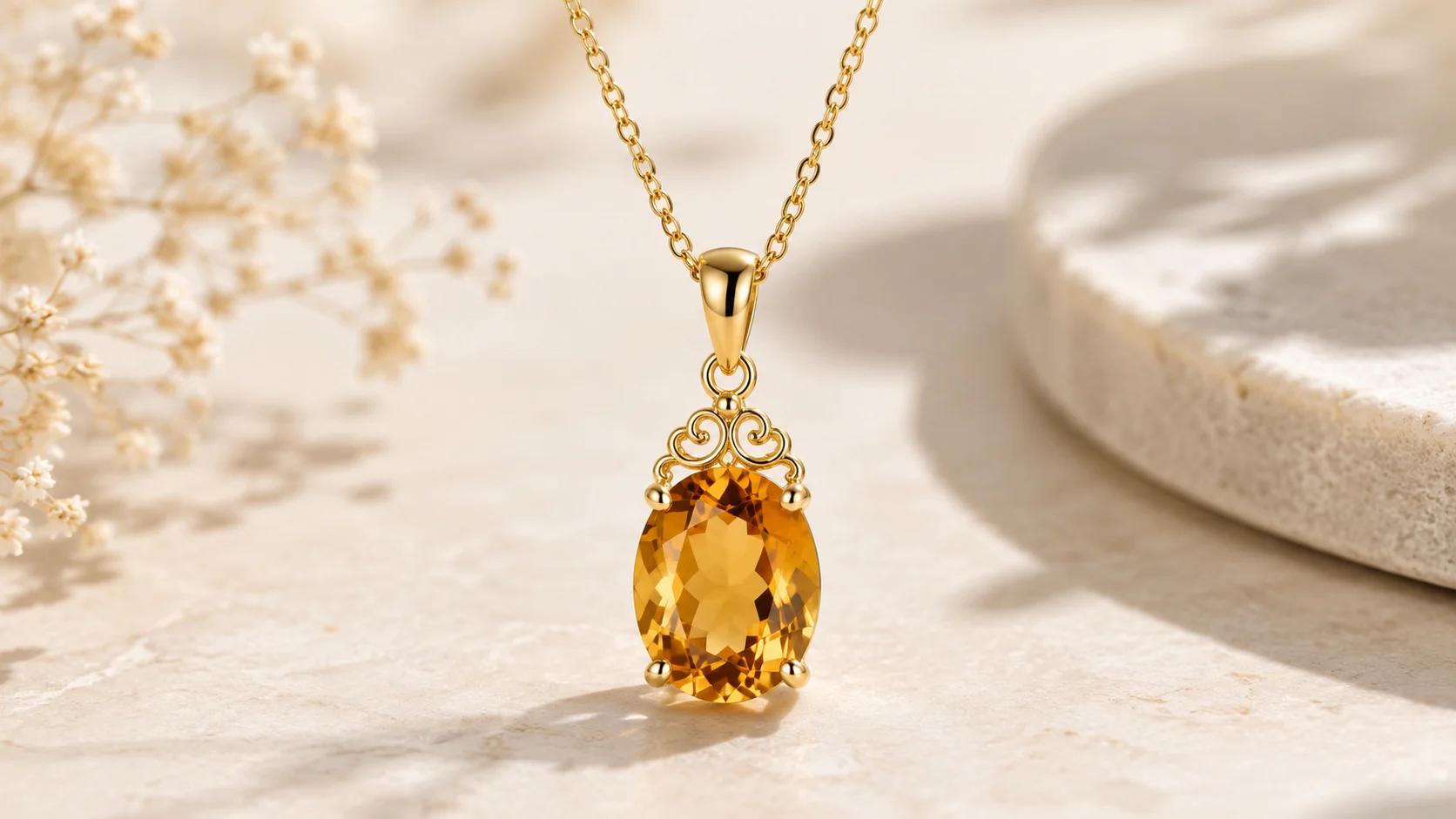
Citrine Necklace: Styles, Lengths & Buying Tips
A citrine necklace is one of the most practical ways to wear yellow-to-orange quartz because the stone usually sits in a relatively protected position compared with rings and bracelets, allowing larger gems, open settings, long drops, carved pendants, and statement designs without exposing the citrine to constant impact. Choosing the right necklace, however, involves much more than selecting an attractive yellow stone. Pendant weight, chain length, chain gauge, bail opening, clasp construction, setting security, metal type, treatment disclosure, neckline compatibility, and the way the piece balances on the chest all affect whether the necklace will actually be comfortable and durable.
Citrine itself is quartz with a Mohs hardness around 7 and no conventional gemstone cleavage, giving it useful resistance to ordinary scratches and everyday wear. Most commercial citrine receives its yellow or orange color by heating suitable natural amethyst, while naturally colored citrine is less common and may command a different market position. Heat-treated material remains quartz and can make excellent jewelry, but sellers should disclose treatment accurately rather than implying that every deeply colored citrine formed naturally with that exact color.
Readers who want the broader mineral, symbolism, and traditional-use background can start with the citrine meaning guide. This page focuses specifically on necklace construction, length, comfort, setting choice, quality, treatment, buying decisions, and maintenance.
Citrine Necklace at a Glance
| Feature | What to Consider |
|---|---|
| Gemstone | Yellow-to-orange quartz |
| Mohs hardness | About 7 |
| Cleavage | None in the conventional gemological sense |
| Main treatment | Heat-treated amethyst is common |
| Best necklace advantage | Low impact exposure and flexibility in stone size |
| Common formats | Pendant, solitaire, station, bead, chain, charm, cluster, lariat |
| Main fit factor | Chain length and pendant drop |
| Main durability factor | Bail, clasp, chain gauge, setting and stone edges |
| Main comfort factor | Total pendant and chain weight |
| Main buying issue | Treatment, metal and stone disclosure |
| Main care concern | Cosmetics, perfume, hair products, oils and chain wear |
| Good everyday choice | Low-profile pendant on a secure chain |
The main advantage of a citrine necklace is that the gemstone experiences much less direct impact than a ring or bracelet. That makes the format especially suitable for larger citrine, but it also shifts attention toward chain mechanics and pendant balance.
Is Citrine Good for Necklaces?
Yes. Citrine is particularly well suited to necklaces because quartz combines useful hardness with generally good jewelry durability, while the chest and neckline area expose the stone to far fewer hard knocks than the hands or wrists.
A citrine pendant can therefore use designs that would be less practical in a ring, including:
- Large faceted stones.
- Long pear-shaped drops.
- Open-backed settings.
- Decorative prongs.
- Carved quartz.
- Large cabochons.
- Multi-stone clusters.
- Crystal-point pendants.
Quartz can still chip if struck sharply, especially at thin girdles, points, corners, or existing fractures, but ordinary necklace wear creates relatively little impact.
The more common failure points are often not the gemstone at all. A weak jump ring, undersized bail, worn chain, poor clasp, or thin setting can cause the entire citrine necklace to fail even when the quartz remains undamaged.
Citrine Necklace Styles
The best style depends on how the necklace will be worn, what clothing it will accompany, and whether the buyer wants a discreet everyday piece or a larger focal gemstone.
Citrine Pendant Necklace
A pendant necklace places one citrine or one decorative element on a chain.
This is one of the most flexible formats because the pendant and chain can sometimes be purchased separately, allowing the wearer to select chain length and thickness independently.
A good citrine pendant should hang straight and remain centered rather than rotating constantly.
Check:
- Bail size.
- Bail thickness.
- Stone orientation.
- Pendant weight.
- Setting depth.
- Back finish.
- Chain compatibility.
A pendant with a very small bail may fit only a thin chain, while a heavy citrine may require substantially stronger support.
Citrine Solitaire Necklace
A solitaire design usually centers one faceted citrine in a relatively simple setting.
This format works well when the gemstone itself is the main visual feature.
Round, oval, cushion, emerald, and pear-shaped citrine are all common choices.
A solitaire citrine necklace should be examined for balance. If the pendant is heavy at the front but the chain is too light, the necklace may rotate, pull uncomfortably, or continually drag the clasp toward the side.
Citrine Station Necklace
A station necklace places several citrine stones at intervals along the chain.
This spreads the color around the neckline instead of concentrating all weight in one pendant.
For station designs, inspect whether each citrine is securely integrated into the chain. Bezel settings are particularly useful because they create a smooth profile with fewer exposed prongs.
The stones should also be spaced so that they do not constantly collide when the necklace moves.
Citrine Bead Necklace
A beaded citrine necklace may use round, faceted, nugget, chip, graduated, or mixed-size quartz beads.
Unlike a single pendant, bead strands place much more total gemstone weight around the neck.
Large beads can become surprisingly heavy.
Check:
- Drill-hole condition.
- Knotting.
- Stringing material.
- Clasp strength.
- Bead spacing.
- Strand flexibility.
A well-made valuable bead necklace may be individually knotted between beads so that a string failure does not allow the entire strand to scatter.
Citrine Charm Necklace
Charm designs use a small citrine drop or symbolic ornament attached to a chain.
This is practical for buyers who want citrine color without the weight of a larger pendant.
The jump ring connecting the charm to the chain deserves careful inspection because it can become the weakest point in the necklace.
A soldered or securely closed ring is preferable for valuable jewelry.
Citrine Cluster Necklace
Cluster designs combine several citrine stones, sometimes with diamonds, cubic zirconia, white sapphire, or other accent stones.
A cluster can create a much larger visual footprint without requiring one large center citrine.
However, each additional stone introduces another setting that must remain secure.
Inspect the reverse side as carefully as the front.
A well-made cluster should have smooth construction, adequate metal support, and no sharp edges that rub against skin or clothing.
Citrine Lariat Necklace
A lariat uses an open, sliding, or elongated design rather than a conventional fixed pendant arrangement.
Citrine can appear at one or both ends.
The format works well with pear-shaped or elongated drops because gravity naturally emphasizes the vertical line.
The main concern is movement. Long hanging elements may swing and strike desks, counters, or other jewelry more frequently than a short pendant.
Choosing the Right Citrine Necklace Length
Chain length determines where the pendant sits and can completely change how the same citrine looks when worn.
Common necklace lengths include approximately:
| Length | Typical Position |
|---|---|
| 14–16 inches | Close to the neck or upper collarbone |
| 17–18 inches | Around the collarbone |
| 20 inches | Slightly below the collarbone |
| 22–24 inches | Upper chest |
| 28–36 inches | Long necklace or statement position |
These positions are approximate because neck size, body proportions, chain construction, and pendant length all affect the final result.
An 18-inch chain with a 2-inch pendant does not visually finish at the same point as an 18-inch chain with a tiny citrine charm.
Therefore, when buying online, consider both chain length and total pendant drop.
16-Inch Citrine Necklace
A shorter citrine necklace usually sits near the base of the neck or upper collarbone.
It works well with:
- Open-neck shirts.
- Scoop necklines.
- Smaller pendants.
- Layered necklace combinations.
Large heavy citrine pendants may feel crowded at this length, especially if the wearer has a larger neck circumference.
Measure before buying rather than assuming that a standard short chain will fit everyone the same way.
18-Inch Citrine Necklace
An 18-inch citrine necklace is one of the most versatile options because it commonly places the pendant near the collarbone.
It works well for everyday solitaires, small-to-medium pendants, birthstone jewelry, and layering.
For many buyers, this is the safest gift length when no precise preference is known, although neck circumference still matters.
An extender chain can provide useful flexibility.
20- to 24-Inch Citrine Necklace
Longer chains move the citrine lower onto the chest and create more space around the neckline.
They are useful for:
- Larger pendants.
- Statement citrine.
- Layering.
- Higher necklines.
- Heavier designs.
As chain length increases, the pendant has more freedom to swing.
That means a heavy citrine should be paired with a sufficiently substantial chain rather than a very fine one chosen only for appearance.
Long Citrine Necklaces
Long necklaces place less visual emphasis on the neckline and more on the central pendant or bead arrangement.
They can work well with large citrine beads or dramatic pendants, but they also move more during walking, bending, and sitting.
A long citrine pendant may strike desks or counters when the wearer leans forward.
For this reason, longer is not automatically safer even though the stone remains away from the hands.
How to Measure for a Citrine Necklace
Use a flexible measuring tape around the neck at the approximate height where the chain will sit.
If no tape is available, use a non-stretch cord and measure the cord against a ruler.
Then consider:
- Pendant length.
- Clothing neckline.
- Preferred movement.
- Layering.
- Neck circumference.
- Chain thickness.
For a pendant necklace, mock up the final length by tying a small object to a cord. This is especially useful for larger citrine because pendant dimensions can dramatically affect how the finished piece looks.
A 20 mm stone and a 50 mm crystal-point pendant may need very different chain lengths even if both are described as citrine necklaces.
Citrine Pendant Size
Citrine is available in relatively large crystals, so substantial pendants are common.
Stone size should be evaluated together with weight.
Quartz has a specific gravity around 2.65, meaning large pendants can become noticeably heavy even though citrine is not among the densest gemstones.
Small pendants work well for frequent wear.
Medium stones provide stronger color while remaining comfortable.
Large statement citrine can be attractive but requires:
- Stronger bails.
- Thicker chains.
- Secure settings.
- More attention to balance.
A pendant should not depend on a tiny jump ring simply because the visible chain is delicate.
Choosing Citrine Color for a Necklace
Citrine colors range from pale straw yellow through lemon, golden yellow, honey, orange, reddish orange, and brownish orange.
The best color depends on preference rather than one universal standard.
For necklaces, strongly saturated citrine often works well because the stone is viewed from a greater distance than a ring.
However, very dark orange-brown material can lose brightness in indoor lighting.
When evaluating a citrine necklace online, look for images under more than one lighting condition.
Strong backlighting can make transparent citrine look dramatically brighter than it appears against skin or clothing.
The stone should still look attractive when light enters primarily from the front and sides.
Natural Citrine vs Heat-Treated Citrine Necklace
Most commercial citrine is heat-treated natural quartz, commonly starting as amethyst.
Heating alters the color-producing centers within the quartz and can create yellow, golden, orange, or brownish tones.
The treatment does not turn quartz into another mineral.
A heat-treated citrine necklace can therefore be genuine citrine jewelry in the commercial sense, but treatment should be described honestly.
The dedicated citrine buying guide explains how natural color, treatment, transparency, cutting, and quality influence purchasing decisions.
When shopping, ask whether the gemstone is:
- Natural-color citrine.
- Heat-treated amethyst.
- Heat-treated smoky quartz.
- Laboratory-grown quartz.
- Coated quartz.
- Glass.
- Another imitation.
Avoid paying a substantial untreated premium simply because a listing uses phrases such as natural crystal or genuine stone.
Those terms do not necessarily explain how the color formed.
How Cut Affects a Citrine Necklace
Cut determines how brightly the citrine reflects light.
A well-cut stone can make moderate color look lively, while poor proportions can make even strongly colored material appear dull.
Look for:
- Balanced outline.
- Symmetrical facets.
- Good polish.
- Limited windowing.
- Limited dark extinction.
- Appropriate depth.
Windowing appears as a transparent or washed-out area through the center of a faceted stone.
Excessive extinction appears as large dark zones.
Both can reduce visual quality.
Because citrine rough is relatively available in large sizes, poor cutting should not automatically be accepted simply because the gemstone is large.
Best Citrine Shapes for Necklaces
Oval citrine works well because it offers good face-up size and fits both classic and contemporary settings.
Round stones provide balanced brilliance.
Pear shapes are particularly suited to pendants because the pointed outline naturally creates a downward visual direction.
Cushion cuts provide softer corners and substantial color.
Emerald cuts emphasize transparency and broad flashes rather than maximum sparkle.
Marquise citrine can create an elongated pendant but requires protection around both pointed ends.
Carved citrine and crystal points offer a different aesthetic entirely, emphasizing natural or sculptural form rather than faceting.
Citrine Necklace Settings
The setting should protect the gemstone while allowing the design to hang correctly.
Prong Setting
Prongs expose more of the citrine to light and minimize visible metal.
They work especially well for transparent faceted stones.
Check that each prong:
- Touches the gemstone.
- Is smoothly finished.
- Does not snag fabric.
- Is thick enough for the stone.
- Is not visibly bent.
Large pendants need proportionally stronger prongs.
Bezel Setting
A bezel surrounds the citrine with metal.
This creates excellent edge protection and a smooth profile.
Bezel-set citrine necklaces are particularly practical for frequent wear because they are less likely to catch clothing, scarves, or hair.
Partial Bezel
A partial bezel protects selected edges while leaving more of the stone open.
This can work well for elongated citrine shapes where the most vulnerable corners receive protection.
Wire-Wrapped Citrine Necklace
Wire wrapping is common with polished stones, crystal points, and irregular citrine.
Quality varies enormously.
The wire should hold the stone mechanically rather than relying on friction alone.
Check for:
- Loose loops.
- Sharp wire ends.
- Thin stressed sections.
- Unstable stones.
- Weak connection to the bail.
Decorative complexity does not automatically mean secure construction.
The Bail Is Critical
The bail connects the pendant to the chain and is one of the most important mechanical components in a citrine necklace.
Its opening must be large enough for the chain and clasp components to pass through if the pendant is removable.
It should also be strong enough for the pendant weight.
A heavy citrine on a very thin open bail can gradually deform the metal.
Inspect:
- Bail thickness.
- Solder points.
- Hinge construction if present.
- Opening size.
- Wear marks.
- Alignment.
If the pendant constantly leans to one side, the bail may be positioned poorly relative to the stone’s center of gravity.
Choosing the Right Chain
A chain should be proportionate to the pendant.
Fine chains can look elegant with small citrine, but a large gemstone needs enough metal strength to support repeated movement.
Popular chain types include:
- Cable.
- Box.
- Rope.
- Wheat.
- Curb.
- Figaro.
- Snake.
- Singapore.
Each construction distributes stress differently.
A box or wheat chain may provide substantial support for a heavier citrine pendant, while a very fine cable chain may be better suited to a light solitaire.
Do not judge chain strength by width alone. Metal purity, construction, hollow versus solid links, wear, and solder quality also matter.
The broader crystal necklaces guide provides additional context for matching gemstone pendants with necklace construction.
Pendant and Chain Compatibility
If buying the pendant and chain separately, make sure the chain can physically pass through the bail.
The widest part of the chain may be the clasp rather than the links.
Measure:
- Bail internal height.
- Bail internal width.
- Chain width.
- Clasp width.
A chain that fits through the bail links may still be impossible to insert if the clasp is too large.
For expensive citrine pendants, having a jeweler match the chain can prevent an avoidable compatibility problem.
Choosing the Clasp
The clasp carries the entire necklace.
Common types include:
Lobster Clasp
Strong, compact, and widely used.
A good lobster clasp should close completely without sticking.
Spring-Ring Clasp
Lightweight and suitable for finer chains.
The spring should snap closed cleanly.
Box Clasp
Common in heavier or more decorative necklaces.
Some designs include additional safety catches.
Toggle Clasp
Easy to operate but depends on correct proportion between the bar and ring.
Very heavy pendants can create enough movement to make poorly proportioned toggles less secure.
Magnetic Clasp
Convenient for some wearers, but expensive citrine necklaces deserve careful consideration because sufficient pulling force can separate the closure.
Clasp convenience should not come at the cost of security.
Gold Citrine Necklace
Yellow gold complements citrine particularly well because both share warm tones.
Rose gold can enhance orange and reddish citrine, while white gold creates more visual contrast.
Ask whether the necklace is:
- Solid gold.
- Gold-filled.
- Vermeil.
- Gold-plated.
- Gold-tone base metal.
These are materially different products.
A plated citrine necklace may look similar when new but the surface layer can wear at the clasp, bail, chain edges, and pendant contact points.
Silver Citrine Necklace
Sterling silver creates strong contrast with golden quartz and is widely used for citrine pendants.
Silver can tarnish, but tarnish does not indicate that the jewelry is fake or damaged.
Gentle polishing is usually sufficient.
Avoid aggressive polishing around delicate prongs or plated surfaces.
A large citrine set in silver should still use enough metal thickness to support the gemstone. The lower cost of silver does not justify structurally weak construction.
Citrine Necklace for Sensitive Skin
In many necklaces, the chain rather than the gemstone maintains the greatest skin contact.
Metal composition therefore deserves attention.
Nickel-containing alloys can create problems for people with metal sensitivities.
Ask for actual metal disclosure rather than relying on phrases such as:
- Skin friendly.
- Hypoallergenic.
- Premium metal.
- Jewelry alloy.
The composition of the clasp, extender, bail, and chain should ideally be understood, not just the visible pendant setting.
Citrine Necklace vs Citrine Earrings
Both are relatively low-impact jewelry formats.
Citrine earrings require pair matching, earring-back security, post or hook construction, and careful weight distribution between the ears.
A necklace uses only one central focal area, so matching is usually irrelevant.
Instead, chain length, pendant weight, bail strength, clasp security, and neckline become the defining issues.
For buyers who want a larger single citrine, a necklace is often the more practical choice because the chest can comfortably support more gemstone weight than the earlobe.
Citrine Necklace vs Citrine Bracelet
Bracelets experience substantially more contact with hard surfaces.
A necklace keeps the gemstone farther from desks, counters, door frames, and hand activity.
That makes necklaces better suited to:
- Large stones.
- Delicate facets.
- Long crystal points.
- More open settings.
Bracelets, however, keep the gemstone more visible to the wearer and may suit people who prefer jewelry they can see without a mirror.
The two formats serve different practical purposes even when the same citrine material is used.
Citrine Necklace as November Birthstone Jewelry
Citrine is one of the recognized November birthstones.
A citrine necklace is particularly practical as a birthstone gift because it avoids the exact finger sizing required for a ring and can be adjusted with an extender chain.
Small solitaires make understated gifts.
Large golden pendants create a stronger statement.
Birthstone symbolism does not affect gemstone identity or treatment, so sellers should still disclose heat treatment and metal composition clearly.
Citrine Necklace Meaning and Symbolism
Citrine is commonly associated with optimism, confidence, creativity, generosity, motivation, and prosperity symbolism.
A citrine necklace can represent these themes without claiming that quartz causes financial gain, improves luck, guarantees success, or changes another person’s behavior.
Because a pendant often rests near the chest, modern crystal traditions sometimes connect citrine necklaces with confidence, warmth, or personal intention.
These ideas are symbolic.
A more grounded use is to assign the necklace a specific reminder.
For example, it might represent:
- Finishing a creative project.
- Speaking with confidence.
- Following a financial plan.
- Recognizing progress.
- Approaching work with consistency.
The practical benefit comes from the action connected with the jewelry, not from a scientifically demonstrated energy field.
How Much Does a Citrine Necklace Cost?
A citrine necklace price reflects two separate components: gemstone value and jewelry construction.
Important factors include:
- Citrine color.
- Transparency.
- Cut quality.
- Stone size.
- Treatment.
- Natural versus laboratory-grown origin.
- Metal type.
- Metal weight.
- Chain quality.
- Setting complexity.
- Accent stones.
- Craftsmanship.
- Brand.
The dedicated citrine price guide explains stone-specific value factors in more detail.
A large citrine does not automatically make a necklace extremely valuable because quartz can occur in large crystals.
Conversely, a modest citrine set in substantial gold with high-quality craftsmanship can cost far more than the gemstone itself.
Buying a Citrine Necklace Online
Online buying requires evaluating both gemstone and construction.
Look for clear information about:
- Exact stone dimensions.
- Carat weight.
- Pendant dimensions.
- Chain length.
- Chain width.
- Metal purity.
- Bail size.
- Clasp type.
- Treatment.
- Accent stones.
- Total necklace weight.
- Return conditions.
Ask whether photographs show the exact necklace or a representative example.
This matters particularly with natural crystal points, carved stones, and beads because color, inclusions, shape, and size may vary significantly between pieces.
Do not rely solely on enlarged close-up photographs.
A pendant that appears substantial on screen may be very small when worn.
Dimensions are more reliable than image scale.
Questions to Ask the Seller
Before purchasing a higher-value citrine necklace, ask:
- Is the citrine natural quartz?
- Has it been heat treated?
- Is the color naturally occurring?
- Is the gemstone synthetic?
- Is any coating present?
- What is the metal?
- Is the metal solid, filled, vermeil, or plated?
- What is the chain length?
- What is the pendant weight?
- Is the chain included?
- What type of clasp is used?
- Are accent stones natural, synthetic, or imitation?
- Are repairs or fillings present?
Clear seller disclosure is more useful than promotional language such as healing grade, manifestation stone, premium energy crystal, or wealth-attracting necklace.
Common Citrine Necklace Buying Mistakes
One common mistake is buying a large pendant on a chain that is too thin.
The piece may look elegant at first but the chain can stretch, kink, or fail under repeated movement.
Another mistake is ignoring the bail opening.
A buyer may purchase a replacement chain only to discover that the clasp cannot pass through the pendant.
Another is judging color only under strong photography lighting.
Deep orange citrine can appear much darker under normal indoor conditions.
A further mistake is paying a premium for supposedly untreated material without credible disclosure.
Heat treatment is common and does not make the necklace undesirable, but the price and description should reflect what the gemstone actually is.
How to Clean a Citrine Necklace
Citrine itself is reasonably durable, but the finished necklace can contain metal, solder, plating, glue, accent stones, coatings, and delicate chain links.
The safest routine method for ordinary untreated citrine jewelry is mild.
The detailed how to clean citrine jewelry guide covers the process more fully.
For routine cleaning:
- Inspect the chain and setting first.
- Use lukewarm water with mild soap.
- Clean the citrine gently with a soft cloth or brush.
- Remove residue around the back of the setting.
- Rinse carefully.
- Dry completely.
- Recheck the clasp, bail, prongs, and jump rings.
Avoid automatically using steam or ultrasonic cleaning when treatment, fractures, glue, plating, antique construction, or accent stones are unknown.
Perfume, Lotion and Hair Products
Necklaces come into frequent contact with products used around the neck and chest.
Perfume, lotion, sunscreen, makeup, hair spray, and skin oils can accumulate on the citrine and metal.
These products may not immediately damage quartz, but buildup reduces brilliance and can affect plated or delicate metal components.
A useful order is:
Apply personal-care products first.
Allow them to dry.
Put the citrine necklace on afterward.
Remove the necklace before using additional sprays around the neck.
When to Remove a Citrine Necklace
Remove the necklace before:
- Swimming.
- Exercise.
- Contact sports.
- Showering.
- Sleeping in long or delicate chains.
- Heavy manual work.
- Applying hair color or strong chemical products.
Quartz may tolerate more than the chain or setting.
Chlorinated or chemically treated water can also affect metal finishes, solder, plating, and other gemstone components.
Long necklaces should be removed before activities where they could catch machinery, equipment, handles, or other objects.
Storing a Citrine Necklace
Store the necklace so the chain does not knot and the citrine does not rub against harder gemstones.
Sapphire, ruby, and diamond can scratch quartz.
A separate compartment, soft pouch, or necklace hanger can work well.
For delicate chains, fastening the clasp before storage may reduce tangling.
Long necklaces can be laid flat or suspended carefully.
Do not place a heavy citrine pendant directly on top of fine chains because the gemstone weight can bend or kink them.
Avoid prolonged storage in strong direct sunlight or high heat.
Frequently Asked Questions
Is citrine good for necklaces?
Yes. Citrine ranks about 7 on the Mohs scale, lacks conventional cleavage, and receives relatively little impact when worn around the neck, making it highly suitable for pendants and necklaces.
Is a citrine necklace suitable for everyday wear?
Yes, provided the setting, bail, chain, and clasp are secure. The necklace should still be removed before swimming, exercise, showering, and activities that can snag or chemically expose the jewelry.
What length citrine necklace should I choose?
Around 18 inches is versatile for many wearers, while longer lengths suit larger pendants, layering, and higher necklines. Neck circumference and pendant drop should always be considered.
Is a 16-inch citrine necklace too short?
It depends on neck size and preference. A 16-inch chain typically sits near the collarbone or base of the neck and works best with smaller pendants.
Is a 20-inch citrine necklace good for a pendant?
Yes. Twenty inches provides additional space for medium or large citrine pendants and often works well with everyday clothing.
Are most citrine necklaces heat-treated?
Much commercial citrine is produced by heating natural amethyst. Heat-treated quartz remains genuine quartz, but treatment should be disclosed.
Is heat-treated citrine fake?
No. Heat-treated amethyst remains natural quartz. It becomes misleading only when the treatment is hidden or represented as naturally occurring untreated color.
What is the best chain for a citrine pendant?
The best chain depends on pendant weight. Small pendants can use fine cable chains, while heavier citrine may require stronger box, wheat, curb, rope, or similar construction.
How do I know if a chain is strong enough?
Compare pendant weight with chain thickness, construction, metal, clasp, and condition. A large citrine should not be suspended from an extremely delicate worn chain.
What is the bail on a citrine necklace?
The bail is the component connecting the pendant to the chain. It must be large enough for the chain or clasp to pass through and strong enough to support the pendant.
Can I replace the chain on a citrine necklace?
Often yes, provided the replacement chain and clasp can pass through the bail. Measure the bail opening before purchasing another chain.
What color citrine is best for necklaces?
Golden yellow, honey, orange, pale yellow, and reddish-orange can all work well. Choose a color that remains attractive in ordinary lighting rather than relying only on heavily illuminated photographs.
Can citrine necklaces use large stones?
Yes. Necklaces are one of the best formats for large citrine because the gemstone is less exposed to impact than in rings or bracelets. Heavy stones still require strong bails and chains.
Can people with sensitive skin wear a citrine necklace?
Usually the metal is more important than the citrine. Ask about the chain, clasp, bail, and setting alloy if metal sensitivity is a concern.
Is a citrine necklace a good November birthstone gift?
Yes. Citrine is a recognized November birthstone, and necklaces are convenient gifts because exact ring sizing is unnecessary.
Can a citrine necklace attract wealth?
There is no scientific evidence that citrine jewelry attracts money, customers, promotions, investment gains, or luck. Prosperity symbolism can instead serve as a reminder of disciplined financial habits, preparation, or confidence.
Can I shower with a citrine necklace?
Removing it is preferable. Quartz can tolerate brief water exposure, but soaps, shampoo, plating, chains, clasps, glue, and other jewelry components may be affected or accumulate residue.
How do I clean a citrine necklace?
Use lukewarm water, mild soap, and gentle cleaning for ordinary untreated citrine in stable jewelry. Avoid aggressive mechanical cleaning when treatments, fillings, coatings, glue, or delicate accent stones are unknown.
Choosing a Citrine Necklace That Works in Real Life
A good citrine necklace should succeed as both gemstone jewelry and a mechanical object. Citrine itself gives the designer useful flexibility because quartz is hard enough for regular wear, lacks conventional cleavage, and can occur in sizes large enough to create substantial pendants without the extreme cost associated with many rarer gems.
The format creates its own priorities.
Chain length determines where the stone sits.
Pendant weight determines how strong the chain should be.
The bail determines whether the pendant hangs correctly and whether replacement chains will fit.
The clasp determines whether the necklace stays on.
The setting determines how well the citrine is protected.
Treatment disclosure determines whether the buyer understands what is being purchased.
These details are more important than a generic list of necklace styles.
Choose a citrine necklace whose color remains attractive in normal light, whose treatment and metal are clearly disclosed, whose pendant weight matches the chain, and whose length works with the person who will actually wear it. When those practical factors are handled properly, citrine can provide durable golden color, flexible styling, November birthstone significance, and optional personal symbolism without relying on exaggerated claims.