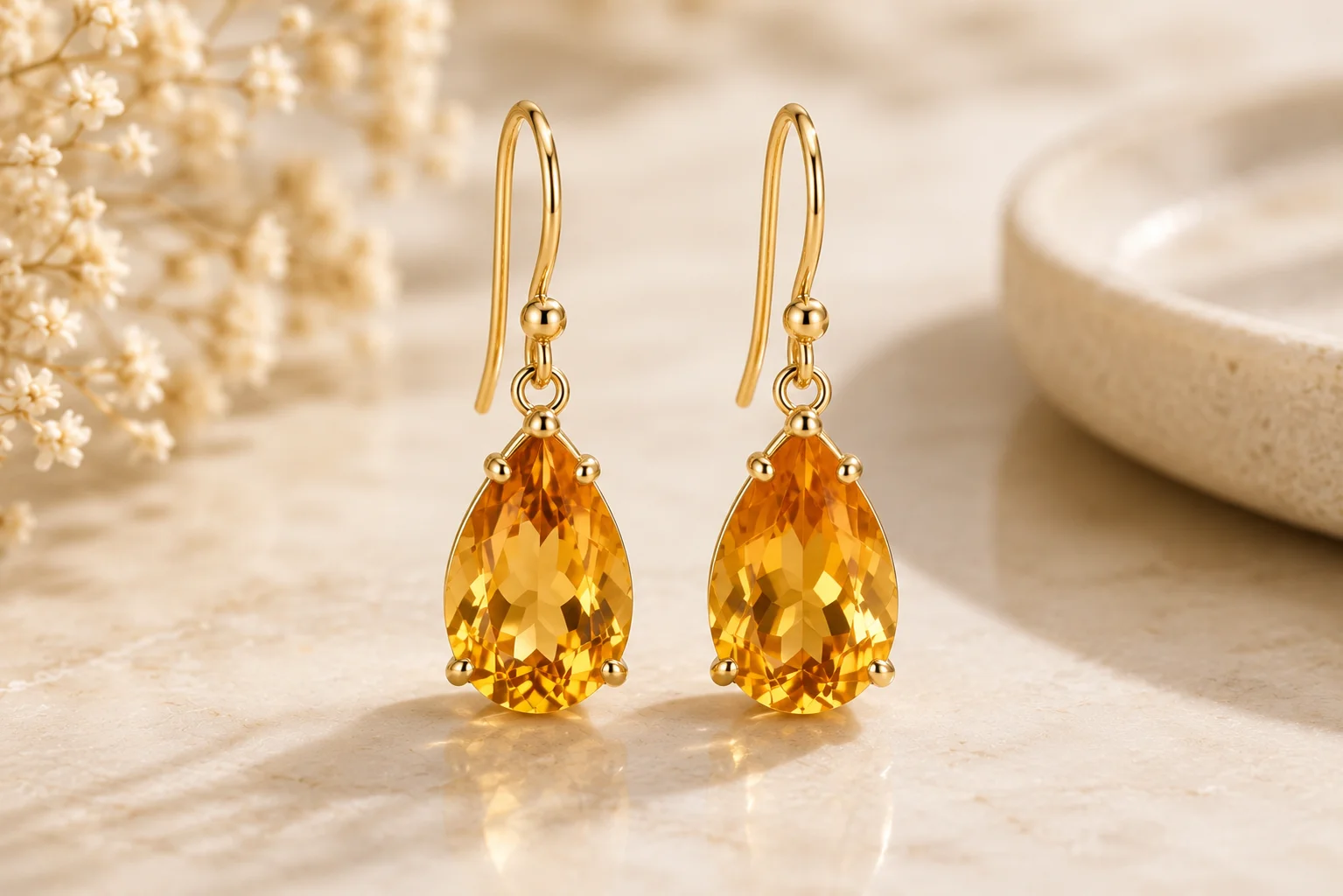
Citrine Earrings: Styles, Quality & Buying Guide
Citrine earrings are one of the easiest ways to wear the warm yellow-to-orange variety of quartz because earrings experience far less impact and abrasion than rings or bracelets, allowing buyers to consider larger stones, more exposed settings, and delicate drops without sacrificing practicality. Citrine ranks about 7 on the Mohs scale, has no conventional gemstone cleavage, and generally offers good durability, yet choosing well still requires attention to color, pair matching, treatment, cut, setting security, metal quality, earring backs, total weight, and how the design will sit on the ear.
Most commercial citrine earrings contain natural quartz whose yellow or orange color was produced by heating suitable amethyst. This treatment is common and can create attractive, durable jewelry, but sellers should describe it accurately rather than presenting every deeply colored citrine as naturally occurring untreated material. Buyers wanting the broader mineral, color, and symbolic background can start with the citrine meaning guide, while this guide focuses specifically on choosing and wearing earrings.
Citrine Earrings at a Glance
| Feature | What to Look For |
|---|---|
| Gemstone | Yellow-to-orange quartz |
| Mohs hardness | About 7 |
| Cleavage | None in the conventional gemological sense |
| Typical treatment | Heat-treated amethyst is common |
| Best earring advantage | Low impact exposure compared with rings and bracelets |
| Popular styles | Studs, drops, dangles, hoops, huggies, halos and clusters |
| Pair-matching priority | Similar color, size, cut and visual brightness |
| Main comfort issue | Total weight and balance |
| Main hardware issue | Posts, hooks, hinges, solder joints and backs |
| Good metals | Gold, platinum, sterling silver and quality alloys |
| Main care issue | Cosmetics, hair products, skin oils and loose settings |
| Buying priority | Stone disclosure plus secure, comfortable construction |
Citrine earrings benefit from the physical durability of quartz, but the earring format introduces its own considerations. A stone can be excellent while the finished jewelry is uncomfortable, poorly balanced, or fitted with weak hardware.
Are Citrine Earrings Durable?
Yes. Citrine earrings are generally suitable for frequent wear because quartz ranks around 7 on the Mohs scale and lacks the prominent cleavage found in gemstones such as topaz.
That hardness gives citrine good resistance to ordinary scratching, although harder materials such as sapphire, ruby, and diamond can still abrade it.
Earrings also receive less mechanical stress than most other jewelry.
A citrine bracelet repeatedly touches desks, clothing, and other surfaces, while rings experience direct hand contact throughout the day. Citrine earrings usually remain beside the face, where hard impacts are less frequent.
That lower exposure means buyers can reasonably consider:
- Larger faceted stones.
- Open prong settings.
- Long drop designs.
- Fine pavilion facets.
- Delicate clusters.
Durability still depends on more than quartz itself. Thin posts, weak hooks, loose prongs, fragile jump rings, poorly soldered components, or oversized stones can make otherwise good citrine earrings impractical.
Citrine Earrings Styles
Different earring styles create different requirements for stone size, setting strength, weight, and comfort.
Citrine Stud Earrings
Studs are among the most practical citrine earrings for frequent wear because the stone sits close to the ear and moves very little.
Common cuts include:
- Round.
- Oval.
- Cushion.
- Princess.
- Emerald.
- Pear.
- Heart.
Studs are particularly effective when buyers want visible golden color without dangling hardware.
A well-made stud should sit reasonably flat against the ear rather than tilting downward. Very large stones may require wider backs or supportive locking backs to keep them correctly positioned.
For larger citrine studs, examine the basket depth. A stone set too far forward from the ear can create leverage that makes the earring droop.
Citrine Drop Earrings
Drop citrine earrings usually suspend one stone or decorative section below the earlobe.
They provide more movement than studs without necessarily becoming long or dramatic.
The main practical concerns are:
- Total length.
- Stone weight.
- Connection strength.
- Jump-ring closure.
- Hook or post security.
- Whether the stones rotate excessively.
Drops can showcase larger citrine because movement allows more light to enter the stones from different angles.
However, excessively heavy drops may become uncomfortable before the gemstones themselves encounter any durability problem.
Citrine Dangle Earrings
Dangles extend farther below the ear and often incorporate multiple articulated sections.
This increased movement creates visual sparkle but also places more stress on small hardware components.
Check every connection point.
A citrine earring containing three stones may have several jump rings, wire links, pins, soldered joints, or setting connections. One weak component can compromise the entire design.
Long earrings should also be checked for tangling with hair, scarves, high collars, and headphones.
Citrine Hoop Earrings
Citrine hoops may use stones set along the front of the hoop, small dangling citrine charms, or alternating gemstones.
The hinge and closure deserve as much attention as the citrine.
A click-lock hoop should close cleanly and remain aligned. If the post must be forced into position or the hoop feels twisted, repeated use may weaken the mechanism.
Inside-outside gemstone hoops provide more face-up sparkle but generally contain more settings and therefore more individual maintenance points.
Citrine Huggie Earrings
Huggies are compact hoops designed to sit close to the earlobe.
They are practical for buyers who want small citrine earrings with more structure than studs.
Because the design is compact, stone dimensions are usually limited, but the close fit reduces snagging.
Check the inner diameter carefully when buying online. A huggie that looks appropriately sized in a product image may be too tight for a thicker earlobe or a piercing positioned farther from the edge.
Citrine Halo Earrings
Halo citrine earrings place smaller accent stones around a central citrine.
This design can make the center stone appear larger and increase overall brightness.
The accents may be:
- Diamond.
- Cubic zirconia.
- White sapphire.
- Moissanite.
- Other gemstones.
Ask what the surrounding stones actually are rather than assuming that every clear halo contains diamonds.
A halo also creates many small settings. Examine whether the accent stones sit evenly and whether any prongs appear bent, lifted, or asymmetrical.
Citrine Cluster Earrings
Cluster earrings combine several citrine stones or mix citrine with other gems.
They can provide substantial visual coverage without requiring one very large center stone.
The main concern is setting density.
Stones positioned too closely may rub against one another if their girdles or exposed surfaces touch, while crowded prongs can make cleaning more difficult.
A good cluster should look intentional from the front and structurally organized from the back.
How to Judge Citrine Quality in Earrings
Citrine earrings should be evaluated both as gemstones and as a matched pair.
A single stone may be excellent but unsuitable beside another stone with visibly different color, size, or brilliance.
The broader citrine buying guide covers individual gemstone quality in more detail, while earring selection adds the matching requirement.
Focus on:
- Color.
- Transparency.
- Clarity.
- Cut.
- Pair matching.
- Treatment.
- Stone dimensions.
- Setting quality.
For earrings, slight differences are often less noticeable once the stones are separated on opposite sides of the face.
Exact laboratory-level matching is unnecessary for most jewelry.
Visible mismatch is the real concern.
Choosing Citrine Color
Citrine can range from very pale yellow through lemon, golden yellow, honey, orange, reddish orange, and brownish orange.
No single color is automatically correct.
What matters is whether the color remains attractive in ordinary lighting and whether both earrings look compatible.
A strongly saturated stone may photograph beautifully under intense backlighting while appearing much darker indoors.
Before buying expensive citrine earrings online, look for photographs showing:
- Neutral indoor light.
- Natural indirect light.
- Front-facing view.
- Side view.
- Both earrings together.
Deep orange material is sometimes marketed using names such as Madeira citrine. This is primarily a commercial color description and does not by itself prove geographic origin, rarity, or untreated status.
Matching Citrine Earrings as a Pair
Pair matching is one of the most form-specific quality factors for citrine earrings.
Evaluate several characteristics together.
Color
The two stones should have broadly similar hue, tone, and saturation.
One strongly orange stone paired with one pale yellow stone may look accidental unless the design intentionally uses contrast.
Size
Dimensions should appear visually compatible.
Carat weight alone is less useful because two stones with the same weight can face up differently depending on proportions.
Cut
Facet arrangement and outline should generally match.
Two oval stones should not have noticeably different length-to-width ratios unless the design is intentionally asymmetric.
Brightness
One citrine can appear darker than its partner because of cut depth, extinction, or color concentration.
View both earrings together rather than examining each stone separately.
Inclusion Pattern
Minor inclusion differences are normal.
Matching does not require identical internal features, but one obviously cloudy stone beside one clean transparent stone can create an uneven appearance.
Natural Citrine vs Heat-Treated Citrine Earrings
Heat-treated amethyst dominates much of the commercial citrine market.
Heating can turn suitable purple quartz into yellow, orange, or brownish-orange material while leaving the basic quartz structure intact.
Therefore, heat-treated citrine earrings can still be genuine quartz earrings.
The treatment should simply be disclosed accurately.
The treated citrine guide explains the distinction between geological natural color and treatment-produced color, while the real vs fake citrine guide covers synthetic quartz, glass, coatings, and other imitations.
When comparing citrine earrings, ask whether the stones are:
- Natural-color citrine.
- Heated natural quartz.
- Laboratory-grown quartz.
- Coated quartz.
- Dyed material.
- Glass.
- Another yellow gemstone.
“Natural stone” does not necessarily mean natural untreated color.
A seller may correctly state that the starting quartz is natural while omitting the fact that it was heated.
Citrine Earrings and Cut Quality
Cut determines how efficiently citrine returns light.
A well-cut stone should generally show:
- Balanced outline.
- Even facet junctions.
- Good polish.
- Attractive brightness.
- Limited windowing.
- Limited excessive extinction.
Windowing occurs when the center of a gemstone appears unusually transparent because light passes through rather than returning to the viewer.
Extinction creates excessively dark areas.
Because citrine is available in relatively large clean crystals, buyers should not assume that a large stone automatically deserves poor cutting.
Good cutting often contributes more to the visual quality of citrine earrings than small differences in clarity.
Best Citrine Shapes for Earrings
Round citrine provides balanced brilliance and easy pair matching.
Oval citrine offers a larger face-up appearance for its weight and works well in both studs and drops.
Pear-shaped stones naturally suit dangle earrings because the pointed end can create a directional drop.
Cushion cuts provide softer corners and a broader vintage-style appearance.
Emerald and rectangular step cuts emphasize color and clarity rather than maximum sparkle.
Heart-shaped citrine earrings are more design-specific and require particularly careful pair matching because small outline differences become obvious.
Shape is mostly a style decision, but sharp corners need enough protection from the setting.
Citrine Earring Settings
Setting choice affects security, light return, comfort, and maintenance.
Prong Settings
Prongs expose more of the citrine to light and work well for faceted stones.
Four-prong settings create a relatively open appearance, while additional prongs may provide more redundancy.
Check that every prong:
- Touches the stone securely.
- Has a smooth finish.
- Does not catch fabric or hair.
- Is appropriately sized.
- Is not excessively thin.
Bezel Settings
A bezel surrounds the stone with metal.
It provides strong edge protection and creates a smooth profile that is less likely to snag.
Bezels can slightly reduce side light but are excellent for practical everyday citrine earrings.
Basket Settings
Basket settings support the stone from beneath while leaving much of the pavilion open.
The basket should be deep enough to protect the stone without extending so far that a stud becomes unstable on the ear.
Halo Settings
Halos increase visual size and sparkle but introduce numerous small prongs or shared settings that should be inspected periodically.
The center citrine should remain the structurally supported focal stone rather than depending on the surrounding halo for stability.
Earring Backs Matter More Than They Look
A secure gemstone is not useful if the entire citrine earring falls out because the back is unreliable.
Butterfly Backs
Butterfly or friction backs are common on studs.
They are convenient but can loosen after repeated use.
If the back slides onto the post with almost no resistance, replacement may be appropriate.
Screw Backs
Screw backs provide additional security for valuable earrings.
They take longer to put on and remove, but accidental detachment is less likely when the threads are correctly maintained.
Locking Backs
Mechanical locking backs can provide excellent security and may also help support larger citrine studs.
Leverbacks
Leverbacks are practical for drop and dangle earrings because the wire closes behind the ear.
Check the hinge and latch regularly.
Fish Hooks
Open hooks are lightweight and simple but easier to lose unless paired with silicone or metal stoppers.
For expensive citrine earrings, the tiny stopper can be worth using.
Citrine Earrings Weight and Comfort
Gemstones may be durable enough for a design that the ear itself finds uncomfortable.
Weight is therefore a genuine quality factor.
Heavy citrine earrings can:
- Pull the earlobe downward.
- Tilt studs forward.
- Stretch piercings.
- Become uncomfortable during extended wear.
- Swing forcefully during movement.
Large quartz stones add weight quickly.
A dramatic pair intended for occasional evening wear can reasonably be heavier than everyday citrine earrings.
When shopping online, ask for the weight of each earring rather than only the combined pair weight.
If the seller provides only total weight, divide it approximately in half for symmetrical designs.
Choosing Metals for Citrine Earrings
Citrine works visually with most jewelry metals.
Yellow gold reinforces golden and orange tones.
Rose gold works particularly well with honey and reddish-orange citrine.
White gold, platinum, and silver create stronger contrast and can make yellow stones appear brighter.
Metal choice should also consider:
- Purity.
- Alloy composition.
- Plating.
- Tarnish.
- Nickel exposure.
- Post material.
- Earring-back material.
For sensitive ears, the post and back may matter more than the visible setting because these components maintain prolonged skin contact.
The gemstones and metals for sensitive skin guide explains why terms such as gold-colored, surgical-style, or hypoallergenic should not replace actual alloy disclosure.
Gold Citrine Earrings
Gold is a popular choice because its warmth complements yellow quartz.
Higher gold purity generally means a greater proportion of gold, but pure gold is too soft for most secure jewelry construction, so practical pieces use alloys.
Ask whether the earrings are:
- Solid gold.
- Gold-filled.
- Vermeil.
- Gold-plated.
- Gold-tone base metal.
These categories have different durability and value.
A gold-colored surface does not establish gold purity.
Posts, backs, and soldered areas should also match the seller’s metal disclosure.
Silver Citrine Earrings
Sterling silver provides an accessible setting for citrine earrings and creates attractive contrast against golden stones.
Silver can tarnish over time, but tarnish is primarily a surface reaction and does not mean the jewelry is ruined.
Use gentle polishing methods that avoid unnecessarily rubbing the citrine itself.
Heavily plated or coated silver pieces should be cleaned even more conservatively because aggressive polishing can wear through surface finishes.
Citrine Earrings for Sensitive Ears
People with metal sensitivities should pay particular attention to posts, wires, and backs.
The citrine itself is normally not the main issue.
Nickel-containing alloys are a common concern for sensitive skin, and an earring can have a high-quality gemstone while still causing irritation because of its metal components.
Ask for precise metal information.
If the seller simply says “hypoallergenic,” request the actual alloy or post composition.
Plating can reduce initial contact with an underlying alloy, but plating wears over time.
Citrine Earrings vs Citrine Bracelet
Citrine earrings usually receive much less impact than a bracelet.
That allows more flexibility in:
- Stone size.
- Exposed faceting.
- Prong settings.
- Delicate shapes.
- Long articulated designs.
A bracelet, however, makes sizing and mechanical flexibility more important.
Buyers deciding between the two formats can use the citrine bracelet guide for wrist fit, bead size, stringing, clasps, and desk-contact considerations.
For durability alone, citrine earrings are generally the easier format.
Citrine Earrings vs Citrine Necklace
Both earrings and necklaces offer relatively protected ways to wear citrine.
A necklace adds considerations involving chain length, neckline, pendant balance, clasp location, and pendant movement.
The citrine necklace guide covers those format-specific decisions separately.
Citrine earrings add a different challenge: matching two gemstones and controlling weight on each ear.
For a coordinated set, exact color matching across earrings and a necklace is not essential, but extreme differences in yellow, orange, and brown tone can make the pieces look unrelated.
Citrine Earrings as Birthstone Jewelry
Citrine is one of the recognized November birthstones.
This makes citrine earrings a practical birthday gift because they do not require the exact sizing needed for a ring.
Studs are especially easy to gift.
Drop earrings require more attention to the recipient’s preference for length and weight.
Birthstone significance does not alter the gemstone’s treatment status, so the same disclosure standards should apply whether the earrings are purchased as birthstone jewelry or ordinary fashion jewelry.
Citrine Earrings Meaning and Symbolism
Citrine is traditionally associated with optimism, confidence, warmth, creativity, generosity, and prosperity symbolism.
Citrine earrings can represent those ideas without needing claims that wearing them produces wealth, luck, business success, emotional healing, or other guaranteed outcomes.
Because earrings are worn near the face, some modern crystal traditions connect them symbolically with confidence or positive expression.
This is metaphor rather than physiology.
A more grounded use is to associate the earrings with a deliberate behavior—for example, preparing carefully before an important presentation, communicating with confidence, or approaching a creative project with consistent effort.
The meaning belongs to the intention attached to the jewelry.
How Much Should Citrine Earrings Cost?
Citrine earring value depends on the gemstones and the finished jewelry.
Important factors include:
- Citrine color.
- Transparency.
- Cut quality.
- Pair matching.
- Stone size.
- Natural versus treated color.
- Metal type.
- Metal purity.
- Accent stones.
- Setting complexity.
- Brand.
- Craftsmanship.
The citrine price guide explains gemstone value factors separately from the additional cost of metal and jewelry construction.
Do not assume that large citrine earrings must be extremely expensive simply because the stones have high carat weights. Quartz occurs in large crystals, and size premiums are generally different from those applied to much rarer gemstones.
Likewise, an elaborate gold setting can cost substantially more than the citrine itself.
Buying Citrine Earrings Online
Online purchases should be evaluated as both gemstone transactions and jewelry transactions.
Look for:
- Photographs of the exact pair where possible.
- Treatment disclosure.
- Stone dimensions.
- Total carat weight.
- Individual earring weight.
- Metal type and purity.
- Back style.
- Post length.
- Accent-stone identity.
- Clear return terms.
Check whether the photographs use unusually warm lighting.
Yellow and orange gemstones can appear substantially richer under warm photography than they do under neutral indoor light.
The seller should also distinguish naturally colored citrine from heated quartz when that distinction affects the price.
Common Citrine Earring Buying Mistakes
One mistake is choosing purely by carat weight.
Large poorly cut stones may appear duller than smaller well-cut citrine.
Another is ignoring earring weight.
A beautiful design that becomes uncomfortable quickly will rarely become a frequently worn piece.
Another common mistake is paying an untreated-natural premium without treatment documentation.
Heat treatment is common and acceptable, but pricing should reflect accurate disclosure.
Buyers also sometimes focus on stone quality while ignoring weak butterfly backs, thin hooks, bent posts, or poorly finished prongs.
The finished earring is only as reliable as its weakest component.
How to Clean Citrine Earrings
Citrine itself usually tolerates gentle cleaning well, but earrings collect hair products, cosmetics, skin oils, foundation, sunscreen, and other residue around settings and backs.
The dedicated guide to cleaning citrine jewelry provides detailed care guidance.
For ordinary untreated citrine in a stable setting:
- Use lukewarm water with mild soap.
- Clean gently with a soft brush or cloth.
- Pay attention to the back of the setting.
- Rinse away soap residue.
- Dry thoroughly.
- Inspect posts, hooks, hinges, prongs, and backs before wearing.
Avoid aggressive steam cleaning.
Ultrasonic cleaning should not be automatic when fractures, coatings, fillings, glue, plated metal, delicate accent stones, or antique construction may be present.
Keeping Citrine Earrings Secure
Inspect earrings periodically rather than waiting for a stone or back to become visibly loose.
Check:
- Prongs.
- Bezel edges.
- Jump rings.
- Hinges.
- Posts.
- Hooks.
- Screw threads.
- Butterfly-back tension.
- Soldered joints.
A faint clicking sound when a stud is gently moved near the ear can sometimes indicate a loose stone, although intentionally shaking jewelry is unnecessary.
If a prong catches hair or fabric repeatedly, have it checked rather than bending it back manually.
When to Remove Citrine Earrings
Remove citrine earrings before activities that expose the jewelry to unnecessary chemicals, impact, or snagging.
That includes:
- Swimming.
- Contact sports.
- Hair coloring.
- Applying strong hair treatments.
- Sleeping in large drops or hoops.
- Activities requiring helmets or tight headgear.
Small studs may be comfortable enough for long wear, but comfort does not mean removal is never useful.
Taking earrings out before applying cosmetics and hair products also reduces buildup behind the stones.
How to Store Citrine Earrings
Store both earrings together but prevent them from scratching one another.
A divided jewelry box, small fabric pouch, or dedicated earring holder works well.
Keep citrine away from harder gemstones such as sapphire, ruby, and diamond.
Posts should not press directly into another gemstone.
For long dangles, lay the earrings flat or hang them in a way that prevents chains and articulated sections from tangling.
Store removable backs with the matching pair so they are not replaced accidentally with loose or incompatible hardware.
Frequently Asked Questions
Are citrine earrings good for everyday wear?
Yes. Citrine ranks about 7 on the Mohs scale and generally has good jewelry durability. Earrings also experience relatively little impact, making them one of the more practical formats for citrine.
Is citrine durable enough for stud earrings?
Yes. Citrine studs are particularly practical because they remain close to the ear and experience little movement or impact.
Are most citrine earrings heat-treated?
A large share of commercial citrine is produced by heating natural amethyst. Heat-treated material remains quartz, but the treatment should be disclosed accurately.
Is heat-treated citrine fake?
No. Heat-treated natural quartz is still natural quartz. The issue arises when treated color is represented as untreated geological color.
What color citrine earrings are best?
There is no universal best color. Look for attractive yellow, golden, honey, or orange coloration that remains lively in normal lighting and matches reasonably well across both earrings.
Should both citrine earrings match exactly?
They should look visually compatible in color, size, cut, and brightness. Perfect microscopic matching is unnecessary because the stones are worn on opposite sides of the face.
What is the best setting for citrine earrings?
Prongs provide maximum light exposure, while bezels offer greater edge protection and reduced snagging. The best choice depends on design, stone size, and how frequently the earrings will be worn.
Are large citrine earrings expensive?
Not necessarily. Citrine occurs in relatively large quartz crystals, so large stones can remain accessible compared with many rarer gemstones. Metal, craftsmanship, matching, treatment status, and cut can significantly affect final jewelry price.
What earring backs are safest?
Screw backs and quality locking backs provide strong security for valuable studs. Well-fitting butterfly backs are also practical, while open fish hooks benefit from additional stoppers.
Why do large citrine studs droop?
Stone weight, shallow backs, thin earlobes, piercing position, or a setting that projects too far forward can make large studs tilt downward. Wider supportive backs may improve positioning.
Can people with sensitive ears wear citrine earrings?
The gemstone itself is usually not the main issue. Metal composition in posts, hooks, and backs matters more. Buyers with sensitivity should request precise alloy information rather than relying only on a “hypoallergenic” label.
Can citrine earrings get wet?
Brief water contact during gentle cleaning is generally acceptable for untreated quartz, but settings, plating, glue, accent stones, and other components may have different care requirements.
Can citrine earrings be worn in the shower?
Removing them is generally better because shampoo, conditioner, soap, and mineral deposits can build up around settings and backs even when the citrine itself is not harmed.
Can citrine earrings fade in sunlight?
Some citrine may change or fade after prolonged intense light or heat exposure. Normal wearing conditions are different from leaving jewelry continuously in strong direct sunlight.
Are citrine earrings good November birthstone gifts?
Yes. They provide recognized November birthstone significance without requiring ring sizing, making studs and moderate drops particularly practical gifts.
Do citrine earrings attract wealth?
There is no scientific evidence that citrine earrings attract money, customers, promotions, investment gains, or luck. Prosperity symbolism can instead represent disciplined action, optimism, generosity, or responsible decision-making.
How do I tell if citrine earrings are real?
First determine whether the stones are quartz using appropriate gemological properties, then consider whether the color is natural, heat-treated, synthetic, coated, or imitated. Visual inspection can help, but treatment origin is not always provable from appearance alone.
Choosing Citrine Earrings That Work as Jewelry
Good citrine earrings should succeed as complete pieces of jewelry rather than merely containing attractive yellow quartz. Citrine’s hardness around 7 and absence of conventional cleavage make it well suited to earrings, while the low-impact position beside the face allows more freedom with stone size, faceting, prongs, drops, and delicate shapes than many other jewelry formats.
The most important earring-specific questions come after gemstone identity.
Do the two citrines match well enough?
Are they cut brightly?
Is their treatment disclosed?
Will the weight remain comfortable?
Are the posts, hooks, hinges, and backs secure?
Does the setting support the stones properly?
Is the metal appropriate for the wearer?
Can the jewelry be cleaned without damaging coatings, glue, accent stones, or plating?
When those practical details are handled well, citrine earrings can provide durable golden color, November birthstone significance, easy styling, and optional personal symbolism without exaggerated promises or unnecessary complexity. Choose the stones for their appearance and disclosure, but choose the earrings for how securely and comfortably they will actually be worn.