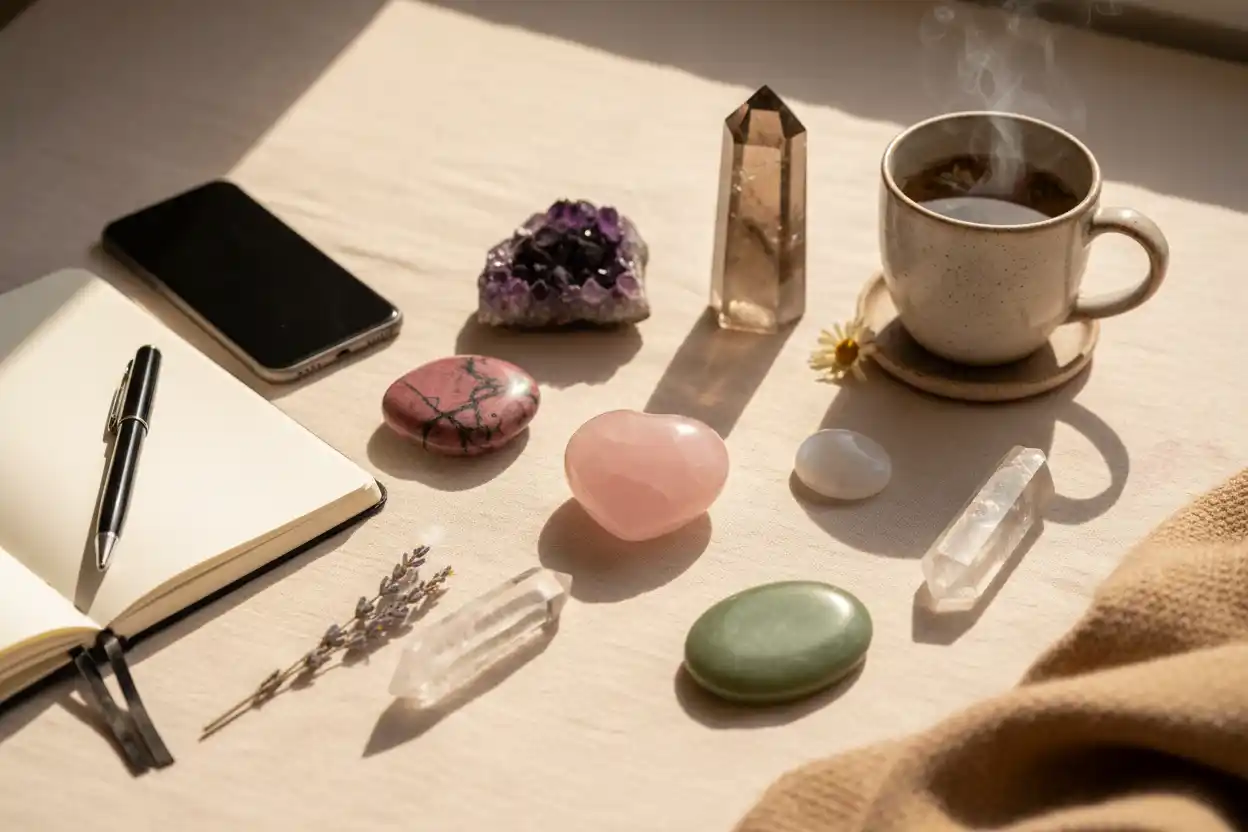
9 Inspiring Crystals for Breakups: Positive Meanings & Smart Everyday Uses
Crystals for breakups can serve as personal reminders of self-compassion, boundaries, reflection, acceptance, and rebuilding daily life after a relationship ends. They cannot erase attachment, make an ex-partner return, force emotional closure, or treat depression, anxiety, or trauma. Their most practical role is symbolic: connect a stone with a real action such as maintaining distance, journaling instead of sending an impulsive message, reconnecting with friends, removing repeated triggers, or creating a new routine.
Rose quartz, rhodonite, smoky quartz, black obsidian, moonstone, lepidolite, amethyst, Apache tears, and labradorite offer nine useful themes for this process. Breakups are rarely one emotion. Relief can appear beside sadness, anger beside longing, and confidence beside uncertainty. A stone does not need to eliminate those contradictions to be meaningful. It can simply mark the response you want to practice while time, relationships, boundaries, and daily habits do the real work of adjustment.
Rose Quartz and Rhodonite for Self-Compassion Without Losing Your Boundaries
Rose quartz is pale to medium pink quartz traditionally associated with affection, compassion, gentleness, and self-respect. Those themes can be particularly useful after a breakup because self-criticism often becomes mixed with grief. People may replay conversations, focus only on their mistakes, or interpret rejection as proof that something is fundamentally wrong with them.
Traditional rose quartz healing properties can be reframed as a reminder to examine what happened without turning the end of one relationship into a judgment about your entire worth. A rose quartz stone beside a journal might represent asking what you learned, what you would change, and what qualities you still value in yourself.
Self-compassion does not require rewriting the relationship as entirely positive or pretending you made no mistakes. It creates enough emotional distance to take responsibility where appropriate without remaining trapped in endless self-punishment.
Rhodonite adds a stronger boundary theme. It commonly appears pink to reddish pink with black manganese-oxide markings, and traditional symbolism often connects it with accountability, reconciliation, emotional balance, and personal limits.
The traditions around rhodonite healing properties can fit the question of whether continued contact is genuinely helping. A rhodonite stone can symbolize maintaining a boundary even when affection remains.
Missing someone does not automatically mean reconnecting is the right decision. Emotional attachment and practical compatibility are different questions.
Smoky Quartz and Black Obsidian for Interrupting Repetitive Thought Loops
Smoky quartz ranges from pale brownish gray to nearly black and belongs to the quartz family. Traditional symbolism frequently emphasizes grounding, practical thinking, and returning attention to immediate reality.
The themes within smoky quartz healing properties can be applied when breakup thoughts repeatedly move from facts into predictions. The relationship ended. That is a fact. Deciding that nobody else will ever understand you, that every future relationship will fail, or that you have permanently lost your only chance at happiness goes much further.
A smoky quartz stone can become a cue to identify the difference.
This does not mean forcing yourself into optimism. It means refusing to treat an emotionally intense prediction as though it were established fact.
Black obsidian offers a more direct reflective theme. It is volcanic glass traditionally associated with truth, self-examination, and confronting patterns that are uncomfortable to acknowledge.
Traditional black obsidian healing properties can support questions about what the relationship actually taught you. Were important boundaries repeatedly ignored? Did you communicate your needs clearly? Were you staying because the relationship was healthy, or because leaving felt frightening?
The goal is not to create a villain or assign every problem to yourself. It is to understand enough of the pattern that the next relationship does not automatically reproduce it.
Moonstone and Lepidolite for Adjusting to a Life That Suddenly Feels Different
Moonstone is a feldspar gem known for adularescence, the moving glow that appears across its surface as the viewing angle changes. Traditional symbolism often connects moonstone with cycles, transition, and adjusting to change.
The themes around moonstone healing properties can fit breakups because separation affects more than the relationship itself. Daily routines, weekends, social groups, living arrangements, future plans, and even familiar places can suddenly feel different.
A moonstone can symbolize allowing a new routine to develop instead of expecting life to feel normal immediately.
Lepidolite is a lithium-bearing mica commonly found in lavender, lilac, pink-purple, and gray-violet shades. Traditional lepidolite healing properties frequently emphasize patience and gradual transition.
That symbolism can be useful when someone understands logically that a breakup was necessary but still experiences strong emotional attachment. Understanding and feeling do not always change at the same speed.
The lithium in lepidolite does not provide a therapeutic dose through ordinary handling, and the stone should never be treated as a substitute for prescribed medication or mental health care.
Physically, lepidolite is also relatively soft and splits easily along its mica layers, so a protected palm stone or display piece is more practical than rough pocket use.
Amethyst and Apache Tears for Reflection, Grief, and the Urge to Reopen Contact
Amethyst is purple quartz traditionally associated with reflection, restraint, and thoughtful choices. Those meanings fit one of the most difficult parts of a breakup: deciding what to do during a temporary surge of emotion.
Traditional amethyst healing properties can be connected with a waiting rule. When you feel a sudden urge to send an emotional message, check an account repeatedly, or restart an argument, the stone can serve as a cue to pause first.
Write the message without sending it. Take a walk. Speak to a friend. Revisit the decision when the emotional intensity has dropped.
A pause does not mean suppressing the feeling. It prevents a temporary state from controlling an action that may create a new cycle of conflict.
Apache tears are rounded forms of obsidian commonly associated with grief, remembrance, and accepting loss. The symbolism surrounding Apache tears healing properties can fit the mourning that follows a relationship even when the breakup was the right decision.
You can grieve the future you imagined, familiar routines, shared experiences, and the version of yourself that existed inside that relationship.
The loss does not become less real because nobody died. Relationship endings can involve genuine grief, and acknowledging that grief is often more useful than pretending you should already be over it.
Labradorite for Rebuilding Identity and Imagining a Different Future
Labradorite can appear gray until light reveals blue, green, gold, orange, or multicolor flashes. This changing appearance has made it traditionally associated with transformation, imagination, adaptation, and seeing possibilities that were not obvious at first.
The themes around labradorite healing properties can become especially meaningful when a breakup leaves someone uncertain about who they are outside the relationship.
Long relationships can merge routines, friendships, plans, hobbies, and identities. After separation, the empty space may initially feel uncomfortable because so many choices were previously shared.
A labradorite stone can symbolize experimenting with that space. Return to an old interest. Try something that did not fit the former routine. Reconnect with people you neglected. Learn what your own weekends, home, and goals look like now.
Rebuilding identity does not mean proving that you are happier immediately. It means allowing life to become personally shaped again.
Breakup Recovery Improves When Boundaries Become Behavioral
A boundary is more useful when it describes an action rather than a hope. Deciding not to contact someone is different from hoping you will not feel tempted to contact them. Muting an account is different from repeatedly checking it while trying not to react.
The traditions around crystals for letting go can support this process when the stone represents a specific boundary rather than an expectation that attachment will disappear automatically.
If contact is necessary because of children, housing, finances, work, or another shared responsibility, boundaries can focus on topic, timing, and communication method rather than complete distance.
Breakup boundaries are not always permanent. Their purpose is to create enough stability for clear decisions.
A stone can mark the boundary, but the behavior is what gives that boundary effect.
Removing Triggers Can Reduce Unnecessary Emotional Repetition
Photographs, messages, social media updates, gifts, shared playlists, and familiar locations can all become emotionally charged after a breakup. There is no universal rule that every reminder should be destroyed or removed immediately.
The better question is whether repeated exposure is helping you process the change or keeping you trapped in a loop.
Some objects can be stored temporarily instead of discarded. Online accounts can be muted rather than monitored constantly. A shared space can be rearranged so that it begins to feel like your own environment again.
The traditions around crystals for emotional healing work best here when the stone supports reflection about what is actually helping.
Healing is not measured by how quickly you can look at old photographs without feeling anything. It is better measured by whether your present life is gradually becoming less controlled by the past relationship.
A Breakup Crystal Routine Should Lead Toward a Real Next Step
Choose one stone rather than turning recovery into a complicated collection. Rose quartz can mean speak to yourself with compassion. Rhodonite can mean maintain the boundary. Amethyst can mean pause before contacting. Labradorite can mean try something new.
Place the stone where the behavior occurs. An amethyst beside your phone can mark the pause rule. Labradorite near a planner can represent scheduling an activity that belongs to your new routine.
Journaling can also be structured around action. Instead of asking only how you feel, ask what triggered the feeling, what you wanted to do next, and what response would move you toward the kind of life you want.
The crystal provides symbolism. The change comes from repeated choices.
When Breakup Distress Needs More Support
Breakups can temporarily affect sleep, appetite, concentration, work, and mood. Strong emotions do not automatically mean something is medically wrong, but persistent or worsening distress deserves attention.
Professional support becomes particularly important when the breakup is connected with abuse, trauma, severe depression, panic, substance misuse, inability to function normally, or thoughts of self-harm.
The traditions around crystals for grief can remain part of a personal ritual, but a crystal should never delay help because someone believes they simply need more time, stronger spiritual practice, or a different stone.
Support can also come from friends, family, community, counseling, faith practices, or other sources that fit the person’s circumstances.
Conclusion
Crystals for breakups can symbolize compassion, boundaries, reflection, grief, patience, transition, and rebuilding identity. Rose quartz, rhodonite, smoky quartz, black obsidian, moonstone, lepidolite, amethyst, Apache tears, and labradorite each offer a different traditional theme that can support a practical recovery routine. Their value comes from connecting those meanings with real choices about contact, daily habits, relationships, attention, and the life you want to build after the breakup.
FAQs
Which crystals are traditionally associated with breakups?
Rose quartz, rhodonite, smoky quartz, amethyst, moonstone, lepidolite, Apache tears, black obsidian, and labradorite are commonly associated with breakup-related themes.
Can a crystal make my ex come back?
No. Crystals cannot control another person’s feelings, decisions, or willingness to restart a relationship.
Which crystal is associated with letting go after a breakup?
Smoky quartz, black obsidian, amethyst, and Apache tears are commonly linked with release, reflection, and transition.
Which crystal symbolizes self-compassion after rejection?
Rose quartz is traditionally associated with compassion, affection, and treating yourself more gently.
Can rhodonite help with relationship boundaries?
Rhodonite can serve as a symbolic reminder of accountability and boundaries, but the boundary itself depends on your actions.
Which crystal suits major change after a breakup?
Moonstone, lepidolite, and labradorite are commonly associated with transition, adaptation, and gradual change.
Should I use crystals to stop thinking about my ex?
A stone can remind you to redirect attention or maintain boundaries, but it cannot directly stop thoughts or erase attachment.
Can crystals replace breakup counseling?
No. Counseling may be useful when distress is persistent, overwhelming, connected with abuse or trauma, or severely affecting daily life.
How should I use a breakup crystal?
Connect one stone with one practical behavior such as journaling, maintaining distance, delaying impulsive contact, or building a new routine.
Crystal meanings and breakup associations are traditional or personal practices, not established mental health treatments.