Crystals for Meditation: Best Stones, Uses & Altar Ideas
Crystals for meditation are commonly used as visual or tactile focus objects during breathing, reflection, journaling, visualization and spiritual practice. Amethyst, clear quartz, smoky quartz, howlite, labradorite, rose quartz and selenite are popular choices, but the best stone depends on what you want the meditation session to emphasize.
Using meditation crystals does not require believing that a mineral changes the brain, opens a measurable energy center or produces a supernatural message. A stone can simply provide a consistent physical cue: when you see or hold it, you return attention to your breath, question, value or chosen practice. That grounded approach leaves room for traditional symbolism while keeping mineral facts and spiritual interpretation separate.
The most useful meditation stones are therefore not necessarily the rarest, largest or most expensive. Choose a stone that is physically safe, comfortable to use and connected with a clear purpose.
Best Crystals for Meditation at a Glance
| Crystal | Traditional or modern symbolic theme | Practical meditation role |
|---|---|---|
| Amethyst | Reflection, moderation, spiritual awareness | Quiet contemplation and perspective |
| Clear quartz | Clarity, intention | Defining one question or focus |
| Smoky quartz | Grounding, release, practicality | Returning attention to present conditions |
| Howlite | Patience, slowing down | Pausing before reacting |
| Labradorite | Perspective, change, imagination | Reframing a question |
| Rose quartz | Compassion, gentleness | Self-compassion and relationship reflection |
| Selenite | Clarity, purification symbolism | Marking a calm meditation space |
| Sodalite | Truth, reason, communication | Examining thoughts and language |
| Moonstone | Cycles, transition | Reflecting on change |
| Carnelian | Initiative, action | Ending reflection with one practical step |
This list is a starting point, not a ranking of scientifically measured effects. The most appropriate choice depends on the meditation method, your intention and the stone’s physical properties.
How Crystals for Meditation Actually Fit Into a Practice
Meditation can be practiced without any object. When crystals are included, their practical function is usually to anchor attention.
For a tactile practice, hold a smooth stone loosely and notice its temperature, weight, texture and edges. When attention wanders, return to one physical detail and then to natural breathing. For a visual practice, place the stone on a stable surface and let its color or pattern become the object you return to.
This is one reason a crystal can be useful even for someone who treats crystal meanings symbolically. The stone creates continuity between sessions. It can represent a question, a value or the beginning and end of a routine.
If your main goal is organizing thoughts rather than spiritual symbolism, the techniques in crystals for mental clarity are a better fit for decision-focused reflection.
Amethyst: One of the Most Popular Crystals for Meditation
Amethyst is among the best-known meditation stones because purple quartz has long been associated with contemplation, restraint and spiritual reflection. Modern practices also connect it with the crown and third-eye chakras.
A simple amethyst meditation does not need an elaborate ritual. Place a smooth piece in your hand or in view, allow your breathing to settle and choose one question. You might ask what deserves attention, which assumption needs reconsideration or what response would better match your values.
The practical guide to using amethyst includes meditation, journaling and intention-setting approaches. For readers specifically interested in chakra symbolism, amethyst chakra associations explain the crown and third-eye traditions separately.
Among these choices, amethyst is particularly suitable when the goal is reflection rather than stimulation. Keep it away from prolonged intense sunlight because purple quartz can fade over time.
Clear Quartz for Meditation With a Defined Intention
Clear quartz is one of the most versatile meditation stones because transparency makes it a natural symbol for clarity. Instead of giving the stone a vague purpose such as “good energy,” assign it one precise role.
For example, place clear quartz beside a notebook and write one sentence describing the purpose of the session. “I want to understand why I keep delaying this conversation” provides a clearer meditation direction than “I want answers.”
Crystals for meditation are more useful when the intention can be translated into an observable question or action. Clear quartz does not amplify thought scientifically, but it can represent the decision to reduce a complicated concern to something you can actually examine.
Smoky Quartz for Grounding Meditation
Smoky quartz is commonly associated with grounding, perspective and release. That makes it especially practical when thoughts feel scattered or the session has become overly abstract.
Start by noticing immediate facts: where you are sitting, what your feet or body are touching, what sounds are present and what task actually needs attention after the session. The stone can become a reminder to return from imagined outcomes to present conditions.
The types of smoky quartz guide explains the mineral’s gray-to-brown color range and quartz identity in more detail. Its grounding symbolism is traditional rather than evidence that the stone physically removes stress or unwanted energy.
If everyday pressure is the main reason for meditating, crystals for stress focuses more specifically on practical responses to workload, tension and overstimulation.
Howlite for Pausing Before You React
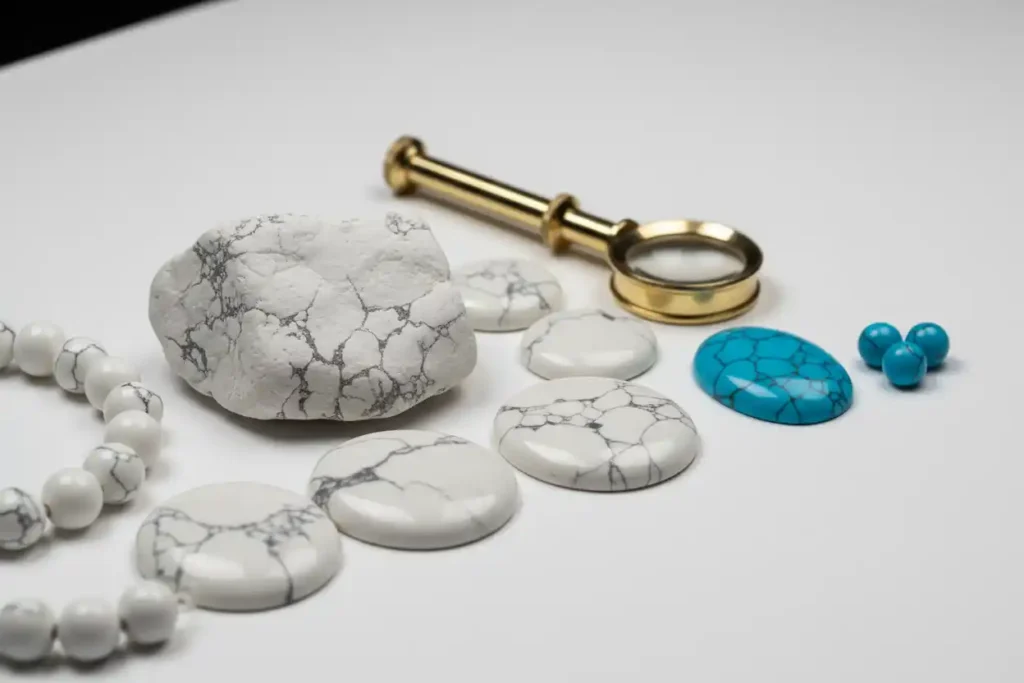
Howlite is often chosen for meditation because modern crystal traditions connect it with patience, awareness and slowing reactive responses.
Use it when the purpose of meditation is not to eliminate emotion but to create enough space to choose what happens next. Hold the stone, name what happened in neutral terms, identify the emotion and decide whether the situation calls for action, communication, waiting or a boundary.
This approach works especially well before sending an emotional message or making a decision while irritated. The related crystals for patience guide explores that pause-and-response approach in greater depth.
Howlite is relatively soft and porous, and dyed material is common. Keep it away from unnecessary soaking, oils and harsh cleaning products.
Labradorite for Perspective and Visualization
Labradorite is valued for labradorescence, the shifting flashes of color visible from certain angles. That changing appearance makes labradorite especially intuitive when the aim is perspective.
During a session, take one unresolved issue and deliberately examine it from another viewpoint. Ask what you may be overlooking, which assumption could be wrong and what the situation might look like to another person.
Crystals for meditation should not be used to treat intuition as certainty. An impression that arises during meditation can be recorded and considered, but consequential decisions still deserve evidence, consent and practical verification.
Labradorite can chip along cleavage planes, so a stable surface is preferable for large or irregular specimens.
Rose Quartz for Compassionate Reflection
Rose quartz is traditionally associated with affection, compassion and emotional gentleness. Within meditation practice, its most constructive role is to support reflection that is kind without becoming unrealistic.
A useful practice is to distinguish compassion from permission. You can care about someone while keeping a boundary. You can acknowledge a mistake without turning one error into a permanent judgment of yourself.
When crystals are used for relationship reflection, they should never be framed as tools that control another person’s feelings, guarantee reconciliation or make someone return. The stone can represent your intentions; another person retains their own choices and boundaries.
Selenite for a Quiet Meditation Space
Selenite is frequently chosen for meditation because its pale appearance is associated in modern spiritual practice with clarity and symbolic purification. It works particularly well as a stationary object rather than a stone that is handled constantly.
Place it on a secure, dry surface near the meditation area. Selenite is very soft, easily scratched and not a good candidate for routine soaking. A stable display position protects both the stone and the person using the space.
Selenite does not disinfect a room or remove pollutants. Physical cleaning, ventilation and ordinary hygiene remain separate from spiritual symbolism.
Choosing Crystals for Meditation by Purpose
The easiest way to choose a meditation stone is to begin with the practice rather than the shopping list.
For quiet reflection, amethyst is a natural choice. For defining one intention, clear quartz fits well. For grounding, smoky quartz is more appropriate. Howlite suits patience, labradorite suits perspective and rose quartz suits compassionate self-examination.
If your practice is specifically chakra-based, general meditation should not be confused with chakra correspondences. The amethyst page above covers one example, while Reiki is another distinct practice. The crystals for Reiki guide explains how stones may be used there with consent, hygiene and nonmedical boundaries.
Crystals for meditation can overlap with several spiritual traditions, but the purpose should remain clear so the ritual does not become a collection of unrelated claims.
Crystals for Meditation and Chakra Practice
Many people select meditation stones according to chakra colors or themes. Purple amethyst may be paired symbolically with the crown or third eye, blue stones with the throat, green or pink stones with the heart and darker stones with grounding themes.
These correspondences belong to spiritual traditions and modern crystal practice. A stone’s color and mineral composition do not demonstrate that it opens, balances or heals an anatomical energy center.
Crystals for meditation can still be meaningful in chakra-focused reflection when the language remains symbolic. For example, a throat-themed meditation might focus on listening honestly or preparing difficult words rather than claiming that a blue stone treats thyroid or vocal problems.
Crystals for Meditation, Dreams and Sleep
Meditation before bed and dream practices may overlap, but they are not the same thing. Crystals for meditation can mark a short wind-down or reflection period without being expected to create dreams.
If dream recall is the goal, the crystals for dreams guide focuses on journaling, bedside safety and avoiding predictive claims.
Keep hard stones, pointed specimens and jewelry out of bedding. Place them securely on a bedside surface instead. Crystals for meditation cannot treat insomnia, recurring nightmares or another sleep disorder.
Creating a Meditation Altar or Dedicated Quiet Space
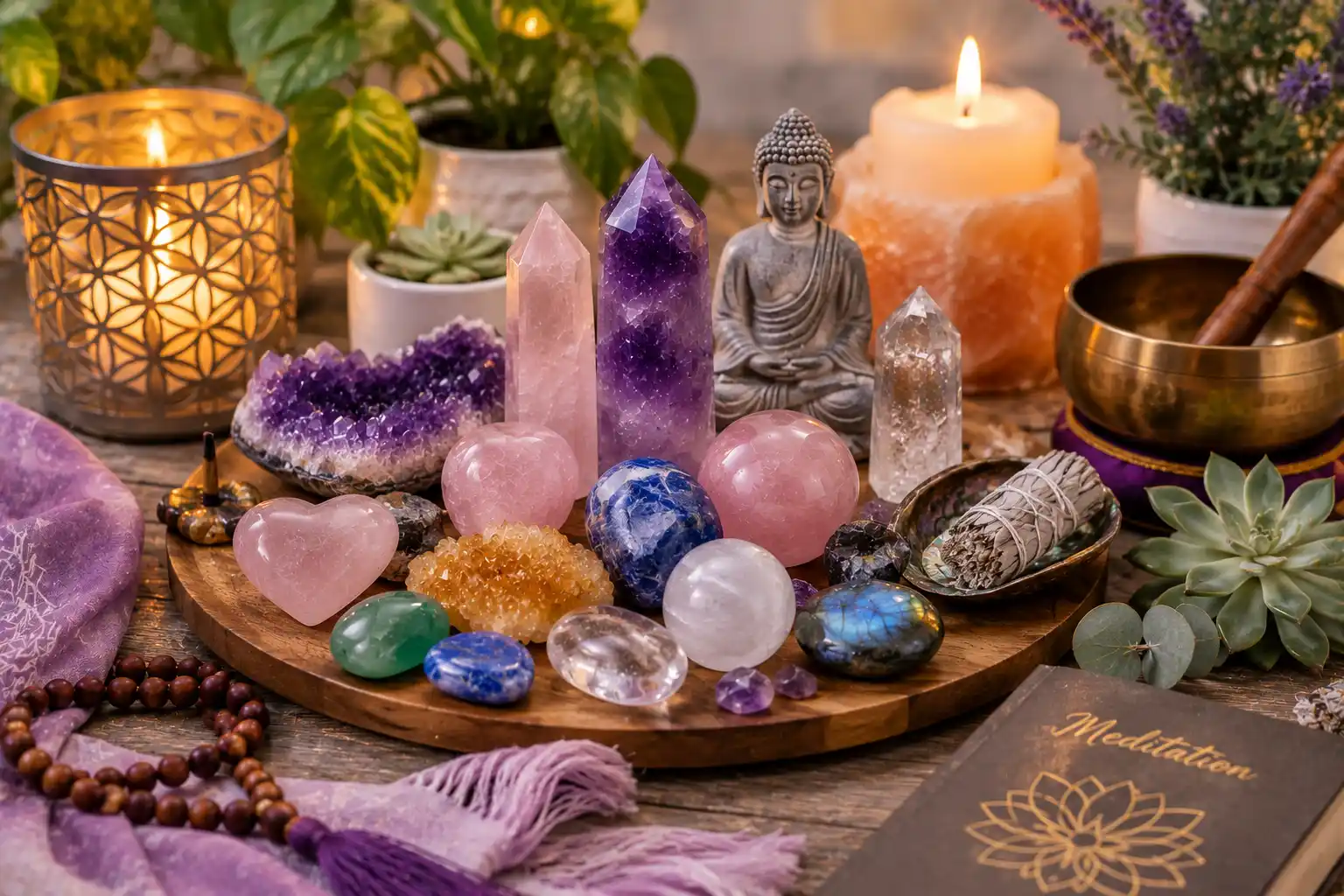
A meditation altar can be very simple. It does not need a large collection of crystals for meditation, expensive objects or a complicated layout. One stone, a notebook and a clean surface may be enough.
Start by deciding what the space is for. If it is primarily for breath awareness, keep the arrangement visually quiet. If it is for journaling, leave enough room to write. If it belongs to a religious or cultural tradition, follow the practices and meanings of that tradition rather than treating every sacred object as interchangeable decoration.
For a general personal meditation space, arrange crystals for meditation according to function. Amethyst might mark reflection, clear quartz can represent the session intention, smoky quartz can sit near the edge as a grounding symbol and selenite can remain in a protected location as part of the visual setting.
The altar should support practice, not become the practice.
Safe Placement of Crystals for Meditation on an Altar
Physical safety matters more than symbolic placement. Heavy crystals for meditation should sit on low, stable surfaces rather than shelves above where you sit. Spheres need secure stands. Sharp points should face away from walkways, hands, children and pets.
Do not place candles directly against crystals. Heat can damage some minerals, melt adhesives, alter treatments or create a fire hazard when combined with cloth, dried herbs or paper. If you use a candle, keep a clear fire-safe zone and never leave it unattended.
Avoid open bowls of small crystals for meditation where young children or pets could swallow them. Fragile material should not be balanced near an edge simply because a diagram suggests a particular direction.
A physically safe layout is always more important than a claimed energetic arrangement.
How Many Crystals for Meditation Should You Use?
One is enough.
Using too many crystals for meditation can make it harder to remember what each object represents. A simple set of two or three stones usually provides more structure than a crowded surface.
A balanced trio could be clear quartz for intention, amethyst for reflection and smoky quartz for grounding. Another person might prefer howlite for patience, rose quartz for compassion and carnelian to mark the transition from thinking to action.
More crystals for meditation do not make a session stronger. Add a stone only when it has a distinct purpose.
How to Hold Crystals for Meditation
Choose a smooth, comfortable piece that does not have sharp edges. Rest it lightly in the palm rather than gripping it.
Notice its weight and temperature, then let your attention move back to breathing. When thoughts wander, touch or look at the stone and return. This makes crystals for meditation part of the attention routine instead of a distraction.
Large specimens should remain on the floor, table or another stable surface. You do not need direct skin contact for a symbolic practice.
If holding a stone causes discomfort, set it down. Meditation should not require maintaining an awkward position.
A Simple Five-Minute Practice With Crystals for Meditation
Choose one of your crystals for meditation and sit somewhere physically comfortable. Place the stone in your hand or in view.
For the first minute, notice natural breathing without trying to force a particular rhythm. During the second minute, observe the crystal’s color, weight or texture. During the third, state one question or intention. During the fourth, allow thoughts to arise without treating every thought as a message. During the final minute, identify one practical action or observation to carry forward.
This is enough. Crystals for meditation do not require long ceremonies to be personally meaningful.
If the session leaves you more agitated, stop, orient to your surroundings and choose a different activity. Meditation is optional, not a test of spiritual ability.
Crystals for Meditation During New-Moon or Intention Rituals
Some people combine crystals for meditation with lunar routines. A recurring date can provide a useful reminder to review goals, but the lunar phase does not scientifically charge a mineral or cause an intention to manifest.
The crystals for the new moon guide focuses on beginnings, review and realistic action. A meditation can use the same principle: reflect, define the next step and then do something observable.
Crystals for meditation should support the transition from reflection into responsible action rather than replacing it.
Cleaning and Caring for Crystals for Meditation
Different crystals for meditation need different physical care. Quartz varieties such as amethyst, clear quartz and smoky quartz are reasonably durable, while selenite is much softer. Labradorite has cleavage and can chip. Howlite is porous and often dyed.
Do not use one universal cleansing method for every stone. Water, salt, sunlight, heat, oils and cleaning chemicals can affect different minerals and treatments in different ways.
Spiritual cleansing and physical cleaning are also different. Sound, visualization or intention may be part of a personal ritual, but they do not remove dirt or disinfect a surface.
Store crystals for meditation so harder stones do not scratch softer ones, and keep fragile pieces protected from impact.
Buying Crystals for Meditation Without Overpaying
You do not need rare material to build a useful set of crystals for meditation. A small polished stone can serve the same symbolic purpose as a large display specimen.
Buy according to correct identification, condition, appearance and physical suitability. Be cautious when a seller claims one specimen has guaranteed powers, cures a condition, predicts the future or is spiritually stronger because of an unverifiable marketing label.
Natural variation is normal. Color intensity, inclusions and size do not automatically determine whether crystals for meditation are better for personal practice.
If you already own a stone you enjoy using safely, there may be no reason to buy another.
Frequently Asked Questions
What are the best crystals for meditation?
Amethyst, clear quartz, smoky quartz, howlite, labradorite, rose quartz and selenite are popular crystals for meditation. Choose according to the purpose of the session rather than assuming one stone is universally best.
What is the best crystal for meditation beginners?
Clear quartz or amethyst are simple choices. Clear quartz suits a defined intention, while amethyst suits quiet reflection. Beginners do not need several crystals for meditation at once.
Do crystals for meditation have to touch the body?
No. Crystals for meditation can be held, placed in view or kept elsewhere in the meditation area. Physical contact is not required for a symbolic practice.
Can crystals for meditation improve concentration?
There is no established evidence that a crystal biologically improves attention. A stone can act as a visible or tactile cue to return to a chosen task or breath. For a more decision-oriented approach, crystals for mental clarity focuses on organizing information and reducing distraction.
Can I use crystals for meditation every day?
Yes, if the routine remains comfortable and useful. There is no spiritual requirement to use crystals for meditation daily, and a short consistent practice may be more practical than an elaborate ritual.
Which crystals for meditation are best for grounding?
Smoky quartz is a common symbolic grounding choice. Gray and brown stones are also frequently associated with practical perspective; the gray crystals guide explains several materials that carry those themes.
Are crystals for meditation safe to keep on an altar?
Yes, when they are placed securely. Keep heavy, pointed, unstable and small swallowable stones away from risky positions, children and pets. Separate crystals from open flames and protect soft minerals from moisture and impact.
Can crystals for meditation open chakras?
Chakra-crystal associations are spiritual traditions rather than scientifically established anatomical effects. Crystals for meditation can be used as symbolic chakra objects without claiming that they physically open or heal an energy center.
Can crystals for meditation help with anxiety or stress?
Crystals may be used as grounding objects during a personal routine, but they do not treat anxiety disorders or other medical or mental-health conditions. The crystals for stress guide keeps those symbolic practices connected with practical coping and appropriate care.
Can I sleep with crystals for meditation under my pillow?
It is safer to keep hard or pointed stones on a stable bedside surface. Objects inside bedding can cause discomfort, damage or injury and may be accessible to children or pets.
Do I need to cleanse crystals for meditation after every session?
No. There is no scientific requirement to energetically cleanse crystals after meditation. If cleansing is part of your spiritual practice, choose a method that is physically compatible with the mineral.
How many crystals for meditation should be on an altar?
One to three is usually enough. Give each stone a specific role and leave enough clear space for comfortable practice. A crowded altar does not make crystals for meditation more effective.
Making the Practice Meaningful
The most useful crystals for meditation are the ones that make your intention clearer without making the ritual more complicated. Amethyst can mark reflection, clear quartz can define a question, smoky quartz can bring attention back to immediate conditions and howlite can represent the pause before a response.
A meditation altar can support the same principle. Keep it simple, stable and personally meaningful. Choose objects because they help you enter the practice, not because you feel pressured to reproduce an elaborate arrangement.
Crystals for meditation can carry cultural, spiritual and personal symbolism, but the meaningful work still happens through attention, reflection, behavior and responsible choices. Use the stone as an anchor, keep physical safety in view and let the session end with something you can understand or act on.
Disclaimer: Meanings associated with crystals for meditation, chakras, spiritual purification and intention-setting come from cultural, historical and contemporary spiritual traditions rather than established medical science. Crystals do not diagnose or treat physical or mental-health conditions, guarantee spiritual experiences, reveal hidden facts or replace qualified care. Use stones safely around heat, water, children, pets and fragile materials, and stop any practice that causes distress or physical discomfort.