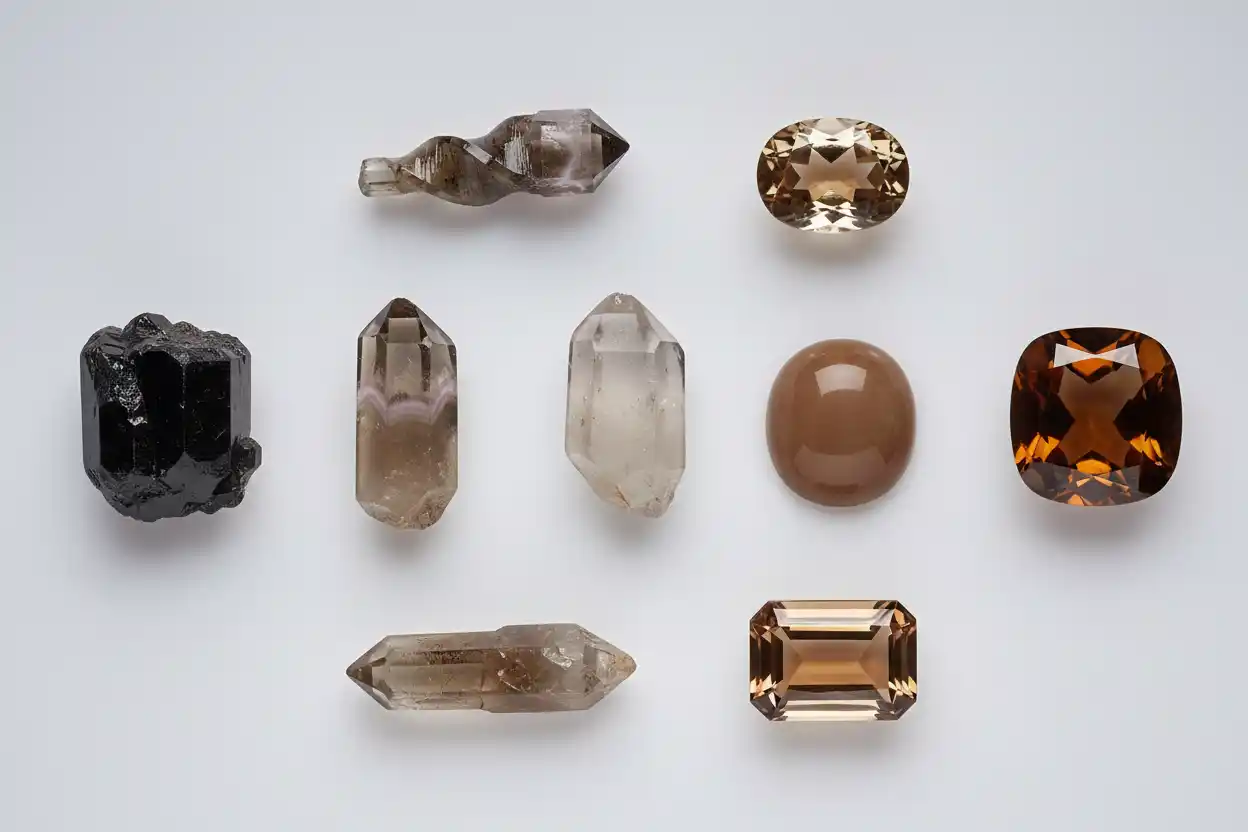
Types of Smoky Quartz: Colors and Varieties Explained
Smoky quartz is the gray, brown, or nearly black transparent-to-translucent variety of crystalline quartz. Its color develops when radiation interacts with aluminum-related defects inside the quartz lattice, creating color centers that absorb visible light.
The different types of smoky quartz are defined mainly by depth and undertone of color, geographic trade names, crystal habit, inclusions, zoning, association with amethyst or citrine, and whether the color formed naturally or through artificial irradiation. The parent smoky quartz meaning and properties guide covers the variety broadly, while this page owns its color and type classification.
Smoky Quartz at a Glance
| Property | Smoky Quartz |
|---|---|
| Composition | Silicon dioxide, SiO₂, with aluminum-related defects and charge-compensating ions |
| Mineral group | Quartz |
| Main colors | Pale smoky gray, taupe, beige-gray, yellow-brown, golden brown, cognac, chocolate, dark brown, gray-black, and nearly black |
| Crystal system | Trigonal |
| Typical habit | Six-sided prisms, pointed crystals, clusters, scepters, skeletal crystals, gwindels, phantoms, massive rough, and faceted gems |
| Luster | Vitreous |
| Transparency | Transparent to opaque in extremely dark material |
| Mohs hardness | 7 |
| Cleavage | None |
| Tenacity | Brittle |
| Common uses | Faceted jewelry, cabochons, beads, carvings, crystal points, clusters, decorative specimens, and optical objects |
| Main care concern | Heat-induced fading, undisclosed irradiation, internal fractures, chipped edges, and confusion with glass or other brown gems |
Smoky Quartz Within the Quartz Family
Smoky quartz shares its basic structure and physical properties with the wider quartz family.
Pure quartz is colorless. Different impurities, inclusions, and defects produce amethyst, citrine, rose quartz, smoky quartz, and several included trade varieties.
Smoky color can overlap with yellow citrine, purple amethyst, or colorless rock crystal inside one crystal. These mixed zones provide evidence that quartz color varieties represent related defect systems rather than unrelated minerals.
The broader types of gemstones guide explains why smoky quartz remains a color variety of one mineral species.
How Smoky Quartz Gets Its Color
Aluminum can substitute for silicon during quartz growth.
Because aluminum carries a different electrical charge, alkali ions or hydrogen-related species compensate within the lattice. Natural radiation from surrounding rocks can remove an electron from an oxygen associated with the aluminum defect.
The resulting color center absorbs visible light and produces gray, brown, or black coloration.
Quartz without the necessary aluminum-related defects will not necessarily become smoky after irradiation. Conversely, aluminum-rich colorless quartz may darken strongly after natural or artificial exposure.
Heat can destroy or reorganize the color centers, lightening the stone or making it colorless. Some material changes at relatively modest temperatures compared with those used for many other gem treatments.
Pale Smoky Quartz
Pale smoky quartz shows a light gray, beige-gray, taupe, or faint brown tint.
The color can be subtle enough to disappear under weak indoor lighting or against a dark setting. Fine cutting becomes especially important because a large window can make the stone appear nearly colorless.
Light material commonly forms near the edges of zoned crystals or in deposits with relatively low natural radiation exposure.
Pale smoky quartz can resemble colorless quartz, pale topaz, glass, and very light champagne gems.
Gray Smoky Quartz
Gray smoky quartz has a neutral smoke, silver-gray, or charcoal-gray body.
Some stones contain slight blue, violet, green, or brown undertones. The apparent modifier can change between daylight, warm artificial light, and transmitted light.
Neutral gray has become popular in contemporary jewelry because it coordinates with white, yellow, and rose metals without the strong warmth of dark brown material.
Champagne Smoky Quartz
Champagne smoky quartz is a commercial color term for pale beige, golden gray, yellow-brown, or light tea-colored quartz.
It overlaps with light smoky quartz and weak citrine. No fixed gemological boundary determines when champagne becomes smoky yellow quartz or pale citrine.
The name describes appearance rather than origin or treatment. Both natural and artificially irradiated quartz can show champagne color.
Golden-Brown Smoky Quartz
Golden-brown material combines smoke color with yellow or warm honey tones.
Some pieces lie near the visual boundary with citrine. If yellow dominates, the trade may prefer citrine; if brown or gray dominates, smoky quartz is more appropriate.
The dedicated smoky quartz versus citrine guide owns the full boundary discussion, while types of citrine classifies the yellow-orange side of the spectrum.
Cognac and Coffee Smoky Quartz
Cognac, coffee, whiskey, and chocolate are informal retail names for medium-to-dark brown smoky quartz.
Cognac usually suggests warm orange-brown or reddish brown, whereas coffee implies a deeper neutral brown. These labels are not standardized.
Strongly colored material can look luxurious when cut to return light, but deep pavilions may create a nearly black center.
Consumers should judge the actual stone under neutral light rather than paying a premium for a beverage-inspired name.
Dark Smoky Quartz
Dark smoky quartz ranges from deep brown and espresso to gray-black.
Thick crystals can appear opaque even when thin edges remain transparent. Strong darkness may come from intense natural or artificial irradiation.
Dark material requires careful cutting. A shallow pavilion can preserve visible brown reflections, while excessive depth produces extinction.
Some dark crystals lighten when exposed to heat. A dealer should not describe every near-black stone as rare morion without considering transparency, provenance, and treatment.
Morion
Morion is the traditional name for very dark brown to black smoky quartz.
The term describes the darkest end of the smoky spectrum rather than a separate mineral. Fine morion may reveal brown, gray, or amber transparency at thin edges.
Natural morion is associated with granitic pegmatites, alpine veins, and regions where quartz received substantial geological radiation.
Artificial irradiation can produce equally dark quartz. Therefore, black color alone does not prove natural morion or a particular locality.
Morion crystals can be impressive specimens, but over-darkening may conceal internal form and inclusions.
Cairngorm Quartz
Cairngorm is a geographic and historic name for yellow-brown to dark smoky quartz associated with the Cairngorm Mountains and other Scottish localities.
Colors range from pale tea and golden brown to deep smoky brown. Dark Scottish material may also be called morion.
Cairngorm quartz has a long history in Scottish jewelry, brooches, kilt pins, seals, and ceremonial objects.
The name should ideally be reserved for documented Scottish material. Ordinary Brazilian or Madagascar smoky quartz should not receive a Cairngorm premium merely because its color looks similar.
Antique Scottish jewelry may derive more value from age, craftsmanship, provenance, metalwork, and cultural context than the quartz itself.
Smoky Citrine
Smoky citrine contains both yellow and smoky brown components.
The stone may be golden yellow with brown zoning, smoky brown with a yellow core, or a gradual transition between both colors.
Overlapping aluminum- and iron-related color mechanisms can develop during growth, irradiation, and heating. Natural stones exist, but treatment can create similar appearances.
“Smoky citrine” is a descriptive overlap category rather than a separate mineral. It should not be used to conceal weak brown citrine or irradiated colorless quartz.
Smoky Amethyst
Smoky amethyst displays purple amethyst color together with gray or brown smoky zones.
The two colors may occur in sectors, layers, phantoms, or gradual transitions. Radiation and trace chemistry affect each growth zone differently.
Some crystals show a smoky core beneath purple terminations. Others combine amethyst, smoky quartz, and colorless quartz within one specimen.
Heating can alter one color system more strongly than another, producing complex results.
Smoky Ametrine
Ametrine contains purple amethyst and yellow citrine. Some crystals also develop smoky layers or sectors.
These three-color combinations can show purple, yellow, brown, and colorless regions in one quartz crystal.
Fine natural material is unusual, but irradiated and heated quartz can imitate multicolor zoning. Laboratory analysis and provenance matter when a seller claims rare natural three-color quartz.
Cairngorm-Style and Scottish Trade Material
Not every piece of Scottish smoky quartz has deep Cairngorm color, and not every antique Scottish-set brown stone is quartz.
Glass, citrine, topaz, paste, and replacement stones can occur in older jewelry. Authentication requires examination of both the gem and mounting.
A regional label should identify origin, not merely a dark brown shade.
Brandberg Smoky Quartz
Brandberg quartz comes from Namibia’s Brandberg region and surrounding mineral fields.
Crystals may contain smoky, amethyst, colorless, phantom, skeletal, and inclusion-rich zones. Some show fluid inclusions, enhydro cavities, hematite, chlorite, or unusual internal forms.
“Brandberg” is a locality trade name rather than a color variety. It should be supported by reliable provenance because visually similar material occurs in Madagascar and other countries.
Collectors value complete natural crystals, distinctive zoning, clarity, inclusions, and documented source more than simple size.
Alpine Smoky Quartz
Alpine smoky quartz forms in fissures within metamorphic mountain regions.
Switzerland, France, Italy, Austria, Pakistan, Russia, and other alpine-type environments have produced sharp smoky crystals with excellent luster.
Crystals may occur with adularia, albite, chlorite, hematite, rutile, calcite, and other minerals.
Locality, crystal perfection, association, and historic mine provenance drive specimen value. A complete natural point may be worth more than the faceted stone it could yield.
Gwindel Smoky Quartz
A gwindel is a twisted quartz crystal habit strongly associated with alpine fissures.
The crystal appears to rotate around its growth axis, producing a spiral or stacked plate-like form. Many gwindels are smoky because their geological environment favored aluminum incorporation and natural irradiation.
Open gwindels show obvious separation between twisted layers, while closed examples appear more compact.
Complete undamaged smoky gwindels from classic alpine localities are highly collectible and should rarely be cut.
Scepter Smoky Quartz
A scepter crystal has a wider younger quartz head grown on a narrower older stem.
The stem, cap, or both may be smoky. Some specimens combine smoky quartz with amethyst, citrine, or colorless layers.
Scepters form when quartz growth resumes under changed conditions. The new stage expands more rapidly than the original stem.
Balanced shape, intact termination, clarity, and contrast between growth stages contribute to value.
Skeletal and Elestial Smoky Quartz
Skeletal smoky quartz grows more rapidly along edges than across complete faces, producing recessed, stepped, or hollowed structures.
Elestial is a trade name commonly applied to complex layered, stepped, or skeletal quartz with multiple terminations and growth surfaces.
Clay, iron oxides, fluids, and other minerals can become trapped in the cavities. The resulting crystals may be fragile and difficult to clean.
A polished smoky elestial freeform is a worked object, while an intact natural skeletal crystal retains its original growth significance.
Phantom Smoky Quartz
Phantom quartz contains the outline of an earlier crystal-growth stage.
A pause allows chlorite, hematite, clay, fine quartz, or another material to coat the old termination. Later growth encloses the outline within clearer quartz.
A smoky phantom can consist of a dark internal point inside a lighter crystal or a pale phantom enclosed by smoky growth.
The related types of clear quartz guide classifies phantom and included forms more broadly without duplicating smoky color categories.
Inclusion-Bearing Smoky Quartz
Smoky quartz can contain rutile, tourmaline, chlorite, hematite, mica, feldspar, apatite, garnet, fluid inclusions, and numerous other minerals.
The host’s brown color can enhance gold rutile or black tourmaline contrast. However, dense inclusions may reduce transparency or create stress.
A natural inclusion can increase value when it is attractive, rare, and well positioned. Surface-reaching fractures remain a durability concern regardless of visual appeal.
Cat’s-Eye and Star Smoky Quartz
Rare included smoky quartz can display chatoyancy or asterism.
Aligned fibers, needles, tubes, or channels may create a moving cat’s-eye band in a cabochon. Intersecting inclusion directions can produce a star.
The effect should move under a single point light source. Fiber-optic glass and scratches can imitate it.
These optical varieties lack a large standardized market, so value depends on body color, transparency, sharpness, size, and reliable identification.
Natural Versus Irradiated Smoky Quartz
Natural smoky quartz receives radiation from uranium-, thorium-, or potassium-bearing minerals in surrounding rock over geological time.
Commercial producers can darken suitable colorless quartz with gamma rays, electrons, or other controlled irradiation. The treated material has the same quartz structure and often the same color-center mechanism.
Visual appearance may not distinguish natural from artificial color. Extremely uniform darkness, large quantities of matching material, and implausibly low prices can suggest treatment but do not prove it.
Irradiation should be disclosed when known. The wider treatment principles appear in gemstone treatments explained.
Heated and Lightened Smoky Quartz
Heating smoky quartz can reduce or remove the brown color.
Controlled heating may create pale yellow, greenish, colorless, or otherwise modified quartz depending on impurities and defect structure.
Accidental heat from a torch, steam cleaner, display lamp, or repair process can also alter the color. Restoration is not always practical.
A lightened stone remains quartz, but treatment history affects how buyers interpret rarity and color origin.
Synthetic Smoky Quartz
Quartz can be grown hydrothermally in laboratories.
Synthetic material may receive smoky color through growth chemistry and irradiation. It can be extremely transparent and occur in large sizes.
Gem-quality synthetic smoky quartz is less commercially visible than treated natural quartz because natural rough is abundant and inexpensive. Nevertheless, it is technically possible and may require advanced testing.
Formation and Geological Environments
Quartz crystallizes from silica-rich hydrothermal fluids, pegmatitic melts, alpine fissures, veins, and cavities.
Smoky color develops only when the quartz contains suitable defects and later receives radiation. Therefore, two colorless crystals from the same general region may respond differently.
Granites and pegmatites often supply both aluminum-bearing quartz and nearby radioactive elements. Alpine fissures can provide sharp well-formed crystals exposed to long-term geological radiation.
Color zoning records changes in growth chemistry and radiation response.
Major Localities
Brazil and Madagascar supply large quantities of faceting rough, crystals, carvings, and decorative specimens.
Switzerland is famous for alpine morion, gwindels, and classic smoky crystals. Scotland provides historic Cairngorm material.
Colorado, New Hampshire, Maine, North Carolina, and other United States regions produce notable crystals. Namibia supplies Brandberg material, while Pakistan, Afghanistan, Russia, Ukraine, China, and Australia also yield collector specimens.
Locality should come from provenance rather than color alone.
Inclusions and Internal Features
Smoky quartz may contain veils, fingerprints, negative crystals, liquid and gas inclusions, phantoms, needles, color bands, and healed fractures.
Natural color zoning can follow crystallographic growth sectors. Artificially irradiated quartz can also display zoning if aluminum concentration varies within the crystal.
Inclusions can support natural origin, but they do not prove natural smoky color. A colorless natural crystal can be irradiated after mining without changing its original inclusions.
How Smoky Quartz Is Identified
Smoky quartz has quartz hardness, refractive index, birefringence, specific gravity, and trigonal optical character.
The gemstone hardness chart places it at Mohs 7, above feldspar and below topaz.
Quartz has no cleavage, although it remains brittle. The gemstone cleavage guide explains why conchoidal fracture and internal cracking still occur.
The general crystal identification guide provides a safer approach than scratch testing finished jewelry.
Common Lookalikes
Brown topaz, brown zircon, tourmaline, andalusite, glass, obsidian, synthetic spinel, and colored cubic zirconia can resemble smoky quartz.
Topaz has perfect cleavage and greater density. Zircon has much stronger dispersion and facet doubling. Brown tourmaline commonly shows stronger pleochroism.
Glass may contain round bubbles and flow lines, though high-quality glass can appear clean.
Colorless quartz with a dark backing or coating can imitate a deeper smoky stone.
Cutting Behavior
Smoky quartz occurs in large crystals and allows almost every cutting style.
Rounds, ovals, cushions, emerald cuts, pears, briolettes, concave cuts, fantasy designs, carvings, and spheres are common.
Dark rough requires shallower cutting to prevent extinction. Pale material may benefit from deeper proportions that concentrate color, although excessive depth reduces face-up size.
Quartz has no cleavage, but cutters must avoid internal fractures, fluid inclusions, and thin corners.
Precision cutting can contribute more value than the rough itself because ordinary smoky quartz is abundant.
Durability and Jewelry Suitability
Smoky quartz has Mohs hardness 7 and no cleavage, making it suitable for most jewelry.
It can still chip at thin girdles, pointed corners, and exposed facets. The distinction between hardness and impact resistance appears in gemstone toughness versus hardness.
Rings benefit from protective settings, particularly when the stone is large. Earrings and pendants experience less impact.
Surface-reaching fractures and enhydro cavities require additional care.
Smoky Quartz Prices in 2026
Smoky quartz remains one of the most affordable transparent gemstones.
Commercial faceted stones commonly retail for approximately $0.50–$5 per carat. Better color, cutting, and clarity may bring prices to $5–$15 per carat.
Precision-cut, concave-cut, fantasy-cut, unusually colored, or large designer stones commonly range around $10–$30 per carat, although the price reflects labor more than rough rarity.
Small points and clusters often cost $5–$40. Attractive cabinet specimens commonly range from $40–$500.
Large transparent crystals, aesthetic alpine groups, gwindels, Brandberg specimens, documented Scottish Cairngorm material, mineral combinations, and historic collections may cost hundreds or thousands of dollars.
The dedicated smoky quartz price guide should retain detailed market tables and future updates.
Buying Guidance
Choose a color depth that remains lively in the intended setting.
View dark stones in ordinary indoor light. A gem that looks brown under photography lights may appear nearly black after mounting.
Compare millimeter dimensions with weight because deeply cut quartz can hide substantial carat weight beneath the setting.
Ask whether the color is natural, irradiated, heated, or unknown. For an expensive locality claim, request provenance.
The dedicated smoky quartz buying guide owns the full transaction checklist.
Cleaning and Storage
Clean smoky quartz with lukewarm water, mild soap, and a soft brush.
Rinse briefly and dry with a lint-free cloth. Avoid sudden temperature changes, especially in stones with large internal fractures or fluid inclusions.
Ultrasonic cleaning may be suitable for sound untreated quartz, but not for filled, coated, repaired, included, or heavily fractured stones.
Heat presents the greater concern because it can lighten smoky color. The complete material-specific process appears in how to clean smoky quartz jewelry.
Strong prolonged heat and intense sunlight may affect some color centers or treated material. Conservative light guidance appears in crystals that fade in sunlight.
Store smoky quartz separately from topaz, sapphire, moissanite, and diamond, which can scratch it.
Meaning and Symbolism
Modern spiritual traditions commonly associate smoky quartz with steadiness, grounding, practical thinking, emotional boundaries, and releasing unhelpful tension.
Pale smoke colors may symbolize calm perspective, while morion is often linked with protection or depth. Cairngorm carries additional Scottish cultural and historical associations.
These interpretations belong to personal, cultural, and spiritual traditions. Mineralogical science does not demonstrate that one shade or locality produces a specific psychological or medical effect.
Smoky quartz appears with related S materials in the crystals that start with S directory and the gemstones that start with S guide.
Frequently Asked Questions
1. What are the main types of smoky quartz?
Major categories include pale smoky, gray, champagne, golden-brown, cognac, dark smoky, morion, Cairngorm, smoky citrine, smoky amethyst, Brandberg, gwindel, scepter, phantom, and included smoky quartz.
2. What is morion quartz?
Morion is the traditional name for extremely dark brown to nearly black smoky quartz.
3. What is Cairngorm quartz?
Cairngorm is smoky yellow-brown to dark brown quartz associated historically with Scottish localities, especially the Cairngorm region.
4. Is black quartz the same as morion?
Some sellers use black quartz for very dark smoky quartz, but the label can also be applied loosely to included or artificially darkened material. Morion is the more established name for dark smoky quartz.
5. What causes smoky quartz color?
Radiation interacts with aluminum-related defects in the quartz lattice, creating color centers that absorb light and produce gray-to-brown color.
6. Is irradiated smoky quartz real quartz?
Yes. It is quartz whose color was created or intensified artificially. The treatment should be disclosed when known.
7. Can smoky quartz be heated into citrine?
Heating can lighten smoky quartz and may produce pale yellow or other colors in suitable material, but not every smoky crystal becomes attractive citrine.
8. What is smoky citrine?
Smoky citrine is quartz containing both yellow citrine and brown or gray smoky components.
9. Can smoky quartz contain amethyst?
Yes. Smoky and purple zones can occur within one crystal, sometimes together with citrine or colorless quartz.
10. Is dark smoky quartz naturally radioactive?
No. Its color records past radiation exposure, but the finished quartz is not automatically radioactive. Associated minerals should be tested separately when a specimen comes from a uranium-bearing locality.
11. Is smoky quartz suitable for daily jewelry?
Yes. Hardness 7 and lack of cleavage make it practical, although sharp corners and internal fractures can still chip.
12. Which smoky quartz type is most valuable?
Exceptional locality specimens, alpine gwindels, fine Brandberg crystals, documented Cairngorm material, rare optical effects, and precision-cut designer stones can command the highest premiums.
Smoky quartz types form a continuous record of trace aluminum, geological radiation, crystal growth, and human treatment. A pale champagne gem, Scottish Cairngorm jewel, black morion point, twisted alpine gwindel, smoky-amethyst phantom, and irradiated commercial stone share one quartz framework, yet their origin and collector significance differ.