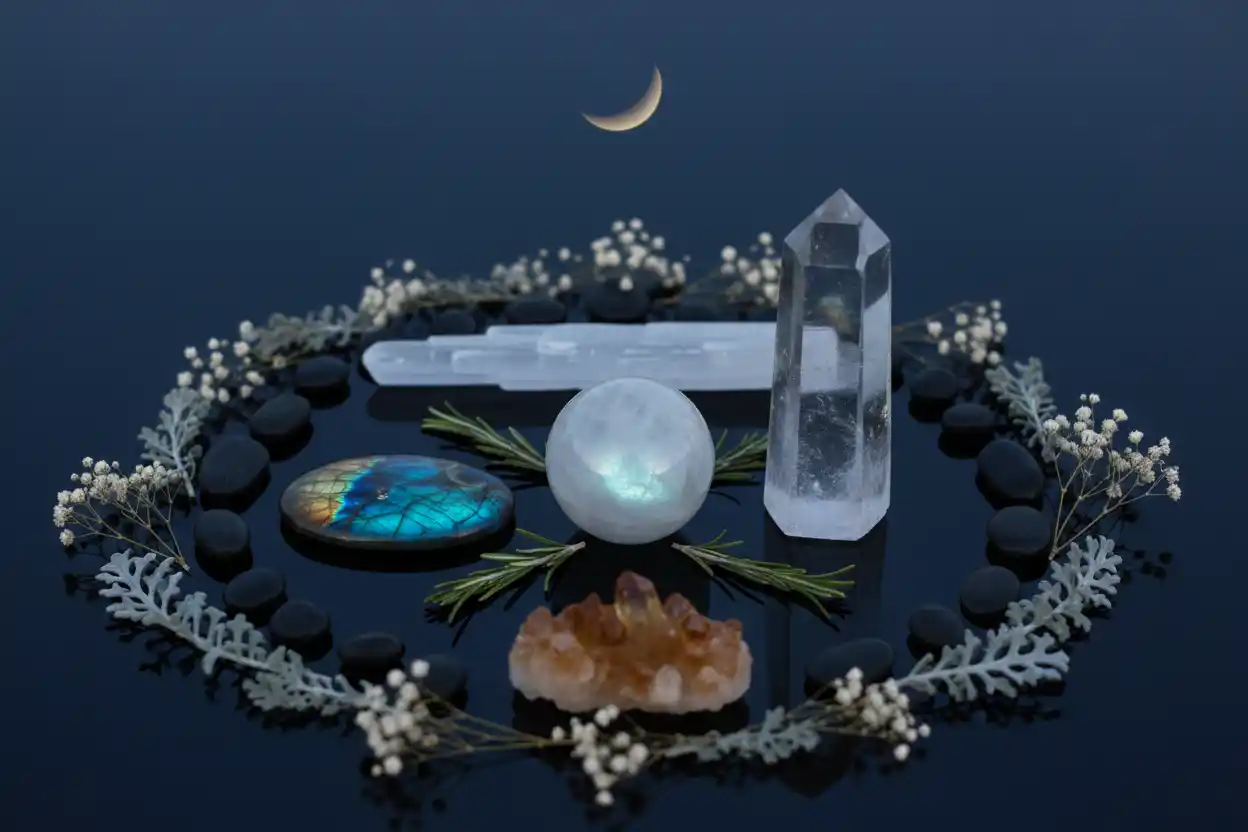
Best Crystals for the New Moon: Top 10 Picks
New-moon crystal practices traditionally focus on intention-setting, beginnings and the quiet planning stage before visible progress appears. The lunar phase does not scientifically charge crystals or cause goals to manifest, but its recurring schedule can provide a meaningful point for reviewing priorities.
Moonstone reflects cycles and transition, while clear quartz supports a precise intention. Labradorite suits adaptability, selenite can mark a quiet ritual space and carnelian encourages action after the reflection ends.
Top 10 New-Moon Crystals at a Glance
| Rank | Crystal | Traditional new-moon theme | Suggested ritual role |
|---|---|---|---|
| 1 | Moonstone | Cycles, transition and intuition | Acknowledge the beginning of a new phase |
| 2 | Clear quartz | Intention and symbolic amplification | Define one measurable goal |
| 3 | Labradorite | Transformation and perspective | Explore a changing direction |
| 4 | Selenite | Clarity and symbolic purification | Mark a quiet ritual space |
| 5 | Black obsidian | Truth and pattern recognition | Identify what could undermine the intention |
| 6 | Smoky quartz | Grounding and practical perspective | Separate controllable and uncontrollable factors |
| 7 | Citrine | Optimism and constructive possibility | Approach the goal with realistic confidence |
| 8 | Carnelian | Initiative and action | Schedule the first visible step |
| 9 | Moss agate | Patient growth and gradual establishment | Support a long-term intention |
| 10 | Chrysoprase | Renewal and openness | Create space for a revised future |
What the New Moon Represents
Astronomically, a new moon occurs when the Moon lies approximately between Earth and the Sun. Its illuminated side faces mostly away from Earth, so the Moon is usually difficult or impossible to see.
In many contemporary spiritual practices, this darkness symbolizes potential, rest, planning and beginnings that have not yet become visible.
The symbolism can support a recurring monthly review. However, the lunar phase does not make an intention more powerful in a scientifically measurable way.
Someone who misses the exact new-moon date can perform the practice at another practical time. Consistency and clear action matter more than astronomical precision.
1. Moonstone for Cycles and Beginnings
Moonstone is the most direct symbolic choice for a new-moon ritual. It is traditionally associated with cycles, emotional awareness and transition.
Use moonstone while reviewing what changed during the previous month. Then identify whether the coming intention continues an existing path or begins a new one.
A person may also record emotional expectations. Excitement, grief and uncertainty can coexist at the start of a new phase.
Moonstone does not predict what will happen during the lunar cycle. Its role is to mark the transition and encourage observation.
Because moonstone can chip along cleavage planes, keep it on a stable cloth or tray.
2. Clear Quartz for One Precise Intention
Clear quartz is widely used in intention-setting and manifestation practices. Its transparent appearance provides a useful symbol for clarity.
Write one outcome in observable terms. “Invite more abundance” gives little practical guidance, whereas “save a defined amount this month” creates a measurable direction.
Next, identify the action that belongs to the coming week. Place the stone beside the written intention until that action is scheduled.
The completed guide to programming crystals explains how to assign a clear purpose without assuming that the mineral independently understands instructions.
3. Labradorite for a Changing Direction
Labradorite carries modern crystal associations with transformation, intuition and adaptability. Its optical flashes appear from certain angles, which makes it an effective symbol of perspective.
Use labradorite when the new-moon intention involves exploration rather than a fixed outcome.
Write what is known, what remains uncertain and what experiment could provide useful information. A small test may be more appropriate than a complete commitment.
Labradorite can therefore support flexibility without encouraging constant reinvention. Set a review date so that the experiment has enough time to produce evidence.
4. Selenite for a Quiet Ritual Space
Selenite is traditionally associated with clarity, peace and symbolic purification. It may mark the physical space used for the new-moon ritual.
Place a stable piece beside a journal and reduce unnecessary stimulation. Silence notifications, close unrelated materials and choose one purpose for the session.
Selenite does not cleanse a room in a scientifically measurable way. Its grounded value lies in becoming a consistent environmental cue.
The stone is soft and water-sensitive. The guide explaining whether selenite is safe in water and sunlight provides material-specific care information.
5. Black Obsidian for Recognizing Obstacles
Black obsidian is volcanic glass traditionally associated with truth, protection and direct pattern recognition.
Before committing to an intention, ask what has prevented similar goals from progressing in the past. Focus on observable behavior and circumstances.
The obstacle may involve an unrealistic timeline, unclear responsibility, avoidance of feedback or a goal that depends heavily on another person’s choices.
Black obsidian can symbolize acknowledging that issue before the new cycle begins. It should not encourage fear about hidden forces or motives.
Inspect broken obsidian carefully because damaged edges may become extremely sharp.
6. Smoky Quartz for Grounded Intention-Setting
Smoky quartz is traditionally linked with grounding, release and practical perspective. It helps prevent a new-moon practice from becoming disconnected from real circumstances.
Divide the goal into controllable, influenceable and uncontrollable elements. Then direct the ritual toward the first category.
For example, preparation and communication may remain within personal control, while another person’s response does not.
Smoky quartz can mark the decision to stop treating the uncontrollable part as a personal task.
7. Citrine for Constructive Optimism
Citrine is traditionally associated with optimism, confidence and favorable opportunity. It suits new-moon intentions involving work, creativity and personal growth.
Write what could go well and what evidence would show that the plan is progressing. Then identify the preparation required.
Optimism should support action rather than remove caution. Citrine cannot guarantee financial, professional or relationship outcomes.
Its most useful new-moon role involves approaching the goal with hope while remaining willing to revise weak assumptions.
8. Carnelian for the First Visible Step
Carnelian is traditionally connected with initiative, courage and action. It provides an important counterbalance to rituals that remain entirely within writing and visualization.
Choose one step that produces external progress. Send the message, begin the draft, attend the meeting or make the appointment.
Schedule the action before ending the new-moon practice. Otherwise, the intention may remain emotionally satisfying but behaviorally inactive.
Carnelian symbolizes crossing from reflection into participation.
9. Moss Agate for Long-Term Intentions
Moss agate is traditionally associated with patience, natural cycles and gradual growth. It suits goals that require several lunar cycles rather than immediate results.
Use moss agate near a habit tracker or progress log. Record small actions consistently instead of evaluating the intention only through dramatic outcomes.
A new moon can provide a monthly review date. However, daily and weekly routines will usually determine whether the goal becomes established.
Moss agate’s symbolism reinforces the idea that unseen or modest progress still matters.
10. Chrysoprase for Renewal
Chrysoprase is traditionally associated with hope, emotional openness and renewal. It may suit a new-moon intention that follows disappointment or the release of an outdated goal.
Ask what space has opened and which new possibility deserves a small experiment.
The next direction does not need to replace the previous one immediately. Chrysoprase supports a gentler form of beginning based on curiosity rather than pressure.
Its symbolism works particularly well when the goal involves reconnecting with life after a difficult transition.
Choosing a New-Moon Crystal by Intention
| New-moon intention | Recommended crystals | Reflective question |
|---|---|---|
| Begin a new phase | Moonstone and chrysoprase | What has changed, and what needs to begin? |
| Define a clear goal | Clear quartz | How will I recognize progress? |
| Explore a new direction | Labradorite | What experiment could provide useful evidence? |
| Create a quiet ritual space | Selenite | What input can be removed during reflection? |
| Recognize obstacles | Black obsidian | Which pattern has interfered before? |
| Ground an ambitious goal | Smoky quartz | Which part remains within my control? |
| Build optimism | Citrine | What favorable outcome is realistically possible? |
| Take the first action | Carnelian | What can be scheduled now? |
| Support gradual growth | Moss agate | Which small action must be repeated? |
| Renew after disappointment | Chrysoprase | What possibility remains open? |
New Moon Versus Full Moon
New-moon and full-moon practices commonly serve different symbolic purposes.
| Lunar phase | Common spiritual emphasis | Practical use |
|---|---|---|
| New moon | Beginning, planning and intention | Define a goal and schedule the first action |
| Waxing moon | Development and momentum | Continue the routine and gather evidence |
| Full moon | Visibility, culmination and review | Assess progress and recognize what has changed |
| Waning moon | Release and simplification | Remove unnecessary steps or outdated goals |
The completed guide to crystals for the full moon focuses on review, gratitude and symbolic release.
These meanings reflect spiritual convention rather than a scientifically established influence of lunar phases on personal outcomes.
New Moon and New Beginnings
The new moon often appears in rituals focused on fresh starts. However, a lunar date alone does not create the beginning.
The completed guide to crystals for new beginnings addresses life transitions, rebuilding routines and the practical structure required after change.
Within a new-moon ritual, keep the intention limited to one stage of that transition. The first goal may simply involve gathering information or establishing a basic routine.
New Moon and Manifestation
Manifestation practices commonly use the new moon as a time for setting intentions. Nevertheless, a desired outcome still depends on actions, resources and external circumstances.
The completed guide to crystals for manifestation explains how to connect visualization with measurable action and evidence-based review.
A new-moon intention should not attempt to control another person, cure illness or guarantee money. Personal behavior provides the safest and clearest focus.
A Simple New-Moon Crystal Ritual
Choose one or two crystals and place them on a stable indoor surface. Write the date and the single intention being considered.
Next, record why the goal matters, what remains within personal control and what obstacle deserves attention.
Choose one action and schedule it. Then close the ritual by putting away unrelated materials and returning to ordinary activity.
The practice does not require fire, smoke, outdoor exposure or elaborate arrangements. A journal and one stone are sufficient.
New-Moon Journaling Prompts
A focused new-moon journal can use a small number of questions:
- What deserves to begin now?
- Why does it matter?
- Which part is within my control?
- What has interfered before?
- What action will happen first?
- When will I review the result?
Answer only the prompts relevant to the current intention. The ritual should create direction rather than become an extensive writing obligation.
New-Moon Crystal Grids
A crystal grid can provide a visual structure. Clear quartz may occupy the center, while moonstone, carnelian and smoky quartz represent transition, action and grounding.
The completed crystal grid guide explains how to assign each position a role.
The geometry does not create a measurable manifestation field. Its value lies in helping the user remember the intention and supporting actions.
Keep small stones away from children and pets, and dismantle the grid when the goal changes.
Does a New-Moon Crystal Need Moonlight?
No. During the exact new moon, the Moon is generally not visibly illuminated from Earth, and direct moonlight is not required for a symbolic practice.
A crystal may remain indoors beside a journal. Clouds, walls and the time of day do not invalidate the intention.
Moonlight does not scientifically add energy to a mineral. Someone may still value lunar symbolism, but physical exposure is optional.
New-Moon Water Safety
Some rituals involve placing water outside during a lunar phase. Drinking water should remain in a sealed food-safe container.
Never place crystals directly in water that will be consumed. Minerals may contain reactive components, treatments, mining residue or contaminants.
Selenite, pyrite and many other materials may also be damaged by water. If the arrangement holds symbolic meaning, place the crystal safely beside the sealed container.
Do not drink water left outdoors in an open vessel.
Candle and Outdoor Safety
Candles are unnecessary for a new-moon ritual. Battery-operated lighting provides atmosphere without an open flame.
When a candle is used, keep it on a heat-resistant surface away from paper, fabric, dried plants and crystal coatings. Never leave it unattended.
Likewise, avoid placing crystals on rooftops, balcony edges or outdoor surfaces exposed to rain, animals or theft.
Indoor rituals provide the same symbolic structure with fewer physical hazards.
Wearing a New-Moon Crystal
A pendant or pocket stone may continue the intention after the ritual. Clear quartz, carnelian and moonstone are common choices when the pieces are securely made.
The stone should remind the person of the scheduled action rather than become a guarantee of success.
Remove jewelry around machinery, sports equipment and tasks where it may catch. Moonstone and labradorite also need impact protection.
Cleansing New-Moon Crystals
Crystals do not need to be cleansed or charged at every lunar phase. Someone following a spiritual practice may choose to reset the intention monthly.
The completed guide to cleansing crystals safely outlines several low-contact methods.
Sound, visualization and dry placement avoid the risks associated with soaking mixed collections. Physical cleaning should always match the mineral.
When a New-Moon Intention Should Be Revised
Review the intention when circumstances, priorities or evidence change. Continuing an unsuitable goal is not automatically more spiritual than revising it.
Moonstone and labradorite can symbolize flexibility, while smoky quartz supports releasing factors outside personal control.
Record what was learned before changing direction. This preserves useful information and prevents the same weak assumption from being repeated in the next cycle.
Conclusion
The best new-moon crystals support planning, renewal and action. Moonstone represents cycles, clear quartz defines the intention and labradorite encourages adaptability. Selenite marks a quiet space, smoky quartz provides grounding and carnelian connects reflection with the first visible step.
The lunar phase does not guarantee manifestation or charge crystals scientifically. Its most useful role is to provide a recurring date for choosing a goal, scheduling an action and reviewing progress honestly.
Frequently Asked Questions
1. What is the best overall crystal for the new moon?
Moonstone is the most direct symbolic choice because it represents cycles and transition. Clear quartz may be better when the primary need involves defining a precise intention.
2. Which crystals should I use for a new-moon ritual?
Moonstone, clear quartz, labradorite, smoky quartz and carnelian create a balanced set for transition, intention, perspective, grounding and action.
3. Does the new moon scientifically charge crystals?
No. The new moon does not add measurable spiritual or therapeutic energy to minerals. Charging is a symbolic practice.
4. Do crystals need direct moonlight during the new moon?
No. Direct moonlight is unnecessary, and the Moon is usually not visibly illuminated during this phase.
5. What is the difference between new-moon and full-moon crystals?
New-moon practices usually emphasize beginnings and planning, while full-moon practices focus on review, culmination and release.
6. Can I use several new-moon crystals together?
Yes, although one to three stones are sufficient. Give each crystal a distinct role so the ritual remains focused.
7. Which new-moon crystal is best for manifestation?
Clear quartz is commonly used for precise intention-setting, while carnelian supports the first action. Crystals cannot guarantee manifestation outcomes.
8. Can selenite be left outside during the new moon?
Selenite should remain dry and protected. An indoor windowsill or table is safer than exposure to rain, dew or humidity.
9. Can I make new-moon water with crystals inside it?
No crystal should be placed in drinking water. Keep water in a clean, sealed food-safe container and position stones outside it.
10. What time should a new-moon ritual be performed?
No exact clock time is required for a personal spiritual practice. Choose a safe and practical period near the lunar date.
11. What should I do after setting a new-moon intention?
Schedule the first practical action, record a review date and place the crystal near the related routine if that cue remains useful.
12. Can a new-moon ritual guarantee a fresh start?
No. A ritual can mark a transition, but meaningful change depends on behavior, support, resources and circumstances.
Disclaimer: New-moon and crystal correspondences are spiritual traditions, not proven methods for controlling events, curing illness or guaranteeing manifestation. Never place crystals in drinking water, and use candles, balconies and outdoor spaces only with appropriate physical safety precautions.