
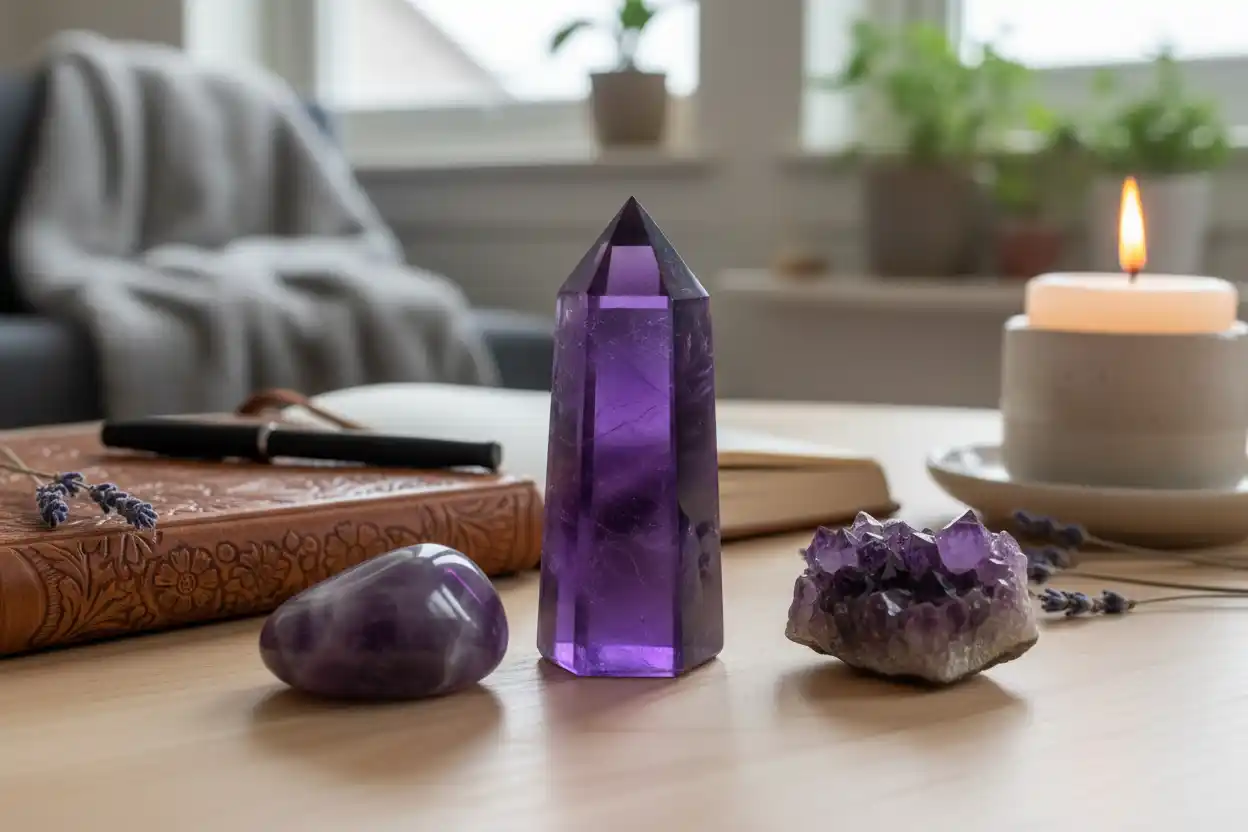

Amethyst can be used as a meditation object, personal reminder, piece of jewelry, desk or bedside stone, journaling prompt, or part of a spiritual intention practice. Because it is a durable variety of quartz, it also works well in forms ranging from small tumbled stones and bracelets to points, clusters, and large geodes.
The most useful approach is to decide what role you want the stone to play. For example, you might keep Amethyst on your desk as a reminder to pause before reacting, hold it during meditation, wear it as a personal symbol, or place a cluster in a quiet area of your home. Traditional crystal practices often connect Amethyst with calmness, reflection, intuition, spiritual awareness, and moderation, although these effects are symbolic beliefs rather than scientifically established properties.
Ways to Use Amethyst at a Glance
| Use | Practical Approach |
|---|---|
| Meditation | Hold a smooth stone or place one nearby |
| Intention-setting | Assign the stone one clear personal reminder |
| Journaling | Keep Amethyst beside your notebook while reflecting |
| Desk | Use it as a cue to pause, focus, or prioritize |
| Bedroom | Place securely on a bedside table |
| Jewelry | Wear a ring, bracelet, earrings, or necklace |
| Crown chakra practice | Place nearby during reflective meditation |
| Third-eye practice | Hold or position safely near the brow |
| Affirmations | Pair one realistic statement with a concrete action |
| Home décor | Display clusters or geodes away from strong direct sun |
| Personal ritual | Incorporate it into prayer, meditation, or quiet reflection |
| Carrying | Keep a smooth tumbled stone in a pouch or secure pocket |
| Crystal combinations | Pair carefully with physically compatible stones |
| Cleansing | Use safe methods appropriate for quartz |
| Charging | Treat as symbolic intention-setting rather than physical energy transfer |
The Amethyst meaning guide covers the stone’s wider symbolism and traditional associations. This page focuses instead on how to incorporate Amethyst into everyday routines.
What Is Amethyst Used For?
Amethyst has been valued for centuries as a purple gemstone and ornamental material.
Today, people use it in several overlapping ways.
Some appreciate Amethyst purely as a mineral or gemstone. Others wear it as jewelry, collect natural crystals, use geodes as décor, or incorporate the stone into meditation and spiritual practices.
Within modern crystal traditions, Amethyst is commonly associated with themes such as reflection, calmness, discernment, intuition, moderation, and spiritual awareness.
Those traditions help explain why Amethyst is so often placed in bedrooms, meditation areas, workspaces, and personal ritual spaces.
However, the mineral itself is still purple quartz. Its measurable properties do not demonstrate that it produces psychological, medical, or spiritual effects.
Start by Choosing an Intention
Before deciding where to place Amethyst or how to hold it, decide why you want to use it.
A vague goal such as “I want Amethyst energy” gives you little direction.
A more practical intention might be:
“I want a reminder to pause before responding.”
“I want to create a consistent meditation routine.”
“I want something on my desk that reminds me to focus.”
“I want a personal symbol of better boundaries.”
“I want a stone that marks the end of my workday and beginning of my evening routine.”
Once the purpose is clear, the way you use the crystal becomes much simpler.
How to Use Amethyst for Meditation
Amethyst is well suited to meditation because small polished stones are comfortable to hold while larger crystals can serve as visual focus objects.
Sit somewhere comfortable and place the stone in your hand or on a stable surface in front of you.
Allow your breathing to settle naturally.
Instead of trying to force a mystical experience, choose one question or intention.
For example:
What deserves my attention today?
What am I reacting to rather than thinking through?
What do I need more information about?
Which decision aligns most closely with my priorities?
Whenever your attention wanders, use the sight or feel of the Amethyst as a cue to return to the exercise.
Do You Have to Hold Amethyst While Meditating?
No.
The stone can sit beside you, in front of you, or elsewhere in the room.
Direct physical contact is not required for a symbolic practice.
This is particularly useful with large clusters, geodes, or sharp natural crystals that would be uncomfortable to hold.
A polished palm stone works well when tactile contact helps you concentrate, while a cluster makes a better stationary focus object.
How Long Should You Meditate With Amethyst?
There is no required duration.
Five minutes can be useful.
Ten or twenty minutes may suit a longer routine.
More time is not automatically better.
A short practice repeated consistently can be more useful than an elaborate hour-long ritual you rarely complete.
Similarly, there is no scientifically established number of minutes required for Amethyst to “activate” or affect a chakra.
Choose a duration that allows reflection without creating strain.
How to Use Amethyst for Intention-Setting
Modern crystal terminology often calls this programming a crystal.
The practice is straightforward.
Choose one purpose for the stone.
For example:
“When I see this Amethyst, I will pause before making an impulsive decision.”
Then place the crystal somewhere you are likely to encounter it when that intention matters.
If the goal is focus, the desk makes sense.
If it represents an evening wind-down routine, the bedside table may be better.
If it represents a personal boundary, jewelry can keep the reminder with you.
Nothing physically changes inside the Amethyst when you assign the intention. The process works as symbolic association.
The broader How to Program Crystals guide covers intention-setting across different stones.
How to Use Amethyst With Affirmations
Amethyst can also become a cue for a short affirmation.
Choose a statement you can actually believe and practice.
For example:
“I can pause before reacting.”
“I give myself time to see clearly.”
“I protect my attention.”
“I can change my mind when I learn something new.”
“I do not need to solve everything immediately.”
Hold or look at the stone while saying the affirmation, then identify one action that expresses it.
If your statement is “I protect my attention,” the practical step might be turning off nonessential notifications for an hour.
That connection between words and behavior makes the ritual more useful.
How to Use Amethyst for Journaling
Place an Amethyst beside your notebook and use it as a signal that the journaling session has started.
Rather than writing aimlessly, choose one prompt.
You might ask:
What am I assuming?
What happened, and what interpretation have I added to it?
What is within my control?
What am I avoiding deciding?
Which part of this situation matters most?
What would I advise someone else in the same position?
The stone provides continuity from one session to another, while the journal records actual thoughts, decisions, and changes.
How to Use Amethyst for Clarity
Crystal traditions often describe Amethyst as a clarity stone.
A grounded way to use that symbolism is to connect the crystal with a deliberate decision-making process.
Place the Amethyst in front of you.
Write down the decision.
Then divide what you know into three categories:
facts,
assumptions,
and missing information.
Next, identify which unknowns actually need answers before you decide.
This approach makes “clarity” something you actively build rather than something you wait for the gemstone to provide.
How to Use Amethyst for Focus
Keep a small stone on your desk.
Assign it a narrow meaning such as:
return to the current task.
Whenever you notice the Amethyst while distracted, ask what you were supposed to be doing.
Then return to that task.
You can make the cue more specific by pairing it with a work routine.
For example, place the stone beside your keyboard only during focused work periods. Move it away during breaks.
Over time, the object can become associated with that particular work mode.
How to Use Amethyst at Work
Amethyst works particularly well as an unobtrusive desk object.
A small cluster, point, or polished stone can mark a workspace without taking up much room.
Instead of expecting it to increase productivity automatically, give it a behavioral meaning.
For example:
pause before sending emotionally charged messages,
finish one priority before starting another,
ask for clarification instead of guessing,
or take a short break before decision fatigue becomes severe.
This gives the stone a clear role in the work environment.
Where to Put Amethyst on a Desk
Place it where you will notice it without interfering with equipment.
Near a monitor, notebook, or pen holder usually works well.
Keep polished pieces away from the edge of the desk.
Large geodes need a stable surface capable of supporting their weight.
Additionally, avoid leaving valuable Amethyst in intense direct sunlight from a nearby window for prolonged periods because strong light and heat can contribute to color fading over time.
How to Use Amethyst for Studying
Amethyst can function as a study cue in much the same way.
Place it beside your study materials only when you are actively working.
Then pair it with one simple rule:
“I return to the question when I become distracted.”
Another useful association is:
“I practice what I do not yet understand.”
The stone cannot improve memory or intelligence directly, but consistent environmental cues can help create a recognizable study routine.
How to Use Amethyst in the Bedroom
Amethyst is commonly placed in bedrooms because modern crystal traditions associate it with calmness and rest.
The safest arrangement is simple: put a secure polished stone, cluster, or small geode on a bedside table.
It can become part of a wind-down routine.
For example, when you notice the stone at night, use it as a cue to stop checking work messages, dim unnecessary screens, write down tomorrow’s tasks, or spend several minutes reading quietly.
This makes the crystal part of a consistent bedtime environment without claiming that it treats sleep disorders.
Where Should Amethyst Go in a Bedroom?
A bedside table is usually the most practical location.
A shelf also works if the specimen is stable.
Avoid balancing heavy geodes above the bed.
Likewise, do not position sharp crystal points where they can fall.
If the room receives intense afternoon sun, choose a location away from prolonged direct exposure.
Physical security and light protection matter more than achieving a specific metaphysical direction.
Can You Put Amethyst Under Your Pillow?
A small smooth stone can physically fit beneath a pillow, but there is little practical reason to do so.
It can create pressure, become lost, or damage bedding.
Sharp points, clusters, jewelry, and rough specimens should not be kept under a pillow.
A bedside table provides the same symbolic presence without the inconvenience.
Can You Sleep With Amethyst?
You can keep Amethyst near your bed as part of a personal nighttime ritual.
However, Amethyst has not been scientifically demonstrated to cure insomnia, prevent nightmares, or medically improve sleep quality.
If the stone helps remind you to follow a calming bedtime routine, that is a more realistic role.
Persistent sleep problems deserve appropriate evidence-based evaluation rather than relying on crystals alone.
How to Use Amethyst for Calm
Use the stone as a cue to slow down before acting.
When you feel overstimulated, hold a polished Amethyst or simply look at one.
Then ask:
What needs action now?
What can wait?
What information am I missing?
What will make this situation worse if I do it impulsively?
A few slow breaths can accompany the exercise.
The goal is not to claim that the mineral removes stress but to use the object to interrupt an automatic response.
How to Use Amethyst During a Stressful Moment
Keep the routine very simple.
Notice the Amethyst.
Stop what you are doing for a moment.
Relax your grip on anything you are holding.
Take several comfortable breaths.
Then identify the next useful action.
You might need to send one message, step away briefly, write something down, or postpone a decision.
An elaborate ritual is unnecessary when the real need is simply creating a pause.
How to Use Amethyst for Emotional Reflection
Amethyst can serve as a neutral object during journaling or conversation preparation.
For example, if you are upset with someone, hold the stone while separating:
what happened,
what you felt,
what you assumed,
what you need,
and what you want to communicate.
This preserves Amethyst’s traditional association with calm reflection without suggesting that the gemstone removes difficult emotions.
How to Use Amethyst for Intuition
Modern spiritual practices often associate Amethyst with intuition.
A useful way to approach this is to treat intuition as information worth examining rather than unquestionable truth.
Hold the stone during reflection and ask:
What is my first impression?
Why might I feel that way?
What facts support it?
What evidence challenges it?
What would change my mind?
Used this way, the crystal symbolizes attentiveness without encouraging certainty based solely on feeling.
How to Use Amethyst for the Crown Chakra
Amethyst is widely associated with the crown chakra in modern crystal traditions.
During crown-focused meditation, place the stone nearby or hold it comfortably.
Then choose a broad reflective question concerning values, purpose, perspective, or spiritual meaning.
For example:
What matters most in this situation?
Which choice aligns with my values?
What perspective am I missing?
The existing Crown Chakra guide covers the chakra itself, so the practical use here should remain Amethyst-specific.
How to Use Amethyst for the Third Eye
Amethyst is also commonly associated with third-eye practices.
A small polished stone can be held or placed nearby during meditation.
Some people briefly place a smooth stone on the forehead while lying down, although this is optional.
Rather than trying to force visions, use the practice for observation.
Notice thoughts and patterns without automatically deciding that every impression has hidden significance.
That approach keeps intuition connected with discernment.
How to Use an Amethyst Point
Amethyst points work well as stationary meditation objects.
Place one on a secure surface where the termination is visible.
Some spiritual practices orient the point toward or away from the body according to symbolic intent.
Mineralogically, the point does not create a scientifically established energy beam.
However, its directional shape can be useful in visualization.
A point facing upward, for example, might symbolize perspective or expansion during a reflective practice.
How to Use an Amethyst Cluster
Clusters work especially well for desks, meditation areas, bookshelves, and display spaces.
Because they contain multiple projecting crystal points, they are less convenient to carry or place on the body.
Instead, treat the cluster as an environmental object.
Place it somewhere that represents the type of activity you associate with it.
A desk cluster might represent thoughtful work.
A meditation-space cluster might mark quiet reflection.
A living-room specimen may simply be appreciated for its natural beauty.
How to Use an Amethyst Geode
Large geodes are best used as decorative mineral specimens.
Choose a stable surface with enough support for the specimen’s weight.
Avoid shelves that could tip or flex.
Keep the geode away from edges and prolonged strong sunlight.
From a spiritual perspective, some people use a geode to define a meditation area or quiet corner.
However, there is no need to sit inside a large geode or perform complicated charging rituals around it.
Its presence as a visually striking natural object is enough to make it meaningful.
How to Use a Tumbled Amethyst
Tumbled stones are among the most versatile forms.
Their smooth surfaces make them easy to hold, carry, place beside a notebook, or use during meditation.
Keep one in a small pouch if carrying it in a bag with keys or metal objects.
Although Amethyst has Mohs hardness 7, repeated contact with harder materials can still create wear.
A tumbled stone also works well for beginners because there are no sharp points to manage.
How to Carry Amethyst
Use a small smooth stone rather than an intricate cluster.
A fabric pouch protects the crystal from coins, keys, tools, and other objects.
Avoid putting valuable specimens loose in a pocket where they can fall out.
If carrying a stone as an intention reminder, assign it one simple purpose rather than trying to attach dozens of meanings.
For instance, touching the stone might remind you:
“I can pause before answering.”
How to Wear Amethyst
Jewelry keeps Amethyst visible and accessible throughout the day.
The best form depends more on lifestyle than metaphysical rules.
An Amethyst bracelet is easy to notice and touch, which makes it useful as an intention cue.
An Amethyst necklace places the stone near the upper torso and works well for symbolic or decorative wear.
An Amethyst ring keeps the gemstone constantly visible but exposes it to more abrasion and impact.
Earrings provide color and sparkle with comparatively low physical wear.
Which Wrist Should You Wear Amethyst On?
Crystal traditions sometimes assign different symbolic meanings to the left and right sides of the body.
These correspondences vary considerably and have no established mineralogical basis.
Therefore, choose the wrist based on comfort, dominant-hand activity, bracelet fit, and personal preference.
If you want to assign your own symbolic meaning, consistency matters more than following an arbitrary universal rule.
How to Use an Amethyst Necklace
A necklace works particularly well as a personal reminder because it can be worn throughout the day without requiring active handling.
You might associate it with:
speaking thoughtfully,
maintaining perspective,
or returning to a chosen intention.
From a practical standpoint, protect the pendant from hard impacts and store it separately from harder gemstones that could scratch its polished surface.
How to Use Amethyst in Your Home
Rather than asking for one universally correct placement, consider what each room is used for.
An Amethyst on a desk can represent concentration.
A bedside stone can mark a rest routine.
A cluster in a meditation area can signal reflection.
A specimen in the living room can simply function as natural décor.
Choose stable surfaces and avoid placing valuable crystals where children, pets, doors, or vibrations could knock them down.
Can You Put Amethyst Near the Front Door?
Yes, if you like the appearance or symbolic meaning.
Some modern crystal practices place Amethyst near entrances as part of protection or calming rituals.
There is no scientific evidence that the crystal creates a protective field around a doorway.
However, a visible stone near the entrance could serve as a reminder to pause when arriving home or leaving for the day.
Can You Put Amethyst in the Bathroom?
You can, but bathrooms are not always ideal display environments.
Humidity, cleaning sprays, cosmetics, accidental splashes, and hard tile surfaces create unnecessary risk.
A secure shelf away from sinks and cleaners is safer than placing a polished stone directly beside water.
Large or valuable specimens are usually better displayed elsewhere.
How to Use Amethyst During Yoga
Place the stone beside the mat where it cannot be stepped on.
Choose a simple intention before beginning your practice.
For example:
move attentively,
avoid comparison,
or stay aware of breathing.
There is no need to hold a stone while performing poses, especially when doing so would affect balance or safe hand placement.
The crystal should support the ritual environment rather than interfere with physical movement.
How to Use Amethyst During Prayer
People from different spiritual backgrounds may incorporate meaningful objects into prayer or contemplation in different ways.
If Amethyst fits respectfully within your own practice, keep the stone nearby or hold it quietly.
It does not need to replace traditional religious objects, texts, or rituals.
Instead, it can simply symbolize reflection, restraint, gratitude, or another personally meaningful theme.
How to Use Amethyst for Manifestation
If you use manifestation terminology, connect the practice with realistic action.
For example, rather than saying:
“Amethyst will bring me the perfect job,”
you might use the stone while identifying a specific goal:
“I want work that gives me more responsibility and better compensation.”
Then identify practical steps:
update your résumé,
research suitable employers,
contact relevant people,
or apply consistently.
The crystal can represent the intention, but external outcomes depend on actions, circumstances, and other people—not on the gemstone alone.
How to Use Amethyst With Other Crystals
Choose combinations according to both symbolism and physical compatibility.
Amethyst and clear quartz are frequently paired because both belong to the quartz family.
Rose Quartz is often combined with Amethyst in practices involving reflection and self-compassion.
Citrine may be used symbolically when someone wants to pair contemplation with action.
However, do not assume every crystal combination is physically safe merely because their metaphysical meanings appear compatible.
Hardness, cleavage, water sensitivity, coatings, and surface treatments still matter.
Amethyst and Clear Quartz
Because both are quartz varieties, they share broadly similar hardness.
A simple symbolic combination might assign:
Amethyst to reflection,
and clear quartz to clarity.
Place them beside one another rather than rubbing polished surfaces together.
The stones have not been scientifically demonstrated to amplify each other’s energy, but the contrasting colors can make the symbolic roles easy to remember.
Amethyst and Rose Quartz
Rose Quartz is commonly associated with love and compassion in modern crystal practice.
When paired with Amethyst, a person might use the combination to represent calm self-reflection.
For example:
“I can be kind to myself while still being accountable.”
Both are quartz varieties, so their physical durability is broadly compatible.
However, protect polished surfaces from unnecessary contact and prolonged strong sunlight.
Amethyst and Citrine
Amethyst and Citrine are both colored quartz varieties.
A symbolic pairing can represent reflection followed by action.
An intention might be:
“I think carefully, then move forward.”
Interestingly, natural material displaying both purple Amethyst and yellow-orange Citrine zones is known as Ametrine.
The combination does not need a metaphysical explanation to be mineralogically interesting.
How to Clean Amethyst After Use
Routine spiritual use does not physically dirty the stone unless it has been handled frequently.
Fingerprints and skin oils can usually be removed with lukewarm water, mild soap, and a soft brush or cloth.
Rinse thoroughly and dry afterward.
Avoid harsh chemicals.
Additionally, be more conservative with fractured stones, unusual treatments, glued jewelry, or delicate settings.
How to Cleanse Amethyst Spiritually
If cleansing is part of your practice, choose a method that respects the mineral.
Moonlight, sound, intention, or brief gentle physical cleaning are straightforward options.
There is no requirement to use salt, prolonged water immersion, extreme sunlight, fire, or elaborate rituals.
Detailed methods belong in the dedicated How to Cleanse and Charge Amethyst guide rather than being repeated here.
Does Amethyst Need to Be Cleansed Every Time You Use It?
No.
There is no mineralogical requirement.
Within spiritual traditions, cleansing frequency is a personal choice.
Some people cleanse when first acquiring a stone or when changing its symbolic purpose.
Others do so occasionally.
Constant cleansing after every meditation, journaling session, or day of wear is unnecessary unless that routine has personal meaning.
Can Amethyst Go in Water?
Sound natural Amethyst generally tolerates brief contact with clean water because it is quartz.
However, long soaking is unnecessary.
Jewelry may contain metals, adhesives, coatings, thread, elastic, or other materials that are less water tolerant than the gemstone.
Likewise, rough specimens may contain matrix minerals with different care requirements.
Brief cleaning is preferable to prolonged immersion.
Can Amethyst Go in Sunlight?
Amethyst can be worn in normal daylight, but prolonged intense sunlight is not ideal for display or charging.
Strong light and heat can contribute to color changes or fading in some Amethyst over time.
Therefore, avoid leaving an important specimen in a sunny window indefinitely.
If sunlight is part of a symbolic practice, brief mild exposure is more conservative than hours of intense direct sun.
How Often Should You Use Amethyst?
As often as the practice remains useful.
There is no required schedule.
You might meditate with it daily, wear it occasionally, keep it permanently on your desk, or use it only during particular periods of reflection.
The stone does not become less effective because you skipped a day.
Likewise, there is no scientific evidence that more frequent contact creates stronger metaphysical results.
Does the Size of Amethyst Matter?
Not for symbolic use.
A large geode may create a dramatic visual presence, while a tiny tumbled stone is easier to carry.
Neither size has been scientifically shown to produce more or less metaphysical effect.
Choose size according to function.
For meditation in your hand, smaller is practical.
For a shelf, cluster or geode forms make more sense.
For jewelry, comfort and setting quality matter most.
Does Darker Amethyst Work Better?
No scientific evidence supports that idea.
Dark, richly saturated Amethyst may be more desirable in certain jewelry markets, while pale lavender material has its own appeal.
Color quality and metaphysical effectiveness are different concepts.
Choose the shade you find visually meaningful rather than assuming darker purple automatically produces stronger spiritual effects.
Does Raw Amethyst Work Better Than Polished Amethyst?
Neither is inherently better for personal or spiritual use.
Raw material preserves the natural crystal surfaces and often appeals to mineral collectors.
Polished stones are smoother, easier to carry, and more comfortable to hold.
Gemological cutting and polishing do not remove Amethyst’s identity as quartz.
The choice is therefore practical and aesthetic.
A Simple Daily Amethyst Routine
You do not need an elaborate ritual.
In the morning, choose one intention and place or wear the Amethyst where you will notice it.
During the day, use the stone as a reminder whenever the relevant situation appears.
In the evening, ask whether you acted according to the intention.
For example:
Morning: “I will pause before making rushed decisions.”
Day: Notice the stone when pressure appears.
Evening: Review one situation in which you paused and one in which you did not.
That is enough to turn the crystal into a consistent reflective tool.
A Five-Minute Amethyst Meditation
Sit comfortably and place the Amethyst in your hand or in front of you.
For the first minute, simply settle your attention.
For the next two minutes, focus on one question.
Then spend another minute noticing any assumptions or emotions connected with it.
During the final minute, identify one practical action.
The result might be sending a message, gathering information, postponing a decision, writing something down, or simply deciding that no immediate action is necessary.
This keeps meditation connected to everyday life.
How Beginners Should Use Amethyst
Beginners do not need to memorize every traditional Amethyst meaning.
Start with one physical stone and one purpose.
For example:
Stone: small tumbled Amethyst.
Purpose: reminder to pause.
Keep it somewhere visible.
Use it consistently for several days.
If that approach feels useful, add meditation, journaling, jewelry, chakra practice, or other rituals gradually.
There is no advantage in turning a simple crystal practice into a complicated set of rules.
What Not to Do With Amethyst
Do not expect Amethyst to diagnose illness, replace medical treatment, guarantee sleep, control another person’s behavior, or ensure a desired outcome.
Avoid destructive mineral tests and unnecessary exposure to strong heat.
Do not place heavy geodes where they can fall.
Avoid prolonged direct sunlight when preserving color matters.
Additionally, do not ingest Amethyst powder or deliberately add unverified mineral specimens directly to drinking water.
A responsible crystal practice should protect both the person and the mineral.
Frequently Asked Questions
What is the best way to use Amethyst?
There is no single best method. Meditation, carrying a tumbled stone, wearing jewelry, desk placement, journaling, and intention-setting are all practical options.
How should beginners use Amethyst?
Start with one stone and one simple intention. Keep it somewhere visible and use it as a reminder before adding more elaborate practices.
Where should I place Amethyst?
Choose the location according to purpose. A desk suits focus, a bedside table suits an evening routine, and a meditation area suits reflection.
Can I carry Amethyst every day?
Yes. Use a smooth stone and protect it from keys, metal tools, and harder gemstones.
Can I wear Amethyst every day?
Yes, although rings experience more abrasion than earrings or necklaces. Amethyst has Mohs hardness 7 and still deserves reasonable care.
Can I meditate with Amethyst?
Yes. Hold a polished stone or position a crystal nearby and use it as a focus object during meditation.
How long should I meditate with Amethyst?
There is no required time. Five to twenty minutes is practical for many routines.
Can Amethyst help with focus?
There is no scientific evidence that the stone directly improves concentration. However, it can serve as a physical cue for a consistent focus routine.
Can I use Amethyst for sleep?
You can include it in a bedtime ritual, but it should not be presented as a scientifically proven treatment for insomnia or other sleep disorders.
Can Amethyst be placed under a pillow?
A small smooth stone can be, but a bedside table is generally more comfortable and safer. Avoid sharp points, clusters, and jewelry beneath a pillow.
Can I use Amethyst for affirmations?
Yes. Pair the stone with a realistic statement and, ideally, a corresponding action.
Can I use Amethyst for manifestation?
You can use it symbolically for goal-setting, but the crystal does not guarantee external outcomes. Practical action remains necessary.
What chakra is Amethyst used for?
Modern crystal traditions most commonly associate Amethyst with the crown chakra and secondarily with the third eye.
Can I use Amethyst with other crystals?
Yes. Clear Quartz, Rose Quartz, and Citrine are common symbolic pairings. Consider physical durability as well as metaphysical associations.
Does Amethyst need cleansing before use?
No mineralogical requirement exists. Spiritual cleansing is optional according to personal practice.
Can Amethyst go in water?
Sound natural Amethyst generally tolerates brief clean-water contact. Long soaking is unnecessary, especially for jewelry or unknown specimens.
Can Amethyst go in sunlight?
Ordinary daylight is fine, but prolonged strong sunlight and heat can contribute to fading, so extended direct exposure is best avoided.
Is raw or polished Amethyst better?
Neither is inherently better. Raw crystals suit natural display and collecting, while polished stones are easier to hold and carry.
Does bigger Amethyst work better?
No scientific evidence shows that larger crystals have stronger metaphysical effects. Choose size according to how you intend to use the stone.
Final Takeaway
The simplest way to use Amethyst is to give it one clear role.
You might keep a stone on your desk as a reminder to focus, hold one during meditation, carry a polished piece as a cue to pause, wear Amethyst jewelry as a personal symbol, or place a cluster in a quiet area of your home.
Within modern crystal traditions, Amethyst is associated with calmness, clarity, reflection, intuition, moderation, and upper-chakra symbolism. However, these are spiritual and cultural interpretations rather than scientifically demonstrated effects of quartz.
For practical use, the strongest approach is to connect the stone with an action:
Amethyst for calm: pause before reacting.
Amethyst for clarity: separate facts from assumptions.
Amethyst for focus: return to the current task.
Amethyst for intuition: notice instincts while checking evidence.
Amethyst for intention: choose a goal and take the next concrete step.
Amethyst does not need complicated rituals to be meaningful. A consistent, thoughtful use that respects both the mineral and your own beliefs is enough.
Disclaimer: Amethyst’s healing, chakra, manifestation, and energetic associations are spiritual or personal beliefs rather than scientifically established medical effects. Crystal practices should complement, not replace, appropriate professional healthcare or mental-health support.