How to Spot Treated or Synthetic Diamond
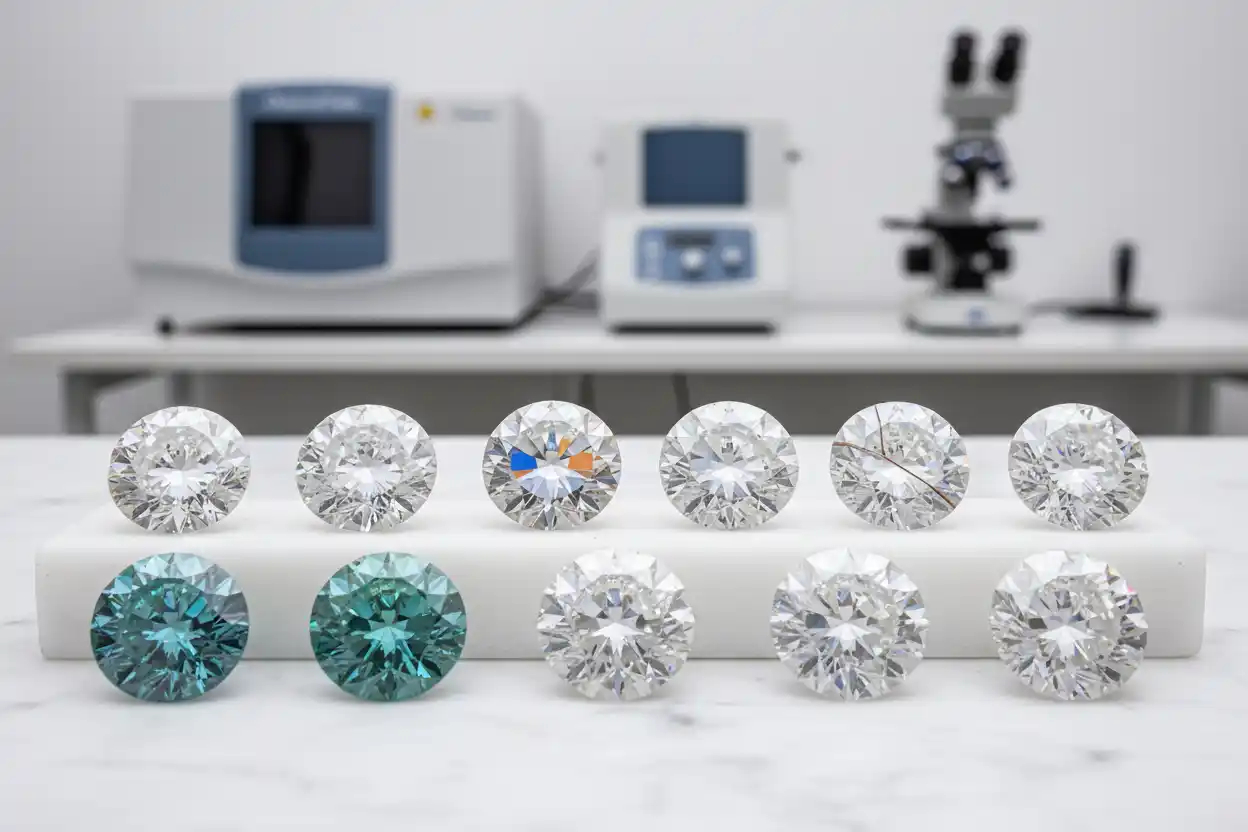
A Diamond can be naturally mined, laboratory grown, color treated, clarity enhanced, coated, assembled, or imitated by a completely different material. These categories often look similar in ordinary jewelry photographs, yet they differ greatly in origin, permanence, care, disclosure, and market value.
Laboratory-grown Diamond is crystalline carbon with essentially the same core structure and physical properties as natural Diamond. It is not the same as Moissanite, cubic zirconia, glass, or another simulant. Likewise, a treated natural Diamond remains naturally formed Diamond, although a process such as high-pressure, high-temperature treatment, irradiation, laser drilling, fracture filling, or coating has altered its appearance.
The correct examination begins with three separate questions. First, is the stone Diamond? Second, did it form naturally or through HPHT or CVD laboratory growth? Third, has either a natural or laboratory-grown Diamond received post-growth color or clarity treatment?
Diamond origin and treatment categories at a glance
| Category | What it is | Typical identification issue | Correct description |
|---|---|---|---|
| Natural untreated Diamond | Naturally formed crystalline carbon | Natural origin, grading, possible undisclosed treatment | Natural Diamond |
| HPHT-treated natural Diamond | Natural Diamond exposed to high pressure and temperature to change color | Treatment can be difficult to see microscopically | HPHT-processed natural Diamond |
| Irradiated Diamond | Natural or laboratory-grown Diamond exposed to radiation | Artificial green, blue, yellow, black, or related color | Irradiated Diamond |
| Irradiated and annealed Diamond | Radiation followed by controlled heating | Pink, red, purple, orange, yellow, or other colors | Color-treated Diamond |
| Laser-drilled Diamond | Natural or laboratory-grown Diamond with microscopic channels made to reach inclusions | Drill channels or internal laser features | Laser-drilled Diamond |
| Fracture-filled Diamond | Surface-reaching breaks filled with glass-like material | Flash effects, filler damage, unstable clarity appearance | Filled Diamond |
| Coated Diamond | Diamond or simulant covered with a thin colored or transparent film | Surface-only color or altered tester response | Coated stone |
| HPHT-grown Diamond | Diamond crystallized under high pressure and temperature | Growth-sector patterns, metallic inclusions, spectroscopy | Laboratory-grown Diamond |
| CVD-grown Diamond | Diamond deposited from carbon-containing gas onto a seed | Layered growth, strain, fluorescence imaging, spectroscopy | Laboratory-grown Diamond |
| Post-growth-treated laboratory Diamond | HPHT- or CVD-grown Diamond whose color was modified after growth | Growth origin and treatment must both be reported | Treated laboratory-grown Diamond |
| Diamond simulant | Moissanite, cubic zirconia, glass, Sapphire, or another lookalike | Different composition and properties | Diamond imitation or simulant |
What natural Diamond is
Diamond is crystalline carbon whose atoms are bonded in a three-dimensional structure. It forms naturally at great depth under high pressure and temperature before reaching the surface in volcanic rocks.
The broader material profile appears in Diamond: Meaning, Properties & Symbolism, while the major natural, colored, industrial, and laboratory-related categories appear in Types of Diamond.
Natural origin does not guarantee that the appearance remains untreated. A mined Diamond can receive color enhancement, clarity enhancement, coating, filling, or laser work after cutting.
Conversely, a laboratory-grown Diamond can be sold without post-growth treatment or can receive HPHT processing, irradiation, annealing, or another color-modifying process after crystallization.
A report must therefore address growth origin and treatment separately.
Laboratory-grown Diamond is not a simulant
HPHT- and CVD-grown Diamonds are genuine crystalline Diamonds produced through human-controlled growth rather than geological formation.
They share natural Diamond’s carbon composition, hardness, high thermal conductivity, refractive index, and crystal structure. A common thermal tester can therefore identify them as Diamond but cannot prove mined origin.
Moissanite and cubic zirconia only simulate Diamond’s appearance. Their compositions, optical properties, density, conductivity, and growth structures differ.
The broad origin-and-value distinction appears in Lab-Grown vs Natural Gemstones. The separate laboratory-grown material profile belongs to Lab Diamond: Meaning, Properties & Symbolism.
Purchase considerations, grading, warranties, and report verification belong to the Lab Diamond Buying Guide, while the distinct market structure appears in the Lab Diamond Price Guide.
HPHT-grown Diamonds
The HPHT growth process recreates the high-pressure and high-temperature conditions under which natural Diamonds form.
A small Diamond seed is placed with a carbon source and metallic catalyst. Under extreme pressure and heat, carbon dissolves in the catalyst and crystallizes onto the seed.
HPHT-grown Diamonds can be colorless, near colorless, yellow, blue, or other colors depending on impurities and later treatment.
Possible microscopic or instrumental clues include metallic flux inclusions, growth sectors with different colors, unusual fluorescence patterns, phosphorescence, and limited strain compared with many natural Diamonds.
Not every HPHT-grown stone displays visible metal. Modern production can create highly clean material, making spectroscopy and fluorescence imaging more important than loupe examination.
The laboratory inscription and report should identify the stone as laboratory grown. Nevertheless, inscriptions can be polished away or copied onto another stone, so the report details must match the exact weight, measurements, and identification.
CVD-grown Diamonds
Chemical vapor deposition grows Diamond at lower pressure inside a vacuum chamber.
A thin Diamond seed is exposed to a carbon-containing gas, commonly involving methane and hydrogen. Energy breaks the gas into reactive components, allowing carbon to deposit layer by layer on the seed.
CVD-grown material commonly develops flat, plate-like growth before being cut. As-grown Diamonds may contain brown or gray components, internal strain, growth bands, dark pinpoint inclusions, or unusual fluorescence.
Post-growth HPHT treatment is frequently used to improve the color of some CVD-grown Diamonds. Irradiation and annealing may create additional fancy colors.
Possible identification evidence includes layered growth, banded strain patterns, fluorescence imaging, photoluminescence features, trace defects, and spectroscopic signatures.
A clean colorless CVD Diamond may look identical to a natural Diamond without specialized equipment.
Post-growth treatment of laboratory Diamonds
The phrase laboratory-grown Diamond describes where the crystal formed. It does not mean the finished stone is untreated.
HPHT processing can reduce undesirable brown or gray components in CVD-grown material. Irradiation and annealing can create blue, green, pink, red, orange, yellow, or purple colors in suitable laboratory Diamonds.
The final disclosure should therefore include laboratory-grown origin and detectable post-growth treatment.
A seller who describes a treated CVD Diamond only as a Diamond hides two commercially important facts: it was grown outside the earth and modified after growth.
Current laboratory reports designed for laboratory-grown Diamonds may state the production method and whether post-growth treatment was detected.
HPHT treatment of natural Diamond
HPHT treatment uses extreme pressure and temperature to rearrange defects within a natural Diamond.
The process can remove or reduce brown color in some type IIa Diamonds, producing a more colorless appearance. In other Diamonds, it can create or strengthen yellow, greenish-yellow, green, blue, pink, or orange-related colors.
HPHT treatment is considered stable under normal wear. However, it changes the commercial category because the improved appearance did not exist in the stone’s mined condition.
The treatment may leave little or no obvious microscopic evidence. Laboratories rely on infrared spectroscopy, photoluminescence, fluorescence imaging, color distribution, defect analysis, and other advanced methods.
HPHT-treated natural Diamond should not be confused with an HPHT-grown Diamond. One formed naturally and was later processed; the other crystallized in an HPHT press.
Irradiation
Diamond irradiation exposes a stone to high-energy particles or radiation to create color centers.
The process can produce green, blue-green, blue, yellow, orange, brown, or black appearances depending on the Diamond type, treatment depth, and later heating.
Older cyclotron-treated Diamonds sometimes show concentrated color near the surface in distinctive patterns. Modern electron or neutron treatment may create more even or deeply penetrating color.
Visual color zoning can provide clues, but treatment may be difficult to recognize once the stone has been cut or annealed.
Commercially released irradiated Diamonds must comply with applicable safety controls. Their treatment remains important because natural fancy-color Diamonds can command far greater prices.
Irradiation followed by annealing
Heating an irradiated Diamond can reorganize the treatment-created defects and produce new colors.
Pink, red, purple, orange, yellow, green, and brownish colors may be created through different combinations of Diamond type, irradiation, temperature, and treatment duration.
A vivid fancy color is therefore not proof of natural color origin. Even complex zoning or attractive saturation can be treatment produced.
Laboratories use ultraviolet-visible absorption, infrared spectroscopy, photoluminescence, fluorescence imaging, and Diamond defect analysis to determine whether a color is natural or treated.
When the price depends heavily on natural fancy color, an independent colored-Diamond report is essential.
Surface coating
A thin colored film can make a Diamond appear whiter, mask a yellow tint, or produce pink, blue, green, purple, black, or iridescent color.
Coating may cover the pavilion, selected facets, the girdle, or the entire stone. In a setting, prongs and enclosed areas can conceal the treated surface.
Possible clues include scratches through the film, uneven color at facet junctions, concentrated color beneath prongs, peeling, iridescent interference, and a colorless area where the coating has worn away.
Modern films can be extremely thin and difficult to see. Some coatings are placed on Diamond simulants to alter surface properties or confuse simple testers.
Coating is not considered as permanent or stable as HPHT processing or properly completed irradiation. Abrasion, polishing, chemicals, and jewelry repair can damage it.
Laser drilling
Laser drilling improves apparent clarity by creating a narrow channel from the surface to a dark inclusion. Acid or another substance may then remove or lighten the inclusion.
Traditional laser drill channels appear as fine straight or slightly tapered tubes reaching an internal feature. They can be easier to see under magnification when illuminated from the side.
More complex internal laser drilling can create feather-like or irregular channels rather than one obvious straight tube.
Laser drilling permanently changes the Diamond. The channel remains even when the inclusion has been reduced.
It is generally considered stable enough for disclosure on a grading report. The treatment does not raise the Diamond’s true original clarity grade; it changes how visible the inclusion appears.
Fracture filling
Fracture filling introduces a glass-like substance into surface-reaching feathers, cracks, or laser drill channels.
The filler’s refractive index approaches that of Diamond, reducing the optical contrast and making the break less visible.
Under magnification, filled fractures may display vivid blue, purple, orange, yellow, or green flash effects. Trapped bubbles, flow structures, incomplete filling, and damaged filler can also appear.
The treatment does not heal the Diamond. The fracture remains and can still affect durability.
Heat, steam, acids, ultrasonic cleaning, repolishing, and jewelry repair may damage, remove, darken, or discolor the filling. Because of this instability, some major laboratories do not issue standard grading reports for fracture-filled Diamonds.
Fracture filling versus laser drilling
Laser drilling creates a permanent channel and is generally stable during normal ownership. Fracture filling adds a foreign substance that may deteriorate or be removed.
A Diamond can receive both treatments. A laser channel may provide access to a fracture that is later filled.
The correct report wording should identify every detected process rather than using one vague clarity-enhanced label.
A buyer should also distinguish appearance improvement from structural improvement. Neither treatment converts the Diamond into a less fractured crystal.
Black Diamond treatments
Natural black Diamonds may owe their appearance to abundant dark inclusions, fractures, graphitic material, or other natural features.
Many commercial black Diamonds are irradiated or heated to create a more uniform opaque black appearance. Fractures may also be filled.
An even black color is not proof of treatment, but low prices and large matched inventories make enhancement likely.
Because opaque stones prevent ordinary internal inspection, spectroscopy and treatment disclosure become especially important.
Diamond simulants
Moissanite, cubic zirconia, white Sapphire, Zircon, glass, and other materials can resemble Diamond but do not share its exact composition and structure.
Their broad identification belongs to Real vs Fake Diamond, while the major options are compared in Best Diamond Alternatives.
Moissanite can confuse older thermal testers because it conducts heat well. It commonly shows greater dispersion and visible facet doubling in suitable orientations. The complete comparison appears in Moissanite vs Diamond vs Lab Diamond and Lab Diamond vs Moissanite.
Cubic zirconia is denser, softer, and more easily abraded. Its material profile appears in Cubic Zirconia: Meaning, Properties & Symbolism.
A Diamond tester cannot answer natural-versus-laboratory growth or identify every treatment.
Microscopic natural-growth clues
Natural Diamonds can show mineral inclusions, feathers, clouds, graining, twinning wisps, pinpoints, and strain patterns.
HPHT-grown material may contain metal flux, growth sectors, or different fluorescence structures. CVD-grown material may show layered growth, dark pinpoints, or banded strain.
These are tendencies rather than universal rules. Natural Diamonds may be extremely clean, while laboratory-grown material can contain convincing inclusions.
Modern identification combines microscopy with ultraviolet fluorescence imaging and spectroscopy rather than expecting one visible feature to settle every case.
Fluorescence and phosphorescence
Natural, HPHT-grown, and CVD-grown Diamonds can fluoresce under ultraviolet light.
The color, intensity, distribution, and persistence of the reaction can provide valuable growth and treatment evidence. HPHT-grown blue Diamonds may show phosphorescence, while CVD-grown material may show layered or banded fluorescence patterns.
A handheld ultraviolet lamp offers only a preliminary observation. Natural Diamonds can fluoresce blue, yellow, orange, green, or other colors, and some remain inert.
Advanced fluorescence imaging examines the whole growth pattern rather than one overall glow.
Spectroscopy and advanced testing
Infrared spectroscopy classifies Diamond type and examines nitrogen, boron, hydrogen, and treatment-related defects.
Photoluminescence spectroscopy detects extremely small defect centers associated with natural growth, HPHT processing, CVD growth, irradiation, and annealing.
Ultraviolet-visible spectroscopy helps determine color origin. Fluorescence imaging reveals growth sectors and layered structures that may remain invisible under a loupe.
Because treatments and production methods continue to evolve, reputable laboratories maintain reference databases and multiple detection methods rather than relying on one instrument.
Laboratory reports and inscriptions
A meaningful Diamond purchase should include a report appropriate to the product.
A natural Diamond report should identify detected treatment and distinguish natural color from treated color where applicable. A laboratory-grown Diamond report should state laboratory origin and may include the HPHT or CVD growth method and detected post-growth treatment.
The Gemstone Certification Labs Compared guide explains why report scope matters. How to Read a Gem Lab Report shows how to match measurements, clarity characteristics, color, inscription, and report number to the exact stone.
Girdle inscriptions are useful but not independently conclusive. A report number can be copied, a girdle can be polished, and one Diamond can be substituted for another.
Always verify the report through the issuing laboratory and confirm that the measurements and plotted characteristics match the physical stone.
Buying treated or laboratory-grown Diamond
Treatment is not automatically unacceptable. The decision depends on price, permanence, care, documentation, and the buyer’s expectations.
A laser-drilled natural Diamond may provide a more attractive appearance at a lower price than an untreated equivalent. A fracture-filled Diamond may look clean initially but require substantially more care and have weaker resale expectations.
A laboratory-grown Diamond can offer larger size and high clarity for the budget but should be evaluated within its own market rather than priced like a mined stone.
The Diamond Buying Guide owns natural-Diamond quality and purchase decisions. Natural pricing appears in the Diamond Price Guide.
Care
Untreated, irradiated, HPHT-treated, laser-drilled, and most laboratory-grown Diamonds can generally tolerate normal professional cleaning when the setting and inclusions are sound.
Fracture-filled and coated Diamonds require far more caution. Steam, ultrasonic vibration, acids, strong chemicals, repolishing, and repair heat can damage their treatments.
The complete routine-care process appears in How to Clean Diamond Jewelry Safely. Laboratory-grown material receives the corresponding guidance in How to Clean Lab Diamond Jewelry Safely.
A jeweler should review the laboratory report before soldering, retipping prongs, resizing, or applying aggressive cleaning.
Engagement-ring implications
Natural and laboratory-grown Diamonds both provide exceptional scratch resistance for engagement rings.
The larger risks involve undisclosed fracture filling, coating, structural cracks, and improper setting rather than the basic hardness of Diamond.
The complete design and buying workflow appears in Diamond Engagement Rings. Diamond’s traditional calendar role appears in April Birthstone: Diamond’s Meaning, History & Buying Guide.
A treated or laboratory-grown stone can serve successfully when the ring owner knows exactly what it is and receives care instructions matched to the treatment.
Frequently Asked Questions
1. Is a laboratory-grown Diamond a real Diamond?
It is crystalline carbon with Diamond’s structure and properties, but it formed through HPHT or CVD laboratory growth rather than geological processes.
2. Is HPHT treatment the same as HPHT growth?
No. HPHT growth creates a laboratory Diamond. HPHT treatment modifies the color of an already formed natural or laboratory-grown Diamond.
3. Can a Diamond tester identify a laboratory-grown Diamond?
No. Natural and laboratory-grown Diamonds usually pass the same thermal or electrical Diamond tests.
4. Can laboratory-grown Diamonds be treated after growth?
Yes. HPHT processing, irradiation, and annealing are used to improve or alter color in some laboratory-grown Diamonds.
5. Is laser drilling permanent?
The channel is permanent and normally stable, although it remains visible under appropriate magnification.
6. Is fracture filling permanent?
No. The filler can be damaged, discolored, removed, or altered by heat, chemicals, steam, ultrasonic cleaning, and repair.
7. How does fracture filling look under magnification?
It may show vivid flash colors, bubbles, flow structures, partial filling, or a different luster within a fracture.
8. Can a natural fancy-color Diamond be artificially colored?
Yes. HPHT treatment, irradiation, annealing, and coating can create or modify many fancy colors.
9. Can a coating make a Diamond look whiter?
Yes. Thin films can hide yellow color or create other apparent colors, but they may wear or be removed.
10. Does a girdle inscription prove a Diamond’s origin?
No. It should be verified against the issuing laboratory’s database and the stone’s exact measurements and characteristics.
11. Can Moissanite fool a Diamond tester?
Some older thermal testers can identify Moissanite as Diamond because both conduct heat well.
12. When is laboratory testing essential?
Testing is essential when the price depends on mined origin, natural fancy color, treatment status, or whether the stone is HPHT- or CVD-grown.
Conclusion
Treated and laboratory-grown Diamonds occupy distinct categories that cannot be separated reliably through hardness, sparkle, or a handheld tester.
HPHT and CVD create laboratory-grown Diamonds. HPHT processing, irradiation, annealing, laser drilling, fracture filling, and coating modify natural or laboratory-grown stones after formation.
The correct sequence confirms Diamond, determines natural or laboratory growth, and then identifies color or clarity treatment. Advanced spectroscopy, fluorescence imaging, careful microscopy, and a verified laboratory report provide the evidence that appearance alone cannot.