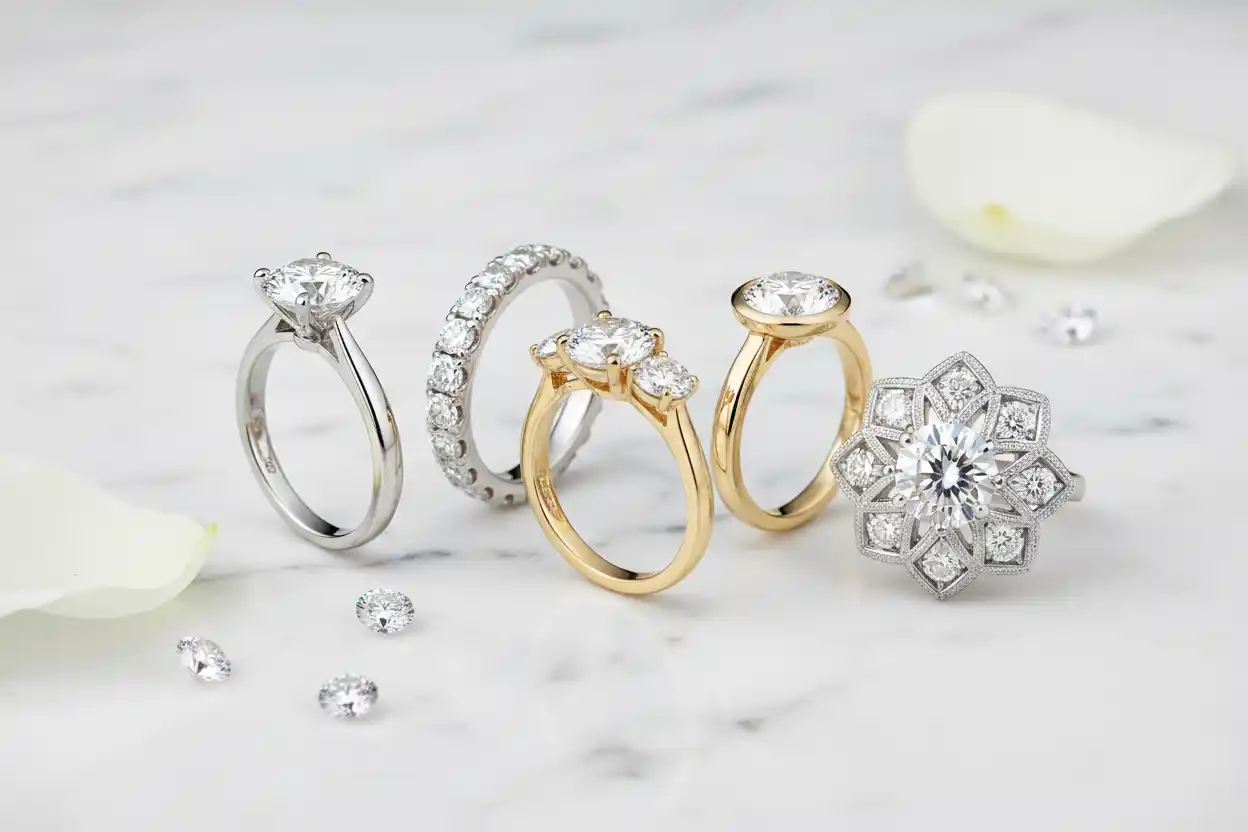
Diamond Rings: Styles, Settings and Buying Tips
Diamond rings include far more than engagement rings. Solitaires, anniversary bands, eternity rings, cocktail designs, signet accents and diamond wedding bands all use the gemstone differently, so buying priorities depend on the ring’s purpose.
A center-stone ring places greater emphasis on cut and individual diamond quality. Multi-stone bands depend heavily on matching and construction, while eternity rings require careful sizing because later adjustment may be difficult.
Diamond’s exceptional hardness provides outstanding scratch resistance, but rings still experience hard impacts and setting wear. A durable purchase therefore combines suitable diamond quality with strong metalwork and realistic wearing habits.
Diamond Rings at a Glance
| Ring type | Main buying priority | Key practical issue |
|---|---|---|
| Solitaire | Center diamond cut and setting | Exposed center stone |
| Three-stone | Center quality and side-stone matching | Overall width and setting height |
| Halo | Center diamond plus small-stone security | More prongs to maintain |
| Diamond band | Matching and smooth settings | Contact with neighboring rings |
| Half-eternity | Diamond matching and resizability | Stones cover only part of circumference |
| Full eternity | Continuous matching | Difficult or impossible resizing |
| Bezel ring | Protection and workmanship | More visible metal |
| Pavé ring | Consistent small diamonds | Setting wear and limited resizing |
| Cocktail ring | Design and construction | Large profile and snagging |
| Signet-style diamond ring | Metalwork and secure accents | Weight and surface abrasion |
Diamond Rings vs Diamond Engagement Rings
A diamond engagement ring is purchased within a proposal or partnership context and usually centers on one major diamond or design.
A general diamond ring may celebrate an anniversary, milestone, fashion preference or no event at all.
The drafted diamond engagement-ring guide owns the detailed proposal-focused buying process, including center-stone selection, partner preferences, wedding-band compatibility and engagement budgeting.
This page focuses on the broader range of diamond ring styles and how their construction changes buying decisions.
Solitaire Diamond Rings
A solitaire places one diamond at the center of the design.
Round brilliant stones create a classic appearance, while oval, pear, emerald, cushion and other shapes provide different proportions.
For a solitaire, the individual center diamond deserves close evaluation because there are few design elements to distract from weak cutting.
A low setting reduces snagging, while a higher setting can create greater visual prominence.
Prongs provide openness; bezels offer stronger edge protection.
The completed diamond buying guide provides the detailed 4Cs framework for selecting the individual stone.
Three-Stone Diamond Rings
Three-stone rings place a center diamond between two smaller stones.
The diamonds may match in shape or use contrasting cuts. A round center with tapered baguettes creates a classic look, while three ovals or emerald cuts provide stronger repetition.
Side-stone matching affects the complete ring’s balance. Strong differences in color or brightness can be obvious.
The total width also matters. Large side stones can make a ring feel broad between neighboring fingers.
Inspect the profile to ensure the settings do not create uncomfortable edges.
Halo Diamond Rings
A halo frames the center stone with small diamonds.
It increases sparkle and apparent size while creating a visual border around the centerpiece.
Double halos create even greater scale but also add more small settings that require maintenance.
Check whether the halo is centered and whether all accent diamonds appear consistent.
A halo should support the center stone rather than compensate for poor cutting or a center diamond the buyer does not genuinely like.
Hidden halos add diamonds beneath the center and are visible mostly from the side.
Diamond Bands
Diamond bands place several diamonds across part or all of the ring.
They may function as wedding bands, anniversary rings, stackers or independent jewelry.
Common settings include prong, channel, pavé and bezel designs.
Consider how the band feels between adjacent fingers. Large protruding stones or rough shared prongs may become uncomfortable.
When stacking, check whether the band rubs against another ring’s prongs or gallery.
Diamond itself is hard enough to scratch neighboring metals and gemstones.
Half-Eternity Rings
Half-eternity rings usually place diamonds across the visible upper portion of the band.
They provide much of the visual effect of a full eternity ring while leaving plain metal beneath the finger.
This makes resizing easier in many designs and reduces exposure of stones on the palm side.
A half-eternity ring may also be more comfortable for frequent desk work because fewer settings contact surfaces.
Inspect where the diamond section ends. Abrupt changes in band width can feel uncomfortable between the fingers.
Full Eternity Rings
Full eternity rings continue diamonds around the entire circumference.
They create uninterrupted sparkle from every angle but present significant sizing and maintenance tradeoffs.
Many eternity designs cannot be resized easily because altering the circumference changes the spacing of every stone.
Diamonds on the underside also receive continuous contact with desks, tools and objects being held.
Confirm size carefully before purchase and ask explicitly about future adjustment options.
Full eternity rings suit wearers prepared for greater maintenance.
Pavé Diamond Rings
Pavé uses many small diamonds held with tiny beads or prongs.
It can create a surface that appears almost continuously diamond-set.
Micro-pavé is especially delicate because the metal components are extremely small.
Thin pavé bands can bend under pressure, potentially loosening diamonds. Repeated resizing may also compromise alignment.
Choose enough metal to support long-term use rather than selecting the thinnest possible band purely for visual delicacy.
Channel-Set Diamond Rings
Channel settings hold diamonds between parallel walls of metal.
They create a relatively smooth surface and work well with rounds, princess cuts and baguettes.
The design reduces exposed prongs but depends heavily on accurate stone calibration and channel construction.
If the band bends significantly, stones can become loose.
Channel-set rings are often practical for people who dislike prongs catching on fabric, although they should still be removed for heavy work.
Bezel-Set Diamond Rings
A bezel surrounds a diamond with metal.
It offers excellent girdle protection and creates a smooth low-profile appearance.
Full bezels are especially useful for active wearers or diamonds with pointed outlines that would otherwise remain exposed.
Partial bezels balance protection with openness.
The quality of the metalwork matters. An uneven bezel can make the diamond appear crooked or obscure more surface than necessary.
Bezels also work well in modern stackable and signet-inspired designs.
Vintage and Antique Diamond Rings
Vintage rings may feature Old European cuts, Old Mine cuts, single cuts, rose cuts or early modern brilliant styles.
Their facet patterns differ from contemporary precision-cut diamonds and should be appreciated according to the period and design.
Inspect old prongs, shanks and previous repairs carefully.
Antique rings may have been resized several times, and metal can become thin.
A modern replacement diamond may alter historical consistency but does not automatically make a piece undesirable. Disclosure and documentation help establish what is original.
Cocktail and Statement Diamond Rings
Cocktail rings prioritize visual design and scale.
They may use clusters of small diamonds, colored diamonds, mixed gemstones or sculptural metalwork.
Because they often sit high or cover a large part of the finger, they are more likely to catch and strike surfaces.
Treat them as deliberate jewelry rather than pieces for manual activity.
Check balance: a heavy top can rotate constantly when the shank is too narrow or the fit is loose.
Signet-Style Diamond Rings
Diamond signet rings incorporate stones into a broader metal face.
Diamonds may form initials, borders, geometric patterns or one central accent.
The substantial metal surface can provide strong protection for small stones when the settings remain low.
However, signet rings also receive heavy surface contact.
Examine polish, engraving depth and edge comfort.
A ring intended for engraving should have enough metal thickness to preserve structural strength after customization.
Understanding Diamond Cut in Rings
Cut affects brilliance, fire and scintillation.
For a center stone, strong cut usually creates more visible improvement than a tiny change in clarity.
Multi-stone rings need consistent light performance. One poorly cut diamond can appear dark beside brighter stones.
Round brilliant diamonds may have standardized laboratory cut grades, while fancy shapes require direct visual assessment.
Examine the ring under ordinary room lighting as well as concentrated showroom light.
Diamond Color in Rings
Diamond color interacts with metal and design.
Yellow and rose gold may visually complement warmer diamonds. Platinum and white gold create greater contrast and may make warmth easier to notice.
In a multi-stone ring, matching is especially important.
A small color difference between isolated stones may be difficult to detect, but repeated mismatches across a band can create an uneven appearance.
Colored diamonds belong to a separate grading and value system and should not be evaluated with the ordinary D-to-Z expectation alone.
The completed diamond color guide provides broader context.
Diamond Clarity
A diamond ring does not automatically need extremely high clarity.
Once inclusions are invisible during ordinary wear and do not threaten durability, higher grades may create little visible benefit.
Step cuts display inclusions more readily than brilliant cuts.
For small diamonds in pavé and bands, consistency of transparency matters more than individual laboratory clarity reports.
Avoid obvious black inclusions, cloudy areas or structural features near exposed edges when they detract from appearance or durability.
Carat Weight in Multi-Stone Rings
Total carat weight describes the combined weight of all diamonds.
A 1-carat three-stone ring may divide that weight among the center and two sides. A 1-carat eternity ring may distribute it across numerous small stones.
Therefore, total weight does not describe visual scale accurately without knowing stone count and dimensions.
For a center-stone ring, request the individual center weight separately.
Compare face-up dimensions alongside carat values.
Natural vs Laboratory-Grown Diamond Rings
Natural and laboratory-grown diamonds share the basic physical properties of diamond but differ in origin and market dynamics.
The completed lab diamond meaning guide explains the distinction.
Laboratory-grown diamonds may make larger stones or more extensive pavé accessible at a different budget level.
Disclosure should remain clear in invoices and product descriptions.
For multi-stone rings, ask whether all diamonds share the same origin category.
Treated Diamonds
Some natural diamonds receive treatments to alter apparent color or clarity.
The completed guide to treated and synthetic diamond identification explains how treated natural stones differ from laboratory-grown diamonds and untreated natural diamonds.
Treatment can affect value and care, particularly with fracture-filled diamonds.
For a significant center stone, an independent laboratory report provides stronger evidence than retail terminology alone.
Small accent stones may be sold through parcel-level disclosure rather than individual reports.
Diamond Rings vs Moissanite Rings
Moissanite is a separate gemstone with high hardness and strong dispersion.
It can provide a visually bright alternative to diamond but has different optical characteristics and market value.
The completed lab diamond versus moissanite comparison explains material differences.
Neither should be misrepresented. Accurate identification lets buyers compare durability, appearance and budget according to their priorities.
Choosing the Metal
Platinum
Platinum is naturally white, dense and resistant to material loss from ordinary wear, though it develops a surface patina.
White Gold
White gold provides a bright appearance and often receives rhodium plating.
Yellow Gold
Yellow gold creates warm contrast and may complement warmer diamonds.
Rose Gold
Rose gold adds a pinkish tone through copper-rich alloying.
Metal choice should account for design, wearer preference, maintenance and potential metal sensitivity.
The strongest setting is the one whose dimensions and workmanship suit the diamonds rather than simply the most expensive alloy.
Ring Width
Thin rings appear delicate and may make a center diamond look proportionally larger.
However, extremely thin shanks can bend more easily.
Wider bands create stronger visual presence and may distribute weight more comfortably, although they can feel tighter at the same nominal ring size.
Consider finger proportions and how the ring will interact with neighboring bands.
A heavily diamond-set wide band may require a different fit from a simple solitaire.
Ring Profile and Setting Height
Low-profile settings reduce snagging and are well suited to practical daily wear.
Higher profiles allow side viewing and sometimes make stacking with another band easier.
However, a tall ring experiences greater leverage when struck.
Look at the ring from the side before purchasing. The center stone should not sit dramatically higher than necessary for the design.
Comfort and security should guide the profile rather than an assumption that taller settings look more valuable.
Choosing Ring Size
Finger size varies with temperature, activity and time of day.
Measure under ordinary conditions and confirm size using a ring width similar to the intended design.
Wide bands may require slightly more room than narrow rings.
Full eternity rings, extensive pavé and unusual structural designs can be difficult to resize.
Ask about sizing limitations before purchasing rather than assuming every ring can be altered later.
Stacking Diamond Rings
Diamond bands can be stacked with plain metal or gemstone rings.
Check whether diamonds or prongs rub directly against neighboring pieces.
A diamond girdle can scratch softer gemstones, while two metal settings can wear each other down through repeated contact.
A spacer band may reduce friction.
Stacking should also remain comfortable between the fingers and should not make removing the rings difficult during swelling.
Diamond Rings for Everyday Wear
Diamond’s hardness makes it exceptionally suitable for frequent wear, but the ring’s metal and setting still require protection.
Remove diamond rings before weight training, gardening, mechanical work, household cleaning and activities involving hard gripping.
Do not rely on gloves to protect jewelry. A ring beneath a glove can still bend, catch or create injury during an accident.
The completed guide to diamond jewelry care explains safe cleaning and inspection.
Diamond Ring Pricing
Price varies according to diamond origin, individual stone sizes, cut, color, clarity, metal and craftsmanship.
A center-stone solitaire concentrates value in one diamond. An eternity ring distributes gemstone weight across many smaller stones but requires extensive matching and setting labor.
Designer branding can add additional cost.
The completed diamond price guide owns current value factors and avoids reducing price to carat weight alone.
Compare complete specifications and construction when evaluating two rings.
Buying a Diamond Ring Online
Check:
- Individual and total carat weights
- Natural or laboratory-grown origin
- Center-stone report when appropriate
- Diamond measurements
- Color and clarity ranges
- Treatment disclosure
- Ring size
- Metal fineness
- Setting height
- Resizing limitations
- Return policy
- Warranty exclusions
Magnified product photos can make rings look larger than they are. Use millimeter measurements and photographs on a hand for better scale.
For substantial purchases, consider independent inspection during the return period.
Grading Reports and Appraisals
Large center diamonds may have independent grading reports.
Small diamonds in bands are usually not individually graded because separate reports would be impractical.
The seller should still provide accurate overall disclosure.
An appraisal estimates a value for a specific purpose and is different from a laboratory grading report.
For insurance, keep reports, invoices and photographs in a secure location separate from the ring.
Cleaning Diamond Rings
Diamonds readily attract oils from skin, lotion and soap, which can reduce visible brilliance.
For many secure untreated rings, clean with warm water, mild dish soap and a soft toothbrush.
Pay particular attention beneath the stone and between pavé settings.
Rinse over a bowl and dry with a lint-free cloth.
Do not assume every treated diamond or antique setting is suitable for ultrasonic or steam cleaning.
Professional Inspection
Have a ring inspected when:
- A diamond moves
- A prong catches fabric
- A pavé stone disappears
- The shank becomes distorted
- A channel develops a gap
- The ring no longer fits normally
Prong wear can progress slowly until the stone is suddenly lost.
A professional inspection should evaluate structural condition, not simply polish the metal.
Frequently worn rings deserve more attention than pieces used only on special occasions.
Storage
Store diamond rings individually in padded compartments.
Diamonds can scratch other diamonds and almost every softer gemstone.
Do not toss several rings into one dish where settings and stones rub.
Keep rings away from household chemicals and high-humidity storage.
When traveling, use a dedicated case that prevents movement and loss rather than carrying valuable rings loosely in a bag.
Conclusion
The best diamond ring depends on its purpose. A solitaire emphasizes center-stone quality, a diamond band depends on matching and construction, while an eternity ring prioritizes exact fit because resizing may be difficult.
Diamond’s exceptional hardness makes it highly suitable for rings, but prongs, channels, links and shanks remain vulnerable to wear. A secure setting and sensible ring profile matter as much as gemstone specifications.
Buy according to visible quality, construction and realistic wear rather than total carat weight or marketing grades alone.
Frequently Asked Questions
1. Are diamond rings suitable for everyday wear?
Yes. Diamond is exceptionally scratch-resistant, but the ring should still be removed for rough work and activities that can damage the setting.
2. What is the most durable diamond ring setting?
A well-made bezel offers excellent edge protection. Low sturdy prong and channel settings can also perform well.
3. Is a full eternity ring better than a half-eternity ring?
Neither is universally better. Full eternity rings provide continuous diamonds but are harder to resize and receive more underside wear.
4. Do diamond rings need high-clarity stones?
Usually not. Eye-clean diamonds without durability-threatening inclusions can provide excellent visible quality.
5. What does total carat weight mean in a diamond ring?
It is the combined weight of all diamonds rather than necessarily the weight of the center stone.
6. Can laboratory-grown diamonds be used in fine rings?
Yes. Laboratory-grown diamonds have the physical properties of diamond, but their origin must be disclosed accurately.
7. Can diamond rings be resized?
Many can, but eternity, pavé and complex designs may have significant resizing limitations.
8. Can diamonds scratch each other?
Yes. Diamonds can scratch other diamonds, so separate storage is advisable.
9. Can a diamond chip even though it is very hard?
Yes. Hardness describes scratch resistance; a sufficiently sharp impact can chip a diamond.
10. Should a diamond ring have a grading report?
A significant individual center diamond often justifies independent grading. Small accent stones usually do not have individual reports.
11. How should a diamond ring be cleaned?
Warm mild soapy water and a soft brush suit many secure untreated rings, followed by careful rinsing and drying.
12. When should a diamond ring be professionally checked?
Arrange inspection when a stone moves, a prong catches, the band bends or the setting develops any visible change.