Emerald Earrings: Styles, Quality and Buying Guide
Emerald earrings are one of the safest and most versatile ways to wear this celebrated green gemstone. Unlike rings and bracelets, earrings encounter relatively few hard surfaces, which reduces impact risk for naturally included and frequently fracture-filled emeralds.
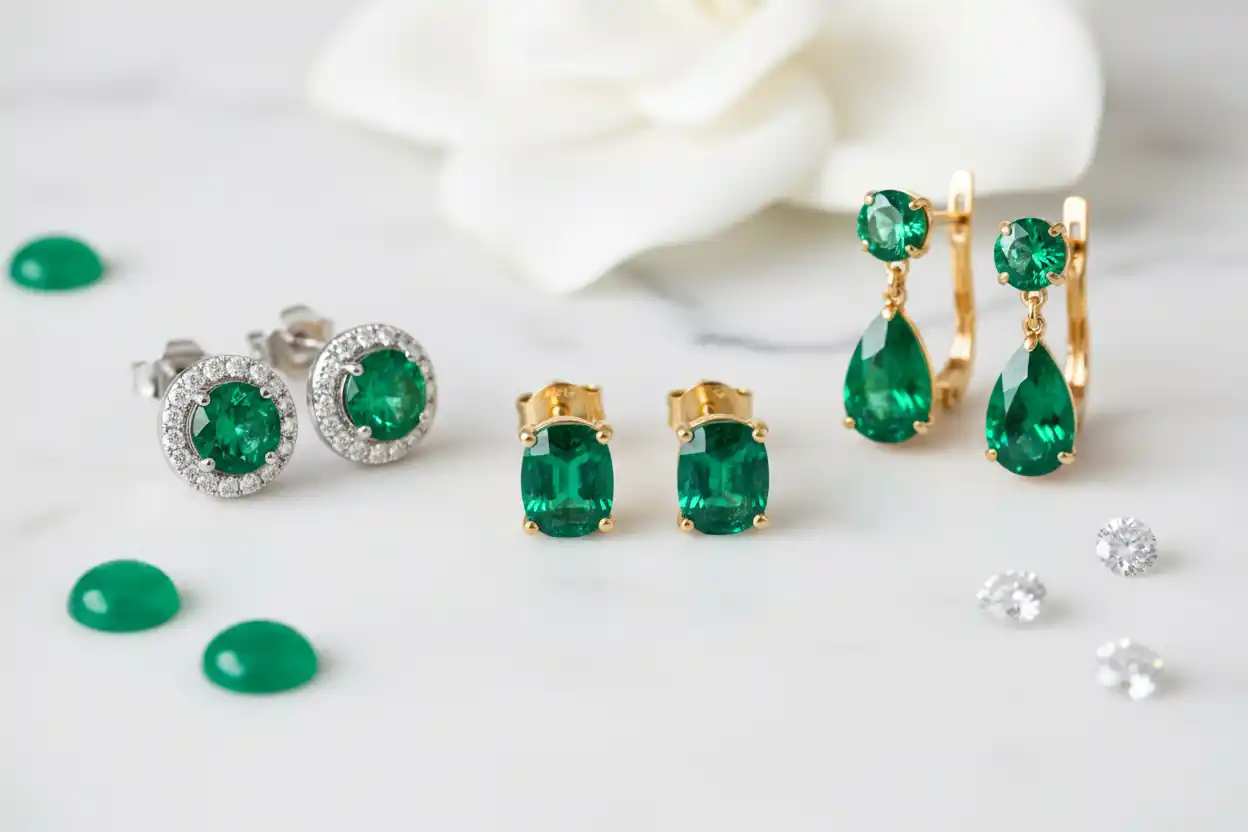
Studs offer the strongest everyday practicality, while halos and drops provide greater visual scale. Regardless of style, a good pair should show compatible color, dimensions and brightness, along with secure settings and backs suited to the earrings’ weight.
Emerald Earrings at a Glance
| Factor | What to look for |
|---|---|
| Gem identity | Natural or clearly disclosed laboratory-grown emerald |
| Color | Attractive green to bluish green |
| Pair matching | Similar hue, tone, saturation, dimensions and transparency |
| Clarity | Natural inclusions are expected |
| Treatment | Written disclosure of fracture filling, dye or other enhancement |
| Best everyday style | Low-profile studs or small bezel-set earrings |
| Best formal style | Halo or drop earrings |
| Setting | Secure prongs, bezels or protective halos |
| Backing | Friction, screw, locking or lever back appropriate to weight |
| Main care issue | Heat, chemicals, fillers and setting security |
Why Earrings Are a Strong Choice for Emerald
Emerald ranks about 7.5 to 8 on the Mohs scale, providing respectable scratch resistance. However, natural fissures can make individual stones more vulnerable to impact.
Earrings reduce that problem because they remain away from most work surfaces.
They also showcase emerald color close to the face, where even relatively small stones can create a strong visual effect.
This means a buyer can prioritize color and pair matching without necessarily purchasing exceptionally large gemstones.
The completed emerald buying guide explains the broader quality factors behind natural emerald purchases.
Emerald Stud Earrings
Studs are the most practical emerald earring style.
Rounds, ovals, cushions and emerald cuts all work well. A low basket or bezel keeps the stone close to the ear and limits snagging.
Pair matching matters because the two stones are viewed simultaneously.
Exact carat weights do not need to be identical when face-up dimensions and color remain balanced.
Larger studs require supportive backs so they do not tilt downward.
For everyday wear, a modest well-matched pair often provides better value than larger stones with noticeably different color.
Emerald-Cut Studs
The rectangular emerald cut has beveled corners and broad step facets.
It creates an elegant geometric appearance and can display the gem’s color particularly well.
However, step facets reveal inclusions more clearly than many brilliant-style cuts. Therefore, transparency and fracture placement deserve careful inspection.
The corners should be protected by appropriate prongs or a bezel.
Pair symmetry is especially important because unequal length-to-width ratios become obvious when the earrings frame the face.
Oval Emerald Earrings
Ovals provide a softer elongated appearance.
They may face up larger than rounds of similar weight depending on proportions, making them useful for creating visual presence.
Check both stones for compatible outlines. One should not be noticeably narrower or fuller than the other.
Windowing can occur when the stones are cut too shallowly.
A four-prong basket works well when constructed securely, while bezels add stronger edge protection.
Bezel-Set Emerald Studs
A bezel surrounds the stone’s girdle with metal.
It is one of the strongest settings for emerald earrings because it protects edges and creates a smooth low-profile surface.
Yellow gold produces a classic green-and-gold contrast, while platinum and white gold create a cooler appearance.
A well-made bezel should be even around the complete stone.
Too much metal can visually reduce the gem, while an uneven bezel may make one earring appear different from the other.
Halo Emerald Earrings
A halo surrounds each emerald with smaller accent stones, commonly diamonds.
The design increases apparent scale and provides additional sparkle around the green center.
Evaluate the emeralds first. A halo cannot correct weak color or poor pair matching.
The surrounding diamonds should also match each other and be securely set.
Halo earrings contain numerous small prongs, so they need periodic inspection. Closely packed settings can collect cosmetics and skin oils behind the stones.
Emerald Drop Earrings
Drop earrings suspend emeralds beneath the earlobe.
The movement allows the color to change subtly under different lighting angles. Drops may combine emeralds with diamonds, pearls or additional emeralds.
Check articulation between components. Links should move smoothly without opening or causing stones to strike each other.
Long earrings can catch hair, scarves and collars.
Therefore, they suit deliberate daytime or evening wear better than activities involving sports, machinery or young children.
Emerald Dangle Earrings
Dangles are generally longer and move more freely than compact drops.
Weight becomes particularly important. Heavy front sections can stretch piercings or become uncomfortable during prolonged wear.
A well-designed pair distributes weight close enough to the ear to remain stable.
Lever backs or secure locking systems are preferable for valuable designs.
Both earrings should hang to the same length and move similarly.
Emerald Hoop and Huggie Earrings
Small emeralds may be mounted around hoops or close-fitting huggies.
Huggies offer greater practicality because they sit near the ear and have less exposed movement.
Stones may be prong, channel or pavé set.
Check that the emeralds face outward after the hoop closes. Poor construction may turn the gem row inward.
Hinges and closures deserve close inspection because a failed mechanism can result in losing the entire earring.
Emerald Cluster Earrings
Clusters combine several smaller emeralds into floral, geometric or abstract forms.
This design can create a broad green surface without requiring two large matching stones.
Slight variations in emerald shade may look attractive when distributed intentionally.
However, random differences in brightness or transparency can make the pair feel poorly assembled.
Every small setting creates an additional maintenance point.
An open-backed cluster is generally easier to clean gently than one with inaccessible closed recesses.
Antique and Vintage Emerald Earrings
Emerald has a long history in fine jewelry, so antique earrings may feature old-cut diamonds, hand engraving and characteristic period settings.
Older pieces require careful structural evaluation.
Inspect:
- Prongs
- Hinges
- Solder joints
- Posts
- Screw fittings
- Replacement stones
- Previous conversions
Some antique earrings were converted from clips or other jewelry forms.
A beautiful period design can still require substantial repair before regular wear.
Do not assume that a green antique stone is emerald without appropriate testing.
Matching Emerald Color
Pair matching is one of the strongest quality considerations in earrings.
Compare the two emeralds for:
- Hue
- Tone
- Saturation
- Transparency
- Dimensions
- Cut pattern
Natural emeralds rarely look perfectly identical. Small variations are acceptable when the pair remains harmonious.
A substantial difference in yellow or blue undertone may become noticeable because the stones sit on opposite sides of the face.
View them together under several lighting conditions rather than evaluating each separately.
Judging Emerald Clarity
Visible inclusions are normal in natural emerald.
Unlike diamond, emerald is not generally expected to appear perfectly inclusion-free.
Prioritize attractive transparency and avoid stones whose fissures create obvious structural concerns.
Some inclusions can add natural character, but heavy cloudiness may reduce brightness.
Step-cut earrings reveal the internal features more clearly than brilliant-style cuts.
When the seller uses broad grades such as AAA, ask what measurable criteria the label represents because commercial quality terms are not universally standardized.
Emerald Enhancement
Fracture filling with oils, waxes or resins is common.
Enhancement can improve apparent clarity by making surface-reaching fissures less visible.
Treatment amount influences value, care and comparison. An emerald with minor enhancement is not equivalent in the market to another stone containing significant filler simply because both are described as natural.
Ask for explicit disclosure.
For a valuable pair, an independent colored-stone report can provide information about identity and detected clarity enhancement.
The completed treated emerald guide examines enhancement in greater depth.
Natural vs Lab Emerald Earrings
Laboratory-grown emerald can create visually impressive matched earrings because growers can produce material with attractive color and greater availability than comparable fine natural stones.
The material is synthetic emerald rather than an imitation.
The completed lab emerald buying guide explains the distinction.
Laboratory-grown origin should be disclosed prominently. Likewise, natural origin should not be inferred solely because an emerald contains inclusions.
Glass and other green simulants belong to a separate category.
Identifying Imitations
Emerald can be imitated by green glass, synthetic spinel, assembled stones and other materials.
Home visual observations may reveal inconsistencies but cannot reliably authenticate every pair.
The completed real versus fake emerald guide explains practical warning signs and limitations.
Never perform scratch, acid or flame tests on jewelry.
For expensive earrings, professional testing provides more useful evidence than destructive experiments.
Origin and Provenance
Colombia, Zambia, Brazil, Afghanistan, Pakistan and other locations are known for emerald production.
Origin may affect market demand, but color alone does not establish locality.
For example, describing an emerald as Colombian based solely on a bluish-green appearance is unreliable.
When geographic origin creates a significant price premium, request independent evidence.
Provenance may matter additionally for antique or historically important earrings, but documentation should distinguish ownership history from geological origin.
Choosing the Metal
Yellow gold provides a classic combination with emerald.
Platinum and white gold create crisp cool contrast, particularly when diamonds surround the green stones.
Rose gold produces a warmer contemporary appearance.
For posts and backs, exact alloy matters when the wearer has metal sensitivities.
Ask for fineness and composition.
A lightweight setting may reduce earring weight, but it should not become so thin that prongs or posts lose strength.
Choosing Earring Backs
Friction Backs
Friction backs work well for small and medium studs when they maintain proper tension.
Screw Backs
Screw backs provide extra mechanical security for valuable studs but may take longer to put on and remove.
Locking Backs
Locking mechanisms provide strong security when properly maintained.
Lever Backs
Lever backs suit drops and dangles, enclosing the ear wire behind the lobe.
The backing should match the front section’s weight. Heavy earrings need enough rear support to remain upright.
Earring Weight and Comfort
A large emerald or elaborate diamond halo can make an earring considerably heavier than it looks in a photograph.
Ask for total earring weight when comfort is a concern.
Large supportive backs distribute pressure more effectively.
Persistent pulling, redness or discomfort indicates that the style may be unsuitable for extended wear.
Jewelry should not be used to force an irritated piercing to tolerate additional weight.
Emerald Earrings with Diamonds
Diamonds create strong contrast and additional brilliance.
Because diamonds are significantly harder than emeralds, settings should prevent direct rubbing between exposed gem edges.
Cleaning must follow emerald requirements. A procedure appropriate for untreated diamonds may damage emerald fillers.
Therefore, never select an ultrasonic cleaning method merely because the design contains diamonds.
The emerald is usually the component that determines the safest care method.
How to Buy Emerald Earrings
Confirm:
- Natural or laboratory-grown origin
- Treatment disclosure
- Emerald dimensions
- Total and individual weights
- Pair matching
- Metal type
- Setting construction
- Backing style
- Return policy
For valuable natural earrings, independent reports may be appropriate.
The completed emerald price guide explains why color, enhancement, size and origin can produce large value differences.
Styling Emerald Studs
Small emerald studs work easily with workwear and casual clothing.
Yellow-gold studs provide a warm traditional appearance, while white metal creates stronger contrast.
Emerald green pairs well with neutral colors, navy, burgundy, cream and black without requiring exact clothing matches.
Studs can also be combined with small diamond or plain-metal earrings in additional piercings.
Keep the overall arrangement balanced rather than competing for maximum gemstone size.
Styling Drops and Halos
Halo earrings suit formal clothing and occasions where greater sparkle is desired.
Drops work particularly well with swept-back hair or open necklines.
When the earrings are visually elaborate, a simple necklace may provide better balance than another large green gemstone.
Jewelry does not need to form an exact matched set.
Repeating the same metal or general design language can create enough visual connection.
Cleaning Emerald Earrings
Emerald earrings should generally be cleaned with warm, mild soapy water and a soft brush.
Avoid steam and ultrasonic cleaning because commonly filled fissures may be affected by heat or vibration.
Clean gently behind the stones and around the posts, where cosmetics and skin oils collect.
Rinse briefly over a bowl rather than an open drain and dry completely.
The completed emerald jewelry cleaning guide provides detailed instructions.
Wearing Emerald Earrings Safely
Put earrings on after applying perfume, hairspray, sunscreen and cosmetics.
Remove them before:
- Sleeping
- Bathing
- Swimming
- Exercising
- Using over-ear equipment that presses on the setting
- Activities where long earrings can catch
Check backs before leaving home.
If a post bends, hinge loosens or prong catches hair, stop wearing the earring until the setting is repaired.
Storage
Fasten the backs and place each earring in a separate padded section.
Do not allow diamonds or sapphires to rub against emerald surfaces.
Posts should not press into the partner stone.
Keep earrings away from excessive heat and chemical fumes.
For travel, use a small rigid jewelry case rather than placing the pair loose in a cosmetic bag.
Professional Inspection
Professional inspection is appropriate when a stone moves, a prong catches or a back loses tension.
High-value pairs should also be checked periodically.
The jeweler can examine whether filler appearance has changed, although restoration of emerald clarity enhancement requires specialist judgment.
Do not attempt to re-oil an emerald at home.
Setting repair and treatment maintenance are separate procedures and should be handled by appropriately qualified professionals.
Conclusion
Emerald earrings combine exceptional green color with one of the safest jewelry formats for this naturally included gemstone. Studs and bezels provide strong everyday practicality, while halos and drops offer greater visual presence.
Choose a pair with harmonious color, dimensions and transparency. Expect natural inclusions, but ask about the amount and type of clarity enhancement because treatments affect both value and care.
Secure backs and gentle cleaning are essential. Even when the emeralds themselves are beautiful, the pair is only as reliable as its posts, prongs, hinges and closures.
Frequently Asked Questions
1. Are emerald earrings suitable for everyday wear?
Yes. Earrings receive fewer impacts than rings or bracelets, making them one of the more practical emerald jewelry formats.
2. What is the best emerald earring style for everyday use?
Low-profile studs or bezel-set earrings provide excellent protection and limited snagging.
3. Should two emerald earrings match perfectly?
They should appear harmonious in color, dimensions and brightness, although small natural differences are normal.
4. Are inclusions normal in emerald earrings?
Yes. Natural emerald commonly contains inclusions and fissures. Their location and severity matter more than complete absence.
5. Are emeralds usually oil-treated?
Many natural emeralds receive oil, resin or another fracture-filling treatment to reduce the visibility of fissures.
6. Are lab-grown emerald earrings genuine emerald jewelry?
They contain synthetic emerald rather than natural emerald. The mineral material is emerald, but laboratory-grown origin must be disclosed.
7. Which metal looks best with emerald earrings?
Yellow gold creates classic warm contrast, while platinum and white gold emphasize cooler green tones. Personal preference should guide the choice.
8. Are screw backs necessary for emerald studs?
No, but screw or locking backs may offer additional security for valuable or heavier earrings.
9. Can emerald earrings contain diamonds?
Yes. Diamond accents are common, although care should follow the more sensitive emerald rather than the diamond.
10. Can emerald earrings go in an ultrasonic cleaner?
No. Ultrasonic cleaning can affect commonly fracture-filled emeralds and should be avoided.
11. How should emerald earrings be cleaned?
Use warm mild soapy water and gentle brushing, followed by brief rinsing and complete drying.
12. Should expensive emerald earrings have laboratory reports?
Independent documentation is advisable when natural identity, treatment extent or claimed origin materially affects the price.